SENTIMENT ANALYSIS AND CLASSIFICATION BY CONSIDERING NEGATION POLARITY SHIFTER AND OPINION SUMMARIZATION FOR PRODUCT REVIEWS
Nilam V. Kolekar,
M.TECH, Department of Computer Engineering, BVDUCOE,Pune, India
Prof. GauriRao,
Associate Professor, Department of Computer Engineering BVDUCOE,Pune, India
ABSTRACT
Sentiment analysis is special kind of task in Natural language processing as it determines the sentiment expressed by the customer or different users in the form of text format. There are different techniques existed to determines the user sentiment into different polarities. BOW it is very popular model used to represent and model the text for sentiment analysis and text classification. It gives better performance for text classification but sometimes BOW model performance becomes worst in sentiment classification, because it has some limitations and disadvantages. The main challenging task in BOW model is polarity shift problem. We proposed a system to address the polarity shift problem to provide feasible solution to the BOW model and make use of BOW model in sentiment analysis with better performance. In this system we are addressing, removing and modifying polarity shift problem in context of sentence-level sentiment analysis and phrase-level sentiment analysis in the contrast of negative reviews. Furthermore we extend our system to determine sentimental features or opinions that has expressed by the customers in given comments (in text format) and opinion targets. At last we performed classification on customer reviews to classify that reviews into three sentiment polarities i.e., positive, negative, neutral class labels and generate graph based on opinion summarization for customer understanding purpose. Proposed system based on lexicon-based approach using dictionary based technique.
1. INTRODUCTION
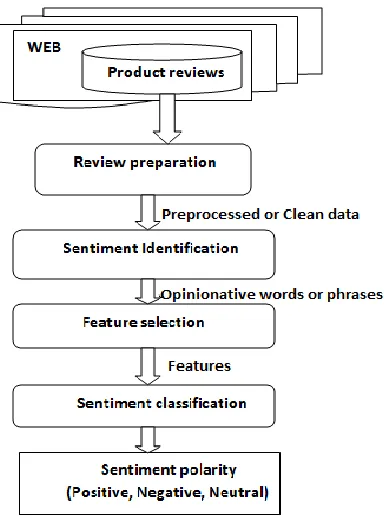
Now a day’s use of internet and e-commerce is growing day by day with this volume of online reviews are growing day to day for online shopping sites so because of online reviews user can decide the quality of particular product. Sentiment analysis and opinion mining these are integral part of Natural Language Processing to determine the subjective attitude or we can say sentiment of user expressed in textual format [1].Sentiment analysis is one type of Natural Language Processing task used to keep track on public mood about a particular Entity, product or topic [6]. Sentiment analysis also referred as opinion mining it is the study of analyzing the users sentiment, opinion, fillings, appraisals, attitude towards particular think, object, individual, topic, product etc [17]. Sentiment analysis it is the process to determine the sentiment of peoples according to its polarity such as positive, negative, neutral sentiment polarity classes about particular product which is expressed in Blogs posts, comments, reviews or tweets on a different sites. In e-commerce and online shopping, customers expressed their fillings in the form of comments, star rating, thumb up and thumb down about their likes and dislikes which is helpful to other peoples to judge the quality of online products. We can see in fig (1) simple model of sentiment analysis and its different tasks first task in sentiment analysis is to extract the customer comments from web after that next task is pre-processing. Data pre-processing phase remove unwanted data from extracted text and produce clean data to process it further. Next step is feature identification it used to identify the opinionative features or phrases from given text, means we can say that it only identify the subjective information from given text which is required for sentiment analysis. Sentiment classification is one of the crucial task in sentiment analysis which we can see in fig(1) which is used to classify the users sentiment into different sentiment polarities like positive, negative, neutral polarity classes.
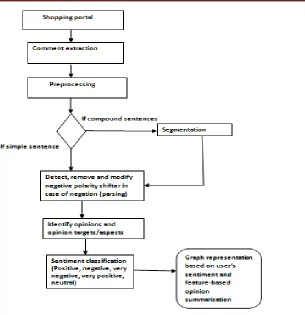
Sentiment classification it is the part of sentiment analysis to classify people’s sentiment into different polarity classes. To model the sentiment features and text for sentiment analysis and classification, BOW (Bag-Of-Word) model is one of the popular model typically useful to represent the text in sentiment analysis [1][2].BOW model used to represent the text in multiset of words format and it represents review text in vector of independent words.BOW model is very simple and efficient for text classification but sometime its performance become worst for sentiment classification, because it has some disadvantages such as it is disregarding of grammar, disturbs word order, breaks syntactic structures and discards some semantic information from available review at the time of model the text[1][18].Polarity shift problem is one of the big problem in BOW model. Many researchers have done their research to address the polarity shift problem. Polarity shift is one of the linguistic phenomenon which change the sentiment orientation; it means polarity shift flips the polarity of text from positive to negative and vice versa. Negation polarity shifter creates the problem in BOW model as it considers only unigram features; for examples “this laptop is good” this text indicate positive sentiment if we add negative polarity shifter “not” in front of sentiment word “good” the sentiment orientation will be change from positive to negative such as “This book is not good”. In Bag-Of-Word (BOW) model two sentiments-opposite texts is to be represent very similarly so its classification results also be the same. We proposed system to address polarity shift problem by detecting, removing and modifying negation in contrast of negative sentences. We build our own shopping portal from which we are extracting comments for sentiment classification. We build our proposed system for sentence-level sentiment analysis and phrase-level sentiment analysis using lexicon-based dictionary. If extracted comment is simple sentence then we directly send it for sentiment classification and also determine the sentiment feature or opinion expressed by customer about particular product into given text and opinion target on which customer has expressed their opinions. If extracted comment is compound sentence and containing negation then we first address the negative polarity shifter, remove and modify it based on some rules. Furthermore we design our system for opinion summarization based on different features of particular product and show summarization in graphical format for each product. In feature-based opinion summarization we are depicting graph for each product according to its features by considering overall reviews on that particular product.
2. LITERATURE SURVEY
is selection of subjective information, there are two types of information which can appear in sentences i.e., subjective information and other is objective information we need subjective type information for sentiment analysis, if sentence is subjective then system will determine that users opinions which appear in text either it is positive, negative, or neutral . For example we have text for sentiment analysis “(1) I bought this book, (2) Story is very nice” in this example we can observe that sentence (1) only represents factual information or objective information and sentence(2) represents subjective information about story of book, so we can identify users opinion from second sentence but not from sentence first. In sentiment analysis our main task is to select the features for sentiment classification purpose, we can select features from given text for sentiment analysis and classification using different techniques such as terms presence, frequency counting, POS(Part-Of-Speech) tagging, Determining Opinion words or features, and last one is negation detection[11].There are different techniques useful for sentiment analysis and classification basically it divided into two types that is machine learning technique and lexicon based approach. Most of the research scholars used machine learning approach with supervised learning to classify the sentiment of customers into different polarities. Supervised machine learning uses different algorithms for sentiment classification such as decision tree classifier, maximum entropy, naive bayesetc [11].Lexicon based approach uses sentiment lexicon with its predefined sentiment terms.We proposed and build system for sentiment analysis with addressing polarity shift problem. As we have discussed above polarity shift is one of the big problem in BOW model. In this paper we train system to address polarity shift problem by addressing, removing and modifying negation polarity shifter in case of negative comments. There are many researchers was conducted their research to address polarity shift problem, for example researchers Das and Chen proposed a system to examine polarity shift problem by simply attaching negation word “NOT” to the sentiment words in the scope of negation *7+, e.g. consider the text “This book is not good” by attaching “NOT” to the sentiment word the word “good” become “good-NOT” in Das and Chen system, but some research scholars reported that this technique has not proven best in all cases to improve the sentiment classification accuracy. Rui Xia et al. [1] [2] they proposed system to address polarity shift problem by creating dual training and dual prediction algorithms. They used lexicon-based antonym dictionary, corpus-based pseudo antonym dictionary and many other techniques to improve the sentiment classification accuracy. J. Na et al. [3] had proposed their system to model the negation by using POS (Part-Of-Speech) tagging.
3. PROPOSED SYSTEM
representation based on customer’s sentiment for each product by considering overall customer reviews on that product.
DICTIONARY BASED APPROACH
Our proposed system based on dictionary based approach, to address polarity shift problem we usedWordNet (Release 2.1) dictionary includes English lexicon dataset. WordNet is a collection of English words with its antonyms and synonyms. In our proposed system we are detecting negation polarity shifter after that remove it and modify sentiment word in the scope of negation with it antonyms so because of that we can provide feasible solution to the BOW model. Here we are replacing sentiment word in the scope of negation with its antonym by making use of WordNet dictionary. We used following tasks and tools to implement proposed system which is given below
3.1 Data Pre-processing
Pre-processing is very vital process in sentiment analysis to clean the extracted data. Aim of pre-processing task is to remove noisy and unwanted data. Pre-pre-processing includes some another tasks also like tokenization, stop words removing process, data filtering etc. In our proposed system we apply pre-processing on fetched data to make that data clean, to perform tokenization of given text, and data filtering.
3.2 Segmentation
Figure (2): “Flow of proposed system” 3.3 Parsing
Here we have created our own parser to detect negation polarity shifter to remove it. We have created array of negation polarity shifters such as “not”, “never”, “don’t”, “couldn’t”, “nobody”, “cant”, “”didn’t, etc., after removal of negative polarity shifter system replace sentiment word in the scope of negation with its antonyms.
3.4 POS (Part-Of-Speech) Tag
Part-Of-Speech tagging plays very important role in NLP to process natural language.
Figure (3): “Process of negation polarity shift detection, elimination and modification”
3.5 Dataset, Resources and Tools used
We have created our own shopping portal for extracting customer reviews on different products, in which we have added four datasets of different domains such as Home Appliances, Books, Computers, and Electronics. We used WordNet dictionary with version WordNet Release 2.1in our implementation, WordNet is one of the well-known NLP resource and useful in sentiment analysis. To implement and build this system we have used different libraries and tools such as OpenNlp toolkit, Stanford libraries for sentiment analysis and classification
4. RESULTS
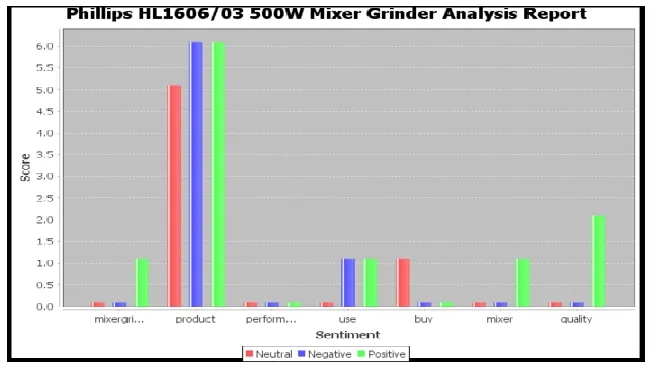
In Fig (4) we have shown the results of opinion summarization for domain home appliances. In which we have generate graphical representation by counting number of positive, negative and neutral opinions of users for each product by considering overall reviews of that product. Here X-axis represents sentiment polarities and Y-axis represents count for the sentiment polarities. Similarly fig (5) represents feature-based opinion summarization; in this we are representing all features of that particular
Figure (4): “Results of Opinion summarization”
Figure (5): “Results of feature-based opinion summarization”
Result of addressing, removing and modifying negation is shown in following table 1, also we have shown result of opinion targets identification, then identify customer’s opinions from given text and sentiment classification by taking some comments.
comment text as input Result of addressing polarity shift as output
Opinion Target as output
Opinion of customers as output
Sentiment classification as output
1. This product is disappointing
- Product disappointing Negative
2. I bought this product - Product Neutral
3. This product is good, satisfactory
performance
- Product,
performance
good, satisfactory
Positive
4. I like this product, but memory is not good
I like this product, but memory is evil
Product, memory
like, evil Negative
Table 1: “result of other things shown in columns” 5. CONCLUSION
References
*1+ Rui Xia, FengXu, ChengqingZong, Qianmu Li, Yong Qi, and Tao Li, “Dual Sentiment
Analysis: considering Two sides of One Review”, IEEE transaction on knowledge and data Engineering, Vol 27, No.8,August 2015.
[2] Rui Xia, Tao Wang, Xuelei Hu , Shoushan Li , ChengqingZong, “Dual Training and Dual Prediction for Polarity Classification”, in Proceedings of the 51st Annual Meeting of the Association for Computational Linguistics, 2013
[3] J. Na, H. Sui, C. Khoo, S. Chan, and Y. Zhou, “Effectiveness of simple linguistic processing in automatic sentiment classificationof product reviews,” in Proc. Conf. Int. Soc. Knowl. Org., 2004,pp. 49–54.
*4+ Kushal Dave, Steve Lawrence and, D. Pennock, “Mining the peanut gallery: Opinion extraction and semantic classification of product reviews”, in Proc. Int. World Wide Web Conf , pp. 519–528 , 2003. [5] Vincent Ng, S. Dasgupta and S. Arifin, “Examining the role of linguistic knowledge sources in the automatic identification and classification of reviews,” in Proc. Int. Conf. Comput. Linguistics Annu.Meeting Assoc. Comput. Linguistics, 2006, pp. 611–618.
*6+ G.Vinodhini and RM.chandrasekaran, “Sentiment Analysis and Opinion Mining: A Survey”, www.ijarcsse.com , ISSN: 2277 128X,Volume 2, Issue 6, June 2012
*7+ S. Das and M. Chen, “Yahoo! for Amazon: Extracting market sentiment from stock message boards,” in Proc. Asia Pacific Finance Assoc. Annu. Conf., 2001.
*8+ Asst.Prof.AKowcika, Aditi Gupta, KarthikSondhi, NishitShivhre, Raunaq Kumar, “Sentiment Analysis for Social Media”. www.ijarcsse.com, ISSN: 2277 128X , Volume 3, Issue 7, July 2013
[9] Shoushan Li, Sophia Yat Mei Lee,Ying Chen, Chu-Ren Huang, Guodong Zhou, “Sentiment classification and polarity shifting”, in International Conference on Computational Linguistics, 2010. *10+ Chloe Clavel and Z. Callejas, ”Sentiment Analysis: From opinion mining to human-agent Interaction” , IEEE transaction on affective computing, 2015.
*11+ WalaaMedhat , Ahmed Hassan , HodaKorashy, “Sentiment analysis algorithms and applications: A survey” , Ain Shams Engineering Journal (www.sciencedirect.com), pp. 1093–1113,2014
*12+ GeorgiosPaltoglou, Mike Thelwall, “More than Bag-of-Words: Sentence-based Document Representation for Sentiment Analysis”, Proceedings of Recent Advance in Natural Language Processing, page546-552, Hissar, Bulgaria, 7-13 September 2013.
*13+ S. Li and C. Huang, “Sentiment classification considering negation and contrast transition,” in Proceeding of the Pacific Asia Conference on Language, Information and Computation, 2009.
[14] Soo-Min Kim and Eduard Hovy, “Determining the sentiment of opinions”, Proceeding of the COLING conference,Geneva,2004
*15+ A. Kennedy and D. Inkpen, “Sentiment classification of movie reviews using contextual valence shifters,” Comput.Intell., vol. 22, pp. 110–125, 2006.
*16+ Minqing Hu and Bing Liu, “Mining Opinion Features in Cutomer Reviews”, American association for Artificial Intelligence, 2004.