Behavioral Analysis Of Customers In Social Media
Through Review And Profile Using Fuzzy Set
Method
C. R. Marcelin Vasantha, Dr. V. Manimozhi
ABSTRACT: Customer reviews are the essential tool to gather the interests of the users. But extracting useful details from a review of a customer is a challenging task. Thus usefulness of the customer reviews are analysed in this work. The customer reviews for particular products are categorized under three major groups such as usefulness, irrelevant, harmful. Each category is allocated with the review score that are given by the customers. We have calculated the customer reviews using fuzzy set. It is one of the best and easiest methods. In fuzzy set, the values lie between 0 and 1and it is called membership value. In this work, we calculate the customer reviews with the range of 0 and 1. The result is proved to be efficient in finding the usefulness of review than existing systems.
Keywords: Fuzzy set method, customer review, product
————————————————————
1.
INTRODUCTON
EVALUATION OF SOCIAL NETWORK SITES
In day to day life internet is an important factor. It is the wide area network connecting across the world. In this work we study about social media networks which are used for business and entrepreneurs to achieve better result. Most of the business uses the social media networks to perform their relationship with customers or users. There are many social media like whatsapp, twitter, you tube, etc. Social media help us to improve the profit in the business level and also help us to spread the small business entrepreneurs. The purpose of using social media networks in the business is to communicate between the customers for getting feedback about customer service, product development and other services.
1.1 BEHAVIOUR ANALYSIS
In this work, behaviour analysis of customer can be calculated which is expansive, massive, and indicative of user preferences, opinions, interests and relationships. The behaviour analysis collect overall reviews from the customers or users. In this work, we analyse the three types of users like IT person, student, and grocery shop man.
1.2 OPINION ANALYSIS
Analysing the opinion from customers is about gathering what they feel and think about the products in e-commerce websites. Social media also plays an important role to convey the opinions from customers. In this work, analysing the three types of users reviews when the user give the opinions like (usefulness, irrelevant, harmful) for particular products are made. In this work, section 2 contains literature survey, section 3 contains methodology and illustration, section 4 concludes the work.
2.
LITERATURE SURVEYMalik Shahzad and Shabbir et al [1] proposed a technique to expose how social media impact on small business entrepreneurs. It also explained how to improve small business using social media applications. In day to day life all small business use the social media applications to popular their business improvement. This work describes how it can be utilized in a positive way. Hajra Waheed et al [2] defined a method to determine the user behaviour in social network sites. SNS are used to interact with the people. The relationship of activities have analysed by SNS with user behaviour. Finally the user behaviours are used in different interpretations. Qian Liu et al [3] proposed a fine grained opinion mining which is an aspect extraction method. This method extracts the opinion from opinion text as well as this method is based on lifelong learning framework. semantic similarity and aspect association based when the method is implemented. Santhosh Kumar .K .L et al [4] designed a technique to express and recognize the users‘ emotion based on their reviews they are currently using the product which is called opinion mining and sentiment analysis. Hanqian WU et al [5] determined an extraction method i.e. fine grained product feature which is using three tasks such as extract the feature opinion pairs using dependency parsing based method, to determinethe similarities to feature of the cluster using analyse the attributes of two features of synonyms with relation of opinion words and they determined finally an enhanced extraction method i.e. implicit feature using review (combined) information. FarekLazhar et al [6] proposed an opinion extraction method. This method is use on dependency grammar to extract the feature opinion pairs of explicit as well as using the domain ontology to extract the opinion pairs of implicit features by exploiting individuals, attributes, relation between concepts. Support vector machine (SVM) is guided for classification task. Rajat Sharma et al [7] implemented an online portals ranking user reviews to enhance decision making process and user experience. This experience is used for other users. User reviews using credibility of the content author and content analysis. They implemented the scores which are used to rank reviews using cumulative weighted score. Vivek Panchal et al [8] proposed product review sentiment ————————————————
C.R.Marcelin Vasantha, Research Scholar, Science& Humanities, Bharath Institute of Higher Education and Research, Selaiyur, Chennai, India. E-mail: [email protected]
Dr.V.Manimozhi, Professor and Head, Department of English,
analysis. TRS are used in Trustworthiness Evaluation. They determined the sentiment classifiers in sentiment analysis which are used in user review as positive, negative, neutral. They computed the generation of a global reputation score of the product, trust of the user who posts a review and review‘s trustworthiness.
3.
METHODOLOGYCustomers generally require quality data when they buy new products. With the growing fame of the internet, online feedback has become an essential proof for the customers who are eager to have an idea about the quality of the product. This study proposes a conceptual method and hypothesizes a product and consumer particular features affect consumers‘ reliability on online feedback and hence serve as important factors which govern the efficiency of the online feedback. In this study, the proposed method mainly concentrates in comparing the feedbacks with consumer profile details. The consumer profile involves many information like name, age, gender, marital status, size of the family, income, caste, race, profession, nationality etc. All the feedbacks obtained are compared with the consumer profile after comparing the product review with respondent‘s review, the product respondent‘s feedback is researched. The Weightage of review is calculated basing on the review comparison. The outcomes turn out to be highly effective in analysing the relevant and irrelevant consumer characteristics for the target market. Finally it provide a usefulness of the customer review.
3.1 ANALYSIS OF REVIEW QUALITY
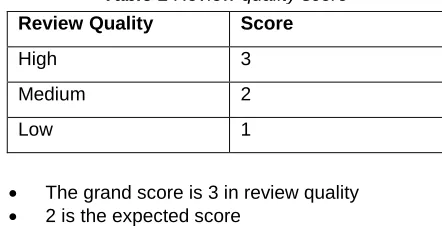
A method is devised for calculating the quality of information in product reviews. The evaluation of review quality is treated as a classification problem and thus employs an effective information quality framework to obtain review features.Three classes of review quality:
1. High Quality Review: A complete and timely information about the product should be provided by a high quality review which is helpful for other customers to make a strong decision about the product. It contains the maximum score 3 in the table of review quality score.
2. Medium Quality Review: In a medium quality review, though the content is relevant to a product, yet it is not information enough. Though such reviews are interesting, they hardly persuade readers to make decisions. It contains the next maximum score 2 in the table of review quality score.
3. Low Quality Review: Only a small amount of information about the product is seen in a low quality review so the readers do not take strong decision about the product according to this review. It contains the minimum score 1 in the table of review quality score.
Review score: The review score given below is based on review quality.
Table 1 Review quality score
The grand score is 3 in review quality
2 is the expected score
Depending on the customers review quality, observation are made. The single user review quality is analysed here. The review quality comes under any one of the aforesaid category. Analysis result would be considered on the basis of review quality, consumer profession and his behaviour.
3.2 ANALYSIS OF CONSUMER BEHAVIOR QUALITY The following noticed consumer behaviour is analysed. Few factors from consumer behaviour has been analysed. Each factor is compared with consumer profession and consumer review quality. The chi-squared method has been availed for analysis process. The analysis result exhibits the standard of consumer reviews. The factors are classified into three type of behaviour that are:
3.2.1 Behaviour Data
Duration Usage – the duration he spent in the social media regularly.
3.2.2 Influence
Number of friends on social media having met individually, fans / followers / likes, comments, Posted contents on social media, sharing the interaction, mode of interacting with family and friends.
3.2.3 Searching behaviour
It gathers the behaviour of the customers in the social media. It contains information about how the users searched the product online, the time he spent to search, the information he shared about the product and discussions he made about the product.
3.2.4 Behaviour Score
Behaviour score is estimated from custom behaviour factor completeness. Twenty factors from customer behaviour has been determined and analysed. This factor consolidates the consumer activities. For instance, if the consumers satisfies behaviour factors, a score is assigned. Behaviour score is estimated depending on the satisfaction level. It can be estimated from the number of factors fulfilled by a customer. If the customer meets 10 factors, then the observed score is high. Availing the chi square method, the consumer's final behaviour is calculated.
3.3 REVIEW COMPARISON
The weightage of reviews in the social networking site (SNS) is involved in this study. To produce an effective result regarding the product quality, this comparisons becomes much significant. Every social media platform has its own unique method to give a genuine information about the business to its potential customers. "There is an
Review Quality Score
High 3
Medium 2
increasing habit among the customers to proactively look for feedbacks which is encouraging for firms which has a positive online reputation", states the firm in its estimation of information. Online feedback is compared to customers.
Product category
A product category is a kind of product or service. Product types are typically invented by a company or an industrial organization to form products .This involves a hierarchy of categories which resembles a tree structure. The product categories can be of a flat structure like a list of product types.
Types of user category:
Relevant user
Irrelevant user
The aforementioned two kinds are obtained from consumer profile.
a) Relevant user
The relevant user are the consumer who is more relevant to the product that is being purchased by him. The outcomes of the product quality are carefully examined and the efficient result is traced by the relevant user. This kind of consumer is known as relevant consumer. Relevant consumer review is termed as effective review, since they have gained a good knowledge about the product.
b) Irrelevant user
Irrelevant user is a consumer who do not have relevancy to that product. Such consumers are called as irrelevant consumer.
3.4 FUZZY SET METHOD
A fuzzy set is defined as a universe of discourse it consists oftotal ordering, That has a height of normal fuzzy set is equal to the maximal membership value, and having values oftwo arbitrary elements of membership grade value is greater than or equal to the two arbitrary boundary elements of smaller membership grade value. The pair (U, M) is the fuzzy set where U is a set and m:U→ [0,1] a membership function. Universe of discourse (sometimes denoted by Ω or X), which is reference set U and for each x
∈ U the value m(x) is called the grade of membership. The fuzzy set theory provides precise results in mathematic operations. The better model phenomena has achieved by this theory that like degree-vagueness and uncertainty.
3.4.1 ILLUSTRATION
In fuzzy system we have categorize the three types of resultant values. The resultant value lies between 0to1
Table 2 Fuzzy system categorize
DESCRIPTION VALUES
Useful 0.8 to 1
Irrelevant 0.4 to 0.7
Harmful 0 to 0.3
1. USEFUL
USER: if the user is an IT based person PRODUCT: laptop
REVIEW: ―Laptop is in good quality but charger is not good enough.The standby time is very less and laptop emits more heat while charging‖.
Table 3 Fuzzy system review- Useful
The review is useful because the user is an IT person. He/ she purchase the laptop So the product is related to the user.
The user in customer behaviour is more importance because user has more friends list in social network and also user search about products in more time.
2. IRRELEVANT
USER: The user is a student PRODUCT: Cookware
REVIEW: ―The cookware is in good quality, but the coated metal content is white‖.
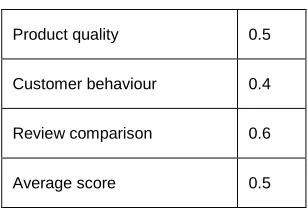
Table 4 Fuzzy system review- Irrelevant
Product quality 0.5
Customer behaviour 0.4
Review comparison 0.6
Average score 0.5
The review is irrelevant because the user is a student he/she doesn‘t known about the cookware product. So the product doesn‘t relate to the user.
The user in customer behaviour is less importance because user has less friends list in social network and also user search about products in less time.
3. HARMFUL
USER: if the user is a grocery shop man PRODUCT: Black gram
REVIEW: ―The black gram is in less quality as well as high cost‖.
Product quality 0.8
Customer behaviour 0.8
Review comparison 0.8
Table 5 Fuzzy system review- Harmful
Product quality 0.3
Customer behaviour 0.1
Review comparison 0.2
Average score 0.2
The review is harmful because the user purchase the item is very less quality and high cost so the product is harmful to the user.
The user in customer behaviour is too less importance because user have a too less friends list in social network compare than 2 and also user search about the products in too less time.
Table 6 Fuzzy system review Comparision
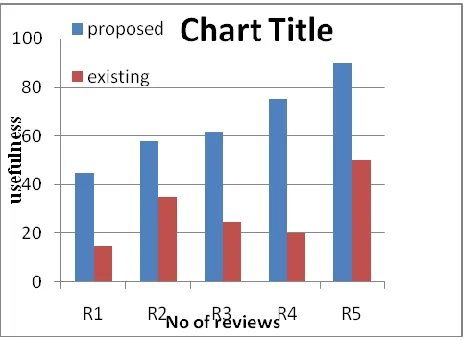
Chi square method is used in existing system to evaluate individual user review and give a result about the product but the usefulness is very low. In this method individual user reviews are confused to determined and not effective. The chi square test is a vastly used non-parametric statistical test which illustrates the magnitude of variation between the observed data and the data expected to be attained with a specific hypothesis. The observed and expected frequencies are said to be totally coinciding when the X2 = 0 and as the value of x2 increases, the variation between the observed and expected data.
Figure 1 chart comparison
In statistical tests, chi square test is the most essential and availed method in statistical tests. Fuzzy set method is used to evaluate the overall review and give a result about the usefulness. In this method usefulness is high performance, more effective.
4 CONCLUSION
In this paper we calculated the usefulness of the customer reviews in step wise using proposed method. Compare with the chi square method, our proposed method is more usefulness and effective. Fuzzy doesn‘t have complicated mathematical analysis works and also the values are easy to evaluate i.e. between 0 to 1. So fuzzy set method reduce the computation time. This work analyses the customers review depending on the types of review, which serves as a main advantage. The relationship of the customer with a product determines the interest of the customer towards the product, which enables product seller to have a better relationship with customer. After three phases of study, the final review result is estimated. Hence, it provides an exact result about the quality of the product.
REFERENCES
[1] Malik ShahzadShabbir, Muhammad Saarim Ghazi and Atta RasoolMehmood, ―Impact of Social Media Applications on Small Business Entrepreneurs‖, Impact of Social MediaApplications on Small Business Entrepreneurs, 2016.
[2] HajraWaheed, Maria Anjum, Mariam Rehman and Amina Khawaja, ―Investigation of user behavior on socialnetworking sites‖, User behavior and SNS, February 2, 2017.
[3] Qian Liu, Bing Liu, Yuanlin Zhang, Doo Soon Kim and ZhiqiangGao, ―Improving Opinion Aspect Extraction Using Semantic Similarity and Aspect Associations‖, Proceedings of the Thirtieth AAAI Conference on Artificial Intelligence (AAAI-16), 2016.
[4] Santhosh Kumar K L, Jayanti Desai and JharnaMajumdar, ―Opinion Mining and Sentiment Analysis on Online Customer Review‖, IEEE International Conference on Computational Intelligence and Computing Research, 2016. [5] Hanqian WU and Tao LIU, ―Fine-grained Product
Feature Extraction in Chinese Reviews‖, International Conference on Computing Intelligence and Information System, 2017.
[6] FarekLazhar and Tlili-GuiassaYamina, ―Mining explicit and implicit opinions from reviews‖, Int. J. Data Mining, Modelling and Management, Vol. 8, No. 1, 2016.
[7] Rajat Sharma, GautamNagpal and Amit Kanwar, ―Algorithm for Ranking Consumer Reviews on E-commerce Websites‖, (IJCSIT) International Journal of Computer Science and Information Technologies, Vol. 6, 2015.
[8] Vivek Panchal, ainebPenwala, SnehaPrabhu, Rhea Shetty and Prof. ReenaMahe, ―Sentiment Analysis of Product Reviews and Trustworthiness Evaluation using TRS‖, International Research Journal of Engineering and Technology(IRJET), Volume: 04, Mar -2017.
NO OF REVIEW USEFULNESS proposed existing
R1 45 15
R2 58 35
R3 62 25
R4 75 20
[9] Wang, X, Yu, C & Wei, Y 2012, ‗Social media peer communication and impacts on purchase intentions: a consumer socialization framework, journal o f Interactive Marketing, vol. 26, no. 4, pp. 198-208
[10]Violino, B 2009, ‗The Buzz on Campus: Social Networking Takes Hold‘. Community College Journal , vol. 79, no. 6, pp. 28‐30.
[11]Vollmer, C & Precourt, G 2008, ‗Always On Advertising, Marketing,, and Media in an Era of Consumer Control‘, McGraw-Hill, New York [12]Voon, Ngui & Agrawal 2011, ‗Determinants of