Supplier Selection using combined MCDM Approach -A Case Study for Mobile selection
S. Maheswari and C. Alphina
Department of Mathematics, Holy Cross College (Autonomous), Tiruchirappalli-620 002.
Abstract
Purchasing management is most essential in today’s running world, because the profit potential
of effective management of the purchasing and supply activities is enormous compared with other
practical management alternatives. One of the most critical way is the selection of the right supplier. A
Multi Criteria Decision Making (MCDM) techniques namely Technique for Order Preference by Similarity
to Ideal Solution (TOPSIS), Fuzzy TOPSIS, Vlse Kriterijumska Optimizacija Kompromisno Resenje (VIKOR)
and Linear Programming (LP) are effectively applied in the supplier selection process.
Entropy is the measure of the disorder degree of the system, and it can also measure the effective
information provided by the data. Therefore, the entropy can be used to determine the weights.
ENTROPY method is used to calculate the weight and give suppliers a ranking; LP effectively allocates
order quantity to each vendor. The alternatives are ranked and compared in order to arrive at an
efficient result. This approach is demonstrated with a real world case study involving four main
evaluation criteria and the firm has to determine the most appropriate and beneficial suppliers, which
results in the great savings in both costs and man hours.
1. INTRODUCTION
Fuzzy set theory provides a major paradigm in modeling and reasoning with uncertainty. In constructing a model, we always attempt to maximize its usefulness. This aim is closely constructed with relationship among these key characteristics of every model complexity credibility and uncertainty. Here uncertainty plays an important role which tends to reduce the complexity and increase credibility of the resulting model. In 1965 the fuzzy set theory was first subjected to technical scrutiny by Lotfi. A. Zadeh, in his seminar work “Fuzzy sets”. It is an extension of crisp sets, by enlarging the triple value set of ‘Grade membership’ from the two value set {0,1} to the unit interval [0,1] of real numbers.
Fuzzy sets are characterized by mapping called ‘Membership functions’ in to [0, 1] which are extension of characteristic functions of crisp sets. The capacity of fuzzy sets to express gradual transition from membership to non-membership and vice versa and has a broad utility. It not only provides representation of measurement uncertainties but also with a poignant representation of vague concepts expressed in natural language. Fuzzy set theory is a tool that gives reasonable analysis of complex, systems without making the process of analysis too complex. Also there might be situations in which a decision maker needs to consider multiple criteria in arriving at the overall best decision. Hence Fuzzy set theory solves all the inventory models in an uncertain environment.
1.2. A Survey of Preliminary Fuzzy Set Theory
The following definitions and preliminaries are required in the sequel of this thesis and hence presented in brief.
1.2.1.Fuzzy Set
If X is a collection of objects denoted generically by x, then a fuzzy set A in X is defined as a set of ordered pairs A = {(x,µA(x)) | x X }, where, µA(x) is called the membership function (or MF for short) for the fuzzy set A. The MF maps each element of X to a membership grade (or membership value) between 0 and 1 (included) Let X = {0, 1, 2, 3, 4, 5, 6} be the set of numbers of children a family may choose to have. Then the fuzzy set B = "desirable number of children in a family" may be described as follows: B = {(0, 0.1), (1, 0.3), (2, 0.7), (3, 1), (4, 0.7), (5, 0.3), (6, 0.1)}. Here we have a discrete ordered universe X. Again, the membership grades of this fuzzy set are obviously subjective.
1.2.2. α-cut
The α -cut or α -level set of a fuzzy set A is a crisp set defined by Aα = {x |μA(x) ≥ α
Strong α -cut or strong α -level set is defined by Aα = {x | μA (x) > α}.
1.3. Fuzzy Numbers
The notion of fuzzy numbers was introduced by Dubois .D and Prade. H [20]. A fuzzy subset of the real line R with membership function à : R [0,1] is called a fuzzy number if
i. Ã is normal,(i.e) there exists an element X0 such that (x0) = 1 ii. Ã is fuzzy convex, (i.e)
µÃ [λx1+(1- )λx2] ≥ µÃ (x1) µÃ(x2), x1, x2 R, λ [0, 1] iii. µÃ , is upper continuous , and
1.3.1. Generalized Fuzzy Number
Any fuzzy subset of the real line R, whose membership function A satisfied the following conditions is a generalized fuzzy numberA~.
(i) µÃ is a continuous mapping from R to the closed interval [0,1], (ii) µÃ = 0, - x a1,
(iii) µÃ= L (x) is strictly increasing on [a1,a2] (iv) µÃ = 1, a2 x a3
(v) A = R (x) is strictly decreasing on [a3, a4] (vi) A = 0, a4 x
where a1, a2, a3 and a4 are real numbers. Also this type of generalized fuzzy number be denoted as A~ = (a1, a2, a3, a4; wA)LR ; When wA=1, it can be simplified as A~ = (a1, a2, a3, a4)LR.
1.3.2. Triangular Fuzzy Number
The fuzzy set A (a1,a2,a3) where a1 a2 a3 and defined on R, is called the triangular fuzzy number, if the membership function of A is given by
1 2
1 2
1
,
a
x
a
a
a
a
x
μ
A = 2 32 3
3
,
a
x
a
a
a
x
a
0, other wise
1.3.3. Trapezoidal Fuzzy Number
The fuzzy set Ã= (a1,a2,a3,a4) where a1≤ a2 ≤a3≤ a4 and defined on R, is called the trapezoidal number if membership function of is given by
A1
a
1x
µA (x) =
1
1 2
2 1
2 3
4
3 4
4 3
x
a
, a
x
a
a
a
1, a
x
a
a - x
, a
x
a
a
a
0, Otherwise
1.4. Operations on Fuzzy Numbers
Though different methods are available for the operation of fuzzy numbers , the function principle is used for the operation of fuzzy numbers in the present thesis.
1.4.1. The Function Principle
The function principle was introduced by Chen [14] to treat fuzzy arithmetical operations. This principle is used for the operation of addition, subtraction, multiplication and division of fuzzy numbers. Suppose A~ = (a1, a2, a3,) and B~ = (b1, b2, b3) are two triangular fuzzy numbers. Then
(i) The addition of A~ and B~ is
A~ + B~ = (a1+b1, a2+b2, a3+b3) where a1, a2, a3, b1, b2, b3 are any real numbers.
(ii) The multiplication of A~ and B~ is A~ x B~ = (c1, c2, c3) where T = { a1b1, a1b3, a3b1, a3b3}
c1 = min T, c2 = a2b2, c3 = Max T
Ã
a
1a
2a
3a
4a
1If a1, a2, a3, b1, b2, b3 are all non zero positive real numbers, then A~ x B~ = (a1b1, a2b2, a3b3)
(iii) - B~= (-b3, -b2, -b1) then the subtraction of A~ and B~ is A~ -B~= (a1-b3, a1-b2, a3-b1)
where a1,a2,a3, b1, b2, b3 are any real numbers (iv)
B
~
1
= 1
B ~
=
1/b
3,1/b
2,1/b
1
where b1, b2, b3 are all non zero positive real number, then thedivision of A~ and B~ is
B
a
1/b
3,
a
2/b
2,
a
3/b
1
~
/
A
~
(v) For any real number K, KA = (Ka1, Ka2, Ka3) if K > 0
KA = (Ka3, Ka2, Ka1) if K < 0
Suppose A = (a1, a2, a3, a4) and
B
= (b1, b2, b3, b4) are trapezoidal fuzzy numbers. Then(i) Addition of A and
B
is A +B
= (a1 + b1, a2 + b2, a3 + b3, a4 + b4) where a1, a2, a3, a4, b1, b2, b3 and b4, are real numbers.(ii) The product of A and
B
is A xB
= (a1b1, a2b2, a3b3, a4b4) if a1, a2, a3, a4, b1, b2, b3 and b4 are all non zero positive real numbers.(iii) The subtraction of
B
from A is A -B
= (a1 – b4, a2 – b3, a3 – b2, a4 – b1) where a1, a2, a3, a4, b1, b2, b3 and b4 are any real numbers.(iv) The division of A and
B
is A /B
= 1 2 3 44 3 2 1
a
a
a
a
,
,
,
b
b
b
b
if a1, a2, a3, a4, b1, b2, b3 and b4 are all non zero positive real numbers.(v) For any real number K, KA = (Ka1, Ka2, Ka3, Ka4) if K > 0
KA = (Ka4, Ka3, Ka2, Ka1) if K < 0
1.4.2.
DECISION MAKING:-1.4.3.
MCDMMulti-criteria decision making (MCDM) is one of the well-known topics of decision making. Fuzzy logic provides a useful way to approach a MCDM problem. Very often in MCDM problems, data are imprecise and fuzzy. In a real-world decision situation, the application of the classic MCDM method may face serious practical constraints, because of the criteria containing imprecision or vagueness inherent in the information.
1.4.4.
T O P S I ST O P S I S ( T e c h n i q u e f o r O r d e r P r e f e r e n c e by Similarity to Ideal Solution) The principle behind TOPSIS is simple: The chosen alternative should be as close to the ideal solution as possible and as far from the negative-ideal solution as possible. The ideal solution is formed as a composite of the best performance values exhibited (in the decision matrix) by any alternative for each attribute.
1.4.5.
FUZZY TOPSISThe technique called fuzzy TOPSIS (Technique for Order Preference by Similarity to Ideal Situation) can be used to evaluate multiple alternatives against the selected criteria.
1.4.6.VIKOR method
VIKOR is one of the multiple criteria decision making (MCDM) models to determine the preference ranking from a set of alternatives in the presence of conflicting criteria. The justification of VIKOR is to use the concept of the compromise programming to determine the preference ranking by the results of the individual and group regrets.
1.5. Defuzzification
Defuzzification is a process of transforming fuzzy values to crisp values. Defuzzification Methods have been widely studied for some years and were applied to fuzzy systems. The major idea behind these methods was to obtain a typical value from a given set according to some specified characters. Defuzzification method provides a correspondence from the set of all fuzzy sets into the set of all real numbers.
The Technique for Order of Preference by Similarity to Ideal Solution (TOPSIS) is a multi-criteria decision analysis method, which was originally developed by Hwang and Yoon in 1981 ,with further developments by Yoon in 1987, and Hwang, Lai and Liu in 1993.TOPSIS is based on the concept that the chosen alternative should have the shortest geometric distance from the positive ideal solution and the longest geometric distance from the negative ideal solution. It is a method of compensatory aggregation that compares a set of alternatives by identifying weights for each criterion, normalising scores for each criterion and calculating the geometric distance between each alternative and the ideal alternative, which is the best score in each criterion. An assumption of TOPSIS is that the criteria are monotonically increasing or decreasing. Normalisation is usually required as the parameters or criteria are often of incongruous dimensions in multi-criteria problems.
The procedure of TOPSIS can be described as follows.
Given a set of alternatives, A = {Ai | i = 1, . . . , n} and a set of criteria C = {cj | j = 1, . . . , m} where X = {xij | i = 1, . . . , n, j = 1, . . . , m} denotes the set of ratings and W = {Wj | j = 1, . . . , m} is the set of weights. Then the information able I = (A, C, X, W) can be represented as:
I C1 C2 .... Cm A1 x11 x12 .... x1m A2 x21 x22 .... x2m
. . . .
. . . .
. . . .
An xn1 xn2 .... xnm W w1 w2 .... wm
Step 1: Calculate normalized ratings by
m j
x x x r
n
i ij ij ij
,...., 1
1,....n i
; )
(
1
2
Step 2: Calculate weighted normalized ratings by
m;
1,....,
j
n;
1,....,
i
)
(
)
(
x
w
r
x
V
ij j ijStep 3: Calculate PIS (positive ideal solution) and negative ideal solution (NIS) by
max ( )| 1,(min | 2
A
PIS V x j J Vij j J
i ij
i
v
1,
v
2,...
v
n
min ( )| 1,(max | 2
A
NIS V x j J Vij j J
i ij
i
v
1,
v
2,...
v
n
measured using the Euclidean distance which is given by
S
V
x
V
x
i
n
m
j
j ij
i
(
)
(
)
1
,...,
1 2
V
x
V
x
i
n
S
m
j
j ij
i
(
)
(
)
1
,...,
1 2
Step 5: Similarities to the PIS can be derived as
n
i
c
n
i
S
S
s
c
i i i ii
1
,...,
[
0
,
1
]
1
,...,
*
*
Finally, the preferred order can be obtained according to the similarities to the PIS (
C
i*) in descending order to choose the best alternatives.NUMERICAL EXAMPLE
Consider a problem of selecting suppliers for a best mobile for a particular specifications of the mobile phones under 4 different criteria namely RAM, Inbuilt memory, Camera Pixels, Memory card,( supported up to) . The problem is to find out the best mobile to use:
HERE LET US KEEP THE COST OF EACH PRODUCT TO BE BETWEEN Rs.13500 – Rs.14000
1. Topsis Method-TABLE 1. INFORMATION TABLE
Alte rn ativ es RAM Cam era P ixe ls Memo ry ca rd In b u ilt me mo ry
Sony Xperia C 0.05 0.610 0.5 0.25
Panasonic 1 0.99 0.25 1
Samsung galaxy grand 0.05 0.610 1 0.5
TABLE 2. NORMALIZED RATINGS
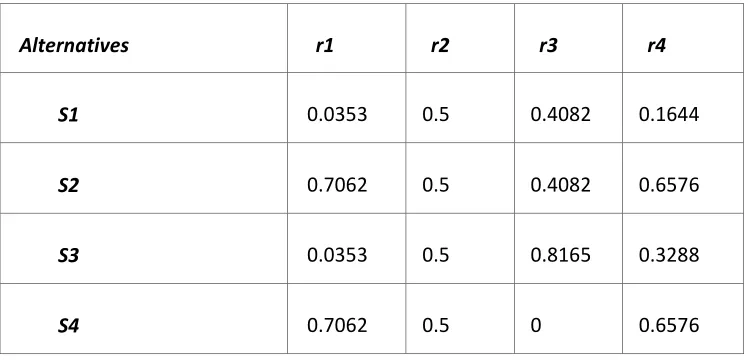
Alternatives r1 r2 r3 r4
S1 0.0353 0.5 0.4082 0.1644
S2 0.7062 0.5 0.4082 0.6576
S3 0.0353 0.5 0.8165 0.3288
S4 0.7062 0.5 0 0.6576
WEIGHT 0.3088 0.0266 0 0.6576
TABLE 3. WEIGHTED NORMALIZED RATINGS
Alternatives
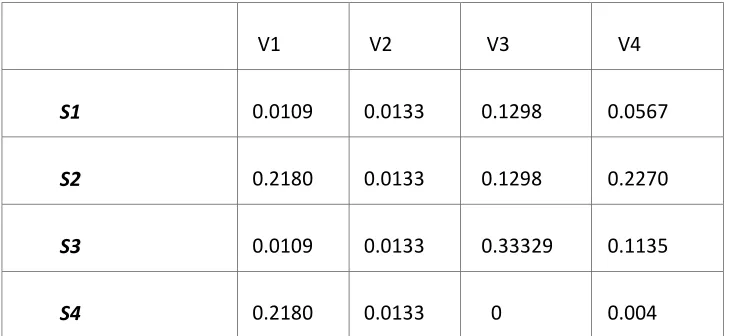
V1 V2 V3 V4
S1 0.0109 0.0133 0.1298 0.0567
S2 0.2180 0.0133 0.1298 0.2270
S3 0.0109 0.0133 0.33329 0.1135
S4 0.2180 0.0133 0 0.004
MAXVJ+ 0.2180 0.0133 0.3332 0.2270
TABLE 4. THE PIS AND THE NIS
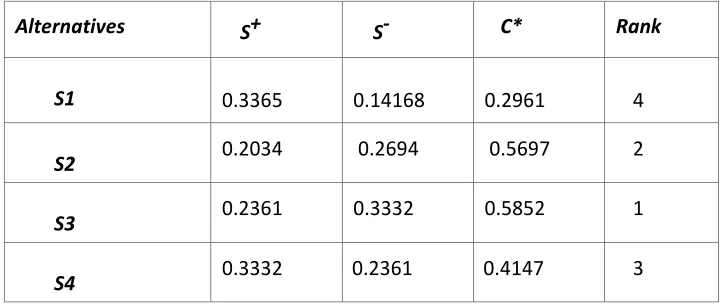
Alternatives S+ S- C* Rank
S1 0.3365 0.14168 0.2961 4
S2 0.2034 0.2694 0.5697 2
S3 0.2361 0.3332 0.5852 1
S4 0.3332 0.2361 0.4147 3
The preferred order of alternatives are S3>S2>S4>S1.On the basis of preferred order, Alternative – III (ie) Supplier – III should be the best choice.
2. VIKOR
The VIKOR method is a multicriteria decision making (MCDM) or Multi-criteria decision analysis method. It was originally developed by Serafim Opricovic to solve decision problems with conflicting and non commensurable (different units) criteria, assuming that compromise is acceptable for conflict resolution, the decision maker wants a solution that is the closest to the ideal, and the alternatives are evaluated according to all established criteria. VIKOR ranks alternatives and determines the solution named compromise that is the closest to the ideal. The VIKOR method of compromise ranking determines a compromise solution, providing a maximum “group utility” for the “majority” and a minimum of an individual regret for the “opponent”. The TOPSIS method determines a solution with the shortest distance to the ideal solution and the greatest distance from the negative-ideal solution, but it does not consider the relative importance of these distances. A comparative analysis of these two methods is illustrated with a numerical example, showing their similarity and some differences.
Step 1: Representation of normalized decision matrix.
The normalized decision matrix can be expressed as follows.
m 1,2,...., i ; ] [ 1 2
m i ij ij ij mxn ij x x f where f FAnd xij-performance of alternative Ai with respect to the j
th
criterion.
Step 2 : Determination of positive ideal and negative ideal solution.
The positive ideal solution A+ and negative ideal solution A- are determined as
(max
f
ij)
j
J
or
(min
f
ij|
j
J
)
i
1
,....,
m
A
f1,f2,...fn
(min
f
ij)
j
J
or
(max
f
ij|
j
J
)
i
1
,....,
m
A
f1,f2,...fn
Where J is the attributes
Step 3”: Calculation of utility measure and regret measure by
nj j j
ij j j i
f
f
f
f
W
S
1
(
)
)
(
) ( ) ( max j j ij j j j i f f f f W R iS
- Utility measureR
i- Regret measureStep 4: Computation of VIKOR index
The VIKOR index can be expressed as
_ ) ) ( ) 1 ( ) ) ( R R R R V S S S S V
Q i j
Where min( i)
i S
S ; max( i)
i S
S ; min( i)
i R
R ; max( i)
i R
R
V- Weight of maximum group utility (usually it is to be set fo 0.5) The alternative having smallest VIKOR value is determined to be the best solution.
Entropy method is used to determine the weight of each indicator.
Step 1 : Calculate
m j ij ij ijr
r
P
1; rij - i
th
scheme, jth indicator value
Step 2: Calculate the , jth indicator entropy value ej
m i ij ij j m K InP P K e 1 ln 1; m is the number of assessments.
Step 3 : Calculate wj
m j j j j)
-e
(
)
-e
(
w
11
1
n is the no. of indicators and 0wj 1;
1,....,
j
n;
1,....,
i
)
(
)
(
1
1
x
r
w
x
V
W
ij j ij m i jNUMERICAL EXAMPLE- TABLE 5. INFORMATION TABLE
A lt er n a ti ve s RAM Cam era P ixe ls Memo ry ca rd In b u ilt me mo ry
S1 0.05 0.610 0.5 0.25
S3 0.05 0.610 1 0.5
S4 1 1 0 1
WEIGHT 0.48 0.48 0.03 0.01
TABLE 6. NORMALIZED RATINGS
Alternatives r1 r2 r3 r4
S1 0.0353 0.5 0.4082 0.1644
S2 0.7062 0.5 0.4082 0.6576
S3 0.0353 0.5 0.8165 0.3288
S4 0.7062 0.5 0 0.6576
TABLE 7. UTILITY MEASURES (Si)
Alternatives Sj Rj
S1 0.8130 = S+ 0.3452= R+
S2 0.1590 = S- 0.1590=R-
S3 0.5389 0.3088
AS, VIKOR INDEX of SUPPLIER I is the least,
SUPPLIER I is to be selected FIRST followed by S3, S4 and S2
3.Fuzzy TOPSIS
Since the preferred ratings usually refer to the subjective uncertainty, it is natural to extend TOPSIS to consider the situation of fuzzy numbers. Fuzzy TOPSIS can be intuitively extended by using the fuzzy arithmetic operations as follows:
Given a set of alternatives,
A
{A
i|
i
1,....,
n}
and a set of criteria C{Cj| j1,....,m}Where
X
~
{
x
~
ij|
i
1
,....,
n
;
j
1
,...,
m
}
denotes the set of fuzzy ratings and}
,...,
1
|
~
{
~
m
j
w
W
ij
is a set of fuzzy weights.The first step of TOPSIS is to calculate normalized ratings by
m j
n i
x x x
r
n
i jn ij
ij , 1,...., ; 1,....,
~ )
( ~
1 2
And then to calculate the weighted normalized ratings by m
j n i
x r w x
vij( ) ~j~ij( ); 1,...., ; 1,....,
~
Next the positive ideal point (PIS) and the negative ideal point (NIS) are derived as
PIS
A
{
~
v
1(
x
),
v
~
2(
x
),....,
v
~
j(
x
),....,
~
v
m(
x
),
VIKORIndex Ranking
S1 Q1 = 0 1
S2 Q2 = 1 4
S3 Q3 = 0.3073 2
} ,...., 1 | ) | ) ( ~ min ), | ) ( ~
{maxvij x jJ1 vij x jJ2 i n
PIS
A
{
~
v
1(
x
),
v
~
2(
x
),....,
v
~
j(
x
),....,
~
v
m(
x
),
} ,...., 1 | ) | ) ( ~ max ), | ) ( ~
{minvij x jJ1 vij x jJ2 i n
Where J1 and J2 are the benefit and the cost attributes respectively.
Similar to the crisp solution, the following step is to calculate the separation from the PIS and the NIS between the alternatives. The separation values cal also be measured using the Euclidean distance given as :
n
x
v
x
v
S
m j j iji
[
~
(
)
~
(
)]
,
1
,....,
~
1 2
Andn
x
v
x
v
S
m j j ijo
(
)]
,
1
,....,
~
)
(
~
[
~
1 2
Where0
)
(
~
)}
(
~
min{
)
(
~
)
(
~
max{
v
ijx
v
jx
v
ijx
v
jx
Next, the similarities to the PIS is given as
n i S D S D S D C i i i
i 1,....,
) ( ) ( [ ) ( *
Where C*i [0,1] i1,...,n
Finally, the preferred orders are ranked according to Ci* in descending order to choose
NUMERICAL EXAMPLE
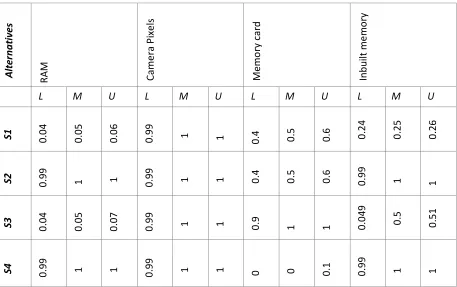
TABLE 8. INFORMATION TABLE
A
lt
er
n
a
ti
ve
s
RAM Cam
era
P
ixe
ls
Memo
ry
ca
rd
In
b
u
ilt
me
mo
ry
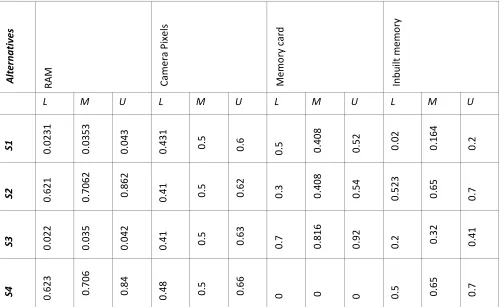
L M U L M U L M U L M U
S1 0.04 0.05 0.06 0.99 1 1 0.4 0.5 0.6 0.2
4
0
.2
5
0
.2
6
S2 0.99 1 1 0.99 1 1 0.4 0.5 0.6 0.9
9
1 1
S3 0.04 0.05 0.07 0.99 1 1 0.9 1 1 0.049 0.5 0.5
1
S4 0.99 1 1 0.99 1 1
0 0 0.1 0.
9
9
TABLE 9. NORMALIZED MATRIX
A
lt
er
n
a
ti
ve
s
RAM Cam
era
P
ixe
ls
Memo
ry
ca
rd
In
b
u
ilt
me
mo
ry
L M U L M U L M U L M U
S1 0.0231 0.03
5
3
0.0
43
0.431 0.5 0.6 0.5 0.4
0
8
0
.5
2
0
.0
2
0
.1
6
4
0
.2
S2 0.621 0.7062 0.862 0.41 0.5 0.62 0.3 0.4
0
8
0
.5
4
0.
5
23
0
.6
5
0.7
S3 0.022 0.035 0.042 0.41 0.5 0.63 0.7 0.8
1
6
0
.9
2
0.2 0.3
2
0
.4
1
S4 0.623 0.706 0.84 0.48 0.5 0.66
0 0 0 0.5 0.
65
0
.7
a
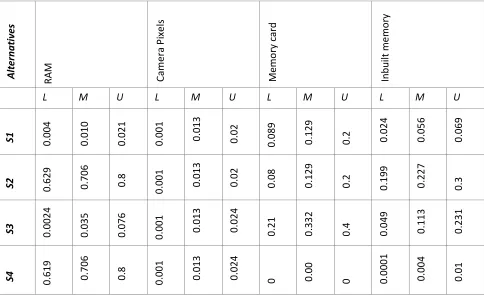
1TABLE 10.WEIGHTED NORMALIZED MATRIX A lt er n a ti ve s RAM Cam era P ixe ls Memo ry ca rd In b u ilt me mo ry
L M U L M U L M U L M U
S1 0.00
4
0
.010 0.021 0.001 0.013
0.02 0.0
89 0 .1 2 9 0
.2 0.02
4 0 .0 5 6 0 .0 6 9
S2 0.629 0.706 0.8 0.001 0.013 0.02 0.0
8 0 .1 2 9 0 .2 0. 1 99 0 .2 2 7 0.3
S3 0.002
4
0
.035 0.076
0.001 0.013 0.024 0.2
1 0 .3 3 2 0
.4 0.049 0.11
3
0
.2
3
1
S4 0.619 0.706 0.8 0.001 0.013 0.024
0 0
.0
0
0 0.0
TABLE 11:
DEFUZZIFICATION TECHNIQUE TO FIND THE MAXIMUM & MINIMUM OF FUZZY VALUES
Alternatives
V1 V2 V3 V4
S1 0.010
9
0.013 3
0.1298 0.0567
S2 0.218
0
0.013 3
0.1298 0.2270
S3 0.010
9
0.013 3
0.3332 9
0.1135
S4 0.218
0
0.013 3
0 0.004
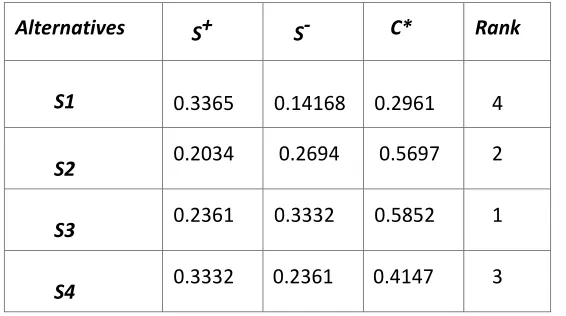
TABLE 12. THE PIS AND THE NIS
Alternatives S+ S- C* Rank
S1 0.3365 0.14168 0.2961 4
S2 0.2034 0.2694 0.5697 2
S3 0.2361 0.3332 0.5852 1
S4 0.3332 0.2361 0.4147 3
The preferred order of alternatives are S3>S2>S4>S1.On the basis of preferred order, Alternative – III (ie) Supplier – III should be the best choice.
MAXVJ+ 0.2180 0.0133 0.3332 0.2270
4. Linear Programming
After calculation of ENTROPY for four suppliers, the weights for the suppliers are 0.3088, 0.0266, 0, and 0.657 respectively.
Then, the optimal order quantity can be obtained through the LP technique. Suppose the customer needs to buy a single piece of mobile from any of the best product. We can obtain the best optimum solution by using the following information.
Max z = 0.3088X1 + 0.0266 X2 +0.657 X4
Subject to:
X1 + x2 +X3+X4=1
13900X1 + 14000X2 + 13500X3+ 14600X4 <=15000 X1+ 2X2 +X3 + 2X4 <=2
8X1+ 13X2 + 8X3 + 13 X4 < = 13
This LP optimization problem is solved by using the software TORA. The optimal order quantities for each supplier are 0, 0, 1 and 0 pieces. And the best mobile that can be selected is Samsung galaxy grand. It can be obtained either using TORA software or LINGO software.
CONCLUSION:
REFERENCES
[1] Bouyssou, D., & Pirlot, M. (2008). On some ordinal models for decision making under uncertainty. Annals of Operations Research, 163(1), 19–48.
[2] Opricovic S, Tzeng GH (2004) Compromise solution by MCDM methods: a comparative analysis of VIKOR and TOPSIS. Eur J Oper Res 156:445–455
[3] Chia-Ling Chang · Chung-Hsin Hsu Applying a Modified VIKOR Method to Classify Land Subdivisions According to Watershed Vulnerability Water Resour Manage (2011) 25:301–309
[4] Das Chakladar N, Chakraborty S (2008) A combined TOPSIS AHP method based approach for non-traditional machining processes selection. Proc IMechE, J of Engg Manuf 222:1613–1623
[5] Bohui Pang · Shizhen Bai. An integrated fuzzy synthetic evaluation approach for supplier selection based on analytic network process J Intell Manuf DOI 10.1007/s10845-011-0551-3
[6] Saaty, T. L. (1996). Decision making with dependence and feedback : The analytic network process. Pittsburgh: RWS Publications
[7] Tong LI, Chen CC, Wang CH (2007) Optimization of multi-response processes using the VIKOR method. Int J Adv Manuf Technol 31:1049–1057
[9] Yang, Y. P., Shieh, H.M., Leu, J. D., & Tzeng, G. H. (2009). A Vikor-based multiple criteria decision method for improving information security risk. International Journal of Information Technology & Decision Making, 8(2), 267–287.
[10] Wallenius, J., Dyer, J. S., Fishburn, P. C., Steuer, R. E., Zionts, S., & Deb, K. (2008). Multiple criteria decision making, multi-attribute utility theory: recent accomplishments and what lies ahead. Management Science, 54(7), 1336–1349.
[11] Wang, T. C., & Chang, T. H. (2007). Application of TOSIS in evaluating initial training aircraft under a fuzzy environment. Expert Systems With Applications, 33(4), 870–880.
[12] Wu, C. R., Lin, C. T., & Lin, Y. F. (2009). Selecting the preferable bancassurance alliance strategic by using expert group decision technique. Expert Systems With Applications, 36(2), 3623–3629.