“THE
EFFECT
OF
BODY
WEIGHT
SUPPORTED
TREADMILL TRAINING (BWSTT) ON SENSORIMOTOR
FUNCTION, BALANCE AND GAIT AMONG PATIENTS
WITH ACUTE MIDDLE CEREBRAL ARTERY STROKE”
-
A QUASI EXPERIMENTAL STUDY
Dissertation submitted to The Tamil Nadu Dr. M.G.R. Medical University
towards partial fulfilment of the requirements of
MASTER OF
PHYSIOTHERAPY (Advanced PT in Neurology) Degree programme.
KMCH COLLEGE OF PHYSIOTHERAPY
(A unit of Kovai Medical Center Research and Educational Trust)
Post Box No. 3209, Avinashi Road,
Coimbatore – 641 014.
2017 - 2019
CERTIFICATE
This is to certify that the dissertation entitled “THE EFFECT OF BODY WEIGHT
SUPPORTED TREADMILL TRAINING (BWSTT) ON SENSORIMOTOR FUNCTION, BALANCE AND GAIT AMONG PATIENTS WITH ACUTE MIDDLE CEREBRAL ARTERY STROKE – A QUASI EXPERIMENTAL STUDY” is a bonafide work done by NANTHINI. P bearing the Register No: 271720084, KMCH College of Physiotherapy, towards partial fulfilment of the requirements of the Master of Physiotherapy (Advanced PT in Neurology) of The Tamil Nadu Dr. M.G.R Medical University, Chennai - 32
PROJECT GUIDE PRINCIPAL
Mrs. A. BRAMMATHA Dr. EDMUND M. D’COUTO
Professor, M.P.T (Neuro)., M.H.R.M M.B.B.S. M.D., Dip. Phys. Med. & Rehab KMCH College of Physiotherapy KMCH College of Physiotherapy
Coimbatore- 641014 Coimbatore- 641014
Project Evaluated on:
ACKNOWLEDGEMENT
First and foremost, I thank god for showering me with his divine blessings, enriched
love and matchless grace, which gave me inner strength and guidance that carried me
throughout my study.
I deeply thank my beloved parents for unconditional love, sincere prayers, unstinted
support and care without which I would not have accomplished anything.
My warm hearted thanks to KMCH management, especially the chairman
Dr.Nalla G. Palaniswamy MD (AB), and the trustee Dr Thavamani D. Palaniswamy MD
(AB)F.A.A.B,for the wide variety of opportunities.
I am delighted to express my profound thanks to our respected principal,
Dr. Edmund Mark D’ Couto, M.D, Phys. Med and Rehab, KMCH college of physiotherapy,
for being a pillar of encouragement and also providing us with all necessary infrastructure
and other facilities.
I thank Dr. O.T Bhuvaneswaran, Phd, chief executive officer, for his role in the
academic front.
I express my sincere gratitude to Mrs.A.P.Kalpana MPT(Cardio), Vice principal
KMCH college of physiotherapy for her constant support and motivation.
I owe my sincere gratitude to my project guide Mrs. A. BRAMMATHA, MPT
(Neuro), Professor, KMCH College of Physiotherapy, For her remarkable support,
guidance, valuable suggestions, patience and motivation throughout study.
I express my heartiest thanks in this instance to, Mr S. Sivakumar, MPT(Ortho) ,
Mr. David V Samuel, MPT(Ortho), Mr J. Prakash, MPT(Ortho), Mr. R. Selvaeswaran,
MPT (Neuro), Miss. Shanmughapriya, MPT(cardio), Mr .T. Karthikeyan, MPT(Neuro)
I extend my grattitude to Mr.K. Venugopal, MA, Mphil, professor, Research and
statistics for guiding me with the necessary tool to analyse my study without which it was
impossible to draw the inference.
I thank the librarians of this institute, Mr.P.Dhamodaran and Mr.Sivasamy and his
fellow members for their cooperation. I sincerely acknowledge my best friends, batch mates,
my seniors, and all my well wishers who were always there to guide and render their support
to me throughout my project.
I also extend my thanks to all the patients for their willingness and co-operation in the
study.
And last but obviously the most I would like to express my heartly thanks to my
beloved classmates and friends for their active participation and cooperation without which
CONTENTS
S.No TITLE Page no
ABSTRACT
1. INTRODUCTION
1.1OPERATIONAL DEFINITIONS 1.2NEED FOR THE STUDY
1 3 5
2. REVIEW OF LITERATURE
2.1 STUDIES ON BODY WEIGHT SUPPORTED TREADMILL TRAINING (BWSTT)
2.2 STUDIES ON FUGL – MEYER SENSORIMOTOR
ASSESSMENT OF PHYSICAL PERFORMANCE(FMA-LE) 2.3 STUDIES ON BERG BALANCE SCALE(BBS)
2.4 STUDIES ON FUNCTIONAL AMBULATION CATEGORY(FAC)
2.5 STUDIES ON ACTIVITIES SPECIFIC BALANCE CONFIDENCE SCALE (ABC)
6 6 10 10 11 12
3. AIM AND OBJECTIVES
3.1 AIM
3.2 OBJECTIVES
13 13 13
4. METHODOLOGY
4.1 RESEARCH DESIGN 4.2 STUDY POPULATION 4.3 SAMPLING TECHNIQUE 4.4 SAMPLE SIZE
4.5 STUDY SETTING 4.6 STUDY CRITERIA
4.6.1 INCLUSION CRITERIA 4.6.2 EXCLUSION CRITERIA 4.7 HYPOTHESIS
4.7.1 NULL HYPOTHESIS
4.7.2 ALTERNATE HYPOTHESIS 4.8 MEASUREMENT TOOLS
4.9 MATERIALS USED
4.10 TREATMENT DURATION 4.11 PROCEDURE
4.12 INTERVENTION
4.13 PHOTOGRAPHIC ILLUSTRATION 4.14 STATISTICAL TOOL
4.14.1 INDEPENDENT ‘t ’TEST 4.14.2 PAIRED ‘t’ TEST
16 16 16 17 17 18 20 25 25 25
5. DATA PRESENTATION
5.1 TABULAR PRESENTATION 5.1.1 DEMOGRAPHIC DATA
5.1.2 PAIRED ‘t’ TEST VALUES FOR VARIABLES OF GROUP A AND GROUP B
5.1.3 INDEPENDENT ‘t’ TEST VALUES FOR VARIABLES OF GROUP A AND GROUP B
5.2 GRAPHICAL REPRESENTATION
5.2.1 FUGL – MEYER SENSORIMOTOR ASSESSMENT OF PHYSICAL PERFORMANCE(FMA-LE)
5.2.2 BERG BALANCE SCALE(BBS)
5.2.3 FUNCTIONAL AMBULATION CATEGORY(FAC) 5.2.4 ACTIVITIES SPECIFIC BALANCE CONFIDENCE SCALE(ABC)
5.2.5 STEP LENGTH 5.2.6 STRIDE LENGTH 5.2.7 CADENCE 26 26 26 27 28 30 30 30 31 31 32 32 33
6. RESULTS AND DATA ANALYSIS 34
7. DISCUSSION 39
9. LIMITATIONS AND SUGGESTIONS 43
10. REFERENCES 44
APPENDIX
I – ETHICAL CLEARENCE
II - INFORMED CONSENT FORM III - DATA PERFORMA
IV - FUGL – MEYER SENSORIMOTOR ASSESSMENT OF PHYSICAL PERFORMANCE(FMA-LE)
V - BERG BALANCE SCALE(BBS)
VI – FUNCTIONAL AMBULATION CATEGORY(FAC)
ABSTRACT
Background: S
troke is defined as the immediate loss of neurological function caused by an interruption of the blood flow to the brain or the rupture of blood vessels in the brain. Hemiparesis is the most frequent neurological deficit presenting with Balance and Gait deficits, which in turn leads to disability among the acute period of post stroke individuals. Locomotor Training, including the use of Body Weight Supported Treadmill Training, is a physical therapy Intervention used to improve recovery of the ability to walk after stroke.Aim & Objective:
To Determine the Effect of Body Weight Supported Treadmill Training (BWSTT) improve Sensorimotor Function(LE), Balance and Gait among patients with Acute Middle Cerebral Artery Stroke.Methodology &Procedure:
Quasi-experimental research design with purposive sampling technique was employed. Sixteen patients undergoing treatment for MCA territory stroke hemiparesis in Kovai Medical Centre and Hospital, Coimbatore, with age group 30 – 75 years were selected. Sixteen (16) patients were randomly allocated into each group. Group A received Conventional Exercise and Group B received Body Weight Supported Treadmill Training (BWSTT) along with Conventional Exercise. Treatment Duration is 5 times/week for totally 3 weeks.Outcome Measures :
Fugl- meyer Sensorimotor assessment of Physical Performance (FMA- LE) for assessing the Motor Function, Berg Balance Scale(BBS) for assessing the Balance, Functional Ambulation Category(FAC) for assessing the Ambulation, Activities Specific Balance Confidence Scale(ABC) for assessing the Confidence Level, Gait Parameters include Step Length, Stride Length, Cadence.Results:
The Data was analyzed by using Paired‘t’ test and Independent‘t’ test. The Group that received Body Weight Supported Treadmill Training had significant improvement in all certain variables except for Berg Balance Scale (BBS), Functional Ambulation Category (FAC), Step Length, and Stride Length.help in recovery, and improves the Sensorimotor Function, Confidence Level and Spatiotemporal parameters (Cadence) among patients with Acute Middle Cerebral Artery Stroke.
INTRODUCTION
The world health organization had used standard criteria in (2015) to define stroke as “a clinical syndrome consisting of rapidly developing clinical signs of focal (or global in case of coma) disturbance of cerebral function lasting more than 24 hours or leading to death, with no apparent cause other than vascular origin”(1)
In 2017, the Incidence and Prevalence of Stroke in India ranged from 105 to 152/100,000 persons per year and crude prevalence of stroke ranged from 44.29 to 559/100,000 persons in different parts of these country during past decade (2)
The change in life style and food habits among people made it common disabling disease in India. Residual moor weakness, Abnormal Movement Synergies, and Spasticity result in altered Gait pattern and contribute to poor balance, risk of fall, and increased energy expenditure during walking(3)
Gait Impairment after Stroke is common, with many stroke survivors living with Residual Gait Problems, despite extensive Rehabilitation (4)
Some of the abnormal gait after stroke that have been identified include reduced stride and step length, wide base of support as well as increased stance periods and altered swing phase periods(4)
Gait Performance is an indicator of mobility impairment and disability after stroke. It predicts mortality, morbidity, and risk of future stroke. The control of gait involves the planning and execution from the multiple cortical areas, such as secondary and pre motor cortex. Stroke patients often have gait impairment such as decreased gait speed and asymmetrical gait cycle as a result of cortical reorganization. Repetitive mass motor task practice had been shown to facilitate neuro plasticity and brain reorganization in stroke patients, resulting in enhanced motor recovery after stroke(5)
Early Intervention with physical therapy to restore walking after stroke was recommended to improve motor function and decrease disability (5)
Locomotor training including the use of Body Weight Supported Treadmill Training is a physical therapy intervention, used to improve recovery of ability to work after stroke(6)
walking speed and longer stance phases have been observed for both affected and unaffected lower limbs. Typically, the stance phase is longer than in duration and occupies a greater proportion of gait cycle on unaffected side, compared to the affected side. Before starting the locomotor training, stroke patients should have,
Strength,
Sit to Stand Transfer,
Standing Balance.
In Physical Rehabilitation – Susan B.O’ Sullivan (Published year – 2014).The Major Requirements of successful walking includes the following:
Support of body mass by Lower Extremity’s
Production of locomotor rhythm
Dynamic postural control of the moving body
Propulsion of the body in the intended direction
Adaptability of locomotor response to changing environmental and task demands(7) Treadmill Training with Body Weight Support not only needs to be effective, but it also needs to be shown not to be deleterious in terms of Quality of life.(8)
Treadmill Training will improve the confidence level to walk, participate in the community may be enhanced (8)
Body Weight Supported Treadmill Training (BWSTT) is a Task – Oriented Technique or Gait Restoration after stroke. Body Weight Supported Treadmill Training has the advantage over conventional therapy as it offers higher intensity, more repetitive and task- oriented practice over the same period of time when compared to conventional therapy. Body Weight Supported Treadmill Training induces changes in corticomotor excitability which leads to improved Balance and Gait performance with stroke (9)
The Treadmill stimulates repetitive and rhythmic stepping with the patient supported in an upright position and bearing weight on the lower limb (10)
NEURO-PHYSIOLOGY
Locomotion is Rhythmic motor activity generated by Spinal Neural Networks called “Central Pattern Generators (CPG)”. CPG’s are neuronal networks that generate the rhythm for walking and shape the pattern of the motor bursts of motor neurons in the leg muscles (11)
These spinal networks are activated, modulated and stopped by supraspinal structures for initiation and adaptive control of goal directed locomotion. CPG’s can produce self – sustained patterns of behaviour independent of sensory behavior. However, Sensory feedback is an integral part of the overall motor control system and is critical in modifying CPG – generated more programs in order to facilitate constant adaptations to the environment(12)
To Encourage experience dependent plasticity in the Central Nervous System, Body Weight Supported Treadmill Training ought to be built on principles of “MOTOR LEARNING” and performed at speed, lower extremity loads, and with limb kinematics that optimizes inputs that the spinal and supraspinal locomotor networks can interpret as normal walking inputs(13)
1.1
OPERATIONAL DEFINITION:
Middle Cerebral Artery (MCA) Stroke` Middle Cerebral Artery (MCA) Stroke is defined as the sudden onset of focal neurologic deficit resulting from Brain Infarction (or) Ischemia in the territory supplied by the MCA. The MCA is by far the largest cerebral artery and this vessel is commonly affected by Cerebrovascular Accident. The MCA Supplies most of the outer cortex brain surface, nearly all the basal ganglia, posterior and anterior internal Capsules. Infarcts that occur within the vast distribution of this vessel lead to diverge neurological sequelae.
Body Weight Supported Treadmill Training (BWSTT)
1.2 NEED FOR THE STUDY
Hemi paresis is the most frequent neurological deficit, presenting with Balance and Gait deficits, which in turn leads to disability among post stroke individuals. Rapid and optimal improvement of Balance, Gait and Postural Control among patients with stroke is essential for their early Functional Independence and Social Participation (14)
Rehabilitation initiated as early as possible has found to have a Better Prognosis. The Rate of Improvement tapers off with time till about 6 months. Rehabilitation initiated after 5 days of the occurrence of stroke has proved to have a better outcome than others (14)
Improving Walking after stroke is one of the main goals of rehabilitation. Body weight supported treadmill training is a Physical Therapy Intervention used to improve the ability to walk after stroke. It is being supported and expanded by various literatures. The Technological advancements in treadmill training will help them in early recovery
Treadmill Training is task – oriented practice and this also ‘increase the motivation, confidence level and active participation for the treatment’
In the Current of Level Of Evidence studies have shown that Body weight supported treadmill training could produce mixed results - “Treadmill Training with Body Weight Support for walking after Stroke [ Cochrane Database Syst Rev 2017] – they concluded that, most of the people after stroke who are able to walk at the beginning of therapy (Treadmill Training) appear to be benefit most from this type of intervention, but people who are not able to walk independently at therapy (Treadmill Training) do not get benefit from this type of intervention. And the Quality of evidence for Treadmill Training after stroke was ‘low to moderate’.
Treadmill Training uses the concept of ‘Motor Learning’. In this Treadmill Training, Feedback is an essential aspect of gait training by using visual inputs, haptic feedback to keep the training program engaging and challenging. So, the treadmill training provides a safe, effective and motivating environment for the patients
Since the advent of better medical facilities and early rehabilitation , the trend has changed towards shorter hospital stay and early discharge. It is important to start the gait immediately after the patient is medically stable so as to improve the functional recovery
2. REVIEW OF LITERATURE
2.1 STUDY ON BODY WEIGHT SUPPORTED TREADMILL
TRAINING
2.1.1 Mehrholz J,Pohl M, et al., ( Cochrane Database Syst Rev, 2014)
“Treadmill Training and Body Weight Support for Walking after Stroke (Review) – Systemic Review” which includes 44 trials with 2658 participants in this updated review. Over all, the use of treadmill training with Body Weight Support did not increase the chances of walking independent compared with other physiotherapy intervention (Risk Difference RD – 0.00, 95 % confidence level (CI0 -0.02 to 0.02 ; P = 0.94; I2 =60%). Overall, the use of treadmill training with body weight support in walking rehabilitation for patients after stroke increased walking velocity and walking endurance significantly. The Pooled MD (random-effects model) for walking velocity was 0.04m/s (95% CI -0.06% to 0.14; P= 0.04; I2 = 40%)and the Pooled MD for walking endurance lasted until the end of scheduled follow up (MD 58.88 meters, 95% CI 29.10 to 88.66; P = 0.0001; I2 = 0) and concluded as Overall, people after Stroke who receive treadmill training with or without body weight support are not more likely to improve their ability to walk independently compared with people after stroke not receiving treadmill training, but walking speed and walking endurance may improve. Specifically, Stroke patients who are able to walk ( but not people who are not able to walk) appear to benefit most of this type of intervention. This review found that improvements in walking endurance in people able to walk may have persisting beneficial effects. Further research should specifically investigate the effects of different frequencies, durations or intensities of treadmill training, as well as the use of handrails, in ambulatory patients, but not in dependent walkers.
2.1.2 Gillian D Baer et al., (2017)
Motor Assessment Scale, Stroke Impact Scale and measure of confidence in walking and the results was feasible to deliver treadmill training to people with sub acute stroke and concluded as Treadmill Training in sub- acute Stroke patients was feasible.
2.1.3 Muhammad Asad ullah et al., (2017)
“ The Effect of Gait Training with Body Weight Support (BWS) with no Body Weight Support (no – BWS) in Stroke patients – Randomized Controlled Trail” which includes 80 patients, in that 40 patients are experiment group and 40 patients are control group, and the outcome measure included is Timed 10 Meter Walk Test, Timed Up and Go Test and Dynamic Gait Index and resulted in better walking abilities than the training of gait while full weight was placed on patients lower extremities and concluded as this research suggested that improvements in gait achieved during supported locomotion can be continued and trains to full weight body over ground waling after a training procedure. Ultimately this will be more useful with better balance and gait over ground walking speed. One of the major advantages of the use of BWS, is to provide the task specific gait training during early days of rehabilitation as needed by the patients. This can recompense for their inability to presume an upright position while stepping forward.
2.1.4 Pamela W. Duncan, P.T.,et al., (2011)
2.1.5 Catherine M Dean et al., (2010)
“ Treadmill Training with Body weight Support in sub acute non – ambulatory stroke improves walking capacity more than over ground walking : A Randomized Controlled trail” which includes 126 patients and the primary outcome measures used were 10 meter walk test, 6 minute walk test and other measures are walking quality and capacity, walking perception, community participation and falls and this study concluded that treadmill training with body weight support results in better walking capacity and perception of walking compared to over ground walking without deleterious effects on walking quality.
2.1.6 Inacio Teixeira Da cunha et al., ( 2002)
“Gait Outcomes After Acute Stroke Rehabilitation with Supported Treadmill Ambulation Training : a Randomized Controlled Pilot Study” which include 15 Acute Stroke participants, in that 7 participants assigned to reular intervention and 6 participants assigned to treadmill training and the outcome measures was Functional Ambulation Category, Gait Speed, Walking Distance, Gait Energy Expenditure and Gait Energy Cost and this study suggested that the small sample size did not generate enough power to detect significant differences in any variable. However, medium to large effect sizes of 0.7 and 1.16 standard deviation units are observed for gait energy cost and walk distance respectively and concluded as this pilot study indicated that Treadmill Training is a safe, feasible, and promising intervention for acute stroke survivors. A larger trial is warranted for statistical relevance.
2.1.7 Mehrholz J et.al ., (2017)
with people after stroke not receiving Treadmill Training, but walking speed and walking endurance may improve slightly in the short term. Specifically, people with stroke who are able to walk (but not people who are dependent in walking at start of treatment ) appear to benefit most from this type of intervention with regard to walking speed and walking endurance. This review did not find, however, that improvements in walking speed and endurance may have persisting beneficial defects. Further research should specifically investigate the effects of different frequencies, duration, or intensities (in terms of speed increments and inclination) of treadmill training, as well as the use of handrails, in ambulatory participants, but not in dependent walkers.
2.1.8 Yu – Rang Mao et.al., (2015)
“The Effect of Body Weight Support Treadmill Training on Gait Recovery, Proximal Lower Limb Motor Pattern, and Balance in patients with Sub acute Stroke” which includes 24 sub acute stroke patients and divided into 12 participants in experiment group ( BWSTT ) and 12 participants ( conventional therapy )outcome measures were Brunel Balance Assessment and Fugl Meyer Assessment Scale and result in both groups improved on balance and lower extremity motor function and concluded that, Sub acute patients with stroke, BWSTT can lead to improved gait quality when compared with conventional gait training. Both methods can improve balance and motor function.
2.1.9 Karen J.McCain et al.,(2007)
investigation of early treadmill training may be warranted in subjects with Acute Stroke.
2.2 STUDY ON FUGL MEGER ASSESSMENT OF PHYSICAL
PERFORMANCE (FMA – LE)
2.2.1 Heesoo Kim et.al.,(2012)
“Reliability, concurrent validity and Responsiveness of the Fugl Meyer Assessment for Hemiplegic Patient’ which included 50 patients and 2 physical therapist and 1 occupational therapist rated 50 video recordings of hemiplegic patients using Fugl Meyer Assessment to test Inter rater reliability and 1 physical therapist rated each of 50 video clips on two occasions, 2 weeks apart, to evaluate the test-retest reliability. Concurrent Validity was examined using Person's correlation co-efficient and concluded that results indicate that the Fugl Meyer Assessment is a Reasonable Assessment of the function of upper and lower extremities of patient with stroke.
2.2.2 Katherine J Sullivan et.al., (2011)
“Fugl Meyer Assessment of Sensoimotor Function after Stroke – Standarized Training Procedure for Clinical Practice and Clinical Trials” which includes 50 individuals with hemi paretic Stroke, 17 trained Physical Therapist across 5- regional clinical sites and an expert rater participants in an Inter Rater Reliability study of the Fugl Meyer-Motor ( Total upper extremity and lower extremity subscores ) and Sensory ( total light touch, Proprioception subscores ) assessments and concluded that it is High Inter-rare Reliability for the Fugl Meyer Motor and Sensory Assessment.
2.3 STUDY ON BERG BALANCE SCALE (BBS)
2.3.1 C.A.Lima et al.,(2018)insufficient, and should not be used alone to determine the risk of falling in older adults.
2.3.2 Stephin Downs et.al., (2013)
“The Berg Balance Scale has High Intra and Inter-Rater Reliability but absolute Reliability varies across the Scale”- A Systemic Review, which includes any clinical population that has undergone assessment with berg balance scale and 11 studies involving 668 participants were included in the review and outcome measures are relative inter-rater reliability, relative inter-rater reliability and absolute reliability ad concluded that the berg balance scale has accepatable reliability.
2.3.3 Lisa Blum et al.,(2008)
“Usefulness of the Berg Balance Scale in Stroke Rehabilitation : A Systematic Review”, the main objective of this study is to identify psychometric properties, strengths and weaknesses in its usefulness for stroke rehabilitation and concluded as it is an effective and appropriate assessment of balance in patients with stroke.
2.4 STUDY ON FUNCTIONAL AMBULATION CATEGORY (FAC)
2.4.1 Chang Sik Park et.al., (2016) “Reliability and Validity of the Modified Ambulation Category Scales in patients with hemi paralysis" which includes 66 stroke patients with hemi paralysis. Inter and intra-rater validity of the mFAC was calculated using the spearman’s correlation co-efficient and concluded that mFAC has sufficient inter and intra reliability and high validity, it can be used as an assessment tool that reflects the gait performance and mobility of stroke patients.
2.4.2 J Mehrholz et al.,(2007)
“Predictive validity and responsiveness of the Functional Ambulation Category in
2.5 STUDY ON ACTIVITIES SPECIFIC BALANCE CONFIDENCE
(ABC) SCALE
2.5.1 Jamal Ali moiz et.al., (2017)
“Activities specific balance confidence scale for predicting future falls in Indian older adults- a prospective cohort study" which includes 125 community dwelling older adults. The Occurrence of falls over the follow up period of 12 months was recorded. Discriminative validity was analysed by comparing the total ABC-H scale between the faller and non-faller groups and concluded that the ABC-H scores were significantly and independently rated with future falls in the community dwelling Indian older adults. The ability of the ABC-H scale to predict future falls was adequate with high sensitivity and specifically values.
2.5.2 Kritine M.C et al.,(2008)
3. AIM & OBJECTIVES
3.1 AIM
To find out the Effect of Body Weight Supported Treadmill Training (BWSTT) on Sensorimotor Function, Balance and Gait among patients with Acute Middle Cerebral Artery Stroke.
3.2 OBJECTIVES
To Study the Effect of Body Weight Supported Treadmill Training (BWSTT) on sensorimotor function by Using Fugl Meyer Assessment – lower extremity (FMA-LE) among Patients with Acute Middle Cerebral Artery Stroke.
To Study the Effect of Body Weight Supported Treadmill Training (BWSTT) on Balance by Using Berg Balance Scale among Patients with Acute Middle Cerebral Artery Stroke.
To Study the Effect of Body Weight Supported Treadmill Training (BWSTT) on Functional Ambulation by Using Functional Ambulation Category among Patients with Acute Middle Cerebral Artery Stroke.
To Study the Effect of Body Weight Supported Treadmill Training (BWSTT) on Balance Confidence by Using Activities Specific Balance Confidence (ABC) Scale among Patients with Acute Middle Cerebral Artery Stroke.
4. MATERIALS AND METHODOLOGY
4.1 RESEARCH DESIGN
Quasi – Experimental Design.
4.2 STUDY POPULATION
MCA Stroke population.
4.3 SAMPLING TECHNIQUE
Purposive Sampling Technique.
4.4 SAMPLE SIZE
16 MCA Stroke Patients
Group A – Control Group (8)
Group B – Experiment Group (8)
4.5 STUDY SETTING
Department of Physical Medicine and Rehabilitation,
Kovai Medical Center and Hospital, Coimbatore.
4.6 CRITERIA FOR SELECTION
Patients who are diagnosed to have MCA Stroke fulfilling the following inclusion and exclusion criteria will be selected for the study.
4.6.1 INCLUSION CRITERIA
Clinically diagnosed as first acute MCA Stroke (confirmed by CT or MRI Scan) – ischemic stroke
Both Right and Left Acute Stroke patients (1 to 7 days)
Both Males and Females.
Aged between 30 to 75 years of age.
Ability to walk 3 Meter (approximately 10 feet) with assistance from not more than one person.
Ability to follow three step commands.
Patients with good cognition (MMSE >24)
4.6.2 EXCLUSION CRITERIA
Pre-existing other neurologic disorders like Parkinsons disease, Multiple Sclerosis, Amyotrophic Lateral Sclerosis.
History of Congestive Heart Failure, cardiac arrhythmias, hypertrophic cardiomyopathy, heart surgery within 3 months.
History of serious chronic obstructive pulmonary disease (or) oxygen dependence.
History of musculoskeletal / orthopaedic conditions like OA, RA, Gout Arthritis (during the period of treatment).
Severe Pain during weight bearing (due to any other cause).
Body weight over 110kg, because the harnesses would not fit individuals over this body weight.
Perceptual or cognitive deficits which can interfere in gait training. Eg. Pusher’s syndrome.
4.7 HYPOTHESIS
4.7.1 NULL HYPOTHESIS
Ho1 - There is no significant change in Lower Limb Sensorimotor function measured using Fugl Meyer Assessment of Physical Performance – Lower extremity (FMA-LE) following the Body Weight Supported Treadmill Training in patients with Acute Middle Cerebral Artery Stroke.
Ho2 – There is no significant change in Functional Balance measured using Berg Balance Scale following the Body Weight Supported Treadmill Training in patients with Acute Middle Cerebral Artery Stroke.
Ho3 - There is no significant change in Functional Ambulation measured using Functional Ambulation Category following the Body Weight Supported Treadmill Training in patients with Acute Middle Cerebral Artery Stroke.
4.7.2 ALTERNATE HYPOTHESIS
Ho1 - There is a significant change in Lower Limb Sensorimotor function measured using Fugl Meyer Assessment of Physical Performance – Lower extremity (FMA-LE) following the Body Weight Supported Treadmill Training in patients with Acute Middle Cerebral Artery Stroke.
Ho2 – There is a significant change in Functional Balance measured using Berg Balance Scale following the Body Weight Supported Treadmill Training in patients with Acute Middle Cerebral Artery Stroke.
Ho3 - There is a significant change in Functional Ambulation measured using Functional Ambulation Category following the Body Weight Supported Treadmill Training in patients with Acute Middle Cerebral Artery Stroke.
Ho4 – There is a significant change in Balance Confidence measured using the Activities Specific Balance Confidence (ABC) Scale following the Body Weight Supported Treadmill Training in patients with Acute Middle Cerebral Artery Stroke.
4.8 MEASUREMENT TOOLS
Fugl – Meyer Sensorimotor Assessment of Physical Performance (FMA-LE)
Berg Balance Scale (BBS)
Functional Ambulation Classification (FAC)
The Activities- Specific Balance Confidence ( ABC) Scale
Selected variables of Gait ; Cadence
Step length Gait Speed
4.9 MATERIALS USED
Universal Gonimeter
Inch Tape
Knee Hammer
Assessment Form
4.10 TREATMENT DURATION
Continuous Body Weight Supported Treadmill Training along with conventional exercise for Experiment Group, Conventional Exercise for Control Group - 5 times/week – 1 hour
Totally 3 weeks
Totally 15 session
4.11 PROCEDURE
Inpatients of Kovai Medical Centre and Hospital undergoing treatment for MCA territory stroke hemi paresis were selected for the study. Patients were recruited on their first visit to Physiotherapy after them being certified medically stable by their consulting physicians. This study was started with daily screening of all MCA Territory stroke hemi paresis inpatients and out-patients of Physical Medicine and Rehabilitation, Kovai Medical Centre and Hospital. Power and Sample size calculation was done. And Got Ethical Approval from Kovai Medical Centre and Hospital. Patients who fulfilled the inclusion criteria and showed willingness to participate in the study and gave the Informed Consent were selected for the study.
Pre test measures on Fugl- Meyer Sensorimotor assessment of Physical Performance , Berg Balance Scale, Functional Ambulation Category, Activities Specific Balance Confidence Scale, Gait Parameters (step length, stride length, cadence) scores were taken prior to Physiotherapy intervention. Patients were then randomly allocated into GROUP A (Control Group) and GROUP B (Experiment Group)
Experimental group received Continuous Body Weight Supported Treadmill Training along with Conventional Exercise given for 5 days – 1 Hour. Control group received Conventional Exercises for 5 days – 1 Hour
4.12. INTERVENTION CONTROL GROUP
The Patients in Control Group receive Conventional Therapy.
Diaphragmatic Breathing Exercises.
Range of Motion Exercises ( by Passive and Active assisted )
{Then progressed to Active Range Of Motion Exercise}
Stretching Exercises given to Upper and lower limb - hold it for 10 seconds
Pelvic Bridging –hold it for 10 to 15 seconds
{Initially starts with bilateral and then progressed to unilateral}
Resisted Exercise by using weight cuffs
Mat Activities training
Supine to side lying
Side lying to prone
Prone on elbows
Prone on hands
Quadripod Position
Sit to Stand training (initially with assistance, then progressed to without assistance)
Parallel Bar Training (by mirror)
Side walking
Forward walking
Tandem walking
Backward walking
(Initially Start with 8 – 10 repetition then progressed to 15 – 20 repetition )
Balance exercise
Functional reaching in all direction
Single limb stance
Co-ordination exercise
Balloon Tossing
Juggling
Frenkel exercise.
EXPERIMENTAL GROUP
Locomotor Training using Body weight supported Treadmill Training (BWSTT)
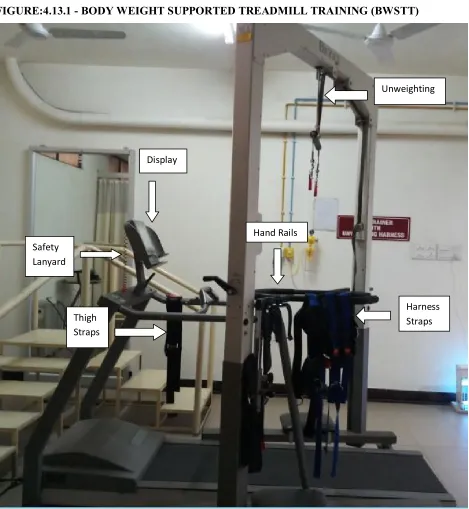
Body Weight Supported Treadmill Training is a training device for Simultaneous control of unweighting, posture and balance on a treadmill or firm surface. Systems providing Dynamic unweighting are a perfect solution for training patients in a wide range of gait disorders.
It helps to maintain proper posture, reduces load, eliminates balance problems and improves motor co-ordination training.
Unique Harness are designed for the uni or bilateral support of the body as well as gradual level change from fully loaded to fully unloaded.
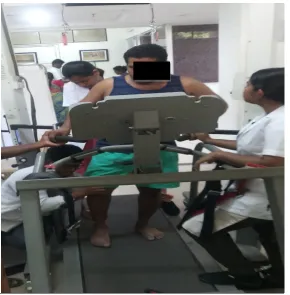
Locomotor Training using Body Weight Supported Treadmill Training allows the therapist to access the Trunk, Pelvis, and Lower Extremities to manually assist, guide, limb placement, weight shifts and stepping symmetry.
The Therapist provides manual resistance to Foot placement during stepping movement of weaker lower extremity and other person will stand behind the patient.
The Harness controls the upright position of the patient in the absence of good postural stability and reduces the fear of falling. The Harness is suspended from a metal frame (or) from the ceiling.
The Harness and Body Weight Treadmill provide the support and reduce the weight on your feet while walk on the treadmill. The Amount of support can be gradually increased (depends on the patients need).
4.13 PHOTOGRAPHIC ILLUSTRATION
FIGURE:4.13.1 - BODY WEIGHT SUPPORTED TREADMILL TRAINING (BWSTT)
Unweighting
Harness Straps Hand Rails
Safety Lanyard
Thigh Straps
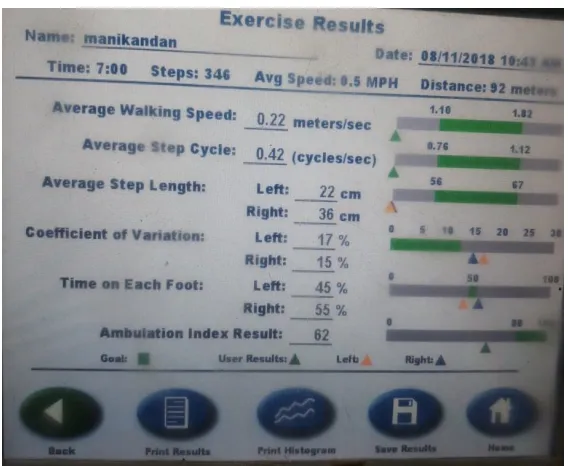
FIGURE: 4.13.2 FIGURE: 4.13.3
GAIT TRAINING MODE GAIT TRAINING SETUP INFORMATION
FIGURE 4.13.4 PATIENT ON TREADMILL TRAINING UNDER SUPERVISION OF PHYSIOTHERAPIST
Patients should be medically stable before starting an active program of physical therapy. Check the,
Blood Pressure and Circulation
Respiration
Mental Capacity for Cognition and Behaviour
Bowel / Bladder Control
Patient Considerations,
Breaks should be incorporated throughout the treatment session as needed.
Always attach the safety lanyard to the patients clothing or wrist before starting the exercises
TREADMILL TRAINING
Switch on the device and make the platform into flat position, and arrange the suspension frame in position.
Explain the procedure to the patient and demonstrate the gait over the gait trainer.
Fasten the pelvic harness to the patient raise the patient by increasing the frame height.
Adjust cross bar height with handle.(adjust length of safety strap as required)
Adjust Harness Straps as needed and connect patient to across bar.
Unweight the patient by turning handle, until stop indicator is centered .
{ Unweight the patient is depend upon the patient’s body weight. Initial Body weight will be 30% to 40% and Maximum we can unweight the patient’s body weight to till 70%
{ As the Treatment progressed, the body weight support was gradually decreased}
Select the training mode in the monitor and enter the patient details in to it .
Attach the emergency stop wire to the patient.
Start the training.
Set the Speed
{By the 1st Day – the speed limit will be 0.5 mph (miles per hour) and by the 3rd week the speed limit will be 1.5 to 2 mph and then gradually increased depends upon the patients.}
Assist the lower limbs, if the patient is weak to walk on the treadmill.
Ask the patient to see the monitor to get the feedback about the gait.
Instruct the patient to adjust the Step Length to get the good comment on the screen.
After training save the data in the computer and take print out for document record.
Switch off the device. Lower the patient and remove the harness and bring the patient to the chair.
Infection Control:
The Harness must be covered with towel to avoid contact with the patient.
New towel is used for every single patient.
Caution:
Do not leave patient unattended.
Inspect ropes, cables, fittings, and harness before use.
2. Conventional Exercise:
4.14 STATISTICAL TOOL
a) Independent‘t’ Test b) Paired‘t’ Test
4.14.1 INDEPENDENT‘t’ TEST (between groups)
=
( ) Where, =
∑ ∑
4.14.2 PAIRED‘t’ TEST (within groups)
t = √ Where, S = ∑ × S = Combined standard deviation
d1 & d2 = difference between initial and final readings in group A & B
n1 & n2= number of patients in group A & group B
5. DATA PRESENTATION
5.1 TABULAR PRESENTATION
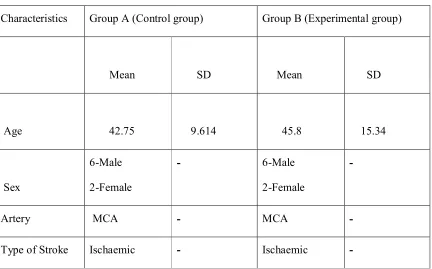
5.1.1 DEMOGRAPHIC DATA OF THE STUDY POPULATION
Characteristics Group A (Control group) Group B (Experimental group)
Mean SD Mean SD
Age 42.75 9.614 45.8 15.34
Sex
6-Male
2-Female
- 6-Male
2-Female
-
Artery MCA - MCA -
[image:42.612.93.525.166.435.2]Type of Stroke Ischaemic - Ischaemic -
5.1.2 Paired ‘t’ test values for variables of both Group A (control Group) and Group B (Experiment Group)
Outcome
Measures Group
Pre &
post test Mean±SD
Calculated ‘t’value Table ‘t’value Level of significance
Fugl meyer assessment-(FMA-LE)
Group-A Pre-test 26.12±2.0
5.535 2.365 P<0.05
Post-test 30.25±0.9
Group-B Pre-test 24.25±1.8
6.977 2.365 P<0.05
Post-test 28.62±0.6
Berg Balance Scale (BBS)
Group-A Pre-test 32.75±3.2
10.02 2.365 P<0.05
Post-test 43.25±2.2
Group-B Pre-test 34.12±1.6
11.31 2.365 P<0.05
Post-test 44.62±2.1
Functional ambulation category (FAC)
Group-A Pre-test 2±0
0 2.365 P>0.05 Post-test 3±0
Group-B Pre-test 1.75±0.4
7.629 2.365 P<0.05
Post-test 3±0
Activities specific balance confidence scale (ABC)
Group-A Pre-test 0.381±0.07
3.146 2.365 P<0.05
Post-test 0.775±0.07
Group-B Pre-test 0.356±0.03
12.08 2.365 P<0.05
Post-test 0.668±0.08
Step length Group-A Pre-test 0.426±0.17
2.677 2.365 P<0.05
Post-test 0.683±0.13
Group-B Pre-test 0.273±0.06
9.85 2.365 P<0.05
Post-test 0.772±0.12
Stride length Group-A Pre-test 0.567±0.04
5.458 2.365 P<0.05
Post-test 0.987±0.12
Group-B Pre-test 0.636±0.08
2.02 2.365 P>0.05 Post-test 1.092±0.11
Cadence Group-A Pre-test 55.75±7.4
32.6
2.365 P<0.05
Post-test 94±8
Post-test 32.62±9.6 13.42 2.365 P<0.05
( Paired ‘t’ test values - [p > 0.05 = Not Significant; p <0.05 = Significant])
5.1.3 Independent ‘t’ test values for variables of Both Groups
Outcome Measures
Group Mean±SD Calculated ‘t’value
Table ‘t’value
Level of significance
Fugl meyer assessment-(FMA-LE)
Group-A 30.25±0.97
3.6 2.145 P<0.05
Group-B 28.62±0.7
Berg balance scale (BBS)
Group-A 43.25±2.2
1.164 2.145 P>0.05 Group-B 44.62±2.1
Functional ambulation category (FAC)
Group-A 3±0
0 2.145 P>0.05 Group-B 3±0
Activities
specific balance confidence scale (ABC)
Group-A 0.77±0.07
4.862 2.145 P<0.05
Group-B 0.66±0.09
Step length
Group-A 0.68±0.14
1.8 2.145 P>0.05 Group-B 0.77±0.07
Stride length Group-A 0.98±0.12
1.604 2.145 P>0.05 Group-B 1.09±0.11
Cadence Group-A 94±8
5.062 2.145 P<0.05
Group-B 91±9.6
5.2 GRAPHICAL REPRESENTATION
5.2.1 Fugl Meyer Assessment of Physical Performance (FMA-LE) Scores : Group A & Group B
Graph 5.2.1 : Mean Value Changes in Fugl Meyer Assessment of Physical Performance (FMA-LE) Scores For Both Group A (Experimental) And Group B (Control)
5.2.2. Berg Balance Scale (BBS) Scores : Group A & Group B
Graph 5.2.2 : Mean Value Changes in Berg Balance Scale (BBS) Scores For Both Group A (Experimental) And Group B (Control)
5.2.3. FUNCTIONAL AMBULATION CATEGORY SCORES : GROUP A & GROUP B
Graph 5.2.3 : Mean Value Changes in Functional Ambulation Category (FAC) Scores For Both Group A (Experimental) And Group B (Control)
5.2.4. ACTIVITIES SPECIFIC BALANCE CONFIDENCE SCALE (ABC) SCORES : GROUP A & GROUP B
Graph 5.2.4 : Mean Value Changes in Activities Specific Balance Confidence Scale (ABC) Scores For Both Group A (Experimental) And Group B (Control)
5.2.5. STEP LENGTH SCORES : GROUP A & GROUP B
Graph 5.2.5 : Mean Value Changes in Step Length Scores For Both Group A (Experimental) And Group B (Control)
5.2.6. STRIDE LENGTH SCORES : GROUP A & GROUP B
Graph 5.2.6 : Mean Value Changes in Stride Length Scores For Both Group A (Experimental) And Group B (Control)
5.2.7. CADENCE SCORES : GROUP A & GROUP B
Graph 5.2.7 : Mean Value Changes in Cadence Scores For Both Group A (Experimental) And Group B (Control)
91
94
89.5 90 90.5 91 91.5 92 92.5 93 93.5 94 94.5
Group-A Group-B
6. RESULTS AND DATA ANALYSIS
(GROUP A – Control Group, GROUP B – Experimental Group)
6.1 INDEPENDENT ‘t’ TEST
6.1.1 : Fugl Meyer Assessment of Physical Performance
For 14 degrees of freedom and at 5% level of significance, the table ‘t’ value is 2.145 and the calculated ‘t value is 3.6. Since the calculated value is greater than the table ‘t’ value . Null hypothesis is rejected and the alternate hypothesis is accepted. (H0 - There is a significant difference exists between the Post test mean values of Fugl Meyer Assessment of Physical Performance Score between Group A and Group B).
6.1.2 : Berg Balance Scale
For 14 degrees of freedom and at 5% level of significance, the table ‘t’ value is 2.145 and the calculated ‘t value is 1.164. Since the calculated value is less than the table ‘t’ value. Null hypothesis is accepted and alternate hypothesis isrejected. (Ho – There is a no significant difference exists between the Post test mean values of Berg Balance Score between Group A and Group B).
6.1.3 : Functional Ambulation Category
For 14 degrees of freedom and at 5% level of significance, the table ‘t’ value is 2.145 and the calculated ‘t value is 0. Since the calculated value is less than the table ‘t’ value . Null hypothesis is accepted and the alternate hypothesis is rejected. (H0 - There is no significant difference exists between the Pretest mean values of Functional Ambulation Category Score between Group A and Group B).
6.1.4 : Acitivites Specific Balance Confidence Scale
For 14 degrees of freedom and at 5% level of significance, the table ‘t’ value is 2.145 and the calculated ‘t value is 4.862. Since the calculated value is greater than the table ‘t’ value. Null hypothesis is rejected and the alternate hypothesis is accepted. (H0 - There is a significant difference exists between the Post test mean values of Acitivity Specific Balance Confidence Scale Score between Group A and Group B).
For 14 degrees of freedom and at 5% level of significance, the table ‘t’ value is 2.145 and the calculated ‘t value is 1.8. Since the calculated value is less than the table ‘t’ value . Null hypothesis is accepted and the alternate hypothesis is rejected. (H0 - There is no significant difference exists between the Post test mean values of step length Score between Group A and Group B).
6.1.6 : Stride Length
For 14 degrees of freedom and at 5% level of significance, the table ‘t’ value is 2.145 and the calculated ‘t value is 1.604. Since the calculated value is less than the table ‘t’ value. Null hypothesis is accepted and the alternate hypothesis is rejected. (H0 - There is no significant difference exists between the Post test mean values of Stride length Score between Group A and Group B).
6.1.7 : Cadence
For 14 degrees of freedom and at 5% level of significance, the table ‘t’ value is 2.145 and the calculated ‘t value is 5.062. Since the calculated value is greater than the table ‘t’ value. Null hypothesis is rejected and alternate hypothesis is accepted. (Ho – There is a significant difference exists between the Post test mean values of cadence Score between Group A and Group B).
6.2 PAIRED ‘t’ TEST
6.2.1 Fugl Meyer Assessment of Physical Performance Group A
For 7 degrees of freedom and at 5% level of significance, the table ‘t’ value is 2.365 and the calculated ‘t value is 5.535. Since the calculated value is greater than the table ‘t’ value . Null hypothesis is rejected and the alternate hypothesis is acepted (H0 - There is a significant difference exists between the Pretest and post test mean values of Fugl Meyer Assessment of Physical Performance Score)
Group B
significant difference exists between the Pretest and post test mean values of Fugl Meyer Assessment of Physical Performance Score)
6.2.2Berg Balance Scale Group A
For 7 degrees of freedom and at 5% level of significance, the table ‘t’ value is 2.365 and the calculated ‘t value is 10.02. Since the calculated value is greater than the table ‘t’ value . Null hypothesis is rejected and the alternate hypothesis is accepted (H0 - There is a significant difference exists between the Pretest and posttest mean values of Berg Balance Score)
Group B
For 7 degrees of freedom and at 5% level of significance, the table ‘t’ value is 2.365 and the calculated ‘t value is 11.31. Since the calculated value is greater than the table ‘t’ value . Null hypothesis is rejected and the alternate hypothesis is accepted (H0 - There is a significant difference exists between the Pretest and posttest mean values of Berg Balance Score)
6.2.3Functional Ambulation Category Group A
For 7 degrees of freedom and at 5% level of significance, the table ‘t’ value is 2.365 and the calculated ‘t value is 0. Since the calculated value is less than the table ‘t’ value . Null hypothesis is accepted and the alternate hypothesis is rejected (H0 - There is a no significant difference exists between the Pretest and posttest mean values of Functional Ambulation Score)
Group B
6.2.4 Acitivity Specific Balance Confidence Scale Group A
For 7 degrees of freedom and at 5% level of significance, the table ‘t’ value is 2.365 and the calculated ‘t value is 3.146. Since the calculated value is greater than the table ‘t’ value . Null hypothesis is rejected and the alternate hypothesis is accepted (H0 - There is a significant difference exists between the Pretest and post test mean values of Acitivity Specific Balance Confidence Scale Score)
Group B
For 7 degrees of freedom and at 5% level of significance, the table ‘t’ value is 2.365 and the calculated ‘t value is 12.08. Since the calculated value is greater than the table ‘t’ value . Null hypothesis is rejected and the alternate hypothesis is accepted (H0 - There is a significant difference exists between the Pretest and post test mean values of Acitivity Specific Balance Confidence Scale Score)
6.2.5Step Length
Group A
For 7 degrees of freedom and at 5% level of significance, the table ‘t’ value is 2.365 and the calculated ‘t value is 2.677. Since the calculated value is greater than the table ‘t’ value . Null hypothesis is rejected and the alternate hypothesis is accepted (H0 - There is a significant difference exists between the Pretest and post test mean step length Score)
Group B
For 7 degrees of freedom and at 5% level of significance, the table ‘t’ value is 2.365 and the calculated ‘t value is 9.85. Since the calculated value is greater than the table ‘t’ value . Null hypothesis is rejected and the alternate hypothesis is accepted (H0 - There is a significant difference exists between the Pretest and post test mean value of step length)
6.2.6 Stride Length Group A
Group B
For 7 degrees of freedom and at 5% level of significance, the table ‘t’ value is 2.365 and the calculated ‘t value is 2.02. Since the calculated value is less than the table ‘t’ value . Null hypothesis is accepted and the alternate hypothesis is rejected (H0 - There is no significant difference exists between the Pretest and posttest mean values of Stride Length)
6.2.7 cadence Group A
For 7 degrees of freedom and at 5% level of significance, the table ‘t’ value is 2.365 and the calculated ‘t value is 32.6. Since the calculated value is greater than the table ‘t’ value . Null hypothesis is rejected and the alternate hypothesis is accepted (H0 - There is a significant difference exists between the Pretest and post test mean value of cadence)
Group B
7. DISCUSSION
Stroke is a disabling condition which requires immediate medical response as well as rehabilitation. Rehabilitation initiated as early as possible is found to be more effective(1) The improvements are seen maximum within the first 30 days which tapers off over 6 months. Gait training initiated as early as possible will help the patient attain a significant functional improvement in standing as well as for ambulation(5)
Currenly, Gait Rehabilitation of the Acute stroke patients are based on task – specific guidelines, with the patients practicing on the treadmill for increasing the repetition. Patients in both groups showed changes in their gait performance and also on other motor functions considerably during the study period. This study is consistent with finding from similar studies(4)
In this study, Treadmill Training began early with routine rehabilitation. It had been demonstrated that earlier gait recovery after stroke is associated with further gait independence and that , the task specific interventions are applied early and intensively may be the most effective
In this Study, sensorimotor recovery was assessed by using- the Fugl – Meyer sensorimotor Assessment of Physical Performance (FMA-LE). This study showed that there was significant difference exists between the Post test mean values of Group A(Control Group) and Group B(Experiment Group).
In this Study, Balance was assessed by using Berg Balance Scale. This study showed that “There was no statistical significant difference between the post test mean values of Group A(Control Group) and Group B(Experiment Group).
Karen et al., discussed that, at the time of discharge, based on the observational gait analysis, the subject walked with a consistent step- through pattern as well as comparable step length and stance time bilaterally. Over all there is a improvement in Berg Balance Scale(4)
The Body Weight Supported Treadmill Training after acute stroke, Ambulation was assessed by using Functional Ambulation Category. This study showed that there is no significant difference exists between the Post test mean values of Group A(Control Group) and Group B(Experiment Group).
C.Werner et al., discussed that, the improvement of Gait ability (median FAC gain from 1 to 4 in group A and from 1 to 3 in group B) during the 6-week intervention period were compared with the results of other groups studying treadmill training. Overall there is a improvement in Functional Ambulation Category(19)
In this study, confidence level was assessed by using Activity Specific Balance Confidence Scale. This study showed that there was significant difference exists between the Post test mean values of Group A(Control Group) and Group B(Experiment Group).
In this Study, the Gait Parameters ( Step Length, Stride Length, Cadence) showed that there is a significant changed in both the groups. There was a practical difficulty in assessing the walking speed during the early phase of stroke.
The Results of this study showed that, treadmill training with body weight support are not more likely to improve their ability to walk independently compared with people after stroke not receiving treadmill training. But Motor Function, Confidence level and spatiotemporal parameters (Cadence) is improved with 3 weeks of Treadmill Training.
This study have got lack of significant difference. It could be due to the small sample size which lacks the power to detect small difference or the short three week intervention period which was not sufficient long to produce further changes.
So, this study suggested that improvements in motor function, balance & gait achieved during Body Weight Supported Treadmill Training can be continued and trains to full weight over ground walking after a training procedure. Ultimately this will be more useful to increase the confidence level and better balance and gait. One of the major use of Body Weight supported Treadmill Training (BWSTT) is to provide the ‘Task Specific Gait Training’ during the early days of rehabilitation as needed by the patients.
Summary and
8. SUMMARY AND CONCLUSION
LIMITATIONS AND
9. LIMITATIONS & SUGGESTIONS
9.1 LIMITATIONS
As only small sample size is included in this study, the results cannot be generalized.
As many patients get discharged during the early stage of rehabilitation, there was difficulty in conducting the study.
Adherence of patients to regular Body Weight Supported Treadmill Training had practical difficulty.
9.2 SUGGESTIONS
Follow-up studies can be done to analyze the sustenance of effects.
A future study with greater sample size is recommended
Other factors which influence the Specific gait parameters of patients can also be analyzed in future research.
This study can be extended to the population of stroke patients in whom other territories are involved.
Further research should specifically investigate the effects of different frequencies, durations or intensities of treadmill training, as well as the use of handrails, in ambulatory patients, but not in dependent walkers.
Observational Gait Analysis with Video recording or Quantifiable gait analysis can also be analyzed in future study
9. REFERENCES
1. Royal college of physician London,Introduction 2015
2. Kamalakannan.S Incidence and prevalence of stroke in India, Indian Journal of Medical research, Pub med 2017, 146,175-185
3. Langhorne P, Coupar F, Pollock A. Motor recovery after stroke: a systematic review. Lancet Neurol. 2009; 8: 741–54
4. Karen et al., (2007) 54 – “ Locomotor Treadmill Training with Body Weight Support Prior to Over – Ground Gait : Promoting Symmetrical Gait in a Subject with Acute Stroke – Case Study”
5. Muhammad Aad Usllah et al., (2017) – The Effect of Gait Training with bdy weight supported with no body weight supported in stroke patients.
6. Pamela W Duncan et al., (2011) – Body Weight Supported Treadmill after Stroke
7. O’Sullivan SB, Schmitz TJ. Physical Rehabilitation. 6th ed. Philadelphia: F.A. Davis Company; 2014
8. Catherine M Dean et al., (2010) – Treadmill Training with Body weight support in subacute non – ambulatory stroke improves walking capacity more than overground walking capacity more than overground walking – A Randomized Trail
9. Yu – Rang Mao et.al., (2015) - “The Effect of Body Weight Support Treadmill Training on Gait Recovery, Proximal Lower Limb Motor Pattern, and Balance in patients with Subacute Stroke”
10.Martha Visintin et al., (1998) – A New Approach to retrain gait in stroke patients through Bdy Weight Supported and Treadmill Stimulation
11.Duyans, J., and H.W. Van De Crommert., 1998- ‘Neural control of locomotion : The central Pattern Generator from cats to humans.”
12.Kandel, E.R. et al., 2000 – Principes of neural science. New York, McGraw-hill, Health professions divisions.
13.Grillner, S. El al., 2008- “Neural bases of goal-directed ocomotion in vertebrates – An overview. “ brain research reviews 57(1):2-12
14.Mackay-Lyons, M. 2002. “ Cental Pattern Generation for locomotion : A review of the evidence :.”Physical therapy 82(10)’
16.Mosseley AM,Stark A, Cameron D, - Treadmill Training and Body Weight Support for walking after stroke”.”Cochrane Database Syst Rev(4): CD002840
17.Da Cunha Jr, et,al.,(2002) “Gait Outcomes After Acute Stroke Rehabilitation With Supported Treadmill Ambulation Training : A Randomize Controlled Pilot Study”
18.Karen J.McCain et al.,(2007)“ Locomotor Treadmill Training with Body Weight Support Prior to Over – Ground Gait : Promoting Symmetrical Gait in a Subject with Acute Stroke – Case Study”
19.Werner et.al., (2007) “Supported Treadmill Training to establish walking in non-ambulatory patients early after stroke – A Prospective Randomized Control”
20.Yu – Rang Mao et.al., (2015) “The Effect of Body Weight Support Treadmill Training on Gait Recovery, Proximal Lower Limb Motor Pattern, and Balance in patients with Subacute Stroke”
21.Gillian D Baee et.al., (2017)“Treadmill Training to Improve Mobility for People with subacute stroke” – A phase 2 feasibility Randomized Control Trial
22.Mehrholz J et.al ., (2017)“Treadmill Training and Body Weight Support for Walking after Stroke"
23.Mehrholz J,Pohl M, et al., ( Cochrane Database Syst Rev, 2014) “Treadmill Training and Body Weight Support for Walking after Stroke (Review) – Systemic Review”
24.Heesoo Kim et.al.,(2012) “Reliability, concurrent validity and Responsiveness of the Fugl Meyer Assessment for Hemiplegic Patient’
25.C.A.Lima et al.,(2018) “The Berg Balance Scale as a clinical screening tool to predict fall risk in older adults : a systematic review
26.Chang Sik Park et.al., (2016) “Reliability and Validity of the Modified Ambulation Category Scales in patients with hemiparalysis"
27.You SH, et al. Virtual Reality - Induced Cortical Reorganization and Associated Locomotor Recovery in Chronic Stroke: An Experimenter-Blind Randomized Study.
Stroke. 2005;36:1166-1171
28.French B, et al. Does Repetitive Task Training Improve Functional Activity After Stroke? A Cochrane Systematic Review and Meta-Analysis. J Rehabil Med. 2010; 42: 9–15
30.Howe TE, Taylor I, Finn P, Jones H. Lateral weight transference exercises following acute stroke: a preliminary study of clinical effectiveness. Clinical Rehabilitation. 2005; 19: 45-53
31.Duncan PW, Goldstein LB, Horner RD, Landsman PB, Samsa GP, Matchar DB. Similar motor recovery of upper and lower extremities after stroke. Stroke.
1994;25:1181-1188
APPENDIX -I
APPENDIX – II
INFORMED CONSENT FORM
I _______________________ , consent the researcher for my voluntary participation
in the study, “ THE EFFECT OF BODY WEIGHT SUPPORTED TREADMILL
TRAINING (BWSTT) ON SENSORIMOTOR FUNCTION, BALANCE AND GAIT AMONG PATIENTS WITH ACUTE MIDDLE CEREBRAL ARTERY STROKE”.The Researcher has explained me about the treatment approach in brief and the risk of
participation and has answered the questions related to the research to my satisfaction.
SIGNATURE OF PARTICIPANT :
SIGNATURE OF RESEARCHER :
SIGNATURE OF WITNESS :
APPENDIX III
DATA PERFORMA
Name :
Age/Sex :
RegNo :
D.O.Adm :
D.O.Ass :
Pathology : Isch/hem
Affected Side : R/L
Outcome Measure’s:
Scale’s Pre Test Post Test
MMSE Fugl Meyer (LL)
Berg Balance Scale
Functional Ambulation Category (FAC) Activity Specific Balance
Confidence Scale(ABC) Gait : Step Length
Stride Length Cadence
Group : Duration of Treatment :
APPENDIX IV
APPENDIX IV
APPENDIX V