Journal of Pain Research
Dove
press
O R I G I N A L R E S E A R C H open access to scientific and medical research
Open Access Full Text Article
Development and validation of an
Arabic-language headache questionnaire
for population-based surveys
Naglaa A El-Sherbiny1
Hatem Samir Shehata2
Hanan Amer2
Alaa Elmazny2
Mohamed Masoud1
Hanan Helmy2
Nevin M Shalaby2
1Faculty of Medicine, Fayoum
University, Faiyum, Egypt; 2Faculty
of Medicine, Cairo University, Cairo, Egypt
Background: The reported prevalence of headache disorders in Arab regions varies
consid-erably between countries. This may be due to a lack of standardized survey instruments that capture the prevalence.
Purpose of the study: Our goal was to construct and validate a structured headache
question-naire for Arabic-speaking headache patients to be used as an epidemiological survey instrument.
Methods: We developed a culturally adapted interviewer-administered questionnaire in Arabic
language comprising two sets of questions. The first set included personal and sociodemographic data together with a screening question regarding the presence of headaches over the last year. The second set was designed to define the type and pattern of headaches according to the International Classification of Headache Disorders criteria (for subjects with “yes” answers on the screening question). Validation process took place in two phases through probability random sampling
selected from 1,221 headache subjects collected in an epidemiological survey 3 (n=70) and
6 months (n=232) later. A detailed assessment of patients’ headaches was performed by neurolo-gists (blinded from the questionnaire diagnosis) who clinically assessed the patients’ headache.
Results: The validity of the questionnaire was tested in 232 subjects with a mean age of
41.2±10.9 years, 72.8% of whom were females. The mean time to complete the questionnaire
was 8.4±1.7 minutes. The intraclass correlation coefficient was 0.903 (95% confidence interval:
0.875–0.925), the Cronbach κ coefficient was 0.775 (95% confidence interval: 0.682–0.837),
and the percentage of agreement was 84.5%.
Conclusion: Our results support the use of this comprehensive questionnaire as a valid tool
for headache assessment among Arabic-speaking patients.
Keywords: Arabic, Egypt, headache, questionnaire, validation
Introduction
Headache disorders are rated among the ten most disabling conditions worldwide.1
Headaches impose a recognizable social and economic burden on individual sufferers and society, as they are one of the prime causes of reduced productivity in working adult patients.2 However, headache is still underdiagnosed and undertreated in
develop-ing countries.3 In Arab countries, and particularly Egypt, the most populous country
in the Middle East, there are several challenges that affect proper headache manage-ment, including insufficient patients’ education, underestimating the significance of “headaches” by family members, and the availability of analgesics as over-the-counter self-medications without access to prescription drugs.4,5
Other principal barriers responsible for poor headache care include: the paucity of large-scale epidemiological studies in Arab countries, limited funding, large and often Correspondence:Hatem Samir Shehata
Faculty of Medicine, Cairo University, 23 Amin Samy Street, off Kasr Alaini, Cairo 11562 Egypt
Tel +20 112 444 4179
Email [email protected]
Journal name: Journal of Pain Research Article Designation: ORIGINAL RESEARCH Year: 2017
Volume: 10
Running head verso: El-Sherbiny et al
Running head recto: Validation of Arabic-language headache questionnaire DOI: http://dx.doi.org/10.2147/JPR.S137795
Journal of Pain Research downloaded from https://www.dovepress.com/ by 118.70.13.36 on 24-Aug-2020
For personal use only.
This article was published in the following Dove Press journal: Journal of Pain Research
26 May 2017
Dovepress
El-Sherbiny et al
rural (less accessible) populations, and the low profile of headache disorders compared with communicable diseases; all these prevent the systematic collection of information.5,6
Furthermore, the results of the available cohorts are hetero-geneous, with divergent prevalence rates that varied from 8% in Saudi Arabia7 to as high as 83.6% in Oman.8 These
conflicting results are likely multifactorial, which are not only related to the differences in methodologies and tools employed for headache assessment in different studies but also are due to defects in good quality data9 and lack of
stan-dardized headache survey instruments for Arabic-speaking patients, which results in striking differences even with similar methodological designs.6
All this indicates a clear need for a culturally appropriate headache assessment tool based on the International Head-ache Society criteria to allow for comparable population-based studies of the prevalence and burden of headache disorders in Arab countries. However, in the process of developing a culturally neutral questionnaire, literal transla-tion, word meanings and methods of administration should be linked to the diversity of societal norms and local realities among Arab regions.
Our goal was to develop a validated, interviewer- administered structured headache questionnaire in Arabic to be used for epidemiological surveys to assess the prevalence of primary headaches in Egypt.
Methods
Questionnaire development
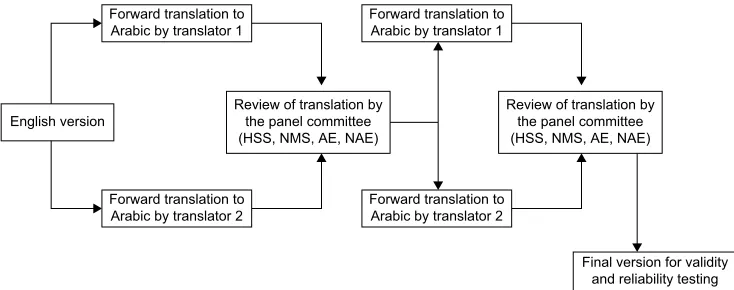
An interviewer-administered structured questionnaire was developed after a review of the literature and was prepared in English by the authors HSS and NMS. It was then translated into Arabic and then back-translated to verify that the origi-nal meaning had not been lost; this was done according to a standardized protocol (Figure 1) adopted from Shaik et al.10
Translation and back-translation was carried out by two separate expert staff members from the English Department at Cairo University; they were fluent in both English and Arabic and were “blinded” to the source language version. A special panel (HSS, NMS, AE, and NAE) reviewed the forward- and back-translated versions to produce the final draft. The final survey document had a clear and concise title and an introduction explaining the purpose of the question-naire together with clear instructions on how to complete it. It was organized into two sections; the first section included relevant personal and sociodemographic data (age, gender, education, marital status, occupation, and location of resi-dence); history of medication use (oral contraceptive use, analgesic medications, and other drugs); and other related medical history (smoking, hypertension, diabetes, and other relevant clinical disorders).
The assessment of medical history began as recom-mended by previous studies,11 with a screening question
about headaches in the last year (1-year prevalence), “Have you had headache during the last year not related to flu, cold, or head injury?” The second part of the questionnaire was completed by subjects who responded “yes” in the screen-ing questionnaire. It included questions designed to define the nature of the headaches and to assess patterns of the headaches according to the International Classification of Headache Disorders (ICHD-IIIb).12
Types of questions
Four types of questions were used: binary questions (eg, yes/ no or male/female); specific questions that do not specify options (eg, How old are you?); multiple choice questions (in which the options were mutually exclusive and covered all possible answers); and scaling questions (eg, on a visual analog scale).13 Examples of questions types are presented in
the questionnaire sample (Supplementary material).
Figure 1 The forward- and back-translation process of the questionnaire.
English version Review of translation bythe panel committee (HSS, NMS, AE, NAE)
Review of translation by the panel committee (HSS, NMS, AE, NAE)
Forward translation to Arabic by translator 2 Forward translation to
Arabic by translator 1 Forward translation toArabic by translator 1
Forward translation to Arabic by translator 2
Final version for validity and reliability testing
Journal of Pain Research downloaded from https://www.dovepress.com/ by 118.70.13.36 on 24-Aug-2020
Dovepress Validation of Arabic-language headache questionnaire
Wording of the questions
Simple and precise language was used, and abbreviations and undefined terms were avoided. For the newly developed questions, all efforts were made to keep questions direct, brief, and clear. The questions were assessed using the Flesch reading ease score, which identifies the number of words in sentences and the number of syllables in words, and then develops a readability formula (using the follow-ing link): http://www.readabilityformulas.com/freetests/ six-readability-formulas.php. The Flesch reading ease score for the final form of the questionnaire was 73.2 (indicating that it was fairly easy-to-read).14
Training of interviewers
The initial interviewer training was done as a part of an epidemiological study5 in Fayoum Governorate, a
devel-oping city in Middle Egypt.15 This was followed by three
consecutive sessions for recruitment and training of the physician interviewers. They received training sessions (from two neurologists, HSS and NMS) that consisted of 1) background information about headache diagnosis, types, and the art of history-taking, 2) skill-based training to reduce the errors related to subjectivity, 3) tips on introducing the research topic to the patients, and 4) methods to apply the questionnaire to capture all data and receive frank answers. The last part consisted of watching five videos of real head-ache patient interviews and interactive role play. Finally, the physician interviewers were instructed about maintaining confidentiality, presenting the questions clearly and exactly as written in a respectful manner, and remaining neutral as the answers were given.
Pilot surveys
A pilot study of the preliminary version of the questionnaire was carried out with 30 adult subjects in both rural and urban areas: 60% were female; mean age was 43.6 years (range 18–78). This was done to verify adequate simplicity, preci-sion, acceptance, and appropriateness for the participants’ educational level and to minimize leading or confusing ques-tions. Final modifications were done based on the response of such pilot survey.
Validation of the questionnaire
The final version of the questionnaire was constructed in two phases. During Phase I, two of the authors (neurologists HSS and NMS) performed three field visits to a randomly selected subsample of 70 subjects (from a total of 1,221) to evaluate the diagnoses of their headaches. Randomization
was done using a computer-designed method by one of the interviewers (NME). The investigators were blinded to the subjects’ questionnaire responses, and they used ICHD-IIIb criteria12 to make their diagnoses. This validity testing
was done within 3 months of the completion of the initial questionnaire, and all 70 subjects participated. Phase II was carried out 6 months after the finish of the epidemiological study and was done in a random sample of 250 of the 1,221 subjects who had a detailed assessment of their headaches by the same two neurologists who, again, were blinded to the questionnaire data. Eighteen headache subjects did not appear for the interview (a dropout rate of 7.2%) and were, therefore, excluded from the current analysis.
Ethical considerations
This study was designed according to the recommendations of the International Headache Society and was approved by the Review Board of the Neurology Department, Cairo Uni-versity. Informed consent was obtained from all the subjects. For illiterate subjects, the interviewers read the consent form about the objectives of the study and the confidentiality of the information so as to obtain verbal consent.
Statistical analyses
Data were collected, coded, and analyzed using the Sta-tistical Package for Social Sciences (SPSS) version 24.0 (IBM Corporation, Armonk, NY, USA). Continuous data were expressed as mean and SD, and categorical data were expressed as frequencies and percentages.
Test–retest reliability and construct
validity
The test–retest reliability was quantified using the intraclass correlation coefficient (ICC) of absolute agreement, and Cronbach’s α coefficient was calculated to assess internal consistency.16 ICCs were classified as follows: “excellent”
(≥0.81), “good” (0.61–0.80), “moderate” (0.41–0.60), and “poor” (≤0.40).17 The percentage agreement was calculated
with criteria established as “excellent” (90%–100%), “good” (75%–89%), “moderate” (60%–74%), or “poor” (<60%).18
Results
Participant characteristics
Of the 250 subjects were invited to participate, 18 (7.2%) refused, and the validity of the questionnaire was, therefore, assessed in 232 subjects. The mean age was 41.2±10.9 years, and the sample included 169 (72.8%) females. None of the participants had any difficulties understanding or answering
Journal of Pain Research downloaded from https://www.dovepress.com/ by 118.70.13.36 on 24-Aug-2020
Dovepress
El-Sherbiny et al
any part of the questionnaire. The subjects’ characteristics are shown in Table 1.
Acceptability and word precision
None of our subjects reported difficulty in understanding the questionnaire at the time of completion. The mean time to complete the questionnaire was 8.4±1.7 minutes.
Strength of agreement
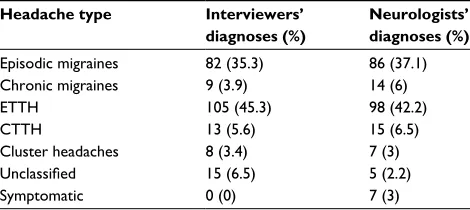
The questionnaire diagnosed migraines in 82 subjects, chronic migraine in 9 subjects, episodic tension-type headache (ETTH) in 105 subjects, chronic tension-type headache (CTTH) in 13 subjects, and cluster headache in 8 subjects. The neurologists were able to diagnose symptomatic headaches in 7 subjects (3%): 2 had errors of refraction, 2 had chronic sinusitis, 1 had marked anemia (hemoglobin
~ 5.7 g%), and 2 had myofascial pain and temporomandibular joint dysfunction. The difference between the interviewers’ diagnoses and neurologists’ diagnoses is shown in Table 2.
Validity and reliability
The results of blind reassessment of the randomly selected 232 headache participants are shown in Table 3; the ICC was 0.903 (95% CI: 0.875–0.925) “excellent”; the overall Cronbach’s κ coefficient was 0.775 (95% CI: 0.682–0.837); and the percentage of agreement was 84.5%.
Discussion
This study presented an interviewer-administered structured questionnaire in Arabic in an epidemiological survey to assess the prevalence of primary headaches in a sample of 232 Egyptians with headaches; 169 (72.8%) of them were females, which reflects the fact that primary headaches are more common than in women, as was recorded by several authorities.3,7–9 The study sample was randomly selected
from a community-based, cross-sectional survey designed to elucidate the prevalence of primary headache disorders in both urban and rural locations in Egypt.5
The interviewer administration of our questionnaire offered additional control over the quality of the measure-ment, and it is suitable to be applied to illiterate population, as 25.9% of general population in Egypt is illiterate.15
An ample interviewer training course was carried out to guarantee an effective interviewing strategy, and this helped us in achieving a higher response rate in the previous epide-miological study; it also contributed to a good concordance between the neurologists’ diagnoses and the developed headache questionnaire in the current study.5
We found that the ICC was 0.903 (95% CI: 0.875–0.925) ie, “excellent,” and the overall Cronbach’s κ coefficient was 0.775 (95% CI: 0.682–0.837), and percentage of agreement was 84.5%. Traditionally, clinical diagnosis is known to be more flexible compared to structured criteria used for case identification for research protocols. In clinical practice, some patients do not necessarily “fit” into any particular diagnostic category, and the majority may have a combina-tion of symptoms that need management regardless of their formal clinical labeling.19 The results of validity testing of the
questionnaire showed that it has high sensitivity compared to clinical diagnoses, with the highest sensitivity for episodic tension headaches (0.93) and the lowest for chronic migraine (0.71), with intermediate values for episodic migraine (0.86) and chronic tension-type headaches (0.79).
Our sensitivity results for episodic migraine are com-parable to a study that presented a computer-assisted tele-phone interviewing questionnaires for migraine, where a sensitivity of 81.5% and specificity of 91.3%, with 91.7% Table 1 Participants’ characteristics (n=232)
Age (years, mean ± SD) 41.2±10.9
Gender (Female), n (%) 169 (72.8)
Residence, n (%)
Rural 86 (37.1)
Urban 146 (62.9)
Education, n (%)
Illiterate 41 (17.7)
Primary education 39 (16.8)
Secondary education 78 (33.6)
Higher education 74 (31.9)
Marriage
Yes 124 (53.4)
No 108 (46.6)
Employment status
Employed 151 (65.1)
Unemployed 62 (26.7)
Student 19 (8.2)
Table 2 The difference between interviewers’ diagnoses and neurologists’ diagnoses
Headache type Interviewers’ diagnoses (%)
Neurologists’ diagnoses (%)
Episodic migraines 82 (35.3) 86 (37.1)
Chronic migraines 9 (3.9) 14 (6)
ETTH 105 (45.3) 98 (42.2)
CTTH 13 (5.6) 15 (6.5)
Cluster headaches 8 (3.4) 7 (3)
Unclassified 15 (6.5) 5 (2.2)
Symptomatic 0 (0) 7 (3)
Abbreviations: CTTH, chronic type headache; ETTH, episodic tension-type headache.
Journal of Pain Research downloaded from https://www.dovepress.com/ by 118.70.13.36 on 24-Aug-2020
Dovepress Validation of Arabic-language headache questionnaire
positive predictive value, were found.20 In another Spanish
cross- sectional, multicenter study that included 9,670 patients to validate Migraine Screen-Questionnaire, the achieved sensitivity was (0.82) and the specificity was (0.97).21
Nev-ertheless, both studies focused on migraine and did not aim to identify types of headaches or differentiate migraine sub-types (“episodic” and “chronic”). Sensitivity and specificity are usually higher when an instrument addressed migraine only. Lipton et al22 presented a 3-item screening
question-naire for migraine and achieved a sensitivity of (0.81) and a specificity of (0.75), with a κ coefficient of 0.68, whereas, in a more detailed migraine-specific questionnaire, Kallela et al23
obtained a sensitivity of (0.99) and a specificity of (0.96). The relatively low sensitivity for detection of chronic migraine by the current questionnaire demonstrated the difficulties in detecting this condition by a simple screening tool. Chronic migraine remains underdiagnosed and under-treated worldwide; in the Chronic Migraine Epidemiology and Outcomes study,24 only 13.6% of the subjects consulted
a specialist and even among those who were evaluated by an expert clinician, only 36% reported receiving a diagnosis of chronic migraine. Lipton et al25 developed and validated a
self-administered case-finding tool called “Identify Chronic Migraine (ID-CM),” which entailed an extensive, four-stage process with strong psychometric properties to help clinicians identify chronic migraine. The final 12-item ID-CM achieved a sensitivity of 80.6%, a specificity of 88.6%, a negative predictive value of 75.0%, and a positive predictive value of 91.5%. However, the sample used for this study was highly selected. Therefore, the results may not be fully generalizable to other settings.
In the current questionnaire, the sensitivity for ETTH was 0.93, but for CTTH it was 0.79. Several studies were conducted to develop and validate diagnostic questionnaires that could identify different headache types including TTH. In a Pakistani study,26 researchers validated an
interviewer-administered headache questionnaire developed by Lifting The Burden that had an overall κ value of 0.77 but was
relatively insensitive for TTH (0.6). Ayzenberg et al27 tested
the same questionnaire and reported the TTH as 64%. Rela-tively few other questionnaires for the diagnosis of TTH have been developed, but Rasmussen et al28 reported a sensitivity
of only 43% (albeit with 96% specificity). The investigators all agree that the difficulties arise from the lack of specific characteristics of TTH, making it difficult to design questions to easily diagnose it.
In our study, the sensitivity of chronic headaches was less than that of episodic types. It was reported that questionnaires cannot distinguish reliably between headache disorders char-acterized by headache on more days than not (eg, chronic migraine and CTTH), but can identify presumptive medica-tion overuse headache from the reported frequency and type of medication taken for the headache.26
The main strengths of this study are the fact that it is the first study to validate an interviewer-administered headache questionnaire in Arabic language among Egyptians in spite of the burden of the disease in our country’s population. Hence, the questionnaire can be used in population-based surveys. Another strength is the concern with literal transla-tions, word precision, meanings and how they are linked to the local realities and culture.29 The appropriateness of the
wording of the questions was assessed by the Flesch reading ease score, which assesses the number of words in sentences and the number syllables in words.13 Another strength of this
study is the nonsignificant differences between the diagnoses provided by nonspecialist physician interviewers and those made by the neurologists.
Possible limitations of our study protocol included pre-senting headache as a unidimensional disorder, which may explain the low sensitivity for detecting chronic migraine. Although unidimensional data are more understandable, easier to explain, and can maximize Cronbach’s α, yet, it can present an oversimplified paradigm for headache diagnosis and dismiss other contributors such as cervicogenic elements, temporomandibular joint disorders, or other neuralgias. In addition to that, an intense skill-based training program for the Table 3 Validity testing (sensitivity, specificity, positive predictive value, and negative predictive value, with 95% CI) from the randomly
selected headache subsample
Type of headache Sensitivity (95% CI)
Specificity (95% CI)
Positive predictive value (95% CI)
Negative predictive value (95% CI)
Episodic migraine 0.86 (0.78–0.97) 0.94 (0.86–0.98) 0.86 (0.69–0.98) 0.92 (0.87–0.99) Chronic migraine 0.71 (0.52–0.99) 0.98 (0.82–1.00) 0.78 (0.63–0.96) 0.96 (0.82–1.00)
ETTH 0.93 (0.79–0.98) 0.93 (0.86–1.00) 0.95 (0.85–1.00) 0.92 (0.82–0.99)
CTTH 0.79 (0.64–1.00) 0.96 (0.89–0.97) 0.85 (0.69–0.99) 0.98 (0.94–1.00)
Unclassified 0.66 (0.12–0.81) 0.97 (0.92–1.00) 0.67 (0.31–0.89) 0.97 (0.91–1.00)
Abbreviations: CTTH, chronic tension-type headache; ETTH, episodic tension-type headache.
Journal of Pain Research downloaded from https://www.dovepress.com/ by 118.70.13.36 on 24-Aug-2020
Dovepress
El-Sherbiny et al
interviewers is needed, including both theoretical and practical education in addition to interactive role playing models, which is a resource-dependent and time-consuming task.
Conclusion
Our study produced the first Arabic questionnaire for evalu-ation of headache symptoms to be used in populevalu-ation-based surveys in the Arab regions using standard methods for validity and reliability.
Disclosure
The authors report no conflicts of interest in this work.
References
1. Steiner TJ, Birbeck GL, Jensen RH, Katsarava Z, Stovner LJ, Martel-letti P. Headache disorders are third cause of disability worldwide. J Headache Pain. 2015;16(1):58.
2. Selekler HM, Gökmen G, Alvur TM, Steiner TJ. Productivity losses attributable to headache, and their attempted recovery, in a heavy-manufacturing workforce in Turkey: implications for employers and politicians. J Headache Pain. 2015;16:96.
3. Mateen FJ, Dua T, Steiner T, Saxena S. Headache disorders in developing countries: research over the past decade. Cephalalgia. 2008;28(11):1107–1114.
4. Kandil M, Hamed SA, Fadel KA, Youssef AH, Abd El Hamed MA, Mohamed KO. Epidemiology of tension-type headache (TTH) in Assuit Governorate, Egypt. J Neurol Neurosci. 2014;5(1):2.
5. El-Sherbiny NA, Masoud M, Shalaby NM, Shehata HS. Prevalence of primary headache disorders in Fayoum Governorate, Egypt. J Headache Pain. 2015;16:85.
6. Neurological disorders. Public Health Challenges. Geneva: World Health Organization; 2006.
7. Jabbar MA, Ogunniyi A. Sociodemographic factors and primary headache syndromes in a Saudi community. Neuroepidemiology. 1997;16:48–52.
8. Deleu D, Khan MA, Al Shehab TA. Prevalence and clinical charac-teristics of headache in a rural community in Oman. Headache. 2002; 42:963–973.
9. Benamer HT, Deleu D, Grosset D. Epidemiology of headache in Arab countries. J Headache Pain. 2010;11:1–3.
10. Shaik MM, Hassan NB, Tan HL, Bhaskar S, Gan SH. Validity and reliability of the Malay version of the Structured Migraine Interview (SMI) Questionnaire. J Headache Pain. 2015;16:22.
11. Mbewe E, Zairemthiama P, Yeh HH, Paul R, Birbeck GL, Steiner TJ. The epidemiology of primary headache disorders in Zambia: a population-based door-to-door survey. J Headache Pain. 2015;16:515.
12. Headache Classification Committee of the International Headache Society (IHS). The international classification of headache disorders, 3rd edition (beta version). Cephalalgia. 2013;33(9):629–808. 13. Leung WC. How to design a questionnaire. Student BMJ. 2001;9:
171–216.
14. Farr JN, Jenkins JJ, Paterson DG. Simplification of Flesch reading ease formula. J Appl Psychol. 1951;35:333–337.
15. CAPMAS. Central Agency for Public Mobilization and Statistics, Egypt in Figures (2015). Available from: http://www.sis.gov.eg/newvr/Egypt-inFigures2015/EgyptinFigures/pages/english%20Link.html. Accessed July 30, 2015.
16. Nunnally J, Bernstein I. Psychometric Theory. 3rd ed. New York, NY: McGraw-Hill; 1994.
17. Mcgraw KO, Wong SP. Forming inferences about some intraclass cor-relation coefficients. Psychological Methods. 1996;1:30–46. 18. Saelens BE, Frank LD, Auffrey C, Whitaker RC, Burdette HL,
Colabi-anchi N. Measuring physical environments of parks and playgrounds: EAPRS instrument development and inter-rater reliability. J Phys Activity Health. 2006;3:S190–S207.
19. Samaan Z, MacGregor EA, Andrew D, McGuffin P, Farmer A. Diag-nosing migraine in research and clinical settings: the validation of the Structured Migraine Interview (SMI). BMC Neurol. 2010;10:7. 20. Porta-Etessam J, Lopez-Gil A, Matias-Guiu J, Fernandez C. Validation of
a diagnostic questionnaire for migraine adapted for a computer assisted telephone interviewing. Neurologia. 2010;25(3):163–167.
21. Lainez MJ, Castillo J, Dominguez M, Palacios G, Diaz S, Rejas J. New uses of the Migraine Screen Questionnaire. (MS-Q): validation in the Primary Care setting and ability to detect hidden migraine. MS-Q in Primary Care. BMC Neurol. 2010;10:39.
22. Lipton RB, Dodick D, Sadovsky R, et al. A self-administered screener for migraine in primary care: the ID Migraine validation study. Neurol-ogy. 2003;61:375–382.
23. Kallela M, Wessman M, Farkkila M. Validation of a migraine-specific questionnaire for use in family studies. Eur J Neurol. 2001;8:61–66. 24. Adams AM, Serrano D, Buse DC, et al. The impact of chronic migraine:
The Chronic Migraine Epidemiology and Outcomes (CaMEO) Study methods and baseline results. Cephalalgia. 2015;35(7):563–578. 25. Lipton RB, Serrano D, Buse DC, et al. Improving the detection of
chronic migraine: development and validation of identify chronic migraine (ID-CM). Cephalalgia. 2016;36(3):203–215.
26. Herekar AD, Herekar AA, Ahmad A, et al. The burden of headache disorders in Pakistan: methodology of a population-based nationwide study, and questionnaire validation. J Headache Pain. 2013;14(1):73. 27. Ayzenberg I, Katsarava Z, Mathalikov R, et al. The burden of headache
in Russia: validation of the diagnostic questionnaire in a population-based sample. Eur J Neurol. 2011;18(3):454–459.
28. Rasmussen BK, Jensen R, Olesen J. Questionnaire versus clinical interview in the diagnosis of headache. Headache. 1991;31(5):290–295. 29. Harkness J. Questionnaire design in comparative research. In: Harkness JA, van de Vijver FJR, Mohler PPH, editors. Cross-Cultural Survey Methods. New York: John Wiley; 2003:19–34.
Journal of Pain Research downloaded from https://www.dovepress.com/ by 118.70.13.36 on 24-Aug-2020
Dovepress
Journal of Pain Research
Publish your work in this journal
Submit your manuscript here: https://www.dovepress.com/journal-of-pain-research-journal
The Journal of Pain Research is an international, peer reviewed, open access, online journal that welcomes laboratory and clinical findings in the fields of pain research and the prevention and management of pain. Original research, reviews, symposium reports, hypoth-esis formation and commentaries are all considered for publication.
The manuscript management system is completely online and includes a very quick and fair peer-review system, which is all easy to use. Visit http://www.dovepress.com/testimonials.php to read real quotes from published authors.
Dove
press
Validation of Arabic-language headache questionnaire
Supplementary material
A sample of the Arabic-language headache questionnaire for population-based surveys
in Egypt
ةيبرعلا رصم ةيروهمج يف يفصنلا عادصلا راشتنا يدم سايقل نايبتسا نم ةنيع
Interviewer name and signature (to be completed by the interviewer) ءاضملاا و نايبتسلاا مدقم مسا...
Please enter today’s date: مويلا خيرات:...
We are conducting a research on prevalence of headache in Egypt, and after obtaining your consent you will be requested to answer the questions asked by the interviewer
الآتية الأسئلة علي الاجابة الاستبيان مقدم منك سيطلب المعلومات نموذج علي موافقتك بعد و العربية مصر جمهورية في النصفي الصداع انتشار مدي لقياس بحث باجراء نقوم اننا
Participant identification: Initials, Number of ID (to be completed by the
interviewer)
مقرلا نم ماقرأ ٤ رخآو يعابرلا مسلاا نم يلولأا فرحلأا( ثحبلا يف كراشملا ةيوه يموقلا(... /... First part: personal, sociodemographic data ةيناكسلا( ةيفارغوميدلا-ةيعامتجلاا و ةيصخشلا تامولعملا :لولأا ءزجلا(
How old are you? ………. year ... ةنس ؟ كرمع مك
What is your gender? Male Female أنثي ذكر سنجلا( عونلا(
. . . . .
. . . . .
Screening question: Have you had headache during the last year not related
to flu, cold, or head injury?
Yes No لا نعم لا ةيضاملا ةنسلا للاخ عادص كيدل ناك له
؟سأرلاب ةباصا وأ دربلا تلازن وأ ازنولفنلااب هل ةقلاع
Second part (completed by subjects who responded “yes” in the screening questionnaire)
قباسلا لاؤسلا يف معنب باجأ يذلا كراشملل لمكتسي :يناثلا ءزجلا
. . . .
. . . .
Do you have the following symptoms during headache?
Nausea
Vomiting
Phonophobia
Photophobia
Conjunctival injection
Lacrimation
Eyelid edema
Ptosis
Facial sweating
Rhinorrhoea
وأ / ءيق ءيقلا يف ةبغر
يلاعلا توصلا لمحت ىلع ةردقلا مدع
يلاعلا رونلا لمحت ىلع ةردقلا مدع
نيعلاب ناقتحا
نفجلاب مروت
نفجلاب راسكنا
هجولاب قرعت
فنلأاب نلايس
؟ عادصلل ةبحاصم ضارعأ دجوت له
Scaling question: Visual Analog Scale for Headache severity
يرصبلا يرظانتلا سايقملا عادصلا ملأ ةدحل
Notes: We welcome the reader to inquire with the corresponding author for more details through the following e-mail ([email protected]).
Journal of Pain Research downloaded from https://www.dovepress.com/ by 118.70.13.36 on 24-Aug-2020