2093
Volume LXI 231 Number 7, 2013
http://dx.doi.org/10.11118/actaun201361072093
HUMAN RESOURCES MANAGEMENT WITHIN
THE PROCESS MANAGEMENT IN SMALL
AND MEDIUM-SIZED ENTERPRISES
Marie Duspivová, Růžena Krninská
Received: April 11, 2013
Abstract
DUSPIVOVÁ MARIE, KRNINSKÁ RŮŽENA: Human resources management within the process management in small and medium-sized enterprises. Acta Universitatis Agriculturae et Silviculturae Mendelianae Brunensis, 2013, LXI, No. 7, pp. 2093–2098
Sector of small and medium-sized enterprises is regarded as the backbone of the economy and a driving force of innovation, employment and social integration. Development of the sector of small and medium-sized enterprises in the Czech Republic has a substantial impact on economic and social development of the country and its various regions. This article deals with the human resources management in small and medium-sized enterprises, because it is more than obvious recently that the prosperity of the organization is depended on human resources and management of them can determine not only whether the organizations succeed, but whether it will be able to survive in turbulent conditions in the present world. The main aim of this paper is to analytical describe the monitoring the process of human resources management in selected categories of enterprises by business activity and number of employees including statistical analysis of causal eff ects. Further to analytical describe the evaluation the process of human resources management and indicators of this process, which are monitored by small and medium-sized enterprises. To achieve this aim were used selected primary data collected in the project GAJU 068/2010/S titled “Process management and its possible implementation in small and medium-sized enterprises”.
human resources management, process management, small and medium-sized enterprises
Small and medium-sized enterprises are the driving force of business, growth, innovation and competitiveness and are also a major employer in worldwide economy. According to Kotlárová (2011) the share of small and medium-sized enterprises in EU comprises over 99% of European companies and provides over 60% job vacancies. This fact is for Czech Republic confi rmed by the report about the development of small and medium enterprise, which shows that the share of small and medium-sized enterprises in the total number of active businesses was 99.84% in 2011. Employee´s contribution of small and medium-sized enterprises on total number of employees in Czech Republic created 60.85 % (Department of Industry and Trade, 2011).
In today’s global economy, which is constantly growing and evolving, it is no longer space for
businesses that still remain in the old and rigid structures and approaches. Modern enterprises must actively attempt for its development and open to their surroundings, fi nd the opportunities to change and not be afraid to use them to own advantage (Reinhardt, 1998). Absolutely necessary becomes the customer orientation, which ensures right setting up of the process management, which according to Burlton (2001), together with information, technology and human resources becomes assets of every organization. Enterprise can keep pace with the dynamic market trends thanks correctly conceived management within the organization, which is in agreement with the strategies (Adler, MandelBaum, Nguyen, Schwerer, 1995).
attention (Scarbrough, 2003).
The personnel work is in modern managing organizations the main interest of management and is being given special attention because of a person with his skills is a driving force of the company and the human work and work behaviour depends on how the organization will be successful and competitive (Schuler, 1992). Kotey, Slade (2005) mention that such should be primary in small and medium-sized enterprises, whose success and survival depends on good personnel work and capable, competent, contented and motivated work team much more than it is in large organizations.
METHODS AND RESOURCES
The main aim of this paper is to analytical describe the monitoring the process of human resources management in selected categories of enterprises by business activity and number of employees including statistical analysis of causal eff ects. Further to analytical describe the evaluation the process of human resources management and indicators of this process, which are monitored by small and medium-sized enterprises.
For this paper were used the collected data within the project GAJU 068/2010/S titled “Process management and its possible implementation in small and medium-sized enterprises”. 187 random chosen small and medium-sized enterprises of the South Bohemian region participated in the research. Basic characteristic and elements of process management were surveyed by structured questionnaire during September 2010 to April 2011. The questionnaire was supplemented by controlled interviews with managers or owners. Within the framework of this paper is to hold forth the process of human resources management, which monitor whole 94% of studied companies, including its evaluation managers and owners. The evaluation was carried out on a scale of 0–100%, where 0% signify no introduction of the process or absolute dissatisfaction with the process and 100% signify absolute satisfaction with the established process.
Research sample of small and medium-sized enterprises was divided for the purpose of this paper according to the business activities and the number of employees. For dividing according to the
Examined data were statistically processed and analyzed in MS Excel 2010 and Statistica 10. Relative and absolute frequency were analyzed and complemented by graphical analysis. Because of the data do not meet the parameters for the use of probabilistic statistical methods, there was the causal eff ect between monitoring the process of human resources management and the selected categories used nonparametric method Kruskal-Wallis test (H test criterion (degrees of freedom df, the number of observations N)). Data were analyzed for signifi cance level = 0.05, therefore the results are presented with 95% probability. Null hypothesis (H0: ˜x = ˜x) claims that between the monitoring process of human resources and entrepreneurial activity (or number of employees) there is no relationship, while the alternative hypothesis (HA: ˜x ≠ ˜x) expresses
that exists diff erence between samples, that there is some relationship. The validity of hypotheses has been drawn on the p-value. In case of rejection of the null hypothesis in favour of the alternative was to analyze the observed relationship used correlation coeffi cient r (−1 < r >1).
RESULTS AND DISCUSSION
The defi nition of small and medium-sized enterprise is based on the Commission Regulation No. 800/2008. This paper deals with the one of the basic criterion for assessing the size of the enterprise concretely the number of employees. Micro enterprises employ fewer than 10 people, small enterprises less than 50 persons and medium-sized enterprises employ fewer than 250 persons (European Commission, 2006).
Fig. 1 shows that enterprises engaged in business trade are the most represented by category of enterprises with 10–24 employees (36%) and with 1–9 employees (32%). Services usually provide enterprises with 10–24 employees and with 50–149 employees (both 35%). Monitored enterprises of building industry usually employ 10–24 employees (46%) and 25–49 employees (22%). Production enterprises are usually classifi ed in the category of enterprises with 10–24 employees (31%) and with 50–149 employees (26%).
of small and medium enterprises. According to the business activity this process monitors 96% of business enterprises, 97% of companies providing services, 94% of building industry and production enterprises.
According to the number of employees the process of human resources management monitors 76% of enterprises with 1–9 employees, 96% of enterprises with 10–24 employees, 97% of enterprises with 25–49 employees, 98% of enterprises with 50–149 employees and 100% of enterprises with 150 to 249 employees.
Causal eff ects monitoring process of human resources management between the selected SMEs by business activities and number of employees were investigated by using non-parametric statistical methods Kruskal-Wallis test.
First, the relationship was tested between monitoring the process of human resources management within the business activities.
H(3, N = 190) = 0.8224200
p – value = 0.8441 > = 0.05
The above test is obtained with a 95% probability that failed to reject the null hypothesis that is between the studied variables there is no relationship.
Furthermore, the relationship was tested between monitoring the process of human resources management and all selected categories of enterprises by number of employees.
H(4, N = 190) = 16.82051
p – value = 0.0021 > = 0.05
With 95% probability it manages to reject the null hypothesis in favour of the alternative, which says that among the studied variables there is a certain relationship. This relationship was further analyzed via the correlation coeffi cient r.
Correlation 1–9 employees 10–24 employees r = = −0.141017 (14 %)
Correlation 1–9 employees 25–49 employees r = = 0.597062 (60 %)
Correlation 1–9 employees 50–149 employees r = = 0.482733 (48 %)
Correlation 1–9 employees 150–249 employees r = = 0.8622263 (86 %)
Correlation 10–24 employees 25–49 employees r = = −0.236047(24 %)
Correlation 10–24 employees 50–149 employees r = = −0.291936 (29 %)
Correlation 10–24 employees 150–249 employees r = = −0.121902 (12 %)
1: Classification of enterprises by business activities and number of employees
I: Monitoring the process of human resources management according to various categories of enterprises
Business activities
Business trade Services Building industry Production
96 % 97 % 94 % 94 %
Number of employees
1–9 10–24 25–49 50–149 150–249
1–9 and 150–249 employees (86%), as well as in enterprises with 25–49 and 50–149 employees (81%). For enterprises with 1–9 and 25–49 employees is a relationship of 60% and between enterprises with 25–49 and 150–249 is a 52% addiction.
It should be noted that the evaluation process relates to the satisfaction of the establishment and functioning of the process, not the results indicators to businesses in the area of human resources management deal.
process in 37% between 81–100% and 31% between 61–80%.
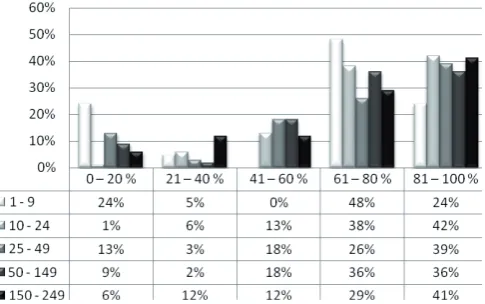
Fig. 3 shows that most enterprises, regardless of size, evaluate the process of human resources management positively. Micro-enterprises, i.e. enterprises with 1–9 employees evaluate this process from 48% between 61–80% and 24% of these enterprises evaluate this process between 81–100%. Enterprises with 10–24 employees evaluate the process by 42% between 81–100%, in the evaluation of 61–80% is ranked 38% of these enterprises.
2: Evaluation the process of human resources management according to business activities
Enterprises with 25–49 employees usually the process of human resources management evaluate between 81–100% (39% of enterprises). Enterprises with 50–149 employees evaluated this process as o en between 61–80% and 81–100% (36% of these enterprises). The largest monitored companies, i.e. companies with 150–249 employees evaluated the introduction of the process of human resources usually between 81–100%.
Tab. II shows that enterprises (without focusing on business activity) usually evaluate the productivity of work (62% of companies), then most o en staff selection (59%) and the utilization of working hours
(53%), then at least monitor the fl uctuation (33 %) and the time on training new workers (25%). Enterprises of business trade o en follow the utilization of working hours (72%), productivity of work (60%) and employee satisfaction (also 60%). Enterprises providing services monitor staff selection and qualifying development (68%). Productivity of work appears only in third place with 57%. The building industry most monitors again the productivity of work (66%) and staff selection (60%). For production is the largest frequency again in productivity of work (63%) and the staff selection (58%).
II: Monitored indicators by business activities
Indicators frequencyTotal Business activities
Business trade Services Building industry Production
Productivity of work 62 % 60 % 57 % 66 % 63 % Staff selection 59 % 52 % 68 % 60 % 58 % Utilization of working hours 53 % 72 % 62 % 48 % 46 % Sickness rate 45 % 52 % 51 % 28 % 50 % Qualifying development 45 % 44 % 68 % 34 % 41 % Accident rate 44 % 52 % 38 % 38 % 49 % Employee satisfaction 44 % 60 % 54 % 26 % 46 % Fluctuation 33 % 36 % 35 % 16 % 41 % Time on training new workers 25 % 16 % 35 % 16 % 28 %
SUMMARY
The main aim of this paper was to analytical describe the monitoring the process of human resources management in selected categories of enterprises by business activity and number of employees including statistical analysis of causal eff ects. Further to analytical describe the evaluation the process of human resources management and indicators of this process, which were monitored by small and medium-sized enterprises. For this paper were used the collected data within the project GAJU 068/2010/S. Examined data were analytically and statistically processed.
The research results showed that the process of human resources management has implemented the majority of monitored enterprises (94%). The best this process evaluated enterprises providing services. 24% of micro-enterprises this process evaluated between 0–20%, this implies that this process is not at all established. Given the number of employees it is logical, because small business owners do not see the need to monitor this process.
Monitored companies, regardless of business activities, usually follow productivity of work, staff selection and utilization of working hours. It is obvious that the owners mostly used hard elements of management and require from their employees perfect results. In the knowledge society is desirable to use so elements of management. From examined indicators deal primarily with the care about qualifying development and employee satisfaction. Just employee satisfaction watching most enterprises engaged in business trade (60%) and enterprises providing services (54%). Qualifying development of their employees o en monitor enterprises providing services (68%).
The basic condition for business success is awareness of the fact that people are the greatest wealth of enterprises and that their management decides whether the organizations succeed or not. It is therefore desirable to enterprises on basis of the results appropriately put the so elements of management in own practice.
Acknowledgement
EUROPEAN COMMISSION, 2006: Nová defi nice malých a středních podniků: Uživatelská příručka a vzor prohlášení. Evropská společenství: Publikace podniky a průmysl. [cit. 2013-02-10]. Cited from http://ec.europa.eu/enterprise/poli-cies/sme/files/sme_definition/sme_user_guide_ cs.pdf.
KLEIBL, J., DVOŘÁKOVÁ, Z., ŠUBRT, B., 2001: Řízení lidských zdrojů. Praha: C. H. Beck. 264 p. ISBN 80-7179-389-2.
KOTEY, B., SLADE, P., 2005: Formal Human Resource Management Practices in Small Growing Firms. Journal of Small Business Management. [cit. 2013-02-10]. Cited from http://apps.web ofknowledge. com/summary.do?product=WOS&search_ mode=Refi ne&qid=3&SID=U246keagO3 egjFiBK LM&page=1&action=sort&sortBy=LC.D;PY.D;A U.A;SO.A;VL.D;PG.A&show.
KOTLÁROVÁ, R., 2011. Statistické údaje MSP. [cit. 2013-02-10]. Cited from http://www. sme-union.cz/wp-content/uploads/2011/08/ S tat i st ic k % C 3 % A 9 % C 3 % B Ad aj e M S P ke -sta%C5%BEen%C3%AD-za-textem.pdf.
DEPARTMENT OF INDUSTRY AND TRADE, 2012. Zpráva o vývoji malého a středního podnikání a jeho
&SID=U246keagO3egjFiBKLM&page=1&action =sort&sortBy=LC.D;PY.D;AU.A;SO.A;VL.D;PG.A &show.
SCHULER, R. S., 1992: Strategic human re-sources management – linking the people with the strategic needs of the business of the business. Organizational Dynamics. [cit. 2013-02-10]. Cited from http://apps.webofknowledge. com/summary.do?product=WOS&search_ mode= Refi ne&qid=3&SID=U246keagO3egjFiBKLM&p age=1&action=sort&sortBy=LC.D;PY.D;AU.A;SO. A;VL.D;PG.A&show.
TRUNEČEK, J., 2004: Znalostní podnik ve znalostní společnosti, Praha: Professional Publishing. 312 p. ISBN 80-86419-67-3.
ULRICH, D., 2009: Mistrovské řízení lidských zdrojů, Praha: Grada Publishing, a. s. 266 p. ISBN 978-80-247-3058-5.
WELCH, D., 1994: Determinants of inter national human ressource management approaches and activities – a suggested framework. Jour nal of Management studies. [cit. 2013-02-10]. Cited from http:// apps. webofknowledge.com/summary. do?product=WOS&search_mode=Refi ne&qid=3 &SID=U246keagO3eg jFiBKLM&page=1&action =sort&sortBy=LC.D;PY.D;AU.A;SO.A;VL.D;PG.A &show.
Address