Introducing High School Students to Engineering Fundamentals by Four Weeks Engineering Innovation Summer Program
Pawan Tyagi and Christine Newmanb
a Mechanical Engineering, University of the District of Columbia, Washington DC-20008
b Center of Educational Outreach, Johns Hopkins University, Baltimore MD 21218
Abstract: Preparing high school students for engineering disciplines is crucial for the
sustainable scientific and technological developments in the USA. This paper discusses a precollege program, which not only expose students to various engineering disciplines but also enable them to consider engineering as the profession. The four-week long “Engineering Innovation (EI)” course is offered every year to high school students by the center of outreach, Johns Hopkins University. EI program is designed to develop problem-solving skills through extensive hands on engineering experiments. A team consisting of an instructor, generally a PhD in Engineering, and a teaching fellow, generally a high school science teacher, closely work with students to pedagogically inculcate basics of core engineering disciplines such as civil, mechanical, electrical, materials, and chemical engineering. EI values independent problem-solving skills and simultaneously promote the team spirit among students. A number of crucial engineering aspects such as professional ethics, communications, technical writing, and understanding of common engineering principles are inculcated among high school students via well-designed individual and group activities. This paper discusses the model of EI program and its impact on students learning and their preparation for the engineering career.
Keywords: education; University of the District of Columbia; engineering education;
summer program
1. Introduction: Shortage of engineering students threatens US's role as world's leading
innovator.1 According to CNN news unprepared college students entering in science, engineering, and mathematics drop out after the first year itself; the alarming percentage of dropout is around 20%.2 Engineering workforce in American Industries and the
development of cutting-edge scientific development will need an unprecedented number of engineers in near future.1 To produce a large number of highly skilled engineering graduates it is crucial to make the high school students interested and prepared in engineering disciplines.1,3 Early exposure of engineering disciplines provides unique opportunity for the high school students to evaluate engineering profession as a future career.4 In addition to early engineering exposure, a more useful aspect of attending an introductory engineering program may be to earn transferable college credits. Transferable college credits have two utilities: (a) make the college education affordable, and (b) reduce the course load in the initial years and allow student to settle in college with a convenient pace.5,6 At present there are a large number of introductory engineering programs, however rarely these program are ABET accredited and provide transferable college credits to high school students. On the other hand there a vast number of courses at community colleges and universities which allow high school students to earn college, credits by attending specific courses; however, such courses are not specifically designed for high school students. Moreover, such courses are unable to give fundamental understanding about engineering disciplines to high school students via rigorous experimental approaches or hands on experience.
Introductory engineering programs for the high school students vary dramatically in their content and nature of instructions. Some of the popular engineering introduction programs are iD Tech camps, NASA SHARP program, National Youth Science Camp, Student Materials Camp, introduction to engineering program at University of Notre Dame etc. Most of the existing programs, which serve as the bridge between high school and college program in engineering, have following shortcomings.
(1) Highly specific to an engineering topic, or too generic to give critical level of understanding about engineering basics.
(2) Less emphasis on engineering fundamentals, more emphasis on demonstrations (3) Instructors are generally skilled in one engineering branch and do not have
To overcome above stated shortcomings Center of Outreach, Johns Hopkins University conducts Engineering Innovation (EI) program for the high school students.7 EI is a four weeks long summer program that exposes high school students to major engineering disciplines like
mechanical, civil, chemical, electrical, and materials. EI is a compact version of EN.500.110 What is Engineering? Course designed by Dr. Michal Karweit for the students with undecided major at JHU. This paper discusses the EI program and its salient features in preparing high school
students for engineering
profession.
2. Introduction of EI program: EI
program benefits high school
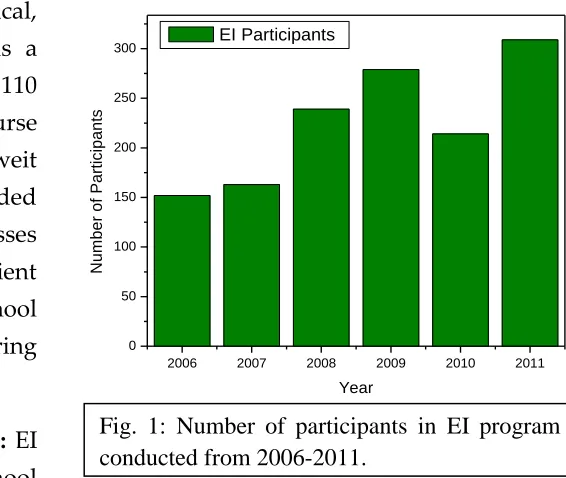
students in three main areas: (a) introduce them to various engineering areas while improving their STEM skills and self-efficacy,8 (b) provide transferrable college credits5 to eligible students, and (c) mitigate the disconnect between college and high school education.9 EI is becoming popular and every year increasing number of participants is joining this program, not only from the USA but also from the abroad. In 2011, 309 high school students attended EI program at various sites in the USA (Fig. 1).
During 2011, following 16 sections were taught in three states (Maryland, Pennsylvania, and California) and the District of Columbia:
California Lutheran University located in Thousand Oaks, California California State University, Fullerton (CSU Fullerton) located in Fullerton, California
Eastern Technical High School located in Baltimore, Maryland
Johns Hopkins University, Elkridge campus (JHU Elkridge) located in Elkridge, Maryland
Johns Hopkins University, Homewood Campus (JHU Homewood) located in Baltimore, Maryland (four sections – A, B, C, and D)
Johns Hopkins University, Rockville campus (JHU Rockville) located in
2006 2007 2008 2009 2010 2011
0 50 100 150 200 250 300 N u m b e r o f Pa rti c ip a n ts Year EI Participants
Rockville, Maryland (two sections – A and B)
Tuscarora High School located in Frederick, Maryland (two sections – A and B).
Pasadena City College located in Pasadena, California
Sci-Tech High School (Sci-Tech) located in Harrisburg, Pennsylvania. University of Baltimore (UB), located in Baltimore, Maryland
University of the District of Columbia (UDC) located in the District of Columbia.
For every site, an instructor, generally with a PhD degree in an engineering discipline, and a regional high school teacher, generally with several year of teaching experience, are paired to conduct EI program. Before the beginning of actual EI program instructors and teaching fellows undergo one week rigorous training at Johns Hopkins University campus. During training instructors and teaching fellows are trained in teaching fundamentals of multiple engineering disciplines. During training instructors and teaching fellows are supervised to conduct a variety of engineering experiments which high school students will be required to do under the EI program for their problem based learning.10
EI course include the lecture and experiments pertaining to a number of important engineering disciplines.7 In order to connect the class room instructions and the experimental learning to the real life applications students are asked to apply learned material to make functional engineering systems. The engineering systems, that student produce are designed to emphasize the core concepts of specific engineering streams.
the representative mathematical model from the raw experimental data teaches student how to approach a new and vaguely defined real life problem. Such skills are the core strengths of an engineer or scientist which is generally never taught by a formal course. A student learn them as the need arise and that to in varying degree; as a major drawback such skills are not discussed in general context and their connection to science and engineering problems pertaining to real life situations remain incompletely explored. EI endowed high school with the ability to deal with new technological problems via simple yet well designed hands on experiments.
EI program acknowledge the fact that most of the high school participants did not preparatory courses to assimilate engineering concepts. To bridge the knowledge gap and to provide an inquiry base teaching of engineering fundamentals generally EI instructor present interactive lectures on the major topics. For instance before the materials lab a class room discussion is presented about the materials properties, usage, and testing. In order use a material as structural material students are taught statistics. Students are asked to apply their understanding about statistics in virtual experiments. In virtual bridge designer experiment students design their bridge and analyze nature of compressive or tensile loads on the individual components of a bridge. After selecting a bridge design, based on their understanding of statistics, student construct individual trusses/ bridge components utilizing their knowledge about spaghettis’ tensile, buckling and bending strength learnt from the materials class and lab.
To further teach the civil engineering basics or at least a small component of it students perform remote measurement lab. This lab utilizes meter scale and string as the surveying tools to measure the aerial distance between the apexes of two multistory buildings. This outdoor lab teaches the ways to estimate engineering quantities using limited resources. Students apply trigonometry to accomplish the assignment and apply calculus for determining the systematic and random type common errors in their measurements. This EI assignment also let student experience the utility of learning math and their applicability in engineering and science.
also enables the students to understand the basics of robotics and associated challenges. Developing a logic circuit from scratch and then seeing it functioning successfully is one of the most positive experiences that students had from the EI program.
To teach the chemical engineering basics students first attend class discussion on important chemical engineering processes like the chemical separations, chemical reactions, diffusion, chemical reactor design, and concepts of mass and energy conservations. Then students take part in chemical processes lab to experience important chemical engineering steps. Chemical separation is the main theme of chemical lab. Students do ethanol distillation from the mixture of water and ethanol. Students also do chromatography based chemical separation. Students discover how to use hydrometer, Maccabe Thiele diagram for quantifying the distillation efficiency.
EI recognize that successful and meaningful engineering career involve understanding of various other subjects, not just mastering technical skills. Other subjects, which EI also include in its curriculum, are professional ethics, finance, communication, and ability to estimate.
To teach the vital role of ethics in engineering and science an interactive session is designed. Different EI instructors conduct ethical education session in several ways; generally by presenting numerous past ethical cases which adversely impacted economy, safety, and social wellbeing. Ethical education is imparted through the discussion on the variety of case studies or hypothetical situations. Students provide their stand with regards to individual case studies. Through the discussion with peers and instructors they realize in many cases difference between right and wrong approach is not obvious. Interestingly, in the beginning EI student appeared to consider ethical discussion unnecessary or not important as they seemed to be content with their own ways of justifying right and wrong practice.
Engineering disciplines are heavily based on communications. In engineering, it is crucial that one engineer effectively communicate the guideline and instruction for the other engineers to enable the economical, safe and efficient completion of a project. For instance, design engineers must effectively communicate the design of an engineering system to the production engineers. To make high school student realize the importance of communication a number of assignment and activities are incorporated in the EI program. EI Students partake in an exercise in which they design mousetrap within the suggested constraint. Then this design is forwarded to randomly chosen students to build it just “based on written instructions”. Finally during an event students test their mousetrap design and give their feedback about the issues they encountered. This is a simple yet highly efficient way to impart the importance of clear articulation and effective communication. In the second communication assignment, students are asked to propose a solution to a pressing technological issue and then market their ideas to other students via a group presentation.
To encourage students to pursue engineering career EI program conduct engineering connection day. On this special day engineers from renowned companies like Northrop Grumman, Ford, local construction companies, active research scientist and higher education specialists are invited to share their insights and experience with EI students. Engineering professional discuss their career journey, views about engineering work they are involved in, and the message for the budding engineers like EI students. Such communication enabled EI student o experience the challenges involved in transitioning from school to college/work.11 EI students do networking, and get exposed to a number of engineering internship opportunities. For some sites higher education option is also talked about. For instance this year dean of School of Engineering at UDC talked about potential advantages of higher education and numerous funding opportunities in graduate schools.
other EI activities. Most of the time EI final exam for earning college credits also includes an estimation problem.
Along with the major EI activities students are taught about graphing, report preparation, error analysis, dimensional reasoning etc.
In the final week of the EI, students work on a weeklong take home exam. Based on their performance in the final exam and grades in the EI assignments which they did throughout the program decide their final grade. In the final week of EI students work in teams to produce Spaghetti Bridge using their engineering skills. On the final day of EI bridge breaking competition is organized. Students test the strength of their bridges in the presence of peers, parents, EI staff and invited guest.
3. Program Evaluation: The degree of success of EI program is accessed by multi-facet
surveys. In the beginning of EI program students are asked to fill out a pre-survey to record their skill levels, attitude for engineering, and future outlook. Similar survey is administered at the end of EI program to statistically quantify the impact of EI program. In addition EI alumni were surveyed to gauge the long term impact of EI on to participating students. Survey of EI alumni was also important to map the EI effect from the new stand point. Alumni which are currently pursuing college degree have more matured and realistic outlook to reevaluate the EI effectiveness. For conducting these surveys and to evaluate the overall effectiveness of EI program an independent program evaluator was appointed. The external program evaluator also interviewed EI students and teaching staff about the various aspects of EI program. The data discussed here is mainly drawn from the surveys of EI students.
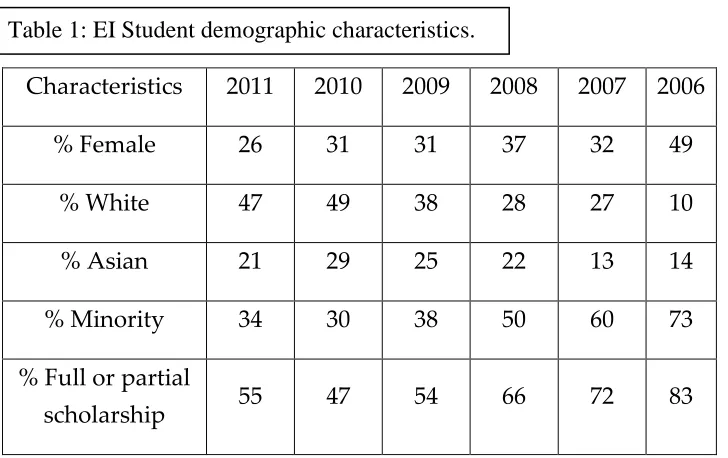
3.1 Findings: EI program was attended by students of different demography. Data
supported EI participants decreased from 83% to 55%. It will be interesting and important to study if minority and female participation can be boosted by the financial support.
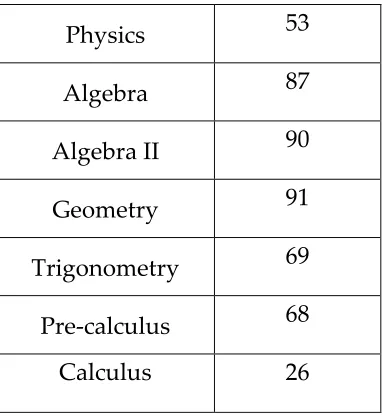
EI program contents are considerably challenging. High school students are generally selected by ensuring that they have earned reasonable proficiency in math, science, and English. Majority of the EI participants took biology, chemistry, algebra, algebra II and geometry (Table 3). The percentage of students who attended trigonometry, pre-calculus, and calculus were 69, 68, and 26, respectively. As discussed elsewhere in this paper, students who attended trigonometry and pre-calculus were found to assimilate EI material more effectively and were more likely to earn college credits. This trend is consistent with the observation about students in STEM disciplines at UDC. Students who completed pre-calculus were highly likely to complete the college degree in time.
Characteristics 2011 2010 2009 2008 2007 2006
% Female 26 31 31 37 32 49
% White 47 49 38 28 27 10
% Asian 21 29 25 22 13 14
% Minority 34 30 38 50 60 73
% Full or partial
scholarship 55 47 54 66 72 83
Courses Percentage
Biology 86
Chemistry 82
Table 1: EI Student demographic characteristics.
EI program allowed 9 to 12 grade high school students to attend the EI program. However, 10th and 11th grade high school students formed the major part of EI classes (Table 4). In 2011 EI program 10th and 11th grade students were 34% and 51% respectively. In 2011, 9th and 12th grade students were 2% and 5%, respectively.
Grade 2011 2010 2009
% 9th 2 4 3
% 10th 34 31 31
% 11th 51 62 59
% 12th 5 2 6
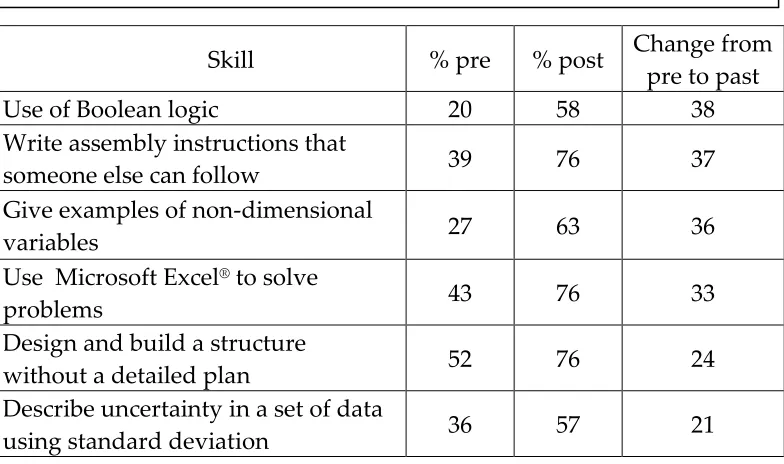
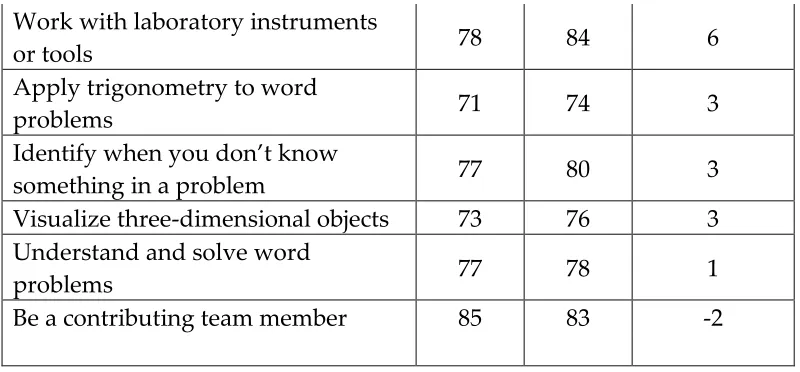
Effectiveness of EI was measured by surveying the EI participants response to specific engineering skills before and after the completion of program. Tabulated results showed that EI program significantly enhanced a number of engineering skills (Table 4). EI participants showed the highest gain in using Boolean logic (38% increase). EI participants learned basics of Boolean logic and then developed understanding about
Physics 53
Algebra 87
Algebra II 90
Geometry 91
Trigonometry 69
Pre-calculus 68
Calculus 26
various types of logic Gates (AND, OR, NOT, NAND, XOR etc.). Students performed experiments on virtual circuit builder computer program to develop circuit diagrams to control the direction of motion of a robot car. Next highest increase was the communication of engineering design (37% increase). During one engineering communication exercise EI students wrote instruction for another student to construct a mouse trap. Under another communication exercise students worked in group to present solution for present day engineering issues- under this exercise they first communicated with the team members and subsequently as a team they communicated with the whole class. A significant improvement was noticed in participants understanding about dimensional analysis. After attending EI program students were able to understand the essence of dimensional quantities; their ability to give example of dimension less variables improved by 36%. A major gain was noted in using Microsoft Excel® software for engineering calculation and analysis (36% increase). During in person interview a number of EI participants expressed their amazement about the capabilities of Microsoft Excel® software. During the analysis of materials lab data students utilized Microsoft Excel® software to develop model for representing bending and bucking load as a function of length and diameter of the mechanical testing samples. Students also used this software to do error analysis and engineering calculations. Table 4 enlists the percentage improvement in various engineering related skills due to the EI program.
Skill % pre % post Change from
pre to past
Use of Boolean logic 20 58 38
Write assembly instructions that
someone else can follow 39 76 37
Give examples of non-dimensional
variables 27 63 36
Use Microsoft Excel® to solve
problems 43 76 33
Design and build a structure
without a detailed plan 52 76 24
Describe uncertainty in a set of data
using standard deviation 36 57 21
Apply data in scientific or
engineering reasoning 55 77 22
Evaluate problems you’ve never seen before and whose answers can’t be found in Google
47 67 20
Work with limits that are
“proportional” to one another and not equal to one another
45 62 17
Use logarithms to analyze data 45 61 16
Describe equations using
dimensions and units 61 76 15
Calculate a mean, standard
deviation, and variance from a set of data
62 76 14
Deal with measurements that
contain errors 54 68 14
Describe the properties of a force 50 64 14
Use a table of values to estimate a
solution from raw data 60 74 14
Work with vector quantities 48 62 14
Develop your own problems or experiments to explore a concept or principle
50 62 12
Simplify a complex problem into a
few key issues 58 70 12
Write a complex lab report that
includes graphs and diagrams 59 71 12
Describe the physical properties of
materials 69 79 10
Know when a problem isn’t posed in
a way that you can answer it 59 68 9
Estimate answers rather than
calculating them 70 78 8
Make oral presentations to an
audience 64 72 8
Sketch or draw two-dimensional or
three dimensional objects 67 75 8
EI program also aims to provide transferable college credits to eligible participants. EI program is ABET accredited and credits earned from this course can be utilized throughout the USA universities and colleges. To earn the college credit students are required to have good standing in EI assignments and passing the final take home exam. In 2011 EI, 62% students earned the college credit. Percentage of student earning the college credit in the 2010, 2009, 2008 were 59%, 65% and 58%, respectively. Mean exam score for all the 2011 EI participants was 44, 50 is the cut off to earn college credit.
Female students performed quite differently as compared to male students. Significantly more male students earned college credit than female students — 54 percent versus 39 percent (chi2=4.64, p=.031). The mean exam score for male students was higher than the mean exam score for female students (48.5% vs. 39.5%, F=7.04, p=.008).
Minority students’ performance was below average. Mean exam score for minority students was 29%; however, mean exam score for non-minority student was 54% (Table 5). As a corollary fewer minority students earned the college credits; 29% of the minority students earned college credit, while 75% of non-minority students earned the college credit. At the sites like UDC it was observed that minority students were relatively less prepared to assimilate EI course material.
Work with laboratory instruments
or tools 78 84 6
Apply trigonometry to word
problems 71 74 3
Identify when you don’t know
something in a problem 77 80 3
Visualize three-dimensional objects 73 76 3
Understand and solve word
problems 77 78 1
Be a contributing team member 85 83 -2
Minority Non-minority
Mean exam score 29% 54%
Earned college credit 25% 75%
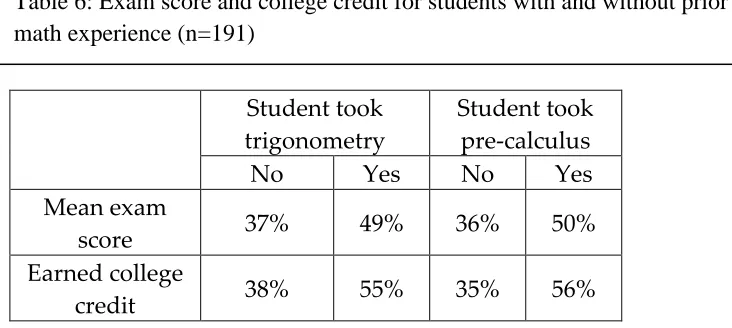
Students’ performance in EI program strongly correlated with their prior math preparation.12-14 Data suggested that students with trigonometry and pre-calculus earned better exam grades and were more successful in earning college credits. Table 6 shows the mean exam scores and receipt of college credit for students who took these two courses previously as compared to those who did not attend these courses. As shown, the mean exam score for students who took a trigonometry class prior to EI was 49%, compared to a mean score of 37 % for students who did not take a trigonometry class (F=14.33, p=.000). Additionally, 55% of students who took a trigonometry class earned college credit, compared to 38% of students who had not taken a trigonometry class prior to the program (chi2=6.93, p=.008). Similar results were found for pre-calculus. Students who had taken pre-calculus had a higher mean exam score than students who did not (50% versus 36%, F=19.95, p=.000) and students who took pre-calculus were also more likely to have earned college credit (56% compared to 35% of students with no pre-calculus experience, chi2=9.88, p=.002). Interestingly, there was no significant difference due to the other courses listed in Table 2. Pre-calculus and trigonometry were found to produce decisive effect on the student performance.
Student took trigonometry
Student took pre-calculus
No Yes No Yes
Mean exam
score 37% 49% 36% 50%
Earned college
credit 38% 55% 35% 56%
In order to compare the learning experience of students who earned the college credit and who did not their skills before and after the EI program were compared (Table 7). This comparison is important in the light of findings about the students learning who attended courses at community college and local universities to earn the college credits. Finding suggested that in many cases even though a student earned college credits but in many cases no measurable difference was noticed in skills.
Our study reflects that student who earned college credit in EI program also garnered more skills. There were two important differences in earned skills for students who earned college credit versus those who did not. First, the percentage of students who could perform these skills after the program were quite a bit higher for students who earned credit compared to students who did not. Second, the percentage improvement in
skills of students was much larger among students who earned college credit than for
students who did not earn college credit. For instance, skill of writing “assembly instructions that someone else can follow” improved greatly for the students who earned the college credits (Table 7). This suggests that students who did not earn credit for the course also did not develop these skills at par with the students who earned credit. This correlation between success in earning college credit and improvement in skills is logical and expected (Table7). This lower level of skill development probably explains the lower exam scores for these students and, ultimately, why these students did not earn the college credit.
Earned credit Did not earn credit
Skill %
pre
% post
Change from pre
to past % pre
% post
Change from pre
to past
Use of Boolean logic 70 89 19 52 62 10
Write assembly instructions that
someone else can follow 68 90 22 72 72 0
Give examples of non-dimensional
variables 68 89 21 55 67 12
Use Excel to solve problems 31 73 42 11 46 35
Design and build a structure without a
detailed plan 53 75 22 41 50 9
Describe uncertainty in a set of data
using standard deviation 62 80 18 49 59 10
Apply data in scientific or engineering
reasoning 57 76 19 44 56 12
Evaluate problems you’ve never seen before and whose answers can’t be found in Google
59 76 17 41 52 11
Work with limits that are
“proportional” to one another and not equal to one another
65 85 20 62 69 7
Use logarithms to analyze data 36 65 29 37 51 14
Describe equations using dimensions
and units 73 85 12 69 74 5
Calculate a mean, standard deviation,
and variance from a set of data 51 80 29 46 58 12
Deal with measurements that contain
errors 47 73 26 45 55 10
Describe the properties of a force 53 87 34 52 68 16
Use a table of values to estimate a
solution from raw data 81 89 8 75 75 0
Work with vector quantities 61 76 15 58 64 6
Develop your own problems or experiments to explore a concept or principle
50 78 28 51 49 -2
Simplify a complex problem into a
few key issues 65 86 21 59 69 10
Write a complex lab report that
includes graphs and diagrams 90 93 3 85 77 -8
Describe the physical properties of
materials 66 81 15 69 72 3
Know when a problem isn’t posed in a
way that you can answer it 78 90 12 80 80 0
Estimate answers rather than
calculating them 62 80 18 67 67 0
Make oral presentations to an
audience 84 90 6 75 69 -6
Sketch or draw two-dimensional or
three dimensional objects 81 87 6 65 65 0
Use math to analyze data 53 92 39 36 63 27
Work with laboratory instruments or
tools 74 86 12 73 68 -5
Identify when you don’t know
something in a problem 66 85 19 53 62 9
Visualize three-dimensional objects 31 79 48 24 49 25
Understand and solve word problems 82 92 10 69 72 3
Be a contributing team member 64 92 28 51 64 13
Effect of EI program on the participants’ outlook about engineering career was studied. A number of questions were asked in the pre and post survey to quantify the change in student attitude about engineering. Data suggested that there was insignificant change in students perception. Students interest in engineering before and after EI program remained practically unchanged (mean pre-score 33.9 and mean post score 33.9) (Table 8). Similar observation were recorded about the other question listed in Table 8. The unchanged perception signifies that EI participants were already quite motivated to explore engineering and its relevance to societal need. In future it may be interesting to form a section of students who are disinterested in engineering and then record the change in their attitude towards engineering before and after the EI program
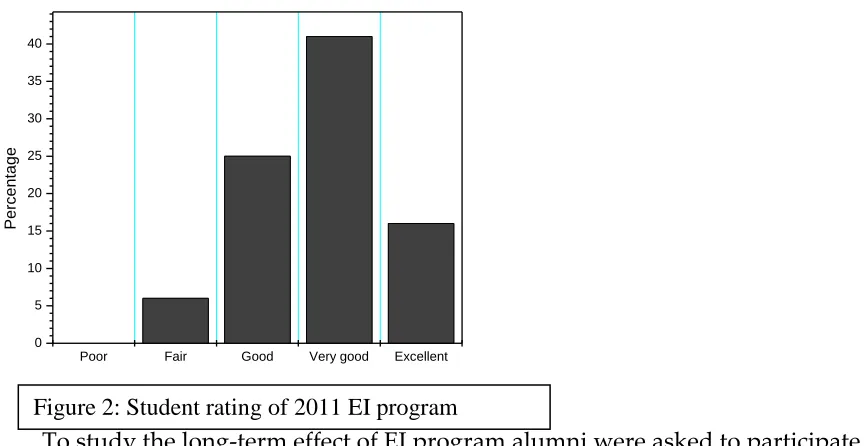
Finally students were asked to rate the EI program. More than 90% student rated EI program good, very good and excellent. More than 40% students rated EI program to be very good. This data signifies that EI program was a positive experience for most of the participants. According to interviews of numerous participants, EI program enabled them to appreciate the engineering from different angles, which they never imagined. It was also noticed that student tend to utilize their positive experiences in their high school
Topic area
Number of
students
Mean pre-score
Mean post-score
Change
Interest in engineering 236 33.9 33.7 -0.2
Enjoyment of engineering
problems/community 217 55.7 56.3 0.6
Perception of how
engineering contribute to society
233 26.5 26.2 -0.3
Perception of how
engineering work 233 18.9 19.4 0.5
classes. For instance, one 2010 EI participant wrote an essay during her high school class pertaining to the meaning of numbers, her new perception developed after attending the EI program. Beside this EI has produced long-term impacts on its alumni.
Poor Fair Good Very good Excellent
0 5 10 15 20 25 30 35 40
P
e
rc
e
n
ta
g
e
To study the long-term effect of EI program alumni were asked to participate in a survey. As a positive note 46% of the alumni reported that due to EI they decided to become engineer (Table 9). Most of the EI alumni (77%) reported that EI enabled them to think more carefully about the engineering career. Due to EI, a number of alumni realize that engineering is not the profession for them. It seems that EI is also a good medium in providing more realistic outlook about engineering for the students with different aptitudes and skill sets. It is also noteworthy that even though 2011 EI students did not showed any significant change in their aptitude about engineering (Table 8), however, once they start applying to colleges and actually begin their first year in college EI experience can assist them in making suitable choices. In future, it may be interesting to note the response of alumni about the impact of EI in their performance at college level engineering courses.
Statement
% Strongly agree or agree As a result of taking EI, I have
decided to become an engineer 46
Figure 2: Student rating of 2011 EI program
As a result of taking EI, I have decided to choose another career in the science
17
EI made me think more carefully about whether or not engineering is for me
77
The major of EI alumni was investigated. It was found that out of 102 surveyed alumni 80 alumni have made the decision about their college major. Cumulatively, 87% EI alumni are doing major in STEM area (Table 10). Alumni who are doing college major in engineering is 56%. This high percentage of EI alumni enrolment in STEM areas suggest that EI can play an important role in developing sustainable interest in STEM fields. This aspect is crucial because a large population of students who joined STEM area generally changed their disciplines after first year.
Percent (%)
Engineering 56
Other
science/math 31
Non-science/math 11
Not specified 1
Summary: Core value of EI program is that it teaches approaches to solve engineering
problems and develop engineering aptitude. Students are given a number of individual and group assignments. They work in team on major engineering experiments like: materials properties, structure design, robot construction, and bridge building etc. Prior to experiments students take part in lecture and discussions on the relevant topics. Instructor and teaching fellow provide optimal pedagogy to foster independent critical thinking. During EI program students are engaged in the discussion of professional ethics, engineering economics, and data analysis. At the end of the third week students are given a take home exam. Passing in this ABET accredited EI program and satisfactory performance in EI assignments make them eligible to get three transferrable college level credits.
Acknowledgment: PT thanks Michael Karweit for discovering engineering innovation
program and nurturing it. PT also thanks Kathleen Dowell of EvalSolutions for the data analysis.
References:
1. ASEE First Bell September 2, 2011 News Letter and
http://www.ajc.com/opinion/strong-u-s-needs-1155439.html
2. US News Education Blog by Jason Koebler September 28 2011,
http://www.usnews.com/education/blogs/high-school-notes/2011/09/28/survey-stem-engagement-begins-early &
http://www.microsoft.com/Presspass/press/2011/sep11/09-07MSSTEMSurveyPR.mspx
3. http://www.cnn.com/2011/US/05/17/education.stem.graduation/index.html
4. Mathers, N., M. Pakakis, et al. "Mars mission program for primary students: Building student and
teacher skills in science, technology, engineering and mathematics." Acta Astronautica 69(7-8): 722-729, and Carroll County Times, “Century senior recalls NASA summer program” Posted: Friday, September 30, 2011 5:15 am | Updated: 9:19 am, Fri Sep 30, 2011.
5. Wilbur, F. P. and D. W. Chapman (1977). "Transferability Of College Credit Earned During
High-School." College And University 52(3): 280-287.
6. Mercurio, J. A., L. Lambert, et al. (1983). "College Credit Earned In High-School - Comparing Student Performance In Project Advance And Advanced Placement." College And University
59(1): 74-86.
7. http://engineering-innovation.jhu.edu/
8. Gore, P. A. (2006). "Academic self-efficacy as a predictor of college outcomes: Two incremental
validity studies." Journal of Career Assessment 14(1): 92-115.
9. Kirst, M. W. (2004). "The high school/college disconnect." Educational Leadership 62(3): 51-55.
10. Urrestarazu, L. P., A. F. Salas, et al. "Multidisciplinary Education for New Landscape Engineering
Concepts using Problem-Based Collaborative Learning. A Case Study in Spain." International Journal Of Engineering Education 27(1): 138-145.
11. Wagner, M. M. and J. Blackorby (1996). "Transition from high school to work or college: How
special education students fare." Future Of Children 6(1): 103-120.
12. Hackett, G. and N. E. Betz (1989). "An Exploration Of The Mathematics Self-Efficacy." Journal For Research In Mathematics Education 20(3): 261-273.
13. Lent, R. W., F. G. Lopez, et al. (1996). "Latent structure of the sources of mathematics self-efficacy." Journal Of Vocational Behavior 49(3): 292-308.