ISSN: 2319-8753
International Journal of Innovative Research in Science,
Engineering and Technology
(An ISO 3297: 2007 Certified Organization)
Vol. 3, Issue 8, August 2014
Effect of Chemical Reaction on Mass
Distribution of a Binary Fluid Mixture in
Unsteady MHD Couette Flow
B.R Sharma
1, Hemanta Konwar
2Professor, Department of Mathematics, Dibrugarh University, Dibrugarh, Assam, India1
Assistant Professor, Department of Mathematics, Kohima Science College, Jotsoma, Nagaland, India2
ABSTRACT: The problem of mass distribution in an unsteady two dimensional flow of a viscous, incompressible, thermally and electrically conducting binary fluid mixture between two infinite vertical parallel plates under the influence of chemical reaction, uniform magnetic field and temperature gradient is studied. The magnetic field lines are assumed to be fixed relative to the moving plates. The governing partial differential equations are first transformed into ODEsby the method of separation of variables and then solved numerically by using MATLAB’s built in solver bvp4c. The solution for the concentration of the rarer and lighter component of the binary fluid mixture for different values of Reynolds number, chemical reaction parameter, Schmidt number, thermal diffusion number and Peclet number are presented graphically to analyse their effects on mass distribution of the components of the binary fluid mixture.
KEYWORDS: Binary fluid mixture, unsteady, MHD Couette flow, magnetic field, chemical reaction, mass
distribution
I. INTRODUCTION
MHD Couette flow between two parallel plates is a classical problem that has important applications in various industrial processing such as power generators and MHD pumps used in chemical energy technology, accelerators, aerodynamics heating, polymer technology, petroleum technology and also in many material processing applications. Heat and mass transfer problems with chemical reaction are of great importance in several processes. The effect of chemical reaction depends upon whether the reaction is homogeneous or heterogeneous. In well-mixed systems, the reaction is heterogeneous if it takes place in the interface and homogeneous if it takes place in solution. In most cases the reaction rates depends upon the concentration of species. A reaction is said to be of first order if the rate of reaction is directly proportional to the species concentration. When fluid moves through a magnetic field then an electric current may be induced and in turn current interacts with the magnetic field to produce a body force on fluid. The influence of a magnetic field in viscous incompressible flow of electrically conducting fluid is used in plastic technology to manufacturing of rayon, nylon etc.
In a binary fluid mixture the diffusion of individual species takes place by three mechanisms namely ordinary diffusion, baro-diffusion and thermo-diffusion. The diffusion flux i of rarer and lighter components is given by Landau and Lifshitz [1] as
[ c k p k T]
p T
D
i (1)
where ρ is the density of the binary fluid mixture, kpD is the baro- diffusion coefficient, kTD is the thermo- diffusion
ISSN: 2319-8753
International Journal of Innovative Research in Science,
Engineering and Technology
(An ISO 3297: 2007 Certified Organization)
Vol. 3, Issue 8, August 2014
diffusion occurs then it might even render an unstable system to stable one. This effect is quite small, but devices can be arranged to produce very steep temperature gradients so that separation of mixtures are affected. Bodosa et al. [3] analysed the heat transfer between two horizontal plates in presence of a uniform magnetic field. Sharma and Singh [4, 5] studied analytically the Soret effect on de-mixing of species in hydro-magnetic flow of a binary mixture of incompressible viscous fluid between two parallel plates, first taking the plates horizontal and second by taking the plates vertical. Attia. H. A. [6] studied the effect of variable properties on the unsteady Couette flow with heat transfer considering the Hall Effect. Sharma et al. [7, 8, 9] investigated analytically the effect of magnetic field on separation of binary fluid mixture for different geometries. Das and Jana [10] investigated heat and mass transfer effects on unsteady MHD free convective flow near a moving vertical plate in porous medium. Sharma et al. [11, 12, 13] studied the effects of axial and radial magnetic field on de-mixing of a binary fluid mixture. Sharma, Singh and Gogoi [14] discussed the effects of magnetic field and temperature gradient on separation of a binary fluid mixture in unsteady Couette flow analytically. They did not consider the effect of chemical reaction in their investigations.
The aim of this research paper is to investigate numerically the effect of chemical reaction on mass distribution in unsteady, incompressible, viscous, electrically conducting binary fluid mixture between two infinite vertical parallel plates both of which are moving with equal velocities in opposite directions.
II. MATHEMATICAL MODELLING
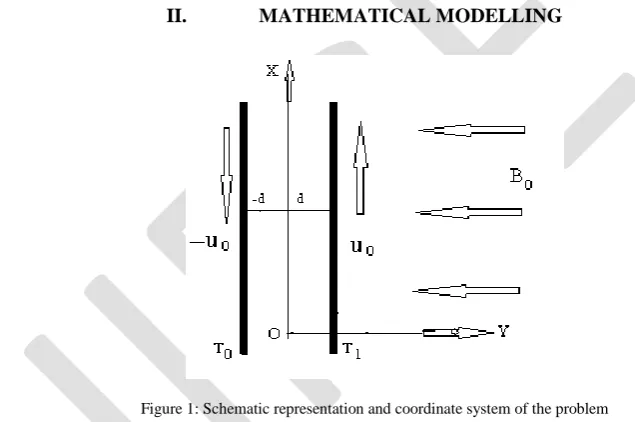
Figure 1: Schematic representation and coordinate system of the problem
The unsteady MHD flow of an incompressible viscous electrically conducting fluid between two infinite vertical parallel plates at a distance 2d apart is considered under the influence of a uniform transverse magnetic field. The flow is assumed to be along the X-direction, which is in the vertical direction through the central line of the channel and Y-axis is along the horizontal direction [see Fig 1]. The plates of the channel are aty = ± d and that the relative velocity between the two plates is 2u0. A uniform magnetic field of strength B0 is applied perpendicular to the plates. The plate y = - d is
maintained at temperature T0, while the temperature of the plate at y = d varies exponentially with time having initial
temperature T1 (T1 >T0). Since the plates are considered infinite in X- direction, hence all the physical quantities will be
independent of x. Therefore all the physical variables become functions of y and t only.
We make the following assumptions:
The magnetic field is weak. The magnetic field lines are assumed to be fixed relative to the moving plates. Boussinesq approximation is applied.
Plates are non-conducting.
ISSN: 2319-8753
International Journal of Innovative Research in Science,
Engineering and Technology
(An ISO 3297: 2007 Certified Organization)
Vol. 3, Issue 8, August 2014
No applied voltage and hence electric field is absent.
Under the above assumptions the governing equations are
1 T
2
2 B
u u 0 u g (T T ) g (c c ),
0 c w
2
t y
(2)
2
T k T
2
t c y
p
(3)
and
1
w1 w1
T 2
c c T
D[ S {(c c ) }] k (c c )
2
t y y y
(4)
where u is the velocity in x- direction, is the kinematic viscosity, g is the acceleration due to gravity, is the
density of the binary fluid mixture, Tis the volumetric coefficients of thermal expansion, cis the volumetric mass
expansion coefficient, is the electric conductivity, T is the temperature of the binary fluid mixture inside the thermal boundary layer, k is the thermal conductivity, cp is the specific heat at constant pressure, c is the concentration of rarer
and lighter components of the binary fluid mixture, D is the mass diffusion coefficient, ST is the Soret coefficient and k1
is the chemical reaction rate constant.
The boundary conditions of the problem are
0 0 w1
u u , TT , cc at y d (5)
and nt
0 1 1 0 w 2
uu , T T (TT ) e , cc at yd (6)
where u0, T0,T1,cw1,cw2 and n are constants.
On introducing the non-dimensional quantities
0 0 w1
0 1 0 w 2 w1
tu T T c c
u y
* * * * *
u , y , t , T , c
u d d T T c c
(7) into equations (2) to (6) we get the following non-dimensional equations
* 2 *
u 1 u Re M u2 * Gr T* Re G c ,* (8)
c
* Re 2 2
t y* Re
2
2
* *
T 1 T
* Pe
t y*
(9)
and
* 2 * *
c c * T *
Re Sc t c c
* 2 d * *
t y* y y
(10)
together with the boundary conditions:
* * *
u 1, T 0, c 0 at y 1 (11)
and
* * nt *
u 1, T 1 e , c 1 at y1 (12)
ISSN: 2319-8753
International Journal of Innovative Research in Science,
Engineering and Technology
(An ISO 3297: 2007 Certified Organization)
Vol. 3, Issue 8, August 2014
3
w 2 w1
0 0 T 1 0 1
0 0
p
d T 1 0
2 2
2
2 2 3
g (c c )
du B d g (T T ) k d c
Re , M , Gr , , Sc , Gr ,
c
D D
u u
c
Pr , Pe Pr . Re, t S (T T ) k (13)
are Reynolds number, Hartmann number, Grashof number, Chemical reaction parameter, Schmidt number, Mass Grashof number, Prandtle number, Peclet number and thermal diffusion number respectively.
III. SOLUTION OF THE PROBLEM
Equations (8)-(10) represent a set of partial differential equations and cannot be solved in closed form. However, it can be reduced to a set of coupled non-linear ordinary differential equations in dimensionless form by using the following transformations:
nt
0 1
* *
u f f (y )e ,
(14)
* * nt
T g g (y )e
0 1
(15)
and n
0 1
t
* *
c h h (y )e (16)
With the help of these transformations equations (8) to (10) with the boundary conditions (11) and (12) become
2 2 2
,
0 0 0 0
Gr
f '' Re M f g Re Gr h c Re
(17)
2 2
1 1 1 c 1
'' Gr
f Re{n Re M }f g Re Gr h ,
Re
(18)
0
"
g 0, (19)
1 1
"
g nPeg 0, (20)
0 d 0 0 0 0 0
" "
h t (h ' g ' h g ) h 0 (21)
and 1 d 1 0 d 1 d 0 1 0 1 1
0
'' '' ''
h t h ' g '(t g n Re Sc) h t (h ' g 'h g ) h 0 (22)
with the boundary conditions
*
f0 1, f10, g00, g10, h00, h10 at y 1 (23)
and f 1, f 0, g 1, g 1, h 1, h 0 at y* 1
0 1 0 1 0 1 (24) Here primes represent ordinary differentiation with respect to y*.
Equations (14) to (19) are highly coupled and nonlinear ODEs. So their solution in closed form is not possible. Hence we solved the equations numerically by using MATLAB’s built in solver bvp4c.
IV. RESULTS AND DISCUSSIONS
ISSN: 2319-8753
International Journal of Innovative Research in Science,
Engineering and Technology
(An ISO 3297: 2007 Certified Organization)
Vol. 3, Issue 8, August 2014
Figure 2: Concentration profile c* against the width of the channely for different values of Re and Pe=6; Sc=0.2 ; t*
d= 0.5; n=2;=0.2; Grc= 2;
Gr=2; M=1; t=0.5; γ =1
Figures 2 reveals that increase in the value of Reynolds number (Re) decreases the concentration of the rarer and lighter component of the binary fluid mixture at any point in the region [-1, 0] and increases the concentration of the rarer and lighter component of the binary fluid mixture at any point in the region [0, 1]. Thus the concentration of the rarer and lighter component of the binary fluid mixture can be increased by increasing the value of the Reynolds number (Re) i.e. with the increase in the value of density of the mixture, with the increase in the values of the magnitude of velocity of the plates, with the increase in the values of the distances between the plates, and with the decrease in the viscosity of the fluid mixture.
Figure 3: Concentration profile c* against the width of the channel y*for different values of chemical reaction parameter γ and Re=30; Pe=6; t d=0.5;
Sc=0.2 ; n=2; ε=0.2; Grc=2; Gr=2; M=1; t=0.5
Figure 3 signifies that if the value of the chemical reaction parameter γ increases then there is a little increase in the concentration of the rarer and lighter component of the binary fluid mixture in the region -1≤y* ≤ - 0.344 and then decreases in the region -0.344≤y* ≤1. Thus by decreasing the value of chemical reaction parameter γ the
ISSN: 2319-8753
International Journal of Innovative Research in Science,
Engineering and Technology
(An ISO 3297: 2007 Certified Organization)
Vol. 3, Issue 8, August 2014
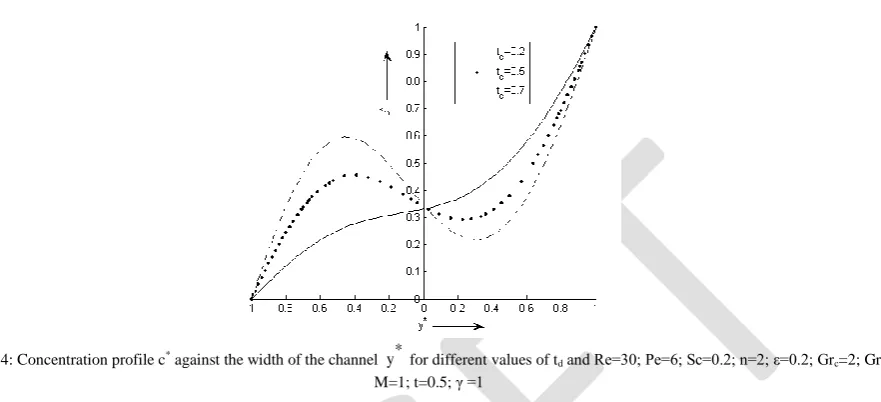
Figure 4: Concentration profile c* against the width of the channel y for different values of t*
d and Re=30; Pe=6; Sc=0.2; n=2; ε=0.2; Grc=2; Gr=2;
M=1; t=0.5; γ =1
Figure 4 depicts that as the value of the thermal diffusion parameter td increases the concentration of the rarer and
lighter component of the binary fluid mixture increases sharply at any point in the region y * ≤ 0 and there is a sharp decrease in the concentration of the rarer and lighter component of the binary fluid mixture at any point in the other half of the channel. Thus by increasing in the value of thermal diffusion parameter td which depends on Soret number
and temperature gradient between the two plates can increase the concentration of the rarer and lighter component of the binary fluid mixture at any point in the region [-1, 0] and can decrease the concentration of the rarer and lighter component of the binary fluid mixture in the region [0, 1].
Figure 5: Concentration profile c* against the width of the channel y for different values of Pe and Sc=0.2; Re=30; t*
d=0.5; n=2; ε=0.2; Grc=2;
Gr=2; M=1; t=0.5; γ =1
ISSN: 2319-8753
International Journal of Innovative Research in Science,
Engineering and Technology
(An ISO 3297: 2007 Certified Organization)
Vol. 3, Issue 8, August 2014
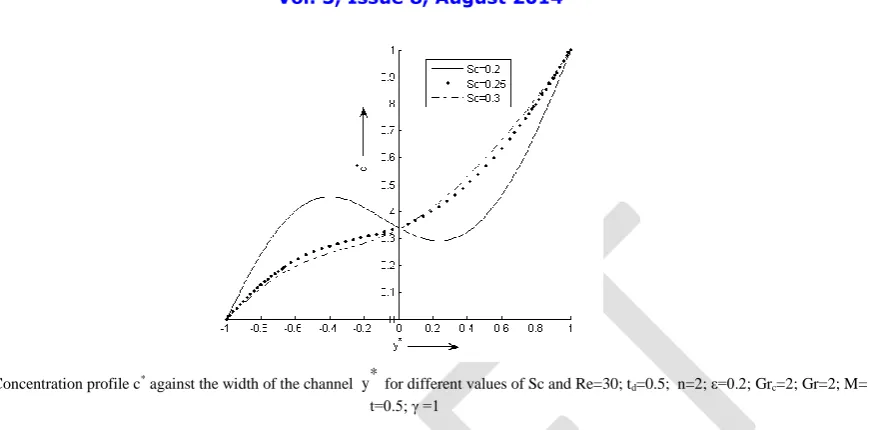
Figure 6: Concentration profile c* against the width of the channel y for different values of Sc and Re=30; t*
d=0.5; n=2; ε=0.2; Grc=2; Gr=2; M=1;
t=0.5; γ =1
From the Figure 6 it is clear that the concentration of the rarer and lighter component of the binary fluid mixture decreases gradually in the region y* ≤ 0 and then increases in the other half of the channel as the value of Schmidt number (Sc) increases. Thus by increasing the value of Schmidt number (Sc) which depends on kinematic viscosity and mass diffusion can decrease the concentration of the rarer and lighter component of the binary fluid mixture at any point in the region [-1, 0] and can increase the concentration of the rarer and lighter component of the binary fluid mixture at any point in the region [0, 1].
V. CONCLUSION
From the observations it is clear that the non dimensionless parameters Re, γ, td, Sc and Pe play important roles in the
mass distribution of species of a binary fluid mixture in an unsteady Couette flow between two vertical moving plates. Concentration of the rarer and lighter components of the binary fluid mixture increases as y* increases from -1 to 1 with the increase in the values of Re, Pe and Sc and concentration of the rarer and lighter component of the binary fluid mixture decreases with the increase in the value of td and chemical reaction parameter γ. Thus Re, Pe, Sc enhance the
rate of separation and td, γ diminish the rate of separation of the rarer and lighter component of the binary fluid
mixture.
ACKNOLEDGEMENTS
The second author is thankful to Nagaland Government for providing financial support and to Dibrugarh University for providing all academic facilities during the preparation of this research paper.
REFERENCES
[1] Landau, L.D., and Lifshitz, E. M., “Electrodynamics of Continuous Media”, Pergamon Press, New York., 1960.
[2] De Groot, S.R., Mazur, P., and Mazur, S., “Non–Equilibrium Thermo-dynamics”, North Holland Publishing Co., Amsterdam, 1962.
[3] Bodosa, G., and Borkakati, A.K., “MHD Couette flow with heat transfer between two horizontal plates in the presence of a uniform magnetic field”, Theoret. Appl. Mech., vol.30, No.1, pp.1-9, 2003.
[4] Sharma,B. R., and Singh, R. N., “Soret effect in generalized MHD Couette flow of a binary mixture”, Bull Cal Math Soc.,vol.96, pp.367-374, 2004.
[5] Sharma, B.R., Singh, R.N., “Soret effect due to natural convection between heated vertical plates in a horizontal small magnetic field”, Ultra Science, vol. 19, pp. 97-106, 2007
ISSN: 2319-8753
International Journal of Innovative Research in Science,
Engineering and Technology
(An ISO 3297: 2007 Certified Organization)
Vol. 3, Issue 8, August 2014
[7] Sharma, B.R., and Singh, R.N., “ Baro diffusion and thermal diffusion a binary fluid mixture confined between two parallel discs in presence of a small axial magnetic field”, Latin American Applied Research vol. 38, pp. 313-320, 2008.
[8] Sharma, B. R., and Singh, R.N., “Thermal diffusion in a binary fluid mixture confined between two concentric circular cylinders in presence of radial magnetic field”, Journal of Energy Heat Mass Transfer, vol. 31, pp. 27-38, 2009.
[9] Sharma, B.R., Singh, R.N., “ Separation of species of a binary fluid mixture confined between two concentric rotating circular cylinders in presence of a strong radial magnetic field”, Heat Mass Transfer,vol. 46, pp. 769-777, 2010.
[10] Das, K., and Jana, S., “Heat and Mass transfer effects on unsteady MHD free convection flow near a moving vertical plate in porous medium”, Bull. Soc. Math., Banja Luka, vol. 17, No.10, pp. 15-32, 2010.
[11] Sharma, B.R., Singh R.N., and Gogoi, Rupam Kr.,“Effect of a Strong Transverse Magnetic Field on Separation of Species of a Binary Fluid Mixturein Generalized Couette Flow”, International Journal of Applied Engineering Research, vol. 6, pp. 2223-2235 , 2011.
[12] Sharma, B.R., Singh, R.N., Gogoi, Rupam Kr., and Nath, Kabita, “Separation of species of a binary fluid mixture confined in a channel in presence of a strong transverse magnetic field”, Hem. Ind.,vol. 66, No.2, pp. 171-180, 2012.
[13] Sharma, B.R., and Nath, Kabita, “Effect of axial magnetic field on demixing of a binary fluid mixture due to the rotation of a heated sphere” Int. Journal of Computer Applications, ISSN 0975-8887,vol.53,No.10, pp.47-52,2012.