Date of Tests:
October, 2004Vendor:
Polycom Inc. Pleasanton, CA (925) 924-6000 www.polycom.comProduct Tested:
SoundStation2WPart #: 2201-07880-001 X2 CF Version: 1668-07881-001 Rev A
Serial number: G204250011817 CVM: 1.58
DSP: S2W.CON.01.015 CPLD: 1.00
Additional Equipment Tested:
SoundStation2W-EX
Part #: 2200-07800-001 C Version: 1668-07802-001 Rev A Serial Number: G204350030713
CVM: 1.58 DSP: S2W.CON.01.015
CPLD: 1.00
ClearOne Max
Model: 910-158-030 Version: Rev 1.2 Serial number: 09670346
T
ESTING
R
EPORT
:
Polycom® SoundStation2W™
Executive Summary:
Polycom® commissioned CT Labs to compare their SoundSta-tion2W™ wireless conference phone unit against the ClearOne Max product. Both units were subjectively tested under a variety of real-world conference room conditions. Overall, CT Labs found the SoundStation2W to be an excellent wireless conference phone product. The SoundStation2W was easier to install and configure, primarily due to the menu buttons and on-screen text. These, along with the button design and layout, made the SoundSta-tion2W easier to use than the Max, and it provided more advanced features, including a display of phone book entries, and the ability to place conference calls using a cellular phone in addition to the usual land line connections.
The Converged Communication In-dustry’s Premier Testing Service
In the small conference room tests, the SoundStation2W per-formed better than the Max in transmitting very quiet talking in the presence of background noise. In the wireless tests comparing subjective audio quality, the SoundStation2W performed better than the Max, even with no added RF interference. When 802.11b RF interference was added near the conference unit, the Sound-Station2W was found to be substantially better than the ClearOne Max.
During our cellular test, we found that the SoundStation2W could easily attach to a cell phone to create a mobile conferencing unit with call quality equal to that of an ordinary cell phone call – very nice! The SoundStation2W EX unit—designed for larger confer-ence rooms—was found to work very well and provided plenty of high-quality audio to fill the room.
Product Description:
The Polycom SoundStation2W is a high-quality wireless conference phone with 2.4 GHz wireless technology, added security of voice encryption, up to 24 hours of talk time, and the ability to place con-ference calls using a cell phone.
SoundStation2W is twice as loud and provides twice the microphone sensitivity as the original SoundStation®. The 2.4 GHz platform pro-vides simple and robust wireless capability with any analog phone line. SoundStation2W supports a 150 foot wireless roaming range from the base station, wireless frequency hopping to avoid interfer-ence, and a long-lasting Lithium-ion battery.
Testing Setup:
H
21'-5 3/8"
11
'-0
"
18'-6 5/8"
7'
-8
5
/8
"
A
D
E
B C
F G
CU
Ceiling Height = 9'
76"
50" 51"
51" 50"
31"
Laptop
La
pt
op
12" 24"
Small Conference Room Test Setup
Base Unit
Figure 1: Small Conference Room Test Setup
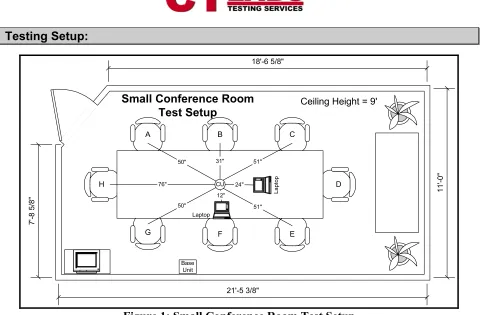
For the Small Conference Room Test Setup (shown in Figure 1), one male tester was located in a separate office using a desktop phone with a handset to communicate with four testers (2 male and 2 female) located in the conference room diagrammed above.
Office #1
Office #2 Conference Room
CU Desktop
Telephone
Base Unit
50 feet 35 feet
2.4 GHz Wireless Router
Laptop computer
2.5 feet 2.5
feet Wireless Test Setup
Figure 2: Wireless Test Setup
Office #1
Office #2
Conference Room
CU
Desktop Telephone
Base Unit 50 feet
35 feet
cellular adapter
Cellular Test Setup
Figure 3: Cellular Test Setup
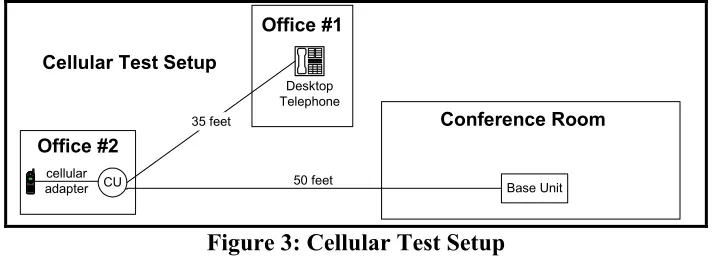
For the Cellular Test Setup (shown in Figure 3), the base unit and the wireless phone unit with the cellular adapter attached were located within the CT Labs test facilities building, where a total of five walls separated the base unit from the wireless phone unit. The base unit was not powered up for any of these tests. Two test-ers (1 male, 1 female) performed a manual speech quality assessment in this configuration.
Summary of Subjective Tests Performed:
Installation and Configuration Evaluation:The purpose of this evaluation was to determine how easy and
error-free the installation and configuration of the unit were to perform, using only the provided vendor documentation.
Display and User Interface Evaluation: The purpose of this evaluation was to determine the functionality,
consis-tency, and ease-of-use of the product while using it to exercise as many of the phone’s features as possible in the time frame designated for this test.
Small Conference Room Tests: The following tests were performed in the small conference room setting:
1. Basic Conversation with Dynamic Range Test: The purpose of this test was to determine basic quality and the
abil-ity of the conference unit to handle varying sound levels. The participants in this test were positioned at fixed loca-tions in the conference room. During the dynamic range portion of this test, the staff used a variety of voice loudness levels1 (loud, normal, quiet, and whispering).
2. Conversation + Background Noise Test: The purpose of this test was to determine the unit’s ability to handle
con-versations in the presence of several typical office noise conditions. Two types of background noise were introduced: (1) a single fan in a fixed location in the conference room and (2) a composite road traffic audio loop (3 minute dura-tion) was played through speakers2 with the intention of creating sound levels consistent with a window opened onto a street moderately busy with traffic.
3. Acoustic Echo Cancellation Test: The purpose of this test was to compare acoustic echo cancellation performance
of the units. The scripted actions in this test involved “real-world” movement scenarios, designed to duplicate people-movement conditions that would typically occur during a conference call. For each scenario, the tester using the “far end” telephone in the quiet office would quickly speak “One, two, three, four, five,” while carefully listening for how much of that utterance could be heard in a return echo.
4. Loudness Test: The purpose of this test was to verify speech quality at the highest volume level for each unit setting.
This test was performed with one person in the conference room using the conference phones, and one person in a separate office using a desk phone handset. Only one conference unit was active at a time -- the base unit for the other phone was unplugged when not in use. The peak volume output of each phone was measured in the conference room while the desk phone user spoke in a very loud voice.
Cellular Tests: The purpose of this test was to verify the level of voice quality of the SoundStation2W conferencing
phone unit while placing calls via a Nokia 2260 cellular phone on the AT&T Wireless TDMA network and the PSTN. Comparisons with cell phone-to-PSTN calls were made to confirm that speech quality was as good as or better than cell phone usage alone using the same test locations.
Wireless Tests: The purpose of this test was to determine the voice quality of the phone units at a distance of 30 to
50 feet from their respective base units, with and without added RF interference from another wireless product oper-ating in the vicinity of the conference unit.
1 All loudness levels used during these tests were calibrated for each speaker using an SPL meter.
2 Two small stereo speakers were used for mid-range and treble, and a single floor-mounted base woofer was used. All speakers
SoundStation2W™
CT Labs Test Results and Findings:
Installation and configuration:
The Polycom SoundSta-tion2W and the ClearOne Max were comparable for ease of setup. The configuration of the SoundStation2W was found to be supe-rior to that of the Max, mainly due to the dedicated menu buttons and descriptive on-screen text provided by the SoundStation2W. The SoundStation2W base unit’s separate power cord allows you to place the base unit in any desired location near a power outlet. With the Max, the base unit plugs directly into the power outlet, which means that the entire unit ends up hanging on the wall or hanging off of a power strip. Also, with the Max, we absolutely needed to use the instruction booklet in order to complete the con-figuration of the phone; the SoundStation2W was much more in-tuitive to set up. Overall, we rated the installation and configura-tion of the SoundStaconfigura-tion2W a “9.8”, and the ClearOne Max a “9.3.”User interface/features analysis:
As compared to the ClearOne Max, the Polycom SoundStation2W offered more fea-tures, including the unique ability to use the conference unit with a cellular phone. Very nice! The SoundStation2W buttons were more user-friendly, since they were slightly concave, not-too-tall, and well placed. With the dedicated-function menu buttons, soft-keys, scrolling menus, and display adjustment and backlighting, the SoundStation2W has an obvious user interface edge over the Max. Overall, the SoundStation2W was found to have a signifi-cantly superior user interface.Features we considered outstanding for the SoundStation2W: de-scriptively labeled, single-function buttons for menu navigation, variable-function soft-key buttons, and the on-screen display of menus and options make for extremely easy learning and use of the phone. A 25 entry phone book allows entries to be displayed in name, company, or phone number order. Even the shape and size of the buttons added to the unit’s ease of use.
The ClearOne Max, on the other hand, provided only minimal explanatory text on the display screen and the phone book con-tents (up to 9 entries) were not viewable. The user is expected to know beforehand which speed dial number is associated with which phone number.
SoundStation2W™
Small Conference Room Tests:
The results of the small conference room tests are presented in this section.During the Basic Conversation Test, the SoundStation2W per-formed the best, with just a slight bit of graininess noted by the participants in the conference room. The ClearOne Max had a small amount of background noise, and the audio level was slightly low as rated by the desk phone participant. The confer-ence room participants also found the Max audio to be noticeably more grainy than the SoundStation2W.
During the Dynamic Range Tests, the SoundStation2W per-formed very well at all audio levels, even when the conference room participants whispered. The ClearOne Max also performed well, but the desk-phone participant found the speech audio level to be too loud when conference room participants spoke loudly. During the Conversations with Background Noise (Condition #1-fan noise) Test, the SoundStation2W was found to have more difficulty transmitting conference room speech during double-talk conditions. The SoundStation2W was noted to have a fast speaker mute on the desk phone talker’s audio but a slower response for re-enabling the conference room microphones when the desk-phone user stopped speaking. The effect of this: it as slightly harder to carry on a full-duplex conversation when the conference room participant speaks at a lower volume than the desk phone participant. However, the ClearOne Max did not handle the transmission of quieter (whispering) talking as well as the Sound-Station2W with fan background noise, as the audio was described by the desk-phone participant as synthetic sounding and “muddy”. During the Conversations with Background Noise (Condition #2-traffic noise) Test, both the SoundStation2W and the Clear-One Max performed well, even with quiet talking.
During the Acoustic Echo Cancellation Tests, the ClearOne Max produced no detectable echoes during our subjective tests, while the SoundStation2W produced small amounts of echo when a par-ticipant moved closer to the conference phone unit. This echo, however, was quickly suppressed within a few seconds and was not found to significantly alter the conversation flow.
About CT Labs
CT Labs is an independent, full-service testing and product analy-sis lab exclusively serving the Converged Communication and IP Telephony industries. CT Labs’ testing automation specialists not only perform a wide variety of standard test suites that validate and exercise products, but can also create custom-developed tests for special testing needs. Testing solutions include tele-phone and graphical user inter-face functional, regression, and load / stress tests. CT Labs prides itself on working with cutting edge technology and products.
The CT Labs Tested program was
designed to provide independent testing and validation of products, including the execution of tests that verify real-world performance and ease of use. Products that
display the CT Labs Tested label
have been tested by CT Labs and have exhibited a high level of quality in their performance and use.
For more information about this or other testing services, contact:
CT Labs
916-577-2100 voicewww.ct-labs.com
Copyright © 2004 CT Labs
This report is intended to be reproduced in its entirety – no portion of this report may be reprinted without prior written permission from CT Labs.
Wireless Tests:
During the baseline wireless tests (with no RF interference), the SoundStation2W was found to work better than the Max. With the SoundStation2W, some dropouts were noted in the audio, especially during double-talk situations. Very slight echo was noted at the beginning of some speech segments, with a slight bit of graininess. With the Max, some pops and clicks were heard, along with some dropouts in the audio. Some echo was heard during double-talk situations along with a slight amount of graininess and distortion.The same subjective speech evaluation was then performed with added RF interference. In this test, the Polycom SoundStation2W unit was much less affected by the addition of 802.11b RF inter-ference than the ClearOne Max. Specifically, the Sound-Station2W performed in a manner similar to the baseline test but with slightly more apparent echo at the beginning of speech seg-ments. The Max, on the other hand, produced many audible pops and clicks, a large number of audio dropouts, many instances of distortion, and some graininess. Under these conditions, it was very difficult to carry on a conference call using the Max.
In the presence of 802.11g RF interference, the SoundStation2W was found to be slightly less affected than the Max. The Sound-Station2W performed about the same as it had with the 802.11b interference, while the Max produced some pops and clicks, some dropouts and echo, a small amount of graininess, and instances of distortion. These interference-induced events affected our ability to carry on a conference call using the Max unit.
Cellular Tests:
After performing several cell phone-to–desk phone calls to determine baseline call quality, the Sound-Station2W was connected to the cellular phone, allowing a con-ference call to be conducted through the SoundStation2W. No discernable decrease in call quality was noted when using the SoundStation2W in this configuration.Large Conference Room Tests:
SoundStation2W EX with add-on microphone Tests:
The SoundStation2W EX, which is designed for larger conference rooms, was then tested. The EX is basically the SoundStation2W unit with support for two add-on microphones. In a 24 x 30 foot room outfitted with a 12’ long table, the additional EX micro-phones were found to perform well. It was very easy for the desk-phone participant to hear even whispering from all participants in the conference room, with the quality of the call being very good.