Protocol for Privacy Protection in IoT
Seyed Farhad Aghili and Hamid Mala
Department of Information Technology Engineering, Faculty of Computer Engineering, University of Isfahan, Hezar
Jerib St., Isfahan 81746-73441, Iran
{sf.aghili@eng, h.mala@eng}.ui.ac.ir
Abstract. The designers of Radio-Frequency IDentification (RFID) systems have a challenging task for
proposing secure mutual authentication protocols for Internet of Things (IoT) applications. Recently, Fanet
al.proposed a new lightweight RFID mutual authentication protocol in the journal of IEEE Transactions
on Industrial Informatics. They claimed that their protocol meets necessary security properties for RFID
systems and can be applied for IoT. In this paper, we analyze the security of this protocol and show that it
is vulnerable against secret disclosure, reader impersonation and tag traceability attacks. Additionally, we
show that in their protocol the anonymity of the tag does not held.
keywords:RFID, IoT, Secret disclosure, Impersonation attack, Anonymity.
1
Introduction
Radio-frequency identification (RFID) is a short range communication technology that is coming to increasing
use as an alternative for bar codes in identifying tagged objects. Generally, an RFID system consists of tag
and reader, and when involving a large capacity of calculation and information, it also requires a server. The
tag usually contains private and important information about the products, and the reader tries to establish a
connection with the tag all the times to achieve the information from the tag. Free-space information transfer in
RFID system makes it vulnerable against security threats such as eavesdropping. Considering the limitations
of tags, we cannot use the advanced crypto primitives such as AES, DES, RSA and SHA1. However,
light-weight cryptography is used in the majority of suggested protocols such as light-light-weight hash functions and
logical operations like XOR and bit rotation [1]. Traditionally, an RFID system involves two recommended
– The channel between the tag and the reader that can be in two states: forward channel and backward
channel in each time. When sending message from the reader to the tag, we have a forward channel but if
the message is being sent in reverse, we have a backward channel. The important challenge in this channel
is eavesdropping of the messages.
– The channel between the reader and the server is formed when the reader and the server communicate
with each other. When an RFID system is employed in an IoT network, this channel is unsecure.
Recently, Fanet al.[2] proposed a mutual authentication protocol and claimed that their protocol owned the
security properties necessary for RFID systems and is suitable for IoT. In this paper, we show that this protocol
has several vulnerabilities. The presented attacks are designed for RFID-based IoT systems.
Paper organization In this paper, the related work is briefly introduced in Section 2. Preliminaries and
nota-tions used in this paper are mentioned in Section 3. We briefly describe Fanet al.lightweight authentication
protocol [2] in Section 4. We analyze the security of Fanet al. protocol in Section 5, and propose several
attacks against this protocol. Finally, in Section 6 we conclude the paper.
2
Related work
In recent decade, many authentication protocols have been proposed for RFID systems. For example, the
HB-family (HB, HB+, HB++, etc.) [3–5] by employing matrix multiplication and some XORs, and the
MAP-family (EMAP, M2AP, LMP+and etc.) [6–8] based on bitwise operations like AND, XOR and OR are some
of the lightweight authentication protocols proposed in literature. However, these two models have several
limitations, weaknesses and vulnerabilities [9–13]. Later, in [14], Kulsenget al.proposed a lightweight
solu-tion to mutual authenticasolu-tion for RFID systems by using Physically Unclonable Funcsolu-tions (PUFs) and Linear
Feedback Shift Registers (LFSRs) which are lightweight operations. However, Kardas [15] showed that their
protocol is not resistant against message injection attack, and has several vulnerabilities.
In order to overcome RFID authentication problems, Cheng et al. [16] employed Chebyshev chaotic
maps. However, Akgun and Caglayan in [17] proposed several attacks like de-synchronization attack and
secret disclosure attack against Chenget al.protocol. In 2014, Benssalahet al.proposed an improvement to
overcome these weaknesses [18]. However in [19], Akgunet al.showed that their protocol is vulnerable to
In [20], Zhuet al.proposed a new Authentication protocol for RFID systems in the Internet of things and
claimed that their protocol is secure. However, in [21] Erguler showed that Zhuet al.’s protocol is vulnerable to
de-synchronization, replay and reader impersonation attacks, which are based on reader compromised attack.
In [22], the authors proposed an ultra-lightweight RFID mutual authentication protocol for IoT in a secure
manner. However, the authors in [23] illustrate that their protocol cannot satisfy all security issues in
RFID-based IoT systems and an attacker can compromise the reader and then execute the denial of service (DoS),
reader and tag impersonation and de-synchronization attacks.
Recently, Fanet al.proposed a lightweight mutual authentication protocol [2]. They claimed that their
pro-tocol owned the security properties necessary for RFID systems and is suitable for universal RFID applications
such as IoT. In this paper, we show that this protocol has several vulnerabilities.
3
Preliminaries and notations
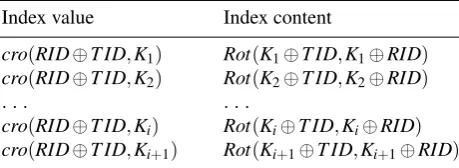
In this section we describe the operation of bit cross (cro(x,y)), Index Data Table(IDT)and notations used in this paper (Table 1).
Table 1.Notations
Notation Description
RID Private ID of the tag T ID Private ID of the reader
NR,NT,NSRandom numbers generated by the reader, the tag and the server respectively
Ki The i-thsession key
PRNG(·) The Pseudo Random Number Generator function cro(x,y) The operation of bit cross
Rot(x,y) The operation of rotation,x=W(y)
⊕ Exclusive OR operation Mark The status of the last session k Concatenation operation
Definition 1: cro(x,y). Suppose thatxandyare two N-bit strings, the corss operation is defined as below: – ∼xmeans the not operation onx.
– The odd bits value of∼xkyare XORed by the even bits of∼ykx, and the result is regarded as the odd
– The even bits of∼xkyare XORed by the odd bits of∼ykx, and the result is regarded as the even bits of
the final result denoted bycro(x,y).
Definition 2: Index Data Table. In Fanet al.scheme, the Index Data Table included index value and index
content which are unique (Table 2). In every session, the value of key is updated, so the index value is fresh
for each session. Moreover, after every successful session, the status ofMarkchanges to "10" from "00".
Table 2.Index Data Table
Index value Index content
cro(RID⊕T ID,K1) Rot(K1⊕T ID,K1⊕RID)
cro(RID⊕T ID,K2) Rot(K2⊕T ID,K2⊕RID)
. . . .
cro(RID⊕T ID,Ki) Rot(Ki⊕T ID,Ki⊕RID)
cro(RID⊕T ID,Ki+1) Rot(Ki+1⊕T ID,Ki+1⊕RID)
4
Fan
et al.
authentication protocol
Recently, Fanet al.proposed a lightweight mutual authentication protocol for RFID systems and they claimed
that their protocol could be used for the IoT. When an RFID system is applied in the IoT, a significant challenge
that must be taken into account by the protocol designer is the potentially insecure channel between the server
and the reader.
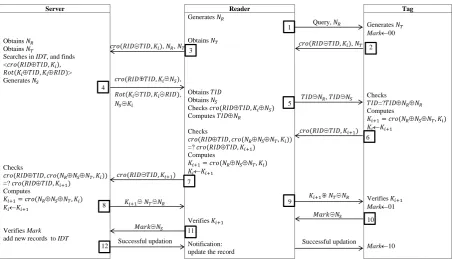
In Fanet al.protocol the three components of the protocol pre-share the tuple(Ki,cro(·),Rot(·),PRNG(·)). The protocol, as shown in Fig. 1, runs the following steps.
1. The reader starts the protocol by sending a random numberNRto the tag;
2. Once the tag received this message, generates a random numberNT and setsMark=00. It then transmits
cro(RID⊕T ID,Ki)kNT to the reader.
3. After receiving the message, the reader obtainsNTand forwardscro(RID⊕T ID,Ki)kNRkNT to the server. 4. Once the server received the message, it obtainsNRandNT and then employscro(RID⊕T ID,Ki)to find the corresponding index content in theIDT. If it can find a match, it indicates that the last session has
been done correctly and the current session is executable. Then the server generates a random number
Server Reader Tag
Obtains Obtains
Searches in IDT, and finds < ( ) ( )> Generates Checks ( ( )) =? ( ) Computes ( )
Verifies Mark
add new records to IDT
Generates
Obtains
Obtains
Obtains
Checks ( )
Computes Checks ( ( )) =? ( ) Computes ( ) Verifies Notification: update the record
Generates
Mark00
Checks =? Computes ( ) Verifies
Mark01
Mark10 Query, 𝑁𝑅
𝑐𝑟𝑜(𝑅𝐼𝐷 𝑇𝐼𝐷 𝐾𝑖), 𝑁𝑇 𝑐𝑟𝑜(𝑅𝐼𝐷 𝑇𝐼𝐷 𝐾𝑖), 𝑁𝑅, 𝑁𝑇 𝑐𝑟𝑜(𝑅𝐼𝐷 𝑇𝐼𝐷 𝐾𝑖 𝑁𝑆), 𝑅𝑜𝑡(𝐾𝑖 𝑇𝐼𝐷 𝐾𝑖 𝑅𝐼𝐷), 𝑁𝑆 𝐾𝑖 𝑇𝐼𝐷 𝑁𝑅, 𝑇𝐼𝐷 𝑁𝑆 𝑐𝑟𝑜(𝑅𝐼𝐷 𝑇𝐼𝐷 𝐾𝑖 ) 𝑐𝑟𝑜(𝑅𝐼𝐷 𝑇𝐼𝐷 𝐾𝑖 ) 𝐾𝑖 𝑁𝑇 𝑁𝑅 𝐾𝑖 𝑁𝑇 𝑁𝑅 𝑀𝑎𝑟𝑘 𝑁𝑆 𝑀𝑎𝑟𝑘 𝑁𝑆
Successful updation Successful updation
1 2 3 4 5 6 7
8 9
10
11
12
Fig. 1.Fanet al.authentication protocol
5. Once the reader received the tuple (cro(RID⊕T ID,Ki⊕NS)kRot(Ki⊕T ID,Ki⊕RID)kNS⊕Ki), accord-ing to the hammaccord-ing weightW(Ki⊕T ID)of the rotation operation andKi⊕Ki⊕T IDit obtainsT ID. It
then obtainsNSand verifies the value ofcro(RID⊕T ID,Ki⊕NS)by comparing with the received value. If so, it computesT ID⊕NRandT ID⊕NSand sends them to the tag.
6. After receiving this message, the tag obtainsNSand ifT ID=T ID⊕NR⊕NRholds, it authenticates the
server and the reader. Then the tag updatesKiasKi+1=cro(NR⊕NS⊕NT,Ki)and sends it to the reader involved in the messagecro(RID⊕T ID,Ki+1). Otherwise the authentication fails.
7. Upon receiving the messagecro(RID⊕T ID,Ki+1), ifcro(RID⊕T ID,cro(NR⊕NS⊕NT,Ki)) =cro(RID⊕
T ID,Ki+1)holds, the reader updatesKiby the same equationKi+1=cro(NR⊕NS⊕NT,Ki)and sends it to the server by the messagecro(RID⊕T ID,Ki+1). Otherwise the protocol will be terminated.
8. Once the server received this message, it does the same checking operation and if it holds, the server
9. Upon receiving the messageKi+1⊕NT⊕NR, ifKi+1= (Ki+1⊕NT⊕NR)⊕NT⊕NRholds, the reader
verifiesKi+1and sends the messageKi+1⊕NT⊕NRto the tag for the same verification process. Otherwise
the protocol will be terminated.
10. Once the tag accepts the validity ofKi+1, it setsMark=01, indicating the synchronization ofKiis
com-pleted. Then the tag computesMark⊕NSand sends it to the server through the reader. Note that in the
original work [2],Markhas been defined as a 2-bit string while parameters likeNSare typically larger
strings, so their XOR does not make any sense. However, without loss of generality, we assumeMarkis
some trivial extension of this 2-bit string.
11. After receiving the messageMark⊕NS, the server obtains the value ofMark and if it is equal to 01,
it concludes that the synchronization ofKi is completed. Then the server adds a new recordcro(RID⊕
T ID,Ki+1),Rot(Ki+1⊕T ID,Ki+1⊕RID)toIDT, after which the notification that the record completes
the update is sent to the tag through the reader.
12. Now, the tag setsMark=10, indicating the authentication protocol is completed.
5
Security analysis of the Fan
et al.
protocol
In this section, we present several attacks against Fanet al.protocol. We show that this protocol is vulnerable
to secret disclosure, reader impersonation and tag traceability attacks. Moreover, we show that in spite of the
designers claim, the protocol fails to protect tag privacy.
Secret disclosure attack In the Fan et al.protocol, the adversary starts the attack by eavesdropping the
messages of Steps 1, 2 and 9 which are respectivelyNR,NT andKi+1⊕NT⊕NR. It then executes the attack by
obtaining the new session keyKi+1from the equationKi+1= (Ki+1⊕NT⊕NR)⊕NR⊕NT.
Attack on the anonymity The attacker can eavesdrop the messages of Steps 1 and 5 which are respectively
NR andT ID⊕NRand jeopardises the anonymity of the target tag by obtaining the identification of the tag
T IDfrom the equationT ID= (T ID⊕NR)⊕NR.
Reader impersonation attack The concept of this attack is that the adversary tries to run a new successful
previous attacks and obtained the tag’s identificationT IDand the tag’s current keyKi. The presented reader
impersonation attack against Fanet al.protocol is described as follows:
1. The adversary starts the protocol by sending random numberNA1to the tag;
2. The tag generates the random numberNT and setsMark=00. It then transmitscro(RID⊕T ID,Ki)kNT to the adversary.
3. Once the adversary received the message, generates another random numberNA2and computesT ID⊕NA1
andT ID⊕NA2and sends them to the tag.
4. After receiving this message, the tag obtainsNA2and verifiesT ID=T ID⊕NA1⊕NA1and authenticates
the adversary. Then it updatesKiasKi+1=cro(NA1⊕NA2⊕NT,Ki)and sends it to the adversary in the blind form ofcro(RID⊕T ID,Ki+1).
5. The adversary usesNA1,NA2,NT andKi, and computesKi+1=cro(NA1⊕NA2⊕NT,Ki). Then, it sends the messageKi+1⊕NT⊕NA1to the tag for the verification process.
6. Upon receiving the messageKi+1⊕NT⊕NA1, the tag checks ifKi+1= (Ki+1⊕NT⊕NA1)⊕NT⊕NA1
holds. So, the tag verifiesKi+1and setsMark=01, indicating the synchronization ofK is completed.
Then the tag computesMark⊕NA2and sends it to the adversary.
7. After receiving the message, the adversary informs the tag that the updation is successful.
8. Now, the tag setsMark=10, indicating the authentication protocol is completed.
Tag traceability attack To trace a target tag, it is enough to link two sessions of the protocol in which
that tag has been involved. In this subsection, we describe a traceability attack on Fanet al.protocol. In this
attack, the adversary uses the link of two sessions of the protocol by eavesdropping the message of Step
1 which iscro(RID⊕T ID,Ki). Before the next update of the tag, its session keyKi is unchanged. So, in
cro(RID⊕T ID,Ki)message, all of the parameters are constant. Thus, the attacker can usecro(RID⊕T ID,Ki) to distinguish and track tags.
6
Conclusion
In this paper, we showed Fanet al.protocol proposed for lightweight RFID systems in IoT is not secure.
We proved that their protocol cannot provide all security requirements in RFID systems and it is vulnerable to
secret disclosure, reader impersonation and tag traceability attacks. Moreover, we showed that in their protocol
References
1. S. Karthikeyan and M. Nesterenko, “RFID security without extensive cryptography,” inProceedings of the 3rd ACM
workshop on Security of ad hoc and sensor networks, pp. 63–67, ACM, 2005.
2. K. Fan, W. Jiang, H. Li, and Y. Yang, “Lightweight RFID Protocol for Medical Privacy Protection in IoT,”IEEE
Transactions on Industrial Informatics, vol. 14, no. 4, pp. 1656–1665, 2018.
3. N. J. Hopper and M. Blum, “Secure human identification protocols,” inInternational Conference on the Theory and
Application of Cryptology and Information Security, pp. 52–66, Springer, 2001.
4. A. Juels and S. A. Weis, “Authenticating pervasive devices with human protocols,” inAnnual International Cryptology
Conference, pp. 293–308, Springer, 2005.
5. J. Bringer, H. Chabanne, and E. Dottax, “Hb++: a lightweight authentication protocol secure against some attacks,” in
Second International Workshop on Security, Privacy and Trust in Pervasive and Ubiquitous Computing (SecPerU’06),
pp. 28–33, IEEE, 2006.
6. P. Peris-Lopez, J. C. Hernandez-Castro, J. M. Estevez-Tapiador, and A. Ribagorda, “EMAP: an efficient
mutual-authentication protocol for low-cost RFID tags,” inOTM Confederated International Conferences" On the Move to
Meaningful Internet Systems", pp. 352–361, Springer, 2006.
7. P. Peris-Lopez, J. C. Hernandez-Castro, J. M. Estevez-Tapiador, and A. Ribagorda, “M2AP: A minimalist
mutual-authentication protocol for low-cost RFID tags,” inInternational Conference on Ubiquitous Intelligence and
Comput-ing, pp. 912–923, Springer, 2006.
8. T. Li, “Employing lightweight primitives on low-cost RFID tags for authentication,” inVehicular Technology
Confer-ence, 2008. VTC 2008-Fall. IEEE 68th, pp. 1–5, IEEE, 2008.
9. H. Gilbert, M. Robshaw, and H. Silvert, “An active attack against HB+ - A provably secure lightweight authentication
protocol,” tech. rep., Cryptology ePrint Archive, Report 2005/237, 2005, available at http://eprint. iacr. org/2005/237.
pdf.
10. K. Ouafi, R. Overbeck, and S. Vaudenay, “On the security of hb# against a man-in-the-middle attack,” inInternational
Conference on the Theory and Application of Cryptology and Information Security, pp. 108–124, Springer, 2008.
11. S. Islam, “Security analysis of LMAP using AVISPA,”International Journal of Security and Networks, vol. 9, no. 1,
pp. 30–39, 2014.
12. M. Safkhani, N. Bagheri, M. Naderi, and S. K. Sanadhya, “Security analysis of lmap++, an RFID authentication
protocol,” inInternet Technology and Secured Transactions (ICITST), 2011 International Conference for, pp. 689–
694, IEEE, 2011.
13. F. Zeng, H. Mu, and X. Wen, “An improved LMAP++ protocol combined with low-cost and privacy protection,” in
14. L. Kulseng, Z. Yu, Y. Wei, and Y. Guan, “Lightweight mutual authentication and ownership transfer for RFID
sys-tems,” inINFOCOM, 2010 Proceedings IEEE, pp. 1–5, IEEE, 2010.
15. S. Kardas, M. Akgün, M. S. Kiraz, and H. Demirci, “Cryptanalysis of lightweight mutual authentication and ownership
transfer for rfid systems,” inLightweight Security & Privacy: Devices, Protocols and Applications (LightSec), 2011
Workshop on, pp. 20–25, IEEE, 2011.
16. Z.-Y. Cheng, Y. Liu, C.-C. Chang, and S.-C. Chang, “Authenticated RFID security mechanism based on chaotic maps,”
Security and Communication Networks, vol. 6, no. 2, pp. 247–256, 2013.
17. M. Akgün, T. Uekae, and M. U. Caglayan, “Vulnerabilities of RFID security protocol based on chaotic maps,” in2014
IEEE 22nd International Conference on Network Protocols, pp. 648–653, IEEE, 2014.
18. M. Benssalah, M. Djeddou, and K. Drouiche, “Security enhancement of the authenticated RFID security mechanism
based on chaotic maps,”Security and Communication Networks, vol. 7, no. 12, pp. 2356–2372, 2014.
19. M. Akgün, A. O. Bayrak, and M. U. ÇaǢglayan, “Attacks and improvements to chaotic map-based RFID
authentica-tion protocol,”Security and Communication Networks, vol. 8, no. 18, pp. 4028–4040, 2015.
20. W. Zhu, J. Yu, and T. Wang, “A security and privacy model for mobile RFID systems in the internet of things,” in
Communication Technology (ICCT), 2012 IEEE 14th International Conference on, pp. 726–732, IEEE, 2012.
21. I. Erguler, “A potential weakness in rfid-based internet-of-things systems,”Pervasive and Mobile Computing, vol. 20,
pp. 115–126, 2015.
22. K. Fan, Y. Gong, C. Liang, H. Li, and Y. Yang, “Lightweight and ultralightweight RFID mutual authentication protocol
with cache in the reader for IoT in 5G,”Security and Communication Networks, vol. 9, no. 16, pp. 3095–3104, 2015.
23. S. F. Aghili, M. Ashouri-Talouki, and H. Mala, “DoS, impersonation and de-synchronization attacks against an