Revocable Identity-based Encryption from Codes with Rank Metric
?Donghoon Chang1, Amit Kumar Chauhan2, Sandeep Kumar1,3, and Somitra Kumar Sanadhya2 1 Indraprastha Institute of Information Technology (IIIT-D), Delhi, India
{donghoon,sandeepk}@iiitd.ac.in
2 Indian Institute of Technology, Ropar, India
{2017csz0008,somitra}@iitrpr.ac.in
3 Department of Mathematics, Shaheed Bhagat Singh College, University of Delhi, India
Abstract. In this paper, we present an identity-based encryption scheme from codes with efficient key revocation. Recently, in Crypto 2017, Gaborit et al. proposed a first identity-based encryption scheme from codes with rank metric, calledRankIBE. To extract the decryption key from any public identity, they constructed a trapdoor function which relies on RankSign, a signature scheme proposed by Gaborit et al. in PQCrypto 2014. We adopt the same trapdoor function to add efficient key revocation functionality in the RankIBEscheme. Our revocable IBE scheme from codes with rank metric makes use of a binary tree data structure to reduce the amount of work in terms of key updates for the key authority. The total size of key updates requires logarithmic complexity in the maximum number of users and linear in the number of revoked users. We prove that our revocable IBE scheme is selective-ID secure in the random oracle model, under the hardness of three problems: the Rank Syndrome Decoding (RSD) problem, the Augmented Low Rank Parity Check Code (LRPC+) problem, and the Rank Support Learning (RSL) problem.
Keywords :Code-based Cryptography, Identity-based Encryption, Key Revocation, Rank Metric, LRPC Codes,RSDProblem.
1
Introduction
The security of traditional public-key cryptosystems relies mainly on the hardness of factoring large integers, solving discrete logarithmic problems, etc. In the presence of quantum computers, these hard problems would be solvable in polynomial time using Shor’s algorithm [33]. Therefore, it is the need of time to design and analyze post-quantum secure cryptosystems, the importance of which has also been reflected in the efforts made by NIST for standardization of post-quantum secure cryptographic protocols [11]. The currently known post-quantum secure cryptosystem emerge from one of these fields: lattice-based, code-based, hash-based and multivariate polynomial based cryptosystems. In particular, our proposed revocable identity-based encryption scheme relies on hard problems from codes with rank metric.
Code-based Cryptography. The history of code based cryptography is as old as of public key cryptography. The first code based encryption scheme relying on Hamming metric, McEliece cryptosystem [27] was introduced in 1978, that uses binary Goppa codes. Its security is based on indistinguishability of Goppa codes from random codes and the inherent complexity of decoding a random linear code, which is considered to be NP-complete [7].
? A preliminary version of this paper appears in the proceedings of the RSA Conference Cryptographers’ Track 2018
Although it provides fast encryption and decryption procedures, it requires an extremely large public key. Till date, the original proposal made by McEliece has been extensively analyzed and unbroken, but the large public key size makes it impractical to use. Various attempts have been made to overcome this drawback, in terms of using quasi-cyclic codes with different underlying algebraic code, mainly subfamilies of alternant codes [6,17,28]. However, most of these were broken by using structural attacks [15]. To prevent the structural attacks and to reduce the public key size, low-density parity-check codes (LDPC) [23] with quasi-cyclic parity check matrix were introduced and analyzed in [3–5]. The drawback of LDPC codes is that the low weight rows can be seen as low weight codewords in the dual code [30]. In 2013, a promising variant of McEliece cryptosystem (with small key) based on quasi-cyclic moderate density parity-check codes (QC-MDPC) [29] was introduced with a security reduction to syndrome decoding problem for a random quasi-cyclic linear code.
In 1985, Gabidulin [16] proposed rank metric as an alternative to Hamming metric. Indeed, Gabidulin [16] showed that it is possible to construct a rank analogue of Reed-Solomon codes, called Gabidulin codes. The generic syndrome decoding problem for the rank metric is considered to be harder than for the Hamming metric. Many variants of McEliece cryptosystem were proposed based on different masking scheme of Gabidulin codes, but most of these were broken by using structural attacks because of the strong algebraic structure of these codes. To avoid structural attacks, Gaborit et al. [19] introduced Low Rank Parity Check (LRPC) codes, similar to LDPC/MDPC codes. One of the major advantages of LRPC codes is that the decoding error probability can be made arbitrarily small by choosing suitable parameters. Moreover, the complexity of best-known attacks against rank-metric based cryptosystems grows very quickly with the size of parameters. It is possible to obtain a general instance of the rank syndrome decoding problem for (say) 280 security with small public key [19].
Identity-based Cryptography. The idea of identity-based cryptography was first introduced by Shamir [32] in 1984, where the public key of a user is his identity (e.g., email address). The private key corresponds to public identity is issued by a trusted authority called private key generator (PKG), who has the knowledge of some extra secret information to generate private keys. This simplifies the public key infrastructure (PKI) and eliminates the requirement of certificate authorities. In his seminal work, Shamir also proposed a concrete implementation of identity-based signature (IBS) scheme. However, he conjectured that the identity-based encryption (IBE) scheme exists as well. In 2001, Boneh and Franklin [9] proposed a fully functional IBE, built on elliptic curves with bilinear pairings. In 2010, Agrawal et al. [1] proposed an efficient IBE based on lattices. Recently, in 2017, Gaborit et al. [18] also proposed a solution to a long standing open problem of building an IBE from codes.
1.1 Our Results
We construct a revocable IBE (RIBE) from codes with rank metric in the random oracle model. Our construction of RIBE makes use of the following building blocks: (i) IBE from codes with rank metric [18]; (ii) trapdoors using RankSign from codes with rank metric [21]; and (iii) the binary tree data structure for key update used in [2,8,10,25,31].
We note that ourRIBE scheme is not a straightforward combination of the aforementioned building blocks since we require that a user’s public key consists of two components: identity (id) and time (t), in order to obtain the non-interactive key revocation procedure. Thus, our construction requires two instances of Gaborit et al.’s IBE scheme to deal with identities and times respectively. Furthermore, Gaborit et al.’s IBE requires the public key as (A,G), whereas our RIBE requires the public key (A,G,u). We require an extra random vectoruto link the identity with time for each node associated to the binary tree. Briefly speaking, this can be achieved by randomly splitting the vector u into two vectorsu1, u2 for each node corresponding to identity and time, respectively. A similar idea is also used in lattice-based RIBE construction of Chen et al. [10]. However, embedding identity and time attributes with additive shares u1, u2of vectoru in our construction is a different approach.
Though the key generation process is different in ourRIBEscheme but the encryption and decryption process is quite similar toIBE[18], in terms of construction and computational requirement. We are able to add revocable functionality without any increase in the size of ciphertext. The inclusion of binary tree data structure improves the efficiency of secret key updates. The key authority needs to perform key updates which has logarithmic complexity in the maximal number of users and linear complexity in the number of revoked users.
We prove that ourRIBEscheme is selective-ID secure in the random oracle model. The security of RIBE relies on three hard problems: Rank Syndrome Decoding (RSD) problem, Rank Support Learning (RSL) problem and the Augmented Low Rank Parity Check Code (LRPC+) problem.
1.2 Organization of the Paper
This paper is organized as follows. Section 2 presents the basic definitions, Section 3 covers the background on codes with rank metric,RankSignsignature scheme, and how to sample secrets using trapdoors. We then describe the construction of revocable IBE (RIBE) from codes with rank metric in Section 4. Section 4.3 proves that
RIBEisIND-sRID-CPAsecure in the random oracle model and Section4.4suggests general parameters. Section5 concludes the work. In AppendixA, we discuss the hardness of rank syndrome decoding problem. In AppendixB, we state and prove the lemma for the indistinguishability of syndromes generated using augmented parity-check matrix. In AppendixC, we provide the complete security proof of our RIBE.
2
Definitions
2.1 Notation
generally for any positive integer mthe finite field with qm elements is denoted by
Fqm. We use bold lowercase and capital letters to denote vectors and matrices respectively. For two matricesA,Bof compatible dimensions, we let (A|B) and A
B !
respectively denote the horizontal and vertical concatenations ofAandB.
2.2 Syntax of Revocable IBE
Here, we recall the definition of revocable IBE scheme from [8].
Definition 1 (Revocable IBE). An identity-based encryption with efficient revocation or simply Revocable IBE scheme RIBE= (S,SK,KU,DK,E,D,R) is defined by seven algorithms and has associated message space M, identity spaceIand time spaceT. We assume that the size ofT is polynomial in the security parameter. Each algorithm is run by an entity which is of one of the following types –key authority,senderorreceiver.Key authority
maintains a revocation listRLand stateST. We say an algorithm is stateful if it updatesRLor ST.
• The statefulsetupalgorithmS(run bykey authority): takes as input the security parameter 1λand the number of usersN, and outputs public parametersPP, master secret key MSK, revocation list RL(initially empty) and stateST.
• The stateful private key generation algorithm SK (run by key authority): takes as input public parameters
PP, master secret keyMSK, identityid∈ I and stateST, and outputs the private key SKid and an updated stateST.
• Thekey update generation algorithm KU (run by key authority): takes as input the public parameters PP, master secret keyMSK, key update timet∈ T, revocation listRLand stateST, and outputs key updateKUt. • The deterministicdecryption key generation algorithmDK (run byreceiver): takes as input the private key
SKid and key update KUt, and outputs decryption key DKid,t, or a special symbol ⊥indicating that id was revoked. (We say that an identityidwas revoked at timetif revocation algorithmRwas run by key authority on input (id,t,RL,ST) for anyRL, ST.)
• The encryption algorithm E (run by sender): takes as input the public parameters PP, identity id ∈ I, encryption timet ∈ T and messagem ∈ M, and outputs ciphertext c. For simplicity and without loss of generality, we assume thatid,tare efficiently computable fromc.
• Thedecryption algorithmD(run byreceiver): takes as input the decryption key DKid,tand ciphertextc, and outputs a messagem∈ Mor a special symbol⊥indicating that the ciphertext is invalid.
• The statefulrevocation algorithmR(run bykey authority): takes as input the identityid∈ I to be revoked, revocation timet∈ T, revocation listRLand stateST, and outputs an updated revocation listRL.
The consistency condition requires that for allλ∈N, allPPandMSKoutput by setup algorithmS, allm∈ M,
id∈ I,t∈ T and all possible statesST and revocation listsRL, if identityidwas not revoked before or, at timet
then the following experiment returns 1 except with a negligible probability: (SKid,ST)←− SK($ PP,MSK,id,ST); KUt
$
←− KU(PP,MSK,t,RL,ST)
DKid,t $
←− DK(SKid,KUt); c←− E($ PP,id,t, m)
2.3 Security of Revocable IBE
Boldyreva et al. [8] formalized the selective-revocable-ID security that captures the usual notion of selective-ID security and also takes revocation into account. In addition to a private key generation oracleSK(·) that outputs private keys for identities of its choice, the adversary is allowed to revoke users at will using a dedicated oracle R(·,·) (taking as input identities id and time t) and can obtain key update information (which is assumed to be public) for any time t via queries toKU(·). We follow the same definition from Boldyreva et al. [8]. For an adversaryAand number of usersN, we define the following experiment:
ExperimentExpindA,RIBE−srid−cpa(1λ) : (id∗,t∗, state)←− A(1$ λ) (PP,MSK,RL,ST)←− S(1$ λ, N)
(m0, m1, state)← ASK(·),KU(·),R(·,·)(PP, state) β←− {0,$ 1}
c∗←E(PP,id∗,t∗, m
b)
β0← ASK(·),KU(·),R(·,·)(PP, c∗, state)
Ifβ0=β, then return 1, else return 0. The following conditions must always hold:
• m0, m1∈ Mand|m0|=|m1|.
• KU(·) and R(·,·) can be queried on time which is greater than or equal to the time of all previous queries,
i.e., the adversary is allowed to query only in non-decreasing order of time. Also, the oracleR(·,·) cannot be queried at timetifKU(·) was queried at timet.
• IfSK(·) was queried on identityid∗ thenR(·,·) must be queried on (id∗,t∗) for any timet≤t∗, i.e., identity
id∗ must be inRLwhen key update oracle KU(·) is queried at timet∗. We define the advantage ofAas the quantity
Advind-srid-cpaA,RIBE (λ) :=
Pr[β0 =β]−1 2 .
Definition 2. The scheme RIBEis said to be IND-sRID-CPAsecure if the function Advind-srid-cpaA,RIBE (λ)is negligible inλ for any efficient adversaryA.
3
Background on Codes with Rank Metric
Definition 3. (Rank metric over Fn
qm) Let x = (x1, x2,· · · , xn) ∈ Fnqm and consider an arbitrary basis (β1, β2,· · ·, βm) of Fmqm of Fqm viewed as an m-dimensional vector space over Fq. Then each entry xj in this
basis can be written as xj =P m
i=1xijβi. Them×n matrix associated with x is given by M(x)= (xij)1≤i≤m 1≤j≤n
.
The rank weight ofx, denoted bykxk is defined as:
kxk= RankM(x).
Note 1. It can be easily seen that the rank weight is invariant under the choice of basis. One can refer to [26] for more properties of codes with rank metric.
Rank Code.A rank code C of length nand dimension kis a subspace of dimension k ofFn
qm, embedded with the rank metric. The generator matrixGofC, is of sizek×n, consisting ofklinearly independent rows.
Minimum Rank distance:LetCbe a rank code overFqm thenr def
== minc16=c2∈Cd(c1, c2) is the minimum rank distance ofC.
Dual Code. One can define usual inner product onFnqm, to define dual of C. The dual code C0 has dimension n−k and the corresponding generator matrix sayH of size (n−k)×n, forms a parity check matrix forC.
Support ofx.Letx= (x1, x2,· · · , xn)∈Fnqm be a vector of rank weightr. Define the setE=hx1, x2, . . . , xniFq, theFq-linear subspace ofFqm generated by the linear combinations of x1, x2,· · ·, xn overFq. The subspace E is called the support of xand is denoted by Supp(x).
3.1 Bounds for Rank Metric Codes.
To present the analogues of Singleton and Gilbert-Varshamov bound for codes with rank metric, we recall the following definitions (given a vectorx∈Fn
qm):
• Sphere of radius`centered atx:S(x, n, m, q, `) ={y∈Fn
qm |d(x,y) =`}. • Ball of radius`centered atx:B(x, n, m, q, `) =∪`
i=0S(x, n, m, q, i).
Since the rank metric is invariant under the translation of vectors, the volume of a sphere and ball does not depend on the center. Therefore, we can defineS(n, m, q, `) which is equal to number ofm×n,q-ary matrices of rank`, where 0≤`≤min(m, n). ClearlyS(n, m, q,0) = 1. Moreover, one can show that [26]:
S(n, m, q, `) = `−1 Y
j=0
(qn−qj)(qm−qj) q`−qj .
B(n, m, q, `) = ` X
i=0
S(n, m, q, i).
Definition 4 (Rank Gilbert-Varshamov bound (RGV)).For a linear code[n, k]overFqm with rank metric,
the Rank Gilbert-Varshamov (RGV) bound is defined as the smallest integer`, such thatB(n, m, q, `)≥qm(n−k).
From decoding point of view, the Gilbert-Varshamov bound for a code C, with parity check matrix H, is the smallest weight r such that for any syndrome s, there exists on average a codeword x of weight r such that HxT=s. In the case of codes with rank metric, form=n, asymptotically we have [26]:
RGV(n, k, m, q)
n ∼1−
r k n.
Definition 5 (Singleton Bound).The singleton bound for codes with rank metric of minimum rankr, is given
by r≤n−k+ 1; whenn > mthis bound can be rewritten as [26]:r≤1 +
(n−k)m n
3.2 Low Rank Parity Check Codes
Definition 6 (Low Rank Parity Check Codes [19]). A Low Rank Parity Check (LRPC) code of rank d,
lengthnand dimension k overFqm is a code defined by an(n−k)×nparity check matrix H= (hij), such that
all its coordinates hij belong to the sameFq-subspace F of dimensiondof Fqm. We denote by{F1,F2, . . . ,Fd}
a basis of F.
The decoding error probability for LRPC codes can be made arbitrarily small up to n−k
d errors [19].
Definition 7 (Augmented Low Rank Parity Check (LRPC+) Codes [21]). Let H ∈ Fq(nm−k)×n be a
homogeneous matrix of full-rank and of weight d, i.e., all its entries belong to the same Fq-vector subspace of
dimension d. LetR∈Fq(nm−k)×` be a random matrix. Let P ∈GLn−k(Fqm)andQ∈GLn+`(Fq)be two invertible
matrices. Let H0=P(R|H)Q be a parity-check matrix of a code C of type [n+`, `+k]. By definition, such a code is anLRPC+ code. If`= 0,C is an LRPC code.
Definition 8 (Simple Codes [18]). A codeC is said to be(n, k, `)-simple when it has a parity-check matrixH
of the form
H=
0`
In−k R
!
where In−k is the (n−k)×(n−k)identity matrix, 0` is the zero-matrix of size `×k and Ris a matrix over Fqm of size(n−k−`)×k. It is called a random simple code if Ris chosen uniformly at random among matrices
of this size.
Decoding of Simple Code.LetC be a random (n, k, `)-simple code with` < m+n− p
(m−n)2+ 4km
2 and
w an integer. If w ≤`, then C can decode an error of weight wwith probability of failure pf ∼ 1
q`−w+1 when q→ ∞[18].
3.3 Hard Problems for Rank-based Cryptography
The security of code based cryptosystems generally relies on the hardness of syndrome decoding problem. We define the rank metric version of this problem.
Definition 9 (Rank (Metric) Syndrome Decoding Problem (RSD)). Let H be a full rank (n−k)×n
matrix overFnqm withk≤n,s∈Fqnm−kandwbe an integer. The problem is to findx∈Fnqm such thatRank(x) =w
andHx=s. We denote this problem as theRSDq,m,n,k,w problem.
TheRSDproblem has recently been proven hard in [22] on probabilistic reduction. We also discuss the hardness of RSDproblem in Appendix A. This problem has an equivalent dual version. LetHbe a parity-check matrix of a codeC andG be a generator matrix. Then theRSDproblem is equivalent to findm∈Fk
qm and x∈Fnqm such that mG+x=y withRank(x) =wandysome preimage of sbyH.
Definition 10 (Decisional Rank Syndrome Decoding Problem (DRSD)). Let G be a full rank k×n
The hardness of theDRSDproblem is proven in [18].
Definition 11 (Rank Support Learning (RSL) Problem [18]). Let Abe a random full-rank matrix of size
(n−k)×n overFqm andU be a subspace of Fqm of dimensionw. LetO be an oracle which gives samples of the
form(A,Av), wherev←−$ Un. TheRSL
q,m,n,k,w problem is to recoverU given only access to the oracle. We say
that the problem is (N,t, )-hard if for every probabilistic algorithmArunning in time t, we have Pr[A(A,AV) =U]≤, V ←−$ Un×N
When we are allowed to make exactlyN calls to the oracle, we denote this problem byRSLq,m,n,k,w,N problem. The
pair (A,AV) is referred to as an instance of theRSLq,m,n,k,w,N problem. The corresponding decisional problem,
namely DRSL, is to distinguish(A,AV)from(A,Y)whereY ←−$ F(qnm−k)×N. TheRSLq,m,n,k,w,N problem is proven as hard as RSDq,m,n,k,w problem in [18].
Definition 12 (LRPC+ Problem [21]). Given an augmented LRPC code, distinguish it from a random code
with the same parameters.
The hardness of this problem is studied in [21,24].
3.4 RankSign Algorithm
We will use RankSign algorithm [21] to construct trapdoors which will be used to generate the secret keys corresponding to identity and time in our RIBE. The security of RankSign algorithm relies on the hardness of theRSDproblem.
In short, theRankSignalgorithm uses an efficient decoding algorithm which takes input a random word of the syndrome space (obtained from the hash of the file we want to sign) and outputs a word of small weight with the given syndrome. This is an instance of theRSDproblem. However, the parity-check matrixHhas a trapdoor which makes theRSDproblem easy. The public key is a description of the code which hides its structure, while the secret key reveals the structure of the code, which allows the signer to solve the RSD problem. TheRankSignalgorithm does not compute a codeword of weight below the Gilbert-Varshamov bound, but instead a codeword of rank weight between the Gilbert-Varshamov and the Singleton bound. The idea is to use a family of augmented Low Rank Parity Check Codes, and an adapted decoding algorithm (called the General Errors/Erasures Decoding algorithm) to produce such a codeword from any syndrome. The decoding algorithm is probabilistic, and the parameters of the code have to be chosen precisely in order to have a probability of success very close to 1. One can refer to [21] for more details.
3.4.1 Sampling Secrets using Trapdoors from RankSign Algorithm. Similar to the approach of Gaborit et al. [18], we also adapt theRankSign algorithm to construct a trapdoor, by which one can sample the secrets corresponding to a public identity. Associated to a matrixA∈F(qnm−k)×n, we define the functionfAas follows:
The matrixAis generated with a trapdoorT such thatfAis a trapdoor function: from a randomp∈Fnqm, with the trapdoor T, one can sample (s,e) =fA−1(p) such thateis indistinguishable from a random element in Wr, the set of all words of rankr and of lengthn.
We extend the same approach to generate secrets corresponding to two attributes identity and time, but these two attributes are bound together in the sense that two secrets will make a complete decryption key in RIBE
setting. In our case, from a randomp∈Fnqmandu∈Fnqm, with the trapdoorT, one can sample (s,e) =fA−1(p+u) such thateis indistinguishable from a random element in Wr.
4
Revocable IBE from Codes with Rank Metric
4.1 The Binary Tree Data Structure
Our construction makes use of binary tree data structure as described in [8]. We denote the binary tree byBT
and its root node by root. If v is a leaf node thenPath(v) stands for the set of nodes on the path fromv to the
root (inclusive of both v androot). Each user is assigned to a leaf node v. Upon registration, the key authority
provides the user with a set of distinct private keys for each node in Path(v). Whenever θ is a non-leaf node, θ` and θr denote the left and right children ofθ respectively. We assume that all nodes in the tree are uniquely encoded as strings, and the tree is defined by all of its node descriptions.
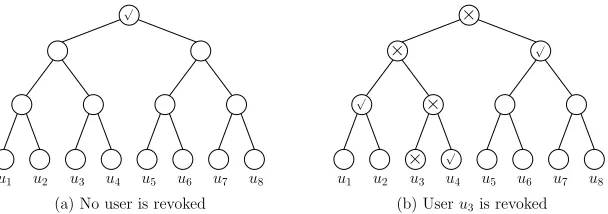
TheKUNodesalgorithm run by thekey authority, at each timet, determines the minimal setY ⊂BTof nodes that contains an ancestor of all leaves corresponding to non-revoked users. This minimal set precisely contains nodes for which key updates have to be published in such a way that only non-revoked users will be able to generate the appropriate decryption key for the matching time. It first marks all ancestors of users that were revoked by timet as revoked nodes. Then, it inserts in Y the non-revoked children of revoked nodes. It can be formally specified as follows:
KUNodes(BT,RL,t) X, Y ←φ ∀(vi,ti)∈RL
ifti ≤t then addPath(vi) toX ∀θ∈X
ifθ`∈/X then addθ` toY, ifθr∈/ X then addθr toY IfY =φthen addroottoY
ReturnY
Thekey authoritythen publishes a key update for all the nodes ofY. A user assigned to leafvis then able to form an effective decryption key for timet if the setY contains a node inPath(v). A graphical description is given in AppendixD.
4.2 Our RIBE Construction
Our Revocable IBE (RIBE) scheme consists of following seven PPT algorithms:
• LetH1:{0,1}∗→Fnqm+`andH2:{0,1}∗→Fnqm+` be two cryptographic hash functions. • Let H is a parity-check matrix of an LRPC code of weight d over Fq(nm−k)×n. Let R ∈ F
(n−k)×` qm be a random matrix. Let P ∈GLn−k(Fqm) andQ ∈GLn+`(Fq) be two invertible matrices. LetA be a full rank (k+`)×(n+`) matrix overFqm such that H0AT=0withH0 =P(R|H)Qand the trapdoorT is (P,Q).
• Define G ∈Fk
0×n0
qm a generator matrix of a public simple code C0 which can decode errors of weight up to 2wr, wherewis the weight of a homogeneous matrix used in encryption algorithm, and ris the rank weight of error vectoreof lengthn+`.
• LetRLbe an empty set and BTbe a binary tree with at leastN leaf nodes, set ST:=BT. • Select a uniformly random vectoru←−$ Fnqm+`.
• OutputRL,ST, the public parameters, and the master key MSK,
PP:= (A,G,u), MSK:=T = (P,Q).
2. Private key generation SK(PP,MSK,id,ST): on input the public parameters PP, the master secret key
MSK, an identityidand the stateST, it picks an unassigned leaf nodev fromBTand storesid in that node. It then performs the following steps:
• ∀θ∈Path(v), ifuθ,1,uθ,2 are undefined, then pickuθ,1 $
←−Fnqm+`, setuθ,2:=u−uθ,1, and store them in nodeθ.
• Computep1=H1(id) and syndromexθ,1=H0pT1 +H0uTθ,1.
• Sampleeθ,1∈Fnqm+`of rank weightr, as H0eTθ,1=xθ,1 using RankSign algorithm with trapdoorT. • Computesθ,1∈Fkqm+` asp1+uθ,1=sθ,1A+eθ,1.
• OutputSKid:={(θ,sθ,1)}θ∈Path(v),ST.
3. Key update generationKU(PP,MSK,t,RL,ST): on input the public parametersPP, the master secret key
MSK, a timet∈Fnqm, the revocation listRL, and the stateST, it performs the following steps: • For allθ∈KUNodes(BT,RL,t), if uθ,1,uθ,2 are undefined, then pickuθ,2
$
←−Fnqm+`, setuθ,1 :=u−uθ,2, and store them in nodeθ.
• Computep2=H2(t) and syndromexθ,2=H0pT2 +H0uTθ,2.
• Sampleeθ,2∈Fnqm+`of rank weightr, as H0eTθ,2=xθ,2 using RankSign algorithm with trapdoorT. • Computesθ,2∈Fkqm+` asp2+uθ,2=sθ,2A+eθ,2.
• OutputKUt:={(θ,sθ,2)}θ∈KUNodes(BT,RL,t),ST.
4. Decryption key generation DK(SKid,KUt): on input a private secret keySKid := {(i,si,1)}i∈I, and key
updateKUt:={(j,sj,2)}j∈J for some set of nodesI,J; it performs the following steps:
• ∀(i,si,1)∈SKid, (j,sj,2)∈KUt, if ∃(i, j) such thati=j thenDKid,t ←(si,1,sj,2); else (ifSKid andKUt do not have any node in common)DKid,t← ⊥.
• OutputDKid,t.
5. Encryption E(PP,id,t,m): on input the public parameters PP, an identity id, a time t, and a message m∈Fk
0
qm, it performs the following steps: • Computep1=H1(id) andp2=H2(t).
• Generate a random homogeneous matrixV ∈Fq(nm+`)×n0 of weightw. • Compute the pair (C,x) ofmas
A
p1+p2+u !
V + 0
mG !
= C
x !
• Output the ciphertextCT= (id,t,C,x).
6. DecryptionD(PP,DKid,t,CT): on input the public parametersPP, a decryption keyDKid,t:= (s1,s2), and a ciphertextCT= (id,t,C,x), it performs the following steps:
• Computep1=H1(id) andp2=H2(t).
• Use the decryption key (s1,s2) withs=s1+s2 to compute
s| −1 C x
!
=sC−x
=−(e1+e2)V −mG.
• Since V is a homogeneous matrix of weight w, and e1, e2 are the error vectors of rank r, we have k(e1+e2)Vk ≤2wr. Therefore, by using the decoding algorithm of C0, we can recoverm.
7. RevocationR(id,t,RL,ST): on input an identityid, a timet, the revocation listRL, and the stateST; letv be the leaf node associated withid. To revoke the identityidat timet, add (v,t) to RL, and returnRL.
4.3 Security Result
Theorem 1. Suppose the hash functions H1 and H2 are random oracles, and the DRSD, DRSL and LRPC+
assumptions hold. Then RIBE scheme is IND-sRID-CPA secure in the random oracle model. More precisely, if
there exists an adversary Aagainst the IND-sRID-CPAsecurity, who makes at mostqH
1 andqH2 distinct queries
to the H1 andH2 random oracles, then the advantage of adversaryAis given by the following expression
ribe ≤ qH 1 +qH2
.
2 q +drsd
+lrpc++drsl,
whereribe,drsd,drsl andlrpc+are respectively the bound on the advantage of the attacks against theRIBEsystem,
the DRSD,DRSL andLRPC+ problems.
• Type 1 Adversary: It chooses to be challenged on the targeted identityid∗ but is revoked before or on time
t∗.
• Type 2 Adversary : It does not challenge the target identityid∗ at any time.
The main difficulty we face in simulating the private key generation and key update oracles with identity
id=id∗ and time t=t∗ respectively, for Type-1 adversary. We need to simulate the queries in such a way that revoked user id∗ does not get key update information at time t∗, since it is revoked at a time t∗. In brief, on private key queryid∗, for nodesθ∈Path(v∗), we choose sθ,1, eθ,1, p1 randomly and define the shares uθ,1 and uθ,2such thatu=uθ,1+uθ,2. On key update queryt∗, for nodesθ /∈Path(v∗), we choosesθ,2,eθ,2,p2randomly and define the sharesuθ,2 anduθ,1such that u=uθ,1+uθ,2. As a consequence, Type-1 adversary does not get the key update information at timet∗ for the identityid∗. On the contrary, it is easy to simulate the queries for Type-2 adversary since it does not query id∗ at any time. Finally, we have a new tuple (p1,u1,s1,e1) which is random, therefore the advantage of adversary to distinguish a RSD pair (A,p+u=sA+e) with a random one, is bounded bydrsdplus some decoding error probability.
In moving from gameG1 toG2, we define matrixAto be a random matrix. Note thatAis used to generate the codewords. Thus, the advantage of adversary in distinguishing an augmented LRPC code from a random code, is bounded by lrpc+.
In moving from gameG2 to G3, we randomly choose challenged ciphertext, then the problem is reducible to
DRSLproblem. Thus, the distinguishing advantage of adversary is bounded bydrsl.
At the end, in gameG4we bound the advantage of adversary to guess the bitβ hidden in perfectly random ciphertext, which is 1/2. This justifies the bound on the advantage of adversary to breakRIBE.
4.4 General Parameters
Here, we discuss the size of parameters for our RIBE scheme against the best known attacks. The parameters used in our scheme are as follows. Letqis the size of the base fieldFq andmis the degree of the extension field Fqm;nis the length of the hidden LRPC code; `is the number of random columns added to the LRPC to hide it; kis the dimension of the LRPC code andr is the rank weight of the signaturee computed by the RankSign
algorithm; (n0, k0, `0) are the parameters of a simple code that can correct up to 2wrerrors. To make the density of decodable syndrome close to 1, these parameters must satisfy the following three conditions [21]:
n=d(n−k); (r−`)(m−r) + (n−k)(rd−m) = 0; r=`+n−k d .
Observe that the three conditions mentioned above are homogeneous ifdis constant. Thus, we can make another set of parameters from one set by multiplying all the parameters (except ford) by a constant.dis the weight of the LRPC+code used for public parameters, which should not be too small to ensure the security of public parameters.
A Practical Set of Parameters. From the security result in Theorem 1, we have ribe ≤ qH
1 +qH2
.2q +drsd+lrpc++drsl. We needribe < 2−λ, where λis the security parameter. Since the first term only depends upon q and the number of queries qH1 and qH2, thus we need q > (qH1 +qH2)2
The size of parameters for ourRIBEare similar toIBEof Gaborit et al. [18] except the case that we have to choose the parameters of the simple code in such a way that it can decode up to 2wr errors and the decoding error with failure probability ≈ 1
q`0 −2wr+1 is small. As an example, we take the standard valuesλ= 128 for the security parameter andqH
1 =qH2 = 2
60, andq= 2192will suffice the standard security requirement. Scheme n n−k m q d ` r dGV dsignPublic Key Size (Bytes) n0 k0 `0 w
RIBE 100 20 96 2192 5 12 16 11 20 4,497,408 of (A,u) 96 9 66 2 With these parameters one can achieve decoding failure probabilitypf ≈2−576, which is negligible.
5
Conclusion and Open Problems
This paper introduced a revocable identity-based encryption scheme, called RIBEfrom codes with rank metric, and proved its selective-ID security in the random oracle model, under the hardness of DRSD,DRSL, andLRPC+
problems. As a future work, it might be possible to construct an adaptive-ID secure RIBE scheme. Another open problem is to construct an adaptive secure IBE and RIBE schemes from rank metric codes in the standard model.
References
1. S. Agrawal, D. Boneh, and X. Boyen. Efficient lattice (H)IBE in the standard model. In Advances in Cryptology - EUROCRYPT 2010, 29th Annual International Conference on the Theory and Applications of Cryptographic
Techniques, French Riviera, May 30 - June 3, 2010. Proceedings, pages 553–572, 2010.
2. W. Aiello, S. Lodha, and R. Ostrovsky. Fast digital identity revocation (extended abstract). InAdvances in Cryptology - CRYPTO ’98, 18th Annual International Cryptology Conference, Santa Barbara, California, USA, August 23-27,
1998, Proceedings, pages 137–152, 1998.
3. M. Baldi, M. Bodrato, and F. Chiaraluce. A New Analysis of the McEliece Cryptosystem Based on QC-LDPC Codes, pages 246–262. Springer Berlin Heidelberg, Berlin, Heidelberg, 2008.
4. M. Baldi, F. Chiaraluce, and R. Garello. On the Usage of Quasi-Cyclic Low-Density Parity-Check Codes in the McEliece Cryptosystem. In2006 First International Conference on Communications and Electronics, pages 305–310, Oct 2006.
5. M. Baldi, F. Chiaraluce, R. Garello, and F. Mininni. Quasi-Cyclic Low-Density Parity-Check Codes in the McEliece Cryptosystem. In2007 IEEE International Conference on Communications, pages 951–956, June 2007.
6. T. P. Berger, P.-L. Cayrel, P. Gaborit, and A. Otmani. Reducing Key Length of the McEliece Cryptosystem, pages 77–97. Springer Berlin Heidelberg, Berlin, Heidelberg, 2009.
7. E. Berlekamp, R. McEliece, and H. van Tilborg. On the inherent intractability of certain coding problems (corresp.).
IEEE Transactions on Information Theory, 24(3):384–386, May 1978.
8. A. Boldyreva, V. Goyal, and V. Kumar. Identity-based encryption with efficient revocation. InProceedings of the 2008 ACM Conference on Computer and Communications Security, CCS 2008, Alexandria, Virginia, USA, October 27-31,
2008, pages 417–426, 2008.
9. D. Boneh and M. K. Franklin. Identity-Based Encryption from the Weil Pairing. In Advances in Cryptology -CRYPTO 2001, 21st Annual International Cryptology Conference, Santa Barbara, California, USA, August 19-23,
2001, Proceedings, pages 213–229, 2001.
10. J. Chen, H. W. Lim, S. Ling, H. Wang, and K. Nguyen. Revocable identity-based encryption from lattices. In
Information Security and Privacy - 17th Australasian Conference, ACISP 2012, Wollongong, NSW, Australia, July
11. L. Chen, S. Jordan, Y. K. Liu, D. Moody, R. Peralta, R. Perlner, and D. Smith-Tone. Report on post-quantum cryptography. National Institute of Standards and Technology Internal Report 8105, 2016.
12. F. L. dit Vehel and L. Perret. Algebraic decoding of codes in rank metric. InProceedings of YACC06, June 2006. 13. J.-C. Faug`ere, M. S. El Din, and P.-J. Spaenlehauer. Computing Loci of Rank Defects of Linear Matrices Using
Gr ¨OBner Bases and Applications to Cryptology. InProceedings of the 2010 International Symposium on Symbolic and
Algebraic Computation, ISSAC ’10, pages 257–264, New York, NY, USA, 2010. ACM.
14. J.-C. Faug`ere, F. Levy-dit Vehel, and L. Perret.Cryptanalysis of MinRank, pages 280–296. Springer Berlin Heidelberg, Berlin, Heidelberg, 2008.
15. J.-C. Faug`ere, A. Otmani, L. Perret, and J.-P. Tillich. Algebraic Cryptanalysis of McEliece Variants with Compact Keys, pages 279–298. Springer Berlin Heidelberg, Berlin, Heidelberg, 2010.
16. E. M. Gabidulin. Theory of codes with maximum rank distance. Probl. Peredachi Inf., (21), pages 3–16, 1985. 17. P. Gaborit. Shorter keys for code based cryptography. In Internatinal Workshop on Coding and
Cryptography-WCC’2205, pages 81–91, 2004.
18. P. Gaborit, A. Hauteville, D. H. Phan, and J. Tillich. Identity-based encryption from codes with rank metric. IACR
Cryptology ePrint Archive, 2017:514, 2017.
19. P. Gaborit, G. Murat, O. Ruatta, and G. Z´emor. Low rank parity check codes and their application to cryptography.
In Proceedings of the Workshop on Coding and Cryptography WCC’2013, 2013.
20. P. Gaborit, O. Ruatta, and J. Schrek. On the complexity of the rank syndrome decoding problem. IEEE Transactions
on Information Theory, 62(2):1006–1019, Feb 2016.
21. P. Gaborit, O. Ruatta, J. Schrek, and G. Z´emor. Ranksign: An efficient signature algorithm based on the rank metric.
InPost-Quantum Cryptography - 6th International Workshop, PQCrypto 2014, Waterloo, ON, Canada, October 1-3,
2014. Proceedings, pages 88–107, 2014.
22. P. Gaborit and G. Zmor. On the hardness of the decoding and the minimum distance problems for rank codes. IEEE
Transactions on Information Theory, 62(12):7245–7252, Dec 2016.
23. R. G. Gallager. Low-Density Parity -Check Codes. PhD thesis, M.I.T. Press, 1963.
24. A. Hauteville and J. P. Tillich. New algorithms for decoding in the rank metric and an attack on the lrpc cryptosystem.
In2015 IEEE International Symposium on Information Theory (ISIT), pages 2747–2751, June 2015.
25. B. Libert and D. Vergnaud. Adaptive-id secure revocable identity-based encryption. In Topics in Cryptology -CT-RSA 2009, The Cryptographers’ Track at the RSA Conference 2009, San Francisco, CA, USA, April 20-24, 2009.
Proceedings, pages 1–15, 2009.
26. P. Loidreau. Asymptotic behaviour of codes in rank metric over finite fields.Des. Codes Cryptography, 71(1):105–118, 2014.
27. R. J. McEliece. A Public-Key Cryptosystem Based On Algebraic Coding Theory.Deep Space Network Progress Report, 44:114–116, Jan. 1978.
28. R. Misoczki and P. S. L. M. Barreto. Compact McEliece Keys from Goppa Codes, pages 376–392. Springer Berlin Heidelberg, Berlin, Heidelberg, 2009.
29. R. Misoczki, J. P. Tillich, N. Sendrier, and P. S. L. M. Barreto. MDPC-McEliece: New McEliece variants from Moderate Density Parity-Check codes. In 2013 IEEE International Symposium on Information Theory, pages 2069–2073, July 2013.
30. C. Monico, J. Rosenthal, and A. Shokrollahi. Using low density parity check codes in the McEliece cryptosystem. In
2000 IEEE International Symposium on Information Theory, pages 215–, 2000.
31. M. Naor and K. Nissim. Certificate revocation and certificate update. IEEE Journal on Selected Areas in
Communications, 18(4):561–570, 2000.
32. A. Shamir. Identity-based cryptosystems and signature schemes. In Advances in Cryptology, Proceedings of
CRYPTO’84, Santa Barbara, California, USA, August 19-22, 1984, Proceedings, pages 47–53, 1984.
33. P. W. Shor. Polynominal time algorithms for discrete logarithms and factoring on a quantum computer. InAlgorithmic
Number Theory, First International Symposium, ANTS-I, Ithaca, NY, USA, May 6-9, 1994, Proceedings, page 289,
34. J. Wang and J. Bi. Lattice-based identity-based broadcast encryption scheme. IACR Cryptology ePrint Archive, 2010:288, 2010.
A
Hardness of Rank Syndrome Decoding Problem
The RSD problem has recently been proven hard in [22] on probabilistic reduction. From a practical point of view, the complexity of attacks grows very fast because of the existing structure in codes. In case of Hamming metric, a key step in the attacks is to find out the number of codewords of lengthnand weightw, which equals to Newton binomial coefficient wn (exponential in nature); whereas in case of rank metric, the number of such codewords corresponds to number of subspaces of dimension w in Fqm, which is equal to Gaussian binomial coefficient of size approximately equal toqw(m−w), whose value is also exponential but with a quadratic term in exponent. Next, we discuss the complexity of two types of possible generic attacks.
Combinatorial Attacks: These attacks adapt the basic information set decoding approach in rank metric context, whose complexity increases very fast with large values of q (as seen above). The recent improvements based on birthday paradox does not fit in case of rank metric because of the different notion of support. In practice, whenm≤n, the best combinatorial attacks have complexityO((n−k)3m3q(r−1)b(k+1)nmc) [20].
Algebraic Attacks:The nature of the rank metric suites the algebraic attacks and solving equations by Gr¨obner basis. These attacks are largely independent ofq and in some cases also independent ofm. There exist different settings of algebraic equation, that can be solved with Gr¨obner basis [12–14,20]. Algebraic attacks solve the system of equations over the base fieldFq, where the number of unknowns is quadratic in the length of the code. As the complexity of Gr¨obner basis technique is exponential in the number of unknowns, it turns out that these attacks have exponential complexity in the length of the code.
B
Distinguishing Lemma
We introduce a slightly modified lemma similar to the result of [18], to prove the security of RIBE.
Lemma 1. LetH0be an augmented parity-check matrix andAbe a generator matrix of the associated code. The
two following distributions are computationally indistinguishable:
• SupposeD0 be the distribution(p,u,s,e) where p $
←−Fkqm+`, u $
←−Fnqm+`, e ∈ Wr is sampled from RankSign
algorithm such that H0eT = H0pT+H0uT and s is the solution of the linear system xA =p+u−e of
unknownx.
• SupposeD1 be the distribution (p0,u0,s0,e0) with u0 $
←− Fnqm+`, s0 $
←−Fkqm+`, e0 $
←− Wr (where Wr be a set of
codewords of rank weightr), andp0+u0=s0A+e0.
The maximum advantage of adversary to distinguish D0 from D1 is bounded by :≤ 2q +drsd, where q is the
size of base field Fq anddrsd is the bound on the successful probability of the attacks against theDRSDproblem.
Proof. LetD2 be the distribution (s,e) wheres $
LetD3be the distribution (s0 =H0e0 T
,e0T) withe0←−$ Wr. Now, as proved in Theorem 2 of [21], if one sample (H0e0T,e0T) according to distributionD3, then the probability that (H0e0
T
,e0T) is not decodable, is less than 2q. Therefore, the advantage of an adversary to distinguishD2 fromD3 is bounded by 2q.
To prove the lemma, now let us examine the distribution D0. Since H0 is a linear map and p $ ←− Fnqm+`, u ←−$ Fn+`
qm , and s =H0pT+H0uT is uniformly distributed among Fkqm+`. This implies (s,e) ← D2. Moreover, (p+u−e) is uniformly distributed among the codewords generated byA, hences←−$ Fkqm+`.
According to the indistinguishability of D2 and D3, the distribution of e0 and e are computationally indistinguishable, andsands0 are both uniformly distributed. Finally, based on the assumption that theDRSD
problem is hard, (p+u) and (p0+u0) are indistinguishable except the negligible advantagedrsd.
Putting all together, the advantage of an adversary to distinguishD0 andD1 is bounded by 2q +drsd. ut
C
Security Proof of RIBE
Proof. Our proof proceeds in a sequence of games where the first game is identical to theIND-sRID-CPA game from Definition2. In the last game of the sequence, the adversary has zero advantage. We show a PPT adversary cannot distinguish between the games which will prove that the adversary has a negligible advantage in winning the originalIND-sRID-CPAgame. TheDRSDproblem is used in proving that gamesG0 andG1are indistinguishable;
LRPC+ problem is used in proving that games G1 and G2 are indistinguishable; andDRSL problem is used in proving that gamesG2 andG3are indistinguishable.
To ensure that no information is leaked about the decryption keys during the game, we consider two kinds of adversaries:
• Type 1 Adversary: It chooses to be challenged on the targeted identityid∗ but is revoked before or on time
t∗.
• Type 2 Adversary : It does not challenge the target identityid∗ at any time.
At the start of the game, we flip a coinrvk←− {0,$ 1} for the type of adversary with whom we will be faced. All the sequence of the games for these two types of adversaries are similar except for game G1. We will show that the adversary cannot distinguish which type of challenger simulated and thus we have probability 1/2 to simulate the correct game.
Regardless of the value of rvk, for each node θ ∈ BT, we split the public key element u ∈ Fnqm+` into two specific additive shares (uθ,1,uθ,2) such thatu =uθ,1+uθ,2. We model hash functions H1 and H2 as random oracles.
Game G0. This is the original IND-sRID-CPA game from Definition 2. An adversaryA outputs the challenge identity id∗ to be targeted at time t∗. Then RIBE.Setup is run, and the adversary A is fed with the public
parameters PP= (A,G,u).A can ask queries toH1,H2 and private key, update key oracles.A also ouputs a pair of messages (m0, m1). Next a challenge ciphertext is produced by flipping a coinβand producing a ciphertext
CT∗= (C∗,x∗) =E(PP,id∗,t∗, mβ).
We denote byS0 the event β0 =β and use the same notation Sn in any game Gn for n= 1,2, . . .as given below.
AdvIND-sRID-CPAA,RIBE (λ) :=ribe =
Pr[S0]− 1 2 ,
whereribe is the bound on the advantage of attacks against theRIBEscheme.
As this is a real attack game, for a private key query on identity id, the private key generation algorithm SK(PP,MSK,id,RL,ST) is run and the private key is given toA. We recall this algorithm : let v ∈ BT be the node that we assign toid.
− ∀θ∈Path(v), ifuθ,1,uθ,2 are undefined, then pickuθ,1 $ ←−Fn+`
qm , setuθ,2:=u−uθ,1, and store them in node θ.
− Computep1=H1(id) and syndromexθ,1=H0pT1 +H0uTθ,1.
− Sampleeθ,1∈Fnqm+` of weightr, asH0eTθ,1=xθ,1 using RankSign algorithm with trapdoorT. − Computesθ,1∈Fkqm+`as p1+uθ,1=sθ,1A+eθ,1.
− OutputSKid :={(θ,sθ,1)}θ∈Path(v),ST.
For a update key query at time t, the key update generation algorithm KU(PP,MSK,t,RL,ST) is run and the updated key is given toA. We also recall this algorithm : letv∈BTbe the node that we assign toid.
− For allθ∈KUNodes(BT,RL,t), ifuθ,1, uθ,2 are undefined, then pickuθ,2 $
←−Fnqm+`, setuθ,1:=u−uθ,2, and store them in nodeθ.
− Computep2=H2(t) and syndromexθ,2=H0pT2 +H0uTθ,2.
− Sampleeθ,2∈Fnqm+` of weightr, asH0eTθ,2=xθ,2 using RankSign algorithm with trapdoorT. − Computesθ,2∈Fkqm+`as p2+uθ,2=sθ,2A+eθ,2.
− OutputKUt:={(θ,sθ,2)}θ∈KUNodes(BT,RL,t),ST.
Finally, the decryption key generation DK(SKid,KUt) algorithm is run : on input a private key SKid := {(i,si,1)}i∈I, and key updateKUt:={(j,sj,2)}j∈J for some set of nodesI,J; it performs the following steps.
− ∀(i,si,1)∈SKid, (j,sj,2)∈KUt, if∃(i, j) s.t.i=j thenDKid,t←(si,1,sj,2); else (ifSKid andKUtdo not have any node in common)DKid,t← ⊥.
− OutputDKid,t= (s1, s2).
Game G1. In this game, we modify the answers to the private key queries and key update queries so that it does not require the trapdoor T anymore. In order to make the answers consistent, we also need to simulate the queries of random oraclesH1 andH2. To do so, we maintain two listsListH1 andListH2, initially set to be empty.
ListH1stores the tuple (id,p1,u1,s1,e1), wherep1 is the value that we respond to theH1 query onid, ands1 is the secret key which corresponds to the public keyp1we generate.ListH2stores the tuple (t,p2,u2,s2,e2), where p2 is the value that we respond to theH2 query ont,s2is the secret key which corresponds to the public keyp2 we generate.
• Ifrvk= 0, we simulate the game to face Type-1 adversary.
− On identity id∗ query : if there exists p1 such that (id∗,p1,·,·,·)∈ H1, return p1; otherwise we pick a random vectorp1
$
←−Fnqm+`. Next, we generateuθ,1 anduθ,2 for every node θinBT as follows: ∗ For allθ∈Path(v∗), we picks
θ,1 $
←−Fnqm−kandeθ,1 $
←−Fnqm. We then generateuθ,1=sθ,1A+eθ,1−p1, and set uθ,2=u−uθ,1. We storeuθ,1 anduθ,2in nodeθ.
∗ For each nodeθ, we add the tuple (id∗,p1,uθ,1,sθ,1,eθ,1) to theListH1.
− On timet∗ query : if there existsp2 such that (t∗,p2,·,·,·)∈H2, returnp2; otherwise we pick a random stringp2
$ ←−Fn+`
qm . Next, we generateuθ,1anduθ,2 for every nodeθ inBTas follows: ∗ For allθ /∈Path(v∗), we picksθ,2
$ ←−Fn−k
qm andeθ,2 $ ←−Fn
qm. We then generateuθ,2=sθ,2A+eθ,2−p2, and set uθ,1=u−uθ,2. We storeuθ,1 anduθ,2in nodeθ.
∗ For each nodeθ, we add the tuple (t∗,p2,uθ,2,sθ,2,eθ,2) to theListH2.
Sinceid∗ has been revoked before adversaryAhas queried for update key at timet∗, thus no ancestor of v∗ lies in the setY determined byKUNodes at timet∗, i.e., we haveKUNodes(BT,RL,t)∩Path(v∗) =φ. Then the challenger responds a private key query forid∗ but using{(θ,sθ,1)}θ∈Path(v∗)and a update key query for t∗ by using{(θ,sθ,2)}θ∈KUNodes(BT,RL,t∗).
• Ifrvk= 1, we simulate the game to face Type-2 adversary. Recall that Type-2 adversaryAdoes not query the private key ofid∗ at any time. We generateuθ,1anduθ,2 for every nodeθ inBTas follows:
− On timetquery : if there existsp2such that (t,p2,·,·,·)∈H2, returnp2; otherwise we pick a random string p2←−$ Fnqm+`. Next, we generateuθ,1 anduθ,2 for every nodeθ inBTas follows:
∗ We picksθ,2 $
←−Fnqm−k and eθ,2 $
←−Fnqm. We generate uθ,2 =sθ,2A+eθ,2−p2, and set uθ,1 =u−uθ,2. We storeuθ,1 anduθ,2in nodeθ.
∗ For each nodeθ, we add the tuple (t,p2,uθ,2,sθ,2,eθ,2) to theListH2.
Since id∗ has never been queried, the challenger responds a update key query for t∗ by using {(θ,sθ,2)}θ∈KUNodes(BT,RL,t∗). Note that whenever adversary A asks identity id query to H1, we return p1 to
A, whereas for private key queries, we returns1to A. Similarly, whenever adversaryAasks timet query toH2, we returnp2toA, whereas for key update queries we returns2toA. We also note that for each nodeθ∈Path(v), the set of qH
1 tuples (p1,uθ,1,sθ,1,eθ,1) in the previous game are sampled from the distributionD0 (as defined in Lemma1) and the set of qH
1 tuples (p1,uθ,1,sθ,1,eθ,1) in this game are sampled from the distributionD1(as defined in Lemma1). Similarly, the set of qH
2 tuples (p2,uθ,2,sθ,2,eθ,2) in the previous game are sampled from the distribution D0 and the set ofqH2 tuples (p2,uθ,2,sθ,2,eθ,2) in this game are sampled from the distribution D1. Thus, from Lemma1, we have
|Pr[S1]−Pr[S0]| ≤(qH1+qH2). 2
q+drsd
,
wheredrsl is the bound on the successful probability of the attacks against theDRSDproblem.
Game G2.In this game, we define matrixAto be a random matrix. We keep all the simulations for secret key and update key queries exactly same as in gameG1. By the assumption that theLRPC+problem is hard, i.e., it is hard to distinguish augmented LRPC code from a random code, this game is indistinguishable from the previous gameG1. Therefore, we have
wherelrpc+ is the bound on the successful probability of the attacks against theLRPC+ problem.
Game G3. In this game, we replace (C∗,x∗) by (C∗ $
←− F(qkm+`)×n0,x∗ $ ←− Fn0
qm). As x∗ is perfectly random, x∗−m∗G is also perfectly random. In other words, this game replaces
A
p1+p2+u !
V = C
∗
x∗−m∗G !
by a perfectly random matrix. The indistinguishability of two gamesG2andG3follows from the hardness of the
DRSL problem, applying it to the matrixA0 = A
p1+p2+u !
, which is perfectly random becauseA, p1, p2 anduare all perfectly random. Thus, we have
|Pr[S3]−Pr[S2]| ≤drsl,
wheredrsl is the bound on the successful probability of the attacks against theDRSLproblem.
Game G4.In this last game, as the challenge ciphertextCT∗= (C∗,x∗) is perfectly random and independent, the bitβ is perfectly hidden to any adversary A. Therefore, we have
Pr[S3] =Pr[S4] and Pr[S4] = 1 2. Putting all together, we have
ribe ≤ qH1 +qH2
. 2
q +drsd
+lrpc++drsl.
This completes the proof. ut
D
Example of Revocation using KUNodes Algorithm
√
×
√
√
√ ×
×
×
u1 u2 u3 u4 u5 u6 u7 u8 u1 u2 u3 u4 u5 u6 u7 u8
(a) No user is revoked (b) Useru3is revoked