IOP Conference Series: Earth and Environmental Science
PAPER • OPEN ACCESS
Numerical Modelling of a Fast Pyrolysis Process in
a Bubbling Fluidized Bed Reactor
To cite this article: S Jalalifar et al 2017 IOP Conf. Ser.: Earth Environ. Sci. 73 012032
View the article online for updates and enhancements.
Related content
Oxidative Pyrolysis of Agricultural Residues in Gasification and Carbonization Processes
Xuan-Huynh Pham, Laurent Van De Steene, Bruno Piriou et al.
-Modeling Lab-sized Anaerobic Fluidized Bed Reactor (AFBR) for Palm Oil Mill Effluent (POME) treatment: from Batch to Continuous Reactors
Muhammad Mufti Azis, Hanifrahmawan Sudibyo and Wiratni Budhijanto
-Ammonium Removal Efficiency in Fixed Bed Reactor and Suspended Growth Reactor Using Ecotru Inoculation
Rusyda Syahidah, Sudarno and Badrus Zaman
1234567890
International Conference on Sustainable Energy Engineering IOP Publishing IOP Conf. Series: Earth and Environmental Science 73 (2017) 012032 doi :10.1088/1755-1315/73/1/012032
Numerical Modelling of a Fast Pyrolysis Process in a Bubbling
Fluidized Bed Reactor
S Jalalifar1, M Ghiji1, R Abbassi1, V Garaniya1, and K Hawboldt2
1 Australian Maritime College, National Centre of Maritime Engineering and Hydrodynamics,
University of Tasmania, Launceston, Tasmania, Australia.
2 Faculty of Engineering and applied Science, Memorial University, St. John’s, NL, Canada.
E-mails: [email protected];
Abstract. In this study, the Eulerian-Granular approach is applied to simulate a fast pyrolysis bubbling fluidized bed reactor. Fast pyrolysis converts biomass to bio-products through thermochemical conversion in absence of oxygen. The aim of this study is to employ a numerical framework for simulation of the fast pyrolysis process and extend this to more complex reactor geometries. The framework first needs to be validated and this was accomplished by modelling a lab-scale pyrolysis fluidized bed reactor in 2-D and comparing with published data. A multi-phase CFD model has been employed to obtain clearer insights into the physical phenomena associated with flow dynamics and heat transfer, and by extension the impact on reaction rates. Biomass thermally decomposes to solid, condensable and non-condensable and therefore a multi-fluid model is used. A simplified reaction model is sued where the many components are grouped into a solid reacting phase, condensable/non-condensable phase, and non-reacting solid phase (the heat carrier). The biomass decomposition is simplified to four reaction mechanisms based on the thermal decomposition of cellulose. A time-splitting method is used for coupling of multi-fluid model and reaction rates. A good agreement is witnessed in the products yield between the CFD simulation and the experiment.
1.Introduction
Concern about limited supply of fossil fuels and environmental risks such as global warming and climate change is a strong motivation for development of environmentally friendly technologies and renewable energy sources. Biomass is abundant and therefore an alternative energy source. All organic materials such as plants (byproduct and residue of agricultural products) and animal resources (available in land and water environments) can be classified as biomass. Agricultural waste such as corn stover, bagasse and residues associated with harvesting crops contain high-energy organics in the form of cellulose, hemicellulose, and lignin. Compared to conventional fossil fuels, energy derived from biomass has lower emissions of sulfur dioxides (SO2) and particulate matter (PM). In addition, energy from biomass is considered carbon neutral because the released carbon dioxide (CO2) into the environment is recycled by the photosynthesis process. The quality of energy derived from biomass can be improved by conversion to a liquid or more homogenous solid. Thermochemical conversions are mainly: direct combustion of biomass to provide heat; gasification to produce gas as a synthesis gas, heat, and/or power; pyrolysis to generate bio-oil, char, and gas [1].
2
1234567890
International Conference on Sustainable Energy Engineering IOP Publishing IOP Conf. Series: Earth and Environmental Science 73 (2017) 012032 doi :10.1088/1755-1315/73/1/012032
directly for the generation of heat and power in boilers, gas turbines, and diesel engines, or it can be refined to produce a higher quality fuel [2, 3].
Fast pyrolysis has been studied for a variety of biomass feedstock, types of reactors, and operating conditions. The reaction mechanisms are complex due to the heterogeneity of the biomass and the number of phases, however some researchers have studied global and intrinsic reaction rates [4, 5]. The drawback to detailed reaction mechanisms is that they are specific to a feedstock and operating conditions and difficult to determine completely due to the multiple reactions occurring in the various phases and the ability to accurately measure the products. Typically, series of global reactions are assumed where the biomass is converted through a series of primary and secondary reactions [6]. The reaction rates are typically derived in reactors where heat and mass transfer resistances are minimized. To properly model a pilot or commercial scale reactor these resistances must be included in the form of transport equations. Physical phenomena such as flow dynamics (multi-phase flow and mechanically moving parts), phase equilibrium, and heat and mass transfer, can be modelled and predicted by means of Computational Fluid Dynamics (CFD) modelling techniques. The reaction rates can be included in the CFD model.
The widespread applications of fluidized bed reactors have motivated many researchers to use CFD techniques to obtain a better understanding of the reactor transport phenomena. Parameters involved in the simulation include; pyrolysis temperature, the size of biomass particles, biomass feed rate, residence time and carrier gas velocity. Temperature and residence time of the condensable and non-condensable gases determine largely the amount of tar (bio-oil) produced. Temperatures exceeding 550-600ºC and longer vapour residence times (e.g. lower nitrogen flow rates) will result in secondary cracking reactions, which decrease yield of the tar and increase the water content [6]. One method to vary the residence times in fluidized beds is to vary the location of the biomass feed relative to the reactor height [7]. The biomass feed rate is a factor in solid particle residence time, there is a balance between minimizing secondary reactions and ensuring the biomass particles are well mixed and reach thermal equilibrium [8]. The carrier gas (typically nitrogen) velocity must be higher than the minimum fluidization velocity to maintain fluidization conditions and ensure the biomass and sand are well mixed to maximize heat transfer. However, if nitrogen flow rates become too high sand may become entrained in the exit gases/char. The biomass particle size determines the heating rate of the particle and ideally, fine particles are used to minimize intraparticle heat and mass transfer resistances. However, there is a balance between minimum particle size and costs to grind to this size.
2.Methodology
2.1.Chemical kinetics of a single particle
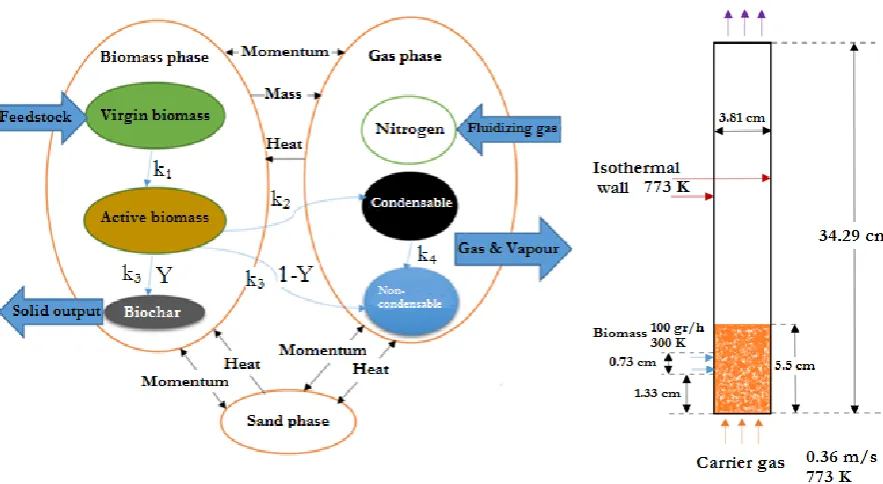
In this study, a combination of the Bradbury et al. [9] model of cellulose to “active material” which then reacts to tar and char is employed. The tar then further reacts to form gas. As illustrated in figure 1, three different phases including biomass phase, sand phase and gas phase are taken into account. Each phase involved in the process has a number of species. The biomass phase includes unreacted biomass and char, while the gas phase include condensable (tar), non-condensable and the nitrogen. The sand phase and nitrogen are inert and do not participate in the chemical reactions. The reaction rate constants are calculated as below:
exp[ / ( )]
i i i
k A Ea RT (1)
1234567890
International Conference on Sustainable Energy Engineering IOP Publishing IOP Conf. Series: Earth and Environmental Science 73 (2017) 012032 doi :10.1088/1755-1315/73/1/012032
2.2.Mathematical methods/models
The fundamental governing equations are the conservation of mass, momentum, energy, and species. Thus, a combination of Multi Fluid Model (MFM) and a chemical solver is the most appropriate method to simulate biomass fast pyrolysis. In multi-fluid model, all phases are treated as continua. For the solution of the governing equations, the Kinetic Theory of Granular Flow (KTFG) [11] is applied to for the solid phases. Further details about the description of the models can be found in the literature [7]. Numerical models and settings.
The multiphase fluid flow, heat transfer, chemical reactions, and species mass transfer in the lab-scale fluidized bed reactor is simulated using the solver FLUENT16.0. The dimensions of the reactor are outlined in figure 2. The laminar multiphase Eulerian-Granular flow is used and the energy equations and species transport are activated. The first fractional step considers merely the spatial solution of the multiphase species with the reaction terms set to zero. In the next fractional step, the reaction terms are integrated in each cell using a stiff ODE solver. Time discretization was done using a second-order implicit method. The pressure-based solver used a least-square cell based phase coupled SIMPLE-algorithm for the pressure velocity coupling and second order (upwind) discretization was applied for the momentum, energy and species modelling parameters. QUICK algorithm is applied for volume fraction calculations. Finally, hybrid initialization is applied and each phases; especially the sand phase; are patched based on the initial packing limit.
2.2.1.Computational domain, initial and boundary conditions
4
1234567890
International Conference on Sustainable Energy Engineering IOP Publishing IOP Conf. Series: Earth and Environmental Science 73 (2017) 012032 doi :10.1088/1755-1315/73/1/012032
Figure 1. Chemical reactions and exchange of mass,
momentum, and heat between phases.
Figure 2. Schematic geometry
of 2-D model of bubbling fluidized bed for simulations.
Table 1. Pre-exponential factor and activation energies for the biomass component [10].
Components Reaction A(s-1) E(MJ/kmol) Heat release, ΔH (kJ/kg)
k1 2.8×10
19
242.4 0
Cellulose k2 3.28×10
14
196.5 255
k3 1.3×10
10
150.5 -20
Tar k4 4.25×10
6
108.0 -42
Table 2.Thermo-physical properties of species [12]
Species Density (kg/m3
)
Particle diameter ds (m)
Molecular weight (g/mol)
Heat capacity Cp (J/kg K)
Dynamic viscosity (kg/ms)
Thermal conductivity k (J/kg K)
Tar - - 100 2500 3×10⁻⁵ 2.577×10⁻²
Gas - - 30 1100 3×10⁻⁵ 5.63×10⁻²
N2 - - 28 1121 3.58×10
-5
2.577×10⁻²
Cellulose 400 4×10⁻⁴ 12.14 2300 - 0.3
Biochar 2333 4×10⁻⁴ 12.01 1100 - 0.1
Sand 2649 5.2×10⁻⁴ 60.08 800 - 0.27
3.Results and discussions
1234567890
International Conference on Sustainable Energy Engineering IOP Publishing IOP Conf. Series: Earth and Environmental Science 73 (2017) 012032 doi :10.1088/1755-1315/73/1/012032
Figure 3. Axial distribution of gas temperature at
statistically steady state condition using different grid sizes (no chemical reactions).
Figure 4. Snapshots of biomass
volume fraction (no chemical reactions)
Figure 5. Temporal evolution of
area-weighted average of biomass volume fraction and gas temperature at the reactor outlet
Figure 6. Temporal evolution of
non-condensable and non-condensable outflux
Figure 7. Mass fraction distribution at steady
state condition Figure 8.
Contour plots of temperature for biomass, gas, and sand at statistically steady
state. 450 500 550 600 650 700 750 800
0 0.05 0.1 0.15 0.2 0.25 0.3 0.35
Gas tem per ature at the ce nter lin e (K )
Axial position (m)
Case 1 Case 2
Case 3 Case 4
740 750 760 770 780 0.0E+00 3.0E-04 6.0E-04 9.0E-04 1.2E-03
160 230 300 370
Ou tfl ow Gas temp erature (K) Biomass vol ume fr ac tion Time (s)
Biomass volume fraction Outflow gas temperature
0 1000 2000 3000 4000 0 100 200 300 400
160 230 300 370 Condensa
6
1234567890
International Conference on Sustainable Energy Engineering IOP Publishing IOP Conf. Series: Earth and Environmental Science 73 (2017) 012032 doi :10.1088/1755-1315/73/1/012032
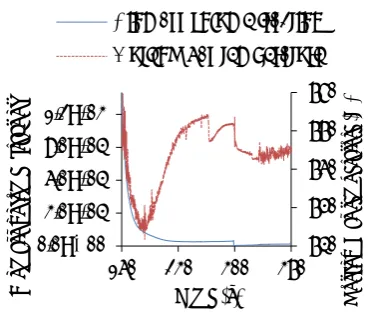
In order to obtain a statistically steady state condition, area-averaged biomass volume fraction, outflow gas temperature, tar and non-condensable flows are monitored. Figures 5 and 6 show the temporal evolution of biomass volume fraction, the outflow gas temperature, non-condensable and tar outflux, respectively. It can be seen that all of the values reach statistically steady state condition after t=330 s. By monitoring the outflux of the products, the yield of tar, non-condensable, and bio-char in the last 40 seconds, are obtained. By integrating the flow of the product at the reactor outlet, the total mass flow rate of each species during the pyrolysis process is obtained. During the process, tar and non-condensable are added to the gas phase whereas biochar remains in the biomass phase. The mass fractions of products are shown in figure 7 at statistically steady state condition. Tar will be cracked into non-condensable as the temperature increases. Snapshots of temperature for the different phases are illustrated in figure 8. It is observed that except for lower temperatures at the biomass inlet due to cold virgin biomass, temperatures in other regions are in the range of 751-773 K.
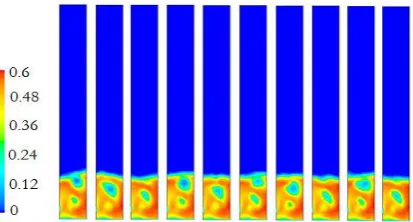
Figure 9 illustrates the volume fraction of sand phase after reaching statistically steady state condition. The formation of bubbles in the mixing zone of the reactor is due to the flow of nitrogen as a fluidizing gas from the bottom of the reactor and entrained biomass from the left side of the reactor. These formations of bubbles enhance the gas-solid mixing and consequently facilitate the heat transfer from hot sand and gas and heated wall to the biomass particles. Hence, the required heat for the process is conveniently supplied.
The comparison of product yield against published experimental data [10] is shown in Table 3. As it can be seen, the predicted products yield match the experimental data very well.
Figure 9. Snapshot of sand volume fraction at statistically steady state condition (t>340s). The first
snapshot on the left is at t=340.1 s and the interval between the snapshots is 0.1 s.
Table 3. Comparison of product yield (wt %) between
simulation and experiment Components
Tar Non-condensable Biochar
Experiment [10] 82.1 12.4 2.2
Current study 77.8 13.8 2.4
4.Conclusion
1234567890
International Conference on Sustainable Energy Engineering IOP Publishing IOP Conf. Series: Earth and Environmental Science 73 (2017) 012032 doi :10.1088/1755-1315/73/1/012032
References
[1] Panwar N, Kothari R, Tyagi V 2012 Thermo chemical conversion of biomass–Eco friendly energy routes, Renewable and Sustainable Energy Reviews, 16 1801-1816.
[2] Goyal H, Seal D, Saxena R 2008 Bio-fuels from thermochemical conversion of renewable resources: a review, Renewable and sustainable energy reviews, 12 504-517.
[3] Balat M, Kırtay E, Balat H 2009 Main routes for the thermo-conversion of biomass into fuels and chemicals. Part 1: Pyrolysis systems, Energy Conversion and Management, 50 3147-3157. [4] Xiong Q, Aramideh S, Kong S C 2014 Assessment of devolatilization schemes in predicting
product yields of biomass fast pyrolysis, Environmental Progress & Sustainable Energy, 33 756-761.
[5] Mellin P, Kantarelis E, Yang W 2014 Computational fluid dynamics modeling of biomass fast pyrolysis in a fluidized bed reactor, using a comprehensive chemistry scheme, Fuel, 117 704-715.
[6] Papari S, Hawboldt K, Helleur R 2017 Production and Characterization of Pyrolysis Oil from Sawmill Residues in an Auger Reactor, Industrial & Engineering Chemistry Research, 56 1920-1925.
[7] Xiong Q, Kong S C, Passalacqua A 2013 Development of a generalized numerical framework for simulating biomass fast pyrolysis in fluidized-bed reactors, Chemical Engineering Science, 99 305-313.
[8] Xiong Q, Aramideh S, Kong S C 2013 Modeling effects of operating conditions on biomass fast pyrolysis in bubbling fluidized bed reactors, Energy & Fuels, 27 5948-5956.
[9] Bradbury A. G., Sakai Y., Shafizadeh F. 1979 A kinetic model for pyrolysis of cellulose, Journal of Applied Polymer Science, 23 3271-3280.
[10] Xue Q, Heindel T, Fox R 2011 A CFD model for biomass fast pyrolysis in fluidized-bed reactors, Chemical Engineering Science, 66 2440-2452.
[11] Gidaspow D 1994 Multiphase flow and fluidization: continuum and kinetic theory descriptions, Academic press, Department of Chemical Engineering, Illinois Institute of Technology, Chicago, Illinois.