Binary Huff Curves
Santosh Ghosh1⋆, Amit Kumar2⋆⋆, Amitabh Das3, and Ingrid Verbauwhede3 1
Security and Privacy Research, Intel Labs
Intel Corporation, 2111 NE 25th Avenue, Hillsboro, OR 97124, US.
Department of Electrical Engineering
Indian Institute of Technology Kharagpur, WB 721302, IN.
{amitrohilla.iitkgp}@hotmail.com 3 COSIC-SCD/ESAT
KU Leuven & iMinds, Kasteelpark Arenberg 10, Bus 2446, Heverlee 3001, BE.
{firstname.lastname}@esat.kuleuven.be
Abstract. Unified formula for computing elliptic curve point addition
and doubling are considered to be resistant against simple power-analysis attack. A new elliptic curve formula known as unified binary Huff curve in this regard has appeared into the literature in 2011. This paper is devoted to analyzing the applicability of this elliptic curve in practice. Our paper has two contributions. We provide an efficient implementation of the unified Huff formula in projective coordinates on FPGA. Secondly, we point out its side-channel vulnerability and show the results of an actual attack. It is claimed that the formula is unified and there will be no power consumption difference when computing point addition and point doubling operations, observable with simple power analysis (SPA). In this paper, we contradict their claim showing actual SPA results on a FPGA platform and propose a modified arithmetic and its suitable implementation technique to overcome the vulnerability.
Key words: Elliptic curves, Binary fields, Side-channel, FPGA,
Karat-suba multiplier, Power analysis, SPA.
1
Introduction
SIDE-CHANNEL ATTACKS [15] are a major threat in present day embedded security era, irrespective of whether the underlying cryptographic algorithm is based on public key or private key. In order to protect an elliptic curve algorithm against simple power-analysis attacks, there are three basic classes of counter-measures: (i) Always double-and-add, (ii) Atomic execution, and (iii) Unified point addition. The first one is too costly as the simple double-and-add algo-rithm executes a point addition only if the secret scalar bit (di) is one. In this ⋆Part of the work has been performed when Santosh Ghosh was a Postdoctoral Fellow
at COSIC, KU Leuven.
⋆⋆
countermeasure, a dummy point addition is executed if di = 0. However, there is a regular version of it due to Montgomery [13]. The second one executes point addition and point doubling by executing several atomic units of finite field operations, where a unit is formed with four operations in sequence: addition, multiplication, negation, and addition. The atomic execution helps to protect against side-channel attacks with several dummy finite field operations. The dummy operations in the first two countermeasures can however be targeted by a C safe-error attack [21]. The unified formula is a good option to protect elliptic curves against side-channel attacks. The development of such a formula is very difficult in practice, and only a few are available till today.
Unified formula for computing point addition and point doubling on an el-liptic curve was introduced in 2001 [4, 12]. Walter [20] observed a vulnerability of Brier and Joye’s unified formula [4] with respect to the irregularity of the implementation of finite field operations. Subsequently, unified point addition formula in affine form [5] and respective projective form [18] were proposed. The latter one also reinforces Walter’s [20] observations with timing analysis during software execution of unified formula. Thereafter, unified formula on Edwards curve was proposed in 2007 [2]. In CT-RSA 2011, unified binary Huff formula was proposed by Devigne and Joye [8], which outperforms other unified formula. In this paper, we demonstrate that the unified binary Huff curve is not ac-tually secure against side-channel attacks. Even though both point operations are executed by the same sequence of finite field operations, due to processing of different coordinates, they demand different amounts of power. This paper pin-points to the fact that the point doubling with unified Huff formula produces zero output in some intermediate finite field operations, which are non-zero in point addition. These zero (non-zero) values for point doubling (point addition) are further used as multiplicands in the unified formula. Results of the mul-tiplications are also zero (non-zero). The power consumption of the multiplier circuit having zero and non-zero data are significantly different and they are vi-sually observable through their power consumption graphs1. We show the actual power consumption graphs of those operations on a SASEBO-G board [19] which proves our claim and successfully demonstrates the vulnerability of the unified huff formula against simple power analysis. Apart from the side-channel resis-tance analysis, this paper also provides an efficient architecture and an optimal countermeasure of binary Huff curve.
We start with a brief overview of binary Huff curve in§2. We show the side-channel vulnerability of the unified binary Huff curve formula in§3. The same section also demonstrates the actual power analysis on a SASEBO-G FPGA board. A suitable countermeasure is proposed in §4 and it is validated by the actual SPA on the SASEBO-G board. The detailed architecture for implementing elliptic curve scalar multiplication based on our proposed SPA-resistant binary Huff curve addition formula is described in§5. Finally, we conclude in§6.
1
2
Binary Huff Curve
In the mid-twentieth century, while studying a Diophantine problem, Huff intro-duced a new model of elliptic curves [10]. After a long gap, the Huff model was revisited in 2010 [14], which fully described and formulated the case of odd char-acteristic fields and provided an outline for binary field. Thereafter, in 2011, the formal construction of a Huff model for binary field was developed by Devigne and Joye [8]. This construction instead of providing general point addition for-mula takes care of side-channel attacks and provides the unified point addition and point doubling formula in binary field. Here we provide a brief description that may help in understanding the contributions of the current paper.
Definition 1 ([14]). A generalized binary Huff curve is the set of projective points(X :Y :Z)∈P2(F
2m)satisfying the equation
E/F2m :aX(Y
2+f Y Z+Z2) =bY(X2+f XZ+Z2), (1)
wherea, b, f ∈F∗2m anda̸=b.
There are three points at infinity satisfying the curve equation, namely (a:
b: 0), (1 : 0 : 0), and (0 : 1 : 0). ForP = (X1:Y1 :Z1) andQ= (X2:Y2:Z2), we getP+Q= (X3:Y3:Z3) with unified point addition/doubling formula [8]:
X3= (Z1Z2+Y1Y2)
(
(X1Z2+X2Z1)(Z12Z22+X1X2Y1Y2)+
αX1X2Z1Z2(Z1Z2+Y1Y2))
Y3= (Z1Z2+X1X2)
(
(Y1Z2+Y2Z1)(Z12Z22+X1X2Y1Y2)+
βY1Y2Z1Z2(Z1Z2+X1X2))
Z3= (Z1Z2+X1X2)(Z1Z2+Y1Y2)(Z12Z22+X1X2Y1Y2),
(2)
whereα= a+bb andβ =a+ab.
The unified formula provided in Eq. (2) can be evaluated as in [8]
m1=X1X2, m2=Y1Y2, m3=Z1Z2,
m4= (X1+Z1)(X2+Z2) +m1+m3, m5= (Y1+Z1)(Y2+Z2) +m2+m3,
m6=m1m3, m7=m2m3, m8=m1m2+m23, m9=m6(m2+m3)2,
m10=m7(m1+m3)2, m11=m8(m2+m3), m12=m8(m1+m3),
X3=m4m11+αm9, Y3=m5m12+βm10, Z3=m11(m1+m3).
3
SPA on Binary Huff Curve
Simple-power analysis or SPA on elliptic curve is based on the observations of power consumption of the cryptoprocessor during the executions of point addition and point doubling. When the operations of point addition and point doubling make use of different formula, they may produce different power traces revealing the secret value of scalardin the computation ofQ= [d]P. A potential approach that counteracts such vulnerability tries to unify the addition formula. Huff curves are equipped with such a unified point addition formula which results in the SPA resistant property. However, sometimes formula based on theoretical assumptions are vulnerable at their actual implementations. The practical results demonstrated in this section proves that the unified binary huff curve formula [8] is not actually secure against SPA attack.
3.1 Pinpointing the SPA Vulnerability
The authors in [8] claim that the unified formula for computing point addition and doubling on Binary Huff curve is secure against side-channel attacks, espe-cially against SPA. However, with a close observation of Eq. (2), we find out that there are behavioral differences during the computations ofP+Q, P ̸=Q
and P+P. Let us consider the computation of X3 = (Z1Z2+Y1Y2)((X1Z2+
X2Z1)(Z12Z 2
2+X1X2Y1Y2) +αX1X2Z1Z2(Z1Z2+Y1Y2)). In this formula it is pointed out that the value of (X1Z2+X2Z1) for the P +P computation is zero inF2m whereas it is in general non-zero for aP+Q, P ̸=Qcomputation. This zero (non-zero) value is further multiplied with (Z12Z22+X1X2Y1Y2), which produces a zero (non-zero) product for point doubling (point addition).
Similarly, in Y3 = (Z1Z2 +X1X2)((Y1Z2+Y2Z1)(Z12Z22 +X1X2Y1Y2) +
βY1Y2Z1Z2(Z1Z2+X1X2)), the value of (Y1Z2+Y2Z1) is zero for point dou-bling and non-zero for point addition. To perform SPA on unified binary Huff curve, the respective formula provided in Eq. (2) has been implemented on an FPGA device. Fig. 1 shows ModelSIM simulation results for computing Eq. (2) as described in Table 4. It only displays respective values of the multiplicands and multiplication results. The sign ‘0’ and ‘>’ indicate zero and non-zero values respectively. It could be observed from the left half of the figure that the multi-plicand a2 goes to zero twice during a point doubling, once for (X1Z2+X2Z1) and once for (Y1Z2+Y2Z1). However, it never goes to zero during a point ad-dition, which is displayed at the right half of the figure. Processing of zero and non-zero values in the datapath consume different amounts of power which can be observed from their respective power graphs. This can help to break the uni-fied binary Huff curve using simple power analysis. In the following section, we show the actual SPA results on FPGA platform.
3.2 Actual Power Analysis Using SASEBO-G Board
Fig. 1.Simulation of unified Huff curve point addition.
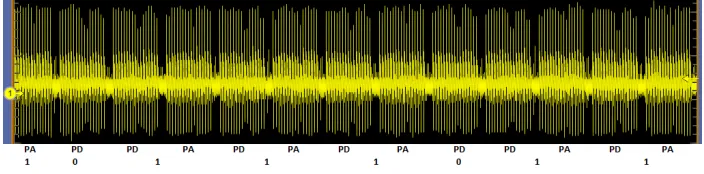
board incorporates a Xilinx FPGA consisting of two Virtex-II pro devices. We implement the elliptic curve point multiplication (ECSM) based on the unified binary Huff curve addition formula (Eq. (2)) on the xc2vp30-fg676-5 device of the SASEBO-G board and perform power analysis. Fig. 2 shows a power trace during the execution of [d]P2on a binary Huff curve using unified formula. The power consumption for executing current unified Huff formula are mostly due to the execution of 17 finite field multiplications as shown in Table 4. Therefore, following observations can be made from this power trace.
Fig. 2.Power consumption for computing [d]P with unified Huff formula.
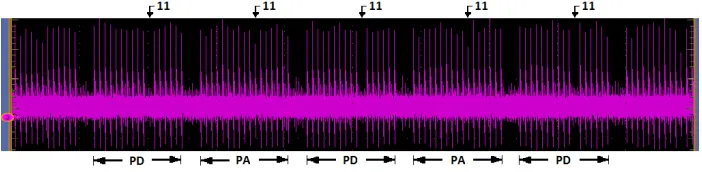
• The power trace during a point addition (PA) or a point doubling (PD) operation consists of 17 peaks for executing multiplications.
• The power consumption peak at the 11-th multiplication cycle is lower than other peaks, as during this cycle the multiplicand a1 remains unchanged from its previous value (see Fig. 1).
• The peak at the 10-th multiplication cycle is also lower for some point addi-tion/doubling executions. They are due to values of the second multiplicand
a2 which is zero during the processing of a point doubling operation (see Table 4 and Fig. 1).
• The peaks at 16-th and 17-th multiplication cycles during the execution of point doublings are also lower than that during point additions. This is because of the zero at the second multiplicand during 16-th multiplication (see Fig.1). The power consumption peaks are low in these two consecutive multiplication cycles due to transitions ofa2 from non-zero to zero and again back to non-zero.
2
Based on the above observations, point addition and point doubling are easily distinguished from their power traces. Figures 3 and 4 show two compact views of power consumptions during a [d]P execution. Through simple power analysis the secret scalar bits are easily guessed as shown in these figures. These results prove that the unified binary Huff curve [8] is vulnerable to SPA. We expect that similar conclusions can be made for software implementations of unified Huff curve on micro-controllers as our FPGA implementation also consists of only one datapath.
Fig. 3.SPA vulnerability of unified binary Huff curve.
Fig. 4.SPA vulnerability : more compact view and leak to the key.
4
Proposed SPA Countermeasure
As pointed out in Section 3.1, the main drawback of the original unified binary Huff formula isX1Z2+X2Z1andY1Z2+Y2Z1computations. During point dou-bling (P+P), resultant values of these two are zero, whereas they are nonzero for point addition (P+Q,P ̸=Q). Hence it could be implicitly inferred that elim-ination of these two sub-operations is sufficient to overcome the vulnerabilities to SPA.
4.1 Unified Huff Curve Arithmetic
Eq. (2) to overcome its vulnerability against SPA attack.
m1=X1X2, m2=Y1Y2, m3=Z1Z2,
m4= (X1+Z1)(X2+Z2), m5= (Y1+Z1)(Y2+Z2),
m6=m1m3, m7=m2m3, m8=m1m2+m23,
m9=m6(m2+m3)2, m10=m7(m1+m3)2, m11=m8(m2+m3),
Z3=m11(m1+m3),
X3=αm9+m4m11+Z3,
Y3=βm10+m5m8(m1+m3) +Z3.
The cost of the above operations is 15M + 2D ≈ 17M, which is exactly the same as with the original one (15M + 2D). In order to ensure the security of the proposed unified arithmetic, it is also implemented on the same FPGA which computes one unified point addition in 17 clock cycles. The architecture is sketched and described in the next section.
4.2 Additional Implementation Guidelines and Security Analysis
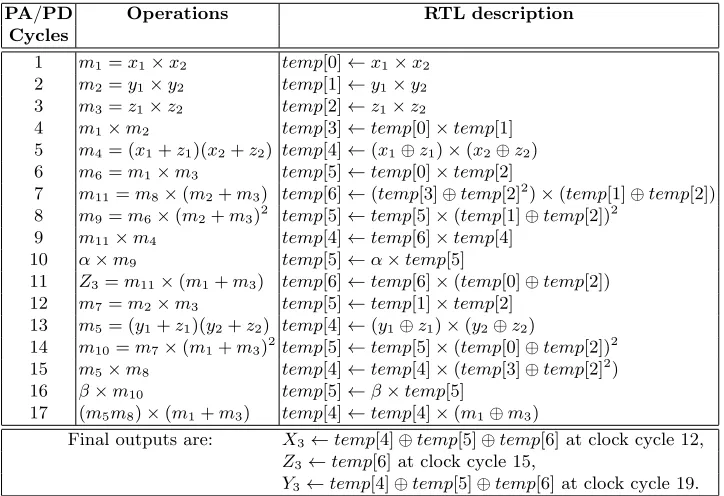
Based on the data dependency and available resources the proposed unified arith-metic can be implemented in several ways. Let us take a sample implementation of this arithmetic on the same set of resources (one multiplier) as used in the previous SPA experiment. Figures 5 and 6 show the corresponding simulation and SPA results, which provides another strange twist! This implementation is also vulnerable against SPA.
Fig. 5.Simulation result of an unsafe implementation of proposed arithmetic.
Let us see the cause of its vulnerability. It can be seen from the simulation result shown in Fig. 5 that the operands at 10-th and 11-th multiplication cycles are same for PD but one of them are different for PA. Therefore, the 11-th multiplication for PD does not consume any power whereas it consumes power for PA (see Fig. 6). This happens due to the following features adopted in this implementation.
1. It schedules the multiplicationsm11(m1+m3) andm4m11at 10-th and 11-th cycles.
2. It choosesm11 as operandafor both multiplications. 3. It choosesm1+m3 andm4 as operandb, respectively.
In case of PD the value ofm4:= (X1+Z1)(X2+Z2) and the value ofm1+m3:=
X1X2+Z1Z2are same but they are different in PA. This makes the difference in power consumptions and makes the implementation vulnerable to SPA. This re-sult exposes the demand of security awareness on the implementation engineers. In order to achieve an actual secure unified Huff curve hardware we sug-gest the implementation and scheduling of operations as shown in Table 5. We demonstrate the results of SPA that has been performed on SASEBO-G board on our proposed unified arithmetic and its scheduling technique. Figure 7 shows the simulation dataflow inside the multiplier with our proposed countermeasure. Contrary to the previous simulation result shown in Fig. 1, in this implementa-tion, the intermediate result used as an operand in the multiplier never becomes zero. In other words, the multiplier never produce a zero for which the power consumption is distinguishable from other non-zero results.
Fig. 7.Simulation of the modified unified Huff curve point addition arithmetic.
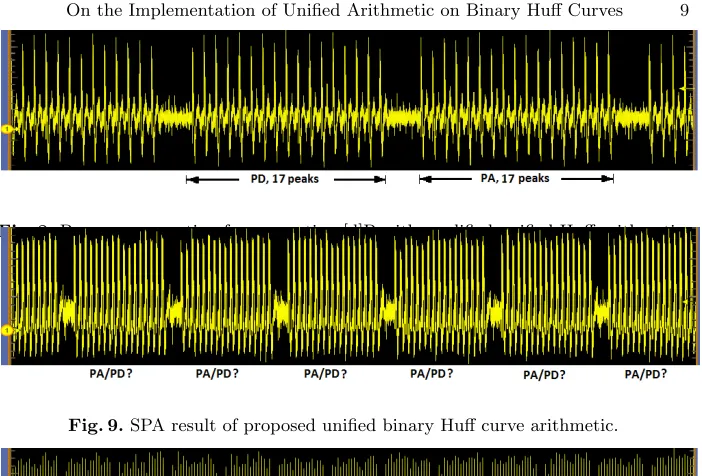
The power analysis as described in Section 3.2 has been repeated for this new implementation and the results are shown in Figures 8, 9, and 10. There are 17 peaks for computing 17 multiplications. However, no observable power consump-tion difference has been found for computing point doubling and point addiconsump-tion. These experimental results ascertain the security of the proposed countermea-sure against SPA. Therefore, the weakness of original Unified Binary Huff curve point addition formula is overcome by the proposed computation technique.
5
Architectural Description
Fig. 8.Power consumption for computing [d]P with modified unified Huff arithmetic.
Fig. 9.SPA result of proposed unified binary Huff curve arithmetic.
Fig. 10.SPA result in compact view on proposed unified binary Huff curve arithmetic.
binary fields. For 256-bit, the binary field F2256 is defined with the irreducible polynomialf(x) =x256+x10+x5+x2+ 1.
5.1 Input/Output
In this finite field, point coordinates (X :Y :Z) and scalardare all 256-bit long. Hence, total input pins required will be at least 256×4 = 1024 and total number of output pins required will be 256×3 = 768. So, a total of 1024 + 768 = 1792 I/O pins are needed. Because of the limitations of the I/O pins on the available FPGA, we send the input parameters through a 32-bit port on FPGA. Hence, to input a 256-bit number, 8 clock cycles are required. Similarly, the output is displayed on a 32-bit port and 24 clock cycles are required to display three coordinates of the resultant point of aQ= [d]P computation. Parameters for the next [d]P operation could be taken in parallel as the design consists of different input and output ports.
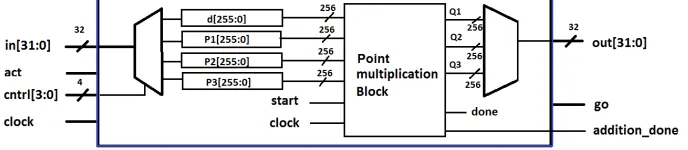
Fig. 11.Architecture of the top module.
constitute the selector pins of a decoder and basically determines which of the four input parameters will be fed to the FPGA currently. There is anactsignal which will enable the circuit to perform a scalar multiplication on the given input scalar and the point. The integerd, andx, y, z coordinates of the input pointP are sent to thepoint multiplication block for computation. The result of the block goes to a multiplexer and the output is displayed on a 32-bit output port. The control pins of the multiplexer will selectx,y and z coordinates one by one. Each coordinate will take 8 clock cycles to be displayed, making a total of 24 cycles. Signal go will be displayed during the display of the output and a signal addition donesignifies the completion of one point addition/doubling operation.
5.2 Datapath for Binary Huff Curve
Figure 12 shows the architecture of the Huff curve point multiplication block which executes left-to-right binary algorithm (Shown in Algorithm 1 in the Ap-pendix). As the point addition and doubling are performed by unified formula, this algorithm can defend against simple power-analysis attacks. The Q regis-ters are initialized with input base point P3. There is a 9-bit counter i which counts fromm−2 down to zero. At every iteration this counter helps to select the corresponding bit of the scalar d. There are two intermediate signalsf lag1 and f lag2 which tell us about the on-going point operation of either addition (P+Q) or doubling (Q+Q). If point doubling operation is going on,f lag1 will be enabled andf lag2 will be disabled. If point addition operation is going on,
f lag2will be enabled andf lag1will be disabled. So, at any point of time during the whole process, one out of these two flags will be high.
There are two sets of input points which are fed to the Point Addition Block. One of the two inputs isQ, which is fed back from the output. Second input is coming from a 2 : 1 multiplexer which will sendP during point addition opera-tion andQduring point doubling operation. The selector pins of the multiplexer results from a control circuitry made off lag1,f lag2andd[i]. It should be noted that the point addition and doubling operations are performed using the same block implemented using Unified Addition Formula (U nif Addas described in
3
In this figure, registers and data buses Pi, Qi, 1 ≤ i ≤ 3 represent the value of
Unified Point Addition Block x1 y1 z1 x2 y2 z2 x3 y3 z3 Q1 control 0 1 P1 0 1 0 1 P2 P3 Q2 Q3 control ckt for selector pins 0 1 0 1 0 1 control ckt for start pins control ckt for counter clock di d0 d1 dm-1 m : 1 m a x flag1 flag2 8-bit down counter i
POINT MULTIPLICATION BLOCK
cl o c k st a rt d P1 P2 P3 Q1 Q2 Q3 ad d it io n d o n e d o n e
Fig. 12.Architecture of Huff curve point multiplication.
Table 5). The start pin of the Point Addition Block results from a control cir-cuitry made off lag1,f lag2and addition donesignals. After the completion of one point operation, addition done will be enabled for one clock cycle during which the Qregisters are updated by the new intermediate result coming out from the Unified Point Addition Block. Finally, once the whole process is com-plete (at the end of the iteration when i= 0), thedone signal will be enabled which enables the top level input-output circuitry.
Execution of SPA-Resistant Unified Point Operations. The proposed
SPA-resistant Huff curve point addition formula is executed with the help of seven temporary registers. The detailed RTL description is provided in Table 5 in the Appendix. The number of registers used in the whole design is optimized through careful data flow analysis of the algorithm. The life time graph of the registers is depicted in Fig. 13. In the graph, the changes of a line style in a life-line indicates the register is reassigned. The life-line beyond clock cycle 19 indicates that the value of that respective register is used in future. It is mainly used for
Q registers, for which the resultant value of the current point addition is used as the input for the next addition.
The proposed design performs one multiplication in one clock cycle. Thus, next multiplicands and current multiplication result are stored in the same clock transition. The multiplicands are sent to the combinatorial circuit of a Karat-suba Multiplier synchronously at the same clock when the result of the previous multiplication is stored in temporary registers. Hence, 17 multiplications (Ref Table 5) are completed in 17 clock cycles. Apart from that, one clock cycle is needed to start the operation, one is needed to store the result of current point addition/doubling, and one is needed to reset all the signals and flip flops. Hence, a total of 20 clock cycles are required to perform one point addition/doubling operation in our proposed SPA-resistant architecture.
Point Addition Block consists of a single multiplier sub-block where the input multiplicands are fed through a multiplexer. The inputs to the multiplexer are a bank of registers and the output signals of some combinatorial circuits which are used to perform addition and squaring operations. The primary inputs that represent the coordinates of two points are coming from the registers placed in the point multiplication block (Fig. 12). Both the squaring and multiplication operations are followed by the reduction sub-block. The selector pins of the multiplexer result from the control circuitry of the 20-bit register flag and the start pin. The outputs of the multiplier block after reduction are stored in one of the seven temporary registers as defined in our RTL table (Table 5). The coordinates of the resultant point are stored in them-bitX3, Y3,andZ3registers and sent to the Point Multiplication Block with a signaladdition doneindicating that a point addition/doubling operation is complete. The field multiplication unit is based on the hybrid Karatsuba multiplier as described in [17]. For a 256-bit field, we use simple Karatsuba decomposition and accumulation upto the multiplicand size of 32-bit and general Karatsuba for 16-bit multiplication.
5.3 Area and Time Results.
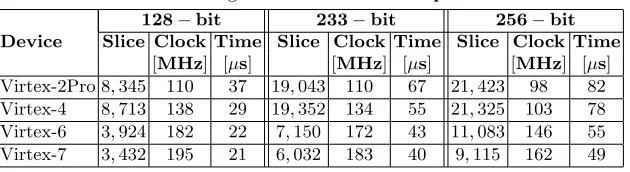
The architecture is described in Verilog (HDL) and synthesized by Xilinx ISE tool to generate the FPGA configuration file. The area and timing results for three different field sizes are depicted in Table 1 and Table 2.
Table 1.Area and timing results of aUnified Huff Additionon FPGA.
Device
128−bit 233−bit 256−bit
Slice Clock Time Slice Clock Time Slice Clock Time [MHz] [µs] [MHz] [µs] [MHz] [µs] Virtex-2Pro 7,270 110 0.19 16,214 109 0.19 19,256 88 0.24 Virtex-4 7,627 145 0.15 16,661 167 0.13 19,242 122 0.17 Virtex-6 3,027 180 0.12 8,091 172 0.12 8,239 152 0.14 Virtex-7 2,363 190 0.11 6,503 180 0.12 7,312 164 0.13
Table 2.Area and timing results of scalar multiplicationon FPGA.
Device
128−bit 233−bit 256−bit
Slice Clock Time Slice Clock Time Slice Clock Time [MHz] [µs] [MHz] [µs] [MHz] [µs] Virtex-2Pro 8,345 110 37 19,043 110 67 21,423 98 82 Virtex-4 8,713 138 29 19,352 134 55 21,325 103 78 Virtex-6 3,924 182 22 7,150 172 43 11,083 146 55 Virtex-7 3,432 195 21 6,032 183 40 9,115 162 49
our design provides 75% performance improvement on a Virtex-4 FPGA com-pared to the only existing binary Huff curve architecture available in the litera-ture. It is claimed by the authors in [8] that the unified binary Huff curve formula is faster than the unified formula on Edwards curve [2], which costs 18M+7D (or 21M+4D). This is proved by the design in [7] as well as in our design, which is ∼3 times faster than the implementation of unified Edwards curve [6]. Another implementation of binary Edwards curves overF2163using Gaussian normal basis has been presented in [1], which computes a [d]P operation in 23.3µs.
Table 3.Performance of the proposed implementation compared to others
.
Work Platform Field Slices Clock Latency Area×Latency
[m] Count[MHz] [µs] ×[105]
Ours XC4V140 233 19,352 134 55 10.6
Unified Edwards [6]XC4V140 233 21,816 50 170 37.1
Unified Huff [7] XC4V140 233 20,437 81 73 14.9
In general, an n-bit point multiplication based on the proposed Unified Huff curve arithmetic costs 25.5n M. This is not a cheap solution of side-channel attacks compared to existing other solutions. It is little bit slower than double-and-add always using Lopez-Dahab which costs 19n M (5M for one PD and 14M for one PA). The same is much slower than the Montgomery ladder, based on Lopez-Dahab fast point multiplication [16] trick which costs only 6n M. However, it should be noted that providing side-channel security is not the main goal of a Huff curve; rather, it provides a complete addition formula for all subgroups on an elliptic curve − even in a subgroup that does not contain the points at infinity. Due to this property the Huff curve is secure against exceptional procedure attacks [11] and batch computing [3]. In this respect, the Huff curve is one step ahead compared to its competitors Edwards [2] and Generalized Hessian curves [9] − on both of which the point addition is complete only on some specific subgroups.
6
Conclusion
The actual power analysis has been performed using SASEBO-G board. It has been successfully demonstrated that the unified binary Huff curve is vulnerable against SPA. A suitable countermeasure has been also proposed and its robust-ness against SPA is demonstrated. The final design with SPA protection has been projected as the best performing unified elliptic curve implementation.
Acknowledgments
This work was supported in part by the Research Council KU Leuven: GOATENSE (GOA/11/007) and by the Flemish iMinds projects. In addition, this work is sup-ported in part by the Flemish Government, FWO G.0550.12N, by the Hercules Foundation AKUL/11/19. Santosh Ghosh was a beneficiary of a mobility grant from the Belgian Federal Science Policy Office co-funded by the Marie Curie Actions from the European Commission. Amitabh Das was initially funded by the Erasmus Mundus External Cooperation Window Lot 15 (EMECW15) when part of the work was performed. The authors are thankful to Marc Joye and Junfeng Fan for their valuable suggestions to perform this work.
References
1. Azarderakhsh, R., Reyhani-Masoleh, A.: Efficient FPGA Implementations of Point Multiplication on Binary Edwards and Generalized Hessian Curves Using Gaussian Normal Basis. IEEE Trans. on VLSI Systems, vol. 20, no. 8, pp. 1453-1466, 2012. 2. Bernstein, D.J., Lange, T., Farashahi, R.R.: Binary Edwards Curves. CHES 2008,
LNCS 5154, Springer-Verlog, pp. 244–265, 2008.
3. Bernstein, D.J.: Batch binary Edwards. Advances in Cryptology−CRYPTO 2009. LNCS 5677, pp. 317–336, Springer, 2009.
4. Brier, ´E., Joye, M.: Weierstraß elliptic curves and side-channel attacks. PKC 2002, LNCS 2274, Springer-Verlag, pp. 335–345, 2002
5. Brier, ´E., D´ech`ene, I., Joye, M.: Unified point addition formulæ? for elliptic curve cryptosystems. Embedded Cryptographic Hardware: Methodologies and Architec-tures, Nova Science Publishers, pp. 247–256, 2004.
6. Chatterjee, A., Sengupta, I.: FPGA implementation of binary edwards curve using ternary representation. GLSVLSI 2011, pp. 73–78, 2011.
7. Chatterjee, A., Sengupta, I.: High-speed unified elliptic curve cryptosystem on FPGAs using binary Huff curves. VDAT 2012, LNCS 7373, Springer-Verlag, pp. 243–251, 2012.
8. Devigne, J., Joye, M.: Binary huff curves. CT-RSA 2011, LNCS 6558, pp. 340–355, Springer-Verlag, 2011.
9. Farashahi, R., Joye, M.: Efficient Arithmetic on Hessian Curves. The 13th Inter-national Conference on Practice and Theory of Public Key Cryptography (PKC 2010), LNCS 6065, pp. 243–260, 2010.
10. Huff, G.B.: Diophantine problems in geometry and elliptic ternary forms. Duke Math. J. 15, pp. 443–453, 1948.
12. Joye, M., Quisquater, J.J.: Hessian elliptic curves and side-channel attacks. CHES 2001, LNCS 2162, Springer-Verlag, pp. 402–410, 2001.
13. Joye, M., Yen, S.M.: The Montgomery powering ladder. CHES 2002, LNCS 2523, Springer-Verlag, pp. 291–302, 2003.
14. Joye, M., Tibouchi, M., Vergnaud, D.: Huff’s model for elliptic curves. Algorithmic Number Theory (ANTS-IX), LNCS 6197, Springer, pp. 234–250, 2010.
15. Kocher, P.C.: Timing attacks on implementations of Diffie-Hellman, RSA, DSS, and other systems. CRYPTO 1996, LNCS 1109, Springer, pp. 104–113, 1996. 16. Lopez, J., Dahab, R.: Fast multiplication on elliptic curves over GF(2m) without
precomputation. CHES 1999. LNCS, vol. 1717, pp. 316–327. Springer, 1999. 17. Rebeiro, C., Mukhopadhyay, D.: High speed compact elliptic curve cryptoprocessor
for FPGA platforms. Indocrypt 2008, LNCS 5365, Springer, pp. 376–388, 2008. 18. Stebila, D., Th´eriault, N.: Unified point addition formulæ and side-channel attacks.
CHES 2006, LNCS 4249, pp. 354–368, 2006.
19. Side-channel attack standard evaluation board. http://www.morita-tech.co.jp/SASEBO/en/board/sasebo-g.html
20. Walter, C.D.: Simple power analysis of unified code for ECC double and add. CHES 2004, LNCS 3156, Springer-Verlag, pp. 191–204, 2004.
21. Yen, S.M., Kim, S., Lim, S., Moon, S.J.: A countermeasure against one physical cryptanalysis may benefit another attack. ICISC’01, LNCS 2288, Springer-Verlag, pp. 269–294, 2002.
Appendix
Algorithm 1: SPA-resistant elliptic curve point multiplication.
Input:P, d= 2m−1+∑mi=0−22idi.
Output:Q= [d]P.
1: Q←P;
2: forifromm−2downto0do;
3: Q←U nif Add(Q, Q);
4: if di= 1thenQ←U nif Add(Q, P);
Table 4.RTL description of unified Huff formula.
PA/PD Operations RTL description
Cycles
1 m1=x1×x2 temp[0]←x1×x2
2 m2=y1×y2 temp[1]←y1×y2
3 m3=z1×z2 temp[2]←z1×z2
4 m1×m2 temp[3]←temp[0]×temp[1]
5 (x1+z1)(x2+z2) temp[4]←(x1⊕z1)×(x2⊕z2)
6 m6=m1×m3 temp[5]←temp[0]×temp[2]
7 m11=m8×(m2+m3) temp[6]←(temp[3]⊕temp[2]2)×(temp[1]⊕temp[2])
8 m9=m6×(m2+m3)2 temp[5]←temp[5]×(temp[1]⊕temp[2])2
9 α×m9 temp[5]←α×temp[5]
10 m11×m4 temp[4]←temp[6]×(temp[4]⊕temp[0]⊕temp[2])
11 Z3=m11×(m1+m3) temp[6]←temp[6]×(temp[0]⊕temp[2])
12 m7=m2×m3 temp[5]←temp[1]×temp[2]
13 m10=m7×(m1+m3)2temp[5]←temp[5]×(temp[0]⊕temp[2])2
14 m12=m8×(m1+m3) temp[4]←(temp[3]⊕temp[2]2)×(temp[0]⊕temp[2])
15 (y1+z1)(y2+z2) temp[3]←(y1⊕z1)×(y2⊕z2)
16 m12×m5 temp[4]←temp[4]×(temp[3]⊕temp[1]⊕temp[2])
17 β×m10 temp[5]←β×temp[5]
Final outputs are: X3←temp[4]⊕temp[5] at the end of step 10,
Z3←temp[6] at the end of step 11,
Y3 ←temp[4]⊕temp[5] at the end of step 17.
Table 5. U nif Add((x1, y1, z1),(x2, y2, z2)): RTL description of proposed
SPA-resistant unified Huff curve addition arithmetic.
PA/PD Operations RTL description
Cycles
1 m1=x1×x2 temp[0]←x1×x2
2 m2=y1×y2 temp[1]←y1×y2
3 m3=z1×z2 temp[2]←z1×z2
4 m1×m2 temp[3]←temp[0]×temp[1]
5 m4= (x1+z1)(x2+z2) temp[4]←(x1⊕z1)×(x2⊕z2)
6 m6=m1×m3 temp[5]←temp[0]×temp[2]
7 m11=m8×(m2+m3) temp[6]←(temp[3]⊕temp[2]2)×(temp[1]⊕temp[2])
8 m9=m6×(m2+m3)2 temp[5]←temp[5]×(temp[1]⊕temp[2])2
9 m11×m4 temp[4]←temp[6]×temp[4]
10 α×m9 temp[5]←α×temp[5]
11 Z3=m11×(m1+m3) temp[6]←temp[6]×(temp[0]⊕temp[2])
12 m7=m2×m3 temp[5]←temp[1]×temp[2]
13 m5= (y1+z1)(y2+z2) temp[4]←(y1⊕z1)×(y2⊕z2)
14 m10=m7×(m1+m3)2temp[5]←temp[5]×(temp[0]⊕temp[2])2
15 m5×m8 temp[4]←temp[4]×(temp[3]⊕temp[2]2)
16 β×m10 temp[5]←β×temp[5]
17 (m5m8)×(m1+m3) temp[4]←temp[4]×(m1⊕m3)
Final outputs are: X3←temp[4]⊕temp[5]⊕temp[6] at clock cycle 12,
Z3←temp[6] at clock cycle 15,
![Fig. 2. Power consumption for computing [d]P with unified Huff formula.](https://thumb-us.123doks.com/thumbv2/123dok_us/7936740.1317690/5.612.139.486.322.411/fig-power-consumption-computing-p-unied-hu-formula.webp)