On the Security of the Multivariate Ring
Learning with Errors Problem
Carl Bootland, Wouter Castryck, Frederik Vercauteren
imec-COSIC, ESAT, KU Leuven Kasteelpark Arenberg 10
3001 Heverlee, Belgium
[email protected], [email protected], [email protected]
Abstract. The Multivariate Ring Learning with Errors (m-RLWE) prob-lem was introduced in 2015 by Pedrouzo-Ulloa, Troncoso-Pastoriza and P´erez-Gonz´alez. Instead of working over a polynomial residue ring with one variable as in RLWE, it works over a polynomial residue ring in several variables. However, care must be taken when choosing the multi-variate rings for use in cryptographic applications as they can be either weak or simply equivalent to univariate RLWE. For example, Pedrouzo-Ulloa et al. suggest using tensor products of cyclotomic rings, in par-ticular power-of-two cyclotomic rings. They claim incorrectly that the security increases with the product of the individual degrees. In this pa-per, we present simple methods to solve the searchm-RLWE problem far more efficiently than is stated in the current literature by reducing the problem to the RLWE problem in dimension equal to the maximal degree of its components (and not the product) and where the noise in-creases with the square-root of the degree of the other components. Our methods utilise the fact that the defining cyclotomic polynomials share algebraically related roots. We use these methods to successfully attack the search variant of them-RLWE problem for a set of parameters es-timated to offer more than 2600 bits of security, and being equivalent to solving the bounded distance decoding problem in a highly struc-tured lattice of dimension 16384, in less than two weeks of computation time or just a few hours if parallelized on 128 cores. Finally, we also show that optimizing module-LWE cryptosystems by introducing an ex-tra ring structure as is common practice to optimize LWE, often results in a total breakdown of security.
1
Introduction
this does to module-LWE what RLWE does to LWE – by adding more structure they are able to construct more efficient schemes with smaller key sizes.
In the simplest case of two variables they define the problem, which they call the Bivariate RLWE (2-RLWE) problem, as follows:
Problem 1. LetRq[x, y] =Zq[x, y]/(f(x), g(y)) be a bivariate polynomial residue ring, with f, g monic irreducible polynomials over Z and an error distribution
χ[x, y] ∈ Rq[x, y] that generates small-norm random bivariate polynomials in
Rq[x, y], distinguish between samples (ai, bi = ai ·s+ei) and (ai, ui) where
ai, ui ← Rq[x, y] are chosen uniformly at random from the ring Rq[x, y], and
s, ei←χ[x, y] are drawn from the error distribution.
Although not explicitly stated in [14], f and g are taken to be two-power cyclotomics, i.e. f(x) = xnx+ 1 and g(y) = yny + 1 with n
x and ny powers of two. They claim and give a sketch proof that the 2-RLWE problem above is equivalent to the RLWE problem in the ringZq[z]/(h(z)) whereh(z) =zn1n2+1, however as will become obvious this is not true as we can solve the 2-RLWE far more easily. The flaw is that while Q[z]/(h(z)) certainly contains isomorphic copies of Q[x]/(f(x)) andQ[x]/(g(y)) it is not the smallest number field which
does so. If we assumen1≥n2then in this specific caseQ[x]/(f(x)) itself has this
property. This shows that we expect to be able to solve the 2-RLWE problem by solving max{n1, n2} dimensional problems, not dimension n1n2. This logic can be made to work more generally with any cyclotomic fields, not just power of two cyclotomics, as detailed in Section 3.1.
The authors then construct a method for encrypted image processing whose security is based on the 2-RLWE problem. The sample parameters proposed for use being n1 =n2 = 2i, dlog2qe= 22 + 3i for i = 7,8,9,10. Using the lower bound given in [11, Equation (5.2)] these instances are estimated to have bit security 2663, 10288, 38880 and 146675 respectively, though these parameters fall well outside the range of parameters for which the bound was derived so these security levels so are unlikely to be accurate; however, using the LWE-estimator of Albrecht et al. [1] gives even larger security estimates. Thus it is clear the authors believe these parameter suggestions give a very high security level. However, in light of our attack, which works here in dimensionn1 =n2, the LWE-estimator gives the estimated security levels as 32, 33, 35 and 98 bits respectively.
Further, in [15] the same authors reformulate them-RLWE problem in terms of the tensor product of number fields and consider the ringRnow as the tensor product of the corresponding rings of integers. They proceed by generalising the security reductions of Lyubashevsky et al. from RLWE to standard problems on ideal lattices to the multivariate case, now reducing them to multivariate ideal lattice problems.
Finally, in [16] the same authors build upon the m-RLWE problem, this time specialised to power-of-two cyclotomics, and give a number of useful multi-dimensional signal processing operations and optimizations for use with their
Although Pedrouzo-Ulloa et al. appear to have come up with them-RLWE problem to deal with multidimensional signals the problem is natural in its own right. As mentioned above it is a rather natural optimization of module LWE (M-LWE), first introduced in [4] where it is called the General Learning with Errors (GLWE) problem. This module structure is used in cryptographic primitives such as the NIST submissions Saber [6] and Kyber[3]. For a ringR, samples from the module LWE distribution are of the form (a, b) wherea←Rn q is uniformly sampled andb=ha,si+emodq wheree←χis sampled from an error distribution ands∈Rqn is the secret vector. LWE is the case whenR=Z
and RLWE is whenn= 1 but now the ringRis a polynomial residue ring. Thus in going from LWE to RLWE we replace the inner product of vectors by the product of polynomials (modulo some polynomial modulus).
As such Module LWE bridges the gap between LWE and RLWE, but is still not as efficient as RLWE. It is thus tempting to replace the inner prod-uct in M-LWE by a prodprod-uct of polynomials, just like RLWE, but where now the coefficients are from a polynomial residue ring (in an independent variable) rather than simply integers. We thus reach the 2-RLWE problem and it is then straightforward to generalise tom-RLWE.
In this paper we give a simple assessment of the security of the m-RLWE problem and present an efficient attack when the polynomial moduli are related in a certain way. The basic idea of the attack is to apply a number of “smallness” preserving ring homomorphisms which reduce the problem to standard RLWE problems, of much lower dimension, and with a slightly larger error distribution. Solving the search variant in each case gives us enough information to recover the secret in the originalm-RLWE problem. For example, for the 2-RLWE problem above withn1≥n2the problem is reduced ton2instances of the RLWE problem in dimensionn1, the same modulusqand with the noise growing only by a factor of√n2. This attack shows that the stated hardness of the problem is much lower than that asserted in the current literature coming from RLWE in dimension
n1n2.
The remainder of the paper is organised as follows: in Section 2 we recall the required background and in Section 3 we define them-RLWE problem and show that in many cases it simply is the standard RLWE-problem. In Section 4 we present our attack on the remaining cases of m-RLWE and the results of our implementation, and in Section 5 we remark that the standard optimization trick going from LWE to RLWE, when applied to module-LWE often results in a total breakdown of security. Finally, Section 6 concludes the paper.
2
Preliminaries
2.1 Subgaussians
We also require the notion of a subgaussian random variable. We follow the approach in [13, Section 2.3] and say that, for anyδ≥0, a random variableX
overRisδ-subgaussian with parameters >0 if for allt∈Rwe have
E(e2πtX)≤eπs
2t2+δ
.
Ifδ= 0 then we drop the refernce to this and say that the random variableX is subgaussian with parameters. We also use the same notation for the probability distribution of X. It is a simple exercise to show that the sum of subgaussian distributions is also subgaussian:
Lemma 1. Let δi, si≥0 and suppose that we have random variablesXi which areδi-subgaussian with parametersi. DefineX to be random variable that is the sum of the Xi and set δ =Piδi and s= Pis
2 i
1/2
then X is δ-subgaussian with parameter s.
We can also apply Markov’s inequality to theδ-subgaussian random variable
X with parameterswhich shows that
Pr(|X| ≥t)≤2e−πt2/s2+δ.
2.2 RLWE variants
Here we also introduce the distinction between the so-called dual- and primal-RLWE problems as well as the polynomial primal-RLWE problem. The starting point for the first two problems is a number field K and its ring of integers OK and an integer modulus q ≥ 2. Typically K is a cyclotomic number field but this need not be the case. Samples are of the form (ai, bi) wherebi =ais+ei and
ai∈ OK/qOK is sampled uniformly at random andei is sampled from an error distribution on KR := K⊗QR. The difference between the two cases is that
in the dual-RLWE case the secret s is sampled from the dual fractional ideal
O∨
K/qOK∨ while in the primal-RLWE case it is sampled fromOK/qOK. Finally, in the PLWE case ai, s∈Zq[x]/(f) for some irreducible polynomial f and the error term is an element of R[x]/(f).
The actual problems come in two variants, a decision version where one has to determine whether the second component of the samples is computed correctly or chosen randomly as in Problem 1, and a search version where one is asked to finds.
2.3 Search RLWE as a BDD problem
In this section we recall a simple and well-known lattice attack on the search variant of the RLWE problem by considering it as a special case of the bounded distance decoding problem (BDD). The attack works given enough samples and is practical for low dimensional problems.
Suppose we are given`samples{(ai, bi)}i∈[`] from the RLWEq,Ψ distribution and suppose we are working in the ring R = Zq[x]/(f(x)), deg(f) = n. Then we know that if s is the secret polynomial we have bi = sai+ei for some
ei with small coefficients. We can rewrite this as a vector-matrix equation by replacing the elements ofRby their (row) vector of coefficients (with respect to the standard power basis inx) which we denote in bold; ifMai is the matrix of
multiplication byai then we havebi =sMai+ei. Since sis the same for each
sample we can concatenate all of the samples into one equation:
b1· · · b`
=s Ma1 · · · Ma`
+ e1· · · e`
.
This is an instance of the bounded distance decoding (BDD) problem in theq-ary latticeLspanned by the rows of (Ma1 · · · Ma`) (with entries taken as integers)
and qIn`; the target vector being v = (b1 · · · b`). Any BDD-solver, such as Kannan’s embedding technique [10] or Babai’s nearest plane algorithm [2], can thus be used to solve search RLWE. Two samples will in practice uniquely define
s and the more samples one has the better the chance of solving the problem. Since we will use the BDD-solver as a black box in our algorithm, we simply refer to the excellent tool of Albrecht et al. [1] which can be used to estimate the running time of these algorithms.
3
The
m
-RLWE Problem
In [15] the authors define the multivariate RLWE distribution, in its dual for-mulation, in terms of a tensor product of number fields K =N
i∈[`]Ki where each Ki is a cyclotomic field; not necessarily distinct. The ring R used is now the tensor product, R = N
i∈[`]OKi, whereOKi is the ring of integers of the
number fieldKi. Further, one defines an integer modulusq≥2 and denotes by
R∨the dual fractional ideal ofR, then T=KR/R∨.
Definition 1 (Multivariate RLWE distribution).Fors∈R∨q and an error distributionψoverKR, a sample from them-RLWE distributionAs,ψ overRq×
T is generated by a←Rq uniformly at random, e←ψ, and outputting (a, b= (a·s)/q+emodR∨).
One can then define the multivariate RLWE search and decision problems in the standard way.
Definition 3 (Multivariate RLWE Decision Problem). LetΓ be a distri-bution over a family of error distridistri-butions, each over KR. The average-case-decision version of the m-RLWE problem, denoted by m-R-DLWEq,Γ, is to distinguish with non-negligible advantage between arbitrarily many independent samples from As,φ, for a random choice of (s, ψ)←U(R∨q)×Γ, and the same number of uniformly random and independent samples from Rq×T.
HereU(R) denotes the uniform distribution onR.
3.1 Decomposition of m-RLWE and the compositum field
It is well known that the n-th cyclotomic ring (respectively field) can be split using the Chinese Remainder Theorem (CRT) into a tensor product of prime-power cyclotomic rings (respectively fields), these prime prime-powers being those ap-pearing in the factorisation of n. In the case of rings, if we denote the j-th cyclotomic polynomial byΦj, we have that if the prime power factorisation ofn isn=pe1
1 · · ·p e`
` then,
Z[x]
(Φn(x))
∼
= Z[x] (Φpe1
1 (x))
⊗ · · · ⊗ Z[x]
(Φpe` ` (x))
.
If ψ is the isomorphism from the right hand side to the left, and we have an instance of them-RLWE problem in the right hand tensor product of rings moduloq then lifting the coefficients to Z, applying ψ and reducing modulo q
will give an instance of the RLWE problem since ψ(q) = q and ψ is a linear map when considering the rings asZ-lattices. Furthermore, this map is “small-ness” preserving so the resulting error distribution is still a distribution of small elements, though possibly with some degradation in precisely how small. As a result we obtain the following: them-RLWE problem for cyclotomic fields with defining polynomialsΦni is only distinct from the RLWE problem when theni
are not all pairwise coprime.
Going back to the more general case of arbitrary number fieldsKithe way to view the problem is via the notion of the compositum of fields, in our case this is the smallest number field which contains isomorphic copies of eachKi. Then there is a natural algebra homomorphism from the tensor product of theKi to the compositum. We can then distinguish two cases: the first case is the so called linearly disjoint case: the map is injective (and as such automatically bijective in our case) and so the tensor product and the compositum are isomorphic. We remark this is only true in terms of number fields themselves and not the corre-sponding rings of integers. However, only when this map is not injective is the
can be used in advanced cryptographic primitives such as somewhat homomor-phic encryption the natural linear map from the tensor product of theKito the compositum is again somewhat “smallness” preserving so that the correspond-ing RLWE problems in the compositum field may still have small enough error polynomials to be able to mount an attack against them.
Since the RLWE problem is widely deemed to be a hard problem in large dimensions, we will only be interested in the case when the fields Ki are not linearly disjoint. The simplest case of this for cyclotomic fields is when m= 2 and the two fields are prime-power cyclotomic fields for the same prime. In particular we will focus on the prime 2 as this is a very popular choice.
4
Attacks
4.1 A distinguishing attack
Our attack is inspired by the “evaluation at one” attack and its variants on non-standard decisional RLWE problems [8,9,5]. These attacks work if the defining polynomialfof the ringR=Z[x]/(f(x)) has a small root moduloq, sayf(θ)≡0
modq. Then evaluation atx=θis well defined and guessing the value ofs(θ) one can test ife(θ) =b(θ)−a(θ)s(θ) is distributed according to the error distribution evaluated atθ. This requirese(θ) to be distinguishable from uniform, which it is ife(θ) remains small enough, henceθshould also be small, e.g. θ=±1.
Note that evaluation atθis equivalent to reduction modulo the ideal gener-ated byx−θ and on further reduction by qthe ring is non-trivial if and only if f(θ) and q are not coprime. To stand any chance of distinguishing though,
f(θ) and q should have a large common factor so that the quotient ring is not too small; this is the case when f(θ)≡0 modq. More generally, for the attack to succeed we really only need that Z[x]/(f(x), q, x−θ) = Z/(f(θ), q) is large enough to distinguish the distribution ofe(θ) from uniform.
In our setting the ringR is equal to Z[x, y]/(f(x), g(y)) so we look for an ideal I of R such that I and (q) are not coprime. In particular, viewing R
as Z[x]/(f(x))[y]/(g(y)) we can try to find a root of g(y) modulo q in the ring Z[x]/(f(x)). If such a root θ(x) exists one can try to distinguish between
e(x, θ(x)) =b(x, θ(x))−a(x, θ(x))s(x, θ(x)) coming from genuinem-RLWE sam-ples ande(x, θ(x)) coming from uniformly random samples.
Example 1. As a small example let us take f(x) = x4+ 1 and g(y) = y2+ 1. We look for a solution to y2+ 1≡0 modqin the ring
Z[x]/(x4+ 1). It is easy
to see that a solution isy=x2, hence we have found a root. Thus the mapping
a(x, y) 7→ a(x, x2) is a ring homomorphism from Z[x, y]/(x4 + 1, y2+ 1) to Z[x]/(x4+1). The error polynomials will be sampled coefficient-wise with respect
to the standard power basis xiyj which we use throughout this paper. Thus writinge(x, y) =P3i=0P1j=0ei,jxiyj we see that under this homomorphism the error polynomiale(x, y) is mapped to
3 X i=0
1 X j=0
We thus see that the image of the error polynomial also has small coefficients as they are just a signed sum of two of the original coefficients and is in particular distinguishable from random for large enough q. This means a distinguishing attack can be successfully mounted against the decisionalm-RLWE problem in this setting.
We can in fact go a step further in the above example asy=−x2is another solution to y2+ 1 ≡0 modq. This may not seem to add much but using this second solution we can perform an attack on the search variant of the problem making the attack much more powerful. More generally, having multiple roots may make a direct attack on the search variant feasible.
4.2 Multiple roots
Take the example of the 2-RLWE problem of Problem 1 with f(x) = xn1 + 1 andg(y) =yn2+ 1 forn
1andn2powers of two so that without loss of generality we can assume thatn2|n1 and letk=n1/n2. Here we have many roots ofg(y) in Z[x]/(f(x)) even before reducing moduloq. Namely we have g(x(2i+1)k) = 0
fori∈[n2] and each of the roots is distinct. We can thus define the map
Θ:Z[x, y]/(f(x), g(y))→(Z[x]/(f(x)))n2
a(x, y)7→(a(x, xk), a(x, x3k), . . . , a(x, x(2n2−1)k)).
This map is essentially the canonical embedding ofZ[y]/(yn2+ 1) where instead of mapping intoZ[eπi/n2]n2 ⊂
Cn2each component maps into the ring of integers
of the compositum of fields which is isomorphic toZ[x]/(xn1 + 1) in our case, and extend this mapping to homomorphically inx. Thus we see thatΘ is a ring homomorphism. We denote byΘithei’th component ofΘwhich is again a ring homomorphism.
Just like the canonical embedding, the map Θ is injective. Write a(x, y) = Pn2−1
j=0 aj(x)yj and leta be the vector of coefficients with respect to the power basis iny:a= (a0(x), . . . , an2−1(x)). Then we have
Θ(a(x, y)) =a
1 1 · · · 1
xk x3k · · · x(2n2−1)k
x2k x6k · · · x(2n2−1)2k ..
. ... . .. ...
x(n2−1)k x3(n2−1)k · · · x(2n2−1)(n2−1)k
.
The matrix appearing above is a Vandermonde matrix and thus has determinant Q
0≤i<j<n2(x
(2j+1)k−x(2i+1)k) which is non-zero as thex(2i+1)k are distinct for
i∈[n2]. HenceΘ is injective and can thus be inverted. Further, forn2>2, the absolute value of this determinant is a square root of the discriminant of the number field Q(eπi/n2). It is well known, see for example [19, Proposition 2.1], that the discriminant isnn2
2 so that the determinant is one of±n n2/2
oddqthe corresponding mapΘmoduloqwhich we denote by ¯Θ, where the bar denotes reduction moduloq, is also invertible, here we mean the map
¯
Θ:Zq[x, y]/(f(x), g(y))→(Zq[x]/(f(x))) n2
a(x, y)7→(a(x, xk), a(x, x3k), . . . , a(x, x(2n2−1)k)).
The inverse mapping from the image ofΘ(or ¯Θif it exists) is given by multiply-ing by the inverse of the Vandermonde matrix on the right. Denotmultiply-ing the Vander-monde matrix byT = (Ti,j)i,j∈[n2] then its inverse is given byU = (Ui,j)i,j∈[n2] whereUi,j=n12x−2jkTj,n2−i= n12x−j(2i+1)kwhere the indices are taken modulo
n2. To see this we compute
(T U)i,j= n2−1
X m=0
Ti,mUm,j= n2−1
X m=0
xi(2m+1)k 1 n2x
−j(2m+1)k
= 1
n2 n2−1
X m=0
x(i−j)(2m+1)k =δi,j.
We now look at how large the coefficients oft-th component of Θ(e(x, y)), denoted Θt(e(x, y)), are if e(x, y) is sampled from them-RLWE error distribu-tion. We suppose that this error distribution has coefficients, with respect to the basisxiyj, sampled independently from a distribution that is subgaussian with parameterσso writinge(x, y) =Pni=02−1Pnj=01−1ei,jxjyi eachei,j is an indepen-dent subgaussian random variable with parameterσ. Then applyingΘtfor some
t∈[n2] gives
Θt(e(x, y)) = n2−1
X i=0
n1−1 X j=0
ei,jxj+i(2t+1)k = n1−1
X j=0
n2−1 X i=0
(−1)qi,je
i,ri,j
!
xj
where we define qi,j andri,j as the quotient and remainder ofj−i(2t+ 1)kon division byn1 (which depends ont):j−i(2t+ 1) =qi,jn1+ri,j withri,j ∈[n1]. Thus we see that the coefficients ofΘt(e(x, y)) are the sum ofn2subgaussians with parameterσand so are themselves subgaussian with parameter√n2σ.
4.3 Our Attack
Here we present a simple attack on the 2-RLWE problem. It combines both the simple lattice attack and the distinguishing attack. We stress that the attack is much more powerful that the distinguishing attack alone as firstly it solves a search rather than a decisional problem and secondly there is no need for any guessing during the attack.
We start with a number of samples{(aj(x, y), bj(x, y))}j∈[`]wherebj(x, y) =
that since ¯Θis a ring homomorphism we have, on definingi,j(x) := ¯Θi(ej(x, y)) andσi(x) = ¯Θi(s(x, y)), that
βi,j(x) =αi,j(x)σi(x) +i,j(x) fori∈[n2], j∈[`].
Our first goal is to find the σi(x) and to do this we use the simple lattice attack from Section 2.3 since for a fixedi the samples (αi,j(x), βi,j(x)) follow a RLWEq,√n2Ψ distribution. This means we need to simply solven2instances of an RLWE problem in dimensionn1 with noise distribution that is
√
n2times wider than for the m-RLWE problem; each instance is independent so can be solved in parallel. If this succeeds we have computed the image ofs(x, y) under ¯Θ and since ¯Θ is invertible for oddq we can compute s(x, y) and solve the 2-RLWE problem.
We implemented and tested our attack in SageMath [18], using the NTL library for lattice reduction. We tested our attack on the smallest parameter set given in [14], namely for n1 =n2 = 128 andq being the smallest prime larger than 242. The secret polynomial is sampled from the error distribution which samples coefficients independently from a discrete Gaussian withσ= 3.19, larger than the statedσ= 1 in the paper [14]. We were able to successfully recover the secret polynomial with just one sample using BKZ reduction with block size 10 to solve the BDD problem instances. This clearly shows that the estimated security level of over 2500 bits, is grossly overestimated. We can see from the estimates given by the LWE estimator [1] that also the parameter set withn1=n2= 256 andn1=n2= 512 offers little to no security (33 and 35 bits respectively) while that forn1=n2= 1024 offers at most 98 bits.
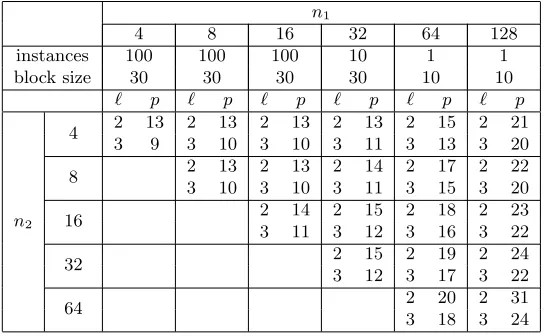
In Table 1 we ran our attack with n1 ≥ n2 and q of the form 2p+ 1 for
p ∈N. The secret polynomial s we try to find is chosen uniformly at random
from Zq[x, y]/(xn1 + 1, yn2 + 1) so the minimum number of 2-RLWE samples possible to recover s is two. We give the minimum q of the stated form for which the attack succeeded with the stated number of samples; here we used the embedding approach combined with BKZ reduction to attempt to solve the BDD instances. Further, the coefficients of the error polynomials were sampled independently using a discrete Gaussian sampler withσ= 3.19. The results are heuristic as we only attempted to solve a limited number of instances for each choice of n1, n2 and q. It is certainly possible to find the secret for smaller q by increasing the block size used, and in specific instances this may not even be necessary.
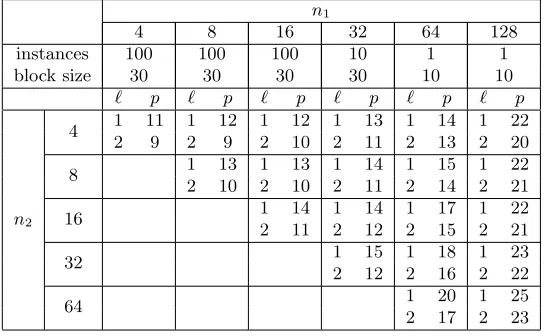
In Table 2 we performed the same attack but this time with the coefficients of the secret polynomial taken from the uniform distribution on{−1,0,1}, hence it is now possible for a successful attack with only one sample.
5
Optimizing module based cryptosystems
We take the example of Kyber [3] which when reduced to its simplest form has a public key which is a module-LWE sample where the secretsis a small element of the module Rk
Table 1.The number of samples`≤3 and the minimalp∈N,p≈log2(q) for which our attack succeeded in each of the stated number of attempts for the stated block size, givenn1,n2 andq= 2p+ 1, and where the secret polynomial is sampled uniformly at random inRq.
n1
4 8 16 32 64 128
instances 100 100 100 10 1 1
block size 30 30 30 30 10 10
` p ` p ` p ` p ` p ` p
n2
4 2 13 2 13 2 13 2 13 2 15 2 21 3 9 3 10 3 10 3 11 3 13 3 20
8 2 13 2 13 2 14 2 17 2 22
3 10 3 10 3 11 3 15 3 20
16 2 14 2 15 2 18 2 23
3 11 3 12 3 16 3 22
32 2 15 2 19 2 24
3 12 3 17 3 22
64 2 20 2 31
3 18 3 24
public key is then a pair (A,b) withAa k×kmatrix whose entries are chosen uniformly at random fromRq andb∈Rkq withb=As+efor some small error element e ∈Rk
q. This means a public key consists of k(k+ 1) elements of Rq. One might be tempted to use a structured matrix, such as an anti-circulant one, instead of a uniformly random one; after all this is essentially how one goes from LWE to its ring based counterpart RLWE and with our current understanding this latter optimization only incurs a negligible deterioration in security.
Let us fix some parameters and observe what happens. The suggested “para-noid” parameters from [3] are to takek = 4 and n= 256 andq = 6781 which gives a (post-quantum) security level of 218 bits, the largest given by the au-thors. Taking the matrixAto be anti-circulant means only having 5 elements of
Rq define the public key instead of 20. Further, the scheme can be interpreted as adding a ring structure on top of Rq in a new variable y satisfying y4+ 1 and replacing matrix multiplication by ring multiplication. Hence, we are in the
m-RLWE setting and working in the tensor product of two power-of-two cyclo-tomic fields of degrees 256 and 4 respectively. We can thus apply our attack with n1 = 256 and n2 = 4 which shows that we can recover s by solving four RLWE problems in dimension 256 from one sample where the error distribution has variance twice that of the original error distribution. The LWE-estimator [1] results in a security of this basic version of “multivariate-Kyber” of at most 107 bits, essentially halving the security. Thus there is a huge difference in terms of security between going from LWE to RLWE and going from module-LWE to
Table 2.The number of samples`≤2 and the minimalp∈N,p≈log2(q) for which our attack succeeded in the stated number of instances and with the stated block size, givenn1,n2andq= 2p+1, and where the secret polynomial is sampled coefficient-wise with each coefficient uniformly random in{−1,0,1}.
n1
4 8 16 32 64 128
instances 100 100 100 10 1 1
block size 30 30 30 30 10 10
` p ` p ` p ` p ` p ` p
n2
4 1 11 1 12 1 12 1 13 1 14 1 22
2 9 2 9 2 10 2 11 2 13 2 20
8 1 13 1 13 1 14 1 15 1 22
2 10 2 10 2 11 2 14 2 21
16 1 14 1 14 1 17 1 22
2 11 2 12 2 15 2 21
32 1 15 1 18 1 23
2 12 2 16 2 22
64 1 20 1 25
2 17 2 23
We note this “multivariate-Kyber” would also be weak with the “light” pa-rameter set wherek= 2 but for the standard parameters wherek= 3 the above attack does not apply as 3 is not a power of two.
6
Conclusion
In this paper we reconsidered them-RLWE problem and its security. We showed that, with a combination of simple evaluation and lattice attacks, the security of the m-RLWE problem is dramatically less than estimated in the current lit-erature. We would therefore not recommend using 2-RLWE for values ofn1 or
n2 less than those used in standard RLWE based schemes for cryptographic purposes. More generally, we conclude that them-RLWE problem using number fields with a small degree compositum field is insecure. Finally, this paper should also serve as a warning to implementers of module-LWE based cryptosystems to not blindly apply the standard optimization trick that is used to transform LWE into RLWE.
Acknowledgements
References
1. M. R. Albrecht, R. Player, and S. Scott. On the concrete hardness of Learning with Errors. Journal of Mathematical Cryptology, 9(3):169–203, 2015.
2. L. Babai. On lov´asz’ lattice reduction and the nearest lattice point problem. Com-binatorica, 6(1):1–13, 1986.
3. J. Bos, L. Ducas, E. Kiltz, T. Lepoint, V. Lyubashevsky, J. M. Schanck, P. Schwabe, G. Seiler, and D. Stehl´e. CRYSTALS - Kyber: A CCA-Secure Module-Lattice-Based KEM. In2018 IEEE European Symposium on Security and Privacy, pages 353–367, 2018.
4. Z. Brakerski, C. Gentry, and V. Vaikuntanathan. Fully Homomorphic Encryption without Bootstrapping. Cryptology ePrint Archive, Report 2011/277, 2011.https: //eprint.iacr.org/2011/277.
5. W. Castryck, I. Iliashenko, and F. Vercauteren. Provably Weak Instances of Ring-LWE Revisited. InEUROCRYPT 2016, pages 147–167. Springer-Verlag, 2016. 6. J.-P. D’Anvers, A. Karmakar, S. Sinha Roy, and F. Vercauteren. Saber:
Module-LWR Based Key Exchange, CPA-Secure Encryption and CCA-Secure KEM. In A. Joux, A. Nitaj, and T. Rachidi, editors,AFRICACRYPT 2018, pages 282–305. Springer International Publishing, 2018.
7. L. Ducas and A. Durmus. Ring-LWE in Polynomial Rings. In M. Fischlin, J. Buch-mann, and M. Manulis, editors,PKC 2012, pages 34–51. Springer Berlin Heidel-berg, 2012.
8. K. Eisentr¨ager, S. Hallgren, and K. Lauter. Weak Instances of PLWE. In A. Joux and A. Youssef, editors,SAC 2014, pages 183–194. Springer International Publish-ing, 2014.
9. Y. Elias, K. E. Lauter, E. ¨Ozman, and K. E. Stange. Provably Weak Instances of Ring-LWE. In R. Gennaro and M. Robshaw, editors,CRYPTO 2015, pages 63–92. Springer Berlin Heidelberg, 2015.
10. R. Kannan. Minkowski’s Convex Body Theorem and Integer Programming. Math-ematics of Operations Research, 12(3):415–440, 1987.
11. R. Lindner and C. Peikert. Better Key Sizes (and Attacks) for LWE-Based En-cryption. In A. Kiayias, editor, CT-RSA 2011, pages 319–339. Springer Berlin Heidelberg, 2011.
12. V. Lyubashevsky, C. Peikert, and O. Regev. On Ideal Lattices and Learning with Errors over Rings. In H. Gilbert, editor,EUROCRYPT 2010, pages 1–23. Springer Berlin Heidelberg, 2010.
13. V. Lyubashevsky, C. Peikert, and O. Regev. A Toolkit for Ring-LWE Cryptogra-phy. In T. Johansson and P. Q. Nguyen, editors,EUROCRYPT 2013, pages 35–54. Springer Berlin Heidelberg, 2013.
14. A. Pedrouzo-Ulloa, J. R. Troncoso-Pastoriza, and F. P´erez-Gonz´alez. Multivariate lattices for encrypted image processing. In IEEE International Conference on Acoustics, Speech and Signal Processing, pages 1707–1711. IEEE, 2015.
15. A. Pedrouzo-Ulloa, J. R. Troncoso-Pastoriza, and F. P´erez-Gonz´alez. On Ring Learning with Errors over the Tensor Product of Number Fields. https://arxiv. org/abs/1607.05244, 2016.
16. A. Pedrouzo-Ulloa, J. R. Troncoso-Pastoriza, and F. P´erez-Gonz´alez. Multivari-ate Cryptosystems for Secure Processing of Multidimensional Signals. CoRR, abs/1712.00848, 2017.
18. The Sage Developers. SageMath, the Sage Mathematics Software System (Version 7.5.1), 2017. http://www.sagemath.org.