ISSN (Print) : 2320 – 3765 ISSN (Online): 2278 – 8875
I
nternational
J
ournal of
A
dvanced
R
esearch in
E
lectrical,
E
lectronics and
I
nstrumentation
E
ngineering
(An ISO 3297: 2007 Certified Organization)
Vol. 3, Issue 11, November 2014
10.15662/ijareeie.2014.0311009
An Automated Bed Positioning and Windows
System Using MEMS Accelerometer
A.Alice Linsie
Assistant Professor, Dept. of ECE, Shanmuganathan Engineering College, Pudukkottai, Tamilnadu, India
ABSTRACT: This paper presents a prototype model for gesture recognition using MEMS accelerometer .The system
is capable of recognizing gestures from MEMS 3-axes accelerometer and it is mainly targeted for hospital applications .The acceleration of hand in all directions were detected by 3-axes MEMS accelerometer. According to the acceleration values corresponding motors were enabled using Microcontroller, to perform tasks like bed positioning & windows open and close using RF transmitter & receiver.LCD is used to display the command which is performed from time to time.
KEYWORDS: MEMS accelerometer, RF transmitter & receiver, Liquid Crystal Display.
I.INTRODUCTION
Gesture recognition is one of the most important area of research these days. As human to machine interaction has been more quite often these days, physical gestures were used as a language for this communication. Several devices like camera, joystick, track ball etc were available for capturing gestures. However each device has its own limitations like mobility, cost etc. In this work, MEMS based accelerometer is used which is compact in size and make it feasible to
use wherever it required. Several works using MEMS accelerometer were available. [4]Ruize Xu et al, discussed about
three different gesture recognition models like sign sequence and Hopfield network, velocity increment , sign sequence and template matching respectively which has the capability to detect seven hand gesture like up, down, left, right, tick, circle, cross based on input from 3-axes accelerometer. Out of the three models they recommended sign sequence and template matching technique because of its highest overall recognition accuracy. Because of this high accuracy template matching technique is also implemented for gesture recognition in our work.
II.EXISTING SYSTEM
Several gesture recognition systems using MEMS accelerometer for various applications like direction controlled wheel
chairs, unwired mouse navigation systems etc were available. [2]Mangaiyarkarasi et al, used template matching
technique in their work of producing voice commands for each gesture and display the same command in LCD which is
aimed to help speech & hearing impaired people. [1]Preeti Srivastava et al, proposed automated wheel chair control
using head gesture recognition for elderly and disabled peoples. However gesture recognition is a wide area and its application can be extended further more. The proposed system is one such extended application using MEMS accelerometer.
III.PROPOSED SYSTEM
ISSN (Print) : 2320 – 3765 ISSN (Online): 2278 – 8875
I
nternational
J
ournal of
A
dvanced
R
esearch in
E
lectrical,
E
lectronics and
I
nstrumentation
E
ngineering
(An ISO 3297: 2007 Certified Organization)
Vol. 3, Issue 11, November 2014
Fig 1.a & 1.b shows the architecture of the proposed MEMS based gesture recognition system. The individual steps are described below.
The sensing device senses acceleration in three axes. For accuracy in detection 3-axes accelerometer is used and all the 3-axes values were used in the analysis. Acceleration values which is analog where conditioned and given to the microcontroller circuit. The microcontroller checks the incoming gesture value with the list of values pre-stored. The motor which has to be enabled for corresponding gestures is allotted through relays.
In case of automated windows, if the sensed acceleration value matches with pre-stored values, the RF transmitter is enabled to transmit signal. Decoder is used to decode signal and RF receiver is used to receive the signal. Upon receiving signal, windows will open/ close according to gestures through stepper motors .LCD is used to display the command along with acceleration values on (X, Y, Z) axes for which the action is now performing.
Fig.1.a Proposed system architecture with transmitter section
Fig 1.b Proposed system architecture with receiver section
a)SENSING DEVICE:
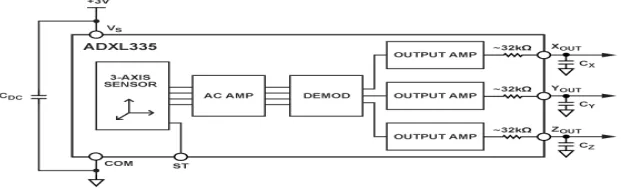
The sensing device used here is ADXL 335 accelerometer. This device has sensor for all the three (X, Y, Z) axes. These axes don’t interfere with one another as they are orthogonal to each other. The advantage of this device is low power consumption, small size etc. This device itself produces conditional voltage output. It measures acceleration with
a minimum full-scale range of ±3 g. It can measure both static as well as dynamic acceleration.
MEMS Accelerometer
Signal Conditioning
Micro Controller
Relay Motor
controlling unit
RF transmitter
Device 1
RF Receiver Microcontroller Relay Device 2
ISSN (Print) : 2320 – 3765 ISSN (Online): 2278 – 8875
I
nternational
J
ournal of
A
dvanced
R
esearch in
E
lectrical,
E
lectronics and
I
nstrumentation
E
ngineering
(An ISO 3297: 2007 Certified Organization)
Vol. 3, Issue 11, November 2014
10.15662/ijareeie.2014.0311009
The sensor is a micro machined structure built on top of a silicon wafer with poly silicon surface. Between silicon wafer & poly silicon surface resistance is created against acceleration. Acceleration is measured using a differential capacitor that consists of one independent fixed plates and another one plates attached to the moving mass. The fixed plate is driven by 180° out-of-phase square wave input. Acceleration deflects the moving plate and unbalances the differential capacitor setup resulting in a sensor output voltage whose amplitude is proportional to acceleration. The technique called Phase-sensitive demodulation is used to determine the magnitude and direction of the acceleration.
b) DATA PROCESSING:
The accelerometer produces the analog values of acceleration for all 3 axes. Each gesture has its own set of values. These values were pre-stored in the microcontroller, along with list of actions which has to be enabled. The tolerance level for each gesture is set as ±5 .When the detected gesture’s value is same as that of pre-stored value, corresponding actions will be enabled through devices. For example if the gesture for patients bed head side up is done, its acceleration value will be compared with pre-stored value. If it matches, then relay which control the head side motor is enabled. If head down gestures is done the relay is made to rotate the motor in anti-clock wise direction.
The procedure is same for legs side bed up & down. For windows open & close, after detecting & comparing gestures, the command will be transmitted through transmitter & after receiver got signal windows like set up will open /close through relay controlled motors.
IV.RESULT AND DISCUSSION
The programming in microcontroller is done by using Embedded C. Proteus software is used for simulating & verifying the results. The simulated results using this software are given below. The Proposed system has following advantages like non-specific user type, mobility, wide area coverage with RF transceiver section.
In the simulated model, crimp port is used in place of accelerometer for acceleration value adjusment. The simulated output has crimp port, microcontroller, LCD, stepper motors.
ISSN (Print) : 2320 – 3765 ISSN (Online): 2278 – 8875
I
nternational
J
ournal of
A
dvanced
R
esearch in
E
lectrical,
E
lectronics and
I
nstrumentation
E
ngineering
(An ISO 3297: 2007 Certified Organization)
Vol. 3, Issue 11, November 2014
Fig.4 Transmitter section of proposed system with MEMS accelerometer, microcontroller and relay to control motors.
Fig.5 Proposed automated bed system with motors on each side for UP and DOWN conditions.
ISSN (Print) : 2320 – 3765 ISSN (Online): 2278 – 8875
I
nternational
J
ournal of
A
dvanced
R
esearch in
E
lectrical,
E
lectronics and
I
nstrumentation
E
ngineering
(An ISO 3297: 2007 Certified Organization)
Vol. 3, Issue 11, November 2014
10.15662/ijareeie.2014.0311009
V.CONCLUSION
In this paper, I presented my work on gesture recognition through MEMS accelerometers. Several application were available using MEMS accelerometer whereas automated bed lifting system and windows system is one of the untouched application using accelerometer. This system can be used in hospitals, homes etc., not only for patients we can use this technique for normal bed position changing on top & bottom side. By this application people don’t need to rely on others. Similarly another application of this work is automated window. Without using remote, manual operation we can simply control windows using gestures from the place where we are. Since I used RF transmitter for this windows application the coverage area is restricted. The main drawback of the system is that as this work is intended for beds, weight of patients also have to be considered. According to weight we need to put more efficient motors for bed lifting .However it requires more cost. And also if the machine is not maintained properly there is a choice for noise pollution which might cause disturbance to patient itself.
REFERENCES
1.Preeti Srivastava, Dr. S. Chatterjee,RitulaThakur “A Novel Head Gesture Recognition Based Control for Intelligent Wheelchairs” International Journal of Research in Electrical & Electronics Engineering, vol.2, issue-2,pp.10-17,April-June 2014.
2.A. Alice linsie, J.Mangaiyarkarasi “ Hand gesture recognition using MEMS for specially challenged people” International journal of VLSI and
Embedded
System, vol.4,issue-2,pp.238-241,March-April 2013.
3.N. Pranathi, Syed Musthak Ahmed , “ Tri-Axis Motion Detection using MEMS for Unwired Mouse Navigation System in the Future Generation
Machines” International Journal of Advanced Research in Computer and Communication Engineering, vol. 2, issue 9,pp.3672-3675,Sep-2013.
4.Ruize Xu, Shengli Zhou, and Wen J. Li , “MEMS accelerometer based nonspecific-user hand gesture recognition” IEEE Sensors journal,
vol.12,no.5,pp.1166-1173,May 2012.
5.S. Zhou, Q. Shan, F. Fei, W. J. Li, C. P. Kwong, and C. K. Wu et al, “Gesture recognition for interactive controllers using MEMS motion sensors,” in Proc. IEEE Int. Conf. Nano /Micro Engineered and Molecular Systems, pp. 935–940, 2009.
6.S. Zhou, Z. Dong, W. J. Li, and C. P. Kwong, “Hand-written character recognition using MEMS motion sensing technology,” in Proc.
IEEE/ASME Int. Conf. Advanced Intelligent Mechatronics, pp.1418–1423, 2008.
7.S. Zhang, C. Yuan, and V. Zhang, “Handwritten character recognition using orientation quantization based on 3-D accelerometer,” presented at
the 5th Annu. Int. Conf. Ubiquitous Systems, 2008.
8.T. Schlomer, B. Poppinga, N. Henze, and S. Boll, “Gesture recognition with a Wii controller,” in Proc. 2nd Int. Conf. Tangible and Embedded
Interaction (TEI’08), Bonn, Germany, pp. 11–14, 2008.