Gabor Based Face Recognition
Using EBGM and PCA
Manan Tiwari
Department of Electronics and Telecommunication Engg. Shri Shnakracharya Group of Institutions Bhilai C.G. India
ABSTRACT- Face recognition has received substantial attention
in recent years due to applications in Research fields such as biometrics community and computer vision. A lot of face recognition algorithms have been developed during the past decades. These algorithms can be classified into appearance-based and model-appearance-based schemes. Principal Component Analysis (PCA) is a typical linear appearance-algorithm, and Elastic Bunch Graph Matching (EBGM) is a two-dimensional model-based approach. This paper reviews the two classical methods and a typical face image database for standard testing.
In many applications of Face recognition, the best possible accuracy is required. In such circumstances, existing efficient algorithms do not guarantee good accuracy for the approximations they produce. We propose an efficient algorithm that recognizes novel faces by first localizing a set of landmark features, Approximates the landmark features, and then measuring similarity between these features. For the first approach we use feature based algorithm called as EBGM (Elastic bunch graph matching). For the second approach we use the statistical based algorithm called as PCA (Principal component analysis). The algorithms are implemented on Matlab environment. Scenarios and performance benchmarking are compared for each of the algorithms.
KEYWORDS: Face recognition, PCA, EBGM, landmark features,Jets.
INTRODUCTION
Machine recognition of Face is emerging as an active research area spanning several disciplines such as image processing, pattern recognition, computer vision and neural network. Research interest in face recognition has grown significantly in recent years as a result of facts such as the increase in emphasis on civilian/commercial research projects, the increasing need for surveillance related application due to drug trafficking, terrorist activities etc., and the availability of real time hardware. [13]
Most of the conventional access control systems have the following drawbacks: these systems do not grant access by "who we are", but by "what we have", such as ID cards, keys, passwords, PIN numbers.These methods require the user to remember a password, to enter a PIN CODE, to carry a badge, or in general, require a human action. The corresponding means (Key, badges, password, PIN CODE) are prone to lost or being forgotten. People are not comfortable in placing their eyes before a scanner or giving a drop of blood for DNA sequencing. Face recognition is one of the few biometric methods that possess the merits of both high accuracy and low intrusiveness.[6]
Human often use faces to rencognize individuals and advancement in computing capability over the past few décades now enables similar recognition automatically. Early face recognition algorithms used simple geometric models but the recognition process has now matured into science of sophisticated mathemetical representations and matching processes. Major advancements and initiatives in the past ten years have propelled face recognition technology into spot light. Face recognition can be used as both identification and recognition. (Open set and closed set).
Face detection is one of the tasks which human vision can do effortlessly. However, for computer vision, this task is not that easy. A general definition of the problem can be stated as follows: Identify all of the regions that contain a face, in a still image or image sequence, independent of any three dimensional transformation of the face and lighting condition of the scene.
The main difficulty in face recognition includes:
1) Physical changes: facial expression change; aging; personal appearance (make-up, glasses, facial hair, hairstyle, disguise).
2) Acquisition geometry changes: change in scale, location and in-plane rotation of the face (facing the camera) as well as rotation in depth (facing the camera obliquely, or presentation of a profile, not full-frontal face).
3) Imaging changes: lighting variation; camera variations; channel characteristics (Especially in broadcast or compressed images). .
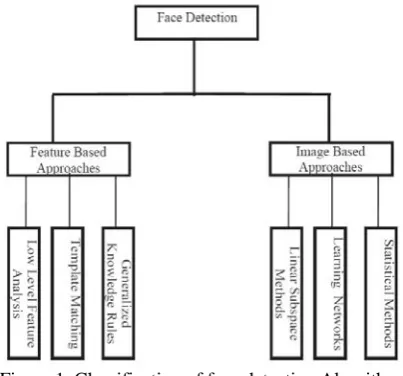
There are several methods used for this problem and they can be broadly classified in two main classes, which are feature-based and image-based approaches. The appearance-based algorithms can be further divided as linear and non-linear;
Previous research has shown that both feature-based and image-based approaches perform effectively while detecting upright frontal faces, whereas feature-based approaches show a better performance for the detection scenarios especially in simple scenes. In this work, two different feature based and statistical based algorithm are used for the purpose of face recognition task.
A. Classification of face detection Algorithms
however, these techniques can be unreliable and unmanageable.
In model-basedtechniques, facial features are represented as 2D models or 3D models. With 2D models, the recognition system tries to represent facial features without attempting to recover the volumetric geometry of the scene whereas in 3D face models the features are represented in 3D that gives more accurate representation of facial features. Due to complex mapping procedures, 3D models are computationally demanding.
Figure 1. Classification of face detection Algorithms
B. Statistical Techniques:
Statistical techniques rely on statistical analysis of facial features. A few of the statistical techniques that are used in face recognition are PCA, ICA and LDA.
1) Principal Component Analysis (PCA): The Principal Component Analysis (PCA) [7] is one of the most successful techniques that have been used in image recognition and compression. PCA is a statistical method under the broad title of factor analysis. The purpose of PCA is to reduce the large dimensionality of the data space (observed variables) to the smaller intrinsic dimensionality of feature space (independent variables), which are needed to describe the data economically. This is the case when there is a strong correlation between observed variables. The jobs which PCA can do are prediction, redundancy removal, feature extraction, data compression, etc. Because PCA is a classical technique which can do something in the linear domain, applications having linear models are suitable, such as signal processing, image processing, system and control theory, communications, etc.
2) Feature Based Techniques:
Feature-based approaches, on the other hand, rely on information about well-defined facial characteristics and the image area around these points to represent a face in the problem space and perform recognition. Examples of these
facial features are the eyes, nose, mouth, eyebrows etc. The exact coordinates of the eyes in particular are ideally given, although in practice the algorithm can only work with estimates obtained from face detection and eye zone locator module that precedes the recognition process. An example of a feature-based approach is the Elastic Bunch Graph Matching (EBGM) algorithm [1, 12], which stores spectral information about the neighborhoods of facial features by convolving these areas with Gabor wavelets (masks).
3) EBGM Algorithm Overview:
EBGM algorithm is a feature-based approach [1, 2] to the face identification problem. In the context of EBGM, the facial features that are used are called fiducial points. Images are represented internally by the algorithm using spectral information of the regions around these features, which is obtained after convolving those portions of the image with a set of Gabor wavelets [5, 2] of varying size, orientation and phase. The results of the convolution for a specific position (called the Gabor Jet) are then collected for all Fiducial points on a given image and aggregated (together with the feature coordinates) in that image’s Face Graph. Having applied this process to all images in the training set, all the resulting Face Graphs are concatenated in a stack-like structure called the Face Bunch Graph (FBG) [5, 1]. This is the system’s model of all individuals it can identify. Automatic feature localization capability is one of the major advantages of the EBGM algorithm. After the Face Graph has been constructed, it is compared against all members of the FBG to determine the closest match according to a given similarity metric.
4). Landmark Locations and Features:
EBGM algorithm is easily divided into three steps. The first step is to determine the landmark locations. A face graph is created for every image that needs to be matched. Finally, similarity of face graphs is computed and final classification is based on this similarity.
Landmarks [1, 12] are parts of the face that are easily located and have similar structure across all faces. Some obvious examples of landmarks are the eyes, nose, and mouth. Each of these landmarks is well defined, is common to all faces, and has distinct representations in image space. Typically landmarks are defined such that their location has a very small error tolerance. Instead of defining a landmark as the “nose”, the landmark is defined as the “nose tip”. The nose tip can be located to within a few pixels.
Landmark Locations are the pixel coordinates of landmarks. Landmark locations define the geometry of the face. An example of this is the nose tip, which has a well defined location.
Gabor jets [1] are used to represent the landmark jet information in the EBGM algorithm. A Gabor jet is produced by convolving the landmark location with a collection of Gabor masks. Therefore, the Gabor jet will contain a good description of the local frequency information around the landmark.
Jet [2]: a set of 40 (5 spatial frequency, 8 orientations) complex Gabor wavelet coefficients for one image point. J = [a1, a2… a40]. Similarity between jets.
d is the displacement of pixels: needs to be estimated. kj:
spatial wave vector. The fig.2 shows the jets.
Figure 2.Jets
METHODOLOGY
Various approaches have been proposed in the literature for face recognition algorithms which can be classified into three categories
ANALYTICAL(FEATURE BASED)
HOLISTIC(GLOBAL)
HYBRID
A .Approach
The proposed approach is as follows:
Recognizes novel faces by first localizing a set of landmark features.
Approximation of landmark features.
And then measuring similarity between these features
For the 1st approach we use feature based algorithm called as
EBGM (Elastic bunch graph matching)
For the 2nd approach we use the statistical based algorithm called as PCA (Principal component analysis).
The methodology for the project work is carried by the use of the HYBRID approach. The difficulty in the analytic approach of EBGM is the requirement of accurate landmark localization which can be achieved by the use of holistic approach method PCA .The approach proceeds as:
LOCALIZATION: Recognize novel faces by first localizing a set of landmark features.
APPROXIMATION: Approximation of landmark features using PCA
COMPARISION: Measuring similarity between these features.
Figure 3. Proposed methodology
In any case, a basic goal should be to cover the face evenly; however, a large number of extra points will be detrimental to the algorithm’s performance, since the areas covered by the Gabor wavelets will be overlapping and thus the information contained in the Gabor jets of neighboring points highly correlated reduces the algorithm speed.
The purpose of PCA is to reduce the large dimensionality of the data space (observed variables) to the smaller intrinsic dimensionality of feature space (independent variables), which are needed to describe the data economically. This is the case when there is a strong correlation between observed variables.
Thus we take a large number of fudicial points on the face for the process of localization, and then we can reduce the large dimensionality of the data space (observed variables) to the smaller intrinsic dimensionality of feature space by using the PCA algorithm.
B. Proposed Algorithm
STEP 1: Jets are selected by hand to serve as facial features. The following figure shows this.
Figure 4. Selection of jets
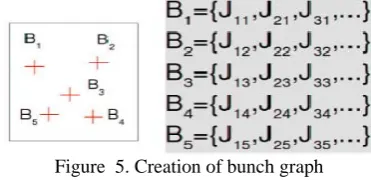
STEP 2: A bunch graph is created each node of the bunch graph corresponds to a facial landmark and contains a bunch of model jets extracted from model imagery.
Figure 5. Creation of bunch graph
STEP 3: An approximation of landmarks is obtained.Let’s suppose we have M facial landmarks of size N (= rows and columns) representing a set of sampled images. pj’s represent the jet values.
' '
,
'
'
'
cos
,
'
'
T a
j
j j j j
j
S
J J
J J
J
J
a a
d k
S
J J
J
J
xi = [p1 : : : pN]T ; i = 1; : : : ;M
The facial landmarks are mean centered by subtracting the mean facial landmarks from each facial landmarks vector. Let m represent the mean facial landmarks
And let wi be defined as mean centered facial landmarks
Our goal is to find a set of ei’s which have the largest possible projection onto each of the wi’s. We wish to find a set of M orthonormal vectors ei for which the quantity
Calculating the coefficients of the principal components and their respective variances is done by finding the eigenfunctions of the sample covariance matrix:
The covariance matrix is given as follows:
STEP 4: After the Approximation by the principal component analysis, landmark points are located for every image. First a novel jet is extracted from the novel image; the displacement of the novel jet from actual location is estimated by comparing it with the most similar model jet from the corresponding bunch.
Figure 6. Novel image
STEP 5: A face graph is created for each image by extracting a jet for each landmark. The graph contains the location of the landmarks and value of the jets. The original image can then be discarded.
Figure 7. Extraction of jet
STEP 6: The last step consist of comparison. Face similarity is computed as a function of landmark locations and jet values
C. Flow Diagram of proposed Algorithm
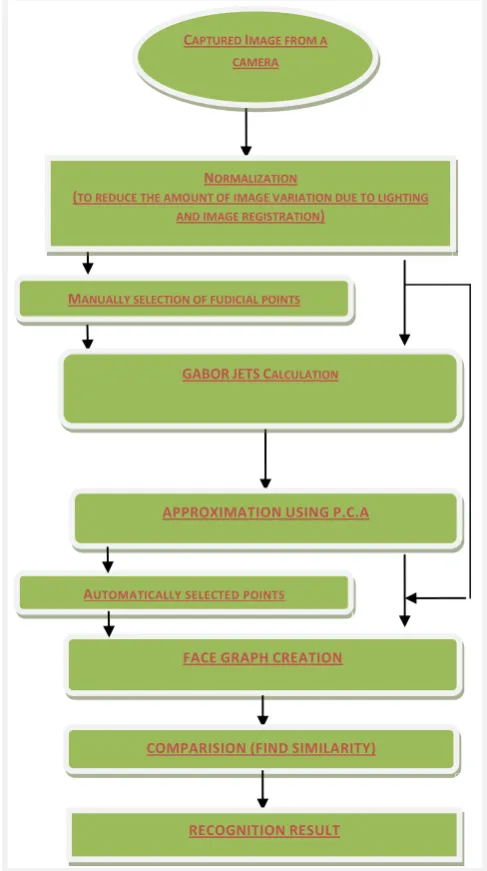
The algorithm is divided into four executables:
Landmark localization, approximation, face graph creation, and similarity measurement.The complete system can be said to consist of five data processing steps, and there are six intermediate data types. The output of the algorithm is a distance matrix which specifies the similarity between each image in the database. The algorithm assumes that more similar images have smaller distances between them.
The complete identification processes is defined in figure 8.
Figure 8. Flow diagram of PROPOSED ALGORITHM
MANUALLY SELECTION OF FUDICIAL POINTS CAPTURED IMAGE FROM A
CAMERA
APPROXIMATION USING P.C.A GABOR JETS CALCULATION
NORMALIZATION
(TO REDUCE THE AMOUNT OF IMAGE VARIATION DUE TO LIGHTING
AND IMAGE REGISTRATION)
AUTOMATICALLY SELECTED POINTS
FACE GRAPH CREATION
COMPARISION (FIND SIMILARITY)
CONCLUSION
A person authentication technique using face recognition is presented where we propose an algorithm based on hybrid approach. After implementation and comparison of the two classical face recognition algorithms, PCA and EBGM, taking in consideration three main factors, total training image number, accuracy rate and processing speed, we find from the result that EBGM perform better than PCA. EBGM has the highest accuracy rate but the computational time is relative long. And if we increase the number of landmarks in EBGM the performance reduces so if we use the hybrid approach better results can be obtained. This technique is based on the extraction of jets. This concept is related to the Gabor wavelet which was introduced by Daugman in 1988.Our work will focus on combining the two algorithms for high accuracy and smaller processing time.
ACKNOWLEDGEMENT
This work is supported by Shri Shnakracharya Group of Institutions Chhattishgarh India.SSITM Junwani Bhilai C.G, India.
REFERENCES
[1] David S. Bolme:” THESIS ON ELASTIC BUNCH GRAPH MATCHING” Colorado State University Fort Collins, Colorado Summer 2003
[2] Laurenz Wiskott, Jean-Marc Fellous, Norbert Kruger, and Christoph von
der Malsburg, Face Recognition by Elastic Bunch Graph Matching,
Tech. Report 96-08, Ruhr-Universitat Bochum, April 1996
[3] Kyungnam Kim:” Face Recognition using PCA”: Department of Computer Science University of Maryland, College Park MD 20742, USA; 1998
[4] M. Kirby and L. Sirovich, Application of the Karhunen-Loeve Procedure for the Characterization of Human Faces, IEEE Trans. on Pattern Analysis and Machine Intelligence 12 (1990), no. 1, 103 – 107. [5] B. Kepenekci, “Face recognition using Gabor wavelet transform,”
Master’s thesis, The Middle East Technical University, Sep., 2001 . [6] Zhaoxian Zhou1, Hua Sun2, and Chaoyang Zhang3,”Face Recognition
Algorithms: Review”2003
[7]. Kresimir Delac 1, Mislav Grgic 2, Panos Liatsis Croatian Telecom, Savska 32, Zagreb, CROATIA University of Zagreb, Faculty of EE & Comp, Unska 3/XII, Zagreb, CROATIA Information and Biomedical Engineering Centre, City University London, U.K 2005
[8] Brunelli, R., and Poggio, T., “Face Recognition: Features vers
Templates”, IEEE Trans. Pattern Anal. Machine Intell., vol. 15,
pp.1042-1052, 1993.
[9] Vladimir Rokhlin, Arthur Szlam, and Mark Tygert UCLA Computational and Applied Math. Technical Report 08-60 September 5, 2008
[10] Face Recognition: Study and Comparison of PCA and EBGM
Algorithms Sachin Katadound Western Kentucky University 1-1-2004
[11]Shang-Hung Lin, Ph.D. IC Media Corporation An Introduction to Face
Recognition Technology Vol. No.3 2000
[12] Elastic Bunch Graph matching Performance And Comparision Andreas Stergious, MSIN 2003
[13]FACE RECOGNITION AND ITS APPLICATIONSAndrew W. Senior
and Ruud M. Bolle IBM T.J.Watson Research Center, Yorktown
Heights,NY 10598, USA.
[14] “Face Detection using Learning Network” by FA˙IK BORAY TEK IN June 2002
[15] Efficient face recognition system using random forest by Vidyut Ghosal Dept. of CSE IIT Kanpur.2009
[16] W. Zhao, R. Chellappa, and P.J. Phillips, Subspace linear discriminant
analysis for face recognition, UMD, 1999.
[17] M. Turk, and A. Pent land, “Face recognition using eigenfaces,” Proc.
IEEE Conf. on Computer Vision and Pattern Recognition, (Maui, HI), June 3-6 1991.
[18] D.M.BlackBurn, J.M.Bone, P.J.Phillips,”Facial Recognition vendor test 2000” www.frvt.org
[19] Image database The AT&T Laboratories, Cambridge at
http://www.uk.research.att.com/facedatabase.html
[20] Ross Beveridge, Evaluation of face recognition algorithms web site,