ADAPTIVE TEACHING PRACTICE:
TEACHER RESPONSE TO UPPER PRIMARY STUDENTS
(YEARS 5-6) WHO EXPERIENCE DIFFICULTY WITH READING
Wendy Scott - Diploma of Teaching, Bachelor of Education, Master of Education
Being a dissertation submitted for the degree of Doctor of Philosophy within the School of Education, Victoria University
FTS THESIS 371 .914472 SCO 30001007614755 Scott, Wendy A
Declaration
I declare that this thesis is my own account of my research and, except where indicated otherwise, contains work that has not been previously submitted for a degree at any tertiary institution.
Abstract
Acknowledgements
I wish to thank my supervisors Associate Professor Tony Kruger and Professor John Wilson for their encouragement and advice.
I acknowledge the support of my family - Laurie, Karen and Laurie. Their faith in my ability was appreciated. Special thanks go to Ken for his love and patience.
I would also hke to thank the teachers and principals at the six schools in which the study was undertaken. The research could not have been completed without their contributions and willing involvement.
TABLE OF CONTENTS
Declaration II Abstract Ill Acknowlegements IV
Table of contents V List of Figures IX List of Tables IX
CHAPTER 1 - ADAPTIVE INSTRUCTION THE FOCUS OF THE STUDY
1.1 The problem statement 1 1.2 Definitions of adaptation 2 1.3 Context of the study 7 1.4 Definitions of other terms
1.4.1 Learning disability and learning difficulty 11
1.4.2 Reading difficulty 13 1.5 Rationale for the study 14 1.6 Research questions 18 1.7 Organisation of the thesis 22
CHAPTER 2 - LITERATURE REVIEW
2.1 Teaching reading - A recent historical perspective 23
2.2 Reading difficulty 34 2.3 The role of the teacher 46 2.4 Teacher knowledge 49
2.4.1 Beliefs of teachers 50 2.4.2 Affect and social conditioning 53
2.4.3 Teacher experience 55 2.4.4 The development of professional knowledge 56
2.4.5 Critical episodes 59
2.8 Adaptive instruction ^"^
2.8.1 Adaptive instruction in response to reading difficulty 7°
CHAPTER 3 - THEORETICAL FRAMEWORKS AND EMERGENT PREDICTIONS
3.1 A theoretical framework for investigating reading ^^
3.2 A theoretical framework for investigating teacher belief °'
3.3 A theoretical model for investigating ways of Knowing 90
3.4 A frameworK for investigating adaptive teaching practices 95
3.5 Predictions about adaptive educational practices and the teaching of
reading ''^2
CHAPTER 4 - RESEARCH METHODOLOGY
4.1 The qualitative paradigm 104
4.2 The research project timeline '•''2
4.3 Sampling techniques 113
4.4 Data collection procedures
4.4.1 Establishing rapport 118
4.4.2 Observations 121
4.4.3 Interviews 122
4.4.4 Student assessment 124
4.5 Data processing and analysis 125
CHAPTER 5 - RESULTS: CONTEXTUAL FACTORS
5.0 Introduction 130
5.1 Teacher preparation 131
5.1.1 Teacher experience by qualifications, current study and length of
service 131 5.1.2 Method of teaching reading and professional development 132
5.2 School context ^3g
5.2.1 The schools in which paarticipating teachers worKed 137
5.2.2 Resources available for the teaching of reading 140
5.2.3 Grade levels, Class Size and Number of Studetns with Reading
Difficulties 141
5.3 Teaching style in reading lessons 147
5.4 Teacher belief 148 5.5 Typology of the adaptive teacher 153
5.6 Summary 153
CHAPTER 6 - RESULTS: STUDENT ABILITY AND TEACHER KNOWLEDGE
6.0 Introduction 155 6.1 Teacher knowledge of student need 156
6.1.1 Amanda's assessment of identified students 156 6.1.2 Brian's assessment of identified students 158 6.1.3 Colin's assessment of identified students 159 6.1.4 Dianne's assessment of identified students 160 6.1.5 Emily's assessment of identified students 161 6.1.6 Frances'assessment of identified students 163 6.1.7 Summary of teachers'statements about student ability 164
6.2 Results of standardised testing 165 6.2.1 Results of formal assessment of students 165
6.2.2 Summary of standardised test results 168
6.3 Teachers'ways of knowing 170 6.4 Revised topology of an adaptive teacher 176
CHAPTER 7 - RESULTS: ADAPTIVE TEACHING PRACTICES
7.0 Introduction 178 7.1 Adaptive educational practices 179
7.1.1 Treatment of the whole class that allowed full participation
of students who experienced difficulties with reading 182 7.1.2 Differential treatment by the teacher offered to a fixed group
of students identified as experiencing difficulty with reading 182 7.1.3 Treatment offered by the teacher to a flexible group of students or
7.3 Differences in adaptive educational practices - responding to specific need.. 189
7.3.1 Amanda: A less adaptive teacher 1° 'IQ2
7.3.2 Amanda's reading and language lessons '^ 7.3.3 Adaptive teaching practices observed in Amanda's classroom 198
7.3.4 Dianne: An adaptive teacher ' 7.3.5 Dianne's language and reading lessons ^
7.3.6 Adaptive teaching practices observed in Dianne's classroom 210
7.4 Student engagement 213
7.5 Summary 218
CHAPTER 8- DISCUSSION
8.0 Introduction 219 8.1 Adaptive teaching practices 219
8.2 Contexts
8.2.1 Teacher preparation, method of teaching reading and reading
style 221 8.2.2 School support for inclusive teaching practices 229
8.2.3 Teacher belief 231 8.3 Teacher Knowledge and student ability 237
8.4 Summary 244
CHAPTER 9 - CONCLUSION
9.1 Adaptive teaching practices 247 9.2 Characteristics of the adaptive teacher 252
9.3 Strengths and significance of the study 253
9.4 Limitations of the study 256 9.5 Suggestions for further research 257
9.6 Summary of the study 258
BIBLIOGRAPHY 259
APPENDICES
Appendix 1 - Sample of questions asKed during interview and responses 279
LIST OF FIGURES
Fig.1 The Logogen Model of Reading 31 Fig.2 Model of Reading Disability 35 Fig.3 The Maddox Theory of Knowledge 49
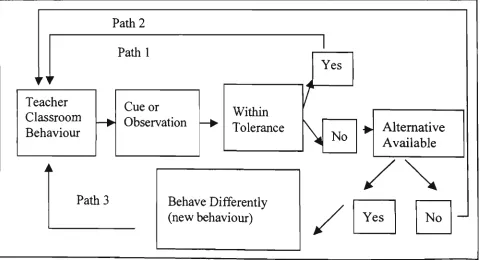
Fig.4 Knowledge to action 50 Fig,5 The threshold theory of interactive decision making 64
Fig. 8.1 Ranking of teachers on a continuum from least to most adaptive 221
Fig. 8.2 Teaching style and the adaptive teaching continuum 222 Fig. 8.3 Teacher beliefs and the adaptive teaching continuum 231 Fig 8.4 Way of Knowing and the adaptive teaching continuum 237
LIST OF TABLES
Table 3.1 Sources of practical Knowledge 93
Table 5.1 Teacher information 131 Table 5.2 Teacher sKill development and the teaching of reading 132
Table 5.3 Information about schools in which participating teachers taught 137 Table 5.4 Factors intrinsic to the school that impact on the teaching of reading ..140
Table 5.5 Description of the grades in which particpating teachers taught 141 Table 5.6 Assistance offered to students who experienced difficulty with reading. 143
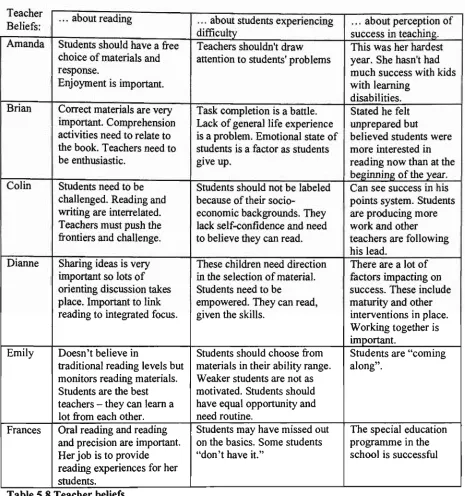
Table 5.7 Teaching style demonstrated during reading lessons 147 Table 5.8 Teacher beliefs about reading, students experiencing difficulty and their
Table 6.8 Students with below average scores on the Neale Analysis of Reading
and Edwards QuicK Word Screening Test 169
Table6.9 Teachers'ways of Knowing 171-173 Table 6.10 Revised typology of the adaptive teacher 1^^
Table 7.1: Number and nature of adaptations made by teachers and observed
in each classroom 1^1 Table 7.2: Reading tasKs, method of presentation and student engagement
in Amanda's class 192 Table 7.3: Reading tasKs, method of presentation and student engagement
in Dianne's class 203 Table 7.4: Reading tasKs, method of presentation and student engagement
in Brian's class 213 Table 7.5: Reading tasKs, method of presentation and student engagement
in Colin's class 215 Table 7.6: Reading tasKs, method of presentation and student engagement
in Emily's class 216 Table 7.7: Reading tasks, method of presentation and student engagement
in Frances' class 217 Table 8.1 Teacher adaptation, engagement of students, teaching style,
CHAPTER 1
ADAPTIVE INSTRUCTION - THE FOCUS OF THE STUDY
1.1 The problem statement
A dilemma faced by many teachers is how best to cater for the variety of skills and competencies that exist in mixed abihty classrooms. Creating a match between student ability and the learning demands made by particular teaching practices is a complex process. In an ideal learning environment, all students would only be presented with tasks that they were ready to master. This means that students would have had sufficient practice at a lower level of operation in a particular skill level and would demonstrate proficiency at this level before being required to move to the next level of skill difficulty. It is difficult to consistently achieve this ideal in a classroom situation, particularly when considering the range of student ability that will present in a classroom and the specific needs of students who exhibit learning difficulties. Creating a match between student ability and task complexity involves both recognition and response to individual needs and abilities.
Quality and equity in education does not mean offering the same program to all, but offering a program which reaches out to every person to maximize intellectual growth and social growth. (Glaser,
1977: Preface)
It has been argued that successful educational outcomes, particularly for those students who experience difficulty with learning, depend on adapting teaching to individual differences (Glaser 1977; Fuchs & Fuchs 1992; Joyce & Showers 1992; Wang 1992; Mcintosh et al. 1993; Sti-adUng 1993; Jenkins et al. 1994; Schumm & Vaughn 1995; Houtveen et al, 1999).
can provide for the needs of mdividuals." Dealing with diversity and responding to individual difference is an issue for teachers in schools today.
Responding to individual needs means adapting teaching in response to student need or sttident skill level. A body of research on adaptive teaching practice or adaptive teaching is developmg (Ysseldyke et al. 1990; Schumm and Vaughn 1991; Fuchs et al. 1992; Mchitosh et al. 1993; Schumm et al. 1994). The current research grew fi-om the recognition that whilst the mmisterial document "Individual Differences" had been widely disseminated and referred to for ahnost a decade, and research studies were taking place m the United States and the United Kingdom, there was little knowledge of how teachers in Victorian schools tackled the problem of responding to the specific needs of individual students.
Response to the perceived needs of students can be conceptuaHsed as any modification or adaptation of teaching practice that accounts for differences in students' existmg knowledge and abihties. The notion of adaptation in relation to teaching practice is relatively new and therefore a number of definitions and different terms are used in the literature to describe similar phenomena.
1.2 Definitions of adaptation
likely to weigh up the costs of different teaching practices in terms of the time and effort they require and the perceived rewards or gains which any alteration in practice might yield,
Babad (1993) notes that whilst equality is the ideal, unequal treatment should be provided for different groups of students. This unequal or differential treatment can, he cautions, be mterpreted as preferential treatment because teachers are motivated to compensate disadvantage and may invest extra effort in trying to educate students experiencing difficulty. Babad (1993) notes however that because expectations of this particular group of students are lower, teachers often keep this additional instruction on a low level.
Four Americans have written extensively on the topic of adaptive instruction (Glaser 1977; Como & Snow 1986; Wang 1992). Glaser (1977) wrote the first comprehensive text on what he described as "adaptive instruction". It was his contention that quality and equality in education did not result firom offering the same education to all students but through the presentation of programs which have the ability to reach out to every student in order to maximize both their intellectual and social growth. In his opinion...
...an educational environment which is not capable of adjusting to these differences inhibits the development of individual potential, becoming elitist and selective, is heavily biased toward the mainstream culture and perpetuates inequality. (Glaser, 1977:2)
sttidents who leam in different ways and the promotion of flexibility in both teaching
and assessment practices.
Como and Snow (1986:605) agree with this focus. They write, "The success of
education depends on adapting teaching to individual differences among learners.
They note that adaptation of teaching is an attempt to meet the challenge of diversity,
with learners adq)tmg to the environment and teacher adaptation of the environment.
According to Como and Snow (1986), if leamers are just "recycled" through the
same teaching program without taking into account individual differences until a
teaching goal is met, then the teaching system must be regarded as non-adaptive.
Ability grouping, in these authors' view, is maladaptive as it leads to the widening of
gaps between students. They warn that there is stigmatisation of students in lower
groups who may suffer low self-esteem and teacher expectation can be reflected in
the performance of the group. Teacher adaptation, they propose, is better considered
at the level of the individual where classroom organisation can be responsive to
individuals through procedures such as flexible grouping, the establishment of
learning centres, the reward structures offered, and the provision of varied materials
with students prompted and reinforced in different ways.
Truly adaptive teaching provides alternative instruction routes to the common goals and not only a single remedial loop, but alternative teaching options for the remediation of inaptitude. It also allows for individual learner goals. (Como & Snow, 1986:607)
Wang (1992:2) writes that a basic premise of adaptive education is that "success in
learning is maximised when students are provided with experiences which build on
their initial competence and are responsive to their learning needs." She notes that in
order to design and unplement adaptive education programs, teachers require
knowledge of the theories of individual differences in learning. Besides theory, she
acknowledges that teachers need practical knowledge in order to implement
successful teaching programs for all. Accordmg to Wang (1992) there are nine
program dimensions of adaptive education - (i) creating and mamtaining
mstructional materials, (ii) developmg student responsibility, (iii) diagnosing student
progress, (vii) motivating students, (viii) prescribing, and (ix) record keeping. An integrated diagnostic-prescriptive process is advocated as centtal to adaptive teaching. The idea is that student needs must be clearly identified, programs set up in response to specific student need and records kept of student response to interventions with subsequent program monitoring, evaluation and upgradmg where necessary,
Wang's (1992) description of adaptive teaching is similar to the description Wilson (1988:18) makes when he refers to quality teaching, notmg that this involves "planning, delivering and evaluating the optunum curriculum for the individual pupil m the context of a range of leamers." The challenge presented to teachers as they prepare lessons for their classes is just how to respond to a heterogeneous group of students.
Teachers have been encouraged to move from thinking of whole classes of students -what and how to teach a particular class, to thinking of teaching individuals within those classes - what and how to teach and ways to respond to the needs of individual students. The premise is that some students have needs that are different from their peers and these needs cannot be met when these students are simply taught as part of a whole class. Gallon et al. (1999:34) refer to the science of the art of teaching: "Starting from what children have in common to establish general principles of teaching and in the light of these principles to determme what moderations of practice are needed to meet specific needs."
Hart (1992:10) describes differentiation as an attempt to "achieve a better match between the demands of the task and children's existing knowledge and existing skills." She cautions however that teachers are experiencing a sense of overload and askmg them to differentiate thek teaching in this climate may have be too daunting and unreahstic an expectation. In a clunate of change where teachers feel pressured, it is Hart's fear that they may revert to separate grouping of children which she, like Como and Snow (1986), believes will only remforce difficulties. Ability grouping, an adaptive teaching practice, has received much attention from some researchers.
Slavin (1993) affirms that any kind of ability grouping carries the possibility of stigma and low expectation of low achievers. He is also concerned that poor examples are set for low achievers when working in groups where there are few good models. It is his contention that ability grouping may have long-term consequences. For Slavin (1993), the practice is m opposition to "egalitarian and democratic norms." Sti-adling and Saunders (1993) record their belief that the fiill implications of streaming for some are not obvious yet.
Adaptive instruction does not mean simply streaming or grouping students according to abiUty. Wang (1992) reminds us that adaptive instruction is not in opposition to the group instruction format altogether, as the provision of a variety of learning settings is important. Flexibility of the instmctional system, she notes, is vital.
Adaptation, adjustments, tailoring and differentiation may all describe a similar phenomenon - the modification of teaching practice in response to specific student need. Adaptation of teaching practice is the term that will be predomuiantly used in the current research rather than the term adaptive instruction as the latter implies that only behaviour that mvolves the teacher dkectly workmg with students is adaptive. Other terms such as modification and differentiation will also be used throughout this thesis. An adaptive practice might involve the teacher instigating interventions such as the use of technology, provision of additional instruction or supervised peer mtoring. A broad view of adaptation will be utiHsed in this research.
in the development of a clearer definition of what constitutes adaptive teaching practice.
1.3 Context of the study
As the topic of adaptive teaching is broad, it will be necessary to narrow the scope of the investigation. Initial key questions are - adaptation of what, by whom and for whom?
In order to study adaptive teaching practices it will be necessary to investigate adaptive teaching practices in a particular area of study. Adaptations made by teachers of upper primary classes (Grades 4-6) will be investigated with specific reference to educational adaptations made for students who experience difficulty with reading.
This research originated from the researcher's extensive experience of teaching and managing schools. It reflects her special interest in assisting students who experience learning difficulties, particularly those students in upper primary years who are described by their teachers and families as unable to read. She has worked with teachers, assisting them to develop diagnostic skills, strategies for responding to student difficulties and techniques for monitoring the effectiveness of interventions,
Reading is a skill that is highly valued in our society. It is seen as a core skill and a means by which information and knowledge can be acquired, Bryant and Bradley (1985:2) note "It is hard to think of anything else which could have so broad an effect on children's development than reading," Pumfiy and Reason (1991:3) refer to literacy as an "amplifier of human abihties," According to these authors, literacy is an application of the symbolic thinking that is characteristic of the species. It facilitates commimication and the conttol we have over our environment. Most importantly, the cumulative effect of an inability to read can result in a lack of opportunity to develop other competencies and can restrict access to information (Stanovich 1986),
governments have miplemented programs to improve literacy levels in our society. Two kinds of national efforts to improve literacy standards operated in Ausfralia throughout the 1980s. The BLIPS Program - Basic Learning in Primary Schools was undertaken between 1985 and 1987 at a cost of $22.59 million. The second program, ELIC - Early Literacy In-service Course used 30% of the fimds available in 1985. This was a stiiicttired professional development program for teachers of Preparatory classes to Year 2 and was nationally co-ordinated by the Commonwealth Schools Commission and the Curriculum Development Cenfre. Upper Primary level literacy mitiatives were developed across several systems but were not co-ordinated as a smgle innovation.
The Commonwealth Government's Ausfralian Language and Literacy Policy (1991) contained a report of a national adult literacy survey that indicated that about 10% of people in Austtalia do not develop sufficient literacy in English as children to cope with the everyday literacy demands of our society. The Ausfrahan Language and Literacy Pohcy (1991) makes reference to the fact that the goal of education should be for "an active Uteracy which allows people to use language to enhance their capacity to think, create and question, which helps them participate more effectively m society." As a direct resuU of this policy the School Language and Literacy Program was implemented. Whilst retaimng the focus on the needs of disadvantaged secondary students, the new program was expanded to also include a focus on the early years of schooling (Kindergarten to Year 3).
Australia's response to the Intemational Literacy Year was released in 1992. The report concluded that the most economically disadvantaged in Ausfralia were those with the lowest levels of literacy. It was estimated that the cost in lost productivity because of low Uteracy levels to Ausfrahan industry was at least $3.2 billion annually.
hi 1996 the Ministerial Council for Education, Employment, Traming and Youth Affairs (MCEETYA) Benchmarking Taskforce commissioned the Curriculum Corporation (Victoria) to undertake the work of developing benchmarks in accordance with MCEETYA decisions. The Curriculum Corporation instituted a consultancy process that operated throughout 1997 and 1998, In April 1998 the Ausfralian Federal, State and Territory Education Ministers and MCEETYA officially approved the set of benchmarks for Reading, Writing and Spelling for Years 3 and 5.
Whilst the benchmarking of skills was deemed to be important, it was acknowledged that there also needed to be a focus upon the exphcit teaching of these skills. It was recognised that literacy development begins from the first year of formal schooling. The Victorian Department of Education's Keys to Life Program, later known as the Early Years Literacy Program, is based on the work of Hill & Crevola (1999). Resources were made available to all government primary schools at the beginning of 1999 to enable them to implement key components of the program. The cenfral element of the program is the emphasis of a coherent whole school approach to the teaching of literacy. This involves establishing shared beliefs of staff and students in the capacity of all students to achieve high standards given sufficient time and support. The program has set performance standards and associated targets. Each class undertaking the program has a structured two-hour literacy teaching block that is divided into reading and writing components. In these components, there are three sequential segments - a whole class focus, small group learning and a sharing session. The focus is on data driven instruction with assessment of all students at the beginning of the year. Ongoing monitoring is undertaken with an emphasis on analysis of running records of students' reading.
sttidents against unseen texts from Reading Recovery levels at the end of Years Prep, One and Two. The author of the newsletter report wamed readers that teachers may spend more time assessmg to prepare measurement data for the Ministry and less time assessmg to inform thefr teaching practice. She questioned how much data a system needs about a child and whether data needs to be kept about all children.
The researcher would question not only the quantity of the data collected, but also the quality and breadth of the data collection. With program emphasis on the Whole Language approach to the teaching of reading, Uttle data were collected on sttidents' decodmg skills. If teachers are to match the demands of the task to individual sttident's abilities and skills, then they require information about all aspects of the task under scrutiny.
The problem of students not reaching literacy standards expected in the community was highlighted in the media at the time the research questions were bemg formulated. Educational reporters at that tune asked if schools were producing students with adequate reading, writing and number skiUs (Herald Sun 23/8/93). The concem of community members about whether our children were being given full opportunity to leam to read and write was expressed (The Age 19/10/93). It was claimed that every year 6,000 Victorian students finish Year 9 with Uttle advancement in readmg, writing and spoken language skills beyond the level achieved m Grade 4 (The Age 17/8/93). Newspaper readers were informed that a ParUamentary Report had clauned that 25% of children leavmg primary school had major literacy problems (The Ausfrahan 4/2/94).
Despite the programs in use in schools during the mid 1990s, the problem of reading disability continued to exist and some teachers, along with members of the wider community, continued to express their concem. It was apparent that teacher professional development had not led to a reduction in the problem of ilUteracy.
It is possible that teachers have been exposed to ideas about how to deal with the problem but professional development programs are not leadmg to changes in practice. There is also the problem of identifying those students who experience difficulty with Uteracy as education professionals often use different criteria and different labels are used. The terms learning difficulties, learning disabilities and students at risk are used interchangeably m Ausfrahan schools (Louden et al. 2000). For this reason, and for the purpose of clarity, the terms are clearly defined in this research.
1.4 Definition of other terms
Throughout the thesis some general terms such as learning disability and reading difficulty are used. It is important that these terms are clearly defined.
1.4.1 Learning disability and learning difficulty
two senior educators - all Victorians and recognised experts in their field, prepared the followmg definitions. Learning difficulties is a generic term used to describe problems with learning. Learning disabilities is considered a subset within the general field of learning difficulties.
It is suggested that 10-16% of children and adolescents experience learning difficulties, exhibitmg both developmental and academic problems. This group comprises those who present with intellectual disability, physical and sensory defects or emotional difficulty, and those who have inadequate environmental experiences and/or lack of appropriate educational experiences.
A smaller group of children, approxunately 2-4%, are described as learning disabled. These children are those who exhibit problems in developmental or academic skills that are significantly below expectation for their age and general ability. Students with learning disabilities have problems that are NOT generally attiibutable to mtellectual disabihty, physical or sensory defect, emotional difficulties, madequate learning envkonment or lack of appropriate educational experiences. Prior (1996:4) writes that students with learning disabilities have specific cognitive impairments such as short-term memory problems, poor auditory discrimination ability and visuo-perceptual problems. It is the processing of visual and auditory information that is unpaired, not visual or auditory acuity. Acuity deficits would be regarded as sensory defect,
A heterogenous group of students who have significant difficulties in the acquisition of literacy and numeracy who are not covered in the Commonwealth's definition of a student/child with a disability. (Rivalland 2000:13)
Whilst many students in our schools who experience difficulty with reading may
have specific learning disabiUty, it was more appropriate to describe students in the
study using the broadest terms as most of these students would not have had the
benefit of fiill assessment to determine specific areas of sfrength and weakness.
1.4.2 Reading difficulty
A number of terms are used to describe students who experience difficulties with
reading, among these are the terms reading disability and dyslexia. Dyslexia is a
medically oriented term. PavUdis and Miles (1981) describe its historical context:
In the older medical literature alexia referred to a total lack of reading skills whilst dyslexia tended to refer to a partial lack of reading abilities, both terms were meant to apply to reading difficulties occurring as a direct result of damage to the brain in previously normal individuals who could once read adequately.
(MeudeU in PavUdis and Miles, 1981: 67)
Obviously the term dyslexia is used in a much broader context today. Reid
(1981:230) points out that dyslexia is simply a word derived from the Greek that
means 'difficulty with reading'. Today we are likely to talk about developmental
dyslexia, which Critchley (1981:1) describes as a learning disabiUty that is mitially
revealed in difficulty in learning to read and is followed by erratic spelling and "lack
of facility in manipulating written as opposed to spoken words." Developmental
dyslexia, like learning disability, "is not due to intellectual madequacy or to lack of
socio-cultural opportunity, to emotional factors or to any known structural brain
defect."
Developmental dyslexia and reading disability are specific terms. Readmg difficulty
could be described as an umbrella term used to describe any problem that students
experience with the reading process. Problems can occur in decoding text, in
comprehension of reading material or both functions of reading. Readuig difficulties
difficulties, physical or sensory problems, lack of educational opportunity or specific cognitive knpairment such as poor auditory discrimination and visual-perceptua problems.
There are a variety of terms used in the literature on the recognition and freatment of readmg problems. The umbreUa term reading difficulty will be used for the purposes of this research. Information about the specific cause or nattire of the reading problems experienced by students is often not available to teachers in educational settmgs. Sttidents identified by tiiek teachers as requiring modified insti^uction will be described as students who experience difficulty with reading.
1.5 Rationale for the study
There are students who experience difficulties with learning. They are identified in our school systems as learning disabled, students with learning difficulties or students at risk. As a consequence of these difficulties, some students require support in order to achieve success in learning highly valued skills such as reading. Teachers are encouraged to meet the individual needs of students through flexible and adaptive teaching practices. The akn of this research is to identify those teaching practices in the context of Victorian classrooms.
A review of the literature revealed that surveys have been undertaken in the United States in order to discover teacher's perceptions of the desirability and feasibility of instructional adaptation. (Ysseldyke et al. 1990; Schumm & Vaughn 1991) and teachers' beUefs, skills and practices in making adaptations for mainsfreamed learning disabled students (Schumm et al. 1994). Schumm et al. (1994) interviewed and observed a subset of twelve teachers from their study in order to find evidence of instructional adaptation but found Uttle evidence of planned adaptive teaching in any of the grade levels observed.
observmg and interviewing students, concluded that students with learning disabilities were freated in much the same way as other students.
The researcher could find no study on adaptive teaching practices imdertaken m Ausfralian schools. It would be useful to identify how teachers in a sample of Victorian schools were meeting the challenge of adaptive inclusive education. Review of the previous research led the researcher to conclude that it would be necessary to both observe and interview teachers as, Schumm et al. (1994) point out that many teachers in thek study reported that they were skilled in adapting course content but did not do so. A body of research is developing on adaptive instruction but a limitation of the previous research has been that when gaps between beliefs and practice have been identified, reasons have not been sought for the discrepancy. The aim of the current research is not only to identify adaptive teaching practices in use in a sample of Victorian schools, but also to identify the characteristics that might differentiate between teachers who were more adaptive and those who were less adaptive in their classroom practice.
Governments are spending large amounts of money on research and the development of educational programs to combat ilUteracy in our community. It may be appropriate for governments to consider the amount and dkection of funding expended on the continuing education of teachers. There are teachers in our schools who have been exposed to a single view of the teaching of reading. For the last two decades the emphasis in pre-service education has been on Whole Language approaches to teaching readmg (Hempenstall 1996). There are teachers who have had little exposure to approaches that involve emphasis on the explicit teaching of decoding skills. It may be beneficial for governments to consider providing pre-service and in-service education to teachers that provides them with the full range of information available on the teaching of reading, to extend the range of our educators' teaching repertoire, and to encourage flexibiUty of approach and responsive teaching.
readmg and the problems that may occur. To be truly adaptive, teachers need to identify and respond to the specific needs of mdividuals in their care. They need to be analytical m thek approach, not sknply following a program or dogma, but having knowledge of a variety of perspectives on reading and the skill to apply appropnate mstructional methodology in response to student knowledge and experience.
Whilst it might be unrealistic to expect teachers to develop an individual program for each child in thek class, teachers are being encouraged to view their students as individuals - each bringing personal experiences, preferences and competencies to the classroom sittiation. Just how teachers go about responding to individuals, particularly those students experiencmg difficulty with reading, warrants closer scrutiny.
This research aims to describe the actions, interactions and instructional procedures teachers employ as they carry out the task of teaching literacy skills to a heterogeneous group of students in a classroom. In identifying the procedures teachers utihse and the conditions under which they intentionally modify their practice or adapt instruction, it will be possible to have a better understanding of the conditions under which teachers in Victorian primary schools tackle the challenge of responding to individual difference.
It could also be useful to investigate teachers' previous experiences and ask them to explain how and why they employ particular sfrategies and techniques in order to discover the reasons they make particular decisions for action. If we are better able to understand the instructional process, it may be possible to improve conditions for both teachers and students.
What theories do they hold about teaching and learning? What past experience and
beUefs are drawn upon? What extemal factors such as school policy and parental
involvement are influential? How do these factors affect the decisions educators
make about teaching? This information would certainly be of interest to those who
devise teacher education programs.
Detailed examples of the adaptive teaching practices utilised in Victorian classroom
could be useful to a range of professionals interested in education. Adminisfrators
and teacher educators need to know how the teaching of reading is being
individualised in classrooms through adaptive teaching practices. Parents may also
have an interest in discovering the nature of instruction that is provided in
classrooms. Finally, and perhaps more importantly, teachers need to be aware of
techniques and sfrategies that are both feasible and practical in the classroom setting.
Along with practical knowledge, teachers may need to hold appropriate belief
systems or philosophies about teaching. Fields (1999) argues that teachers need
inducement to think critically about how they view the educability of students ki
their care. Once this critical examination has taken place, Fields is convinced that it
will be difficult for them to sustain, in belief or practice, the view that only some
students can leam. As Slavin (1993) has noted, the fact that students differ cannot be
denied. What we should be debating is how we can best respond to these differences.
We need a far better understanding of how to teach heterogeneous groups of students: how to choose teaching methods that work for all students, when and how to use co-operative learning most effectively, when and how to individualize, when and how to use tutors and technology to help struggling students, when and how to allow time to vary, when and how to group. Each of these strategies has its own benefits and costs, which are certainly different for different types of objectives, students and settings. A real science of instruction would be working systematically to understand these issues. (Slavin, 1993:13)
The study has particular impUcations for those involved in the pre-service and
in-service fraining of teachers. What do teachers remember of the fraiiung they received
on how to teach reading in initial fraining courses? Do they believe they were
provided with sufficient information or information that was dkectly franslatable into
pre-service framkig programs? If teachers are not making use of information presented during uutial fraining then what causes them to disregard the information presented? What is taught about adaptation in kiitial framing courses? How much mformation are student teachers given about those who experience difficulty with readmg? How much mformation can students at this level assimilate when they have limited experience of teachmg sttidents who do not experience difficulty with readmg? Is there an optimum time for providing this information to teachers?
The same questions could be asked of those who provide in-service fraining and professional development programs for teachers. Is there a certain time when teachers are more open to learning about adaptive instruction in particular? Might they need to have a certam degree of experience in dealing with students who do not experience difficulties before they are presented with information about how to cater for difference? Do beliefs that develop as a resuh of early experiences of teaching impact upon teaching practice? Can beliefs that resuh from early experiences of teaching be altered?
Information gathered in the research might also have implications for educational poUcy makers. It also has implications for those who recruit and select teachers. The study would also be of interest to those researchers investigating classroom teaching practice and the teaching of reading. There may also be some implications for policy makers m terms of placement of students with difficulties - matching students who have specific needs with teachers who are more adaptive in their approach to teaching.
1.6 Research questions
CONTEXTUAL FACTORS
1.6.1 How are teachers prepared for the task of teaching students with diverse educational needs?
Information about the teachers in the study was sought in order to provide a context for data collected on their adaptive teaching practices. Variables such as length of service, teaching qualifications and participation in professional development programs could all influence a teacher's willingness or abiUty to modify or adapt instruction.
1.6.2 How do school systems and administrators support those staff members who are given the responsibility of teaching students who experience difHculties with reading?
Support may be provided to teaching staff in a variety of ways. These include the development of policies relating to student diversity, reducing class size or monitoring the number of students in each class who experience difficulties, the provision of appropriate teaching resources and the provision of additional teaching
support for remediation purposes. An important factor may be the perceived level of support teachers receive in order to provide requked levels of support for students m need.
1.6.3 What teaching styles are utilised by teachers in their daily interactions with students?
Teachers develop particular ways of relating and responding to students. The teaching styles of participants will be recorded and categorised.
1.6.4 How do teachers' beliefs influence the way they teach reading to students who experience difficulties?
STUDENT ABILITY AND NEED
1.6.5 What characterises those students described by their teachers as experiencing difficulty with reading?
The acknowledgement of specific need would need to precede any proactive adaptation made to accommodate that need. It is accepted that in any class students will present with a range of skiUs and abihties. It follows that in any class there may be students who present with reading difficulties. It would be expected that most teachers could identify those students in thek class who experience difficulty.
As classroom teachers are often responsible for the initial identification of students who experience difficulty and making referrals for further assessment and support, it would be useful to identify the types of information teachers collect about their students.
It would be worthwhile to discover the proportion of students in a class that teachers recognise as presenting with difficulties in reading and to determine, through both diagnostic testing and informal observation, the specific problems they experience with the reading task. Once the particular problems that students experience with reading have been identified, it would be useful to know how these students are being catered for in the classroom.
ADAPTIVE TEACHING PRACTICES
1.6.6 How do Victorian teachers of Grades 4, 5 and 6 respond to the needs of students who experience difficulty with reading?
What types of adaptive teaching practices do teachers employ?
Adaptation is a difficuh concept to describe. Adaptation can be made to what teachers teach - the lessons given and the tasks presented as a result of those lessons and how they teach - whether they teach the whole class, groups of students or individuals.
and how much is reactive, determkied at the time of teaching. Teachers can either wait for students to ask for assistance or provide specific and planned ongoing instruction. It may be possible to discover whether some adqjtations are made more routinely than other adaptations.
1.6.7 How do teachers differ in their approach to adaptive teaching practices? What methods of instruction do some teachers in the study use in order to develop the reading skills of their students?
In order to study adaptation the researcher will need to examine the instructional methodologies upon which adaptations are based. This question provides the background for any discussion about adaptation that may be made to the teaching practices of primary educators. Initially it will be necessary to identify the particular methods, routines and procedures teachers utilise when teaching reading in upper primary classes and then examine adaptation in the light of these teaching practices. It is not only a question of how teachers are adapting reading instruction. It will also be important to examine the particular types of lessons or tasks that can be adapted.
Teachers are operating in an environment where large-scale assessment and literacy programs have been funded by governments to address the perceived literacy problems that exist in our community. Methodologies for teaching reading have been in a state of change.
Over the last 25 years a number of different approaches to teaching reading have been advocated by those responsible for the fraiiung of teachers. There has been a shift from teaching the sub-skills of reading ki phonics-based approaches to approaches that focus on the meaning imparted by the text. "Phonics", "look say", "language experience" and more recently "whole language" approaches have been presented to teachers as methods of teaching reading. There has also been a move to encourage teachers to look closely at the genre of the material that they are presenting to students and also to encourage students to differentiate the types of skills that could be used in analysing various forms of text.
initial traming, through involvement m professional development and in-service ttaining programs, and in consultation with their colleagues. Researchers are beginning to compile kiformation about how teachers assimilate and utilise the mformation they have encoimtered as readers and teachers of reading. Little is known about how teachers respond to the task of teaching reading in classrooms or students with mixed abilities.
1.7 Organisation of the thesis
The focus of the sttidy is how teachers adapt instruction for children who experience difficulty with readmg. As readmg is the focus for this sttidy of instiTictional adaptation, the literature on reading and reading difficulty is reviewed in Chapter 2. Teacher practice, it is proposed, is dependent upon the knowledge and the beUefs held by teachers. The literattire on teacher knowledge, decision-making and the theories and principles held by teachers will be reviewed. This will be followed by a review of literature on the beliefs of teachers. Theories of belief, thinking and action that could provide useful frameworks for exploring and analysing data will be presented. Fmally the literature on adaptive teaching practices, will be reviewed.
CHAPTER 2
LITERATURE REVIEW
The literature review is presented in two mam sections. Chapter 2, The Literature
Review, was prepared prior to data collection and written to inform research
undertaken during 1994 and 1995. The review is broad, covering topics that might
influence the teaching of reading and adaptive educational practices in classrooms.
Chapter 3 - Theoretical Frameworks was compiled during the research project when
data were first analysed and during the later process in which extensive analysis of
data was undertaken. In this section of the thesis the focus of the research is
narrowed and refined. Whilst some of the ideas presented in this section of the
review of the literature are not directly referred to ki the analysis of the data, ideas
presented influenced the type of data that was collected and formed the basis upon
which the theoretical frameworks were developed.
2.1 Teaching reading - a recent historical perspective
Reading is the process of understanding written language. It begins with aflutter of patterns on the retina and ends (when successful) with a definite idea about the author's intended message. Thus reading is at once a perceptual and a cognitive process. (Rumelhart, 1994:864)
Reading is not always an easy skill to leam. Adams (1994a: 848) reminds us that
beginning reading is quite difficult for some children. She notes this is because the
ability to respond instantly and effortlessly to the written word involves a significant
amount of perceptual learning. Orthographic (or visual) information, phonological
information (that which relates to the sounds ki language), meaning and context must
all be considered. The ability to decode and get meaning from text is of primary
importance at all stages of the reading process. Adams (1994a) is careful to point out
that whilst learning to recognise mdividual words is a small component of Uteracy
Stanovich (1986:363), m his thorough research of tiie literattu-e, writes how a begkining reader must at some pomt discover the alphabetic principle that "umts or print map onto units of sound." The principle, he notes, may be either induced by the child or acquked through a process of dkect mstmction. The following questions are posed: Do children leam to read best through dkect instiiiction or through the immersion of students m meanmgful print from which they will deduce the alphabetic principle? Which is tiie more appropriate mstiiictional stance? These questions are bemg constantiy debated. The direct instruction approach is often termed the Code Emphasis Approach and the deductive approach to decodmg is termed Whole Language.
graphic and phonic relationships to try to unlock the pronunciation of the word but do not have a story or the meaning to help them.
Stanovich (1986:372) would disagree with this statement. After his review of reading research, Stanovich concluded "there is no evidence to indicate that decoding words into phonological form takes place without meaning exfraction, even in poor readers." Adams (1994b: 12) confirms this view, writmg that the process of sounding out words serves to "tum on" their meaning. "The consequence of the effort of sounding out words," she notes, "sfrengthens the spelUng to meaning connection and in keeping with this finding research has shown that phonics instmction has been shown to lead to sfronger vocabulary development among yoimg readers."
Whilst there are some points of contention, proponents of both instmctional methods agree that children need to become sfrategic readers who have plans for decoding unfamiliar words (Goodman 1993; Durkin 1993; Adams 1994a; Adams 1994b; Gaskins 1994). There are other points upon which those who promote Whole Language and those who promote Code Emphasis or Dkect Instmction are in agreement.
Durkin (1993) notes that in developing decoding sfrategies students may use words that they can read to help recognise others that are visually unfamiUar. They may use spoken contexts as well as letter-sound relationships in decoding new words. Durkin (1993:191) goes on to state that the great myth is that teachers do not teach phonics in Whole Language classrooms. "Even though the spellings and pronunciations of English words do not have letter by letter, sound by sound correspondence, spellings and pronimciations do adhere to certain pattems." She believes that these pattems make it possible for readers to decode famiUar words. Reading however must be meaiungful and both context and graphophonic cues, she notes, can be utilised in the framework of the reader making sense of the text.
orthography (the system of spellings and punctuation of our written language). His own research indicates that readers use three sources of information to construct meaiung from text: visual information from print, soimd information from oral language and phonic kiformation developed from readers' understanding of how written and oral language relate. Two more types of knowledge, according to Goodman (1993:3), are utilised ki reading: knowledge of the grammatical stmcture of our language and coherent meaning.
All readers can and do use phonics. But they use it within the complex process of making sense of print as they read, and of expressing comprehensively what they need to say as they write.... phonics is an important component of reading alphabetically written language. But it is only one component, and has predictive values only in meaningful context. (Goodman, 1993:50-51)
The question seems to be one of when to infroduce phonics and how much emphasis to place on this sfrategy or skill. Chall (1967) produced a semkial document titied "Learning to Read: The Great Debate" in which she undertook a critical examination of existing research comparing different approaches to beginning reading. She stated that it was her intention to compare the effects of meaning emphasis versus code emphasis in reading instmction. Williams (1994:61) reminds us however that in the 1960s when this research was undertaken, the altemative to phoiucs was the whole word method and NOT the whole language philosophy.
There is a difference between what has been labelled whole word and meaiyng emphasis approaches to reading instruction. "The older schemes (whole word) emphasised sight recognition supplemented with phonics, stmctural analysis and content. Newer schemes tend to emphasise contextual cues and sight recognition supplemented by phonics and sti^cttiral analysis" (Kidson 1985:98). Kidson notes tiiat the amount of phonics taught under Whole Language schemes is less and there is little emphasis on vowel sounding mles.
a) Look- Say - No phonics at all are presented in this method. The emphasis is on visual recognition of the whole word, gettkig the thought and reading whole sentences.
b) Systematic Phonics - This method involves the systematic teaching of phonics, usually but not always before the kifroduction of whole words.
c) Intiinsic or Analytic Phonics - This method sfressed sight or what Chall termed "thought reading" and infroduced phonics later. Students were encouraged to leam sounds through analysing known sight words.
d) Lingusitic - In this method, confroUed materials were introduced to children in order to systematically introduce words with kicreasing levels of difficulty.
Chall (1967:83) concluded that early sfress on phonics or code learning "not only produces better word recognition and spelling but also makes it easier for the child to eventually read with understanding - at least up until the beginning of fourth year." She also concluded that a phonic approach has greater fransfer value (Chall 1967:106). Equal or superior spelling achievement was made by children in systematic phonics groups in Grades 1-6 (Chall 1967:112). Chall found evidence to disprove the generaUsation that systematic phonics produces readers who do not read for meaning (ChaU 1967:112).
Interestingly Chall (1967:125) asked the question whether different methods might be appropriate for different children. She concluded only that systematic decoding instmction was as effective for slow leamers but this sfrategy took longer.
advocated the Whole Language approach where time is spent on reading rather than the teaching of what she terms "discrete, low level reading skills."
Twenty years after her review of the Uterattu-e, Chall (1989) reminded teachers and researchers that she recommends a code emphasis only as a beginning reading method and does not recommend ignormg reading for meaning practice. "Teaching only phonics and in isolation was not a recommendation" (Chall 1989:525).
The Phonic or Code Emphasis approach to reading instiiiction was described by Bumes and Page (1985) as a bottom up view of reading. The meaning emphasis promoted in Whole Language is described as a top down view of reading. The top down or meaning theorists, according to these authors, view semantic, syntactic and graphophonic information as knportant. Semantic information includes the concepts that the reader holds which are based on thek previous experiences. Syntactic information mvolves drawing on knowledge of the stmcture of language and graphophonic mformation draws on familiarity with the symbols used. These autiiors write that efficient readers sample from text and make predictions that they either confirm or reject and correct. The unpUcations of the meaning emphasis method of instmction is tiiat we should capitalize on the existmg understanding of the students, kicrease the predictabiUty of material in the early stages of reading instioiction, promote positive attitudes towards reading, and encourage predictkig and meaning seeking in reading.
Should the emphasis on reading mstmction, ask Calfee and Drum (1986:805), be placed on decoding or meaning? Should instmction go from part to whole or the reverse? These authors answer both questions in the affirmative and state that many sfrategies help beginning readers. They conclude that substantial evidence pomts to the advantage of early phonics but also note: "It is probably a mistake to design an instmctional program in which one component (eg. decoding) becomes an imnecessary barrier to the acquisition of other components" (Calfee and Drum,
1986:812).
Beck and Juel (1992:105) note that mstmction ki decoding merely provides a tool that enables students to attack the pronunciation of words that are not immediately recognisable. It is their contention that early attainment of decoding skill is important because it accurately predicts later skill in reading comprehension. "The issue is no longer whether children should be taught phonics but more specifically how it should be done" (Beck and Juel, 1992:112). These authors explore explicit and impUcit phonics instmction. In their definition explicit phonics involves directly teaching the individual sounds of letters whereas implicit phonics involves the induction of sounds from "accumulated auditory and visual exposure to words." They conclude that the available research does not permit a decisive answer as to which method is the most appropriate but they conclude that a frend of the data favours explicit phonics. They write: "The problem with knplicit phonics is that many children fail to induce the sounds because they are unable to segment a word into distinctive sounds."
early reading in tum feeds back to knprove the child's knowledge of more complex sound pattems." Phonemic awareness plays an important role in reading. In order for the connection between sound and symbol to take place, beginning readers need to be able to identify sound units m words. Mimro and Mimro (1993) claim that teaching children about the phonological stmcture of speech helps them to read more easily. It is further noted that teaching phonemic awareness by itself has less impact on later reading than when it is taught in conjimction with sound-print teaching.
Skilled readers, accordmg to Munro and Munro (1994:12), draw on a range of verbal processes and use skategies to assist them in constmcting an understanding of the meaning of text. These sfrategies include "visualisation, paraphrasing, self questioning, elaborating and inferring." When readers encounter a printed word they may recognise it via orthographic information which Munro and Munro (1994:13) define as "a dkect visual access mechanism by which information about how words look or are written (that is, orthographic information) stored in the reader's lexicon is matched with print information." If a word is unfamiliar readers may use "phonological re-coding to convert the word to a sound form in order to make a sound match." Lahey, (1996) reported these findings in the local press. The newsreport states that children who recognise words automatically have learnt to read by recognising clusters rather than single sounds. Successful readers are said to be able to "fransport the sound cluster in one word to the same cluster in another. Thus, a child who knows stamp is likely to know camp, cramp, lamp and damp." Munro and Munro (1994:17) state that readers have a number of strategies for dealing with unfamiliar words. "When unable to recognise multi-letter groups in a word, they may work at the single letter level."
Context
Auditory feature analysis "~| i
Visual feature analysis ••^ Logogen System • Response
Figure 1. The Logogen Model of Reading: Crowder and Wagner (1992:95)
In a sknilar way, word recognition has been studied in terms of three hyphotheses outlined by Solso (1991:369)
a) The graphemic encoding hypothesis asserts that memory representations are visual.
b) The phonemic encoding hypothesis proposes that visual input is converted and encoded phonologically.
c) The dual encoding hypothesis proposes both visual and phonological codes with parallel retrieval processes.
The process utilised by the student may depend upon the reading task or the ckcumstance. It has been proposed that the way students tackle cognitive problems and the way they leam about reading and spelling is similar (Bryant and Bradley (1985:85). In both of these tasks, the authors suggest, students have to choose which sfrategy is the most appropriate and they must leam that different strategies work better with different ckcumstances.
described as the social constmction of experience. Genre is dynamic and changes as society itself changes. The argument, as described by Freedman and Medway (1994:5), is that every text has to be understood in relation to a situation. Freedman, m Freedman and Medway (1994:63), states that "knowing a genre is knowkig how to take it up: the manners are reciprocal," She asks: "What do you do with a form if you've never been taught to fill one out? What do you do witii tiieoretical writing if all you have ever leamt to read is narrative?" Interpreting text tiierefore is seen as basically a way of learning to understand its genre and considering the tactics, sfrategies or conventions that may be appropriate to the particular form of reading task.
Literature based instmction could be seen as a particular part or subset of the Genre movement. Nicoll and Roberts (1993:2) confine thek definition of literattire-based mstiiiction to "texts which demonsfrate die creative use of imagination, and which, while they relate to real experience, are not of the same order." The focus is on the analysis of fictive texts such as narrative, poetry and drama. The major aim of a Literature Based program, say Nicoll and Roberts, is to develop a desire in the student to read interesting and meaningful text. Daily practice of reading is recommended with the teacher reading aloud to students, the students reading silently to themselves daily and instmctional reading where the teacher stmctures lessons and scaffolds learning experiences for children. Follow up activities after reading should be purposeful. Nicoll and Roberts (1993) note that the best activities are text specific. It is suggested that students should share products such as story maps, plot profiles, literary report cards or wanted posters with thek peers.
Instruction is scaffolded by a more capable other who initially provides a lot of structure and guidance through instructional dialogue. This instructional support, like a scaffold, is progressively removed as the less capable other internalises cognitive processes and the dialogue used to regulate them. (Graham and Harris,
1994:150)
Like Whole Language approaches. Genre and Literature Based programs aim to help students with meaning constmction of text. Generating meaning from text is important but the ability to decode text is also of obvious importance. Ellis (1989:409), like Stanovich (1986), hypothesises that a lack of decoding automaticity will result in mental overload for the reader. He proposed that energies focussed on lower level reading processes such as the attention and short-term memory demand required for decoding leave little energy for higher order processes of comprehension.
There must also be some motivation on tiie part of tiie sttident to read. Bamett an frwin (1994:113) tell us "fostering literacy requkes tiie development of the affective predisposition, as well as tiie cognitive abiUty to read." Scott, Hiebert and Anderson (1994) note that readkig is a motivated process. They state tiiat readers who differ in achievement often differ m tiiek perceptions of tiiek reasons for success or failure. A positive predisposition to read may be related to tiie particular reading task tiiat is presented to students.
Most players in the field of literacy have shifted from thinking of reading as hierarchical or skills based to a constructivist paradigm. A pressing concem is not whether to use authentic literacy experiences but how to embed instruction in authentic literacy experiences for students who are notfiuent readers. (Scott, Hiebert and Anderson 1994:266)
The mstmction of sttidents who are not fluent and who experience difficulty in learning to read is the focus of the research.
2.2 Reading difficulty
Just as tiiere is no clear description of the best way to teach reading, tiiere is no clear description of tiie sttident who experiences difficulty attaining tiie skill. Bryant and Bradley (1985:5) write: "The typical example of a poor reader is a distinct mdividual witii his [sic] own pattem of sttengths and weaknesses." Different difficulties requke different remedies. Pumfiy and Reason (1991:94) note tiiat Bryant and Bradley have suggested the "existence of a contkiua for each component of the reading process, with every child varying m its position on each of the continua, thus recognising the uniqueness of the individual."
The delay theory attributes reading difficulty to difficulties in establishing cerebral dominance. They write that children with learning disabilities, ki comparison with confrols, are "deficient ki thek ability to process auditory receptive language unilaterally m the left hemisphere (Obrzut and Uecker 1994:31)." In addition "right hemispherical attentional activation interferes with left hemispherical verbal processing in children with learning disabilities" and "children with learning disabilities experience a greater imbalance m activation between hemispheres, suggestive of attentional-control dysfunction." This would account for the notion, described by Swanson, Lee and Keogh (1990:29), that "learning disabled children's ability to access knowledge remains mert unless they are prompted to use certain cognitive strategies."
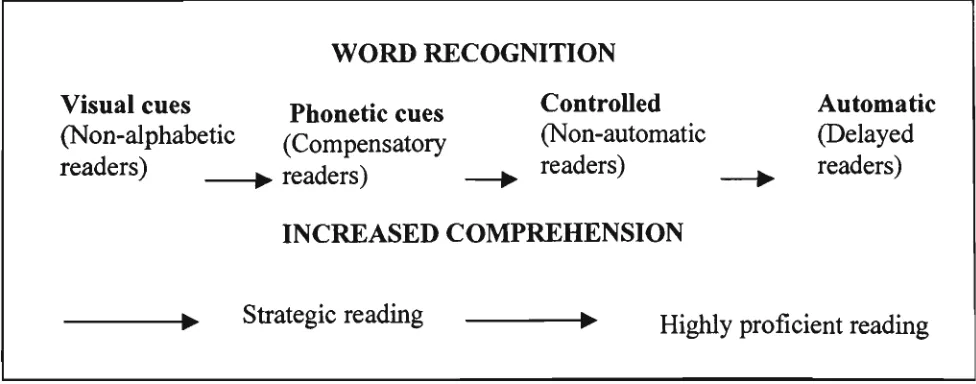
Whether neuropsychological theories of delay or difference are accepted, children who experience difficulty with reading are present in classrooms and requke education. A number of researchers agree that some children do not discover the graphophonic system wdthout dkect, exphcit mstmction (Barr 1991, Beech 1985, Spear-Swerling and Stemberg 1994). The explicit teaching of phonological skills is suggested for those students experiencing difficulty with readmg. Spear-Swerling and Stemberg (1994:93) state: "One caimot become a highly proficient reader by eschewing phonological skills in favour of purely visual skills or by using contextual ability to compensate for faulty word decoding skills." These researchers devised a model that ties together and explains what they describe as the most reUable research findings across age and grade span.
WORD RECOGNITION
Visual cues Phonetic cues Controlled Automatic (Non-alphabetic (Compensatory (Non-automatic (Delayed
readers) ^ readers) ^ readers) ^ readers)
INCREASED COMPREHENSION
• Sfrategic readkig • Highly proficient readmg
The researchers state that there are pattems of reading difficulty. Non-alphabetic readers have no phonetic skills and rely heavily on visual cues. Activities that promote phonological awareness, letter-sound knowledge and understanding of the alphabetic principle are recommended for students operating at this level. Compensatory readers have limited phonetic skills and rely heavily on sentence context and sight words. Dkect instmction in decoding skills and encouragement to apply these in context is suggested for students described as compensatory readers. Non-automatic readers engage m effortfiil decoding of text and may use sentence context as a cue. These readers, it is suggested, could develop automisation of decodmg skills through kicreased practice in reading. Motivation is seen to be of particular knportance for this group. Delayed readers have automatic word recognition but lag behind thek peers in readmg comprehension. Direct instmction in reading sfrategies and higher-level comprehension skills that have been missed is recommended for these students. Sub-optimal readers have automatic word recognition but lack higher-level skills of analysis of text.
The authors conclude tiiat "A sound readkig program obviously needs to develop both fluent decodmg and good comprehension" (Spear-SwerUng and Stemberg,
1994:102). The authors propose that a combkiation of Whole Language techniques with a systematic decoding program would be appropriate for many youngsters who experience difficulty with reading. They suggest that this type of educational program would also be suitable for many students considered non-disabled.