www.euacademic.org DRJI Value: 5.9 (B+)
The Implementation of the Blended Learning Model
for ESP Course Practice
GUO YING
Doctor Student of Philosophy in Education City University Malaysia, Petaling Jaya, Selangor, Malaysia Lecturer Faculty of Applied Foreign Languages Guangdong Polytechnic of Science and Technology Zhuhai, Guangdong, China
Abstract
In China, Blended learning model has been used for educational purposes to improve students’ learning abilities and teachers’ teaching effectiveness. But how to combine on-line and off-line teaching activities to enhance students’ learning performance is still need to be considered. The purpose of this study was to implement the effects of using blended learning model for ESP course practice. Tow groups of second year vocational students at Guangdong Polytechnic of Science and Technology were targeted to the experimental and the control groups. Students in the experimental group were taught using blended leaning model and the students in the control group were taught using traditional face-to-face method. The results indicated positive effects of using blended learning model. Therefore, blended learning model should be the effective way to improve students’ language proficiency and probably to enhance students’ self-regulated learning skills and achieve long-life learning habits.
Key words: Blended learning model, ESP, Teaching Practice
1. INTRODUCTION
Constructivist learning theory. The blended learning approach that effectively combines the advantages of online learning and classroom teaching is assumed effective in mobilizing the initiative of both teachers and students and promoting learner autonomy. While Blended Learning combines online digital media with traditional classroom methods, which are of great significance to change the traditional ESP classroom teaching mode, it will significantly improve the effects of English teaching. Blended Learning Mode has more advantages in improving college students ESP application ability and is helpful to stimulate their interest in learning, and further enhance their ESP listening, speaking, reading, and writing performance. Teachers have also been greatly improved in this teaching mode and have been helped learners see values of learning through blended discussions and explicate how the face-to-face and online discussions are integrated. Recently, blended-learning (BL) has become more and more popular in English Language Teaching because of its usefulness, it now has expanded in many other academic subjects. Recent studies show that BL technology into ESP classes has two significant results, firstly, students learn quicker and better through a virtual learning environment which is learning flexible, offering them autonomy and self-pacing according to their interests and needs and secondly, teachers have more time to do what they do best, they can use the rich resources of the classroom to provide interesting lessons (Iuliana, 2013). Even so, there still have some voices that argue it is problematic and offers nothing new.
This paper indicates how effective of BL model in ESP teaching practice for college students to achieve the long-life learning in Business English Faculty. In this research, the 180 students and 5 teachers will be tracked.
The Problem Statement and Goals
fragmentation of teaching content, difficulty in selecting online classroom teaching resources, lack of emotional communication between teachers and students, teaching effect need to be improved and teaching evaluation to be relatively difficult. So how to solve these problems should be verified to improve the effectiveness of the ESP Blended Learning Mode.
The term blended learning originated in the business world in connection with corporate training (Sharma and Barrett, 2007), then was employed in higher education (MacDonald, 2006) and lastly it appeared in language teaching and learning.
Blended learning is not a simple mixture of online learning and face-to-face learning, but a combination and integration of teaching and learning related aspects. It is a problem that educators must face and solve in the new era to cultivate students' self-regulated learning ability by means of information-based teaching. Therefore, how to develop students‟ self-regulated learning skills and lifelong learning abilities by instructional designs would be the key point of the study. How to apply the pattern in the future, empirical research will be conducted to discuss the influence of blended learning model on ESP students‟ learning motivation, strategies and achievements in this paper.
Objectives and Hypotheses of the study
The study aims to identify the effect of using blended learning model to enhance the students‟ self-regulated learning ability. The study also tested the following null hypotheses:
1.There is no significant different between the mean score of the control group and experimental group for the task accomplishment and language proficiency.
2.There is no significant difference in the change of self-regulated learning of the control group and the experimental group towards blended learning and face-to-face method.
2. LITERATURE REVIEW
individuals, they cannot be fully transferred from teachers to students, so students have to try to make sense of what is taught by trying to fit it with their experience (Lorsbach & Tobin, 1997). Based on Carlile & Jordan (2005), constructivism is a significant procedure that small changes in the knowledge construction may lead to changes in overall understanding. Therefore, teachers‟ main job in this approach is to give directions of students constructing their new information through exploratory activities and make connections to their own conclusions (Martin, 2006). Student-centered learning is the main characteristic of the Construcivist perspective. It includes using information technology to encourage students learning activities and building positive relationships with teachers. In addition, constructivism is a process approach, that teacher is as a director to guide students reconstruct the information and make decisions about their learning. Blended learning model provides an environment to both teachers and students to generate ideas and achieve educational objective at anytime wherever you are. It will also help to make criteria formative assessment systematically and promote of independent learning.
Professor He Kekang (2004a, pp. 23-35) said: “Blending Learning is the combination of the advantages of traditional learning methods and E-learning (i.e., digital or network learning)”. The teacher should play a dominated role in guiding, inspiring, and monitoring the teaching process, at the same time, give full play to students‟ initiative, enthusiasm, and creativity in the process of learning. Only by combining the two can we reinforce complementary advantages, thus achieving the best learning result (Harvey, 2003).
How to combine the network technology with the traditional foreign language classroom and give full play to their advantages has become a widely studied topic. In recent years, there have been many articles about Blended Learning of foreign languages in China. Ma Wulin and some scholars have made an empirical study on the blended learning mode of College English. They believe that this new learning model can effectively alleviate the contradiction between the individualized needs of learners and the limited capacity of classroom teaching, which is conducive to improving the efficiency of College English classroom teaching.
process. Blending provides various benefits over using any single learning delivery medium alone (Intakhab, 2014).Therefore, blended learning mode has significant advantages for ESP learners.
Firstly, Teachers use the blended learning method to make students participate in the classroom, give the classroom order of independent learning, promote the process of classroom learning, and carry out personalized communication and thinking collision in combination with personal situation. To gain knowledge in discussion, acquire knowledge, master knowledge and use knowledge in research, so as to gain the pleasure of learning. It will lay a good foundation for the future social development and self-regulated learning.
Secondly, blended learning model can greatly stimulate the enthusiasm of students in the process of teaching. It can extend the reach to those who could not attend at a specific time, and it can also combine the typical examples in the network resources with the course knowledge, or promote students to find answers in the network resources in the way of completing homework, cultivate students' awareness of new learning methods, and train students' self-regulated learning ability through this way.
Thirdly, blended learning is a concept to introduced using synchronous learning activities, such as face-to-face interaction with instructors and collaborative peers as an asynchronous learning activity complement by learning participants (Piskurich, 2006). It is a combination of components from synchronous and asynchronous learning aspects with the aim to reach learning effectiveness (Piskurich, 2006). Blended learning is a design of learning system that combines between synchronous learning and asynchronous learning activities to achieve instructional goals (Lubis et al., 2019).
Based on the previous researches, the flexibility of the blended learning model has been noticed by large number of universities. That‟s why more and more education institutions and universities to make great effort to redesign courses and build all kinds of platforms. For the ESP course, it also needs to change from traditional face-to-face teacher-led classes to technology-based student-centered blended learning classes. In this paper, some theoretical frameworks and real data to be used in practice to enrich students‟ language learning experience.
Guangdong Polytechnic Science and Technology. The course named International Business English, the purpose of this course is to develop the four aspects of students‟ language skills and communication skills in order to pass BEC (Business English Certificate) examination in future, to achieve the life-long learning.
3.METHODOLOGY
To start with, choose the “chaoxing” as a platform was the first step we establish a satisfied, tailor-made and user-friendly subject platform. It is the most creative element of this business English course on blended-learning model. In this platform, learners can logon the web or App to study. Moreover, students are encouraged to develop their autonomous learning abilities and to work towards fulfilling their language learning goals.
The whole subject divided into two semesters and the whole program is made up of two main language sets, namely ESP in business field and business English Certificate respectively. The whole course is designed for 64 hours offline and 16 hours online for each semester, and the students meet the lecturer twice a week for interacting language learning tasks. The BEC (Business English Certificate) level should be fulfilled at the end of the course. 80% and more students are expected to reach the „B1‟level, although a „B2‟ level might also be expected for the very few outstanding and hardworking students.
video and other multimedia contents. Internet is used in a personal, participative, collaborative and reflective way (Esteban & Cristina, 2014). At this stage, the lecturer use in-class teaching activities such as PowerPoint slides, group discussion, role play and contest to deduct how to use of some words and phrases from specific context. And, made some suggestions for some specific topics. Lecturer also compared with discussions on-line, and solve some difficulties when using “Quiz” in class. Then the lecturer will introduce some exam related materials and assign some exercises. Through these exercises, the students will check what kind of knowledge they have acquired, and what kind of aspects they need to enhance. The exercises included different type of questions, such as multiple choice, fill-in, matching and also some business related discussions or forum presentations. The feedback and evaluation is given by lecturer who mark the exercises.
Data Analysis
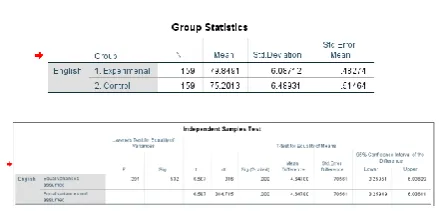
The „Statistical Package for the Social Sciences‟ (SPSS) Windows version 24.0 should be used to gather the data. The T-test (for independent samples) was done to evaluate the effects of using the blended learning model and the face-to-face method on every dependent variables.
Hypothesis 1: There is no significant different between the overall score of the control group and experimental group for the task accomplishment and language proficiency.
From the t-test, the findings indicate the overall score of the Experimental Group was 79.85 while for the control group was 75.20. The t-test results indicate a significant difference between the overall scores from the Experimental and Control Groups. Therefore, the null hypothesis 1 is invalid. The findings indicate that the blended learning model has helped students to get higher score in their subject and language used more precise compared to the Control Group taught with the traditional face-to-face method.
Hypothesis 2: There is no significant difference in the change of self-regulated learning of the control group and the experimental group towards blended learning and face-to-face method.
3. Class and teacher evaluation – please show how far you agree with these statements:
Strongly Agree
Agree Neither Agree nor Disagree
The teaching schedule is reasonable and clear 95.7% 4.3%
Professional knowledge and sufficient ability 96% 4%
Appropriate methods, use of information technologies to mobilize the enthusiasms of students
94% 6%
Can conduct extracurricular tutoring or guide students to develop interest group activities
94.7% 5.3%
Through the study of this course, students have mastered the knowledge and skills related to the course and improve the students‟ abilities
96.3% 3.7%
The assessment is fair and the method is reasonable 95.2% 4.8% Unneeded follow teachers‟ guide or scaffolding during the
training progress
65% 30% 5%
Critical think and self-regulated learning 68% 32%
The results indicate that the entire English program meet students requirements and make them satisfied; on the other hand, students‟ language skills have a great progress, due to the teaching model changed of blended learning. Therefore, the hypothesis 2 is rejected. That means, from a year effort of the teaching team, an online interactive multimedia language learning environment has made a great improvement. On-line discussion and preview will make great efficacy through encourage students show their own ideas in the “discussion group”. They share different ideas and make the suggestion more efficiency.
Based on the questionnaire, 65% of students thought they are autonomous in their studies, they thought during the training progress they didn‟t need teachers‟ instruction or scaffolding, they can adjust their pace to study through critical thinking and self-regulated learning.
4. CONCLUSION
give learners a real chance to experience independent learning and collaborative learning towards lifelong learning.
REFERENCES
1. Carlile, O. & Jordan, A. (2005). It works in practice but will it work in theory? The theoretical underpinnings of pedagogy. In O‟Neill, G., Moore, S. & Mc Mullin, B. (Eds), Emerging Issues in the Practice of University Learning and Teaching. Dublin: Aishe
2. Danny,G., Fernando, R., Bianca. C., Li. Q.J., Mark. W. (2019). Does blended instruction enhance English language learning in developing countries? Evidence from Mexico, Original Manuscript, 2019-05
3. Esteban, S. G., Cristina, T.M. (2014). Critical reflections on teaching ESP through constructivist, communicative and collaborative technological integrated Procedures, Procedia - Social and Behavioral Sciences 141 ( 2014 ) 342 – 346
4. Harvey S.(2003). Building Effective Blended Learning Programs, November
-December 2003 Issue of Educational Technology, Volume 43, Number 6,
Pages 51-54.
5. He Kekang. (2004a). Viewing the New Development of Educational
Technology Theory from the Perspective of Blended Learning, Audio-visual Education Research, 1003-1553(2004)03-0001-06
6. Intakhab A. K. (2014). Effectiveness of Blended Learning for Teaching of English: An Exploratory Study, Research Journal of Recent Sciences , Vol. 3(3), 78-85, March
7. Iuliana, L. (2013). The Increasing Need for Blended-Learning Models in Courses of English for Specific Courses in Romanian Universities, Procedia - Social and Behavioral Sciences 76 (470 – 475)
8. Lubis, M., Parsusah, M., Komaro, M., Djohar, A. (2019). Blended Learning,
Implementation Strategy: The New Era of Education, Atlantis Press, Volume 299
9. Lorsbach, A.W. & Tobin, K. (1997). Constructivism as a referent for science teaching. Retrieved April 4, 2012 from http://www.exploratorium.edu/IPI/resources/research/constructivism.html
10. Martin, D. J. (2006). Elementary Science methods: A constructivist
approach (4th ed.). United State: Thomson Wadsworth