
arXiv:hep-ph/0110215v2 31 Oct 2001
IPPP/01/37 DCPT/01/74 CERN-TH/2001-273 Cavendish-HEP-2001/14 October 2001
MRST2001: partons and
α
Sfrom precise deep inelastic
scattering and Tevatron jet data
A.D. Martina, R.G. Robertsb, W.J. Stirlinga and R.S. Thornec,1
a Department of Physics and Institute for Particle Physics Phenomenology, University of
Durham, Durham, DH1 3LE
b Theory Division, CERN, 1211 Geneva 23, Switzerland
c Cavendish Laboratory, University of Cambridge, Madingley Road, Cambridge, CB3 0HE
Abstract
We use all the available new precise data for deep inelastic and related hard scattering processes to perform NLO global parton analyses. These new data allow an improved determination of partons and, in particular, the inclusion of the recent measurements of the structure functions at HERA and of the inclusive jets at the Tevatron help to determine the gluon distribution and αS better than ever before. We find a somewhat smaller gluon at lowx than previous determinations and that αS(MZ2) = 0.119±0.002 (expt.)±
0.003 (theory).
1
1
Introduction
Recently a great deal of new data have become available which help to determine the parton distributions of the proton. In particular we have new measurements of the structure functions by the H1 [1, 2, 3] and ZEUS [4] collaborations at HERA, and of the inclusive jet distribution by the D0 [5] and CDF [6] collaborations at the Tevatron. These new data are both more precise and extend the kinematic range, and thus constrain the parton distributions, and the strong couplingαS, more tightly than ever before. ZEUS have also released a new measurement
of the charm contribution to the structure function [7] which, although it still has large errors, covers a wider kinematic range than previously. In addition, the CCFR collaboration [8] have re-analysed their neutrino data in a model independent way and the discrepancy with the NMC data forx <∼0.1 has been largely resolved. Also NuTeV data are becoming available [9], both for single and double muon production, and are improving the constraints from the neutrino sector. The E866 collaboration [10] also have increased statistics for pp and pn Drell-Yan production and improve the determination of the difference between the ¯uand ¯d distributions. Finally we note that as well as the usual data sets used in our previous fits, i.e. BCDMS [11] and SLAC [12] proton data, NMC proton and deuterium data [13], E665 proton data and deuterium data [14], CCFR data onF3ν(¯ν)N(x, Q2) [15], E605 Drell-Yan data [16] and CDFW-asymmetry data [17] we have also included BCDMS [18] and SLAC deuterium data [12] in order to obtain as precise a determination of the separate contributions of the up and down valence quarks at high x as possible.2 We also include the most recent ZEUS SVX data [20] since it spans a slightly different range to that in [4]. We no longer include prompt photon data due to theoretical problems and possible inconsistencies between data sets, and instead allow the highx gluon to be determined by the vastly improved Tevatron jet data.
We note that both H1 [3] and ZEUS [4] have recently performed NLO DGLAP fits to their respective data, supplemented in the former case by BCDMS data with yµ > 0.3, and in the
latter case by BCDMS, NMC, E665 and CCFR F3ν(¯ν)N(x, Q2) data. In particular, the H1 analysis determines αS and the gluon simultaneously. A value
αS(MZ2) = 0.1150 ± 0.0017(expt.)
+0.0009
−0.0005 (model) (1)
is obtained, with an additional uncertainty of about±0.005, mainly due to the uncertainty in the renormalization scale. A preliminary ZEUS analysis, reported at DIS2001, quoted αS(MZ2) =
0.1172±0.0008(uncor.)±0.0054(cor.) [21]. There is also an analysis including some of both the recent H1 and ZEUS data along with NMC, SLAC and BCDMS data, and which allows higher twist contributions, which obtains αS(MZ2) = 0.1171 ± 0.0015(expt.) [22]. We will find that
the inclusion of additional data sets tend to increase these values somewhat. As an example of this we emphasize that the Tevatron jet data are an important ingredient in pinning down the value of αS from deep inelastic scattering (DIS) and related data, since they provide the
dominant constraint on the gluon at large x. In fact, the inclusion of new jet data [5, 6] into the global analysis considerably improves the determination of the gluon. For example, we find an uncertainty of about 15% on the gluon distribution atx= 0.4 andQ2 = 20 GeV2, but this is correlated with the value of αS(MZ2).
2
The new optimum parton set
We perform a global NLO DGLAP analysis incorporating all the high-precision data mentioned in the Introduction. The evolution begins at Q2
0 = 1 GeV2 where there are three active quark flavours. We work in the MS renormalization scheme and use the Thorne-Roberts [23] variable flavour number procedure to evolve through the charm and bottom thresholds. We note that we let all data sets in the fit carry equal weight. This is because we now feel that the full set of data is spread relatively evenly over the kinematic range of x and Q2, and also over the different partons, e.g. the Tevatron jet data is now extensive enough to determine the high x gluon accurately, and we no longer have to give existing data a high weight to tie down this particular region of parton space. In fact those data sets with very few points, e.g. the E866 Drell-Yan asymmetry measurements, probe partons (in this case ¯d−u¯) to which the rest of the data are rather insensitive, and the few points with unit weight are sufficient. We note that our best fit gives a χ2 per point of about 1 for all data sets (except for the E605 Drell-Yan data, for the reason given in section 6) justifying the equal weighting.
As well as deciding on data sets and weights, we have to decide on a set of cuts in the usual variables Q2, W2 and x. In order to investigate this we made a study of the sensitivity of the analysis to variation of these data cuts. We discovered that there was only marginal evidence for an improvement in quality if the Q2 cut was raised from 2 GeV2 to 3 GeV2 and no marked improvement above this. There was a marked improvement in quality if W2 is raised from our previous cut of 10 GeV2 until we reach 12.5 GeV2, which may easily be interpreted as due to the influence of higher twist and/or large ln(1−x) terms in the perturbative expansion. Hence, for the global fit presented below DIS data with Q2 >2 GeV2 and W2 >12.5 GeV2 are included, in order to exclude regions where higher twist and/or higher orders inαS are expected to play
an important role. We also found that if a lower cut in x was introduced there was continual improvement in the quality of the fit until x reached a value of about 0.005, suggesting that ln(1/x) terms in the perturbative series may be important. The results and consequences of these cuts, particularly that in x, will be dealt with in a future paper [24], but for the present analysis we take the conventional approach of not using any x cut and investigate/suffer the consequences.
The optimum global NLO fit is obtained with the starting parameterizations of the partons at Q2
0 = 1 GeV2 given by
xuV = 0.158x0.25(1−x)3.33(1 + 5.61x0.5+ 55.49x) (2)
xS = 0.222x−0.26(1−x)7.10(1 + 3.42x0.5+ 10.30x) (4) xg = 1.90x0.09(1−x)3.70(1 + 1.26x0.5−1.43x)−0.21x−0.33(1−x)10. (5)
The flavour structure of the light quark sea is taken to be
2¯u,2 ¯d,2¯s = 0.4S−∆, 0.4S+ ∆, 0.2S (6)
with s= ¯s, as implied by the NuTeV data [9], and where
x∆ = x( ¯d−u¯) = 1.195x1.24(1−x)9.10(1 + 14.05x−45.52x2) (7)
The masses of the quarks are taken to be mc = 1.43 GeV and mb = 4.3 GeV, the former
giving the best fit to the charm structure function data. The optimum fit corresponds to αS(MZ2) = 0.119, i.e. ΛMS(nf = 4) = 323 MeV, in very good agreement with the world
average.3 We estimate the error in α
S(MZ2) due to the errors on the data fitted in the global
analysis to be about ±0.002, as will be explained in detail later. The resulting partons are shown in Fig. 1.
The improved HERA data greatly increase the constraints on the gluon at small x. The extra term in (5) is required to achieve an acceptable fit, and allows the starting gluon to become negative at small x. A fixed (1−x)10 behaviour is incorporated in this extra term so that only the small x form of the gluon is affected. Not including this additional term, which allows the input gluon to be negative at small x, would lead to the input gluon being strongly valence-like and to a global increase inχ2 of about 100. Note that only half this increase comes from the data points at very lowx (sayx <0.001), the rest coming from the HERA and NMC points in the region 0.001< x < 0.1, as will be discussed in the next section. The gluon in the present analysis becomes positive for all x >10−5 and Q2 >5 GeV2, and forQ2 >2−3 GeV2
for x > 10−4. We note that while a negative gluon distribution may be slightly disturbing,
there is no real reason for worry since the gluon distribution is not a real physical quantity, particularly in a somewhat unphysical factorization scheme such as MS. The implications for physical quantities will be discussed in the next section.
Recall that in the MRST99 analysis [27] the uncertainties in the gluon were illustrated by presenting the optimal fit g together with two fits g ↑ and g ↓, with larger and smaller gluons at large x, which represented the extremes of acceptable descriptions of the data. The present analysis, with greatly improved data, significantly reduces the uncertainty in the gluon distribution and yields an optimal solution with a largexgluon nearer tog↑than tog. For this reason in Fig. 2 we compare the present partons with those of the g↑ set of MRST99 [27]. We see that the major difference is in the gluon, or is a consequence of this changed gluon. First, we note the extended parameterization for the gluon, required by the new HERA data, leads to a far smaller gluon at the lowest x and Q2. Since the quarks are determined by evolution
3We use the matching between the
nf- andnf+1-flavour couplings calculated in [25], and corrected in [26],
up to NLO inαS. At this order the coupling is continuous across threshold but the derivative is discontinuous.
driven by the gluon in this range, they are also smaller than their MRST99 counterparts. The gluon is also smaller in the range x∼0.3 than that for MRST99(g ↑) — the jet data requiring less gluon in this range than the prompt photon data with no intrinsic kT included. Both these
reductions in the gluon allow for slightly more gluon in the rangex ∼0.1, giving an increased dF2(x, Q2)/dlnQ2 forxa little below this. The shape of the charm (and, to a lesser extent, the strange) distribution simply follows the gluon since it is generated mainly by evolution from the gluon. Finally we note that the down quark is slightly smaller at high x than in MRST99 due to the effect of the extra deuterium data included in the present fit, and as a consequence it is slightly larger for values of xin the region of 0.01.
3
The description of the DIS data
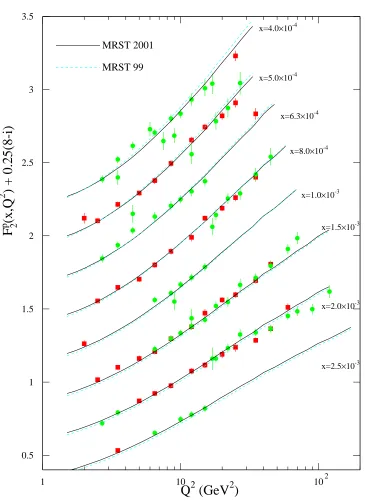
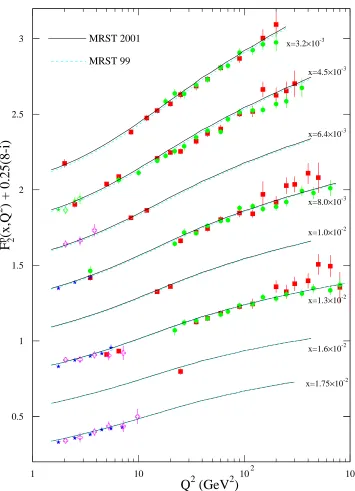
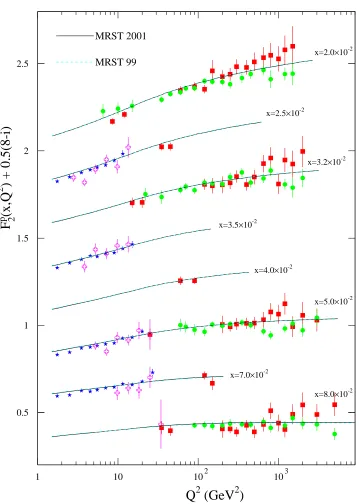
A good description of the HERA data is obtained, as can be seen from Figs. 3-6.4 Compared to MRST99, the curves for F2 are flatter in Q2 for x <0.001, but slightly steeper at higher x. In fact for 0.001 < x <0.01 the data, particularly the high Q2 H1 and the NMC data, would prefer a higher dF2/dlnQ2, as can be seen in Figs. 5 and 6, where the low Q2 NMC data is consistently below the theory and the high Q2 H1 data is mostly above the theory. It appears as though the ZEUS data at high Q2 tend to lie below the H1 data, and are more consistent with the fit. However, we note that the preliminary ZEUS 98-99 data for Q2 ≥200 GeV2 [28] seem to be more in line with the H1 data and prefer a steeper slope (i.e. they lie consistently above MRST99 and hence would also be above MRST2001). The systematic failure in this region ofxis a cause for concern regarding the validity of an NLO fit. In fact we note that the aforementioned improvement to the fit in this region, which comes from allowing the negative input gluon at small x, is because this form allows there to be more gluon in the moderate x region (from the momentum sum rule), and hence a larger value of dF2(x, Q2)/dlnQ2, as preferred by the data. We also note that although at the lowestxandQ2 our gluon distribution is considerably negative, dF2/dlnQ2 is quite clearly positive. This highlights the fact that the frequently quoted relationship dF2/dlnQ2 ∝ αS(Q2)xg(x, Q2) is not even approximately true
at small x and Q2 when one works beyond leading order in perturbative QCD. Qualitative arguments about evidence for saturationetc. which rely on this relationship should be treated with caution.
The fits to HERA data have been performed using the simplistic procedure of adding the systematic and statistical errors in quadrature. However, we have actually performed an anal-ysis of the effects of the correlated errors. To be specific we have first performed fits to the data with only uncorrelated errors, then let the contributions of the correlated errors come into effect, and finally iterated. We find that the absolute value of the χ2 using this procedure
4
Note that as in previous fits we have effectively fit the published cross section rather thanF2(x, Q2
) at the larger values of Q2, i.e. we have corrected for our own values of
FL(x, Q2) rather than use those obtained by
increases for the ZEUS data, and stays more or less constant for the H1 data, but that some-what surprisingly the position of the minima and incremental changes in χ2 when comparing different theoretical results stays much the same as when using the more simplistic addition in quadrature of all errors. Hence, we decide to present the simpler procedure in determining the partons, and discuss details of the effects of correlated errors in an Appendix since the results with full errors turn out to be an unnecessary complication. We do however let the ZEUS normalization go to its lower limit of 98% in our fits in order to obtain the optimum description.
The comparison with the charm data [7, 29] can be seen5 in Fig. 7. As one can see it is of a perfectly acceptable quality, and the errors on this data are still large. There is, however, a slight tendency to undershoot the data at the lowest values of x and Q2, and this may be a sign of the need to improve the theoretical treatment in this region. In this region of low x and Q2 the prediction for the charm structure function is a little smaller than that for the MRST99 partons, which is entirely due to the smaller gluon we now find in this region. Finally we note that the fit to the higher xEMC charm data [31] is very similar to that for the default set in Fig. 27 of [32] (the high x gluon is now a little larger, but mc is 1.43 GeV rather than
1.35 GeV), and hence is perfectly acceptable.
The prediction for FL(x, Q2) is shown in Fig. 8, which also shows the prediction of the
MRST99 partons. We see that the increased precision of the HERA data and the increased flexibility of the gluon parameterization have led to a significant decrease in the prediction for FL(x, Q2) at lowx and Q2, replaced by a slight increase for x∼0.05. Indeed, it now seems as
though FL(x, Q2) is taking a distinctly unphysical form for low x and Q2 < 5 GeV2, and for
part of this range is negative, and therefore certainly disallowed.6 This is a direct consequence of the negative nature of the gluon distribution at smallxandQ2, and may be taken as another clear sign that the standard NLO fit is not working completely properly at small x.7 As far as we are aware FL(x, Q2) is the most direct probe of the gluon distribution at small x and Q2,
and is the most appropriate quantity to examine in order to see the real pathological effects of the negative gluon distribution. Fc
2(x, Q2) is less sensitive since at low Q2 the kinematic constraint on charm production (W2 ≥4m2
c) means one is probing the gluon at higher x than
for FL(x, Q2), and as seen in Fig. 7, F2c(x, Q2) is perfectly well behaved down to x <0.0001.
At higher xthe main change in our fit is due to the reanalysis of the CCFR data [8]. Their reanalysis no longer extracts F2(x, Q2) by modeling bothFL(x, Q2) and ∆xF3(x, Q2), but now
5Updated charm data from the H1 collaboration have recently become available [30], but the results depend
on which Monte Carlo is used to extrapolate over the full range of phase space. Since these data are similar to their previous charm data [29], we show only the latter in Fig. 7.
6
In principle, it is internally inconsistent to fit toF2(x, Q2) data in a region where the predicted values of
FL(x, Q2) are negative, namelyx <10−4andQ2>∼2 GeV2. Since only 6 points are affected, carrying practically
no weight in the fit, we do not remove these points.
7
We do not compare to the H1 extraction ofFL(x, Q2) [33] since the different assumptions used in our fit
lead to significantly different forms for the gluon and forαS(MZ2), and hence different extrapolations into the
extracts either FL(x, Q2) or ∆xF3(x, Q2) (there is a high degree of correlation between these) and F2(x, Q2) separately in a Physics Model Independent manner. This has gone a long way towards resolving the apparent discrepancy between CCFR and NMC data onF2(x, Q2), where it had previously been impossible to simultaneously fit both forx <0.1. The quality of the fit to the new CCFRF2(x, Q2) data is shown in Fig. 9. Overall the fit is very good. One might argue that there is still a systematic problem at the lowest Q2, but this is far less pronounced than with previous analyses. There is also potentially a small error associated with the shadowing corrections (details of which are found in [32]) which we do not account for. The reanalysis has also established the validity of the previousF3(x, Q2) neutrino data. These data are essentially unaffected by the reanalysis, but we are now confident in using the data over the wholexrange, rather than just forx≥0.1. The fit is good over the whole range ofx. Note that we normalize the complete set of CCFR data up by 1% in order to obtain the best fit.
Other than this, the other new DIS data (at least new for our fit) at high x are simply the SLAC and BCDMS deuterium data, which we have introduced for the first time. The fit to these data is shown in Fig. 10. It is of a perfectly acceptable quality, and one can see that, as with the proton data, the SLAC deuterium measurements prefer a rather steeper fall with Q2 than the BCDMS data, and consequently a larger αS. The SLAC data are normalized up by
2.5% and the BCDMS down by 2%.
4
Tevatron Jet Data and the Gluon
One of the major differences between the MRST2001 partons and our previous parton sets is the manner in which the high ET Tevatron jets have been included. In the past [32] we have
simply checked that there is reasonable agreement with our predictions and the jet data. The difficulties in using the prompt photon data in order to determine the high x gluon combined with the considerable improvement in Tevatron jet data [5, 6] has led to a change in emphasis. Besides the increase in precision, the D0 jet data are available in a range of rapidity intervals and so constrain the partons, and the gluon in particular, over a much wider x range. We, therefore, now include the D0 and CDF jet data in the global fit on an equal footing with all other data sets.8 However, because in this case the correlated systematic errors are the dominant source of error, being much larger than the uncorrelated errors, it is imperative to deal with these in a correct manner. In fact we adopt the same method of fitting to the data as do the respective experimental collaborations when describing their own data. Note, however, that rather than using some NLO prescription such as JETRAD [35] or EKS [36] to generate an NLO correction for each point, we derive a smooth NLO K-factor by fitting to a set of such points. Since the NLO corrections generated from the above programs have some error and
8
The D0 collaboration have recently produced data using thekT algorithm rather than the more usual cone
algorithm [34]. The agreement between the two methods is moderate, the major difference being at lowET.
scatter, this means that our value ofχ2will not be identical to that obtained by the experiments themselves for the same parton set (though it will be very close). In particular our values of χ2 for the CDF1B jet data are a little higher, while for the D0 jet data they are slightly lower.
We find that for our best global fit we obtain a reasonable description of the combined jet data with a χ2 of 170 for 113 points. The quality of the fits is shown in Figs. 11 and 12 — the error bars account for uncorrelated errors alone. In both cases it is clear that while at the low ET end the normalization is about correct, at higher ET (and rapidity) the theory lies below
the data. An acceptable fit is then obtained by accounting for the correlated systematic errors.
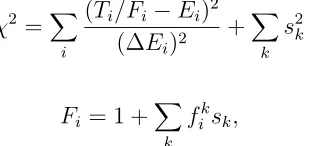
First, for the CDF1B fit the (data−theory) obtained is allowed to move by letting data move relative to theory by application of each of the sources of correlated error, i.e. the χ2 is obtained from
χ2 =X
i
(Ti/Fi−Ei)2
(∆Ei)2
+X
k
s2k (8)
with
Fi = 1 + X
k
fiksk, (9)
where Ti is the theory prediction for data point i, Ei is the measurement with uncorrelated
error ∆Ei, and fik is the one-sigma correlated systematic error for pointi from error source k.
Hence, the data and theory move relative to each other at the cost of an increase inχ2 ofP ks2k,
where sk is the fraction of one-sigma which has been utilized for each error source.9 Hence in
Fig. 12 we see that the effect of introducing the error correlations Fi has been to bring down
the data at higher ET significantly in order to match the shape of the theory prediction. This
large shift requires many of thesk to be of the order of 1, and for them all to conspire to move
the data in the same direction relative to the theory.
For the D0 jet data the fit is performed using the full error matrix, i.e.
χ2 =X
i,j
(Ei−Ti)[(Ti/Ei)Cij(Tj/Ej)]−1(Ej −Tj), (10)
where Cij are the covariance matrix elements defined by
Cij = X
k
ρkij∆E k i∆E
k
j, (11)
where k runs over all sources of error, ∆Ek
i is the error of point i and ρkij is the correlation
between points i and j. This is actually a very similar way to obtain a χ2 to the previous method (see Appendix A of [6]). However, it accounts for the correlated systematic errors in a rather less transparent manner, though the good fit to the D0 jet data must clearly be obtained in much the same way. We illustrate the correlated errors in Fig. 11 simply by introducing a band with width given by adding each source of correlated error in quadrature. Although this
9
Since these correlated errors are expected to cut off rather more sharply than Gaussian errors we limit each
is not as explicit as in Fig. 12, it indicates roughly how the data may move relative to the theory without a large cost in χ2.
At the central value ofαS(MZ2) of 0.119, this global fit (including jet data) allows a variation
in g(x, Q2) of about 5% for x > 0.1 and Q2 ∼ 2000 GeV2, which corresponds to 10 −15% accuracy for x > 0.1 and Q2 ∼ 20 GeV2. This is a factor of 3 or so less than the MRST99 variation of the gluon ranging from the g ↑ to the g ↓ gluon, and hence we do not provide parton sets with gluon extremes. Since the body of jet cross section data is (very roughly)
∝αS(ET2/4)g(x, ET/2), theng(x, µ2) forµ2 of order 103 GeV2 is roughly inversely proportional
to αS(MZ2). However, at high x the gluon distribution decreases more rapidly with increasing
Q2, the larger the value of the coupling. This increase in speed of evolution with increasing α S
more than compensates for the decrease in the high-scale gluon required by the jets with αS,
and for low Q2 (Q2 ∼10 GeV2) the high x gluon increases asα
S(MZ2) increases.
We note, however, that these optimum global fits are not the best possible fits to the high ET jet data. The fit is only achieved by compensating for the smallness of the theory at high
jetET andη(both of which probe the highestx) using the correlated systematic errors. Hence,
the fit can be improved by an increase in the size of the highxgluon. In principle it is possible to obtain a fit with a χ2 of about 120 for the 113 points (see below) rather than χ2 = 170, the scatter of data points making thisχ2 value about the lowest that is achievable. At the central
αS(MZ2) value of 0.119 it is possible to raise the high xgluon sufficiently to improve the quality
of the jet fit to χ2 = 135, but only at the cost of ∆χ2 = 60 for the rest of the data. This is mainly at the expense of the description of the moderatexDIS data, i.e. H1, ZEUS and NMC data, since the increase of gluon at high x is countered by a decrease at intermediate x, and hence a decrease indF2(x, Q2)/dlnQ2. At lower αS the price is even higher since the lower αS
already impacts upon the behaviour ofdF2(x, Q2)/dlnQ2.
However, as one goes to higher αS(MZ2) the situation changes. At αS(MZ2) = 0.121 one
can obtain a fit to the jet data with χ2 = 118, and where this improvement is only marginally overcompensated by the deterioration in the rest of the fit compared to the best global fit. For this set of partons, denoted by MRST2001J or simply J, the fit to the jet data is shown in Figs. 13 and 14. For the fit to the D0 data the shape is obviously greatly improved, both as a function of ET and of η, demonstrating that the apparent excess χ2 in the description of
the Tevatron jet data is either a problem of parton distributions or of systematic errors, but is unlikely to be a sign of new physics. The normalization of the theory is a little high, but this is easily accounted for by the systematic error in normalization. The fit to the CDF1B data actually gives a slightly worse χ2 than before. But now the fit does not rely on a large shift of data due to systematic errors, and is perhaps more satisfactory in this sense. The problem with this J set of partons is the behaviour of the gluon. The input form at Q2
0 = 1 GeV2 is
xg = 123.5x1.16(1−x)4.69(1−3.57x0.5+ 3.41x)−0.038x−0.5(1−x)10, (12)
shape has a rather worrying “kink” which results in the distinct “shoulder” atQ2 = 20 GeV2.10 We do not deem this to be an acceptable gluon (admittedly a subjective decision), and rule this fit out, although we do make the MRST2001J set of partons available. AtαS(MZ2) = 0.120
we obtain a similar result, i.e. the best overall fit gives about χ2 = 135 for the jet data, but has a gluon with the same type of peculiarities (though less severe). Again we rule this fit out. Hence, in our fits we impose the condition that d2(xg(x, Q2
0))/dx2 does not change sign in the region of highx which rules out the possibility of both kinks and shoulders in the high xgluon distribution. Imposing this condition results in a fit to the jet data within the global fit which is roughly independent of αS(MZ2).11
5
Description of other data
The fit to much of the rest of the data is very much along the lines discussed in detail in [32]. The NuTev data [9] on single and double muon production do not qualitatively change the conclusions regarding the strange contribution to the sea already indicated by the CCFR dimuon data [37], i.e. that the strange distribution is acceptably obtained from half the average of the ¯uand ¯ddistributions atQ2
0 = 1 GeV2. Similarly the E866 collaboration [10] have provided new data on the Drell-Yan asymmetry which is more accurate and extends the kinematic range slightly, but does not really change the relative ¯u,d¯behaviour of the partons. In particular, our simple parameterization of ¯d−u¯ still suggests that ( ¯d/u¯) ≤ 1 for x > 0.35, but there is no evidence whether this is really true or not. The lepton rapidity asymmetry data from CDF [17] (related to the W rapidity asymmetry) also continue to give us important information on the u/d ratio.
Finally the E605 Drell-Yan data [16] still play an important role in pinning down the form of the sea quarks at high x. However, they also play an important and unexpected role in influencing the fit to the jet data and determining αS(MZ2). As we will see below, the quality
of the description of these data deteriorates as αS(MZ2) increases. This is actually an indirect
effect. As αS(MZ2) increases, the high x gluon at lower Q2 increases so as to give the correct
gluon normalization when evolved up to the scales appropriate for the description of the jet data. This larger high x gluon (and larger αS(MZ2)) drives a positive evolution of the high
x sea quarks. As this effect becomes more significant it distorts the shape of the sea quark distribution in the range relevant for fitting Drell-Yan data, worsening the fit. Therefore the E605 data prefer lower value ofαS(MZ2) and a lower highxgluon. Indeed, for the MRST2001J
10This seems to be made possible by the interplay between a very large coefficient for the first term in (12),
the large power ofx, i.e. x1.16
in this term, and the extra effect of the second term controlling the very small
xbehaviour. This second term then effectively frees one parameter in the first term, which for previous parton sets represented the full parameterization of the input gluon, allowing more flexibility in the highxform of the gluon.
11We note that a very good fit to the jet data could be achieved for
αS(MZ2)<0.118 with a gluon without
type partons the fit to the Drell-Yan data deteriorates quite seriously compared to the best global fit. Hence, these data have assumed a more important role in the context of the whole global fit than previously.
6
Quality of Fit and Determination of
α
S(M
Z2)
.
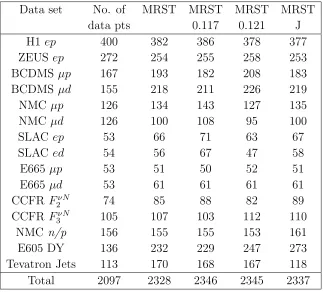
The quality of the central fit for the major data sets is shown in Table 1 below. For each of the smaller data sets, e.g. CDF W-asymmetry [17] and E866 Drell-Yan asymmetry [10], the χ2 per degree of freedom is about 1 per point. For all the DIS data sets the numbers are quoted for statistical and systematic errors added in quadrature. The quality of the fits to the individual data sets is satisfactory. For the E605 data the systematic errors are quoted in a slightly ambiguous manner, and are generally subdominant, and so we fit to statistical errors alone. Hence, the quite largeχ2 in this case. The treatment of the correlated systematic errors for the Tevatron jet data has been discussed in Section 4.
Table 1: Quality of the fit for MRST2001 partons to different data sets. The first MRST column shows the χ2 values of the optimum fit with α
S(MZ2) = 0.119. Also shown are the
values for parton sets obtained from fits with αS(MZ2) = 0.117 and 0.121, as well as those for
parton set J which has structure in the highx gluon.
Data set No. of MRST MRST MRST MRST
data pts 0.117 0.121 J
H1ep 400 382 386 378 377
ZEUSep 272 254 255 258 253
BCDMS µp 167 193 182 208 183
BCDMS µd 155 218 211 226 219
NMC µp 126 134 143 127 135
NMC µd 126 100 108 95 100
SLACep 53 66 71 63 67
SLAC ed 54 56 67 47 58
E665 µp 53 51 50 52 51
E665 µd 53 61 61 61 61
CCFRFνN
2 74 85 88 82 89
CCFRFνN
3 105 107 103 112 110
NMC n/p 156 155 155 153 161
E605 DY 136 232 229 247 273
Tevatron Jets 113 170 168 167 118
The way in which the quality of the fit to both the total and to each data set varies with αS(MZ2) is shown in detail in Fig. 16. It must be remembered that the quality of the fit for a
single data set within the context of a global fit is not the same thing as the quality of the fit for that set alone, and many sets influence each other strongly. Nevertheless, one can pick out some interesting facts from Fig. 16.
For the DIS data sets it is clear that only the two BCDMS sets strongly prefer lower values of αS(MZ2). These are more than compensated by the SLAC and NMC data sets, which for
both proton and deuterium structure functions strongly prefer higher values ofαS(MZ2). Both
CCFR data sets are relatively insensitive to the value of the coupling, at least for 0.116 < αS(MZ2) <0.122. This also appears to be true for the H1 and ZEUS data sets. However, this
latter apparent insensitivity is due to the fact that the combined HERA data sets carry a lot of weight in the fit, and the gluon distribution at small x is largely determined by ensuring that these data are fit well. This is therefore just a manifestation of the long-established fact that the smallxgluon and the value of αS(MZ2) are completely correlated in fits to the HERA data,
and without any additional handle on the gluon12 there is no way to remove this. It is clear from Fig. 16 that if one takes only BCDMS data as well as HERA data, as in the H1 analysis [3], one will determine a low value of αS(MZ2), but taking SLAC or NMC as the additional set
a very different conclusion will be reached.
The combined Tevatron jet data behaves similarly to the HERA data, i.e. the gluon con-spires withαS(MZ2) to give roughly the sameχ2for allαS. Interestingly the jet data and HERA
data manage to conspire with each other so that the sum of theirχ2 remains roughly constant. As αS(MZ2) increases the gluon at moderate Q2 and high xincreases to maintain the fit to the
jet data. From the momentum sum rule this leaves less gluon at smallx, but the largerαS(MZ2)
manages to keep the value of dF2(x, Q2)/dlnQ2 acceptable. The fact that this trade-off be-tween HERA F2(x, Q2) data and Tevatron jet data results in almost complete insensitivity to
αS(MZ2) strikes us as remarkable. Note, however, that the constant totalχ2 for the jets is made
up of a contribution from the CDF1B data which increases sharply with increasing αS(MZ2),
and a rapidly falling contribution from the D0 jet data. In detail one finds that the general normalization and shape of the theory compared to data improves with increasing αS(MZ2).
This leads to the improvement in the fit to D0 data. However, the precise shape of the CDF1B data seems easiest to achieve by obtaining a poor comparison between theory and data which is then compensated for by quite large movements coming from the correlated errors. When the shape and size is nearly correct to begin with this seems to leave less room for maneuver for the correlated errors to produce exactly the correct shape (note that theχ2 is better in Fig. 12 than in Fig. 14). Hence, if one is uncomfortable about letting the correlated errors conspire to move the data by a large amount the high αS(MZ2) fits are better.
Finally, as discussed in the last section, the E605 Drell-Yan data prefer a low value of αS(MZ2). However, this is mainly due to the correlation between the value of αS(MZ2) and the
high x gluon brought about by the jet and HERA data.
12The charm structure function is strongly correlated to the evolution of the total structure function, and
Putting all the contributions together we obtain a totalχ2 which has quite a sharp minimum atαS(MZ2) = 0.119. We then adjudge the error in this best value ofαS(MZ2), within the context
of an NLO-in-αS fit, by letting the χ2 increase by about 20 units. Clearly it is inappropriate
to base the error on the increase of a single unit, for a variety of reasons. First, the treatment of the errors in this analysis is far from statistically rigorous, and even if it were, the errors themselves are far from having a true Gaussian distribution. Also, we have made many decisions in performing this analysis, such as data cuts, the choice of parameterizations of partons, etc. Changing any of these and refitting would lead to changes inχ2of about 5−10 for the remaining data, and so our increase in χ2 should be at least this value . Making our choice of an increase of 20 we obtain αS(MZ2) = 0.119±0.002(expt.). We see from Fig. 16 that beyond these limits
the global χ2 increases very quickly.13
Thus, we present our determination of αS(MZ2) as
αS(MZ2) = 0.1190 ± 0.002(expt.) ± 0.003(theory). (13)
We do not adopt the traditional, but ad hoc, manner of obtaining the theoretical error by varying renormalization and factorization scales up and down by factors of 2 (or of 4). This takes no account of the errors attributable to higher order logarithmic enhancements. For example, in DIS there are additional logarithms in (1−x) and 1/xin the coefficient functions and splitting functions at higher orders inαSwhich variations in scale tell us nothing about. Similar
logarithmic enhancements also exist for the other quantities fitted, such as data near threshold. Hence, we obtain our theory error by comparing with alternative theoretical treatments which do tell us something more concrete about the missing corrections, i.e. approximate NNLO fits e.g. [38], or fits which attempt a resummation of ln(1/x) and ln(1− x) terms [39]. These suggest that 0.003 is an appropriate theoretical error.14
As regards the errors on the partons themselves, in a separate study we will present the uncertainties in the predictions of key observables, and show how they reflect the uncertainties on the parton distributions. An example of this is seen in [40]. However, as in the case of αS(MZ2), we believe the theoretical errors to be generally more important than the experimental
errors, particularly in some regions of parameter space.
7
Conclusions
In this paper we have performed global analyses of all the most up-to-date data on deep inelastic scattering and related processes in order to best determine the parton distributions and the
13
We have also investigated the fits without the Tevatron jet data included. Even though removing this constraint allows gluons to migrate to lower xand in principle fit the HERA data with lowerαS, the overall
impact on the global fit is not large. The minimum moves down by ∆αS(MZ2)∼0.0002. For rather low values
of αS(MZ2), e.g. 0.116 or lower, the removal of the high xgluon constraint does allow an improvement in the
fit to HERA and NMC data, but at this value ofαS(MZ2) the global fit has become much worse anyway, and
all one would obtain with jet data removed would be a shape for the totalχ2like that in Fig. 16, but with the
slope on the left-hand side a little more shallow.
14
value of αS(MZ2) within the context of a conventional NLO fit. This is an improvement on
our previous analyses mainly because of some very important new sets of data. In particular the new HERA data [1, 2, 3, 4] are far more precise than previously and cover an extended range in x and Q2. Also the new D0 and CDF Tevatron jet data are again more precise, with systematic errors which are better understood, and which extend their previous kinematic ranges. These new HERA and Tevatron data sets together impose far more stringent limits on the parton distributions than ever before. We also obtain a tight constraint on the value of αS(MZ2). Our best overall fit corresponds to αS(MZ2) = 0.119, and investigating variations
about this minimum we obtainαS(MZ2) = 0.119±0.002(expt.)±0.003(theory). The quality of
the fits for the two experimental limits of 0.117 and 0.121 can be seen in Fig. 16, and are also detailed in Table 1.
The new data sets have a particularly strong impact on the gluon distribution. In order to fit the new HERA data well we have been forced into an extension of our previous input gluon parameterization, allowing it to become negative at smallx. Indeed atQ2
0 = 1 GeV2 it behaves like xg(x, Q2
0) ∼0.2x−0.33 for x < 0.001, and this is necessary not only to obtain a good fit at lowx and Q2, but also to allow enough gluon at higher x to obtain large enough (dF
2/dlnQ2) for x ∼ 0.01, and enough gluon at large x for the Tevatron jets. As αS(MZ2) increases the
very small x gluon becomes more negative. This is due to a combination of factors, i.e. the change of gluon needed by the jets at high xand by (dF2/dlnQ2) at medium x, but the most obvious explanation is that as αS(MZ2) increases the positive effect of the quark-gluon splitting
function at very small x increases (particularly the NLO contribution), and the gluon in this region correspondingly decreases. The result of a negative gluon at low Q2 and x has been confirmed by backwards evolution in [21] (and to a lesser extent in [3]). It will be interesting to see whether a similar conclusion is obtained by other analyses [41, 42]. We anticipate that the evolution from positive definite parton distributions at very low scales [42] will be very difficult to sustain.
The Tevatron jet data constrain the high x gluon (though from the momentum sum rule and convolutions performed in evolution equations it also affects lower x). These provide a far better constraint than any previous data, and from the best global fit we now estimate the uncertainty in the gluon distribution for x > 0.1 and Q2 ∼ 20 GeV2 to be 10−15%, with the error decreasing with increasing Q2. This removes the need to produce the sets of parton distributions with extreme gluons that were presented in the MRST98 [32] and MRST99 [27] analyses. There is, however, the caveat that if we were to allow the input gluon to have a rather unusual shape and also let αS(MZ2) be ≥ 0.120 we can produce a fit which is much better for
the jet data, without too great an expense in χ2 for the rest of the data. The best possible jet fit is obtained for αS(MZ2) = 0.121, and the parton set is denoted by MRST2001J. The gluon
is shown in Fig. 15, and the quality of the fit using this set of partons is shown in Table 1. We see that the total χ2 is not much higher than the central fit, and is better than the nominal fit for αS(MZ2) = 0.121. In particular the large highx gluon helps to counter the deterioration in
Table 2: Predictions innb for W and Z production at the Tevatron and LHC, compared with those of MRST99 [27].
MRST99 MRST2001
Tevatron Bℓν ·σW 2.45 2.48
Bℓ+ℓ−·σZ 0.226 0.228
LHC Bℓν ·σW 20.3 20.5
Bℓ+ℓ−·σZ 1.87 1.89
structure in the form of the high xgluon at low scales, but make it available as an alternative set. It is in some senses similar to the CTEQHJ parton set [43] obtained by forcing the best fits to previous highET jet data, but does not seem to have quite the same features and moreover,
we find that our very good fit to jet data can only be achieved without a huge cost inχ2 to the fit to other data for αS(MZ2)>0.120.
Other than the gluon, and the heavy quark distributions which are generated entirely by evolution and mainly from the gluon, there are no really dramatic changes in our parton distributions, as can be seen in Fig. 2. The inclusion of more deuterium data has caused a slight decrease in the high x down quark distribution, and a corresponding increase for x∼10−2, but there is nothing else too significant. Indeed, our central value ofα
S(MZ2) has not
changed much either. Though the changes are small, it is important to quantify their influence on the precision predictions of the W and Z production cross sections at the LHC and the Tevatron. Table 2 shows the changes in the predictions for these cross sections when going from the default MRST99 parton set [27] to the present set where, for ease of comparison, we have kept the electroweak parameters unchanged. We see that the predicted cross sections have increased by about 1%. This is partly caused by the increase in the down quark distribution in the relevant (x, Q2) range, see the second plot in Fig. 2. The uncertainty of such predictions and the influence on the parton uncertainty will be the subject of a future paper.
As a final point we note that the overall quality of the NLO-in-αS fit remains fairly good.
The raised cut in W2, from 10 GeV2 to 12.5 GeV2 has removed some deficiencies in the high
x slope which may be due to higher twist or higher orders in αS(Q2). Also, it is noticed that
investigating cuts in Q2 implies little evidence for higher twist at generalx. However, some of the previous areas of concern have been increased rather than reduced. It is a worrying point that the minimum χ2 values for many individual data sets within the global fit (Fig. 16) lie outside the rangeαS(MZ2) = 0.116−0.122. Also, as in previous fits, there is also still a struggle
to get a steep enough evolution of F2(x, Q2) in the region x ∼ 0.01 as is seen in Figs. 5 and 6. Moreover, it is also difficult to obtain enough high x gluon to get a very good fit to the jet data. These two points, coupled with the rather slow evolution of F2(x, Q2) at the lowest
x, combine to produce a gluon which has gone from being valence-like to very negative at the input scale Q2
a prediction for FL(x, Q2) that is worryingly small at very small x (Fig. 8). Hence there are
implications of problems at small x. We have not really considered the effect of a lower x cut in this paper, but will demonstrate in a future paper [24] that investigating fits with lowxdata cut out does have a serious effect on the partons and has strong implications on the real success of the standard NLO-in-αS fit at low x. Remember that in the same way that the highxform
of the gluon imposed by jet data influences small x via the sum rule and convolutions, cutting out small x data can influence the fit and partons at higher x. However, the effect of varying the x cut on the value of αS is minimal, since the major constraint comes from the evolution
of the high x partons. It is, therefore, not surprising that the value remains well within our quoted experimental error, 0.119 ±0.002. On a related point we have already noticed that extending the theory to (an approximate) NNLO-in-αS does lead to a general improvement in
the quality of the fit, and to some significant changes in partons and predictions, particularly at small x. We have not considered NNLO at all here, but will produce detailed results in a forthcoming paper [38].
In summary, in this paper we have used all deep inelastic and hadron collider data available in order to obtain the most accurate and precise determination of the NLO parton distributions currently in existence, and have also determined the value of the strong coupling constant αS(MZ2) with tight constraints. This enables us to probe the success of the conventional NLO
perturbative QCD framework in describing hadronic collider physics, and we find that overall it is still working well. This then provides us with the necessary starting point for predicting and explaining new physics coming from present and future particle colliders.
The FORTRAN code for the four NLO parton sets mentioned in Table 1 can be found at http://durpdg.dur.ac.uk/hepdata/mrs
Acknowledgments
We would like to thank Levan Babukhadia, Iain Bertram, Anwar Bhati, Arie Bodek, John Collins, Mandy Cooper-Sarkar, Brenna Flaugher, Brian Foster, Nigel Glover, Eram Rizvi, Olaf Ruske, Neils Tuning, Andreas Vogt, Rainer Wallny, Un-ki Yang and Rik Yoshida for useful discussions and information concerning the data. RST would like to thank the Royal Society for the award of a University Research Fellowship. This work was supported in part by the EU Fourth Framework Programme “Training and Mobility of Researchers”, Network “Quantum Chromodynamics and the Deep Structure of Elementary Particles”, contract FMRX-CT98-0194(DG 12 - MIHT).
Appendix
procedure as for the CDF jet data, i.e. in order to obtain the χ2 we use (8), which is also the procedure usually adopted by the H1 collaboration. As before we limit the size of each of the sk to be ≤1, though again this has little effect.
Let us discuss the fit to the ZEUS data first, since this is particularly simple. If we take our default fit and compare to the ZEUS data with uncorrelated errors only, we obtain a χ2 of 378 for the 242 points in [4]. If we keep the theory fixed and let the sk for the sources of
correlated errors vary then χ2 lowers to 331. The way in which it does this is very simple – the majority of the data normalizes down to its minimum of 98%, while that below Q2 = 27 GeV2 takes its normalization down the further available 1%. This seems to be essentially in order to bring the data into line with the H1 normalization (which matches well with that of the NMC data). All further changes are a very minor perturbation to this. Those error sources which could alter the shape, such as the positron energy scale and hadronic energy flow labeled type B, play no part, presumably because they would cause dramatic alterations in a few bins which would only lead to a deterioration of the fit.
The effect for H1 data is a little more complicated. The default fit using uncorrelated errors alone gives aχ2of 485 for the 400 points. If we let thes
kfor the sources of correlated errors vary,
then χ2 lowers to 381. This comes from 3 sources. Some of the low x and Q2 points move up
∼2%, coming closer to the ZEUS data. Some of the highestx points use their large correlated errors to move up 5−10% since they clearly fell below theory (and the extrapolation of BCDMS data). Finally, the biggest improvement comes from the region 0.001< x <0.08, where the low Q2 points move up by up to 3%, and the highQ2 points minimize their normalization to move down by 2−3%. These effects combine to flatten the slope with Q2 at fixed x and partially reconcile the data with the failure of the theory to have a large enough dF2(x, Q2)/dlnQ2 in this range of x.
Thus the data shift from their central values to partially account for either the incompat-ibility between H1 and ZEUS data, or between data and theory. If the data are then moved from their central values to those imposed by the correlated systematic errors and the fit redone there is to all intents and purposes no change in either αS(MZ2) or the partons, i.e the iteration
essentially converges at the first step. To be precise, the value of αS(MZ2) for the best fit moves
by less than 0.0003, the quark distributions change by less than 0.5% at all x and Q2, and the gluon distribution changes by a maximum of 1.5% at Q2 ∼ 2 GeV2, lowering to 1% at
Q2 = 5 GeV2 and 0.5% at Q2 > 20 GeV2.15 Hence, the correlated systematic errors simply allow the data to readjust themselves to best match the possible theory and other data sets, but rather surprisingly the parameters in the theory do not alter at all significantly to rematch the altered data. We summarize the major effects. First, the normalization change of the ZEUS measurements, and of lowQ2, lowx H1 measurements brings the data sets closer together, but does not change the best fit, which is a still a compromise between them. Second,the raising of
15The percentage change in the gluon distribution is large at low
Q2in the precise region of
the highxH1 data improves its description, but these data carry virtually no weight compared to NMC, BCDMS and SLAC data. Finally, the flattening of the intermediate x data in Q2 again improves the fit quality, but dF2(x, Q2)/dlnQ2 is still too flat for these data even after the alteration, and also for NMC data, so the pull on the fit is only partly diminished.
In fact we also notice that the increments in χ2 between different fits are very similar when the correlated systematic errors are used in full to when the simple addition in quadra-ture of statistical and systematic errors is used. This can be seen by examining the fits for αS(MZ2) = 0.116 to αS(MZ2) = 0.122 using the iterative procedure described above. We find
that although the base points of the curves for HERA data in the bottom right plot in Fig. 16 move (significantly for ZEUS), the shape and scale of the curves is extremely similar to those shown – there is a very slight tendency for the lowαS(MZ2)χ2 to be lower and the highαs(MZ2)
χ2 to be higher, but only by a couple of units. The refit in the second stage of the iteration results in the χ2 for other data sets changing, but only by a couple of points each, and in such a way that the total change for non-HERA data is only a couple of points in total. Hence, the curve for the total χ2 in the top left of Fig. 16 is changed by at most 3–4 units at each
αS(MZ2), except for the common shift, and all conclusions on parton distributions for the best
fit and uncertainty of αS(MZ2) are unaltered. We have also examined more significant changes
in theory curves by comparing to a theoretical model designed to work better at small x. In this case the fit to H1 data gives a better description of dF2(x, Q2)/dlnQ2, with a χ2 of 420, if uncorrelated errors alone are used. When correlated errors are allowed to contribute, no large correction is needed for intermediate x so the improvement is of 420− 81 = 339 compared to 485−104 = 381 above. In both cases the final χ2 values are within a 3–4 units of that obtained from the simplistic procedure. For ZEUS data the model gives aχ2 value 18 worse for quadrature, and 23 worse for the full treatment of errors, and in this case the increment when statistical errors alone are used is much the same.
References
[1] H1 Collaboration: C. Adloff et al., Eur. Phys. J. C13 (2000) 609.
[2] H1 Collaboration: C. Adloff et al., Eur. Phys. J. C19 (2001) 269.
[3] H1 Collaboration: C. Adloff et al., Eur. Phys. J. C21 (2001) 33.
[4] ZEUS Collaboration: S. Chekanov et al., Eur. Phys. J.C21 (2001) 443.
[5] D0 Collaboration: B. Abbottet al., Phys. Rev. Lett. 86 (2001) 1707.
[6] CDF Collaboration: T. Affolder et al., Phys. Rev. D64(2001) 032001.
[7] ZEUS Collaboration: J. Breitweg et al., Eur. Phys. J. C12 (2000) 35.
[8] CCFR Collaboration: U.K. Yanget al., Phys. Rev. Lett. 86 (2001) 2742.
[9] NuTeV Collaboration: M. Goncharov et al., hep-ex/0102049.
[10] E866 Collaboration: R.S. Towell et al., Phys. Rev. D64 (2001) 052002.
[11] BCDMS Collaboration: A.C. Benvenuti et al., Phys. Lett. B223(1989) 485.
[12] L.W. Whitlow et al., Phys. Lett. B282 (1992) 475, L.W. Whitlow, preprint SLAC-357 (1990).
[13] NMC Collaboration: M. Arneodo et al., Nucl. Phys. B483 (1997) 3; Nucl. Phys. B487
(1997) 3.
[14] M.R. Adams et al., Phys. Rev. D54(1996) 3006.
[15] CCFR Collaboration: W.G. Seligman et al., Phys. Rev. Lett. 79 (1997) 1213.
[16] E605 Collaboration: G. Moreno et al., Phys. Rev. D43 (1991) 2815.
[17] CDF Collaboration: F. Abeet al., Phys. Rev. Lett. 81 (1998) 5744.
[18] BCDMS Collaboration: A.C. Benvenuti et al., Phys. Lett. B236(1989) 592.
[19] B. Badelek and J. Kwiecinski, Phys. Rev. D50(1994) R4.
[20] ZEUS collaboration: J. Breitweg et al., Eur. Phys. J. C7(1999) 609.
[21] A.M. Cooper-Sarkar, hep-ph/0110386, proceedings of International Europhysics Confer-ence on HEP 2001, Budapest.
[23] R.S. Thorne and R.G. Roberts, Phys. Rev. D57 (1998) 6871; Phys. Lett. B421 (1998) 303, Eur. Phys. J. C19 (2001) 339.
[24] A.D. Martin, R.G. Roberts, W.J. Stirling and R.S. Thorne, in preparation.
[25] W. Bernreuther and W. Wetzel, Nucl. Phys. B197(1982) 228; W. Bernreuther, Ann. Phys. 151 (1983) 127.
[26] S.A. Larin, T. van Ritenberg and J.A.M. Vermaseren, Nucl. Phys. B438(1995) 278.
[27] A.D. Martin, R.G. Roberts, W.J. Stirling and R.S. Thorne, Eur. Phys. J.C14(2000) 133.
[28] ZEUS collaboration: International Conference on High Energy Physics 2001, Budapest, Hungary, Abstract 632.
[29] C. Adloff et al., Zeit. Phys. C72(1996) 503.
[30] H1 Collaboration: C. Adloff et al., hep-ex/0108039.
[31] J.J. Aubert et al., Nucl. Phys. B213(1983) 31.
[32] A.D. Martin, R.G. Roberts, W.J. Stirling and R.S. Thorne, Eur. Phys. J. C4(1998) 463.
[33] D. Eckstein, presented at DIS2001, Bologna, April (2001), H1prelim-01-041.
[34] D0 collaboration: V.M. Abazov et al., hep-ex/0109041.
[35] W.T. Giele, E.W.N. Glover and D.A. Kosower, Phys. Rev. Lett. 73 (1994) 2019.
[36] S.D. Ellis, Z. Kunszt and D.E. Soper, Phys. Rev. Lett.64 (1990) 2121; Z. Kunszt and D.E. Soper, Phys. Rev. D46 (1992) 192.
[37] CCFR collaboration: A.O. Bazarko et al., Z. Phys. C65(1995) 189.
[38] A.D. Martin, R.G. Roberts, W.J. Stirling and R.S. Thorne, Eur. Phys. J.C16(2000) 117; A.D. Martin, R.G. Roberts, W.J. Stirling and R.S. Thorne, in preparation.
[39] R.S. Thorne, Phys. Rev. D60(1999) 054031; R.S. Thorne, in preparation.
[40] A.D. Martin, R.G. Roberts, W.J. Stirling and R.S. Thorne,hep-ph/0106075.
[41] CTEQ Collaboration: H.L. Lai et al., Eur. Phys. J. C12 (2000) 375.
[42] M. Gl¨uck, E. Reya and A. Vogt, Eur. Phys. J.C5 (1998) 461.
0 1 2
10-4 10-3 10-2 x 10⁻¹
xf(x,Q
2 )
MRST2001 partons Q2 = 10 GeV2
g/10
u
d s
c
0 1 2
10-4 10-3 10-2 x 10⁻¹
xf(x,Q
2 )
Q2 = 104 GeV2
g/10
u d s
c
Comparison of MRST2001 partons with MRST99 partons
0.8 1 1.2
10-4 10-3 10-2 x 10⁻¹ 1
Ratio MRST2001/MRST99(g↑)
at Q2 = 10 GeV2
g
u
s
d c
0.8 0.9 1 1.1
10-4 10-3 10-2 x 10⁻¹ 1
Ratio MRST2001/MRST99(g↑)
at Q2 = 104 GeV2
d u
g s c
MRST(2001) NLO fit , x = 0.00005 - 0.00032
0.5 0.75 1 1.25 1.5 1.75 2 2.25 2.5 2.75 3
1 10
F
2p
(x,Q
2) + 0.25(8-i)
Q
2(GeV
2)
x=5.3×10⁻⁵x=7.8×10⁻⁵
x=1.0×10⁻⁴
x=1.3×10⁻⁴
x=1.7×10⁻⁴
x=2.1×10⁻⁴
x=2.5×10⁻⁴
x=3.2×10⁻⁴
MRST 2001
MRST 99
H1 96/97+98/99 ZEUS 96/97 (×0.98) NMC
E665
MRST(2001) NLO fit , x=0.0004 - 0.0025
0.5 1 1.5 2 2.5 3 3.5
1 10 102
F
2p
(x,Q
2) + 0.25(8-i)
Q
2(GeV
2)
x=4.0×10⁻⁴
x=5.0×10⁻⁴
x=6.3×10⁻⁴
x=8.0×10⁻⁴
x=1.0×10⁻³
x=1.5×10⁻³
x=2.0×10⁻³
x=2.5×10⁻³
MRST 2001
MRST 99
MRST(2001) NLO fit , x= 0.0032 - 0.0175
0.5 1 1.5 2 2.5 3
1 10 102 103
F
2p
(x,Q
2) + 0.25(8-i)
Q
2(GeV
2)
x=3.2×10⁻³
x=4.5×10⁻³
x=6.4×10⁻³
x=8.0×10⁻³
x=1.0×10⁻²
x=1.3×10⁻²
x=1.6×10⁻²
x=1.75×10⁻²
MRST 2001
MRST 99
MRST(2001) NLO fit , x=0.02 - 0.08
0.5 1 1.5 2 2.5
1 10 102 103
F
2p
(x,Q
2) + 0.5(8-i)
Q
2(GeV
2)
x=2.0×10⁻²
x=2.5×10⁻²
x=3.2×10⁻²
x=3.5×10⁻²
x=4.0×10⁻²
x=5.0×10⁻²
x=7.0×10⁻²
x=8.0×10⁻²
MRST 2001
MRST 99
10-2 1
102
104
106
1 10 102
F
2cQ
2(GeV
2)
MRST2001MRST99
x=0.020 x=0.008 (×4) x=0.004 (×42) x=0.0032 (×43) x=0.002 (×44) x=0.0012 (×45) x=0.0008 (×46) x=0.0005 (×47) x=0.0003 (×48) x=0.00013 (×49) x=0.00005 (×410)
HERA Data: H1 94 (open symbols) ZEUS 96-97 (closed symbols)
Figure 7: Comparison of the MRST2001 prediction of Fc
0 0.1 0.2 0.3 0.4 0.5
10-5 10-4 10-3 10-2 10-1 1
F L
(x,Q
2 )
Q2=2 GeV2
MRST2001 MRST99
0 0.1 0.2 0.3 0.4 0.5
10-5 10-4 10-3 10-2 10-1
Q2=5 GeV2
0 0.1 0.2 0.3 0.4 0.5
10-5 10-4 10-3 10-2 10-1 1
x
F L
(x,Q
2 )
Q2=20 GeV2
0 0.1 0.2 0.3 0.4 0.5
10-5 10-4 10-3 10-2 10-1
x
Q2=100 GeV2
Figure 8: Comparison of the MRST2001 prediction of FL(x, Q2) with that of MRST99 for
New CCFR data comparison with MRST 2001
0 0.25 0.5 0.75 1 1.25 1.5 1.75 2 2.25 2.5
1 10 102
F
2(x,Q
2)
Q
2(GeV
2)
CCFR PMI data W2> 12.5 GeV2
x=0.015 (+0.4)
x=0.045 (+0.3)
x=0.08 (+0.2)
x=0.125(+0.1)
x=0.175 (+0.1)
x=0.225 (+0.1) x=0.275 (+0.1)
x=0.35 (+0.1)
x=0.45 (+0.1)
x=0.55 (+0.1)
x=0.65 (+0.1)
0.1 0.2
10 102
x=0.35
Q2 (GeV2)
F
2d0.05 0.11 0.17
10 102
x=0.45
Q2 (GeV2)
F
2d0.05 0.1
10 102
x=0.55
Q2 (GeV2)
F
2d0.02 0.04
10 102
x=0.65
Q2 (GeV2)
F
2dSLAC (×1.025)
BCDMS (×0.98)
MRST 2001 and D0 jet data, αS(MZ)=0.119 , χ2= 106/82 pts
0 0.5 1
0 50 100 150 200 250 300 350 400 450
0.0 < |η | < 0.5
0 0.5 1
0 50 100 150 200 250 300 350 400 450
0.5 < |η| < 1.0
0 0.5 1
0 50 100 150 200 250 300 350 400 450
1.0 < |η| < 1.5
(Data - Theory) / Theory
-0.5 0 0.5 1
0 50 100 150 200 250 300 350 400 450
1.5 < |η| < 2.0
E
T(GeV)
Figure 11: Quality of the MRST2001 fit to the D0 high ET jet data in different η bins [5].
MRST 2001 and CDF1B jet data
0 0.2 0.4 0.6 0.8 1
0 50 100 150 200 250 300 350 400 450
E
T(GeV)
α
s= 0.119
χ
2= 64/31
(Data - Theory) / Theory
Without systematic errors
With systematic errors
Figure 12: Quality of the MRST2001 fit to the CDF1B high ET jet data [6]. The open points
MRST 2001J and D0 jet data, αS(MZ)=0.121 , χ2= 45/82 pts
0 0.5 1
0 50 100 150 200 250 300 350 400 450
0.0 < |η | < 0.5
0 0.5 1
0 50 100 150 200 250 300 350 400 450
0.5 < |η| < 1.0
0 0.5 1
0 50 100 150 200 250 300 350 400 450
1.0 < |η| < 1.5
(Data - Theory) / Theory
-0.5 0 0.5 1
0 50 100 150 200 250 300 350 400 450
1.5 < |η| < 2.0
E
T(GeV)
Figure 13: Quality of the MRST2001J fit to the D0 high ET jet data [5] in different η bins.
MRST 2001J and CDF1B jet data
0 0.2 0.4 0.6 0.8 1
0 50 100 150 200 250 300 350 400 450
E
T(GeV)
α
s= 0.121
χ
2= 73/31
(Data - Theory) / Theory
Without systematic errors
With systematic errors
Figure 14: Quality of the MRST2001J fit to the CDF1B highET jet data [6]. The open points
0 0.5 1 1.5 2
10-2 10-1
x
xg(x,Q
2
)
Q2=1 GeV2
set J MRST 2001
10-3
10-2
10-1
1 10
10-2 10-1
x
xg(x,Q
2
)
Q2=20 GeV2
200 220 240 260 280
0.116 0.118 0.12 0.122
χ
2
−
no. pts
Total (2097 pts)
0 20 40 60
0.116 0.118 0.12 0.122
D0 jet (82 pts)
CDF1B jet (31 pts)
Total jet (113 pts)
60 80 100 120 140
0.116 0.118 0.12 0.122
χ
2
−
no. pts
E605 (136 pts)
0 20 40 60 80
0.116 0.118 0.12 0.122
BCDMS F2µp (167 pts)
BCDMS Fµ2d (155 pts)
-40 -20 0 20 40
0.116 0.118 0.12 0.122
α
s(M
Z2)
χ
2
−
no. pts
NMC Fµ2p (126 pts)
NMC Fµ2d (126 pts)
SLAC F2 ep
(53 pts)
SLAC F2ed (54 pts)
-40 -20 0 20
0.116 0.118 0.12 0.122
α
s(M
Z2)
CCFR F2νN (74 pts) CCFR xF3νN (105 pts)
H1 (400 pts)
ZEUS (272 pts)
Figure 16: The quality of the fit to the individual data sets included in the global analysis, shown together with the grand total χ2, as a function of α
S(MZ2). In total there are 2097 data
![Table 2: Predictions in nb for W and Z production at the Tevatron and LHC, compared withthose of MRST99 [27].](https://thumb-us.123doks.com/thumbv2/123dok_us/7922768.1315515/15.612.174.422.122.206/table-predictions-production-tevatron-lhc-compared-withthose-mrst.webp)

![Figure 2: Comparison of the MRST2001 partons with those of MRST99(g ↑) [27] at Q2 =10 GeV2 and Q2 = 104 GeV2.](https://thumb-us.123doks.com/thumbv2/123dok_us/7922768.1315515/22.612.175.516.98.592/figure-comparison-mrst-partons-mrst-q-gev-gev.webp)

![Figure 7: Comparison of the MRST2001 prediction of F c2(x, Q2) with data [7, 29].](https://thumb-us.123doks.com/thumbv2/123dok_us/7922768.1315515/27.612.169.518.105.607/figure-comparison-mrst-prediction-f-c-q-data.webp)
