Improving Multipath AODV for Video Transmission
MayuriBaldaniya* , Prof. NehaSisodiya**
*Department of IT,ParulInstiitute Of Engineering & Technology/GTU ,India **Department of CSE ,ParulInstiitute Of Engineering & Technology/GTU ,India
Abstract - Video transmission is nowa days become a well
established facility and has many applications.Video transmission over wireless network requires link reliability. videos are having more data to be transmitted during communication. Traditional routing protocol suffers from limitation like link failure. It motivates to Multi-Path routing scheme that provides reliability. There is also need to make modification during path selection in multipath protocol. It is possible to enhance network lifetime with selecting energy weighted routes.
Keywords –Multipath , Video Streaming, MANET ,MDC I. INTRODUCTION
A Mobile Adhoc Network is a collection of independent mobile nodes that can communicate to each other via radio waves.[10] Each of the nodes have a wireless interface to communicate with each other. TheseMANET networks is fully distributed, and can work at any place without the help of any fixed infrastructure as access points or base stations. [6]
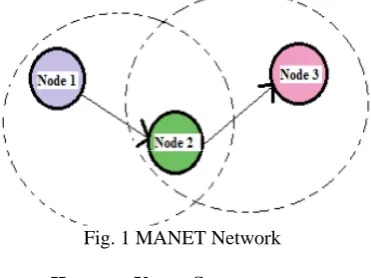
Fig.1 shows a simple ad-hoc network with 3 nodes. Node 1 and node 3 are not within range of each other. However the node 2 can be used to forward packets between node 1and node 2. The node 2 will act as a router and these three nodes together form an ad-hoc network. MANET is collection of communication node that wishes to communicate with each other, but has no any fixed infrastructure and pre defined topology of wireless links. Every node is free to move anywhere, anyplace, anytime. Any node can join and leave in network[5].Mobility is core functionality in network. In network router perform task of routing. It is also different form infrastructure wireless network, in which special node known as an access point manages communication among other nodes. In network topology can be dynamic and unpredictable[5][11]
Fig. 1 MANET Network
II. VIDEO STREAMING
Video is an essential media for communication now a days. Video streaming over the Internet has become a
well-established service and has many successful applications. Streaming is the process of playing out a file even as it downloading. It is a combination of video, voice and animation. Multimedia data has different characteristic as compared to data traffic. Its packet size is quite larger than data, so there are various purpose to built protocol for streaming over network. Streaming media may be either real-time or on-demand.
On demand streams are stored on the server and based on the user requirement content is transmitted. Then, user may play video or may download the video for viewing purpose. Real time stream are only available on a some particular time. For example, when the event is occurring and user can record the video .Video Communication may be point to point communication, multicast or broadcast. Video may be pre-encoded or may be encoded in real time.
Issues regarding video streaming are:
Topology Changes: The node mobility leads to continuous changes in topology, which means that routes may be formed and broken rapidly. When a route breaks, the discovery of a new route will most likely introduce delays, which will affect the quality of an ongoing media stream. In addition, the topology change may introduce new bottleneck links in the network path, leading to a reduction in bandwidth.
Resource Constraints: The devices participating in a MANET will generally be small devices, which imply limited processing power, memory and storage capacity. Being small mobile devices, they will normally be battery . There are many challenges which is same as MANET network. So, it is required to overcome the challenges. powered, which means energy consumption must be kept at a minimum. Wireless communication will often mean limited bandwidth, and as mentioned, the nature of wireless communications means that this bandwidth is shared by all devices in the surrounding area. Additionally, an increase in network traffic places additional load on the nodes in the network, which in turn increases energy consumption. Lack Of Fixed InfrastructureThe lack of a fixed infrastructure requires that nodes function as routers in the network. This can introduce large bottlenecks, if a lot of responsibility is assigned to a node with very limited resources. [11]
III. MULTIPATH ROUTING
protocol. Multipath routing protocols gives advantages of fault tolerance (by ensuring the availability of backup routes at all times).
The use of back-up routes leads to less packet loss, makes communication sessions last longer and provides robustness to mobility and fading.
All of these factors result in less energy consumption and there is the potential benefit that the lifetime of the network will be increased. Moreover, by dispatching the data packets of each flow through many network nodes along different paths, a better distribution of the traffic load may be achieved. Extending network lifetime energy related parameters are used.[9]
It can used to provide load balancing, which reduces the congestion on a single path. Node-disjoint multipath routing help us to create multipath in the network in which there is no any node common other then source and destination. MANETs consist of mobile nodes that cause frequent link failures. This link failure causes two main problems. Firstly, when a route break occurs, all packets that have already been transmitted on that route are dropped and it decreasing the average packet delivery ratio (PDR). Secondly, the transmission of data traffic is halted for the time till a new route is discovered and it increasing the average end-to-end delay[1]
Path Diversity: Receiver can always receive some data during at any period of time , except when all the paths are down all together, which occurs very rarely, often than single path failures.[6]
Load Balancing: Balance traffic load in higher number of nodes and links.[8]
Fault Tolerance: By adding redundancy, to reduce the effect of network failure, it is important that the paths are disjoint. Multipath routing protocol offers multiple paths with sufficient path diversity it is less probable that a link failure affecting one of the paths
Fig. 2 General architecture for the multipath transport of real time multimedia applications [7]
Fig. 2 shows general architecture for multipath transport of multimedia application from the sender side video is compressed by a video encoder into M streams. We call multistream coder when M>1. Then the streams are partitioned and assigned to K paths by a trafficallocator. Paths are maintained by multipath routing. When the
streams arrive, At the receiver side they are first put into a resequencingbufferto restore them. At the end, the video is extracted from the resequencing buffer to be decoded and displayed. If any part of a sub stream is lost, The video decoder is expected to perform appropriate error concealment. In practice, from the sender side it is desirable to use a predesigned multistream coder that always produces a fixed number of streams (say, two to four)[7][12]
IV. TECHNIQUES FOR MULTISTREAM CODING[12]
It is technology that allow stream to be split into multiple streams. Here are two different schemes shown, which differs in terms of their operation.
Feedback Based Reference Picture Selection[7]
One simple way to generate multiple video streams is to code a video into one stream in aStandard way and then scatter that stream onto multiple paths (e.g., sending bits corresponding to the even frames on one path and those for the odd frames on the other). It has poor performance since the streams on the two paths are dependent on each other. That is, the even frames are predicted from the previous (odd) frame, and vice versa. This method improved by exploring the reference picture selection (RPS) technique Specifically, However, a more network-aware coding method is used, which selects the reference picture based on feedback and estimated path status. Negative acknowledgment (NACK) for the frame either it is damaged or lost otherwise (ACK) positive ack. The encoder can then estimate the status of the paths and infer which of the previous frames are damaged.
Multiple Description Coding
Another technique is to use multiple description coding. This is the technique that generates multiple descriptors. With MDC two descriptors are generated for sending odd picture as one descriptor and even as another descriptor. Suppose when coding a picture encode using two kind of prediction.
• A prediction from a linear superposition of previously coded two frames, pictures n– 1 and n – 2, called the central prediction.
• A prediction from the previously coded picture in the same description, picture n – 2, called the side prediction.
Then the encoder codes two signals for picture n; that is, the central prediction error (theDifference between picture n and the central prediction) and the reference mismatch signal
(Essentially the difference between the central and side predictions).
prediction and the quantize used forThe reference mismatch.
TABLE 1
Feed Back
needed Decoding Delay
MDC NO NO
RPS YES NO
Table 1 shows comparison between these of two schemas. Which is MDC and RPS,If we have application in which feedback is needed then we have to choose RPS schema. If any of the applications in which no need of feedback then we can use MDC. For video application it is desirable to use MDC with multipath channel so, there will less loss of data
V. LITERATURE SURVEY
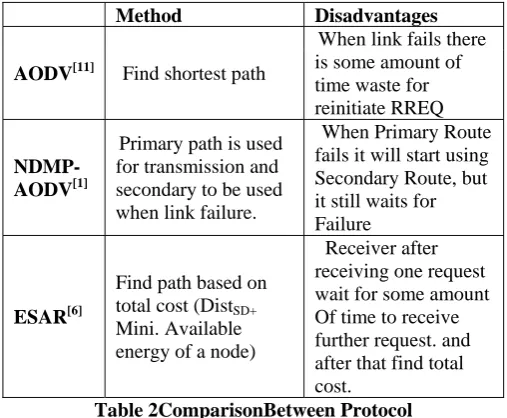
In paper[1] author has proposed a node disjoint multipath routing protocol which is based on traditional AODV Protocol. In this approach as soon as first route is created, source starts data transmission. Backup route is also determined concurrently with the data transmission through the first route. This system propose three different route maintenance method, if active route is broken 3 way for Maintaining system.1) When primary route is broken data sent through secondary path. 2) Source node start route Discovery. 3) Intermediate node also have to store multiple path for data transmission. Performance evaluation of proposed methods show effectiveness in terms of route availability, control overhead, average end-to-end delay and packet delivery ratio .
NDMP-AODV is able to provide low end-to-end delay. Reducing initial delay source route send data as soon as primary route is discovered. It may be improve the route selection process that it can select routes that can satisfy user application requirements. This is required for applications like video on demand, surveillance systems etc which have high transmission rates as compared to the available channel bandwidth.
In this paper [2] author has defined algorithm which focus on two parameters. First is total energy of a path and second is residual battery power of a node . Traditional routing protocols don’t consider energy of nodes while selecting routes. So, using the same route for a longer duration leads to partitioning of the network. This paper attempts to modify AODV to make it energy aware. Protocol finds the best route and increases the lifetime of the network. Scheme outperforms in terms of high mobility scenarios.
Algorithm takes care of crucial things, battery status of the path, and number of drained nodes in the path.Energy of the network is also reduced using variable transmission power when data transmission is done. Scheme analyses various route energy before selecting a route for transmission.
In this paper [3] author’s algorithm was on EnergySaving Ad hoc Routing (ESAR).This algorithm helps to achieve
longer lifetime .Initially from source to destination send the route request. Receiver from the receiving side waits for some time for collecting other request. This algorithm considers actual distance between source and destination and minimum available energy of a node in the path. Selected path is chosen as a best path for transmission until any node reach uptoit’s threshold value.There is also backup path which work as alternate path. This process is repetitive till all the paths from source to destination are exhausted with their battery power.
In paper [4] author propose multipath routing policy having the best energy level .They have brought a solution to the problems involved by link failures due to node mobility in ad hoc network routing. Multipath approach helps to reducing the end-to-end delay. Alternative paths are available and used to forward the data packets. Here this algorithm not having any best energy management and there is no criteria for security is described into the paper. In paper[8]author shows which are the techniques are available for video streaming. And which are the challenges for video streaming. They have suggest that It is beneficial to combine multistream coding techniques with multiple routes. They have shown different techniques like MDC, cross layer optimization. Author also addressed the challenges which are there for video streaming. Some challenges are wireless medium, topology changes, battery constraint devices.
Method Disadvantages
AODV[11] Find shortest path
When link fails there is some amount of time waste for reinitiate RREQ
NDMP-AODV[1]
Primary path is used for transmission and secondary to be used when link failure.
When Primary Route fails it will start using Secondary Route, but it still waits for Failure
ESAR[6]
Find path based on total cost (DistSD+
Mini. Available energy of a node)
Receiver after receiving one request wait for some amount Of time to receive further request. and after that find total cost.
Table 2ComparisonBetween Protocol
VI PROPOSED WORK
For the propose work it uses video application in MANET. Initially video is given as an input. And whole video not added into the network. It divided into the different streams. And that streams are passed into the network. In the network they transmit like node disjoint protocol. Proposed approach is based on node disjoint multipath protocol.Here concept of network lifetime is added because due to single node dies out whole network dies out due to the depletion of energy.
When it send request to intermediate node check if this request is duplicate or fresh one by searching entery in S_ Table(include source IP Address and RREQ flooding ID(Rf_id)).If it is duplicate then discard .If it is newer one then rebroadcast RREQ into the network.
Source node flood request in network .when destination gets request it replay of its route request.RREP send to source via intermediate node. All intermediate node having flag which initially have value of F when any intermediate node receive request value of flag become T. so, any intermediate node can’t get duplicate request.This help to maintain node-disjoint property in the algorithm.When node forward to destination and destination send replay and then it get back path 1.
When it get path1 means primary path, It starts data transmission. And simultaneously searching for secondary path. Here for that it will choose best path. For that min-max concept is used. Suppose for secondary path it will wait for some amount of time and for that time suppose 3 path requests arrived. P1, P2, P3. For every path it check minimum energy node into whole path. Like P1’s node has minimum 3j energy, P2’s node has minimum 6j energy and P3’s node having minimum 4j energy. then we will choose path with having maximum energy. This will be P2. This will be called as best path.When it find best path we switch our route from primary path to secondary path. For the secondary path it will make limit of 3 path. When algorithm checks that there is last path is remaining it will do again RREQ.
Maximum try for this proposed work is that itutilize all the nodes into the network. And switch path without waiting for link failure it will helpful for improving network lifetime.
VII. RESULT ANALYSIS
Here simulation is done on ns2. For the input video is taken. And used in encoded format so that it can packetize into network and transfer over network. Network is created of 50 nodes.Video is divided into 2 streams using MDC.
Fig. 3 Energy Consumption vs Pause time
Here Fig. 3 shows enrgy consumption In joule . in aodv we can say that it is higher then our proposed system.
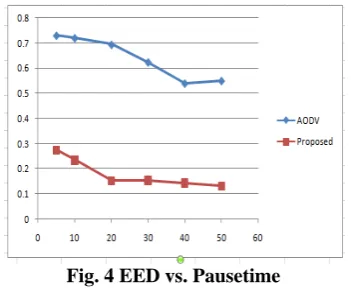
Fig. 4 EED vs. Pausetime
Fig. 4 shows end to end delay .In proposed system end to end delay is less as compared to normal aodv. Average end to end delay of ENDM_AODV is lower and smoother than that of AODV. This is mainly because Proposed protocol can use alternate routing in link broke so then reduced the delay of source node rerouting.
Fig. 5 PDR vs. Pause time
In Fig 5 shows that as pause time increases packet delivery ratio is going to be increase. Packet loss in AODV is higher, But proposed protocol can have secondary path, so it can send the data through alternate paths to arrive the same destination node, so the probability of packet discarded is small. At the time of the discovery link broken. Further because of considering the maximum residual energy of each node in selecting path, the chance of path broke is smaller, so the packet delivery ratio is increased
Fig. 6 Network Lifetime vs. Pause time
VIII.CONCLUSION
Video communication becomes an interested research topic due to constant growth of multimedia communication. There are so many protocols available. But Multipath is good choice for video communication. Here propsed schem help to improve network lifetime for Video transmission. After result analysis it can be showed that proposed scheme have less energy consumption , good packet delivery ratio, and also not compromise with end to end delay .
REFERENCES
[1] C. Lal ,V.Laxmi, M.S.Gaur, “A Node-Disjoint Multipath Routing
Method Based On Aodv Protocol For Manets”, 26th IEEE International Conference On Advanced Information Networking And Applications, 2012
[2] SeemaVermaPinki Nayak2* And RekhaAgarwal ,”Energy Energy
Efficient Routing In Mobile Adhoc Networks Based Onaodv Protocol”, IJCSI International Journal Of Computer Science Issues, Vol. 9, Issue 6, No 2, ISSN 1694-0814, November 2012
[3] Utkarsh, Mukesh Mishra And SuchismitaChinara ,” ESAR: An
Energy Saving Ad Hoc Routing Algorithm For MANET” , Advanced Computing (Icoac), 2012 Fourth International Conference On IEEE 2012
[4] Smail Omar, MekkakiaZoulikha, Bernard Cousin “Energy
Efficiency In Ad Hoc Wireless Networks With Node-Disjoint Path Routing”Systems, Signal Processing And Their Applications (WOSSPA), 2011
[5] Harsharndeep Singh, MeenuDhiman And HarmunishTaneja,”
EVSM: Enhanced Video Streaming In Mobile Ad-Hoc Networks, International Journal Of Computer Science And Telecommunications Volume 3, Issue 9, September 2012
[6] Shiwen Mao, Shunan Lin, Shivendra S. Panwar, Yao Wang,,
EmreCelebi,” Video Transport Over Ad Hoc Networks: Multistreamcoding With Multipath Transport”, IEEE Journal On Selected Areas In Communications, Vol. 21, No. 10, December 2003
[7] DjShiwen Mao, Shunan Lin, Yao Wang, Shivendra S. Panwar, And
YihanLi,Multipath Video Transport Overad Hoc Networks, IEEE Wireless Communications, August 2005
[8] Morten Lindeberg ,Stein Kristiansen Thomas Plagemann , Vera
Goebel, “Challenges And Techniques For Video Streaming Over Mobile Ad Hocnetworks”,Springer-Verlag 2010
[9] VidyaKudachi, VinodJadav,”Performance Evaluation Of Node
Disjoint Multipath Routing Protocol Based On Aodv For Manet” International Journal Of Advanced Electrical And Electronics Engineering, Issn (Print) : 2278-8948, Volume-2, Issue-6, 2013
[10] Aarti , Dr. S. S. Tyagi, “ Study Of Manet: Characteristics,
Challenges, Application And Security Attacks” , International Journal Of Advanced Research In Computer Science And Software Engineering, Volume 3, Issue 5, May 2013
[11] MayuriBaldaniya, NehaSisodiya, “A Review on Multipath Protocol for Video Transmission”,International Journal of Computer Science and Information Technologies(IJCSIT), Volume 5, Issue 1,January 2014, ISSN :0975-9646.
![Fig. 2 General architecture for the multipath transport of real time multimedia applications [7]](https://thumb-us.123doks.com/thumbv2/123dok_us/7834119.1298182/2.595.53.293.489.666/fig-general-architecture-multipath-transport-real-multimedia-applications.webp)