A Scalable Generalization of Nakamoto Consensus
February 2, 2020
Yonatan Sompolinsky
School of Engineering and Computer
Science, The Hebrew University of
Jerusalem, Israel
DAGlabs
Shai Wyborski
School of Engineering and Computer
Science, The Hebrew University of
Jerusalem, Israel
DAGlabs
Aviv Zohar
School of Engineering and Computer
Science, The Hebrew University of
Jerusalem, Israel
ABSTRACT
In 2008 Satoshi Nakamoto invented the basis for blockchain-based distributed ledgers. The core concept of this system is an open and anonymous network of nodes, or miners, which together maintain a public ledger of transactions. The ledger takes the form of a chain of blocks,the blockchain, where each block is a batch of new transactions collected from users. One primary problem with Satoshi’s blockchain is its highly limited scalability. The security of Satoshi’slongest chain rule, more generally known asthe Bitcoin protocol, requires that all honest nodes be aware of each other’s blocks very soon after the block’s creation. To this end, the throughput of the system is artificially suppressed so that each block fully propagates before the next one is created, and that very few “orphan blocks” that fork the chain be created spontaneously. In this paper we present PHANTOM, a proof-of-work based protocol for a permissionless ledger that generalizes Nakamoto’s blockchain to a direct acyclic graph of blocks (blockDAG). PHANTOM includes a parameter k that controls the level of tolerance of the protocol to blocks that were created concurrently, which can be set to accommodate higher throughput. It thus avoids the security-scalability tradeoff which Satoshi’s protocol suffers from.
PHANTOM solves an optimization problem over the blockDAG to distinguish between blocks mined properly by honest nodes and those created by non-cooperating nodes who chose to deviate from the mining protocol. Using this distinction, PHANTOM provides a robust total order on the blockDAG in a way that is eventually agreed upon by all honest nodes. Implementing PHANTOM requires solving an NP-hard problem, and to avoid this prohibitive computation, we devised an efficient greedy algorithm GHOSTDAG that captures the essence of PHANTOM.
We provide a formal proof of the security of GHOSTDAG, namely, that its ordering of blocks is irreversible up to an exponentially negligible factor. We discuss the properties of GHOSTDAG and how it compares to other DAG based protocols.
1
INTRODUCTION
The security of the Bitcoin protocol relies on blocks propagating quickly to all miners in the network [5, 10, 15]. Block creation itself is slowed down via the requirement that each block contain a proof-of-work. For the Bitcoin protocol to be secure, block propagation must be faster than the typical time it takes the network together to create the next block. In order to guarantee this property, the creation of blocks in Bitcoin is regulated by the protocol to occur
only once every 10 minutes, and the block size itself is limited to allow for fast transmission. As a result, Bitcoin suffers from a highly restrictive throughput on the order of 3-7 transactions per second (tps)1.
The PHANTOM protocol.In this paper we present PHANTOM, a protocol that generalizes Nakamoto’s longest chain protocol. While Bitcoin blocks each contain a hash of a single predecessor block in the chain they are extending which implies that blocks for a tree, PHANTOM structures blocks in a Directed Acyclic Graph, a
blockDAG. Each block can thus include several hash references to predecessors. PHANTOM then provides a total ordering over all blocks and transactions, and outputs a consistent set of accepted transactions. Unlike the Bitcoin protocol, where blocks that are not on the main chain are discarded, PHANTOM incorporates all blocks in the blockDAG into the ledger, but places blocks that were created by attackers later in the order.
In rough terms, PHANTOM consists of a three-step procedure: (1) Using the structure of the blockDAG, we recognize a set of well-connected blocks (we later refer to these as blue blocks); this procedure is used to exclude blocks created by misbehaving nodes and is the heart of the protocol: Blocks that either reference only old blocks from the DAG, or are withheld by their creator for some time, will be excluded from the set of blue blocks with high probability.
(2) We complete the DAG’s naturally induced partial ordering to a full topological order in a way that favours blocks inside the selected cluster and penalizes those outside it.
(3) The order over blocks induces an order over transactions; transactions in the same block are ordered according to the order of their appearance in the block. We iterate over all transactions in this order, and accept each one that is consistent (according to the underlying consistency notion) with all transactions approved so far.
Propagation delay.The first step above is parameterized withk, which is a function of the assumed network delay diameter. In that, PHANTOM is similar to Nakamoto Consensus which assumes that an upper bound on the network’s delay diameter. In fact, under low throughput we can setk=0, in which case PHANTOM coincides with Nakamoto Consensus.
However, while Nakamoto Consensus suppresses the throughput and sets the block creation rateλsuch thatD·λ≪1, PHANTOM
1
does not impose an a priori constraint over λ. Instead, the throughput (in terms ofλand the block size) can be set to approach the network’s capacity, and thenkcan be set after the fact to ensure the safety of the protocol. This alleviates the security-scalability tradeoff that Nakamoto Consensus suffers. Still, increasingkdoes not come without cost, as we will discuss shortly.
GHOSTDAG.In its vanilla form, PHANTOM requires solving an NP-hard problem, and is therefore unsuitable for practical applications. Instead, we use the intuition behind PHANTOM to devise a greedy algorithm, GHOSTDAG, which can be implemented efficiently. We prove formally that GHOSTDAG is secure, in the sense that its ordering of blocks becomes exponentially difficult to reverse as time develops.
The main achievement of GHOSTDAG can be summarized as follows:
Theorem(Informal). Given two transactionstx1,tx2 that were
published and embedded in the blockDAG at some point in time, the probability that GHOSTDAG’s order betweentx1andtx2changes
over time decreases exponentially as time grows, even under a high block creation rate that is non-negligible relative to the network’s propagation delay, assuming that a majority of the computational power is held by honest nodes.
We will reformalize this theorem in Section 3, and provide a formal proof in Section A.
We now proceed to describe the PHANTOM and GHOSTDAG protocols more formally.
2
THE PHANTOM PROTOCOL
2.1
Preliminaries
The following terminology is used extensively throughout this paper. A DAG of blocks is denotedG=(C,E), whereCrepresents blocks andErepresents the hash references to previous blocks. We frequently writeB ∈ G instead ofB ∈ C.past(B,G) ⊂ C denotes the subset of blocks reachable from B, and similarly f uture(B,G) ⊂ Cdenotes the subset of blocks from whichBis reachable; these are blocks that were provably created before and afterB, correspondingly.An edge in the DAG points back in time,
from the new block to previously created blocks which it extends.
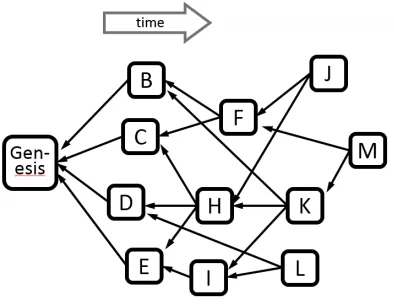
We denote byanticone(B,G)the set of blocks outsidepast(B,G) andf uture(B,G)(excludingBitself ); this is the set of blocks in the DAG which did not referenceB(directly or indirectly via their predecessors) and were not referenced byB(directly or indirectly viaB’s predecessors).2 Finally,tips(G)is the set of blocks with in-degree 0 (usually, the most recent blocks). This terminology is demonstrated in Figure 1.
2.2
The DAG mining protocol
Rather than extending a single chain, a miner in PHANTOM references in its new block all blocks intips(G), whereGis the DAG that the miner observes locally at the time when the new block is created. Additionally, the miner should broadcast its new block as fast as possible. These two rules together constitute the DAG mining protocol in PHANTOM.
2
We will frequently abbreviate the notation and write, e.g.,anticone(B), instead of
anticone(B,G).
Figure 1: An example of a block DAGG. Each block references all blocks that were known to its miner at the time it was created. The DAG terminology applies toH as follows:
past(H) = {Genesis,C,D,E} – blocks which H
references directly or indirectly, and which were provably created beforeH;
f utur e(H) = {J,K,M} – blocks which referenceH directly or indirectly, and which were provably created afterH;
anticone(H) = {B,F,I,L}– the order between these blocks andHis ambiguous. Reaching consensus on the order between blocks and other blocks in their anticone is the main challenge that we face.
tips(G) = {J,L,M}– leaf-blocks, namely, blocks with in-degree 0; these will be referenced in the header of the next block.
2.3
The DAG ordering protocol
The aforementioned DAG mining protocol implies in particular that even when two blocks contain conflicting transactions, both blocks are incorporated into the blockDAG and referenced by all (honest) miners. The core challenge is then how to recover the consistency of the blockDAG. This is done in our framework by ordering all blocks – and by extension, all transactions – and accepting transactions one by one, eliminating individual transactions that are inconsistent with those approved before them. PHANTOM achieves consensus on the order of blocks, and this guarantees agreement on the set of accepted transactions as well.
Essentially, Bitcoin can be seen as an ordering protocol as well, according to which transactions embedded in the longest chain of blocks precede those off the longest chain. Unfortunately, Bitcoin’s protocol is known to be secure only under slow block rates (see Section 4).
A Scalable Generalization of Nakamoto Consensus
February 2, 2020
Yonatan Sompolinsky, Shai Wyborski, and Aviv Zoharand the novelty of PHANTOM lies mainly in the first colouring procedure.
2.3.1 The intuition behind PHANTOM.Just like Bitcoin,
PHANTOM relies on the ability of honest nodes to communicate to their peers recent blocks in a timely manner, and on the assumption that honest nodes possess more than 50% of the hashrate. The block rate in Bitcoin is suppressed so as to ensure block creation is slower than the time it takes to communicate them. In PHANTOM, on the other hand, we notice that the set of honest blocks can be recognized even when the block rate is high and many forks appear spontaneously: Due to the communication and cooperation of honest mines, we should expect to see in the DAG a “well-connected” cluster of blocks.
Indeed, letDbe an upper bound on the network’s propagation delay. If blockBwas mined by an honest miner at timet, then any block published before timet−Dnecessarily arrived at its miner before timet, and is therefore included inpast(B). Similarly, the honest miner will publishBimmediately, and soBwill be included in the past set of any block mined after timet+D. As a result, the set of honest blocks inB’s anticone is typically small, and consists only of blocks created in the interval[t−D,t+D]. The proof-of-work mechanism guarantees that the number of blocks created in an interval of length 2·Dis typically below somek>0.
In short, the set of blocks created by honest nodes is well-connected. The following definition captures “well-connectedness”:
Definition 1. Given a DAGG=(C,E), a subsetS⊆ Cis called a
k-cluster, if∀B∈S:|anticone(B) ∩S| ≤k.
Attacker nodes may deviate arbitrarily from the mining rules, have large anticones, and even artificially increase the anticone of honest blocks. Nonetheless, since honest miners possess more proof-of-work power, it is usually impossible for malicious miners to create a well-connected set of blocks that is larger than that created by honest nodes. PHANTOM utilizes this fact and selects the largest well-connected set within the DAG, by solving the following optimization problem:
Maximum
k
-cluster SubDAG (
MCS
k)
Input:DAGG=(C,E)
Output: A subset S∗ ⊂ C of maximum size, s.t.
|anticone(B) ∩S∗| ≤kfor allB∈S∗.
In this formulation, the parameter k is predetermined;see Section 4 for more details. An example of a maximumk-cluster appears in Figure 2.
2.3.2 The PHANTOM protocol.Following the above intuition, the ordering protocol of PHANTOM comprises the following two steps: (1) Given a blockG, solveMCSk(G); let’s refer to its output as
the Blue set and to its complement set as the Red one. (2) Determine the order between Blue blocks according to some
topological sort. Then, for any Blue blockB, add to the order just beforeBall of the Red blocks inpast(B)that weren’t added to the order yet; these Red blocks too should be added in a topological manner.3
3
The topological sorts in this second step are additionally required to be agnostic to future blocks: For any Blue blockB, the order on blocks inpast(B)should remain
Figure 2: An example of the largest 3-cluster of blocks within a given DAG:A,B,C,D,F,G,I,J(coloured blue). It is easy to verify that each of these blue blocks has at most3 blue blocks in its anticone, and (a bit less easy) that this is the largest set with this property. Setting PHANTOM’s inter-connectivity parameter with
k = 3 means that at most 4blocks are assumed to be created within each unit of delay, so that typical anticone sizes should not exceed 3. Blocks outside the largest 3-cluster,E,H,K (coloured red), belong to the attacker (w.h.p.). For instance, blockEhas 6 blue blocks in its anticone (B,C,D,F,G,I); these blocks didn’t referenceE, presumably becauseEwas withheld from their miners. Similarly, blockKadmits 6 blue blocks in its anticone (B,C,G,F,I,J); presumably, its malicious miner received already some blocks from(B,C,D,G), but violated the mining protocol by not referencing them.
An example of the output of the PHANTOM procedure on the small blockDAG from Figure 2 is:(A,D,C,G,B,F,I,E,J,H,K). Unfortunately, the Maximumk-cluster SubDAG problem is NP hard (see problem [GT26] in [6]), and PHANTOM is therefore of less practical use for an ever-growing blockDAG. We thus introduce a greedy algorithm that is more suitable for implementation. We call this greedy variant GHOSTDAG.4
2.4
The GHOSTDAG protocol
Similar to PHANTOM, the GHOSTDAG protocol selects ak-cluster, which induces a colouring of the blocks as Blues (blocks in the selected cluster) and Reds (blocks outside the cluster). However, instead of searching for the largestk-cluster, GHOSTDAG finds a k-cluster using a greedy algorithm. The algorithm constructs the Blue set of the DAG by first inheriting the Blue set of the best tip Bmax, i.e., the tip with the largest Blue set in its past, and then adds
the same if we remove from the DAG blocks inf utur e(B). This can be implemented, for instance, using a priority queue that pops out blocks according to the size of their past set.
4
to the Blue set blocks outsideBmax’s past in a way that preserves
thek-cluster property.
Observe that this greedy inheritance rule induces a chain: The last block of the chain is the selected tip ofG,Bmax; the next block
in the chain is the selected tip of the DAGpast(Bmax); and so on down to theдenesis. We denote this chain byChn(G)=(дenesis=
Chn0(G),Chn1(G), . . . ,Chnh(G)).
The final order over all blocks, in GHOSTDAG, follows a similar path as the colouring procedure: We order the blockDAG by first inheriting the order ofBmax on blocks inpast(Bmax), then addingBmax itself to the order, and finally adding blocks outsidepast(Bmax)according to some topological ordering. Thus, essentially, the order over blocks becomes robust as the colouring procedure.
2.4.1 Formal algorithm.The procedures described above are formalized in Algorithm 1 below. The algorithm begins with the base case where the DAG consists of theдenesisblock only (lines 2-3). Next, it performs a recursive call to compute the Blue sets and ordering of the past of each of the DAG’s tips (lines 4-5), and inherits those of the best tip (lines 6-8). Then, the selected tip is added to the Blue setBlueSetG and to the last position in the current ordered listOrderedListG(lines 9-10). Then we iterate overanticone(Bmax,G)in some topological way which guarantees
that a block is visited only after its predecessors are (lines 11-14).5 For every block we visit, we check if addingBto the Blue set will preserve thek-cluster property, and if this condition is satisfied, we addBto the Blue set (lines 9-13); either way, we addBto the current last position in the list (line 14). Finally, we return the Blue set and the ordered Note that the recursion in the algorithm (line 5) halts, because for any blockB∈G:|past(B)|<|G|.
Algorithm 1Ordering the DAG
Input: G– a block DAG,k– the propagation parameter
Output: BLU Ek(G)– the Blue set ofG;ord – an ordered list containing all blocks inG
1: functionOrderDAG(G,k)
2: ifG=={дenesis}then
3: return[{дenesis},{дenesis}] 4: forB∈tips(G)do
5: [BlueSetB,OrderedListB] ←OrderDAG(past(B),k)
6: Bmax ← arg max{|BlueSetB|:B∈tips(G)}
(break ties according to lowest hash)
7: BlueSetG ←BlueSetB
max
8: OrderedListG ←OrderedListB
max
9: addBmaxtoBlueSetG
10: addBmaxto the end ofOrderedListG
11: forB∈anticone(Bmax,G)doin some topological ordering 12: ifBlueSetG∪ {B}is ak-clusterthen
13: addBtoBlueSetG
14: addBto the end ofOrderedListG
15: return[BlueSetG,OrderedListG]
5
This can be implemented in several ways, e.g., by inserting all blocks in
anticone(Bmax)into a deterministic priority queue which respects the topology. That is, the queue should pop out a block only after all of its parents have been popped out, and the order in which it pops blocks should be fully determined by the blockDAG.
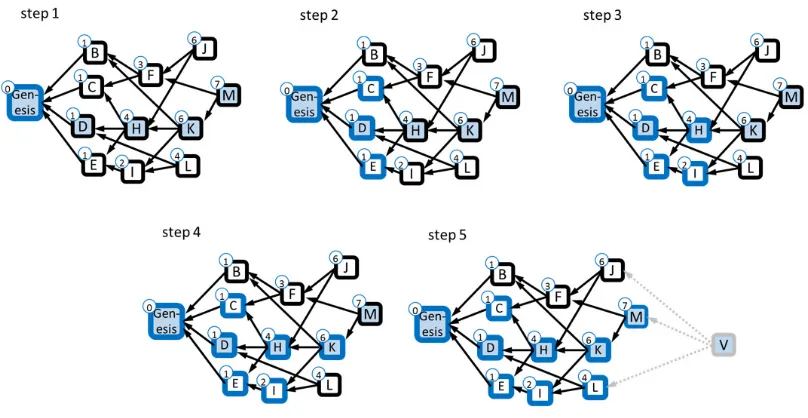
We demonstrate the operation of this algorithm in Figure 3.We will introduce some variants of Algorithm 1 in Section 6. Finally, we have an efficient implementation of Algorithm 1, and we tested it under high block rates (λ=10 and 25 blocks per second, for blocks of size 0.1-1 MB). We will make the implementation available in the full version of this paper.
2.5
Collapse to Bitcoin when
k
=
0
If the block creation rate is kept low, as in Bitcoin, the parameterk can be safely set to 0, as honest blocks are likely to create a chain (see Section 4). In such a setup, both PHANTOM and GHOSTDAG converge to Bitcoin’s rule in the sense that, in case of a chain split, blocks on the longest chain precede those off the longest chain. These protocols would differ from Bitcoin’s rule in that, as of according to the DAG mining protocol, blocks in the longest chain would eventually reference those off the longest chain, in PHANTOM or GHOSTDAG, and will thereby insert them in the order.
In fact, it is easy to see that the longest chain is, by definition, the largest 0-cluster of the DAG. Accordingly, our protocols can be seen as a generalization of Satoshi’s longest-chain rule to a setup where block rate is high and propagation delays are not negligible. In Appendix A we prove that GHOSTDAG remains secure under high block creation rates as well. We leave the formal analysis of PHANTOM for future work.
3
FORMAL MODEL AND STATEMENT
In this section we describe our formal framework. While we introduce new notation and terminology, the reader should keep in mind thatwe stick to Nakamoto Consensus’s model in almost
every respect—transactions, blocks, Proof-of-work, computationally bounded attacker, P2P propagation of blocks, probabilistic security guarantees, etc. The “only” difference is that a block references (possibly) several predecessors rather than a single one. While this has far reaching consequences on how the ledger is to be interpreted, on the mining side things remain largely the same.
3.1
Network
We follow the model specified in [14]. The network of nodes (or miners) is denotedN,honestdenotes the set of nodes that abide to the mining protocol (as defined below), andmaliciousdenotes the rest of the nodes. Honest nodes form a connected component in
N’s topology, and the communication delay diameter of the honest subnetwork isD: if an honest nodev∈ Nsends a message of size b MB at timet, it arrives at all honest nodes by timet+Dthe latest. The attacker is assumed to suffer no delays on its outgoing or incoming links.
A Scalable Generalization of Nakamoto Consensus
February 2, 2020
Yonatan Sompolinsky, Shai Wyborski, and Aviv ZoharFigure 3: An example of a blockDAGGand the operation of GHOSTDAG to construct its blue setBLU Ek(G)set, under the parameterk=3. The small circle near each blockXrepresents its score, namely, the number of blue blocks in the DAGpast(X). The algorithm selects the chain greedily, starting from the highest scoring tipM, then selecting its predecessorK(the highest scoring tip inpast(M)), thenH,D(breaking theC,D,Etie arbitrarily), and finallyGenesis. For methodological reasons, we add to this chain a hypothetical “virtual” blockV– a block whose past equals the entire current DAG. Blocks in the chain(дenesis,D,H,K,M,V)are marked with a light-blue shade. Using this chain, we construct the DAG’s set of blue blocks,BLU Ek(G). The set is constructed recursively, starting with an empty one, as follows: In step 1 we visitDand addдenesisto the blue set, as the only block inpast(D). Next, in step 2, we visitHand add toBLU Ek(G)blocks that are blue in
past(H), namely,C,D,E. In step 3 we visitKand addH,I; note that blockBis inpast(K)but was not added to the blue set, since it has 4
blue blocks in its anticone. In step 4 we visitMand addKto the blue set; again, note thatF ∈past(M)could not be added to the blue set due to its large blue anticone. Finally, in step 5, we visit the blockvir tual(G)=V, and addMand toBLU Ek(G), leavingLaway due to its large blue anticone, and leavingJaway because adding it would causeIto suffer too large a blue anticone (it already hasC,D,andHin it).
3.2
Mining framework
Proof-of-work.Nodes create blocks of transactions by solving Proof-of-work puzzles. Block creation follows a Poisson process with parameterλ. For the sake of simplicity, we assume thatλis constant.6We denote bytime(B)the absolute time ofB’s creation. The computational power of nodev∈ Nis captured by 0<αv<1, which represents the probability that nodevwill be the creator of the next block in the system (at any point in time; this is a memoryless process).
Block references.Every block specifies its direct predecessors by referencing their ID in its header (a block’s ID is obtained by applying a collision resistant hash to its header); the choice of predecessors will be described in the next subsection. This results in a structure of a direct acyclic graph (DAG) of blocks (as blocks can only reference blocks created before them), denoted typically G=(V,E). Here,Vrepresents blocks andErepresents the hash references. We will frequently writeB∈Ginstead ofB∈ V.
DAG topology.The topology of the blockDAG induces a natural partial ordering over blocks, as follows: if there is a path in the DAG from blockCto blockBwe writeB∈past(C); in this case,Cwas
6
In practice,λmust occasionally be readjusted to account for shifting network conditions. PHANTOM can support a retargeting mechanism similar to Bitcoin’s, e.g., readjust every time thatChn(G)grows by 2016 blocks.
provably created afterBand thereforeBshould precedeCin the order.7A node does not consider a block as valid until it receives its entire past set. The unique blockдenesisis the block created at the inception of the system, and every valid block must have it in its past set.
Similarly, the future set of a block,f uture(B), represents blocks that were provably created after it:B ∈ past(C) ⇐⇒ C ∈ f uture(B). In contrast to the past set, the future set of a block keeps growing in time, as more blocks are created and are referencing it. To avoid ambiguity, we writef uture(B) ∩Gorf uture(B,G), and usef uture(B)only when the context is clear or unimportant.
The setanticone(B,G)represents all blocks inG that belong neither toB’s future nor to its past (excludingBas well). These are blocks whose ordering with respect toBis not defined by the partial ordering that the topology of the DAG induces. Formally, for two distinct blocksB,C ∈ G:C ∈ anticone(B,G) ⇐⇒
(B<past(C) ∧C<past(B)) ⇐⇒ B ∈ anticone(C,G). Here too we usually specify the context,anticone(B,G), because the anticone set can grow with time. In Figure 1 above we illustrate this terminology.
7
DAG mining protocol.Gvt denotes the block DAG that nodev ∈
Nobserves at timet. This DAG represents the history of all (valid) block-messages received by the node.
Atipof the DAG is a leaf-block, namely, a block with in-degree 0. The instructions to a miner in the DAG paradigm are simple:
(1) When creating or receiving a block, transmit it to all of one’s peers inN. Formally, this implies that∀v,u∈honest:Gvt ⊆ Gut+D.
(2) When creating a block, embed in its header a list containing the hash of all tips in the locally-observed DAG. Formally, this implies that if blockBwas created at timet, by honest nodev, thenpast(B)=Gvt.8
Since these are the only two mining rules in our system, a byzantine behaviour of the attacker (which controls up toα of the mining power) amounts to an arbitrary deviation from one or both of these instructions.
For convenience, we additionally regard the virtual block of the DAG,virtual(G), which is a hypothetical (un-mined) block which points to the DAG’s tips as its parents. Thus,past(virtual(G))=G. Essentially,virtual(G)represent the block template for the next block to be created by the miner, if it is honest.
3.3
DAG client protocol
The DAG as described so far possibly embeds conflicting transactions. In our work, these conflicts are resolved via an ordering protocol, namely, a protocol through which all nodes agree on the order of all transactions in the system. We refer to the ordering rule asthe client protocol, as every participant in the network can run the ordering procedure on its client locally without any need to communicate additional messages with other clients. Once such an order is agreed, one can iterate over all transactions in the prescribed order and approve each transaction that is
consistentwith those approved so far. In the case where transactions represent payments in Bitcoin’s UTXO model, a transaction would be consistent with the set of previously approved transactions if its inputs belong to this set and none of these inputs are already spent by another transaction in the set (i.e., no “double spend”). However, our work is agnostic to the precise definitions of the transaction space and of the underlying consistency notion—for our purpose, suffice it to regard an abstract transaction spaceUand an abstract consistency function that determines whether a set of transactions T ⊆ Uis consistent or not.
Formally, an ordering ruleordtakes as input a blockDAGGand outputs a linear order overG’s blocks,ord(G)=(B0,B1, . . . ,B|G|).
Transactions in the same block are ordered according to their appearance in it, and this convention allows us to talk henceforth on the order of blocks only. With respect to a given ruleord, we writeB ≺ord(G)Cif the index ofBprecedes that ofCinord(G); we abbreviate and writeB ≺GCor evenB≺Cwhen the context is understood. For convenience, we use the same notationB≺GC whenB∈GbutC<G.
8
Technically it is more accurate to writepast(B)=Gvt \ {B}, as a block does not belongs to its own past set.
3.4
Convergence of the order
The following definition captures the desired security of the protocol, in terms of the probability that some order between two blocks will be reversed.
Definition 2. Fix a ruleordand a nodeu ∈ N. LetB ∈Gut. The functionRisku is defined by the probability that from the point of view ofua block that did not precedeBin timet+rwill later come to precede it:
Risku(B,t,r):=Pr
∃s>t+r,∃C∈Gus :B≺Gu
t+r C∧C≺Gus B
IfB<Gut we defineRisku(B,t,r)=0.
The functionRiskis the maximalRiskuover honest nodes:
Risk(B,t,r)= max
u∈honestRisku
(B,t,r)
In the definition above, the probability is taken over all random events in the network, including block creation and propagation, as well as the attacker’s arbitrary (byzantine) behaviour. The convergence property below guarantees that the order between a block and those succeeding it (or those not published yet) will not be reversed,w.h.p.This captures the security of the protocol, as it provides honest nodes with (probabilistic) security guarantees regarding possible reorgs.
Property 1. An ordering ruleordis said to (1-α)-convergeif∀t >0
andB: lim
r→∞Risk(B,t,r)=
0, even when a fractionαof the mining
power is byzantine.
Ideally, we would wantRisk(B,t,r)=0 to vanish exponentially fast so as to ensure speedy confirmation times.
Remark. Property 1 essentially couples the Safety and Liveness properties required from consensus protocols. Indeed, once
Risk(B,t,r)<ϵ, a decision to accept transactions inBcan be made
(Liveness), and is guaranteed to be irreversible (Safety) up to an error probability ofϵ—as in Nakamoto Consensus and similar protocols, decisions are only irreversible in the probabilistic sense. Nevertheless, we avoid phrasing our results in these terms, for the sake of clarity of presentation. The complication arises from the need to analyze the system from the perspective of everynodeGvt; this technicality is
not unique to PHANTOM, and should be regarded in any work that formalizes blockchain based consensus (unless propagation delays are assumed to be negligible). We leave the task of bridging this gap to a later version.
The security threshold is the minimal portion of the hashing power that an attacker must acquire in order to disrupt the protocol’s operation:
Definition 3. Thesecurity thresholdof an ordering ruleord is
defined as the maximalα(attacker’s relative computational power) for whichord(1-α)-convergesexponentially fast.
3.5
Main result
A protocol is scalable if it is safe to increase the block creation rateλwithout compromising the security, that is, if the security threshold does not deteriorate asλincreases (this can be phrased also in terms of increasing the block sizebrather thanλ).
A Scalable Generalization of Nakamoto Consensus
February 2, 2020
Yonatan Sompolinsky, Shai Wyborski, and Aviv ZoharTheorem 4(GHOSTDAG scales). Given a block creation rateλ>0, δ > 0, andDmax > 0, ifDmax is equal to or greater than the
network’s propagation delay diameterD, then the security threshold of GHOSTDAG, parameterized withk(Dmax,δ), is lower bounded by
1
2· (1−δ).
The parameterization of GHOSTDAG viak(Dmax,δ)is defined in the subsequent section. Theorem 4 encapsulates the main achievement of our work. We prove the theorem formally in Section A. Contrast this result to a theorem regarding Nakamoto Consensus, which appears in several forms in previous work (e.g., [11, 15]):
Theorem 5(Nakamoto Consensus does not scale). The security
threshold of Nakamoto Consensus goes to 0 asD·λgrows.
Finally, we note that even ifDmax ̸≥D, the system’s security does not immediately break apart. Rather, the minimal power needed to attack the system goes from 50% (times (1−δ)) to 0, deteriorating at a rate that depends on the error gapD−Dmax.
4
SCALABILITY AND NETWORK DELAYS
4.1
The propagation delay parameter
D
maxThe scalability of a distributed algorithm is closely tied to the assumptions it makes on the underlying network, and specifically on its propagation delayD =D(b)whereb is the block-size in KB. The real value ofDis both unknown and sensitive to shifting network conditions. For this reason, Bitcoin operates under the assumption thatDis much smaller than 10 minutes, and sets the average block interval time to 10 minutes. While this seems like an overestimation of the network’s propagation delay under normal conditions (at least in 2018’s Internet terms), some safety margin must be taken, to account for peculiar network conditions as well. Similarly, in PHANTOM (and GHOSTDAG) we assume that the unknownDis upper bounded by someDmax =Dmax(b)which is known to the protocol. The protocol does not explicitly encode Dmax, rather, it is used to parameterizek, as will be described in the next subsection.
The use of an a priori known bound Dmax distinguishes GHOSTDAG’s (and PHANTOM’s) security model from that of SPECTRE [14]. While the security of both protocols depends on the assumption that the network’s propagation delayDis upper bounded by some constant, in SPECTRE the value of such a constant need not be known or assumed by the protocol, whereas GHOSTDAG makes explicit use of this parameter (viak) when ordering the DAG’s blocks. The fact that the order between any two blocks becomes robust in GHOSTDAG, but not in SPECTRE, should be ascribed to this added assumption; see further discussion in Section 5.
4.2
The anticone size parameter
k
The parameterkis decided from the outset and hard-coded in the protocol. It is defined as follows:
k(Dmax,δ):=min
n
ˆ
k∈N:f(kˆ,Dmax)<δ
o
(1)
f(kˆ,D
max):=max
∞
Õ
j=kˆ+1
e−2·C ·(2·C)
j
j! , 2·C ˆ k+2·C
, (2)
whereC := Dmax ·λ. The motivation behind this definition is twofold.
Natural anticone size.First, we want to devise a bound over the number of blocks created in parallel. Since the block creation rate follows a Poisson process, for an arbitrary blockBcreated at time t,k(Dmax,δ)bounds the number of additional blocks created in the time interval[t−Dmax,t+Dmax], with probability of at least 1−δ; the termÍ∞
j=kˆ+1e
−2·Dmax·λ· (2·Dmax·λ)j
j! from (2) bounds
the probability that more thankblocks were created in parallel to Bin the time interval[t−Dmax,t+Dmax].
Observe that blocks created in the intervals[0,t−Dmax)and
(t+Dmax,∞), by honest nodes, belong toB’s past and future sets, respectively. Consequently, in principle,|anticone(B)| ≤kwith probability of 1−δat least. However, an attacker can artificially increaseB’s anticone by creating blocks that do not reference it and by withholding his blocks so thatBcannot reference them.
Chain growth rate.The second motivation for (1) is potential manipulations by attackers on the increase rate of the blue set. GHOSTDAG does not guarantee that discovering new blocks necessarily increases the size of the blue set. Fortunately, by increasingk, we are able guarantee that the adverse effect is arbitrarily small. Indeed, A worst case analysis carried out in Lemma 9 shows that the overall decrease is at most by a factor of
1− 2·C
k+2·C
. This is the role of the right-hand size term inside (2). We note one caveat here: the probability 2·C
k+2·C
does not vanish exponentially fast withk. To fix this, a tighter analysis of the effect of these attacks is needed; we leave this challenge to future work.
4.3
Trade-offs
Theorem 4, and the parameterization of GHOSTDAG in (1), tie togetherk,Dmax, λ, andδ. Striving for a better performance by modifying one parameter (e.g., increasingλto obtain larger throughput and more frequent blocks) must be understood and considered against the effect on all other parameters.
Increased block creation rate.Although the security threshold does not deteriorate as λ is increased, λ cannot be increased indefinitely, or otherwise the network becomes congested. The value ofλ should be set such that nodes that are expected to participate in the system can support such a throughput. For instance, if nodes are required to maintain a bandwidth of at least 1MBper second, and blocks are of sizeb=1 MB, then the block creation rate should be set toλ=1 blocks per second (this is merely a back-of-the-envelope calculation, and in practice other messages consume the bandwidth as well).
security threshold – by choosing a lowerδ– requires increasing k. A largekleads to slow confirmation times, as will be discussed shortly.9
Larger safety margin.Similarly, ifDmaxis to be increased, one needs to increasekas well in order to maintain the same security level (represented byδ).
As discussed in Subsection 4.1, it is better to overestimateDand choose a largeDmax in order to remain on the safe side.10Recall that the security of Bitcoin’s chain depends on the assumption that D·λ ≪ 1, namely, that w.h.p. at leastDseconds pass between consecutive blocks, so that forks are rare. Thus, Bitcoin’s large safety margin overD suppresses its throughput severely as it requires selecting a very low block rateλ = 1/600 (one block per 10 minutes). This is not the case with GHOSTDAG’s DAG, as the security of the DAG ordering does not rely on the assumption D·λ≪1. Therefore, even if we overestimateD, we can still allow for very high block creation rates while maintaining the same level of security. Consequently, GHOSTDAG supports a very large throughput, and does not suffer from a security-scalability tradeoff. That said, in GHOSTDAG there is still a tradeoff between a large safety margin and fast convergence of the protocol. A gross overestimation ofDmax – resulting an increase ink – would significantly increase the waiting time for transaction settlement. Thus,Dmax should be set to a reasonable level. In Section 5 we discuss how this tradeoff can be restricted to visible conflicts only, and how applications such as payments can enjoy much faster confirmation times.
A note on the effective throughput.To increase the number of transactions included in the DAG per second, the protocol designer can increase the block rateλor/and the block sizeb(which in turn affectsDmax =Dmax(b)). However, if honest miners include in their blocks the very same transactions, this would not contribute to the number ofuniquetransactions included in the DAG, per second. There are two approaches to fix this. The first is to observe that honest and rational miners are actually incentivized to randomize over the transactions available to them in order to avoid “collision” and to thereby maximize their own profit; see more on this in [8]. The second approach is to shard the transaction space and allow the block to contain transactions from one shard only, in a way that guarantees that parallel blocks will not collide on the same shard, with high probability. This technique was used in some of the works mentioned in Section 7, under “Parallel Nakamoto Chains”. Both techniques can be deployed in GHOSTDAG. Consequently, increasing the block rate or block size does indeed lead to a linear increase in the effective throughput.
5
CONFIRMATION TIMES
As in Nakamoto Consensus, the waiting time for transaction confirmation depends on the assumed attacker sizeα, and on the allowed errorϵ. The security analysis given in Appendix A shows that within constant expected time the chain of the honest network enters into a block race with any hypothetical or actual 9
The advanced reader should notice that although increasingλhas a similar negative effect onk, it has at the same time a positive effect on confirmation times, and so a certainλwill be optimal as far as confirmation times are concerned.
10
Several blockchain based projects do not do so, and consequently compromise the security threshold of their system.
attacker chain. It is implied that the waiting time for the ordering between a given blockBand other blocks becomes robust at a rate ofO
log α 1−α(1/ϵ)
. This analysis was asymptotic, and we leave the task of tightening the analysis and improving the constants (hidden in theO) for future work.
Still, we observe that in the case of payments, transactions of honest users can be confirmed much faster. Indeed, an honest user will not publish a conflicting transaction, and her transaction will therefore be commutative with all other published transactions. Of course, the payee does not knowa prioriwho of the payers is honest, and will thus wait until the block containing the transaction is guaranteed (w.h.p.) to precede any new block that might be published by the attacker. Blocks that are published in the interim will not contain a conflicting transaction, in the case of an honest payer, and will therefore not delay acceptance.
Formally, we argue that GHOSTDAG enjoys the following property: Given a published blockb, the probability that a newly added block inanticone(b)will be accepted as a blue block decays exponentially:
Proposition 6. If blocksbandcwere published at timestandt+r, respectively, andc∈anticone(b), then the probability thatcwill ever be considered blue isO(e−C·r)for some positive constantC.
Proof. Lemma 9 implies that the number of adversary blocks that are in the blue set of an honest node and not inpast(B)grows linearly withr. LetBr = f uture(B) ∩past(Br)whereBr is the honest tip of the node just beforer. Then for anyN and for any sufficiently largerit holds that|Br| ≤N+k. All blocks inBrare inanticone(C), for anyC∈anticone(B)that was discovered after t+r: indeed, ifB′∈ Br satisfiesB′<CthenB′<B, and ifC<B′ then it was discovered beforet+r. Therefore, ifBr remains the honest tip at timet+r, thenCis not in the blue set of the honest node, as it has at least|Br|>kblue blocks in its anticone.
LetB′be a block such thatC∈BlueSet(B′), then |BlueSet(B′) ∩
Br| ≤k, or otherwiseCcannot be insideBlueSet(B′). This proves that for the honest node to considerCblue, a blockB′has to win a block-race withBr – up to 3kblocks which it can freeload – which started a timetthe latest and lasted up tot+rat least. The probability of winning such a block-race is inO(e−C·r). □
In fact, following a similar analysis to that developed in [13, 14], the probability ofCbecoming blue is
∞
Õ
m=0
m+N+k−
1 m
·αm· (1−α′)N+k·
α
1−α′
max(N−m,0)
where 1−α′=(1−α) · (1−δ)as derived in Lemma 9. This implies, practically, that a merchant who received a payment in a blockB, listens to the blockDAG and sees no conflicting payment in any block inB’s anticone, can accept the payment when the latter term becomes smaller thanϵ(- the error probability allowed by the merchant).
A Scalable Generalization of Nakamoto Consensus
February 2, 2020
Yonatan Sompolinsky, Shai Wyborski, and Aviv Zoharwell), the waiting time for transaction confirmation would be in the order of 45 seconds. Note that if the actual network delay is smaller than the 7 seconds bound – say, below 4 seconds, as in Bitcoin’s Relay Network [1] – then the waiting time will remain the same. This demonstrates that GHOSTDAG is not responsive to the actual network delay. For comparison, under the same conditions, SPECTRE’s waiting time would be in the order of 21 seconds. This is due to SPECTRE not assuming any upper bound within the protocol, which enables it to be responsive.
6
VARIANTS
In Section 2 we described PHANTOM’s greedy algorithm to mark blocks as blue or red (Algorithm 1). In fact, similar algorithms may be able to provide similar guarantees. We describe below two such greedy variants, which Weconjecturethat Algorithm 1 can be replaced with each of these variants, and perhaps even improve over its performance as analyzed in Section 5.
6.1
Iterative elimination of blocks
The first proposed variant is based on an iterative method common in combinatorial optimization. The algorithm works as follows: Given a block DAGG, we iteratively eliminate from the Blue set the block with largest Blue anticone, and continue doing so until we arrive at ak-cluster:
Algorithm 2Selection of a blue set
Input: G=(V,E)– a block DAG,k– the propagation parameter
Output: BLU Ek(G)– the dense-set ofG
1: functionCALC-BlUE(G,k)
2: BLU Ek(G) ←V
3: while∃b ∈BLU Ek(G)with|anticone(b) ∩BLU Ek(G)|> kdo
4: c ← argbmax{|anticone(b) ∩BLU Ek(G)|} (with arbitrary tie-breaking)
5: removecfromBLU Ek(G)
6: returnBLU Ek(G)
This variant can be thought of, informally, as a greedy approximation to the Maximum k-cluster SubDAG problem described in Section 1. In order to understand the intuition behind this algorithm consider a straw-man algorithm for finding a large enoughk-cluster:Remove all blocks with anticone larger thank. Such a method would clearly fail since the attacker can artificially increase the anticone of all honest blocks by publishing a chain that is disconnected from the entire DAG (apart from the genesis). Instead, Algorithm 2 first penalizes and removes (from the blue set) blocks that suffer from the largest anticones, then updates the (blue) anticone sizes and checks whether there still exist blocks with too large of anticones. It is clear how publishing a disconnected chain will fail, with this iterative elimination method, and we leave the analysis of its security against arbitrary attack methods to future work.
6.2
SPECTRE as a colouring method for
PHANTOM
SPECTRE is a protocol that outputs a pairwise ordering over DAGs [14]. Given a DAGG, and two blocksb,cinG, let us write b≺Gcifbprecedescin the ordering outputted by SPECTRE. The gap of a block is defined by the number of blocks in its anticone that precede it in the order:дap(b,G):=| {c:c≺Gb} |. Similarly to the size of a block’s anticone, an honest block regularly enjoys a small gap, and outlier blocks with too large a gap can be suspected as suspicious and malicious; however, as in the previous subsection, a sophisticated attacker may be able to artificially increase the gap of many honest blocks simultaneously. To that end, we focus on a more subtle metric, defined in the SPECTRE work: Given a block b in a DAGG, we are interested inb’s “pumping” index, which informally measures by how muchb’s weight needs to be increased in order forbto precede all other blocks in its anticone. Formally, for anyj ∈N,⟨b,G,j⟩represents the DAGGmodified as follows:j blocksb1, . . . ,bjare added to the immediate future ofbsuch that
all ofb’s immediate children inGare immediate children ofbj in⟨b,G,j⟩, andb1isb’s only immediate child in⟨b,G,j⟩. Finally,
pumpinд_idxis the minimaljsuch thatbenjoys a gap of zero in
⟨b,G,j⟩:pumpinд_idx(b,G):=min{j:дap(b,⟨b,G,j⟩)=0}.11 The pumping indexpumpinд_idx(b,G)can be considered asb’s pumping index, and we conjecture that eliminating all blocks with dist_дap(b,G)equal to or smaller thankyields a secure algorithm which enjoys SPECTRE’s speed. The method is summarized in the following method:
Algorithm 3Selection of a blue set
Input: G=(V,E)– a block DAG,k– the propagation parameter
Output: BLU Ek(G)– the dense-set ofG
1: functionCALC-BlUE(G,k)
2: BLU Ek(G) ← ∅ 3: ≺G←SPECT RE(G) 4: forb∈Gdo
5: ifpumpinд_idx(b,G) ≤kthen
6: addbtoBLU Ek(G)
7: returnBLU Ek(G)
As mentioned, we conjecture that this method too leads to a secure protocol (in terms of Theorem 4). Implementing Algorithm 3 may be impractical, and it is therefore more interesting on a theoretical basis. Indeed, sinceSPECTRE is responsive and converges at the rate of the actual network delayD(rather than the rate controlled by the protocol’s upper bound overD), Algorithm 3 is likely to produce faster confirmation times than GHOSTDAG. Analysis of this algorithm is left for future work as well.
7
RELATED WORK
Many suggestions to improve the scalability of permissionless blockchains have been proposed in recent years. These proposals fall into two main categories,on-chain scalingandoff-chain scaling.
On-chain scaling.The protocols in this category may differ, e.g., in how fast blocks are created, how blocks are organized in the 11
ledger (a chain, a tree, a DAG, etc.), which transactions in the ledger are considered valid, and more. PHANTOM belongs to this line of works. Previous works in this family of protocols includes GHOST [15], where a main chain of blocks is chosen according to a greedy algorithm and not through the longest chain rule; Inclusive [8], where any chain-selection rule is extended to an ordered DAG and transactions off the main chain are added in a consistent manner; Bitcoin NG [3], where the ledger consists of slowkey blocks(containing no transactions) and fastmicroblocks that contain transactions. The sole purpose of key blocks in Bitcoin NG is to define the miner that is eligible to create microblocks in that epoch and confirm thus transactions at a high rate.
GHOST is still susceptible to some attacks, one of which was described in [7]. The DAG in Inclusive adds throughput but not security to the main chain, hence suffers from the same limitations as the underlying main chain selection rule. Key blocks in Bitcoin NG are still generated slowly, thus confirmation times remain high. Our work is most similar to the SPECTRE protocol [14]. SPECTRE enjoys both high throughput and fast confirmation times. It uses the structure of the DAG as representing an abstract vote regarding the order between each pair of blocks. One caveat of SPECTRE is that the output of this pairwise ordering may not be extendable to a total order, due to possible Condorcet cycles. Another related caveat is that SPECTRE does not guarantee convergence of the ordering between two blocks that were published in time proximity to one another. Thisweakliveness property is showed to suffice for the use case of payments, where conflicts in two such blocks canonly harm a malicioususer that published a double spend. PHANTOM solves these issue and provides a linear ordering over the blocks of the DAG. As such, PHANTOM can support consensus regarding any general computation, including generalSmart Contracts, which SPECTRE cannot handle. Indeed, in order for a computation or contract to be processed correctly and consistently, the full order of events in the ledger is usually required, and particularly the order of inputs to the contract.12PHANTOM’s linear ordering does not come without cost—confirmation times are mush slower than those in SPECTRE. In Section 5 we discuss the confirmation times in PHANTOM compared to those of SPECTRE, when the user does not publish a visible double spend.
Parallel Nakamoto Chains.Another line of work attempts to avoid the scalability-security tradeoff imposed by the longest chain rule by dividing the ledger intokseparate Nakamoto chains [2, 4, 16]. The basic technique behind these protocols is to assign a block to one of the chains only after it was successfully mined, using the proof-of-work randomness represented in (the hash of ) its header. This randomness ensures that an attacker cannot choose which chain to concentrate its attack on. One way to view these protocols and compare them against PHANTOM (and GHOSTDAG) is that Nakamoto Consensus operates under the assumption thatD·λ≪1, PHANTOM under the assumption thatD·λ≪k, and these parallel chain protocols underD·λ/k≪1; indeed, by dividing the protocol intokseparate chains, each chain is mined at a rate ofλ/k, and this
12
Contracts that do not require such a strict ordering can indeed be served under SPECTRE as well.
inequality ensures that each chain enjoys a negligible orphan rate similarly to Nakamoto Consensus.
Protocols in this paradigm must specify the order over blocks in the ledger of parallel chains. The performance of these protocols depends on their respective ordering rules, and we differ the task of rigorously comparing them to GHOSTDAG to the full version of this paper.
An attack on a previous variant. The work in [9]
presents a DAG-based protocol Conflux, which is identical to Inclusive-GHOST [8, 15]. In the appendix section of [9] there appears an attack on a previous version of PHANTOM. In that version, the greedy algorithm inherited the blue setS of the maximal tip, and added blocks toSas long as their anticone in Swas of sizekor less. The fact that the greedy algorithm – in contrast to vanilla PHANTOM– did not attempt at enforcing the k-cluster property on the chosen set of blue blocks was shown in [9] to be exploitable by an attacker. The greedy algorithm presented in this updated version of the paper, GHOSTDAG, does enforce thek-cluster property; we utilize this fact to prove its correctness. We thank the authors of [9] for highlighting this subtlety.
Off-chain scaling.Our work is orthogonal and complementary to off-chain scaling solutions, and can enhance their operation by orders-of-magnitude. For instance, when the DAG is used to serve channel-settlement transactions of Bitcoin’s Lightning Network [12], it allows for a much cheaper access (due to larger supply of blocks and capacity) and much faster processing than if the LN were operating over a chain.
8
DISCUSSION
In this work we have introduced the PHANTOM paradigm, which generalizes over Nakamoto’s chain into a DAG, and which imposes noa prioriconstraint over the system’s throughput, thus avoiding the scalability-security tradeoff imposed by Nakamoto Consensus. We described a greedy algorithm, GHOSTDAG, which is more practical to implement, and proved its security rigorously. There are still several open research questions regarding GHOSTDAG: a tight analysis of its confirmation times, a comparison between it and the variants suggested in Section 6, and a security analysis of the original PHANTOM protocol which wasn’t provided in this work.
REFERENCES
[1] Bitcoin’s relay network stats. http://bitcoinfibre.org/stats.html. Accessed: 2020-01-20.
[2] Vivek Bagaria, Sreeram Kannan, David Tse, Giulia Fanti, and Pramod Viswanath. Prism: Deconstructing the blockchain to approach physical limits. InProceedings
of the 2019 ACM SIGSAC Conference on Computer and Communications Security, pages 585–602, 2019.
[3] IttayEyal, AdemEfeGencer,EminGünSirer,and RobbertVanRenesse. Bitcoin-ng: A scalable blockchain protocol. In13th USENIX Symposium on
Networked Systems Design and Implementation (NSDI 16), pages 45–59, 2016. [4] Matthias Fitzi, Peter Gazi, Aggelos Kiayias, and Alexander Russell. Parallel
chains: Improving throughput and latency of blockchain protocols via parallel composition.IACR Cryptology ePrint Archive, 2018:1119, 2018.
[5] Juan Garay, Aggelos Kiayias, and Nikos Leonardos. The bitcoin backbone protocol: Analysis and applications. InAnnual International Conference on the
Theory and Applications of Cryptographic Techniques, pages 281–310. Springer, 2015.
A Scalable Generalization of Nakamoto Consensus
February 2, 2020
Yonatan Sompolinsky, Shai Wyborski, and Aviv Zohar[7] Aggelos Kiayias and Giorgos Panagiotakos. On trees, chains and fast transactions in the blockchain. Cryptology ePrint Archive, Report 2016/545, 2016. [8] Yoad Lewenberg, Yonatan Sompolinsky, and Aviv Zohar. Inclusive block chain
protocols. InInternational Conference on Financial Cryptography and Data
Security, pages 528–547. Springer, 2015.
[9] Chenxing Li, Peilun Li, Dong Zhou, Wei Xu, Fan Long, and Andrew Yao. Scaling nakamoto consensus to thousands of transactions per second.arXiv preprint
arXiv:1805.03870, 2018.
[10] Rafael Pass, Lior Seeman, and Abhi Shelat. Analysis of the blockchain protocol in asynchronous networks.IACR Cryptology ePrint Archive, 2016:454, 2016. [11] Rafael Pass and Elaine Shi. Hybrid consensus: Efficient consensus in the
permissionless model, 2016.
[12] Joseph Poon and Thaddeus Dryja. The bitcoin lightning network: Scalable off-chain instant payments.Technical Report (draft), 2015.
[13] Meni Rosenfeld. Analysis of hashrate-based double spending.arXiv preprint
arXiv:1402.2009, 2014.
[14] Yonatan Sompolinsky, Yoad Lewenberg, and Aviv Zohar. Spectre: A fast and scalable cryptocurrency protocol. IACR Cryptology ePrint Archive, 2016:1159, 2016.
[15] Yonatan Sompolinsky and Aviv Zohar. Secure high-rate transaction processing in bitcoin. InInternational Conference on Financial Cryptography and Data Security, pages 507–527. Springer, 2015.
[16] Haifeng Yu, Ivica Nikolic, Ruomu Hou, and Prateek Saxena. Ohie: Blockchain scaling made simple.arXiv preprint arXiv:1811.12628, 2018.
A
GHOSTDAG SCALABILITY PROOF
We present a prove that the GHOSTDAG order converges, and that an attacker (with less than 50%) is unable to cause reorgs. We restate the theorem from Section 3:
Theorem 4(GHOSTDAG scales) Given a block creation rateλ>0, δ > 0, andDmax > 0, ifDmax is equal to or greater than the
network’s propagation delay diameterD, then the security threshold of GHOSTDAG, parameterized withk(Dmax,δ), is at least1
2·(1−δ).
A.1
Assumptions and notations
We first remind the reader that the topology of the DAG is regarded in our context in reverse to the usual convention, namely, if there is a path from a blockB to a blockC we say thatC is aparent ofB, whereas most literature concerning DAGs would say that Bis a parent (or predecessor) ofC. In our context blocks always point toolderblocks, so this anti-convention is biologically justified whereas the conventional terminology is misleading.
We assume a worst case byzantine attacker which suffers no internal delays or delays from or to honest nodes, and which deviates from the mining protocol arbitrarily (see definition). Still, regardless of any attacker intervention in the network, he cannot cause messages between honest nodes to take longer thanDmaxto propagate. In the sequel, to avoid clutter, we useDinstead ofDmax to denote the bound on the network delay (note that in previous sectionsDwas used to denote theactualdelay).
When discussing the honest network, we fix an arbitrary honest nodeu∈honestand assume its point of view, whereby terms such asthehonest chain should be interpreted fromu’s point of view. To that effect, by thehonest (attacker) tipsat timet we mean all immediate parents of the virtual block of the honest (attacker) node at timet, by thehonest (attacker) chainwe mean the selected chain of the virtual block, and by thehonest (attacker) blue setwe mean the blue set of the virtual block of the honest (attacker) node.
The attacker does not follow the consensus rules and in particular may create a block which points at blocks which are not tips, and withhold any blocks they create. Hence, we separate between the
time a block wascreated(by the attacker) and by the time it was
discovered(by the arbitrary honest nodeu).
Thehonest scorewH(t)is defined as the score of the virtual block of the honest node at timet. Theadvantageof a blockBis defined asadv(B)=score(B) −wH(t), wheretis the timeBwas created. Theattacker advantageadv(t)is the maximum ofadv(B)over all attacker tips at timet. For a given blockB, we define therelative
advantageadvB(t)to be the maximum ofadv(B)over all attacker tips at timet such thatBisnotin their selected chain (or−∞if there are none). We say thatBconvinced the honest node at timet if it was discovered beforet−2Dand was in the selected chain at timet.
We useB →C to denote thatCis an immediate parent ofB andB ⇒Cto indicate that it is a selected parent. We useC <B to denote thatC ∈past(B)andC <⋆ Bto denote atCis in the selected chain ofB. We useC ≤BandC ≤⋆Bto denote the same, with the possibility thatB=C.
We define many constants throughout the proof with the proviso that they only depend "on system parameters", by which we mean that they only depend onλ,Dandk(and not ont, on the particular DAG structure of any node, etc.).
A.2
Proof Structure
Due to the definition of security threshold in Definition 3, Theorem 4 reduces to the following proposition.
Proposition 7(GHOSTDAG security). For anyt,r, the probability
that the ordering of two blocks published before timetwill change after timet +r isO(e−cr), wherec depends only on the system parameters.
In terms of Section 3, Proposition 7 states thatRisku(B,t,r) decays exponentially fast, at a rate which does not depend onu ort. This implies thatRisk(B,t,r)decays at the same rate, and in particular that the GHOSTDAG ordering rule(1−α)-converges.
The correctness of this Proposition 7 follows from the following proposition:
Proposition 8. Assume thatBconvinced the network at timet, then
advB(t)is bound from above by a Markovian process onZwhich goes to−∞exponentially fast.13
.
The following two lemmas, which are of independent interest, are part of the proof of Proposition 8. The first lemma states that the growth rate of the blue score of the public chain is 1−α, up to a factor arbitrarily close to 1:
Lemma 9. The expected value ofwH(t +r) −wH(t)is at least
(1−α) (1−δ)rλ.
The next lemma states that the attacker’s advantage can be capped with high probability:
Lemma 10. The advantageadv(t)is upper bounded by a stochastic process which admits a stationary distribution with an exponentially decaying tail.
13
In the same sense that a random walk onZwhich is biased to the left goes to−∞ exponentially fast. That is, ifTis the transition operator andpis a finitely supported distribution onZ, then for anyN∈Zit holds that∥Π[N,∞)TO(N)p∥1=O(cN)for some constantc<1 (which is α
A.3
Blue set growth
In this section we discuss the non monotonicity of the chain weight and prove Lemma 9.
In Nakamoto Consensus the longest chain is chosen, and it is therefore impossible for an adversary to reduce the length of the longest chain by publishing blocks. Stated otherwise, the score of a Bitcoin node increases monotonically. In GHOSTDAG this no longer holds. Indeed, there are cases where by learning of new blocks, the blue score of the virtual node actuallydecreases. This might have an adverse effect on the growth of the blue set, that is, of the score of the honest network. This adverse effect is bounded by a constant factor of
1− 2Dλ
k+2Dλ
which is already built intoδin the definition of the security threshold (1). That this is the appropriate factor is exactly the statement of Lemma 9, which we now prove.
Lemma 9. The expected value ofwH(t +r) −wH(t)is at least
(1−α) (1−δ)rλ.
Proof. Assume that a blockBwas published that causedwH to decrease. LetB′be the honest selected tip right beforeBwas published. We must have that B′ ≮ B and thatscore(B) ≥ score(B′), then the reduction in score is at most the amount of blocks inanticone(B′)that the virtual node considered blue before Bwas discovered, and red afterBwas discovered. In particular, any such block must have an anticone larger thank. If all blocks are honest then the probability of this is at mostδ. This proves the theorem for the special case of an attacker which indefinitely withholds their blocks.
To generalize to the adversarial setting, we need to argue the most damage an attacker can cause to the blue score by withholding blocks. Assume that at timeta blockCwas discovered that reduced the blue score, and letBbe the honest selected tip right beforeC was published. IfB<⋆Cthenscore(C)>score(B), contradicting the hypothesis. It follows thatC→Bcan only increasescore(C), so we may assume without loss thatC̸→B. It follows thatscore(C) ≥ score(B), for elseBwould have remained the honest selected tip and the score could not have decreased.
LetnBbe the number of blue blocks in the anticone ofBthat were in the honest blue whenBwas the selected tip, and letnC be defined similarly forC, then the decrease in score is at most nB−nC. However, note that if the selected chain ofCcontains less thankblocks above max(SelectedChain(B) ∩SelectedChain(C)) thennB≥nC (as any block inanticone(B)could be a blue block, up tokblocks), and the score actually did not decrease.
It follows that the adversary gains the most by publishingk+1 blocks in the anticone of the selected parent such that the most recent published block has score at least as large as that of the selected parent. This will cause the honest network to switch a chain, such that all the blocks in the anticone of the old selected parent, except thek+1 blocks published by the adversary, will be considered red (as they are all in the anticone of the publishedk+1 blocks, which are blue). On average, there are at most 2Dλsuch blocks, so that the adversary has managed to replacek+2Dλblue blocks withk+1 blue blocks.
This implies that the highest factor by which the adversary can reduce the growth of the honest blue set is k
k+2Dλ=1− 2Dλ
k+2Dλ.
Letδ0be the probability that a particular honest block has an
honest anticone larger thank. It follows that the expected value ofwH(t) −wH(s)is at least(1−α)(1−δ0)
1− 2Dλ
k+2Dλ
(t−s)λ> (1−α)(1−δ)(t−s)λ, where the last inequality holds by equation 2
in the definition ofk. □
A.4
Freeloading and Bounded Advantage
In this section we prove Lemma 10, by a reduction to the analysis carried in [14]. The main challenge in this reduction is that the attacker may use the work done by the honest network to boost the score of their competing chain, by including honest blocks in the blue set of the chain tip. We call this phenomenonfreeloading, more formally:
Definition 11. We say thatC ∈ Aisfreeloading offB ∈ H if B∈BlueSet(C), andC′<⋆CimpliesB<BlueSet(C′).
It turns out that the advantage an attacker can gain by freeloading is bound by a constant depending only on system parameters.
Lemma 12(The Freeloader Bound). IfCis freeloading offBthen score(C) ≤score(B)+3k.
Proof. First note that ifC⇒Bthenscore(C) ≤score(B)+k, as GHOSTDAG does not add more thankblue blocks toC’s blue set over that of its selected parentB. We subsequently treat the case whereC̸⇒B.
LetD<⋆Cbe maximal such thatD<B(this set is not empty as it contains the genesis block).Thenscore(B) >score(D). We show below thatscore(C) −score(D) ≤3k+1 and conclude that score(C) ≤score(B)+3k.
Note the following observations:
•score(C) −score(D) ≤ |BlueSet(C) \past(D) |,
•BlueSet(C) \past(D) ⊂ D1 ∪ D2 ∪ D3 where: D1 = past(C) ∩ f uture(B), D2 = past(B) ∩ f uture(D), and
D3=past(C) ∩anticone(B).
•SelectedChain(C) ∩f uture(D) , ∅: the contrary implies thatC→D. However, thatB<Cimplies that there is some C → B′such thatB ≤ B′. Butscore(B′) ≥ score(B) > score(D), which impliesC̸⇒D, contradictingD<⋆C. Now, let E1,E2 be the maximal and minimal elements of
SelectedChain(C) ∩f uture(D)respectively. If it does not hold that C⇒E1then there must be a block between them, contradicting
the maximality ofE1. Similarly,E2⇒D.
If D1 intersectspast(E1) then B < E1, contradicting the
minimality ofC. AssumeD1∈ D1∩f uture(E1), thenscore(E1)<
score(D1) and sinceD1 < C we get thatC ̸⇒ E1, which is a contradiction.
Similarly, ifD2intersectsf uture(E2)then the maximality of Dis contradicted, and ifD2intersectspast(E2)thenE2 ⇒ Dis
contradicted.
HenceD1 ⊂ anticone(E1), D2 ⊂ anticone(E2) andD3 ⊂ anticone(B)where it holds thatE1,E2,B∈BlueSet(c). Therefore |Di ∩BlueSet(C)| ≤ k fori = 1,2,3, and sinceBlueSet(C) ∩