The Communication Complexity of
Private Simultaneous Messages, Revisited
?Benny Applebaum1, Thomas Holenstein2, Manoj Mishra3, and Ofer Shayevitz1
1
Tel Aviv University, Tel Aviv, Israel {benny.applebaum,ofersha}@gmail.com
2 Google, Zurich, Switzerland
3 N.I.S.E.R., Bhubaneswar, India[email protected]
Abstract. Private Simultaneous Message (PSM) protocols were intro-duced by Feige, Kilian and Naor (STOC ’94) as a minimal non-interactive model for information-theoretic three-party secure computation. While it is known that every functionf :{0,1}k× {0,1}k → {0,1}admits a
PSM protocol with exponential communication of 2k/2 (Beimel et al., TCC ’14), the best known (non-explicit) lower-bound is 3k−O(1) bits. To prove this lower-bound, FKN identified a set of simple requirements, showed that any function that satisfies these requirements is subject to the 3k−O(1) lower-bound, and proved that a random function is likely to satisfy the requirements.
We revisit the FKN lower-bound and prove the following results:
(Counterexample) We construct a function that satisfies the FKN requirements but has a PSM protocol with communication of 2k+O(1) bits, revealing a gap in the FKN proof.
(PSM lower-bounds)We show that, by imposing additional require-ments, the FKN argument can be fixed leading to a 3k−O(logk) lower-bound for a random function. We also get a similar lower-lower-bound for a function that can be computed by a polynomial-size circuit (or even polynomial-time Turing machine under standard complexity-theoretic assumptions). This yields the first non-trivial lower-bound for an explicit Boolean function partially resolving an open problem of Data, Prab-hakaran and PrabPrab-hakaran (Crypto ’14, IEEE Information Theory ’16). We further extend these results to the setting of imperfect PSM protocols which may have small correctness or privacy error.
(CDS lower-bounds)We show that the original FKN argument applies (as is) to some weak form of PSM protocols which are strongly related to the setting of Conditional Disclosure of Secrets (CDS). This connection yields a simple combinatorial criterion for establishing linear Ω(k)-bit CDS lower-bounds. As a corollary, we settle the complexity of the Inner Product predicate resolving an open problem of Gay, Kerenidis, and Wee (Crypto ’15).
?This is the full version of a paper appearing in EUROCRYPT 2018. This work was
1
Introduction
Information theoretic cryptography studies the problem of secure communication and computation in the presence of computationally unbounded adversaries. Un-like the case of computational cryptography whose full understanding is closely tied to basic open problems in computational complexity, information theoretic solutions depend “only” on non-computational (typically combinatorial or alge-braic) objects. One may therefore hope to gain a full understanding of the power and limitations of information theoretic primitives. Indeed, Shannon’s famous treatment of perfectly secure symmetric encryption [30] provides an archetypi-cal example for such a study.
Unfortunately, for most primitives, the picture is far from being complete. This is especially true for the problem ofsecure function evaluation (SFE) [33], in which a set of parties P1, . . . , Pm wish to jointly evaluate a function f over their inputs while keeping those inputs private. Seminal completeness results show that any function can be securely evaluated with information theoretic security [10, 13] (or computational security [33, 19]) under various adversarial settings. However, the communication complexity of these solutions is tied to thecomputational complexity of the function (i.e., its circuit size), and it is un-known whether this relation is inherent. For instance, as noted by Beaver, Micali, and Rogaway [8] three decades ago, we cannot even rule out the possibility that any function can be securely computed by a constant number of parties with communication that is polynomial in the input length, even in the simple set-ting where the adversary passively corrupts a single party. More generally, the communication complexity of securely computing a function (possibly via an inefficient protocol) is wide open, even in the most basic models.
1.1 A Minimal Model for Secure Computation
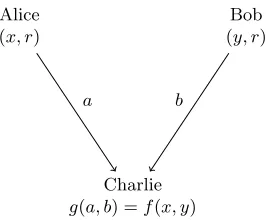
In light of the above, it makes sense to study the limitation of information theoretic secure computation in its simplest form. In [16] Feige, Kilian and Naor (hereinafter referred to as FKN) presented such a “Minimal Model for Secure Computation”. In this model, Alice and Bob hold private inputs,xandy, and they wish to let Charlie learn the value off(x, y) without leaking any additional information. The communication pattern is minimal. Alice and Bob each send to Charlie a single message,aandbrespectively, which depends on the party’s input and on a random string rwhich is shared between Alice and Bob but is hidden from Charlie. Given (a, b) Charlie should be able to recover f(x, y) without learning additional information. The parties are assumed to be computationally unbounded, and the goal is to minimize the communication complexity of the protocol (i.e., the total number of bits sent by Alice and Bob). Following [23], we refer to such a protocol as aprivate simultaneous message protocol (PSM).
Alice (x, r)
Bob (y, r)
Charlie
g(a, b) =f(x, y)
a b
Fig. 1.Schematic of a PSM protocol.
– (δ-Correctness) The protocol has correctness error ofδ if for every (x, y)∈ X × Y it holds that
Pr r←R$
[f(x, y)6=g(ΠA(x, r), ΠB(y, r))]≤δ
– (-Privacy) The protocol has privacy error of if for every pair of inputs (x, y)∈ X × Y and(x0, y0)∈ X × Y for whichf(x, y) =f(x0, y0)the random variables
(ΠA(x, r), ΠB(y, r)) and (ΠA(x0, r), ΠA(y0, r), (1)
induced by a uniform choice ofr← R$ , are-close in statistical distance.
We mainly consider perfectprotocols which enjoy both perfect correctness (δ= 0) and perfect privacy(= 0). We define the communication complexityof the protocol to be log|A|+ log|B|.
The correctness and privacy conditions assert that, for every pair of inputs (x, y) and (x0, y0), the transcript distributions are either close to each other when
f(x, y) =f(x0, y0), or far apart whenf(x, y)6=f(x0, y0). Hence, the joint compu-tation of Alice and Bob,Cr(x, y) = (ΠA(x, r), ΠB(y, r)), can be also viewed as a “randomized encoding” [24, 5] (or “garbled version”) of the functionf(x, y) that has the property of being 2-decomposable into anx-part and ay-part. Being es-sentially non-interactive, such protocols (and their multiparty variants [23]) have found various applications in cryptography (cf. [22, 2]). Moreover, it was shown in [9, 6] that PSM is the strongest model among several other non-interactive models for secret-sharing and zero-knowledge proofs.
somewhat weak but still non-trivial since an insecure solution (in which Alice and Bob just send their inputs to Charlie) costs 2k bits of communication. The question of improving this lower-bound is an intriguing open problem. In this paper, we aim for a more modest goal. Inspired by the general theory of communication complexity, we ask:
How does the PSM complexity of a functionf relate to its combinatorial properties? Is there a “simple” condition that guarantees a non-trivial lower-bound on the PSM complexity?
We believe that such a step is necessary towards proving stronger lower-bounds. Additionally, as we will see, this question leads to several interesting insights for related information-theoretic tasks.
1.2 Revisiting the FKN lower-bound
Our starting point is the original proof of the 3k lower-bound from [16]. In order to prove a lower-bound FKN relax the privacy condition by requiring that Charlie will not be able to recover the last bit of Alice’s input. Formally, let us denote by ¯xthe string obtained by flipping the last bit of x. Then, the privacy condition (Eq. 1) is relaxed to hold only over sibling inputs (x, y) and (¯x, y) for which f(x, y) = f(¯x, y). We refer to this relaxation as weak privacy. Since (standard) privacy implies weak privacy, it suffices to lower-bound the communication complexity of weakly private PSM protocols.
To prove a lower-bound for random functions, FKN (implicitly) identify three conditions which hold for most functions and show that if a function
f : {0,1}k × {0,1}k → {0,1} satisfies these conditions then any weak PSM forf has communication complexity of at least 3k−O(1). The FKN conditions are:
1. The function f is non-degenerate, namely, for every x6= x0 there exists y
for whichf(x, y)6=f(x0, y) and similarly, for everyy6=y0 there existsxfor whichf(x, y)6=f(x, y0).
2. The function is useful in the sense that for at least 12−o(1) of the inputs (x, y) it holds that f(x, y) =f(¯x, y) where ¯xdenotes the string xwith its last bit flipped. (An input (x, y) for which the equation holds is referred to as beinguseful.4)
3. We say that (x1, . . . , xm)×(y1, . . . , yn) is acomplement similar rectangle of
f iff(xi, yj) =f(¯xi, yj) for every 1≤i≤mand 1≤j≤n. Then,f has no complement similar rectangle of sizemnlarger thanM = 2k+1. Equivalently, the function f0(x, y) = f(x, y)−f(¯x, y), which can be viewed as a partial derivative off with respect to its last coordinate, has no 0-monochromatic rectangle of sizeM.
We observe that the above conditions are, in fact, insufficient to prove a non-trivial lower-bound. As a starting point, we note that the inner-product function
4
has low PSM complexity and has no large monochromatic rectangles. While the inner-product function cannot be used directly as a counterexample (since it has huge complement similar rectangles), we can construct a related function
f such that: (1) the derivative f0 is (a variant of) the inner product function and so f0 has no large monochromatic rectangles; and (2) by applying some local preprocessing on Alice’s input, the computation of f(x, y) reduces to the computation of the inner product function. Altogether, we prove the following theorem (see Section 3).
Theorem 1 (FKN counterexample). There exists a functionf : {0,1}k×
{0,1}k→ {0,1} that satisfies the FKN conditions but has a (standard) PSM of communication complexity of 2k+O(1).
Let us take a closer look at the proof of the FKN lower-bound to see where the gap is. The FKN proof boils down to showing that the setSrof all possible transcripts (a, b) sent by Alice and Bob under a random stringr, has relatively small intersection with the setSr0 of all possible transcripts (a, b) sent by Alice and Bob under a different random string r0. Such a collision,c = (a, b)∈Sr∩
Sr0, is counted as a trivial collision if the inputs (x, y) that generate c under
r are the same as the inputs (x0, y0) that generate c under r0. Otherwise, the collision is counted as non-trivial. The argument mistakenly assumes that all non-trivial collisions are due to sibling inputs, i.e., (x0, y0) = (¯x, y). In other words, it is implicitly assumed that the transcript (a, b) fully reveals all the information about (x, y) except for the last input ofx. (In addition to the value of f(x, y) which is revealed due to the correctness property.) More formally, a weakly private fully revealing PSM Π = (ΠA, ΠB, g) for a functionf :{0,1}k×
{0,1}k → {0,1} is a perfect PSM for the function f0 : {0,1}k × {0,1}k →
{0,1}k−1× {0,1}k× {0,1}that takes (x, y) and outputs (x[1 :k−1], y, f(x, y)), wherex[1 :k−1] is the (k−1)-prefix ofx. (See also Definition 4.)
We show that the original FKN argument holds if one considers fully-revealing PSM protocols. (See Theorem 8 for a slightly stronger version.)
Theorem 2 (LB’s against weakly private fully revealing PSM). Let f :
{0,1}k× {0,1}k → {0,1} be a non-degenerate function. Let M be an upper-bound on size of the largest complement similar rectangle of f and let U be a lower-bound on the number of useful inputs of f. Then, any weakly-private fully-revealing PSM for f has communication complexity of at least 2 logU −
logM−O(1). In particular, for all buto(1)fraction of the functionsf :{0,1}k×
{0,1}k→ {0,1}, we get a lower-bound of 3k−O(1).
A lower-bound of c bits against fully-revealing weakly-private PSM easily yields a lower-bound ofc−2k+ 1 bits for PSM. (Since a standard PSM can be turned into a fully-revealing weakly-private PSM by letting Alice/Bob append
expensive than standard PSM. Nevertheless, as we will see in Section 1.4, lower-bounds for fully-revealing weakly-private PSM have useful implications for other models.
1.3 Fixing the PSM lower-bound
We show that the FKN argument can be fixed by posing stronger requirements onf. Roughly speaking, instead of limiting the size of complement similar rect-angles, we limit the size of any pair ofsimilarrectangles by a parameterM. That is, if the restriction off to the ordered rectangleR= (x1, . . . , xm)×(y1, . . . , y`) is equal to the restriction of f to the ordered rectangle R0 = (x01, . . . , x0m)×
(y10, . . . , y0`) and the rectangles are disjoint in the sense that either xi 6= x0i for everyi, oryj6=yj0 for everyj, then the sizem`ofRshould be at mostM. (See Section 2 for a formal definition.)
Theorem 3 (perfect-PSM LB’s). LetX,Y be sets of size at least 3, and let
f :X × Y → {0,1} be a non-degenerate function for which any pair of disjoint similar rectangles (R, R0) satisfies |R| ≤M. Then, any perfect PSM for f has communication of at least 2(log|X |+ log|Y|)−logM −2.
The theorem is proved by a distributional version of the FKN argument which also implies Theorem 2. (See Section 4.) As a corollary, we recover the original lower-bound claimed by FKN.
Corollary 1. For a 1−o(1) fraction of the functions f : {0,1}k × {0,1}k →
{0,1} any perfect PSM protocol for f requires 3k−2 logk−O(1) bits of total communication.5
Proof. It is not hard to verify that 1−o(1) fraction of all functions are non-degenerate. In Section 6 we further show that, for 1−o(1) of the functions, any pair of disjoint similar rectangles (R, R0) satisfies|R| ≤k2·2k. The proof follows
from Theorem 3. ut
By partially de-randomizing the proof, we show that the above lower-bound applies to a function that is computable by a family of polynomial-size cir-cuits, or, under standard complexity-theoretic assumptions, by a polynomial-time Turing machine. This resolves an open question of Data, Prabhakaran and Prabhakaran [15] who proved a similar lower-bound for an explicit non-boolean functionf :{0,1}k× {0,1}k→ {0,1}k−1. Prior to our work, we could not even rule out the (absurd!) possibility that all efficiently computable functions admit a perfect PSM with communication of 2k+o(k).
Theorem 4. There exists a sequence of polynomial-size circuits
f =fk:{0,1}k× {0,1}k → {0,1}
5
such that any perfect PSM forfk has communication complexity of at least3k−
O(logk)bits. Moreover, assuming the existence of a hitting-set generator against co-nondeterministic uniform algorithms, f is computable by a polynomial-time Turing machine.6
Remark 1 (On the hitting-set generator assumption). The exact definition of a hitting-set generator against co-nondeterministic uniform algorithms is post-poned to Section 6. For now, let us just say that the existence of such a generator follows from standard Nissan-Wigderson type complexity-theoretic assumptions. In particular, it suffices to assume that the class Eof functions computable in 2O(n)-deterministic time contains a function that has no sub-exponential non-deterministic circuits [28], or, more liberally, that some function in E has no sub-exponential time Arthur-Merlin protocol [21]. (See also the discussion in [7].)
Lower-bounds for imperfect PSM’s. We extend Theorem 3 to handle imperfect PSM protocols by strengthening the non-degeneracy condition and the non self-similarity condition. This can be used to prove an imperfect version of Corollary 1 showing that, for almost all functions, an imperfect PSM with correctness error
δand privacy errormust communicate at least
min{3k−2 log(k),2k+ log(1/),2k+ log(1/δ)} −O(1)
bits. An analogous extension of Theorem 4, yields a similar bound for an explicit function. (See Section 5.)
1.4 Applications to Conditional Disclosure of Secrets
We move on to the closely related model of Conditional Disclosure of Secrets (CDS) [18]. In the CDS model, Alice holds an input xand Bob holds an input
y, and, in addition, Alice holds a secret bits. The referee, Charlie, holds both
xandy, but does not know the secret s. Similarly to the PSM case, Alice and Bob use shared randomness to compute the messages aand b that are sent to Charlie. The CDS requires that Charlie can recover sfrom (a, b) if and only if the predicatef(x, y) evaluates to one.7
Definition 2 (Conditional Disclosure of Secrets).Aconditional disclosure of secrets(CDS) protocolΠ = (ΠA, ΠB, g)for a predicatef :X ×Y → {0,1}and domainS of secrets is a triple of functionsΠA:X ×S ×R → A,ΠB:Y ×R → B andg:X × Y × A × B → S that satisfy the following two properties:
6 It is worth mentioning that the proof of Theorem 4 strongly relies on the explicit combinatorial condition given in Theorem 3 (and we do not know how to obtain it directly from Corollary 1). This illustrates again the importance of relating PSM complexity to other more explicit properties of functions.
1. (Perfect Correctness) For every (x, y)that satisfies f and any secret s∈ S
we have that:
Pr r←R$
[g(x, y, ΠA(x, s, r), ΠB(y, r))6=s] = 0.
2. (Perfect Privacy) For every input(x, y)that does not satisfyf and any pair of secretss, s0∈ S the distributions
(x, y, ΠA(x, s, r), ΠB(y, r)) and (x, y, ΠA(x, s0, r), ΠB(y, r)),
induced byr← R$ are identically distributed.
The communication complexity of the CDS protocol is (log|A|+ log|B|) and its randomness complexity is log|R|. By default, we assume that the protocol supports single-bit secrets (S={0,1}).8
Intuitively, CDS is weaker than PSM since it either releases s or keeps it private but it cannot manipulate the secret data.9 Still, this notion has found useful applications in various contexts such as information-theoretically private information retrieval (PIR) protocols [14], priced oblivious transfer protocols [1], secret sharing schemes for graph-based access structures (cf. [11, 12, 31]), and attribute-based encryption [20, 29].
The communication complexity of CDS. In light of the above, it is interesting to understand the communication complexity of CDS. Protocols with commu-nication of O(t) were constructed for t-size Boolean formula by [18] and were extended tot-size (arithmetic) branching programs by [25] and tot-size (arith-metic) span programs by [6]. Until recently, the CDS complexity of a general predicatef :{0,1}k× {0,1}k → {0,1} was no better than its PSM complexity, i.e., O(2k/2) [9]. This was improved to 2O(√klogk)by Liu, Vaikuntanathan and Wee [27]. Moreover, Applebaum et al. [4] showed that, for very long secrets, the amortized complexity of CDS can be reduced toO(logk) bits per bit of secret. Very recently, the amortized cost was further reduced to O(1) establishing the existence of general CDS with constant rate [3].
Lower-bounds for the communication complexity of CDS were first estab-lished by Gay, Kerenidis, and Wee [17]. Their main result shows that the CDS communication of a predicatef is at least logarithmic in its randomized one-way communication complexity, and leads to anΩ(logk) lower-bound for several ex-plicit functions. Applebaum et al. [4] observed that weakly private PSM reduces to CDS. This observation together with the 3k-bit FKN lower-bound for weakly
8 One may consider imperfect variants of CDS. In this paper we restrict our attention to the (more common) setting of perfect CDS.
private PSM has lead to a CDS lower-bound ofk−o(k) bits for some non-explicit predicate. (The reduction loses about 2k bits.)
In this paper, we further exploit the connection between CDS and PSM by observing that CDS protocols for a predicate h(x, y) give rise to weakly private fully revealing PSM for the function f((x◦s), y) = h(x, y)∧s, where
◦ denotes concatenation. By using our lower-bounds for weakly private fully revealing PSM’s we get the following theorem. (See Section 7 for a proof.)
Theorem 5. Let h : X × Y → {0,1} be a predicate. Suppose that M upper-bounds the size of the largest 0-monochromatic rectangle ofhand that for every
x∈ X, the residual functionh(x,·)is not the constant zero function. Then, the communication complexity of any perfect CDS forhis at least
2 log|f−1(0)| −logM −log|X | −log|Y| −1,
where|f−1(0)|denotes the number of inputs (x, y) that are mapped to zero.
Unlike the non-explicit lower-bound of [4], the above theorem provides a simple and clean sufficient condition for proving non-trivial CDS lower-bounds. For example, we can easily show that a random function has at least linear CDS complexity.
Corollary 2. For all but ao(1)fraction of the predicatesh:{0,1}k× {0,1}k →
{0,1}, any perfect CDS forhhas communication of at leastk−4−o(1).
Proof. Let h: {0,1}k× {0,1}k → {0,1} be a randomly chosen predicate. Let
K= 2kand let= 1/√K. There are exactly 2K·2K= 22Krectangles. Therefore, by a union-bound, the probability of having a 0-monochromatic rectangle of size
M = 2K(1 +) is at most
22K·2−M = 2−2K = 2−Ω( √
K).
Also, since h has K2 inputs, the probability of having less than (1
2 −)·K 2 unsatisfying inputs is, by a Chernoff bound, 2−Ω(2K2) = 2−Ω(K). Finally, by the union bound, the probability that there exists x ∈ X for which h(x,·) is the all-zero function is at most K·2−K. It follows, by Theorem 5, that with probability of 1−2−Ω(
√
K), the function h has a CDS complexity of at least
k−4−o(1). ut
We can also get lower-bounds for explicit functions. For example, Gay et al. [17] studied the CDS complexity of the binary inner product functionh(x, y) =
hx, yi. They proved an upper-bound ofk+ 1 bits and a lower-bound ofΩ(logk) bits, and asked as an open question whether a lower-bound of Ω(k) can be es-tablished. (The question was open even for the special case of linear CDS for which [17] proved anΩ(√k) lower-bound). By plugging the inner-product pred-icate into Theorem 5, we conclude:
Proof. It suffices to prove the lower bound for the restriction of inner-product in whichx6= 0n. It is well known (cf. [26]) that the largest monochromatic rectangle is of sizeM = 2k, and the number of “zero” inputs is exactlyS= 22k−1−2k−1. Hence, Theorem 5 yields a lower-bound ofk−3−o(1). ut
This lower-bound matches the k+ 1 upper-bound up to a constant additive difference (of 4 bits). It also implies that in any ABE scheme for the inner-product function which is based on the dual system methodology [32] either the ciphertext or the secret-key must be of lengthΩ(k). (See [17] for discussion.)
Organization. Following some preliminaries (Section 2), we present the counter example for the FKN lower-bound (Section 3). We then analyze the communi-cation complexity of perfect PSM (Section 4) and imperfect PSM (Section 5). Based on these results, we obtain PSM lower-bounds for random and explicit functions (Section 6), as well as CDS lower-bounds (Section 7).
Acknowledgement. We are grateful to the reviewers of Eurocrypt 2018 and the Journal of Cryptology for the helpful and valuable comments on our manuscript. We especially thank the anonymous JOC referee for detecting a flaw in the orig-inal proof of Claims 9 and 13. BA and MM are supported by the European Union’s Horizon 2020 Programme (ERC-StG-2014-2020) under grant agreement no. 639813 ERC-CLC, the Check Point Institute for Information Security, and the Blavatnik Interdisciplinary Cyber Research Center. OS and MM are sup-ported by ERC grant no. 639573.
2
Preliminaries
For a string (or a vector) xof lengthn, and indices 1 ≤i≤j ≤n, we let x[i] denote thei-th entry ofx, and letx[i:j] denote the string (x[i], x[i+1]. . . , x[j]). By convention, all logarithms are taken base 2.
Rectangles. LetX ⊂ {0,1}∗andY ⊂ {0,1}∗be some finite domains. (Typically, the set of all binary strings of some specified length.) An(ordered) rectangle of size m×noverX × Y is a pairρ= (x,y), wherex= (x1, . . . , xm)⊆ Xm and y= (y1, . . . , yn)⊆ Ynsatisfyxi6=xj andyi6=yjfor alli6=j. We say that (x, y) belongs toρifx=xiandy=yj for somei, j(or by abuse of notation we simply writex∈xandy∈y). The size of an (m×n)-rectangleρismn, and its density with respect to some probability distributionµoverX × Y, isP
x∈x,y∈yµ(x, y).
Letρ= (x,y) and ρ0 = (x0,y0) be a pair of (m×n)-rectangles. We say thatρ
and ρ0 arex-disjoint (resp., y-disjoint) if xi 6=x0i for all i∈ {1, . . . , m} (resp., if yj 6=yj0 for all j ∈ {1, . . . , n}). We say thatρ and ρ0 are disjoint if they are either x-disjoint ory-disjoint.
As an example, consider the three (2×3)-rectangles ρ1 = (1,2),(5,6,7)
,
ρ2 = (2,1),(6,5,4), and ρ3 = (1,3),(7,5,6). Among those, ρ1 and ρ3 are
ρ1 and ρ2 are both x-disjoint and y-disjoint. Therefore, each of these pairs is considered to be disjoint.
Iff :X × Y → Z is a function and ρa rectangle of sizem×n, we let f[ρ] be the matrix M of size m×n whose entry Mij is f(xi, yj). A rectangle ρ is 0-monochromatic (resp., 1-monochromatic) if f[ρ] is the all-zero matrix (resp., all-one matrix). A rectangle ρ is similar to a rectangle ρ0 (with respect to f) if f[ρ] = f[ρ0]. A rectangle (x = (x1, . . . , xm),y) is complement similar if it is similar to the rectangle ((¯x1, . . . ,x¯m),y), where ¯xdenotes the stringxwith its last bit flipped.
Probabilistic notation. We will use calligraphic lettersA,B, . . . , to denote finite sets. Lower case letters denote values from these sets, i.e., x∈ X. Upper case letters usually denote random variables (unless the meaning is clear from the context).
Given two random variablesAandBover the same setA, we usekA−Bkto denote theirstatistical distancekA−Bk=12P
a∈A|Pr[A=a]−Pr[B=a]|. The min-entropy ofA, denoted byH∞(A), is minus the logarithm of the probability of the most likely value of A, i.e.,−log maxa∈APr[A=a].
3
A Counterexample to the FKN lower-bound
LetT0,T1 be a pair of (k−1)×(k−1) non-singular matrices (over the binary fieldF= GF[2]) with the property thatT=T0+T1is also non-singular. (The existence of such matrices is guaranteed via a simple probabilistic argument.10) Define the mapping L:Fk →Fk by
x7→(Tx[k]·x[1 :k−1])◦x[k],
where ◦ denotes concatenation. That is, if the last entry of x is zero then L
appliesT0 to the k−1 prefixx0=x[1 :k−1] and extends the resultingk−1 vector by an additional 0 entry, and ifx[k] = 1 then the prefixx0 is sent toT1x0
and the vector is extended by an additional 1 entry. Note that Lis a bijection (since T0,T1 are non-singular). The functionf :Fk×Fk→Fis defined by
(x, y)7→ hL(x), yi,
whereh·,·idenotes the inner-product function overF.
In Section 3.1, we will prove thatf satisfies the FKN conditions (described in Section 1.2).
10
Whenk−1 is even, there is a simple deterministic construction: TakeT0 (resp.,T1) to be the upper triangular matrix (resp., lower triangular matrix) whose entries on and above main diagonal (resp., on and below the diagonal) are ones and all other entries are zero. It is not hard to verify that both matrices are non-singular. Also
Lemma 1. The functionf is (1) non-degenerate, (2) useful, and (3) its largest complement similar rectangle is of size at mostM = 2k+1.
Recall that f is non-degenerate if for every distinct x6=x0 (resp., y 6=y0) the residual functions f(x,·) and f(x0,·) (resp., f(·, y0) and f(·, y0)) are distinct. It is useful if Prx,y[f(x, y) = f(¯x, y)] ≥ 1
2, where ¯x denotes the string x with its last entry flipped. Also, a rectangle R = (x,y) is complement similar if
f(x, y) =f(¯x, y) for every x∈x, y∈y.
In Section 3.2 we will show thatf admits a PSM with communication com-plexity of 2k+O(1).
Lemma 2. The functionf has a PSM protocol with communication complexity of 2k+ 2.
Theorem 1 follows from Lemma 1 and Lemma 2.
3.1 f satisfies the FKN properties (Proof of Lemma 1)
(1)f is non-degenerate. Fixx16=x2∈Fkand observe thatL(x1)6=L(x2) (since
L is a bijection). Therefore there exists y for which f(x1, y) = hL(x1), yi 6=
hL(x2), yi = f(x2, y). (In fact this holds for half of y’s). Similarly, for every
y16=y2 there exists v∈Fk for whichhv, y1i 6=hv, y2i, and sinceLis a bijection we can takex=L−1(v) and get thatf(x, y1) =hv, y1i 6=hv, y2i=f(x, y2).
(2)f is useful. Choosex0←$ Fk−1andy←$ Fk and observe thatf(x0◦0, y) =
f(x0◦1, y) if and only if
hTx0, y[1 :k−1]i+yk = 0,
which happens with probability 12.
(3) The largest complement similar rectangle is of size at most 2k+1. Fix some rectangle R = (x,y), where x= (x1, . . . , xm) ∈(Fk)m and y = (y1, . . . , yn)∈ (Fk)n. We show that if R is complement similar then mn ≤2·2k. Since R is complement similar for everyx∈x, y∈yit holds
f(x, y) =f(¯x, y),
which by definition off implies that
hTx0◦1, yi= 0,
wherex0 is the (k−1) prefix ofx. Letdbe the dimension of the linear subspace spanned by the vectors inx, and som≤2d. SinceThas full rank, the dimension of the subspaceV spanned by{(Tx[1 :k−1]◦1) :x∈x} is at leastd−1. (We may lose 1 in the dimension due to the removal of the last entry of the vectors
x ∈ x.) Noting that every y ∈ y is orthogonal to V, we conclude that the dimension of the subspace spanned byy is at mostk−(d−1). It follows that
3.2 PSM for f (Proof of Lemma 2)
Note that f can be expressed as applying the inner product to v and y where
v can be locally computed based on x. Hence it suffices to construct a PSM for the inner-product function and let Alice compute v and apply the inner-product protocol to v. (This reduction is a special instance of the so-called substitution lemma of randomize encoding, cf. [22, 2].) Lemma 2 now follows from the following lemma.
Lemma 3. The inner product function hip :Fk×Fk →Fhas a PSM protocol with communication complexity of2k+ 2.
A proof of the lemma appears11 in [27, Corollary 3]. For the sake of self-containment we describe here an alternative proof.
Proof. We show a PSM Π = (ΠA, ΠB, g) with communication 2k under the promise that the inputs of Alice and Bob, x, y, are both not equal to the all zero vector. To get a PSM for the general case, let Alice and Bob locally extend their inputs x, y to k+ 1-long inputs x0 =x◦1 and y0 =y◦1. Then run the protocolΠ and at the end let Charlie flip the outcome. It is easy to verify that the reduction preserves correctness and privacy. Since the inputs are longer by a single bit the communication becomes 2(k+ 1) as promised.
We move on to describe the protocolΠ. The common randomness consists of a random invertible matrixR∈Fk×k. Given non-zero x∈Fk, Alice outputs
a=Rxwhere xis viewed as a column vector. Bob, who holdsy ∈Fk, outputs
b=yTR−1. Charlie outputsba.
Prefect correctness is immediate: (yTR−1)·(Rx) = yTx, as required. To prove perfect privacy, we use the following claim.
Claim 6. Let x, y∈ Fk be non-zero vectors and denote their inner-product by
z. Then, there exists an invertible matrix M ∈ Fk×k for which Me1 =x and
vzTM−1 =yT whereei is the i-th unit vector, and vz is taken to be e1 if z= 1 andek ifz= 0.
Proof. Let us first rewrite the conditionvTzM−1=yT asvzT =yTM. LetV ⊂Fk be the linear subspace of all vectors that are orthogonal to y. Note that the dimension ofV isk−1. We distinguish between two cases based on the value of
z.
Suppose thatz= 0, that is,x∈V andvz=ek. Then set the first column of M to be xand choose the next k−2 columnsM2, . . . ,Mk−1 so that together withxthey form a basis for V. Let the last columnMk be some vector outside
V. Observe that the columns are linearly independent and so M is invertible. Also, it is not hard to verify thatMe1=xand that yTM=eTk.
Next, consider the case wherez= 1, that is,x /∈V andvz=e1. Then, take M1 =xand let the other columns M2, . . . ,Mk to be some basis for V. Since
x is non-zero the columns of M are linearly independent. Also, Me1 =x and
yTM=eT
1. The claim follows. ut
11
We can now prove perfect privacy. Fix some non-zero x, y ∈ Fk and let
z=hx, yi. We show that the joint distribution of the messages (A, B) depends only onz. In particular, (A, B) is distributed identically to (Re1, vTbR
−1) where R a random invertible matrix. Indeed, letting M be the matrix guaranteed in Claim 6 we can write
(Rx, yTR−1) = (R(Me1),(vTzM−1)R−1).
Noting that T = RM is also a random invertible matrix (since the the set of invertible matrices forms a group) we conclude that the RHS is identically
distributed toTe1, vzTT−1, as claimed. ut
Remark 2. Overall the PSM for f has the following form: Alice sends a=R·
(L(x)◦1) and Bob sendsb= (y◦1)TR−1where R∈
F(k+1)×(k+1)is a random invertible matrix. The privacy proof shows that if the input (x, y) is mapped to (a, b) for some R then for every (x0, y0) for whichf(x, y) = f(x0, y0), there existsR0 under which the input (x0, y0) is mapped to (a, b) as well. Hence, there are collisions between non-sibling inputs. As explained in the introduction, this makes the FKN lower-bound inapplicable.
4
Lower bound for perfect PSM protocols
In this Section we will prove a lower bound for perfect PSM protocols.
Definition 3. For a functionf :X ×Y → Zand distributionµover the domain
X × Y with marginalsµA andµB, define
α(µ) = max (R1,R2)
min(µ(R1), µ(R2)),
where the maximum ranges over all pairs of similar disjoint rectangles(R1, R2). We also define
β(µ) = min
z Pr[ (X, Y)6= (X
0, Y0)|f(X, Y) =f(X0, Y0) =z],
where(X, Y)and(X0, Y0)represent two independent samples fromµ, and min-imum is taken over all z’s in the support of f(X, Y). Finally, we say that f is non-degenerate with respect toµ if for every x6=x0 in the support of µA there exists somey∈ Y for which f(x, y)6=f(x0, y), and similarly for everyy6=y0 in the support ofµB there exists somex∈ X for whichf(x, y)6=f(x, y0).
In Section 4.1, we prove the following key lemma.
Lemma 4. Let f : X × Y → Z. Then the communication complexity of any perfect PSM protocol is at least
max
µ log(1/α(µ)) +H∞(µ)−log(1/β(µ))−1,
where the maximum is taken over all (not necessarily product) distribution µ
The lower-bound is meaningful as long as β is not too small. Intuitively, this makes sure that the privacy requirement (which holds only over inputs on which the function agrees) is not trivial to achieve underµ.
For the special case of a Boolean functionf, we can use the uniform distri-bution over X × Y and prove Theorem 3 from the introduction (restated here for the convenience of the reader).
Theorem 7 (Thm 3 restated). Let X,Y be sets of size at least 3. Let f :
X × Y → {0,1} be a non-degenerate function for which any pair of disjoint similar rectangles (R, R0) satisfies |R| ≤M. Then, any perfect PSM for f has communication of at least 2(log|X |+ log|Y|)−logM −2.
Proof. By the key lemma (Lemma 4), it suffices to show that, for the uniform distributionµ, we have
α(µ)≤M/(|X ||Y|), H∞(µ) = log|X |+ log|Y|, andβ(µ)≥1/2.
The first two inequalities are immediate. The third inequality follows by noting that for every possible outcomez∈ {0,1},
Pr[ (X, Y)6= (X0, Y0)|f(X, Y) =f(X0, Y0) =z] = 1− 1
Nz
≥1− 1
|X | −1 ≥1/2,
whereNz is the number of preimages ofz underf. The inequalityNz≥ |X | −1 follows by observing that ifNz≤ |X | −2, then there must be a pairx6=x0 for which the restricted functions f(x,·) and f(x0,·) are both equal to 1−z. This
contradicts the non-degeneracy off. ut
We note that the additive constant 2 in the theorem statement can be replaced by 1 +ok(1) when the size of the domainX × Y grows withk.
Weakly private fully revealing PSM. We can also derive a lower-bound on the communication complexity of weakly private fully revealing PSM. We begin with a formal definition.
Definition 4 (Weakly Private Fully Revealing PSM). A weakly private fully revealing PSMΠ = (ΠA, ΠB, g)for a functionf :{0,1}k1×{0,1}k2 → Zis a perfect PSM for the functionf0:{0,1}k1× {0,1}k2 → {0,1}k1−1× {0,1}k2× Z
that takes (x, y)and outputs (x[1 :k1−1], y, f(x, y)), where x[1 :k1−1]is the (k1−1)-prefix of x.
In the following, we say thatf is weakly non-degenerateif for every xthere exists y such that f(x, y) 6= f(¯x, y). Recall that an input (x, y) is useful if
f(x, y) =f(¯x, y). We prove the following (stronger) version of Theorem 2 from the introduction.
Theorem 8. Let f : {0,1}k1 × {0,1}k2 → {0,1} be a weakly non-degenerate
rectangle of f and let U be a lower-bound on the number of useful inputs of f. Then, any weakly-private fully-revealing PSM forf has communication complex-ity of at least2 logU−logM−2. In particular, for all but ano(1)fraction of the predicates f :{0,1}k× {0,1}k→ {0,1} we get a lower-bound of 3k−4−o(1).
Proof. Letf0 be the function defined in Definition 4 based onf. We will prove a lower-bound on the communication complexity of any perfect PSM forf0. Let
µ be the uniform distribution over the set of useful inputs. Since f is weakly non-degenerate the function f0 is non-degenerate underµ. The first part of the theorem follows from Lemma 4 by noting that
α(µ)≤M/U, β(µ) = 1/2, and H∞(µ)≥logU.
Indeed, the bound onαfollows by noting that the complement similar rectangles are the only similar disjoint rectangles, and the bound on β follows by noting that everyzin the support off0(µ) has exactly two preimages for whichµassigns equal weights.
To prove the second (“in particular”) part observe that, for a random function
f, each pair of inputs (x, y) and (¯x, y) gets the samef-value with probability 12 independently of other inputs. Hence, with all buto(1) probability, a fraction of
1
2−o(1) of all 2
2k−1of the pairs is mapped to the same value, and so there will be 22k−1(1−o(1)) useful inputs. (Since each successful pair contributes two useful inputs.) Also, each M-size rectangle R is complement similar with probability 2−M. By taking a union bound over all 22k+1 rectangles, we conclude thatf has an M = 2k+1(1 +o(1))-size complement similar rectangle with probability at most 22k+1−M =o(1). We conclude that, all but ano(1) fraction of the functions, do not have weakly-private fully-revealing PSM with complexity smaller than
3k−4−o(1). ut
A direct combinatorial proof of this theorem (based on the FKN argument) appears in Appendix A.
4.1 Proof of the Key Lemma (Lemma 4)
Fix some functionf :X × Y → Z and letΠ = (ΠA, ΠB, g) be a perfect PSM protocol forf. Letµdenote some distribution over the domainX ×Yand assume that f is non-degenerate with respect to µ.
To simplify notation somewhat, we define the following events:
P(=):≡(A=A0)∧(B=B0)
I(=):≡(X =X0)∧(Y =Y0)
I(6=):≡(X 6=X0)∨(Y 6=Y0)≡ ¬I(=)
F(=):≡f(X, Y) =f(X0, Y0)
(The notationP is chosen to indicate equivalence/inequivalence ofProtocol mes-sage andIto indicate equivalence/inequivalence of theInputs.) Our lower-bound follows from the following claims.
Claim 9. The communication complexity ofΠis at leastlog(1/Pr[I(6=)∧P(=)])− log(1/β).
Proof. We upper-bound the collision probability Pr[(A, B) = (A0, B0)] of two random executions by showing that
Pr[P(=)]≤ Pr[I(6=)∧ P (=)]
β . (2)
Because the collision probability of two independent instances of a random variable is at least the inverse of the alphabet size, the alphabet of A and B
must have size at leastβ/Pr[I(6=)∧ P(=)]. Thus, in total the protocol requires
log(1/Pr[I(6=)∧ P(=)])−log(1/β)
bits of communication.
We move on to prove (2). That is, we show that Pr[I(6=)∧ P(=)] is at least
βPr[P(=)]. First, by perfect correctnessP(=)happens only whenF(=)happens, hence
Pr[I(6=)∧ P(=)] = Pr[I(6=)∧ P(=)∧ F(=)] = Pr[I(6=)∧ P(=)| F=] Pr[F=].
Denoting byF=z the eventf(X, Y) =f(X0, Y0) =z, the RHS equals to
X
z
Pr[I(6=)∧ P(=)| F=z] Pr[F=z], (3)
where the sum ranges over all z’s in the supportZ off(X, Y). Below we argue that, by perfect privacy, for every z ∈ Z, the conditional random variables [I(6=)| F=z] and [P(=)| F=z] are statistically independent. Hence, (3) equals to
X
z
Pr[I(6=)| F=z] Pr[P(=)| F=z] Pr[F=z]≥X
z
βPr[P(=)| F=z] Pr[F=z]
=βPr[P(=)],
It remains to show that, for every z ∈ Z, the conditional random vari-ables [I(6=) | F=z] and [P(=) | F=z] are statistically independent. To see this, note that by privacy, for every fixing of (X, Y, X0, Y0) to (x, y, x0, y0) for which
f(x, y) =f(x0, y0) =z, the distribution of the random variables [(A, B, A0, B0)|
X =x, Y = y, X0 =x0, Y0 =y0] remains the same regardless of the values of (x, y, x0, y0). Hence, conditioning onF(=z), the random variable (A, B, A0, B0) is independent of (X, Y, X0, Y0), which implies that [I(6=)| F=z] and [P(=)| F=z] are statistically independent. This completes the proof of Claim 9. ut
Claim 10. For any pair of stringsr andr0,
Pr[P(=)∧ I(6=)|R=r, R0 =r0]≤2α(µ)2−H∞(µ).
Proof. We see that
Pr
P(=)∧ I(6=)|R=r∧R0=r0]≤Pr
P(=)∧(X 6=X0)|R=r∧R0=r0] + Pr
P(=)∧(Y 6=Y0)|R=r∧R0=r0].
Due to symmetry it suffices to bound the first summand byα(µ)2−H∞(µ). Say thatxcollides withx0ifΠA(x, r) =ΠA(x0, r0). Restricting our attention to x’s in the support of µA, we claim that everyx can collide with at most a singlex0. Indeed, if this is not the case, thenΠA(x, r) =ΠA(x0, r0) =ΠA(x00, r0). The second equality implies that when the randomness is r0, for every y, the messages (a, b) communicated under (x0, y) are equal to the ones communicated under (x00, y). By perfect correctness, this implies that f(x0, y) = f(x00, y) for every y, contradicting the non-degeneracy of f underµ. Analogously, let us say that y collides withy0 ifΠ
B(y, r) =ΠB(y0, r0). The same reasoning shows that every yin the support of µB can collide with at most a singley0 in the support ofµB.
Letx= (x1, . . . , xm) andx0 = (x01, . . . , x0m) be a complete list of entries for which xi collides withx0i and xi 6=x0i andµA(xi), µA(x0i)>0. Analogously let y = (y1, . . . , yn) and y0 = (y10, . . . , yn0) be a complete list for whichyi collides with y0i and µB(yi), µB(yi0) > 0. (Note that we do not require yi 6=y0i.) Since collisions are unique (as explained above), the tuples x,x0,y,y0 are uniquely determined up to permutation.
By definition, the tuples (x, y, x0, y0) with x 6= x0, and (a, b) = (a0, b0) are exactly those of the form (xi, yj, x0i, y0j) for someiandj.
Now, consider the twox-disjoint rectanglesρ= (x,y) and ρ0 = (x0,y0) and assume, without loss of generality, thatµ(ρ)≤µ(ρ0). Since Alice and Bob both send the same messages with randomnessron inputs (xi, yj) as they send with randomnessr0 on inputsx0i, y0j, we see that it must be thatf(xi, yj) =f(x0i, y0j) if the protocol is correct. Therefore,f[ρ]=f[ρ0], and soµ(ρ)≤α(µ).
To complete the argument, note that P(=)∧(X 6= X0) can only happen if we pick (X, Y) = (xi, yj) and (X0, Y0) = (x0i, yj0) for some i, j. The event that there existsi, j for which (X, Y) = (xi, yj) has probability at mostα(µ). The event that (X0, Y0) = (x0i, y0j) for the same (i, j) has probability at most
Claim 10 implies that
Pr[P(=)∧ I(6=)] =X r,r0
Pr[P(=)∧ I(6=)|R=r, R0=r0] Pr[R=r, R0=r0]
≤X
r,r0
2α(µ)2−H∞(µ)Pr[R=r, R0=r0]
≤2α(µ)2−H∞(µ).
Combined with Claim 9, this yields Lemma 4. ut
5
Lower bounds for imperfect PSM protocols
In this section we prove a lower-bound on the communication complexity of imperfect PSM protocols. For this, we will have to strengthen the requirements from the functionf.
Definition 5. Let f :X × Y → Z.
– We callf somewhat regularif for every possible imagez∈ Z the number of preimagesf−1(z)is at least0.9|X |·|Y||Z| and at most1.1|X |·|Y||Z| .
– We callf strongly non-degenerate if for any x6=x0 we have |{y|f(x, y) =
f(x0, y)}| ≤ 0.9|Y| and for any y 6= y0 we have |{x|f(x, y) = f(x, y0)}| ≤
0.9|X |.
– A pair of orderedm×nrectanglesρ= (x,y)andρ0= (x0,y0)in which either
xi 6=x0i for all i ∈[m], oryi 6=y0i for alli ∈[n] are called approximately similarif for 0.99 of the pairs(i, j)we have f(xi, yj) =f(x0i, yj0).
(All the constants in the above definition are somewhat arbitrary and other constants may be chosen.)
In Section 5.1 we prove the following theorem:
Theorem 11. Letf :X ×Y → Zbe a somewhat-regular, strongly non-degenerate function whose largest approximately similar pair of rectangles is of size at most
M. Then, any PSM forfwith privacy error ofand correctness error ofδ < 1 100, requires at least
log|X |+ log|Y|+ min
log|X |+ log|Y| −logPr[F1(=)]
,
log|X |+ log|Y| −logM,
log(1/),
log(1/δ)−logPr[F1(=)]
−c (4)
In the special case of a Boolean functionf, it holds that Pr[F(=)] = Pr[f(X, Y) =
f(X0, Y0)]≥1/2, and the communication lower-bound simplifies to
log|X |+ log|Y|+ min{log|X |+ log|Y| −logM,log(1/),log(1/δ)} −c
wherecis some universal constant. In Section 6, we will use Theorem 11 to prove imperfect PSM lower-bounds for random functions and for efficiently computable functions.
5.1 Proof of Theorem 11
In the following, all random variables are defined as in Section 4 where µ is simply the uniform distribution overX × Y. In order to analyze protocols that are not perfectly private or perfectly correct, we first study the mistakes the protocol does in a few more details. Fix a PSM protocol Π = (ΠA, ΠB, g) for
f with correctness error ofδ <1/100 and privacy error of . We letβ(x, r) be the probability thatf(X, Y)6=g(A, B) conditioned on (X, R) = (x, r), and (by abuse of notation) define β(y, r) analogously. That is,
β(x, r) := Pr[f(X, Y)6=g(A, B)|(X, R) = (x, r)], β(y, r) := Pr[f(X, Y)6=g(A, B)|(Y, R) = (y, r)].
We then consider the event
Hδ:≡
β(X, R)≤5δ∧β(X0, R0)≤5δ∧β(Y, R)≤5δ∧β(Y0, R0)≤5δ.
Intuitively,Hδ occurs if what the players see is unlikely to produce an error.
Claim 12. Pr[Hδ]≥1 5. Proof. We compute
Pr[¬Hδ]≤2 Pr[β(X, R)>5δ∨β(Y, R)>5δ]
≤2 Pr[β(X, R)>5δ] + 2 Pr[β(Y, R)>5δ],
where we used the union bound. Because
Pr[f(X, Y)6=g(A, B)]≥Pr[β(X, R)>5δ]·Pr[f(X, Y)6=g(A, B)|β(X, R)>5δ]
>Pr[β(X, R)>5δ]·5δ,
and similarly for Pr[β(Y, R)>5δ], we get Pr[¬Hδ]≤4Pr[f(X,Y5)6=δ g(A,B)] ≤45. ut
Our main goal is to derive an upper-bound on the conditional probability Pr[P(=)|Hδ]. Since the event Hδ represents a restriction of the alphabets X,Y,R, the con-ditional collision probability Pr[P(=)|H
δ] is indicative of only a subset of the alphabetA × B. That is,
Pr[P(=)|Hδ]≥ 1
Therefore, an upper-bound on the conditional probability Pr[P(=)|H
δ] translates into a lower-bound on the communication complexity.
Now,
Pr[P(=)∧ H
δ] = Pr[P(=)∧ I(=)∧ Hδ] + Pr[P(=)∧ I(6=)∧ Hδ].
We upper-bound each of the two summands. In Section 5.3 we show that
Pr[P(=)∧ I(=)∧ Hδ]≤ 1 |X ||Y|
1.5
Pr[F(=)] ·
1
|X ||Y|+ 60δ
+
. (5)
In Section 5.4 we prove that
Pr[P(=)∧ I(6=)∧ Hδ]≤max˜c δ2
|X ||Y|,
M
|X |2|Y|2
, (6)
where ˜c is a universal constant. We conclude that
Pr[P(=)∧ H δ]≤
O(1)
|X ||Y|·max
1
|X ||Y|Pr[F(=)],
δ
Pr[F(=)], ,
M
|X ||Y|
.
Since Pr[Hδ]≥ 15, we get:
Pr[P(=)|H δ]≤
O(1)
|X ||Y|·max
1
|X ||Y|Pr[F(=)],
δ
Pr[F(=)], ,
M
|X ||Y|
Thus,
|A × B| ≥ 1
Pr[P(=)|H δ]
≥ |X ||Y| ·Ω
min
|X ||Y|Pr[F(=)],|X ||Y| M ,
Pr[F(=)]
δ ,
1
,
which proves Theorem 11. ut
5.2 A useful fact
The proofs of Equations (5) and (6) both exploit the non-degeneracy of f via the following simple fact.
Fact 13. Suppose that f is strongly non-degenerate and that (ΠA, ΠB, g) is a PSM for f. Suppose that there is a setx⊂ X of at least kdistinct inputs whose
A-message collide under some string r, that is, ΠA(x, r) = ΠA(x0, r) for any
x, x0∈x. Then, for at least k−1 of the inputsx∈x’s, the protocol conditioned on rerrs for at least 1/20fraction of they’s, i.e.,
Pr y←Y$
An analogues fact holds for collisions over theB-messages.
Proof. Assume, towards a contradiction, that there is a pair of distinct inputs
x6=x0∈x, for which
Pr y←Y$
[g(ΠA(x, r), ΠB(y, r))6=f(x, y)]<1/20,
and
Pr y←Y$
[g(ΠA(x0, r), ΠB(y, r))6=f(x0, y)]<1/20,
since ΠA(x, r) = ΠA(x0, r), we conclude that f(x, y) and f(x0, y) disagree on less than 0.1-fraction of the y’s, which contradicts the fact that f is strongly
non-degenerate. ut
5.3 Proof of Eq. (5)
Eq. (5) follows by combining the following two claims.
Claim 14. Suppose thatf is somewhat regular and that(ΠA, ΠB, g)is a PSM forf with privacy error of . Then,
Pr[P(=)∧ I(=)∧ Hδ]≤ 1
|X ||Y|
1.5 Pr[P(=)|F(=)] +.
Proof. First,
Pr[P(=)∧ I(=)∧ H
δ]≤Pr[I(=)∧ P(=)]
= Pr[I(=)] Pr[P(=)| I(=)]
= 1
|X ||Y|Pr[P
(=)| I(=)]. (7)
To establish the claim it suffices to show that
Pr[P(=)| I(=)]≤+ 1.5Pr[P(=)| F(=)]. (8)
By Bayes’ rule, we can rewrite (8) as
X
x,y
p(x, y)q(x, y)≤+ 1.5 X x,y
p0(x, y)q0(x, y)
!
. (9)
where
p(x, y) := Pr[P(=)| I(=),(X, Y) = (x, y)], q(x, y) := Pr[(X, Y) = (x, y)| I(=)],
and
In the remainder of the proof, we establish (9), by relating, for every (x, y), the value ofp(x, y) top0(x.y) and the value ofq(x, y) toq0(x, y).
First, observe that conditioning on I(=) does not affect the distribution of (X, Y), hence
∀(x, y) : q(x, y) = Pr[(X, Y) = (x, y)] = 1/N, (10)
whereN =|X | · |Y|. Also, lettingNz denote the number of preimages ofz∈ Z under f, it holds that
∀(x, y) : q0(x, y) =NPf(x,y) zNz2
≥ 0.9(N/|Z|) |Z|(1.1)2N2/|Z|2 =
0.9
(1.1)2N, (11)
where the inequality follows from the fact thatf is somewhat regular. (Recall that “somewhat regularity” just means that, for everyz,Nz∈[0.9|Z|N ,1.1|Z|N ].) By combining Equations (10),(11), we get that
∀(x, y) : q(x, y)≤(1.1)
2 0.9 q
0(x, y)<1.5q0(x, y). (12)
We will later use privacy to show that
∀(x, y) : p(x, y)≤p0(x, y) +. (13)
By combining Equations (12), and (13), we get
X
x,y
p(x, y)q(x, y)≤X
x,y
(p0(x, y) +)q(x, y)
=X
x,y
p0(x, y)q(x, y) +X
x,y
p0(x, y)
≤1.5 X x,y
p0(x, y)q0(x, y)
!
+,
and (9) follows.
It remains to prove (13). Since the eventP(=)is a function of (A, B, A0, B0), the difference|p(x, y)−p0(x, y)|is upper-bounded by the statistical distance
(A, B, A0, B0)|(X, Y) = (x, y),I(=)
−(A, B, A0, B0)|(X, Y) = (x, y),F(=)
. (14)
We show that, for every (x, y), (14) is at most . In fact, we prove a stronger statement: for every (x, y) and (x0, y0) for which f(x, y) =f(x0, y0), the random variable
[(A, B, A0, B0)|(X, Y) = (x, y),(X0, Y0) = (x, y)] is-close in statistical distance to
Indeed, in both cases the (A, B)-part is statistically independent of (A0, B0), and therefore the statistical distance is just the statistical distance between
[(A0, B0)|(X0, Y0) = (x, y)] and [(A0, B0)|(X0, Y0) = (x0, y0)]
which is at mostby-privacy. This completes the proof of the claim. ut
By Claim 14, in order to prove Eq. (5) it suffices to prove the following claim.
Claim 15. Supposef is strongly non-degenerate and(ΠA, ΠB, g)is a PSM with correctness error ofδ. Then,
Pr[P(=)|F(=)]≤ 1 Pr[F(=)]·
1
|X ||Y|+ 60δ
.
Proof. We definek(r, a) :=|{x|ΠA(x, r) =a}|andk(r, b) :=|{y|ΠB(y, r) =b}|, the number of inputs to the respective part of a protocol that map toa, respec-tively to b, for a fixed randomnessr.
We first bound Pr[P(=)]. Fix randomnessr,r0, andx, y, and leta=Π A(x, r),
b=ΠB(y, r). We see that
Pr[P(=)|R=r, R0=r0, X =x, Y =y] = k(r0, a)k(r0, b)
|X ||Y| .
We can write the RHS as
1
|X ||Y|+
(k(r0, a)−1)|Y| ·(k(r0, b)−1)|X |
|X |2|Y|2 +
(k(r0, a)−1)|Y|
|X ||Y|2 +
(k(r0, b)−1)|X | |X |2|Y| .
Thus, by lettingk(r, a, b) = max{(k(r, a)−1)|Y|,(k(r, b)−1)|X |}, we get
Pr[P(=)|R=r, R0=r0, X=x, Y =y]
≤ 1
|X ||Y|+
(k(r0, a, b))2
|X |2|Y|2 +
k(r0, a, b)
|X ||Y|2 +
k(r0, a, b)
|X |2|Y| . (15)
Becausef is strongly non-degenerate, we see that for any a,b, we have
Pr[f(X0, Y0)6=g(A0, B0)|R0=r0]
≥max
1 20·
(k(r0, a)−1)
|X | ,
1 20·
(k(r0, b)−1)
|Y|
= max
1
20·
(k(r0, a)−1)· |Y|
|X ||Y| ,
1 20·
(k(r0, b)−1)|X | |X ||Y|
= 1
20|X ||Y|k(r
0, a, b).
Indeed, if k(r0, a)>1, then by Fact 13, for at leastk(r0, a)−1 of the choices of
similarly, for the symmetric case wherek(r0, b)>1). Multiplying both sides by Pr[R0=r0] and summing up the inequalities over allr0, we get:
Pr[f(X0, Y0)=6 g(A0, B0)]≥ 1
20|X ||Y|E[k(R
0, a, b)].
Since the PSM isδ-correct, the LHS is at mostδ, and we get:
20δ≥ E(k(R
0, a, b))
|X ||Y| .
Plugging this into (15), and taking expectations overr, r0, x, y, we conclude that
Pr[P(=)]≤ 1
|X ||Y|+ 20δ+
20δ
|Y| +
20δ
|X |
≤ 1
|X ||Y|+ 60δ
Since Pr[P(=)|F(=)]≤Pr[P(=)]/Pr[F(=)], we get the claim. ut
5.4 Proof of Eq. (6)
Claim 16. Suppose that f is a strongly non-degenerate function whose largest approximately similar pair of rectangles is of size at most M, and assume that (ΠA, ΠB, g) is a PSM protocol for f with correctness error of δ < 1001 . Then, for any fixed choicer andr0 of the randomness, we have
Pr
P(=)∧ I(6=)∧ H
δ|R=r∧R0 =r0]≤max
˜
c δ
2
|X ||Y|,
M
|X |2|Y|2
,
wherec˜is some universal constant.
Proof. We see that Pr
P(=)∧ I(6=)∧ H
δ|R=r∧R0=r0] is at most
Pr
P(=)∧(X6=X0)∧ Hδ|R=r∧R0=r0] + PrP(=)∧(Y 6=Y0)∧ H
δ|R=r∧R0=r0]. Due to symmetry it suffices to bound the first summand.
As in the proof of the perfect case, we say thatxandx0 arecolliding (under
r andr0) ifΠA(x, r) =ΠA(x0, r0). We restrict our attention to inputsxandx0
for whichβ(x, r)≤5δ andβ(x0, r0)≤5δ.
Claim. Suppose that β(x, r)≤5δ. Thenxcan collide with at most a single x0
for whichβ(x0, r0)≤5δ.
Proof. If this is not the case, then there exist x0 6= x00 for which ΠA(x, r) =
ΠA(x0, r0) =ΠA(x00, r0) andβ(x0, r0), β(x00, r0)≤5δ. By Fact 13, eitherβ(x0, r0) or β(x00, r0) must be at least 201 which is larger than 5δforδ <1/100. Thus we
A similar conclusion for y, y0 ∈ Y, holds as well. That is, for everyy ∈ Y with
β(y, r) ≤ 5δ there exists at most a single y0 with β(y0, r0) ≤ 5δ for which a collision ΠB(y, r) =ΠB(y0, r0) occurs.
Let x = (x1, . . . , xn) and x0 = (x01, . . . , x0n) be a complete list of colliding elements for which all of the following hold for alli:
ΠA(xi, r) =ΠA(x0i, r
0) x
i6=x0i
β(xi, r)≤5δ, β(x0i, r0)≤5δ .
Analogously, let y = (y1, . . . , ym) and y0 = (y10, . . . , y0m) be a complete list of colliding elements for which
ΠB(yi, r) =ΠB(y0i, r0), β(yi, r)≤5δ, andβ(y0i, r0)≤5δ .
(In the latter case, pairs (yi, y0i) are allowed to be equal.) By definition, the resulting rectangles ρ= (x,y) and ρ0 = (x0,y0) are x-disjoint. Note that Alice and Bob both send the same messages with randomness r on inputs (xi, yj) as they send with randomness r0 on inputs x0i, yj0, for any (i, j). Also, by the above claim, the tuples x,x0,y,y0 are uniquely determined up to permutation. We conclude that the event P(=)∧(X 6= X0)∧ H
δ happens if and only if we pick (X, Y) = (xi, yj) fromρand (X0, Y0) = (x0i, yj0) fromρ0, for some (i, j). The probability of this is |X ||Y|mn · 1
|X ||Y|.
Ifn≤200·5δ· |X |andm≤200·5δ· |Y|, then |X |mn2|Y|2 is at most
40 000·25δ2
|X ||Y| , and we are done. Otherwise, eithern >200·5δ· |X |or m >200·5δ· |Y|holds. We will show that in this caseρandρ0 are approximately similar rectangles and conclude thatmn≤M, giving us |X |mn2|Y|2 ≤
M |X |2|Y|2.
Claim. Suppose thatn >200·5δ· |X |orm >200·5δ· |Y|. Then the rectangles
ρandρ0 are approximately similar.
Proof. Let us assume that m >200·5δ· |Y|. (The other case is handled sym-metrically). For every (i, j)∈[n]×[m] it holds that
gr(xi, yj) =gr0(x0i, yj0),
where gr=g(ΠA(x, r), ΠB(y, r)). Hence, to prove thatf[ρ] agrees with f[ρ0] on all but 1/100 of the inputs, it suffices to show thatgr (resp.,gr0) disagrees with
f over at most 1/200-fraction of the entries of ρ (resp., ρ0). Indeed, for every
xi ∈x (resp.,x0i∈x0) the number of y’s for which the PSM errs over r(resp., overr0) is at most 5δ|Y|. Overall, for each of the rectanglesρandρ0, the number of decoding errors produced by the PSM (overrandr0respectively) is bounded above by n×5δ|Y|. As a result, f disagrees with gr (resp., gr0) on at most
n×5δ|Y|
mn ≤1/200 fraction of the inputs inρ(resp.,ρ
0). The claim follows.
6
Imperfect PSM lower-bounds for random and explicit
functions
In this section we will show that most functions have non-trivial imperfect PSM complexity, and establish the existence of an explicit function that admits a non-trivial imperfect PSM lower-bound. Formally, in Section 6.1 we will prove the following theorem (which strengthens Corollary 1 from the introduction).
Theorem 17. For a 1−o(1) fraction of the functions f :{0,1}k × {0,1}k →
{0,1} any PSM protocol forf with privacy error ofand correctness error ofδ,
δ < 1001 , requires at least
`(k, , δ) = min{3k−2 log(k),2k+ log(1/),2k+ log(1/δ)} −c (16)
bits of communication, wherec is some universal constant.
By de-randomizing the proof, we derive (in Section 6.2) the following theorem (which strengthens Theorem 4 from the introduction).
Theorem 18. There exists a sequence of polynomial-size circuits
f =fk:{0,1}k× {0,1}k → {0,1}
such that any δ-correct -private PSM for fk has communication complexity of at least `(k, , δ) bits (as defined in (16)). Moreover, assuming the existence of a hitting-set generator against co-nondeterministic uniform algorithms, there exists an explicit family f which is computable by a polynomial-time Turing machine whose imperfect PSM communication complexity is at least`(k, , δ)−
O(logk).
The reader is advised to read the following subsections sequentially since the proof of Theorem 18 builds over the proof of Theorem 17.
6.1 Lower bounds for random functions (Proof of Thm. 17)
We will need the following definition.
Definition 6 (good function).We say that a functionf :{0,1}k× {0,1}k →
{0,1} is goodif it satisfies the following conditions:
1. For every setS⊂ {0,1}k× {0,1}k ofk2consecutive pairs of strings (accord-ing to some predefined order over{0,1}k×{0,1}k), the functionf, restricted to the inputs inS, is somewhat regular (as per Definition 5). That is,
0.9k 2 2 ≤
X
(x,y)∈S
2. For every x 6= x0 and every set y of k2 consecutive strings (according to some predefined order over {0,1}k), it holds that f(x, y) = f(x0, y) for at most0.9-fraction of the elements y∈y.
3. Similarly, for every y6=y0 and setx ofk2 consecutive strings (according to some predefined order over {0,1}k), it holds that f(x, y) = f(x, y0) for at most0.9-fraction ofx∈x.
4. For every pair of k2×k2 x-disjoint or y-disjoint rectangles R, R0, it holds thatf[R] disagrees with f[R0] on at least0.01fraction of the entries.
Claim 19. Any good f : {0,1}k × {0,1}k → {0,1} satisfies the conditions of Theorem 11 withM = 2k·k2, and therefore anyδ-correct -private PSM forf,
δ < 1001 , requires communication of
`(k, , δ) = min{3k−2 log(k),2k+ log(1/),2k+ log(1/δ)} −c,
for some universal constant c.
Proof. Fix some good f. First, since f is somewhat regular on every block of consecutive inputs (Condition (1)), it is also somewhat regular over the whole domain. Next, Condition (2) guarantees that f(x,·) and f(x0,·) differ on 0.1 fraction of each k2 block of consecutive y’s, and therefore, overall, they must differ on a 0.1 fraction of all possibley’s. Applying the same argument on the
y-axis (using condition (3)), we conclude that a goodf must be strongly non-degenerate.
Finally, we claim that a goodf cannot have a pair ofx-disjoint approximately similarm×nrectanglesR, R0 of sizemn≥2k·k2. To see this, observe that the latter condition implies that m, nare both larger thank2, and therefore, again by an averaging argument, there must exists a pair of k2×k2 x-disjoint sub-rectangles R00 ⊆ R0, R01 ⊆ R1 which are also approximately similar. Applying the same argument toy-disjoint rectangles we conclude that any goodf satisfies
the conditions of Theorem 11. ut
We say that a family of functions {fz:A → B}z∈Z is t-wise independent functions if for any t-tuple of distinct inputs (a1, . . . , at) and for a uniformly chosenz← Z$ , the joint distribution of (fz(a1), . . . , fz(at)) is uniform overBt.
Claim 20. Pick f : {0,1}k× {0,1}k → {0,1} uniformly at random among all such functions. Then, with probability 1−o(1), the resulting function is good. Moreover, this holds even if f is chosen from a family of k4-wise independent functions.
Proof. Choosef randomly from a family ofk4-wise independent hash functions. By a multiplicative Chernoff bound, the probability thatf fails to be somewhat regular over some fixed setS ⊂ {0,1}k× {0,1}k of size k2, is 2−Ω(k2). (Indeed,