Energy Storage System for Dc Micro Grid
Using PIC Microcontroller
Sanas Renuka V
1, Patil Anupama S
2P.G. Student, Department of Electrical Engg, Dnyanganga College of Engineering & Research, Pune, India1
Assistant Professor, Department of Electrical Engg, Dnyanganga College of Engineering & Research, Pune, India2
ABSTRACT: The distributed energy resource is very importance aspects in near future .Distributed generation allows
collection of energy from many sources and give lower environmental impacts. The generated power at distribution level can be directly fed to the utility distribution network .In this paper, The smart energy management system are used where the dual battery monitoring system works alternately.PIC microcontroller is used to regulate the actual operating function on the charger. Therefore, wind turbine generator, photovoltaic system in addition to battery is used for the development of microgrid. It is ideally appropriate for residential along with commercial applications.
KEYWORDS: Battery system, photovoltaic (PV), solar tracker, wind power generations,PIC Microcontroller.
I. INTRODUCTION
Green power dependent distributed generators (DGs) play a dominant part in production of electricity, with the rise in the global warming. Distributed generation depending on solar technology, wind, biomass, mini-hydro as well as utilization of fuel cells and microturbines will offer significant momentum in near future. A microgrid is made of group of loads and distributed generators that will work as an individual controllable system. As power distribution technique microgrid can work in parallel with or even separated from the main electrical power grid. The actual microgrid principal introduces the lowering multiple number of reverse conversions in a single AC as well as DC grid and also make it possible for to variable AC and DC sources as well as loads.
The interconnection of distributed generators to the utility through power electronic converters offers increase concerned about secure operation and protection of equipment’s. The microgrid will also meet its special requirements such as, development of local reliability, local voltages support, reduction of feeder losses, and increased efficiency through use of waste heat, uninterruptible power supply or correction of voltage sag.
In today's work the overall efficiency of hybrid AC or DC microgrid system is assessed in the grid tied mode. In this wind turbine generator, photovoltaic system in addition to electric battery are used for the growth of microgrid from the customer point of view, microgrids deliver both thermal and electricity requirements and in addition improve local reliability, reduce emissions, improve power excellence by supportive voltage and also lowering voltage dips and potentially reduced charges of energy offer. Distributed energy sources can potentially reduce the requirement for distribution as well as transmission services. There are various advantages offered by microgrids to help end-consumers, utilities and community, such as enhanced power performance, reduced overall power consumption, lowered greenhouse gases and pollutant emissions, increased service quality and local reliability.
II. RELATED WORK
reliability of the system as well as the requirement of power quality. Ramji Tiwari, M. Anantha Kumar has used A Multi Port DC –DC converter to integrate the renewable sources to the DC bus. An Energy Storage Element such as Battery is also integrated with the DC bus so that it can store energy when present in excess. [1]. Lawrence K. Lettinga, Josiah L. Munda, Yskandar Hamam has proposed a energy management strategy microgrid here a fuzzy logic controller is used for power sharing between the battery and supercapacitor. [2] Sowmini priya.S, Rajakumar has improved the performance of energy storage system by combining vanadium-redox flow battery and supercapacitor using wind turbine generators.[7]Sofia Lalouni, Djamila Rekioua has proposed a supervisor control for a photovoltaic system that comprises photovoltaic panel, a battery bank and a DC load. [8]. Jitender Kaushal, Prasenjit Basak presents the importance of distributed energy resources.[6]. Patil A. R., Atar K. D, Potdar A. A, Mudholkar R. R. Used The Fuzzy Logic Algorithm in battery charging process improves the efficiency of battery charging process [9] G.mahesh kumar, y.damodharam, s.suresh used renewable sources such as wind and solar power. and it is synchronized to the ac grid or directly to dc Consumers.[3] K. Hemanth presents the design and implementation of an energy management system (EMS) with fuzzy control for a dc microgrid system.[5] Kai Strunz, Ehsan Abbasi, and Duc Nguyen Huu has proposed Operational controls to support the integration of wind and solar power.[4]L. Roggia, L. Schuch, C. Rech, H. L. Hey, and J. R. Pinheiro presents a residential microgrid composed of photovoltaic panels and biofuel generator [10] Fesli, U. Bayir, R. Ozer, M covers realization of a hybrid renewable energy system for a domestic application, which runs under a microcontroller to utilize the solar and wind power.[11]
III. MICROGRID ARCHITECTURE
Fig.1 shows block diagram of Microgrid Architecture of System with wind and PV, Multilevel Energy storage System comprising BESS, super capacitor. In which wind energy conversions systems, produced power in ac form and it is can be converted into dc through ac –dc converter. Where dc is fed to the dc bus. Also solar power will be produced dc power from PV panels and this power will be fed to the dc bus through dc-dc converter. The main sources of wind and solar radiation are converted and interfaced with a DC bus and feed power to the load, therefore dc-dc or ac-dc converters are used. The Bus can balance the voltage between the energy storage system and DC load. A common DC Bus is shared between the loads and to store the energy.
Fig.1 Block Diagram of Microgrid Architecture of System
Instead of it is aimed at compensating for a fast fluctuation of power .The use of supercapacitor in parallel with the battery allows reducing the power rating and the cost. The supercapacitor stores the energy in electrical form, without converting it into any other kind of energy in order to save it. The most important advantages of a supercapacitor are its very high efficiency. The multilevel energy storage mitigates potential effects on the main grid.
The Energy storage system in the Microgrid is controlled to regulate the main dc bus voltage when there is not sufficient power production in PV as well as Wind .e.g. if an upper voltage limit say 390V, then battery will be charged in buck mode. If lower voltage limit say 370V, after that battery will be charged in boost mode. If not within in limit subsequently then it will be in float mode.
IV.PROPOSED SYSTEM
In this paper Renewable Sources such as Wind as well as Solar Panel are used for DC Micro Grid with Energy Storage System .The power management will consist of smart battery that combines both communication devices and electronics that are able to control the charge. To achieve this economical system, intelligence will be applied to software design for simple batteries. Thus our main objective is to implement smart microcontroller for low cost management system Power management system consists of photovoltaic system, a charger device, selector system and
battery system.
Fig.2 Hardware Architecture ofProposed System
A. PIC Microcontroller
Fig.3 PIC Microcontroller
PIC 16F877A is used as smart microcontroller which performs two main functions. First it detects sunlight & second it controls the tracked solar panels to get maximum power. It interprets operated information from batteries and solar panels to regulate the working mode of the charger.
B. Photovoltaic System with Tracked Solar Panels
Light weight panel provides lower power consumption.Photovoltaic System with Tracked Solar Panels is as shown in fig.4 as tracked solar panels gives increased efficiency than fixed solar panels. The consumption increases according to solar tracking system which is dependent on dc motor, thus typical DC motor will be is used to reduce power consumption. Thus dc motor will be going to use for solar panel rotation.
Fig.4 Photovoltaic System with Tracked Solar Panels
The most powerful light source can be track with the help of analog signals. They are obtained by the photo sensors since they include amplifier and also signal conditioner integrated circuits. Solar panels right angle to the light source which has more light intensity. Due to which more energy collection is possible.
C. Wind Energy Conversion Systems (WECS)
WECS convert wind energy into electrical energy using ac to dc converter. The main element of WECS is the wind turbine. it is coupled to the generator through a gearbox. Usually induction generators are used in WECS. Wind turbines are used to convert the wind power into electric power. Electric generator inside the turbine converts the mechanical power into the electric power. The energy production by wind turbines depends on the wind velocity acting on the turbine.
D. Batteries Switching Mechanism
Batteries switching system consists of relays to connect charger to batteries. Their main function is to connect electrically charging & discharging path between batteries, the charger module & dual battery pack. Its function is routing current from PV panels to the input of charger and from there to the electric battery selected in every second.
E. Batteries Monitoring System
F. Charging and discharging system
The charging & discharging gives selection of battery one & two and also it gives information about charging & discharging of batteries. The batteries used are of 12v, 1200mA. The voltage variation inside the PVpanels is recognized by I/V sensor as a power variation. Most of these signals are widely-used by the SHM to enable, disable, and regulate the current of the charger by using a PWM signal. When the algorithm detects that light conditions supply higher output power at the PV panel, the SHM improves the output current of charger up to the maximum regulation. Also when light conditions cause a power fall in the PV panels, the SHM staggeringly minimizes the current drawn to the battery until power balances at the PV panels.
In the event of reaching the maximum allowed voltage for battery charging, the SHM algorithm lowers generated power decreasing the output current of the charger device. This helps us to implement a safety scheme against falls in solar power input to raise system performance.
G. Batteries Rechargeable System
In this proposed method we will be going to use Batteries rechargeable system, consist of two separate batteries that work alternately. In conventional battery system recharging of single battery is possible. So that we can use the battery when it is fully charged and it remains idle during recharging process. This drawback is eliminated by using Batteries rechargeable system. In this case when one battery gets energy from PV panels and wind generator. Other battery supplies energy to load required to it.
V. EXPECTED RESULT
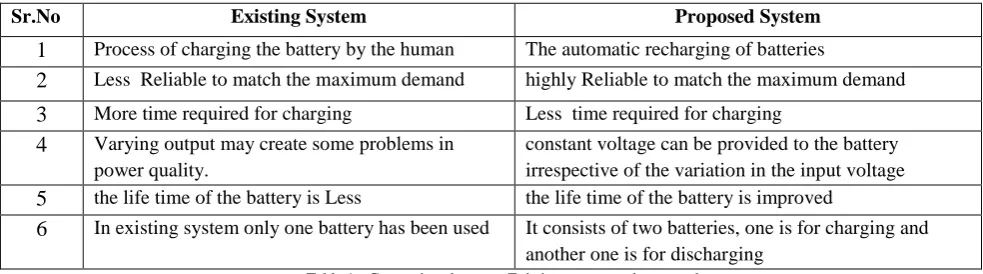
The concept in this paper gives the charging and discharging of two batteries alternately by using relays as from PV panels and wind generator. The other battery supplies energy to load. We are going to experiment on two cells of 12 V, 1200mA Li-Po batteries, and we are going to observer that two separate batteries that work alternately. In this case when one battery voltage decreases up to 9v then it gets energy from PV panels and wind generator other battery having voltage level 12 v supplies energy to load required to it. The Comparison between Existing system and proposed system is given in table.1 which shows that proposed system is more advantages than existing system as it required more time for charging and life time of the battery is less as Only one battery has been used in existing system.
Sr.No Existing System Proposed System
1
Process of charging the battery by the human The automatic recharging of batteries2
Less Reliable to match the maximum demand highly Reliable to match the maximum demand3
More time required for charging Less time required for charging4
Varying output may create some problems inpower quality.
constant voltage can be provided to the battery irrespective of the variation in the input voltage
5
the life time of the battery is Less the life time of the battery is improved6
In existing system only one battery has been used It consists of two batteries, one is for charging and another one is for dischargingTable 1:- Comparison between Existing system and proposed system
VI.CONCLUSION
microcontroller. Also we are going to use PIC 16F877A microcontroller as a smart host microcontroller which offers low cost, high performance, and low power consumption, and so the system consumes less power.
REFERENCES
[1] Ramji Tiwari, M. Anantha Kumar, “Integration and Distribution of Renewable Sources in DC Micro Grid with Energy Storage System,” IJIRSET, Volume 3,Special Issue 3, pp.2713-2718, March 2014.
[2] Lawrence K. Lettinga, Josiah L.Mundaa, Yskandar Hamama, “Dynamic performance analysis of an integrated wind photovoltaic microgrid with storage,”International Journal of Smart Grid and Clean Energy, vol. 3, no .3, July 2014.
[3] G.mahesh Kumar, Damodharam, Suresh, “Integrated Wind and Solar Power Dc Microgrid For Day-a-head Scheduling,” Proceedings Of Eleventh IRF International Conference, 17th August 2014.
[4] Kai Strunz, Ehsan Abbasi, and Duc Nguyen Huu, “ DC Microgrid for Wind and Solar Power Integration,” IEEE Journal, Vol. 2, No. 1, March 2014.
[5] K. Hemanth, “Battery Energy Management System for DC Micro Grids with Fuzzy Controller,” IJIRSET, Vol 3, Special Issue 1, February 2014.
[6] Jitender Kaushal, Prasenjit Basak “The Deployment of Microgrid as an Emerging Power System in India and its Simulation using Matlab-Simulink,” IJAREEIE, Vol. 3, Issue 4, April 2014.
[7] Sowmini priya.S, Rajakumar, “An Energy Storage System for Wind Turbine Generators-Battery and Supercapacitor,” IJERA, Vol. 3, Issue 2, pp.1219-1223, March -April 2013.
[8] Sofia Lalouni, Djamila Rekioua, “Energy management of Photovoltaic System with Battery Storage,” CIER, Vol. 2, 2013. Energy Management System based on Fuzzy Logic Controlled for Power Distribution,” International Journal of Research in Advent Technology, Vol.2, No.4, April 2014
[9] Patil A. R., Atar K. D, Potdar A. A, Mudholkar R. R“Embedded Fuzzy Module For Battery Charger Control,” IJAREEIE, Vol. 2, Issue 8, August 2013.
[10] Roggia L, Rech C, Schuch, L Baggio, J.E Hey, H.L,Pinheiro, J.R, “Design of a sustainable residential microgrid system including PHEV and energy storage device,” Power Electronics and Applications,pp.1-9, Aug. 30 2011-Sept. 1 2011 .