A SAT-based Public Key Cryptography Scheme
Sebastian E. Schmittner
Abstract—A homomorphic public key crypto-scheme based on the Boolean Satisfiability Problem is proposed. The public key is a SAT formula satisfied by the private key. Probabilistic encryption generates functions implied to be false by the public key XOR the message bits. A zero-knowledge proof is used to provide signatures.
Index Terms—Public key cryptosystems, Cryptographic protocols, Data Encryption, Message authentication, Digital signatures.
F
1
I
NTRODUCTIONA
SYMMETRICantly used today are vulnerable (at least) tocryptography schemes predomin-attacks from quantum computers using Shor’s algorithm. Assuming P6=NP and that NP-hard problems can not be solved efficiently, not even on a quantum computer, cryptography based on NP-hard prob-lems is dubbed “post-quantum”. Daniel Bernstein [1] lists Hash-based, Code-based, Lattice-based, and Multivariate-quadratic-equations cryptography as the existing post-quantum algorithms. The aim of this paper is to introduce a different crypto-system based on the Boolean Satisfiability Problem (SAT). This problem of finding a pre-image of 1 under a Boolean function given in a certain conjunctive form (see Section 2) is well known to be NP-complete. Although a SAT instance can, from a certain angle, be viewed as a multivariate-equation, our encryption scheme is different from the systems mentioned above. In particular, we use a fulfilling assignment as the secret key rather than a trap door.Using SAT to provide a post-quantum key pair is not a far-fetched idea. The main point of this paper is how to use them to encrypt and decrypt. To this end, we randomly produce Boolean functions which are implied to be false by the public key and hence evaluate to 0on the private key. These functions⊕the message bits form the cipher.
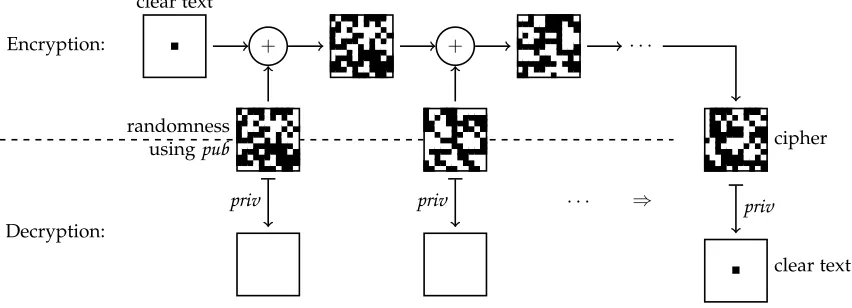
The paper is organised as follows: We illustrate the main point of using randomness for encryption in a (somewhat over simplified) picture in Figure 1. The guiding example in Section 1.1 illustrates the main ideas more accurately. In Sec-tion 2, we describe and discuss our algorithms in detail. The probabilistic scheme introduced there is vulnerable to an oracle attack, which is discussed in Section 3, as well as some other attacks. In this section we also compute bounds for the parameters of the encryption to resist all mentioned attacks and also explain how the oracle attack can be countered. In Section 5 we introduce an identification and signature scheme, which is independent from the encryption scheme. We conclude in Section 6.
• Universit¨at zu K¨oln
Institut f ¨ur Theoretische Physik Z ¨ulpicher Straße 77; D-50937 K¨oln [email protected]
1.1 Example
Before explaining the key generation and encryption al-gorithm in detail, we start with a simple toy example to guide the readers intuition. A possible1private/public key pair for Alice is:
priv = (1,1,0,0,1,0,0) (1) pub= (¯x1∨x¯2∨¯x3)∧(¯x1∨x4∨x5) (2) ∧(x1∨x6∨x7) (3)
sincepub(priv) = 1. Bob wants to send a bity ∈Bto Alice.
He rewrites
¯
c1=x1x2x3 (4)
¯
c2=x1⊕x1x4⊕x1x5⊕x1x4x5 (5) ¯
c3= 1⊕x1⊕x6⊕x7⊕x1x6⊕x1x7⊕x6x7 (6)
⊕x1x6x7 (7)
and randomly generates
R2,3=x4⊕x5⊕x6⊕x4x5⊕x4x6x7 (8) ⊕x5x6x7⊕x4x5x6x7 (9) R1,3= 1⊕x2x3⊕x6x7⊕x2x3x6x7 (10) R1,2= 1⊕x4⊕x5⊕x2x3⊕x4x5. (11)
The cipher is
g= ¯c1R2,3⊕¯c2R1,3⊕¯c3R1,2 (12a) =y⊕1⊕x4⊕x5⊕x6⊕x7⊕x1x6⊕x1x7 (12b) ⊕x2x3⊕x4x5⊕x4x6⊕x4x7⊕x5x6⊕x5x7 (12c) ⊕x6x7⊕x1x4x6⊕x1x4x7⊕x1x5x6⊕x1x5x7 (12d) ⊕x2x3x6⊕x2x3x7⊕x4x5x6⊕x4x5x7 (12e) ⊕x4x6x7⊕x5x6x7⊕x1x2x3x7⊕x1x4x5x6 (12f) ⊕x1x4x5x7⊕x2x3x6x7⊕x4x5x6x7 (12g)
Bob sends the cipher g for the clear text y to Alice, who decodesg(priv) =y.
Mallet can attack the scheme above by replacing a literal in g by a truth value, sayx3 7→ 1. He sends the modified cipher to Alice and from Alice’s reply, he will notice whether Alice received the correct bit or not. Hence he concludes that
clear text
Encryption:
Decryption:
randomness usingpub
+ + · · ·
cipher
priv priv · · · ⇒ priv
clear text
Figure 1. Encryption (top): The text is hidden in random noise patterns generated from the public keypub. Subsequent additions hide the structure of the noise patterns to make it harder to subtract the noise.
Decryption (bottom): Via the private key, every noise pattern generated frompubis “switched off” and hence the clear text is revealed from the sum.
x3= 0in the private key. Alice might notice the attack by a suitable syntax check on the decoded text (containing more than one bit), but the security of the key pair is lost anyway. This attack can be countered as follows. Bob seeds his random number generator, which chooses the clauses and generates the random functionsRi, with a hash of the salted
clear text. He then sends the salt together with the encrypted message. If the clear text was long enough, it would take Mallet very long to guess the right seed from the salt alone (hence decoding the message). But knowing the salt and the clear text, Alice can easily re-encrypt the message after decryption and check whether the cipher has been altered by Mallet. She rejects any faulty message, regardless of the private key, hence not revealing any information.
2
A
LGORITHMSIn this section we specify the algorithms for key generation and encryption. The public key,pub, is a “planted” random k-SAT instance for k ∈ N with k > 2. This is a Boolean function inn∈Nvariables,pub:Bn→B, which is given as
a conjunction ofm∈Nmanyk-clauses,cj :Bk ⊂Bn→B,
together with a truth assignment, the private key priv ∈ pub−1(1). In summary
pub:x7→
m
^
j=1
cj(x), cj :x7→ k
_
i=1
(xI(i,j)⊕s(i, j)), (13)
where the signss(i, j) ∈Bdetermine wether the literal xI
is negated. To discuss the complexity of the algorithms, we use the notation
O(f) :=
g:N→R lim sup
n→∞
|g(n)| f(n) <∞
, (14)
o(f) :=
g:N→R
lim sup
n→∞
|g(n)| f(n) = 0
, (15)
andΘ(f) :=O(f)\o(f)forf :N→R+.
2.1 Key Generation
A key pair is generated as follows:
1) Choose the private keypriv ∈Bnat random.
2) Generate the clausecj by randomly choosingkdistinct
integersIj,i∈ {1, . . . , n}and “signs”si ∈B.
3) Ifcj(priv)accept the clause, otherwise reject it.2
4) Repeat untilmclauses have been generated.
In other words, the data to be generated and stored for the each key pair is
I:{1, . . . , m} × {1, . . . , k} → {1, . . . , n} (16)
and s:{1, . . . , m} × {1, . . . , k} →B, (17)
hence the length of the public key is inΘ(mk(log(n) + 1)). The run time is proportional to the public key length3.
It is very important to generate hard instances as public keys. Therefore we must ensure thatpriv is (almost surely) the unique solution, i.e.mneeds to be larger than the critical value, m > mc = αc(k)n for someαc(k) ∈ Θ(1), see [4].
Choosingmrather close tomc yields the most difficult
in-stance. This is well known in similar setups, see Appendix E for some of our own benchmarks. Choosingm∝nfor fixed k leads to a public key length of Θ(nlog(n)). A different scaling ofmwithnis not recommended, since the resulting SAT instances then become much easier to solve.
2.2 Encryption and Decryption
We fix parametersα, β∈Nwith2≤βαto tune the run time and security of the encryption.
1) Choose α many tuples of β many distinct clauses at random,J :{1, . . . , α} × {1, . . . , β} → {1, . . . , m}such thatJ(i, a)6=J(i, b)for alla6=b.
2) The cipher encodingy∈Bis the algebraic normal form
(ANF) of
g=y⊕
α
M
i=1
β
M
a=1 ¯
cJ(i,a)∧Ri,a. (18)
HereRi,ais a random function. It depends on the same
set of variables as the clauses {cJ(i,b)|b 6= a} and is
generated in ANF where each possible term occurs with probability1/2.
3) The decryption “algorithm” isg(priv) =y.
In choosing the clauses in Step 1, some care is to be taken: (a) To counter attacks discussed in Section 3.1.2, it is
prefer-able if the clauses within one tuple share variprefer-ables. This is particularly important if one of the clauses does not contain negations, i.e.s(i,1) =. . .=s(i, k) = 0. (b) We have to ensure that each tuple shares at least one
clause with another tuple to counter the attack dis-cussed in Section 3.2.
(c) Each clause ofpub is to appear in some tuple as dis-cussed in Section 3.3.
We can ensure (b) and (c) by choosingJ as follows: First choose a permutationσ∈Smat random. Then setJ(i, a) =
σ(i+a−1), where the indices are understood modulom. In this schemeα=m. To also ensure (a) one should enhance the probability of neighbouring clauses,cσ(j)andcσ(j)+1, to have variables in common when generatingσ.
To turn the negated clauses in (18) into ANF, one can use various identities, such asx∨y=x⊕y⊕xy, butx∨y= ¯x¯y is the most efficient one here. It leads to
1⊕(x1⊕s1)∨. . .∨(xk⊕sk) (19a)
= (x1⊕s1⊕1)∧. . .∧(xk⊕sk⊕1). (19b)
The resulting ANF (obtained by distributing ∧ over ⊕) is of length ≤ 2k. The run time to compute the cipher in
(18) as well as the length of the resulting cipher are in O(α2βk). Consequently, we need to chooseβ ∈ O(log(m)) in order for the run time to be polynomial. The length can be expected to be shorter than the run time by a factor>2 due to the cancellation of terms in the sum and due toRi,a
only containing2(β−1)k−1 terms on average. If we choose β = log2(m)/k and α ∝ m, we have α2βk ∝ m2
. For β ∈ Θ(1), run time and cipher length formally only scale withm, but for m ≈ 210 and β = k = 3 the pre-factor is still comparable tom. In short, encryption with this setup has complexityO(m2).
3
K
NOWNA
TTACKS ANDI
MPROVEDS
CHEMESDenote by Gb = Gb(pub) the set of all possible ciphers
encodingb∈Band byG=G1∪G0the set of all ciphers. Since the problem of deriving the private from the public key is known to be hard, we will focus on attacks on the cipher. We will refer to the problem of deciding forg ∈G whether g ∈ G0 or g ∈ G1 as the decoding problem. We do not have a proof that this is a hard problem, although some related problems are (see Appendix A). In this section we focus on some particular attacks, i.e. algorithms that solve the decoding problem and show that all of them have exponential run time, if the parameters of the encryption algorithm are chosen suitably.
3.1 Simple Attacks
3.1.1 Enumeration of Ciphers Attack
Since the set of all possible ciphers for a given public key is finite, a trivial brute force attack is to just enumerate it. In order to prevent this attack, the encryption parametersα
andβ need to be large enough. More precisely, the number of possible ciphers is roughly
m β
!α
2αβ((β−1)k). (20)
We can ensure this number to be (super) exponentially large by choosing
n∈O(αβ). (21)
Further we should apply some fixed invertible linear trans-formation to the message bit vector before encoding. This way, decoding a few of the cipher bits does not reveal any clear text bits.
3.1.2 Constant Term Probability Attack
Another rather trivial attack is to determineg(0, . . . ,0)for a cipher g ∈ G. This is just the presence or absence of the constant1in the ANF, which is where the message bit enters. Hence this property must not distinguishG0 from G1.
The ANF of a random clause of length k contains a constant 1with probability 1−2−k, hence the probability for each summand in (18) to contain the constant 1 is 2−k−1. This is rather small, but a variant of the central limit theorem is in this case on our side, see Appendix B. As a consequence, the probability for g(0, . . . ,0) = 1 tends to 1/2exponentially quickly withαβat the scale of
αβ2k. (22)
Considering the enumeration attack from Section 3.1.1, the bound established in (21) is much stronger than (22). In other words, the encryption resists the constant term attack if parameters are chosen such that it resists the enumeration attack.
A more refined version of this attack focuses on those clauses which can contribute a summand1, namely thoseci
which do not contain any negation. For those,
¯
ci= (xi1⊕1). . .(xik⊕1) = 1⊕xi1⊕. . .⊕xi1xi2. . . xik (23)
contributes a constant to the cipher sum iff the correspond-ing Ri also contains the constant 1. An attacker can try to
judge wether the latter is the case by looking for the order k term, xi1xi2. . . xik, in the cipher sum. The same term could be caused by another clause depending on the same variables, but such a clause is part of pub with vanishing probability for largem ∝n. Hence we need to ensure that ci shares at least one variable with another clause in the
same tuple or that another clause in the same tuple contains no negated literals. Both of these can lead to the appearance of the same orderkterm, see the example in Section 1.1.
3.1.3 Cipher Value Probability Attack
An attacker can try to estimate |{g−1(1)}|
for any g ∈ G by evaluating g on a random set of trial inputs. Hence this value must not distinguishG1 from G0. This attack is structurally very similar to the constant term attack (Sec-tion 3.1.2). For each clause c of length k, the number of inputs on whichcis1is|{c−1(1)}|= 2k−1. The probability
summands to contain a constant1, ifR= 1with probability 1/2. Even if theRs are chosen such that they evaluates to1 only on∝2−βkmany inputs, choosing
αk (24)
still ensures that the probability forg(1) = 1is exponentially close to1/2according to Appendix B. Sinceβ∈O(log(m)) for run time reasons, condition (24) is again ensured by (21).
3.2 Decoding Attack
More sophisticated attacks exploit the structure of the en-coding algorithm. Any function ing ∈ Gis necessarily of the form
g=y⊕
m
M
i=1 ¯ ciRi
for some functions Ri (see Appendix C). A crucial point
of our whole scheme is that polynomial long division does
notwork over finite fields such asB, because the degree is
not well behaved under addition and multiplication in the polynomial ring. This can be seen in the Example 1.1. A simpler example isxn+1=x
and hence e.g.x2y⊕y2x5= 0 . Such “collisions” are sufficiently likely to secure our ciphers, if the random functionsRI are chosen in a good way.
Attacks on the structure of the encoding algorithm start with the following observation. The set of all clauses which depend only on literals in a small set{xi1, . . . , xiM}has an expected size of
M k
!
m
nk , (25)
which is exponentially small forM ∈o(m). In other words, a small set of clauses C is most likely uniquely determ-ined by D(C) := S
ci∈CD(ci) where D(c(x1, . . . , xk)) = {x1, . . . , xk}denotes the variables on whichcdepends. This
means that most likely all tuplesJ(i,1), . . . , J(i, β)used to generate our cipherg in Section 2.2 can be identified from the ANF ofg. For a given tuple, this leaves2β(β−1)kchoices
for the random functions associated with it. If we choose β = log2(m)/k (see Section 2.2) then2β(β−1)k ≈ mlog(m). This is super polynomial in m, but, for reasonable values ofm, an attacker can still produce all possible summands associated with this tuple and try to add them tog. He can check whether all terms involving variables from this tuple cancel. However, the same variables will occur also in other tuples. In fact, we should ensure that also some of theclauses
from this tuple appear in other tuples. This will leave the attacker with a few possibilities for the random function, which can only be decided once the touples sharing clauses are decided as well. But since all tuples are connected (indirectly) by sharing clauses, the run time of this attack is exponential inαwhich we chose to be of the order ofm.
3.3 Reduced SAT Problem Attack
If an attacker can learn that only a certain set of clauses was used to produce a cipher, he can try to solve the SAT problem given by the conjunction of only those clauses that were used. If the ratio of used clauses to variables appearing in those clauses is small enough, the SAT problem is easily solvable and any solution can be used to decode the cipher.
To resist this attack, care is to be taken in Step (1) of the encryption (Section 2.2). The set of all clauses used, C =Sα
i=1
Sβ
a=1{cJ(i,a)} should not depend on more than |C|n/mmany different variables. Furthermore, reducing the number of clauses used, even at constant clauses to variables ratio, effectively reduces the key length. Overall, we should ensure that (almost) all clauses are used to generate the cipher.
3.4 Oracle Attack
The communication according to the algorithms from Sec-tion 2.2 is vulnerable to the following attack: If the recipient is expected to send a reply to an encrypted message, an attacker can fake a cipher by replacing a literal with a guessed truth value. If he can learn from the reply whether the cipher was correctly decoded, he gets a strong hint, or even evidence, for the assignment of this literal in the private key. Repeating the attack in a suitable scheme will reveal the full private key. This is a severe attack which limits the scope of application of the random encryption algorithm to such cases where replies are only send to authenticated communication partners. Post-quantum au-thentication could be provided by e.g. a hash-based scheme, see [1, Hash-based Digital Signature Schemes]), or by our identification scheme introduced in Section 5. One could also use only one-time key pairs for encryption, again with the problem of authenticating the new keys.
Instead, we have developed two improved version of our scheme. The one which we consider superior resist the oracle attack completely and is described in Section 3.4.1. In special circumstances, also the version described in Ap-pendix D might be useful. The latter makes the oracle attack substantially more difficult and preserves the probabilistic nature of the encryption.
3.4.1 Proof of Honest Encryption
The version of the encryption/decryption scheme described here prevents the oracle attack completely without increas-ing the complexity of the encryption algorithm. Key gener-ation is unchanged, but decryption becomes as complex as encryption and the feature of stochastic ciphers is lost. More precisely, using the encryption discussed in Section 2.2, the cipher is not a function of the public key and clear text. In particular, even if Bob encodes the same clear text twice, he will get different ciphers. This makes repetition-attacks im-possible and the algorithm is very resistant against rainbow table type attacks. It is, of course, only pseudo random. In other words, the cipherisa function of public key, clear text
and the seed of the pseudo random number generator (PRNG),
implicitly used to make the random choices. This can be used to verify that the cipher was not tempered with in order to oracle the private key, at the cost of loosing the rainbow-resistance. The latter can then be restored in the usual way by salting.
seed from the clear text and the salt. He then checks that the received cipher text matches that one that is computed from the public key, the clear text, and the seed according to the fixed encryption algorithm. This way, oracle attacks can be detected without revealing any information.
The cost to pay is that the implementation of the PRNG and the encryption algorithm on the sender and receiver side have to match and that the receiver has to re-do the most time consuming part of the whole scheme, the encryption. Further more, the clear text needs to be long enough (of ordern) in order to prevent a brute force attack on the seed. Notice that the seed, as computed from the salt
and clear text, is to be considered as a key for decoding the particular message. If an attacker can find the seed he can decode the cipher without the private key.
4
H
OMOMORPHICE
NCRYPTIONThe encryption described in Section 2.2 is fully homo-morphic. That means that if Alice wants to know the value ofanyfunctionf :Bn →
Bn onx∈Bn, she can encryptx
bit-wise into the cipherc= (c1, . . . , cn) :Bn→Bnas above
and then send c to Charley, who has more computation power available. Charley computes f ◦c and sends this processed cipher back to Alice. She decrypts
(f ◦c) (priv) =f(c(priv)) =f(x). (26)
Notice that oracle attacks by Charley can not be countered by a proof of honest encryption requirement in this setting (see Section 3.4), or else Alice would have to redo the whole computation. Anyway, due to the encryption being malleable, trust in Charly to honestly compute f is needed. One might also use multi-Key encryption as described in Appendix D to check that Charley computes honestly and discard the key-pair otherwise.
A more severe drawback is that any computation on the cipher “bits”ci, while not introducing any noise, does
increase the length of the cipher. In particular, if |ci|
de-notes the number of summands in the ANF of ci, then
|ci⊕cj| ≤ |ci|+|ci|and|ci∧cj| ≤ |ci||ci|, where the bounds
will likely (almost) saturate for short ciphers. As soon as about half of all possible terms are present, i.e.|ci| ≈2n−1,
the length will likely not grow further. But since originally |ci| ∝ m ∝ n, this means that multiplication leads to an
exponential growth in the cipher length. Consequently, only few multiplications are feasible in our scheme.
This growth in length can be traded for “noise” by discarding all terms longer (counting the number of literals in a product) than a fixed length L. The probability of such terms being satisfied by the (unknown) private key is 2−L, i.e. if only 2L
terms are discarded, the cipher probably still decrypts correctly. The final length of the cipher bits is then limited to2L, but the “noise” generated
by multiplications will at some point make it impossible to decrypt the cipher, hence effectively also limiting the number of possible multiplications inf. In this sense our scheme is only somewhat homomorphic and bootstraping is needed to make it fully homomorphic without the ciphers becoming unfeasibly large.
5
I
DENTIFICATION ANDS
IGNATURESIn this sections we introduce a zero-knowledge proof for our key pairs. This leads to an identification and signature scheme, which is independent from the encryption scheme discussed above, apart from sharing the same type of pub-lic/private key pairs. In fact, the scheme proposed here is a variant of the one by Blum based on the Hamitlon cycle problem [2]. The latter is NP-complete, hence polynomial-time equivalent to SAT, but one can apply the ideas more directly.
5.1 Zero-Knowledge Proof/Identification
Let pub again be a k-SAT instance in n boolean variables and priv ∈ pub−1(1) a solution only known to Alice. The zero-knowledge proof consists ofK rounds, each of which proceeds as follows:
1) Alice chooses a random invertible function f :
Bn → Bn and commits to f∗(pub) = pub ◦ f
and to f−1(priv). More precisely, the commitment to f∗(pub) is to be in the form of committing to each literal in the pull back of the form, i.e. to each f∗(xI(1,1)), f∗(xI(1,2)), . . . , f∗(xI(m, k)).
2) Bob chooses whether Alice should reveal either 2.a) all off∗(pub)or
2.b) f−1(priv) together with
f∗(xI(i,ai))|i∈ {1, . . . , m} , where Alice randomly chooses theai∈ {1, . . . , k}such
thatf∗(xI(i,ai)) f
−1( priv)
= 1for alli.
In this scheme Bob either verifies that Alice did not cheat when generatingf∗(pub)or that she indeed knows a solu-tion. Fake proofs will hence be discovered with probability 1/2each round and the probability to get through all rounds is2−K.
The run time of the above scheme depends on what kind of functions we allow forf. If we only use permutations4, the run time for generating the permutation, its inverse and reshufflingpriv isO(n)andO(m)for re-labellingpub. However, in this case the number of1s and0s in the public key is leaked by revealing f−1(priv). To avoid this, we should at least add a random affine shift s ∈ Bn to the
permutation, i.e.f(x) =σ(x) +s.
5.2 Signatures
By a Fiat-Shamir heuristic we can convert the above inter-active identification into a signature scheme. To this end, let h : B∗ → BK be a cryptographic hash function. To sign a
document:
1) Alice generatesK random functions,f1, . . . , fK, as in
Section 5.1 and commits to allfi−1(priv)andf∗(pub). 2) She then computes a hash of the document to be signed,
concatenated with (a suitable encoding of) her commit-ments. Denote the latter byC.
3) She reveals the information as in Step 2 of Section 5.1, choosing 2.a) or 2.b) in theith round if the ith bit of the hash is0 or 1, respectively. Denote this revealed information byR.
The signature consists of C and R. It is verified by Bob by checking that the correct information was revealed by re-computing the hash. He also checks that the revealed information is valid as in Section 5.1, of course.
To fake this signature, Alice could fake the zero-knowledge proofs and generate signatures until, by chance, a valid one is generated. However, the probability for this to happen is as small as cheating in the identification scheme, i.e. exponentially small in the number of rounds.
6
C
ONCLUSIONWe have introduced a public key crypto-scheme based on the Boolean Satisfiability Problem. The motivation for developing such an algorithm is to fill the arsenal of post-quantum cryptography with some fresh ammunition. The simplicity of the scheme developed in this paper might be an advantage over the well known post-quantum schemes. More conceptually, we are not aware of any scheme which uses random ciphers in a similar way (compare to Fig-ure 1). Furthermore, there is quite some freedom in the details of the encryption algorithm, in particular in choosing probability distributions for the random functionsRI. This
makes it possible to adapt the algorithm, if more sophist-icated attacks are discovered in the future. The encryption presented in Section 2.2 has undergone some evolution to resist all attacks which came to our mind. The version using a proof honest encryption has no vulnerabilities currently known to us, but of course much more crypto-analysis is needed and the reader is invited to devise stronger attacks to challenge and improve the algorithm. In particular, we have not proven that it is (NP-)hard to decipher a message without knowledge of the private key. It is the problem of deducing the private from the public key that is NP-hard, i.e. “post-quantum”, by construction. The same is true for the signature scheme presented in Section 5.2, which is independent of our encryption scheme. It is analogous to Blum’s well known scheme [2], adapted to our SAT scenario. A notable feature of our encryption is that, in principle, it is fully homomorpic, i.e. applying any function to the cipher bit vector and then decoding yields the same result as decoding and then applying the function. However, as discussed in Section 4, the cipher might become unfeasibly long if to many multiplications are applied to it, hence our scheme is effectively only somewhat homomorphic. The oracle attack mentioned in Section 3.4 is a stronger incarnation of malleability. It is a severe generic attack on any cipher consisting of Boolean functions. Enforcing honest encryption, as explained in Section 3.4.1, is a generic counter. The multi-key version of our scheme described in Ap-pendix D is another work around, however, not completely resistant. Although it only reveals much less information, the key pairs still need to be changed regularly, but here this could here be feasible. In some special situations, like using our scheme for homomorphic encryption, the multi-key version might be preferable. Encryption is considerably more complex than key generation and decryption, which in particular yields some protection against DOS attacks for multi-key schemes.
The length of the public key and the run time of the key generation algorithm scale asO(nlogn)with the length
of the private key n. The length of the cipher and the run time of the encryption algorithm per bit of clear text scale as O(m1+) with ≥ 0 and we have identified
2αc(k)n > m > αc(k)nas the relevant parameter range for
hard planted SAT instances (see Appendix E). The crucial question is how big n should be in practice today. At the SAT Competition 20145, random 3-SAT instances of size n≈104
have been solved form≈mcin less than one hour.6
These instances were selected in order to be solvable within that time, but still they are randomly generated with non-negligible probability. Our own benchmarks (Appendix E) show that the MiniSat solver [3] can not break keys of length n > 210 ≈ 103 on a modern PC using one thread. Taking large scale parallelisation into account, we should at least choosen >211, but in view of the SAT Competition results, n >214seems more advisable.
Key generation is very fast and choosing evenn >107 is not a problem here. However, encryption with our not very much optimised proof of concept implementation [6] already takes time of the order of few seconds per bit of clear text to encode with α = m = 5n = 5×210 and β = 3and still tenth of seconds per bit forβ = 2and the other parameters as before. Although there is certainly room for improving the implementation, the constraint β ≥ 2 means that the run time of the encryption algorithm is in O(m1+)with ≥ 3/5 for m ≈ 210. These run times are not yet very well suited for practical applications. However, the situation could be improved by advancing away from bit-wise encryption. Encoding longer messages at once is an interesting topic for future research. One could use the (vector space) embedding of polynomials with binary coef-ficients into polynomials with coefcoef-ficients in any finite field
Fq to encode the message in a shorterq-adic representation
decimal by decimal. However, increasingqmakes polyno-mial long division more likely possible, hence the security considerations in Section 3.2 need to be seriously reviewed in this setting. If one can counter the attack from Section 3.3 by other means than using all clauses, smaller α would also lead to a substantial speed up. Anyway, before more research builds on the ideas presented here, we would like our algorithm to be challenged by more advanced attacks in order to improve it. Furthermore, the problems which we have proven to be NP-hard (see Appendix A) are still not very close to the decoding problem. To build faith in this encryption really being post-quantum secure, more research in this direction is in order.
A
CKNOWLEDGEMENTWe acknowledge helpful discussions with Rainer Schrader and Ewald Speckenmeyer as well as their research groups in Cologne. In particular, we would like to thank Martin Olschewski, who pointed out the oracle attack.
We are very thankful to Paulo Barreto for friendly advice and his interest in our first draft of this paper. In particular his suggestion to introduce signatures via a zero knowledge proof brought this idea home to us and he stressed that
5. http://www.satcompetition.org/2014/
being homomorphic might be an important property of our scheme, rather than a side effect.
The author was supported by Martin Zirnbauer, by a grant from Deutsche Telekom Stiftung, and another grant from the Bonn-Cologne Graduate School of Physics and Astronomy, funded by the DFG.
R
EFERENCES[1] D. J. Bernstein, J. Buchmann, and E. Dahmen, editors.Post-Quantum Cryptography. Springer-Verlag Berlin Heidelberg, 2009.
[2] M. Blum. How to prove a theorem so no one else can claim it.ICM Proceedings, 2:1444–1451, 1986.
[3] N. Een and N. Sorensson. Minisat. http://www.minisat.se/. [4] S. Kirkpatrick and B. Selman. Critical behavior in the
satisfiab-ility of random boolean expressions. Science (New York, N.Y.), 264(5163):1297–1301, 1994.
[5] F. Krzakala, M. Mezard, and L. Zdeborova. Reweighted belief propagation and quiet planting for random k-SAT. Journal on Satisfiability, Boolean Modeling and Computation, 8:149–171, 2014. [6] S. E. Schmittner. A prove of concept implementation of a SAT-based
A
PPENDIXA
S
OMEH
ARDP
ROBLEMSIn this section, we establish that some problems related to the decoding problem (see Section 3) are hard. To this end, fix a public keypuband assume thatpub−1(1) ={priv}. The partitioning of ciphersG=G0∪G1is characterised by
G1={g∈G|pub⇒g} (27)
G0={g∈G|pub⇒¯g}. (28)
Deriving the private key is harder than decoding, since ∀g ∈G:g∈Gg(priv). Assuming that allg∈Gare given in such a form that evaluatingg(priv)is possible in polynomial time, the decoding problem is in NP.
IfGwould contain the elementary functionsX :={x7→ xi}then the decoding problem would be (polynomial time)
equivalent to deriving the private key, hence solving the SAT problem. A set of functions Y of polynomials size will be called “hard to decode”, if solving the decoding problem for eachf ∈Y determines (by a polynomial time algorithm) the solution of the SAT problem. The following sets of functions are hard to decode:
1) The elementary functionsX
2) Any set of functions containing a subset that is hard to decode
3) {f⊕sf|f ∈Y}wheresf ∈Bare known andY is hard
to decode
4) {f⊕g|f ∈Y}whereY is hard to decode andgis any Boolean function
5) {f∧g|f ∈Y} ∪ {f∧g|f¯ ∈Y}withY,gas above 6) {xi∧f|f ∈Y, xi∈X}withX,Y as above
7) {xi∨f|f ∈Y, xi∈X}withX,Y as above
(3) is hard to decode sincef ⊕s ∈Gb ↔f ∈Gb⊕s. (4) is
hard to decode since we can decide for eachf ⊕gwhether or not it is implied by pub, then assume that g(priv) = 0 and use thatY is hard to decode to produce a trial solution priv0. Ifpub(priv0)6= 1theng(priv) = 1and we can use (3). (5) is hard to decide since one of the two sets evaluates to {0}onpriv. Since there are only two possibilities forg(priv) one can check both in polynomial time, similar to (4). In (6) (and similarly in (7)) we can decide{x1∧f}. If this turns out to be a subset ofG0 then we likely havex1(priv) = 0 and we proceed deciding{x2∧f}. After polynomial time we either arrive at somexi(priv) = 1and can hence derive
priv or conclude thatpriv = (0, . . . ,0).
The above construction shows that some generic prob-lems similar to the decoding problem are hard to decide. Notice, however, that the sender can not (on purpose) en-code a message of polynomial length into a hard to enen-code set of functions in polynomial time, or else he would solve the SAT problem.
A
PPENDIXB
B
OOLEANC
ENTRALL
IMITT
HEOREMConsider a set of i.i.d. Boolean variables xi, with p1 := prob(xi= 1). Then
p⊕0 := prob
M
M
i=1 xi= 0
!
=
bM/2c
X
j=0 M 2j
!
p21j(1−p1)M−2j
(29)
p⊕1 := prob
M
M
i=1 xi= 1
!
=
dM/2e−1
X
j=0
M 2j+ 1
!
p21j+1(1−p1)M−2j−1
(30)
and hence|p⊕0 −p⊕1| =|1−2p1|M converges to0for any 0 < p1 < 1 and M → ∞ at exponential speed. In other words, for large enoughM we havep⊕1 ≈1/2irrespective of p1. Large enough here means M −1/log|1−2p1|, which meansM p−11/2for smallp11/2.
A
PPENDIXC
S
TRUCTURE OFC
IPHERSIn this section we discuss which functions g can, in prin-ciple, be constructed from the public key pub without knowledge of the private key, such that pub ⇒ g, i.e. g ∈ G1. We will therefore assume that only the clauses ci
ofpub = Vm
i=1ci can be used as the elementary building
blocks for whichpub⇒ciis known.
Any encryption algorithm of the type discussed in this paper will lead to sets of ciphers G and Gb which are
contained in the setsG˜ andG˜b, respectively. The latter are
constructed as follows
1) 1∈G˜1andci∈G˜1fori∈ {1, . . . , m}.
2) f ∈ G˜a, g ∈ G˜b ⇒ f ⊕g ∈G˜a⊕b,f ∧g ∈ G˜a∧b and
f∨g∈G˜a∨b. In particular,g¯= 1⊕g∈G˜¯b. 3) f ∈G˜1, garbitrary⇒f ∨g∈G˜1andf¯∧g∈G˜0.
The sets that can be constructed from (1) using (2) and (3) are
˜ G0=
(m
^
i=1 ¯
cifi|fi:Bn→B
)
(31)
˜
G1={1⊕f |f ∈G0}. (32)
These are stable under (2), sincef∨g= 1⊕f¯g¯=f⊕g⊕f g andf = 1⊕f¯. Further, the set of Boolean functions used in (2) is complete.
A
PPENDIXD
M
ULTI-
KEYC
HAINSIn some situations, the proof of honest encryption method laid out in Section 3.4 might not be favourable, for example if the feature of (pseudo) random ciphers is crucial or re-computing the encryption on the receiver side is to costly. In such cases, we can still substantially weaken the oracle attack. The key idea here is to introduce redundancy, which increases key length and all run times by a constant factor.
After decoding, the recipient has to decide whether or not to accept the message (bit), if the cipher is invalid. Re-jecting all invalid ciphers would reveal as much information about the private key as the simple version of Section 2. Therefore we fix a threshold t ∈ {2, . . . , γ/2} and accept the bit with value given by the majority, if the minority is smaller than t. To properly choose t, we consider the two possible outcomes of the attack:
1) If the message is rejected, the attacker learns that more than the (known) thresholdtof the bits he guessed did not match the private keys.
2) If the message is accepted, the attacker will learn whether or not he guessed the majority of bits right (from the reply of the receiver).
To keep the information leakage about the private key as small as possible, we should choose t large in order to make (1) unlikely. More precisely, if f ∈ {0. . . . , γ} of the encoded versions of the bit are manipulated by replacing one variable with a guessed value (such that the change in the function influences its value), the probability of rejection is
probr(t, f) = 1 2f
X
t≤T≤f
f T
!
, (33)
which can be expressed through the error function for large f. Iffis close or even equal tot, the attacker gains substan-tial information, but for this attack, the success probability is exponentially small int.
In the opposite case of choosingf close toγ, the attack is most likely detected if t is small enough. Concretely choosing e.g.
t=γ 2 −
c 2
√
γ (34)
withc = 3means that more than99.7%(for largeγ) of the attacks will be detected with hardly any information gain for the attacker. More precisely, the probability of a successfully attack of this type scales down super exponentially (with the complementary error function) and is below10−8 already forc= 6. In practice, choosingt∝γwith a proportionality factor slightly smaller than1/2should be most reasonable.
The attacker gains most information from an attack with probr(t, f)≈1/2, i.e.f ≈2t. This attack being rejected or not indicates that more or less than half of the private key bits were guessed correctly. Gathering this knowledge from O(γ2)attacks in a suitable scheme will reveal the value of all γ bits of the keys with a high confidence level on the attackers side. Hence the multi-key hardened version is not fully resistant against the oracle attack, but the attack will almost surely be noticed before substantial information is leaked. This invalidates the authenticity of the attacker in an authenticated communication. Even if information was leaked, not all keys in the chain have to be replaced, which limits the damage of a successful attack.
One can improve the scheme a little more by also choosing γ at random for each decryption, but still stat-istical analysis will eventually reveal the private key bits. Hence the proof of honest encryption scheme introduced in Section 3.4.1 is certainly more secure than the multi-key scheme.
A
PPENDIXE
B
ENCHMARKSWe have conducted some simple bench marks for breaking the public key, i.e. solving the SAT instance, using MiniSat [3]. It is well known that random instances are the hardest form≈mc=αc(k)n. For the planted instances that we use
as public keys, it turns out that the hardest instances have slightly more clauses.
E.1 3-SAT
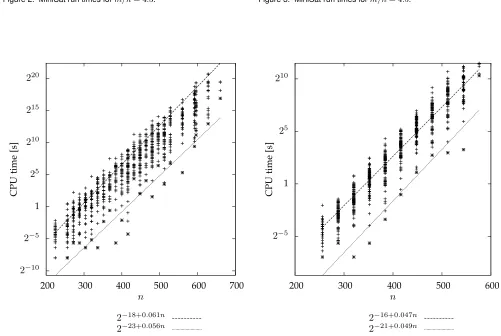
For k = 3 we find (see Figure 7 to 2) that the hardest instance have m ≈ 5n where mc ≈ 4.2n [4]. In Figure 2
we show the run time of MiniSat for various random instances generated by our key generator as a function of the number of variables for fixedm/n = 4.3. This is very close to the critical ratio. Fitting an exponential function to the minimal run times, we extrapolate that one should choose n100 ≈ 1500 to ensure that the MiniSat solver would take at least 100 years to break the public key. For m/n = 4.5, as displayed in Figure 3, we find the same n100 within the error of our approximation, but for m/n = 5 (Figure 4) n100 < 1000 is significantly smaller. Increasingm/nfurther leads to an increases inn100which again reaches n100 ≈ 1500 for m/n = 8. Consequently, we choose m/n = 5 and a private key length n = 210 for k = 3 as the default values for the proof-of-concept implementation [6]. This leads to a public key length of aboutk∗m∗(log2(n) + 1)≈165 kbit. Notice that the keys generated with these parameters can be considered “PC-secure” but securing the keys against more sophisticated massively parallel solvers rather requiresn&211.
E.2 4-SAT
For k = 4the critical ratio of clauses to variables is about mc = 9.8n. Using m/n = 10 our MiniSat benchmarks
2−10 2−5 1 25 210
300 400 500 600 700 800
CPU
time
[s]
n
2−13+0.033n 2−22+0.036n
Figure 2. MiniSat run times form/n= 4.3.
2−5 1 25 210 215
200 300 400 500 600 700
CPU
time
[s]
n
2−14+0.042n 2−18+0.032n
Figure 3. MiniSat run times form/n= 4.5.
2−10 2−5 1 25 210 215 220
200 300 400 500 600 700
CPU
time
[s]
n
2−18+0.061n
2−23+0.056n
Figure 4. MiniSat run times form/n= 5.
2−5 1 25 210
200 300 400 500 600
CPU
time
[s]
n
2−16+0.047n
2−21+0.049n
2−10 2−5 1 25
200 300 400 500 600
CPU
time
[s]
n
2−16+0.04n
2−23+0.046n
Figure 6. MiniSat run times form/n= 7.
2−5 1 25 210
200 300 400 500 600 700 800 900
CPU
time
[s]
n
2−15+0.032n
2−17+0.031n