| REVIEW
Tools for Predicting the Functional Impact of
Nonsynonymous Genetic Variation
Haiming Tang and Paul D. Thomas1 Division of Bioinformatics, Department of Preventive Medicine, University of Southern California, Los Angeles, California 90033 ORCID IDs: 0000-0001-7058-349X (H.T.); 0000-0002-9074-3507 (P.D.T.)
ABSTRACTAs personal genome sequencing becomes a reality, understanding the effects of genetic variants on phenotype—particularly the impact of germline variants on disease risk and the impact of somatic variants on cancer development and treatment—continues to increase in importance. Because of their clear potential for affecting phenotype, nonsynonymous genetic variants (variants that cause a change in the amino acid sequence of a protein encoded by a gene) have long been the target of efforts to predict the effects of genetic variation. Whole-genome sequencing is identifying large numbers of nonsynonymous variants in each genome, intensifying the need for computational methods that accurately predict which of these are likely to impact disease phenotypes. This review focuses on nonsynonymous variant prediction with two aims in mind: (1) to review the prioritization methods that have been developed to date and the principles on which they are based and (2) to discuss the challenges to further improving these methods.
KEYWORDSgenetic variation; phenotypic effects; human disease; protein mutation
A
DVANCES in sequencing technologies are rapidlymak-ing whole-genome sequencmak-ing of germline or somatic DNA routinely available for prognostic and diagnostic pur-poses. During the past decade and more, millions of single-nucleotide variants have been identified as the most common type of genetic difference, both among individuals (Interna-tional HapMap Consortium 2005; Cottonet al.2008; Abecasis et al. 2012) and between different somatic cells within an individual (Cancer Genome Atlas Research Network 2008; Campbellet al.2015). Single-nucleotide variants are a sub-stitution of one DNA base pair for another and may fall with-in genes (either protewith-in-codwith-ing or functional RNA genes) with-in gene regulatory regions or in intergenic regions. Substitu-tions in the coding sequence of protein-encoding genes can be either synonymous (i.e., they encode the same amino acid due to redundancy/degeneracy in the genetic code and so have no effect on the protein product of a gene) or nonsynonymous (i.e., they change a single amino acid in the protein). Here, we focus specifically on nonsynonymous genetic variants (NSVs), of which there are an average number of3000 per individual genome (Abecasiset al.2012).
Proteins, either alone or in complex with other cellular molecules, comprise molecular “machines” that function at the biochemical level. An NSV by definition changes the se-quence of a protein. However, only a subset of NSVs have a damaging functional effect (i.e., affecting the biochemical activity or regulatory control of a protein), as proteins are large molecules and their structures can be quite robust to single-site mutations. Note that the term “damaging” does not necessarily imply an impairment of a protein’s bio-chemical activity—in some cases a NSV that increases a protein’s biochemical activity can have a negative effect on the protein’s ability to properly serve one of its biolog-ical roles. In turn, some, but not all, damaging NSVs will be deleterious, meaning that they result in a phenotype at the organism level that is subject to natural selection (specif-ically, negative selection). Disease-causing, or pathogenic, NSVs obviously have a phenotypic effect, which may be subject to natural selection but is not necessarily so. Thus path-ogenic NSVs are very often but not necessarily deleterious in the strict sense. Finally, most common (high frequency in a popula-tion) NSVs, and many if not most rare NSVs, have no appreciable deleterious or pathogenic effect and are called“neutral.”
Thus, the challenge of NSV impact prediction can be stated simply as a needle-in-the-haystack problem: most NSVs car-ried by an individual are neutral, so we need ways to predict the relatively few NSVs that will, upon closer investigation, Copyright © 2016 by the Genetics Society of America
doi: 10.1534/genetics.116.190033
Manuscript received September 4, 2015; accepted for publication April 1, 2016. 1Corresponding author: Division of Bioinformatics, Department of Preventive
turn out to be deleterious or pathogenic. Of course, genetic variation outside of protein-coding regions can also have phenotypic consequence, and with projects such as ENCODE now generating hypotheses about potential regulatory re-gions of the human genome (Encode Project Consortium 2012), methods for identification of disease-relevant regula-tory variants is currently a major focus. Nevertheless, because of the clear mechanism by which NSVs can impact biological function and therefore phenotype, NSV prioritization remains an active area of research in which improvements are still re-quired to meet the demands of precision genomic medicine (Fernaldet al.2011; Shendure and Akey 2015).
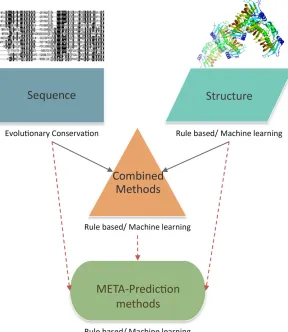
Computational methodologies for predicting the impact of NSVs fall into four main categories: sequence conservation-based, structure analysis-conservation-based, combined (including both sequence and structure information), and meta-prediction (predictors that integrate results from multiple predictors) approaches (Figure 1). We first review the foundations of SNV prediction methods in protein sequence and structure analysis. We then discuss each of the categories of computa-tional prediction method in more detail, describing the basic principles underlying each approach and the differences be-tween specific computational tools that have been developed in each area. We try to place particular emphasis on advances in methodology. Finally, after reviewing how NSV prediction method accuracy is assessed, we outline remaining chal-lenges in thefield, and prospects for further advancement.
Methods for Predicting Effects of NSVs: Overview and Background
The theoretical underpinnings of NSV prioritization methods were arguably developed at the dawn of molecular biology. Based on the limited structural studies available at the time on hemoglobin (primarily the peptide segments located near the heme iron), as well as partial amino acid sequences of hemoglobins from a number of other mammalian species, Zuckerkandl and Pauling first proposed the principle that disease can arise through a change in a protein’s amino acid sequence that affects its functioning as molecular machine and the corollary that different amino acids contribute to that functioning to different degrees (Zuckerkandl and Pauling 1962). They formulated the hypotheses that now underlie the two primary approaches to NSV prediction: that the amino acids of greatest functional importance can be identified either (1) directly by inspection of the protein structure or (2) indirectly by comparing the sequences of re-lated proteins from different species and noting the positions that display evolutionary conservation. These hypotheses were borne out, and elaborated upon, by seminal large-scale protein mutagenesis-fitness studies on HIV-1 protease (Loeb et al.1989), T4 lysozyme (Pazdraket al.1997), andEscherichia coli lacI protein (Markiewicz et al. 1994). In these studies, nearly every position in the protein was mutated to multiple different amino acids, and the relative fitness of organisms bearing the mutation was measured.
In protein structure analysis, the effect of a NSV is pre-dicted from its likely effects on protein stability or function. As Zuckerkandl and Pauling (1962) observed, a small num-ber of positions in hemoglobin are in direct physical contact with oxygen or heme, and, as NSVs at these sites could change the distribution of electrons critical for catalysis, they would likely have effects on hemoglobin’s ability to perform its oxy-gen delivery function. A much larger number of positions were predicted to play an important role in the stability of the overall structure of each monomeric subunit as well as the functional tetramer, which stably positions the few directly functional sites. Thus most of the effects of NSVs would be on protein stability. In either case, protein structure analysis requires consideration of physical mechanisms by which an NSV might affect its functioning, which would then presum-ably result in phenotypic effects.
Sequence conservation analysis, on the other hand, begins with observation of the effects of natural selection, which operates at the phenotypic level. Evolutionary conservation among homologs reflects the effects of negative selection against mutations that reduced thefitness of the individuals bearing those mutations. In a typical protein family, some positions in the protein are absolutely conserved among ho-mologs, while other positions display varying degrees of toler-ance for different amino acids. In this approach, observations of substitution patterns over macroevolutionary timescales, in which sequences typically differ at many different positions, are used to estimate effects of a single unit of potential microevolutionary change, a NSV in an individual. The pre-diction of impact will be accurate only insofar as the effects are similar on these timescales and population scales (e.g., a small selective effect can be enough to retain evolutionary conservation in a large population although the effect in a single individual lifetime may be difficult to detect).
Early Computational Methods: Quantitating Sequence Conservation and Rules for Structural Features
structural effects (Wang and Moult 2001), or a combination of the two (Ramensky et al. 2002). Evolutionary conservation was treated as quantitative, while structural effects were han-dled as qualitative features for rule-based prediction.
The early sequence conservation methods borrowed from earlier work in assigning a probability to a replacement of one amino acid by another over evolutionary time (Dayhoffet al. 1978; Henikoff and Henikoff 1992; Joneset al.1992). In this work, amino acid replacement probabilities were derived empirically from a database of known protein sequences. Ho-mologous proteins were aligned to each other, providing one-to-one correspondences between presumably homologous amino acids within a group of related proteins, which were then used to generate statistics for pairwise amino acid sub-stitutions (often expressed as a symmetric 20320 matrix). These statistical matrices quickly came to replace earlier em-pirical methods of estimating amino acid replacement from physicochemical properties of amino acids, such as the Grantham scale (Grantham 1974), and reached widespread use in sequence database searching in algorithms such as FASTA (Pearson and Lipman 1988) and BLAST (Altschul et al.1990). However, the major drawback in these pairwise matrices is that they estimate an average replacement prob-ability over all proteins. As observed by Zuckerkandl and Pauling (1962), and made abundantly clear by mutagenesis studies (Loeb et al.1989; Markiewicz et al.1994; Pazdrak
et al.1997), some sites in proteins are apparently tolerant to mutation, while others are not, and it matters very much not only what the amino acid change is, but also where in the sequence it occurs. As protein databases became larger, it became statistically feasible in many cases to compute prob-abilities specifically for each position in an alignment, termed “profiles”(Gribskov 1994). A profile is expressed as an amino acid probability vector for each position in the alignment, and pairwise amino acid replacements can simply be derived from the two relative profile probabilities. Not surprisingly, position-specific probabilities significantly outperform aver-age substitution scores at identifying deleterious NSVs (Ng and Henikoff 2001). All the early conservation-based NSV prediction methods utilized position-specific profiles, al-though in somewhat different ways.
The differences among these early methods were in three main areas. Thefirst was in the construction of alignments, both in identifying a set of homologs and in the algorithm used to align them. SIFT used PSI-BLAST (Altschulet al.1997),
while PANTHER-subPSEC (Thomaset al.2003) used hidden
gave more weight to the prior probabilities for amino acids compared to the weighting scheme used in PANTHER-subPSEC (Sjolanderet al.1996), potentially leading to larger differences between these methods when the alignment contains either relatively few, or relatively closely related homologs. The third difference lies in how these amino acid probabilities were used to determine a quantitative substitution effect score. PolyPhen used the ratio between the proba-bilities of the wild-type and substituted alleles, PANTHER-subPSEC used the absolute value of that ratio to focus on the magnitude rather than the directionality of the change (i.e., an NSV could be judged deleterious if it dramatically decreasedor increased the probability compared to the wild type), and SIFT used the ratio between the substituted amino acid probability and that of the most probable amino acid at that position, in effect treating the NSV not in terms of change from one amino acid to another, but rather in terms of the fit between the observed amino acid and the profile.
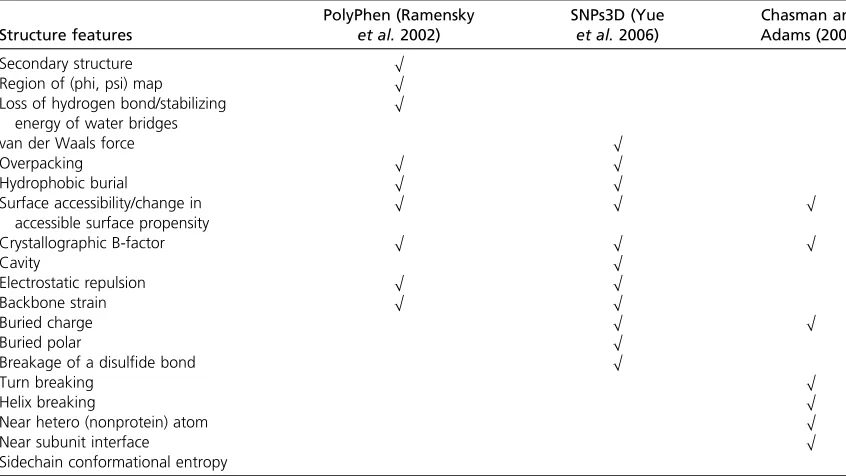
Unlike sequence conservation, effects on protein structure are diverse and cannot be treated in a single unified formalism. Early methods for variant-effect prediction utilized multiple general features describing thefit between an amino acid and its local environment within a three-dimensional structure (and thus affecting protein stability), as well as features describing specific functional roles for a particular amino acid, such as an enzyme active site or ligand-binding site (Table 1). An NSV at a specific functional site is likely to be deleterious, but as dis-cussed above this applies to relatively few amino acid sites in a typical protein. These sites—such as enzyme active sites and individual residues that bind metal ions, other cofactors, or ligands—can be identified from direct analysis of protein struc-tures, or, more commonly, from prior analysis results that are captured in resources such as the Swiss-Prot database (Boeckmannet al.2003; UniProt Consortium 2011). Of much broader applicability are predictions of NSVs that decrease protein stability by a few kcals/mol, as this can substantially affect the amount of the correctly folded and functional pro-tein in the cell. The free energy costs of many perturbations arising from a particular amino acid change (e.g., increasing hydrophobic surface area exposed to water or introducing a charged amino acid in the nonpolar protein core) have been well studied. These early methods used these costs to ratio-nally guide the selection of features that are likely to have significant stability effects on most proteins. To combine the various features into a prediction of functional effect, empirical rules were developed. Thus, different structure-based methods differ in which features they consider, and how they are com-bined into rules for predicting functional impact.
Further Developments in Evolutionary Conservation-Based and Structure-Conservation-Based Methods
Sequence conservation-based methods
Conservation-based methods perform as well as structure-based methods on benchmarking sets (described in more
detail below), but can be applied to a much larger number of human NSVs because they can be used even when there is no known three-dimensional structure of a homologous pro-tein. Consequently, extensive efforts have been made to im-prove conservation-based methods. The MAPP algorithm (Stone and Sidow 2005) converts an amino-acid-probability profile into a multidimensional profile of physicochemical properties and assesses an NSV according to its fit to the physicochemical profile rather than to an amino acid profile. The same article also demonstrated the value of creating a conservation profile based only on orthologous proteins (Fitch 1970) (i.e., descended from the same gene in their common ancestor species, like human hemoglobin and horse hemoglobin) rather than also including paralogous proteins (i.e., genes that descend from homologous but distinct genes in their common ancestor species, like human hemoglobin and human myoglobin). This approach is based on the recog-nition that duplicated genes are likely to have diverged some-what in function to becomefixed in the genome (Ohno 1970) and that the functional divergence may arise from adaptive amino acid substitutions at some positions in the protein se-quence of one or both duplicates. The PANTHER-subPSEC al-gorithm was improved by allowing paralogous proteins to be included in the profile only if they match the profile of orthol-ogous proteins arising from the same duplication event in a phylogenetic tree (Thomas and Kejariwal 2004). Thus the profiles are subfamily-specific if the subfamily displays a significantly different profile from the entire family.
(Bridghamet al.2009). This phenomenon is often referred to as “compensatory mutation” and may be quite widespread (Kondrashovet al.2002; Kulathinalet al.2004; Liao and Zhang 2007). By considering evolutionary change within a family of related proteins, the methods discussed in this section begin to address the problem of correctly identifying the constraints on a particular protein of interest even if they differ from other related proteins.
Because of the reliance of sequence conservation methods on a multiple sequence alignment, it seems obvious that alignment quality would affect the prediction accuracy of these methods on benchmark tests (Ng and Henikoff 2006; Thusberget al.2011). Karchin suggested that alignment dif-ferences might partially explain difdif-ferences in predictions from different algorithms (Karchin 2009). Hickset al.tested these hypotheses by comparing SIFT and PolyPhen-2 on alignments constructed by four different methods (Hicks et al.2011). While SIFT accuracy was slightly decreased by using the alignment generated by PolyPhen-2, this decrease was not statistically significant, and only use of an alignment that is composed of only distantly related homologs (,50% pairwise identity among all homologs) had a significant ef-fect on SIFT performance. PolyPhen-2 accuracy, on the other hand, was unaffected by alignment methods. It is possible that this increased robustness to alignment differences may be due to PolyPhen’s use of several additional features other than conservation. Agreement between the predictions from SIFT and PolyPhen-2 was not increased regardless of which alignments were used, suggesting that differences in align-ments do not contribute appreciably to prediction discrep-ancies between algorithms. These results also suggest that the alignments generated by both SIFT and PolyPhen-2 are
generally of high quality and further improvement in this area may yield limited gains in predictive value. However, this study was limited to NSVs in four human proteins, and it is not clear how these conclusions will hold for more com-prehensive test sets.
Structure-based methods
Further advances in structure-based methods have focused on predictions of impact on protein stability. Recent reviews have covered the development of methods in thisfield (Masso and Vaisman 2010; Compiani and Capriotti 2013), as well as assessment of relative performance (Potapov et al. 2009), so we focus here on the major recent methodological devel-opments. Stability predictions are based on an explicit or implicit model of the change in stability (D-D-G or change in free-energy difference between folded and unfolded states) upon substitution with a different amino acid. For the purposes of NSV impact prediction, the main interest is in mutations that have a relatively large effect on protein stability and can thus be expected to have an appreciable effect on the amount of functional protein (i.e., in the confor-mation required for its function and stable enough to avoid degradation) presentin vivo. Proteins vary in stability, but a
D-D-G in the range of 2 kcal/mol is generally considered to result in a mutational“hot spot”of sufficient effect. Using this criterion, Potapovet al.found that the accuracy of predicting such hot spots was between 72 and 80% across six different commonly used methods (Potapovet al.2009). While their initial assessment of one method, Rosetta (Rohlet al.2004), suggested a somewhat lower accuracy, a later study has shown that this resulted from inappropriate parameter set-tings (Kellogget al.2011).
Table 1 List of structure features used by methods
Structure features
PolyPhen (Ramensky
et al.2002)
SNPs3D (Yue
et al.2006)
Chasman and Adams (2001)
Secondary structure O
Region of (phi, psi) map O Loss of hydrogen bond/stabilizing
energy of water bridges
O
van der Waals force O
Overpacking O O
Hydrophobic burial O O
Surface accessibility/change in accessible surface propensity
O O O
Crystallographic B-factor O O O
Cavity O
Electrostatic repulsion O O
Backbone strain O O
Buried charge O O
Buried polar O
Breakage of a disulfide bond O
Turn breaking O
Helix breaking O
Near hetero (nonprotein) atom O
Near subunit interface O
Most mutant stability change prediction programs use an explicit model of the energetics of the folded (requiring a 3D structure) and unfolded (generally assumed to depend only on the amino acid substitution) states of the protein. Protein backbone conformation may be assumed to remain unper-turbed or to allow small changes upon mutation; sidechains may be allowed to rotate and repack within varying distances of the mutated amino acid. Energy functions, also called“ po-tentials,”consist of linear combinations of terms to capture different interactions or entropic factors (e.g., solvation or conformational entropy) and can be physics-based or statis-tical (inferred from observed frequencies). The relative weights of the terms can derive from experimental measure-ments or theoretical calculations or can be optimized to solve a particular task. Fold-X (Gueroiset al.2002) is a mostly physics-based energy function (or“potential”) that uses a full atomic description of the structure of the proteins. Terms of the func-tion were weighted to maximize thefit to experimentally mea-sured D-D-G values for hundreds of point mutants. Rosetta (Rohlet al. 2004) computes energies using a potential that includes numerous terms, both statistical and physics-based, and can sample both protein backbone and sidechain rotamers to adjustable degrees. CC/PBSA (Benedixet al.2009) performs conformational sampling, computes energies using an all-atom physics-based potential, and reports an averageD-D-G over the sampled conformations. EGAD (Pokala and Handel 2005) uses an all-atom physics-based potential with a fixed native state conformation; however, the unfolded state is modeled explicitly. Machine learning has also been applied to develop mutant stability prediction methods. Unlike the approaches based on explicit modeling of the energetics of folding, these methods consider only the folded state of the protein and result in an energy-like scoring that is a nonlinear function of a wide variety of features. I-Mutant (Capriottiet al.2005) trained a support-vector machine (SVM, discussed in more detail below) on a database of experimentally assayed single substitutions, where for each substitution the SVM is given the quantitative known change in stability as well as a feature vector that encodes (1) the two variant amino acids and (2) the number of amino acids of each type in a 9Å radius within the three-dimensional struc-ture, in essence allowing the SVM to determine an energy-like function that depends on the amino acids in a 9Å sphere. AUTO-MUTE (Masso and Vaisman 2010) uses an SVM and Random Forests (another machine-learning technique that we discuss more below) using known experimental D-D-G values with features that include the amino acid substitution and a“statistical potential”(Sippl 1990) calculated from com-binations of four residues in mutual physical contact in a da-tabase of known protein structures.
Combining Sequence Conservation with Structural Features
PolyPhen (Ramenskyet al.2002) was thefirst widely available software to combine sequence conservation with structural features. As with early structure-based methods (Wang and
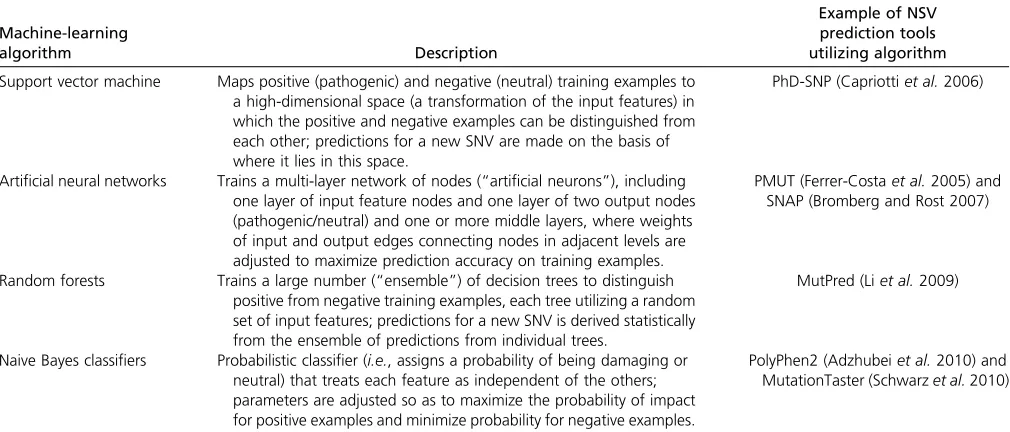
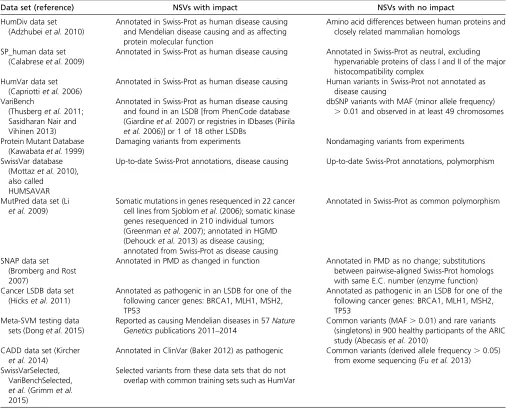
Moult 2001), it used a series of empirical rules to combine these various features into an overall prediction. These rules are rational and attempt to capture knowledge about the forces driving protein stability and function, but arbitrary in that there are many rational ways to combine the various features. Machine-learning techniques have been employed by many new NSV impact prediction tools to better integrate available features. The general approach is tofirst collect pre-determined positive (typically pathogenic NSVs) and negative (neutral NSVs) examples and“train”a“machine-learning pre-diction classifier” that effectively distinguishes between the positive and negative training examples. Training is typically accomplished by iteratively adjusting a computational repre-sentation of the input“features”(e.g., sequence conservation and structural features), so as to separate the positive from negative training examples to the greatest extent possible. Parameters of the prediction algorithms are then optimized using one or more cross-validation sets. Finally, performance of the prediction algorithm is analyzed on a test set to estimate its general applicability to new data and compare it with other methods. The first work of this kind employed a Bayesian network learning algorithm (Caiet al.2004), and the subse-quent decade has seen many variations on this basic theme. A growing number of machine-learning-based NSV impact pre-diction tools are now available. They differ from each other primarily in three ways: the type of machine-learning algorithm used, the set of input features that are considered, and the sets of NSVs of known (or inferred) effect that are used as training and test sets. Table 2 lists the main algorithms that have been employed and some representative NSV impact prediction methods that have utilized these algorithms. Table 3 lists rep-resentative NSV data sets that are used as training or test data sets of some machine-learning-based methods. The selection of training set and test set is very important for development of machine-learning tools and correct assessment of these tools.
performance assessment data sets contain NSVs on which some machine-learning methods have been trained. Even if these estimates are accurate, the performance improvement of machine-learning methods over non-machine-learning methods with few features such as SIFT, PANTHER-subPSEC, and MAPP, while significant, is not dramatic (accuracy im-provement on the order of a few percentage points). Indeed, after controlling for two types of circularity (see discussion of prediction assessment below), Grimm et al. (2015) found that the improvement of combined and meta-prediction methods, compared to conservation-based methods, is sub-stantially less dramatic than originally reported.
In addition to structural features that reflect effects on protein stability, other biological features have proved useful in identifying NSVs that impact protein function. For instance, including Gene Ontology functional class information in an SVM classifier SNPs&GO (Calabrese et al.2009) improved prediction rates by nearly 5% on the HumVar benchmark. MutPred (Liet al. 2009) includes a number of“functional” features that have been mapped to specific amino acids in the protein sequence, such as sites of post-translational modifi -cations (e.g., phosphorylation sites), DNA-binding sites, and catalytic active sites.
Meta-prediction Methods
Because a large number of tools perform quite well on existing benchmark tests, it is perhaps not surprising that meta-prediction methods that integrate the scores from multiple prediction methods have recently been developed. This approach is largely justified by numerous studies showing that, despite similar overall prediction accuracy, individual methods can disagree substantially for the same NSV. CONDEL (Gonzalez-Perez and Lopez-Bigas 2011) was the first meta-prediction method,
using a linear, weighted average of scores fromfive different prediction methods, to produce a final prediction. CAROL (Lopes et al. 2012) combines the predictions of SIFT and PolyPhen-2 using a linear, weighted Z-score. But because of their flexibility in handling multiple and diverse feature types, machine-learning approaches have become the most widely applied for constructing meta-predictors. An increas-ingly common approach has been to (1) evaluate multiple existing prediction methods, (2) select some number of top-performing methods relative to a given benchmark data set and a particular metric of performance, and (3) train a machine-learning classifier using as features the scores from each of the top-performing methods. PON-P was thefirst of these, integrating a conservation method (SIFT), a structural stability-based method (I-Mutant), and three combined machine-learning-based methods (SNAP, PolyPhen-2, PhD-SNP), using Random Forests to make afinal prediction (Olatubosun et al. 2012). Numerous other studies have since followed this general approach, such as Meta-SNP (Capriotti et al. 2013a), CoVEC (Frousios et al.2013), PredictSNP (Bendl et al.2014), and Meta-SVM (Donget al.2015). Taking the idea of producing a meta-prediction from multiple individ-ual prediction algorithms yet a step further, methods such as
CADD (Kircher et al. 2014) treat the output of any NSV
effect-prediction method as simply one type of“annotation” of a variant and then use an SVM-based approach to make a meta-prediction from a large list of diverse annotations.
Assessment of NSV Impact Predictions
Assessment of the accuracy of predictions is an increasingly important issue. Already in 2006, Ng and Henikoff observed that a wide variety of prediction methods were available, making it difficult for users such as medical geneticists to Table 2 Machine-learning algorithms used in NSV prediction and the specific tools developed using each algorithm
Machine-learning
algorithm Description
Example of NSV prediction tools utilizing algorithm
Support vector machine Maps positive (pathogenic) and negative (neutral) training examples to a high-dimensional space (a transformation of the input features) in which the positive and negative examples can be distinguished from each other; predictions for a new SNV are made on the basis of where it lies in this space.
PhD-SNP (Capriottiet al.2006)
Artificial neural networks Trains a multi-layer network of nodes (“artificial neurons”), including one layer of input feature nodes and one layer of two output nodes (pathogenic/neutral) and one or more middle layers, where weights of input and output edges connecting nodes in adjacent levels are adjusted to maximize prediction accuracy on training examples.
PMUT (Ferrer-Costaet al.2005) and SNAP (Bromberg and Rost 2007)
Random forests Trains a large number (“ensemble”) of decision trees to distinguish positive from negative training examples, each tree utilizing a random set of input features; predictions for a new SNV is derived statistically from the ensemble of predictions from individual trees.
MutPred (Liet al.2009)
Naive Bayes classifiers Probabilistic classifier (i.e., assigns a probability of being damaging or neutral) that treats each feature as independent of the others; parameters are adjusted so as to maximize the probability of impact for positive examples and minimize probability for negative examples.
know which methods to use and how to interpret different predictions for the same NSV (Ng and Henikoff 2006). The problem has become far greater today. Publication standards
in the field have generally demanded that a new method
must outperform at least the most popular existing methods on one or more of the widely used benchmark data sets. It is worth discussing the aims of these benchmarks (Table 3) to explore how they might be better used to drive progress in the field. The benchmarks generally fall into two classes: those that distinguish presumed disease-causing variants from variants that have been observed but not associated with disease, and those that distinguish between mutations with and without effect in an experimental assay. In thefirst class, presumed disease-causing variants have been obtained from comprehensive databases, most commonly Swiss-Prot (Mottazet al. 2010), but also OMIM (Hamoshet al. 2005) and HGMD (Stensonet al.2003) or from locus-specific data-bases [LSDBs, typically focusing on only a single human
gene, are reviewed in (Greenblattet al.2008)] such as the IARC TP53 database (Olivieret al.2002) and the BIC
data-base on BRCA1 and BRCA2 (Goldgar et al. 2004).
Non-disease-associated variants have been obtained in diverse ways: from substitutions between closely related orthologs (Ramensky et al.2002), from non-disease-associated hu-man variants reported in Swiss-Prot (Boeckhu-mannet al.2003), or from either all or common (e.g., a minor allele frequency
.1% in at least one population) human NSV alleles in a public resource like dbSNP (Sherry et al.2001). These sets of non-disease-associated variants are relatively comprehensive, cov-ering many genes and variants, but can be expected to have some degree of error simply because of our ignorance about the phenotypic effects of most alleles. Consequently, they are useful for statistical comparisons because they are expected to contain fewer NSVs with effects compared to the disease-associated sets, but any given NSV in the undisease-associated sets may actually have an impact on function.
Table 3 Representative data sets used to evaluate the performance of NSV impact predictions
Data set (reference) NSVs with impact NSVs with no impact
HumDiv data set (Adzhubeiet al.2010)
Annotated in Swiss-Prot as human disease causing and Mendelian disease causing and as affecting protein molecular function
Amino acid differences between human proteins and closely related mammalian homologs
SP_human data set (Calabreseet al.2009)
Annotated in Swiss-Prot as human disease causing Annotated in Swiss-Prot as neutral, excluding hypervariable proteins of class I and II of the major histocompatibility complex
HumVar data set (Capriottiet al.2006)
Annotated in Swiss-Prot as human disease causing Human variants in Swiss-Prot not annotated as disease causing
VariBench
(Thusberget al.2011; Sasidharan Nair and Vihinen 2013)
Annotated in Swiss-Prot as human disease causing and found in an LSDB [from PhenCode database (Giardineet al.2007) or registries in IDbases (Piirila
et al.2006)] or 1 of 18 other LSDBs
dbSNP variants with MAF (minor allele frequency)
.0.01 and observed in at least 49 chromosomes
Protein Mutant Database (Kawabataet al.1999)
Damaging variants from experiments Nondamaging variants from experiments
SwissVar database (Mottazet al.2010), also called
HUMSAVAR
Up-to-date Swiss-Prot annotations, disease causing Up-to-date Swiss-Prot annotations, polymorphism
MutPred data set (Li
et al.2009)
Somatic mutations in genes resequenced in 22 cancer cell lines from Sjoblomet al.(2006); somatic kinase genes resequenced in 210 individual tumors (Greenmanet al.2007); annotated in HGMD (Dehoucket al.2013) as disease causing; annotated from Swiss-Prot as disease causing
Annotated in Swiss-Prot as common polymorphism
SNAP data set (Bromberg and Rost 2007)
Annotated in PMD as changed in function Annotated in PMD as no change; substitutions between pairwise-aligned Swiss-Prot homologs with same E.C. number (enzyme function) Cancer LSDB data set
(Hickset al.2011)
Annotated as pathogenic in an LSDB for one of the following cancer genes: BRCA1, MLH1, MSH2, TP53
Annotated as pathogenic in an LSDB for one of the following cancer genes: BRCA1, MLH1, MSH2, TP53
Meta-SVM testing data sets (Donget al.2015)
Reported as causing Mendelian diseases in 57Nature Geneticspublications 2011–2014
Common variants (MAF.0.01) and rare variants (singletons) in 900 healthy participants of the ARIC study (Abecasiset al.2010)
CADD data set (Kircher
et al.2014)
Annotated in ClinVar (Baker 2012) as pathogenic Common variants (derived allele frequency.0.05) from exome sequencing (Fuet al.2013) SwissVarSelected,
VariBenchSelected,
et al.(Grimmet al. 2015)
Potential biases in these evaluation sets are important to identify, as they can lead to spurious assessments of the performance of NSV impact prediction methods. Grimm et al. (2015) recently characterized two such biases, which they call“type 1 and type 2 circularity.”Type 1 circularity is simply that the set of variants (both pathogenic and neutral) used to train a method can also appear in the evaluation set, leading to overinflation of prediction accuracy. Grimmet al. (2015) createdfiltered data sets for evaluation by removing variants that overlap with commonly used training sets, to create, for example, a SwissVarSelected and VariBenchSe-lected data set that minimizes the impact of type 1 circularity on prediction evaluation. Type 2 circularity is less obvious: evaluation sets tend to contain a large proportion of proteins for which the variants in the set are either all pathogenic or all neutral. Thus, a simple rule can outperform all existing pre-diction methods just by “gaming”the system, predicting all variants in a given protein as either pathogenic or neutral. This bias explains the large improvement in prediction accuracy achieved by FATHMM (Shihabet al.2013) when it includes (in addition to conservation) a term based on a particular pro-tein domain. Importantly, the bias leading to type 2 circularity is much more pronounced for some evaluation sets than for others: only 5% of variants in VariBenchSelected are found in proteins having both pathogenic and neutral variants in the set, while this is true of.25% of variants in SwissVarSelected. This analysis suggests that evaluations based on SwissVarSelected are likely to better reflect actual performance in real world applications, in which nearly all proteins can be expected to harbor both pathogenic and neutral variants. Taking this a step further, Grimmet al.(2015) also assess performance on subsets of SwissVarSelected, where proteins are grouped according to how well balanced the variants are in both pathogenic and neutral classes. Finally, this analysis suggests that LSDBs, the source of many VariBench variants, may suffer from systematic bias toward pathogenic variants.
The second class of evaluation sets, experimentally assayed effects of NSVs, is currently available for a very small number of proteins. These are mutagenesis studies, followed by an assay of function. The Protein Mutant Database contains a collection of.200,000 mutations, but unfortunately has not added data since 2003. Perhaps the most relevant assays are those based upon a direct fitness measurement, such as the growth of a microorganism containing either the wild-type or variant forms of a gene. Even when using such assays the number of NSVs impacting function may be underestimated: only a single
fixed environment is typically assayed, so it is likely that some NSVs that are apparently neutral in the assay actually do have
fitness effects under other conditions. Nevertheless such depth experimental studies afford the possibility of close in-spection of predictions on individual variants to potentially identify systematic errors. In addition to the classic mutagen-esis studies mentioned above, a few more recent studies have been carried out on specific proteins, such as cystathionine beta synthase (CBS) (Wei et al. 2010; Dimster-Denk et al. 2013) and methylenetetrahydofolate reductase (Mariniet al.
2010). Wei et al. identified eight mutations—of the .200 NSVs that they tested in CBS—that were consistently incor-rectly predicted by six different methods (Wei et al.2010), suggesting a systematic overprediction of effects arising from NSVs that involve mutation of a cysteine residue. For a differ-ent set of CBS mutants, Dimster-Denket al.(2013) found that predicted D-D-G changes of .4 kcal/mol from Rosetta (Kellogget al.2011) were predictive of loss of function, but for moderate changes no correlation was found between pre-dicted values and functional assay results.
Several authors have previously suggested that the field could benefit greatly from the assessment of truly blinded predictions at regular intervals, similarly to the Critical Assess-ment of Structure Prediction experiAssess-ments (Moultet al.2014) that proved their utility in thefield of protein structure pre-diction from primary amino acid sequence. The Critical Assess-ment of Genome Interpretation (CAGI) experiAssess-ment,first held in 2012–2013, included a challenge for interpretation of genet-ic variants. Unfortunately, thisfirst experiment has had limited impact on thefield to date, with no general publication de-scribing its results and few articles referencing it (a rare exam-ple is Chenet al.2014), but a new CAGI experiment was just completed in February of 2016 (https://genomeinterpretation. org). While results were not available at the time of press, the experiment certainly holds promise in this area.
It is also important to consider which metrics are applied to assess accuracy on a given benchmark. As Cline and Karchin (2011) pointed out, the optimal comparisons use a method like the Receiver Operating Characteristic (ROC), which considers equally both true positive (sensitivity or recall) and false positive (specificity or precision) prediction rates and considers all pos-sible thresholds in a quantitative manner. ROC analyses have dominated thefield since its early days, with area under the curve (AUC) becoming the most common metric for the accu-racy of predictions. It might be even more informative to follow the practice of other predictionfields that have focused on AUC for low false-positive rates [e.g., ,20% as in (Gribskov and Robinson 1996)] rather than the entire ROC curve, as these are the predictions that are most likely to be used in real world applications. Other accuracy measures such as the Matthews Correlation Coefficient and Balanced Error Rate are also useful but can depend on the threshold employed (Weiet al.2010). Finally, it is important to avoid conflating absence of a prediction with a prediction of absence of a functional effect. Nearly all prediction methods are unable to make predictions for some NSVs, and this number can vary widely between methods. While it is certainly useful to compare the prediction coverage for different methods, these comparisons should be kept distinct from the accuracy of predictions (e.g., Thusberg et al.2011; Shihabet al.2013) rather than included in a quasi-ROC analysis (e.g., Donget al.2015).
Conclusions and Prospects
research and continual improvement (Capriottiet al.2012). We have focused here on evolutionary conservation methods, combined methods using both conservation and structural features, and meta-prediction methods that make a unified prediction from multiple conservation, structural, or com-bined methods. These three classes are the most important for biomedical applications because they can be applied to a much larger number of SNVs, given that many human pro-teins currently have neither an experimentally determined structure nor a close homolog from which to build a model. Furthermore, in methods using both conservation-based and structure-based features, conservation has been repeat-edly found to be the single most informative feature (Ramenskyet al.2002; Bromberg and Rost 2007; Liet al. 2009). Recent efforts to overcome the limitations of previ-ous conservation-based metrics, such as considering amino acid physico-chemical similarity (Stone and Sidow 2005), subfamily-specific conservation (Thomas and Kejariwal 2004; Reva et al. 2011), and evolutionary reconstruction (Marini et al.2010) have shown that further improvement in this ap-proach is still possible. Incorporation of other potential im-provements, including but not limited to modeling lineage-specific selection, may hold further promise. Com-bined and meta-prediction methods have a large space of po-tential combinations of features, and even development of novel feature types, yet to explore. Incorporation of the more recent conservation-based methods as a feature in machine-learning-based predictors would also be a natural next step.
In addition to methodological improvements, the field would benefit from advances in at least three more areas. Thefirst area is reliable access to accurate predictions from multiple methods, which becomes increasingly important as the demand for variant interpretation grows. One could envision an integrated variant resource to address this need. Databases such as dbNSFP (Liuet al.2011), SNPdbe (Schaeferet al.2012), and the PON-P server (Niroulaet al. 2015) have begun to make progress in this area by including predictions for an increasing number of methods on an in-creasing number of variants. An integrated variant data re-source would also help to prevent problems in properly running each software package in a local environment, as well as issues with using an out-of-date version of a given software package. For example, we ran the PANTHER-subPSEC package locally on the same data set as reported in Shihabet al.(2013) and found that, surprisingly, the predic-tions for many variants did not match, possibly due to a bug or local installation problem with the software version used for the publication. Stable, shared data resources with persistent identifiers and versioning of predictions could have a dramatic effect on the accessibility, reproducibility, and utility of variant-effect prediction methods in biomedical applications.
The second area is further work on benchmark data sets, which are essential for accurate evaluation of prediction methods. As in nearly all domains of science, positive exam-ples are easier to establish than negative examexam-ples, but gold standard sets of both pathogenic and neutral variants are
required. The recent work of Grimmet al.(2015) represents a significant step toward developing such sets, butfiltering out biased variants necessarily reduces the size and statistical power of the evaluation set. A focused effort in producing additional benchmark data sets, particularly those based on experimental mutagenesis under multiple conditions, could potentially address this issue. As described above, some more recent data sets of this kind have been generated (Mariniet al. 2010; Dimster-Denket al.2013) but a more comprehensive set of mutations in a larger number of proteins is needed.
The third area is supporting more systematic approaches to new method development: developers of new prediction methods attempt, whenever possible, to critically assess why performance is improved over previous methods. This could entail comparing the performance of a new method to a baseline for that method that keeps all other variablesfixed, such as the set of training examples, multiple alignments, etc. For machine-learning methods, this could also entail an effort to report and, ideally, standardize training sets and test sets. Several recent articles have demonstrated this principle par-ticularly well. For example, for SNPs&GO (Capriotti et al. 2013b) the same learning procedure was followed with and without the additional Gene Ontology information (Ashburner et al.2000) to quantitate the improvement in prediction accu-racy from this one additional data source. SNAP2 (Hechtet al. 2015) reported results for multiple different machine-learning methods using the same set of features. The FATHMM article (Shihabet al.2013) reported the performance of their method before and after incorporating protein domain-specific patho-genicity weights. There are numerous other cases in the litera-ture, and consistent adherence to such systematic analyses will help drive further improvements, and even suggest fruit-ful combinations of existing methods. For example, the un-weighted sequence, conservation-based method used by FATHMM performed worse than other conservation-based methods, suggesting that the same weighting (notwithstand-ing circularity issues discussed above) could be added to these other conservation-based methods to produce even better overall prediction rates.
causal variants in human disease (Lewingeret al.2007; O’Fallon et al.2013; Deoet al.2014). The medical genetics applications envisioned in the early days of NSV prediction are only just beginning, and further improvements in prediction accuracy and availability will be required to help realize their full potential.
Acknowledgments
We thank Emidio Capriotti and Jasper Rine for critical reading of this manuscript and helpful discussions.
Literature Cited
Abecasis, G. R., D. Altshuler, A. Auton, L. D. Brooks, R. M. Durbin
et al., 2010 A map of human genome variation from popula-tion-scale sequencing. Nature 467: 1061–1073.
Abecasis, G. R., A. Auton, L. D. Brooks, M. A. DePristo, R. M. Durbin
et al., 2012 An integrated map of genetic variation from 1,092 human genomes. Nature 491: 56–65.
Adzhubei, I. A., S. Schmidt, L. Peshkin, V. E. Ramensky, A. Gerasimova
et al., 2010 A method and server for predicting damaging mis-sense mutations. Nat. Methods 7: 248–249.
Altschul, SF, W Gish, W Miller, E W Myers, and D J Lipman, 1990 Basic local alignment search tool. J. Mol. Biol. 215(3): 403–410 Altschul, S. F., T. L. Madden, A. A. Schaffer, J. Zhang, Z. Zhang
et al., 1997 Gapped BLAST and PSI-BLAST: a new generation of protein database search programs. Nucleic Acids Res. 25: 3389–3402.
Ashburner, M., C. A. Ball, J. A. Blake, D. Botstein, H. Butleret al., 2000 Gene ontology: tool for the unification of biology. The Gene Ontology Consortium. Nat. Genet. 25: 25–29.
Baker, M., 2012 One-stop shop for disease genes. Nature 491: 171.
Barenboim, M., and T. Manke, 2013 ChroMoS: an integrated web tool for SNP classification, prioritization and functional interpre-tation. Bioinformatics 29: 2197–2198.
Barenboim, M., B. J. Zoltick, Y. Guo, and D. R. Weinberger, 2010 MicroSNiPer: a web tool for prediction of SNP effects on putative microRNA targets. Hum. Mutat. 31: 1223–1232. Barrett, C., R. Hughey, and K. Karplus, 1997 Scoring hidden
Markov models. Comput. Appl. Biosci. 13: 191–199. Bendl, J., J. Stourac, O. Salanda, A. Pavelka, E. D. Wiebenet al.,
2014 PredictSNP: robust and accurate consensus classifier for prediction of disease-related mutations. PLOS Comput. Biol. 10: e1003440.
Benedix, A., C. M. Becker, B. L. de Groot, A. Caflisch, and R. A. Bockmann, 2009 Predicting free energy changes using struc-tural ensembles. Nat. Methods 6: 3–4.
Boeckmann, B., A. Bairoch, R. Apweiler, M. C. Blatter, A. Estreicher
et al., 2003 The SWISS-PROT protein knowledgebase and its supplement TrEMBL in 2003. Nucleic Acids Res. 31: 365–370. Bridgham, J. T., E. A. Ortlund, and J. W. Thornton, 2009 An
epistatic ratchet constrains the direction of glucocorticoid recep-tor evolution. Nature 461: 515–519.
Bromberg, Y., and B. Rost, 2007 SNAP: predict effect of non-synonymous polymorphisms on function. Nucleic Acids Res. 35: 3823–3835.
Buetow, K. H., M. N. Edmonson, and A. B. Cassidy, 1999 Reliable identification of large numbers of candidate SNPs from public EST data. Nat. Genet. 21: 323–325.
Cai, Z., E. F. Tsung, V. D. Marinescu, M. F. Ramoni, A. Rivaet al., 2004 Bayesian approach to discovering pathogenic SNPs in conserved protein domains. Hum. Mutat. 24: 178–184.
Calabrese, R., E. Capriotti, P. Fariselli, P. L. Martelli, and R. Casa-dio, 2009 Functional annotations improve the predictive score of human disease-related mutations in proteins. Hum. Mutat. 30: 1237–1244.
Campbell, I. M., C. A. Shaw, P. Stankiewicz, and J. R. Lupski, 2015 Somatic mosaicism: implications for disease and trans-mission genetics. Trends Genet. 31: 382–392.
Cancer Genome Atlas Research Network, 2008 Comprehensive genomic characterization defines human glioblastoma genes and core pathways. Nature 455: 1061–1068.
Capriotti, E., P. Fariselli, and R. Casadio, 2005 I-Mutant2.0: pre-dicting stability changes upon mutation from the protein se-quence or structure. Nucleic Acids Res. 33: W306–W310. Capriotti, E., R. Calabrese, and R. Casadio, 2006 Predicting the
insurgence of human genetic diseases associated to single point protein mutations with support vector machines and evolution-ary information. Bioinformatics 22: 2729–2734.
Capriotti, E., N. L. Nehrt, M. G. Kann, and Y. Bromberg, 2012 Bioinformatics for personal genome interpretation. Brief. Bioinform. 13: 495–512.
Capriotti, E., R. B. Altman, and Y. Bromberg, 2013a Collective judgment predicts disease-associated single nucleotide variants. BMC Genomics 14(Suppl 3): S2.
Capriotti, E., R. Calabrese, P. Fariselli, P. L. Martelli, R. B. Altman
et al., 2013b WS-SNPs&GO: a web server for predicting the deleterious effect of human protein variants using functional annotation. BMC Genomics 14(Suppl 3): S6.
Cargill, M., D. Altshuler, J. Ireland, P. Sklar, K. Ardlie et al., 1999 Characterization of single-nucleotide polymorphisms in coding regions of human genes. Nat. Genet. 22: 231–238. Chasman, D., and R. M. Adams, 2001 Predicting the functional
consequences of non-synonymous single nucleotide polymor-phisms: structure-based assessment of amino acid variation. J. Mol. Biol. 307: 683–706.
Chen, Y. C., C. Douville, C. Wang, N. Niknafs, G. Yeo et al., 2014 A probabilistic model to predict clinical phenotypic traits from genome sequencing. PLOS Comput. Biol. 10: e1003825. Cline, M. S., and R. Karchin, 2011 Using bioinformatics to predict
the functional impact of SNVs. Bioinformatics 27: 441–448. Collins, F. S., L. D. Brooks, and A. Chakravarti, 1998 A DNA
poly-morphism discovery resource for research on human genetic variation. Genome Res. 8: 1229–1231.
Compiani, M., and E. Capriotti, 2013 Computational and theoret-ical methods for protein folding. Biochemistry 52: 8601–8624. Cooper, G. M., E. A. Stone, G. Asimenos, E. D. Green, S. Batzoglou
et al., 2005 Distribution and intensity of constraint in mam-malian genomic sequence. Genome Res. 15: 901–913. Cotton, R. G., A. D. Auerbach, M. Axton, C. I. Barash, S. F. Berkovic
et al., 2008 GENETICS. The Human Variome Project. Science 322: 861–862.
Dayhoff, M. O., R. M. Schwartz, and B. C. Orcutt, 1978 A model of evolutionary change in proteins. Atlas Prot. Sequence Struct.
5:345–351.
Dehouck, Y., J. Kwasigroch, M. Rooman, and D. Gilis, 2013 BeAtMuSiC: prediction of changes in protein-protein bind-ing affinity on mutations. Nucleic Acids Res. 41: W333–W339. Deo, R. C., G. Musso, M. Tasan, P. Tang, A. Poon et al.,
2014 Prioritizing causal disease genes using unbiased genomic features. Genome Biol. 15: 534.
Dimster-Denk, D., K. W. Tripp, N. J. Marini, S. Marqusee, and J. Rine, 2013 Mono and dual cofactor dependence of human cystathionine beta-synthase enzyme variants in vivo and in vitro. G3 (Bethesda) 3: 1619–1628.
Encode Project Consortium, 2012 An integrated encyclopedia of DNA elements in the human genome. Nature 489: 57–74. Fernald, G. H., E. Capriotti, R. Daneshjou, K. J. Karczewski, and R.
B. Altman, 2011 Bioinformatics challenges for personalized medicine. Bioinformatics 27: 1741–1748.
Ferrer-Costa, C., J. L. Gelpi, L. Zamakola, I. Parraga, X. de la Cruz
et al., 2005 PMUT: a web-based tool for the annotation of pathological mutations on proteins. Bioinformatics 21: 3176– 3178.
Fitch, W. M., 1970 Distinguishing homologous from analogous proteins. Syst. Zool. 19: 99–113.
Frousios, K., C. S. Iliopoulos, T. Schlitt, and M. A. Simpson, 2013 Predicting the functional consequences of non-synonymous DNA sequence variants: evaluation of bioinformatics tools and development of a consensus strategy. Genomics 102: 223–228.
Fu, W., T. D. O’Connor, G. Jun, H. M. Kang, G. Abecasiset al., 2013 Analysis of 6,515 exomes reveals the recent origin of most human protein-coding variants. Nature 493: 216–220. Giardine, B., C. Riemer, T. Hefferon, D. Thomas, F. Hsu et al.,
2007 PhenCode: connecting ENCODE data with mutations and phenotype. Hum. Mutat. 28: 554–562.
Goldgar, D. E., D. F. Easton, A. M. Deffenbaugh, A. N. A. Monteiro, S. V. Tavtigianet al., 2004 Integrated evaluation of DNA se-quence variants of unknown clinical significance: application to BRCA1 and BRCA2. Am. J. Hum. Genet. 75: 535–544. Gonzalez-Perez, A., and N. Lopez-Bigas, 2011 Improving the
as-sessment of the outcome of nonsynonymous SNVs with a con-sensus deleteriousness score, Condel. Am. J. Hum. Genet. 88: 440–449.
Grantham, R., 1974 Amino acid difference formula to help ex-plain protein evolution. Science 185: 862–864.
Greenblatt, M. S., L. C. Brody, W. D. Foulkes, M. Genuardi, R. M. Hofstra et al., 2008 Locus-specific databases and recommen-dations to strengthen their contribution to the classification of variants in cancer susceptibility genes. Hum. Mutat. 29: 1273– 1281.
Greenman, C., P. Stephens, R. Smith, G. L. Dalgliesh, C. Hunter
et al., 2007 Patterns of somatic mutation in human cancer genomes. Nature 446: 153–158.
Gribskov, M., 1994 Profile analysis. Methods Mol. Biol. 25: 247– 266.
Gribskov, M., and N. L. Robinson, 1996 Use of receiver operating characteristic (ROC) analysis to evaluate sequence matching. Comput. Chem. 20: 25–33.
Grimm, D. G., C. A. Azencott, F. Aicheler, U. Gieraths, D. G. Mac-Arthuret al., 2015 The evaluation of tools used to predict the impact of missense variants is hindered by two types of circu-larity. Hum. Mutat. 36: 513–523.
Guerois, R., J. E. Nielsen, and L. Serrano, 2002 Predicting changes in the stability of proteins and protein complexes: a study of more than 1000 mutations. J. Mol. Biol. 320: 369–387. Halushka, M. K., J. B. Fan, K. Bentley, L. Hsie, N. Shen et al., 1999 Patterns of single-nucleotide polymorphisms in candi-date genes for blood-pressure homeostasis. Nat. Genet. 22: 239–247.
Hamosh, A., A. F. Scott, J. S. Amberger, C. A. Bocchini, and V. A. McKusick, 2005 Online Mendelian Inheritance in Man (OMIM), a knowledgebase of human genes and genetic disor-ders. Nucleic Acids Res. 33: D514–D517.
Hecht, M., Y. Bromberg, and B. Rost, 2015 Better prediction of functional effects for sequence variants. BMC Genomics 16: S1. Henikoff, S., and J. G. Henikoff, 1992 Amino acid substitution matrices from protein blocks. Proc. Natl. Acad. Sci. USA 89: 10915–10919.
Henikoff, S., and J. G. Henikoff, 1994 Position-based sequence weights. J. Mol. Biol. 243: 574–578.
Hicks, S., D. A. Wheeler, S. E. Plon, and M. Kimmel, 2011 Prediction of missense mutation functionality depends on both the algorithm and sequence alignment employed. Hum. Mutat. 32: 661–668.
International HapMap Consortium, 2005 A haplotype map of the human genome. Nature 437: 1299–1320.
Jones, D. T., W. R. Taylor, and J. M. Thornton, 1992 The rapid generation of mutation data matrices from protein sequences. Comput. Appl. Biosci. 8: 275–282.
Karchin, R., 2009 Next generation tools for the annotation of human SNPs. Brief. Bioinform. 10: 35–52.
Kawabata, T., M. Ota, and K. Nishikawa, 1999 The Protein Mu-tant Database. Nucleic Acids Res. 27: 355–357.
Kellogg, E. H., A. Leaver-Fay, and D. Baker, 2011 Role of confor-mational sampling in computing mutation-induced changes in protein structure and stability. Proteins 79: 830–838.
Kircher, M., D. M. Witten, P. Jain, B. J. O’Roak and G. M. Cooper, 2014 A general framework for estimating the relative patho-genicity of human genetic variants. 46:310–315.
Kondrashov, A. S., S. Sunyaev, and F. A. Kondrashov, 2002 Dobzhansky-Muller incompatibilities in protein evolu-tion. Proc. Natl. Acad. Sci. USA 99: 14878–14883.
Kulathinal, R. J., B. R. Bettencourt, and D. L. Hartl, 2004 Compensated deleterious mutations in insect genomes. Science 306: 1553–1554.
Lewinger, J. P., D. V. Conti, J. W. Baurley, T. J. Triche, and D. C. Thomas, 2007 Hierarchical Bayes prioritization of marker as-sociations from a genome-wide association scan for further in-vestigation. Genet. Epidemiol. 31: 871–882.
Li, B., V. G. Krishnan, M. E. Mort, F. Xin, K. K. Kamati et al., 2009 Automated inference of molecular mechanisms of dis-ease from amino acid substitutions. Bioinformatics 25: 2744– 2750.
Liao, B. Y., and J. Zhang, 2007 Mouse duplicate genes are as essential as singletons. Trends Genet. 23: 378–381.
Liu, X., X. Jian, and E. Boerwinkle, 2011 dbNSFP: a lightweight database of human nonsynonymous SNPs and their functional predictions. Hum. Mutat. 32: 894–899.
Loeb, D. D., R. Swanstrom, L. Everitt, M. Manchester, S. E. Stamper
et al., 1989 Complete mutagenesis of the HIV-1 protease. Na-ture 340: 397–400.
Lopes, M. C., C. Joyce, G. R. Ritchie, S. L. John, F. Cunningham
et al., 2012 A combined functional annotation score for non-synonymous variants. Hum. Hered. 73: 47–51.
Macintyre, G., J. Bailey, I. Haviv, and A. Kowalczyk, 2010 is-rSNP: a novel technique for in silico regulatory SNP detection. Bioin-formatics 26: i524–i530.
Marini, N. J., P. D. Thomas, and J. Rine, 2010 The use of orthologous sequences to predict the impact of amino acid substitutions on protein function. PLoS Genet. 6: e1000968.
Markiewicz, P., L. G. Kleina, C. Cruz, S. Ehret, and J. H. Miller, 1994 Genetic studies of the lac repressor. XIV. Analysis of 4000 altered Escherichia coli lac repressors reveals essential and non-essential residues, as well as“spacers”which do not require a specific sequence. J. Mol. Biol. 240: 421–433. Masso, M., and I. I. Vaisman, 2010 AUTO-MUTE: web-based tools
for predicting stability changes in proteins due to single amino acid replacements. Protein Eng. Des. Sel. 23: 683–687. Miller, M. P., and S. Kumar, 2001 Understanding human disease
mutations through the use of interspecific genetic variation. Hum. Mol. Genet. 10: 2319–2328.
Mottaz, A., F. P. David, A. L. Veuthey, and Y. L. Yip, 2010 Easy retrieval of single amino-acid polymorphisms and phenotype information using SwissVar. Bioinformatics 26: 851–852. Moult, J., K. Fidelis, A. Kryshtafovych, T. Schwede, and A. Tramontano,
Ng, P. C., and S. Henikoff, 2001 Predicting deleterious amino acid substitutions. Genome Res. 11: 863–874.
Ng, P. C., and S. Henikoff, 2006 Predicting the effects of amino acid substitutions on protein function. Annu. Rev. Genomics Hum. Genet. 7: 61–80.
Niroula, A., S. Urolagin, and M. Vihinen, 2015 PON-P2: predic-tion method for fast and reliable identification of harmful vari-ants. PLoS One 10: e0117380.
O’Fallon, B. D., W. Wooderchak-Donahue, P. Bayrak-Toydemir, and D. Crockett, 2013 VarRanker: rapid prioritization of sequence variations associated with human disease. BMC Bioinformatics 14(Suppl 13): S1.
Ohno, S., 1970 Evolution by Gene Duplication. Springer-Verlag, New York.
Olatubosun, A., J. Valiaho, J. Harkonen, J. Thusberg, and M. Vihinen, 2012 PON-P: integrated predictor for pathogenicity of missense variants. Hum. Mutat. 33: 1166–1174.
Olivier, M., R. Eeles, M. Hollstein, M. A. Khan, C. C. Harriset al., 2002 The IARC TP53 database: new online mutation analysis and recommendations to users. Hum. Mutat. 19: 607–614. Pazdrak, K., T. Adachi, and R. Alam, 1997 Src homology 2 protein
tyrosine phosphatase (SHPTP2)/Src homology 2 phosphatase 2 (SHP2) tyrosine phosphatase is a positive regulator of the in-terleukin 5 receptor signal transduction pathways leading to the prolongation of eosinophil survival. J. Exp. Med. 186: 561–568. Pearson, WR, and D J Lipman, 1988 Improved tools for biolog-ical sequence comparison. Proc. Natl. Acad. Sci. USA 85: 2444–2448
Piirila, H., J. Valiaho, and M. Vihinen, 2006 Immunodeficiency mutation databases (IDbases). Hum. Mutat. 27: 1200–1208. Pokala, N., and T. M. Handel, 2005 Energy functions for protein
design: adjustment with protein-protein complex affinities, models for the unfolded state, and negative design of solubility and specificity. J. Mol. Biol. 347: 203–227.
Pollard, K. S., M. J. Hubisz, K. R. Rosenbloom, and A. Siepel, 2010 Detection of nonneutral substitution rates on mamma-lian phylogenies. Genome Res. 20: 110–121.
Potapov, V., M. Cohen, and G. Schreiber, 2009 Assessing compu-tational methods for predicting protein stability upon mutation: good on average but not in the details. Protein Eng. Des. Sel. 22: 553–560.
Ramensky, V., P. Bork, and S. Sunyaev, 2002 Human non-synonymous SNPs: server and survey. Nucleic Acids Res. 30: 3894–3900.
Reva, B., Y. Antipin, and C. Sander, 2011 Predicting the functional impact of protein mutations: application to cancer genomics. Nucleic Acids Res. 39: e118.
Rohl, C. A., C. E. Strauss, K. M. Misura, and D. Baker, 2004 Protein structure prediction using Rosetta. Methods En-zymol. 383: 66–93.
Sasidharan Nair, P., and M. Vihinen, 2013 VariBench: a bench-mark database for variations. Hum. Mutat. 34: 42–49. Schaefer, C., A. Meier, B. Rost, and Y. Bromberg, 2012 SNPdbe:
constructing an nsSNP functional impacts database. Bioinfor-matics 28: 601–602.
Schwarz, J. M., C. Rodelsperger, M. Schuelke, and D. Seelow, 2010 MutationTaster evaluates disease-causing potential of sequence alterations. Nat. Methods 7: 575–576.
Shendure, J., and J. M. Akey, 2015 The origins, determinants, and consequences of human mutations. Science 349: 1478–1483. Sherry, S. T., M. H. Ward, M. Kholodov, J. Baker, L. Phanet al.,
2001 dbSNP: the NCBI database of genetic variation. Nucleic Acids Res. 29: 308–311.
Shihab, H. A., J. Gough, D. N. Cooper, P. D. Stenson, G. L. Barker
et al., 2013 Predicting the functional, molecular, and pheno-typic consequences of amino acid substitutions using hidden Markov models. Hum. Mutat. 34: 57–65.
Siepel, A., G. Bejerano, J. S. Pedersen, A. S. Hinrichs, M. Houet al., 2005 Evolutionarily conserved elements in vertebrate, insect, worm, and yeast genomes. Genome Res. 15: 1034–1050. Sippl, M. J., 1990 Calculation of conformational ensembles from
potentials of mean force. An approach to the knowledge-based prediction of local structures in globular proteins. J. Mol. Biol. 213: 859–883.
Sjoblom, T., S. Jones, L. D. Wood, D. W. Parsons, J. Lin et al., 2006 The consensus coding sequences of human breast and colorectal cancers. Science 314: 268–274.
Sjolander, K., K. Karplus, M. Brown, R. Hughey, A. Krogh et al., 1996 Dirichlet mixtures: a method for improved detection of weak but significant protein sequence homology. Comput. Appl. Biosci. 12: 327–345.
Stenson, P. D., E. V. Ball, M. Mort, A. D. Phillips, J. A. Shielet al., 2003 Human Gene Mutation Database (HGMD): 2003 update. Hum. Mutat. 21: 577–581.
Stone, E. A., and A. Sidow, 2005 Physicochemical constraint vio-lation by missense substitutions mediates impairment of protein function and disease severity. Genome Res. 15: 978–986. Sunyaev, S. R., F. Eisenhaber, I. V. Rodchenkov, B. Eisenhaber, V. G.
Tumanyanet al., 1999 PSIC: profile extraction from sequence alignments with position-specific counts of independent obser-vations. Protein Eng. 12: 387–394.
Tang, H., and P. D. Thomas, 2016 PANTHER-PSEP: predicting disease-causing mutations using position-specific evolutionary preservation. Bioinformatics.
Thomas, P. D., and A. Kejariwal, 2004 Coding single-nucleotide polymorphisms associated with complexvs.Mendelian disease: evolutionary evidence for differences in molecular effects. Proc. Natl. Acad. Sci. USA 101: 15398–15403.
Thomas, P. D., M. J. Campbell, A. Kejariwal, H. Mi, B. Karlaket al., 2003 PANTHER: a library of protein families and subfamilies indexed by function. Genome Res. 13: 2129–2141.
Thusberg, J., A. Olatubosun, and M. Vihinen, 2011 Performance of mutation pathogenicity prediction methods on missense var-iants. Hum. Mutat. 32: 358–368.
UniProt Consortium, 2011 Ongoing and future developments at the Universal Protein Resource. Nucleic Acids Res. 39: D214– D219.
Wang, Z., and J. Moult, 2001 SNPs, protein structure, and dis-ease. Hum. Mutat. 17: 263–270.
Wei, Q., L. Wang, Q. Wang, W. D. Kruger, and R. L. Dunbrack, Jr.., 2010 Testing computational prediction of missense mutation phenotypes: functional characterization of 204 mutations of hu-man cystathionine beta synthase. Proteins 78: 2058–2074. Yang, Z., 1997 PAML: a program package for phylogenetic
anal-ysis by maximum likelihood. Comput. Appl. Biosci. 13: 555– 556.
Yue, P., E. Melamud, and J. Moult, 2006 SNPs3D: candidate gene and SNP selection for association studies. BMC Bioinformatics 7: 166.
Zhao, Y., W. T. Clark, M. Mort, D. N. Cooper, P. Radivojacet al., 2011 Prediction of functional regulatory SNPs in monogenic and complex disease. Hum. Mutat.32:1183–1190.
Zuckerkandl, E., and L. Pauling, 1962 Molecular disease, evolu-tion and genic heterogenetity, pp. 189–225 inHorizons in