ISSN (Online) : 2319 - 8753
ISSN (Print) : 2347 - 6710
I
nternationalJ
ournal ofI
nnovativeR
esearch inS
cience,E
ngineering andT
echnologyAn ISO 3297: 2007 Certified Organization Volume 4, Special Issue 1, February 2015 THIRD NATIONAL CONFERENCE ON ADVANCES IN CHEMISTRY (NCAC – 2015)
On 18th February 2015 Organized by
Department of Chemistry, Easwari Engineering College (SRM Group of Institutions), Chennai-600089, India.
Inhibitory Effect of SPT and Phosphonic acids
controlling the Corrosion of Carbon Steel in
Neutral Environment
B.Balanaga karthik
1, C.Thangavelu
2Department of Chemistry, SRR Engineering College, Padur, Chennai, TN, India1
Associate Professor, Department of Chemistry, Government Arts College for women, Nilakkottai, TN, India2
ABSTRACT: The corrosion characteristics of carbon steel were investigated in the 60 ppm Cl- for a period of 3 days immersion in presence and absence of Zinc ions. This work comprises of laboratory studies. The experimental method included determination of corrosion rate by weight-loss method, EIS and Polarization studies. A large increase in charge transfer resistance and also decrease in double layer capacitance indicates that the formation of protective film on the surface. The ternary inhibitor system functions as an anodic inhibitor which is confirmed by Polarization study. The 25 ppm of SPT, 50 ppm DTPMP and 10 ppm Zn2+ gives maximum Inhibition Efficiency (IE) of 93%. The surface morphology of carbon steel was confirmed by SEM and AFM analysis.
KEYWORDS: Carbon steel, EIS, SEM, AFM, neutral environment
KEYWORDS:Carbon steel, EIS, SEM, AFM, Neutral environment
I. INTRODUCTION
The principles and choice of corrosion inhibitor in recent years have begun taking into account health and safety considerations. The use of harmful chemical substance has been constrained with no contact with the environment. Now a days the search of non-toxic, eco-friendly corrosion inhibitors in essential for cooling water systems. Several inhibitors are used for corrosion inhibition of carbon steel. Among that the very important corrosion inhibitors for the inhibition of carbon steel is phosphonic acids. In economical point of view, it is not cheap one. So the combination of some of the additives are reduces the cost. In the present study, ((Diethylenetriamine penta(methylene phosphonic acid (DTPMP) used as inhibitor and Sodium Potassium Tartrate (SPT) and Zinc ions are used as additives which reduces the cost of inhibitors and also increases the inhibition action. The environment chosen for the study is 60 ppm Cl- . Many phosphonic acids have been reported for the inhibition of corrosion such as ATMP [1], DTPMP [2], PPA [3], HEDP [4]. The phosphonic acids chosen for the purpose is they are good complexing agents, eco-friendly non-toxic in nature.
II. MATERIALSANDMETHODS
Preparation of Carbon Steel specimen
Carbon Steel samples with the composition (C – 0.188 % , S – 0.016 %, Si – 0.346 %,Mn – 1.15%, P – 0.036 %, Cr – 0.557 %, Mo – 0.225 %, Ni – 0.0847 %, Al – 0.0417 %, Cu- 0.0342 %, Ti- 0.0149 %, V –0.0313 %, Pb- 0.0006 % and rest Iron 97.27%) were used for weight-loss study and electrochemical measurements, specimen of the size 1.0 cm x 0.2 cm x 4.0 cm were cut, polished to mirror finish by table grinding wheels, degreased with Trichloroethylene. The environment chosen for the study is 60 ppm Cl-.
PREPARATION OF SOLUTIONS: Phosphonic acid (DTPMP)
ISSN (Online) : 2319 - 8753
ISSN (Print) : 2347 - 6710
I
nternationalJ
ournal ofI
nnovativeR
esearch inS
cience,E
ngineering andT
echnologyAn ISO 3297: 2007 Certified Organization Volume 4, Special Issue 1, February 2015 THIRD NATIONAL CONFERENCE ON ADVANCES IN CHEMISTRY (NCAC – 2015)
On 18th February 2015 Organized by
Department of Chemistry, Easwari Engineering College (SRM Group of Institutions), Chennai-600089, India.
Scheme 1: Schematic representation of DTPMP
Scheme 2: Schematic representation of SPT
Sodium Potassium Tartrate (SPT) Solution
0.5 g of SPT was dissolved in triple distilled water and made it up to 100 mL in a standard measuring flask. 1 mL of this solution was diluted to 100 mL to get 50 ppm of Sodium Potassium Tartrate.
Zinc Sulphate solution
Exactly 0.44 g of Zinc sulphate was dissolved in triple-distilled water and makes it up to 1 litre. A hundred – fold dilution yields exactly 10 ppm of Zn2+ ion concentration.
WEIGHT – LOSS MEASUREMENT
Carbon Steel specimen in Triplicate were immersed in 60 ppm Cl- with and without inhibitor. After the immersion period is over specimens were taken out, rinsed in running tap water and kept in a desiccators. The corrosion products were cleaned with Clark’s solution [5]. Then Weight – loss determined in order to calculate the Inhibition Efficiency and Corrosion Rate (CR) using the following formulae.
Wo – Wi
IE = --- x 100 Wo
Where,
Wo = Weight – loss in absence of an inhibitor, Wi = Weight – loss in presence of an inhibitor.
534 X Loss in Weight (mg)
CR = --- (mpy) D (g/cm3) X A (in2) X T (Hrs)
D – Density of the metal specimen (g/cm3), A – Area of the specimen in in2, T – Immersion time in Hours
SURFACE EXAMINATION STUDIES
ISSN (Online) : 2319 - 8753
ISSN (Print) : 2347 - 6710
I
nternationalJ
ournal ofI
nnovativeR
esearch inS
cience,E
ngineering andT
echnologyAn ISO 3297: 2007 Certified Organization Volume 4, Special Issue 1, February 2015 THIRD NATIONAL CONFERENCE ON ADVANCES IN CHEMISTRY (NCAC – 2015)
On 18th February 2015 Organized by
Department of Chemistry, Easwari Engineering College (SRM Group of Institutions), Chennai-600089, India.
ELECTROCHEMICAL STUDIES Electrochemical Impedance Spectra:
The electrochemical measurements presented in this study were performed using the Electrochemical Workstation (Model No. CHI760, CH Instruments, USA). Prior to the electrochemical measurements, the metal specimens were prepared according to the above described procedure. The real part (Z’) and the imaginary part (Z”) of the cell impedance were measured. The Charge transfer resistance (Rct) and Double layer Capacitance (Cdl) value [6] were
measured using the following relation.
1 Cdl = ---
2 Π Rct fmax
Polarization Study:
The measurements were carried out using corrosion measurements system Electrochemical Workstation (Model No. CHI760 D, CH Instruments, USA). A three electrode cell assembly was used. The working electrode used was a rectangular specimen of carbon steel, with one face of the electrode of constant 1 cm2 area exposed and the rest being shielded with araldite. A rectangular platinum foil was used as the counter electrode. The area of the counter electrode was much larger compared to the area of the working electrode. This can exert a uniform potential field on the working electrode and minimize the polarization effect on the counter. The reference electrode used was saturated calomel electrode (SCE). The reference electrode was placed close to the working electrode to minimize iR contribution. A time interval of about 5 to 10 min was given for the working electrode to attain a steady state open circuit potential. The results such as inhibition efficiency, Tafel slopes, Ecorr and icorr [7] values are presented.
SURFACE EXAMINATION STUDIES Scanning Electron Microscope (SEM)
Surface analysis was carried out using Scanning Electron Microscope (SEM). The Carbon steel specimens were immersed in 60 ppm Cl- solution without and with inhibitor for about 1 day. After one day, immersed specimens were taken out from the test solution, cleaned with double distilled water and dried at room temperature. A SEM [8, 9] experiment was performed by using a model JSM 6390 Scanning Electron Microscope.
Atomic Force Microscopy (AFM) Analysis
The Carbon steel specimens immersed in various test solutions for 1 day were taken out, rinsed with double distilled water, dried and subjected to the surface examination. The surface morphology AFM [10, 11] measurement of Carbon Steel surface was analysed by XIE-Instrument atomic force microscopy.
III.RESULTSANDDISCUSSION
Evaluation of improvement of IE of Sodium Potassium Tartrate with Zn2+
Sodium potassium Tartrate (SPT) in corrosion control of carbon steel immersed in 60 ppm Cl– for a period of 3 days in the absence and the presence of Zn2+. The Inhibition Efficiency (IE) and Corrosion Rate (CR) are given in Table 1. It shows that SPT and Zn2+ alone have some IE. In the absence of SPT, the rate of transport of Zn2+from the bulk of the solution towards the metal surface is slower than the rate of corrosion process on the metal surface. Hence the lower corrosion inhibition takes place in the absence of SPT. When SPT is combined with Zn2+ions the increase of IE is observed. 25 ppm SPT has only 8 % IE and 10 ppm Zn2+ has only 24 %. But their combination shows 45 % IE. This suggests a synergistic effect between the binary inhibitor formulation SPT and Zn2+ ions; SPT is able to transport Zn2+ towards the metal surface.
ISSN (Online) : 2319 - 8753
ISSN (Print) : 2347 - 6710
I
nternationalJ
ournal ofI
nnovativeR
esearch inS
cience,E
ngineering andT
echnologyAn ISO 3297: 2007 Certified Organization Volume 4, Special Issue 1, February 2015 THIRD NATIONAL CONFERENCE ON ADVANCES IN CHEMISTRY (NCAC – 2015)
On 18th February 2015 Organized by
Department of Chemistry, Easwari Engineering College (SRM Group of Institutions), Chennai-600089, India.
Table 1 The Corrosion rate (CR) and Inhibition Efficiency (IE) of carbon steel in absence and presence of inhibitor in 60 ppm Cl- by weight – loss method.
SPT ppm
Zn2+ Ppm
DTPMP Ppm
Corrosion Rate
(mpy) IE %
25 0 0 1.62 8
0 10 0 1.34 24
0 0 50 1.36 22
25 10 0 0.96 45
0 10 50 1.03 41
25 10 10 0.44 74
25 10 25 0.30 83
25 10 50 0.11 93
25 10 75 0.33 81
25 10 100 0.37 79
Graph 1 Variation of CR for 25 ppm SPT and 10 ppm Zn2+ with DTPMP
Graph 2 Concentration of DTPMP vs Inhibition Efficiency
0 0.2 0.4 0.6
10 25 50 75 100
Cor
rosion
Rat
e
in
m
p
y
Concentration in ppm
Variation of CR for 25 ppm SPT and
10 ppm Zn
2+with DTPMP
74 83 93 81 79
0 50 100
10 25 50 75 100
In
h
ib
ition
E
ff
icie
n
cy
in
%
Concentration of DTPMP in ppm
Inhibition Efficiency with the
ISSN (Online) : 2319 - 8753
ISSN (Print) : 2347 - 6710
I
nternationalJ
ournal ofI
nnovativeR
esearch inS
cience,E
ngineering andT
echnologyAn ISO 3297: 2007 Certified Organization Volume 4, Special Issue 1, February 2015 THIRD NATIONAL CONFERENCE ON ADVANCES IN CHEMISTRY (NCAC – 2015)
On 18th February 2015 Organized by
Department of Chemistry, Easwari Engineering College (SRM Group of Institutions), Chennai-600089, India.
Analysis of Electrochemical Impedance Spectra (EIS)
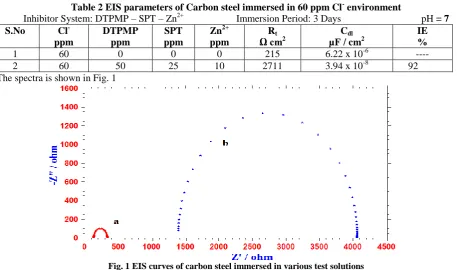
The EIS parameters of carbon steel immersed in various test solutions are given in Table 2
Table 2 EIS parameters of Carbon steel immersed in 60 ppm Cl- environment
Inhibitor System: DTPMP – SPT – Zn2+ Immersion Period: 3 Days pH = 7 S.No Cl
-ppm
DTPMP ppm
SPT ppm
Zn2+ ppm
Rt
Ω cm2
Cdl
µF / cm2
IE %
1 60 0 0 0 215 6.22 x 10⁻⁶ ----
2 60 50 25 10 2711 3.94 x 10⁻⁸ 92
The spectra is shown in Fig. 1
Fig. 1 EIS curves of carbon steel immersed in various test solutions
a) 60 ppm Cl- b) 60 ppm Cl- + 50 ppm DTPMP + 25 ppm SPT + 10 ppm Zn2+
The impedance behaviour of carbon steel in 60 ppm Cl- with and without inhibitors are given in Table 2. From the observation the charge transfer resistance of uninhibited solution is 215 ohm cm2, for inhibited solution containing 50 ppm DTPMP, 25 ppm SPT and 10 ppm Zn2+ is 2711 ohm cm2. But the double layer capacitance (Cdl) value getting
decreases from 6.22 x 10⁻⁶µF / cm2 to 3.94 x 10⁻⁸ µF / cm2. The decreases in Cdl attributed to increases in thickness of
electronic double layer. In addition, the formation of protective film is confirmed by increase in Rct values. The
percentage of efficiency of the inhibitor can be calculated by using following relation. IE = R’ct - Rct/ R’ct
R’ct – Charge transfer resistance for inhibited solution Rct - Charge transfer resistance for uninhibited solution
By using the above relation the percentage efficiency of the inhibitor was calculated. This inhibitor formulation gives 92 % IE. Thus the EIS spectral data reveal that a protective film is formed on the metal surface.
Potentiodynamic Polarization study:
The corrosion parameters of carbon steel in various test solutions are given Table 3
Table 3 Corrosion parameters of carbon steel immersed in 60 ppm Cl- environment obtained by the polarization study.
Inhibitor System: DTPMP – SPT – Zn2+ Immersion Period: 3 Days pH = 7
S.No Cl -ppm
DTPMP ppm
SPT ppm
Zn2+ ppm
Ecorr.
mV vs SCE bc
mV ba
mV
I corr
A/cm2
I E %
1 60 0 0 0 -598 189.75 193.05 1.26x 10⁻⁵ -
ISSN (Online) : 2319 - 8753
ISSN (Print) : 2347 - 6710
I
nternationalJ
ournal ofI
nnovativeR
esearch inS
cience,E
ngineering andT
echnologyAn ISO 3297: 2007 Certified Organization Volume 4, Special Issue 1, February 2015 THIRD NATIONAL CONFERENCE ON ADVANCES IN CHEMISTRY (NCAC – 2015)
On 18th February 2015 Organized by
Department of Chemistry, Easwari Engineering College (SRM Group of Institutions), Chennai-600089, India.
The polarization curves are shown in the Fig. 2
Fig. 2 Potentiodynamic polarization curves of carbon steel immersed in various test solutions.
a) 60 ppm Cl- b) 60 ppm Cl- + 50 ppm DTPMP + 25 ppm SPT + 10 ppm Zn2+
The Tafel extrapolation method is used to determined icorr values and corrosion rate. The Fig.2 representing the anodic
and cathodic polarization curves with and without inhibitor. The added inhibitor shows that the shift of potential was observed towards to the anodic region, which means the anodic reaction controlled predominantly. The corrosion current was decreased considerably in the presence of inhibitor formulation. The value of Corrosion rate of Carbon steel in the presence of inhibitor was much smaller than that in the absence of an inhibitor. In presence of inhibitor the IE was about 77.5%. When Carbon steel immersed in 60 ppm Cl- environment the corrosion current Icorr is 1.26 x 10 -5
A/cm2. When 50 ppm DTPMP, 25ppm SPT, 10 ppm Zn2+ are added the corrosion current decreases to 2.84 x 10⁻⁶ A / cm2. The significant reduction in corrosion current indicates a decrease in corrosion rate in the presence of inhibitor. The shift of corrosion potential (-598 to -440) also indicates that the anodic reaction is controlled predominantly. From the Polarization curves it can be inferred that Zn (OH)2 formed on the metal surface retards the oxygen reduction
reaction and thus controls the cathodic reaction with a predominance of anodic reaction on the metal surface. The DTPMP- SPT – Zn2+ system shifts the corrosion potential to anodic side. Thus the ternary inhibitor formulation acts as anodic inhibitor. This confirms the protective film formed on the metal surface.
SEM ANALYSIS
Fig.3 Scanning Electron Microscope of the Carbon Steel immersed in various test solution
ISSN (Online) : 2319 - 8753
ISSN (Print) : 2347 - 6710
I
nternationalJ
ournal ofI
nnovativeR
esearch inS
cience,E
ngineering andT
echnologyAn ISO 3297: 2007 Certified Organization Volume 4, Special Issue 1, February 2015 THIRD NATIONAL CONFERENCE ON ADVANCES IN CHEMISTRY (NCAC – 2015)
On 18th February 2015 Organized by
Department of Chemistry, Easwari Engineering College (SRM Group of Institutions), Chennai-600089, India.
The SEM (Scanning Electron Microscope) images are taken for the system in presence and absence of inhibitor. Normally for comparison, control metal (polished), Metals without inhibitors (Uninhibited), in presence of inhibitors (Inhibited) was taken in 60 ppm Cl- solution.
The SEM micrographs of polished Carbon steel (Control metal) is shown in Fig. 3 a,d with X 1000 and x 3000 magnification respectively, from the images it was observed that the surface is smooth. This indicates the absence of any corrosion products on the metal surface.
The SEM images of Carbon steel which is immersed in 60 ppm Cl-. Here, the roughness of the metal surface increases which shown in the Fig. 3.b, e
In presence of inhibitor formulations the surface coverage increases is shown in Fig. 3.c,f , the formulations are 60 ppm Cl- + 50 ppm DTPMP + 25 ppm SPT + 10 ppm Zn2+. This formulation forms a protective film on the metal surface by the way of forming insoluble complexes. The surface covered by a thin layer of inhibitor which effectively controls the dissolution of Carbon steel.
Analysis of Atomic Force Microscopy (AFM)
Atomic force microscopy is the powerful technique to collect the roughness statistics from the variety of surfaces. All AFM images were taken using XEI instruments 5 x 5 micrometer and 10 x 10 micrometer areas with the scan rate of 0.45 Hz.
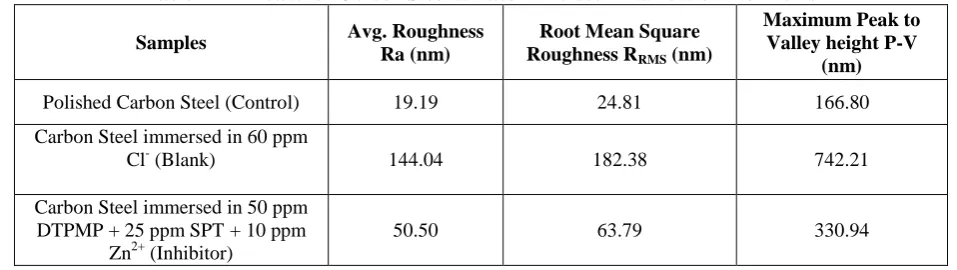
The 2 – Dimensional and 3 – Dimensional AFM morphologies are taken for polished Carbon Steel, metal immersed in the corrosive environment and Inhibitor system which is shown in Fig. 4 a,b,c and Fig. 4 d,e,f respectively.
AFM analysis performed to get the values of Ra (Average Roughness), RRMS (Root Mean Square Roughness) and P-V
height (Peak to Valley) height. The slight roughness observed on the polished Carbon steel surface due to atmospheric Corrosion. The Ra, R RMS and P-V height values are given 19.19 nm, 24.81 nm and 166.80 nm respectively for polished carbon steel. The Ra, R RMS and P-V height values for the Carbon steel immersed in 60 ppm Cl– are given 144.04 nm, 182.38 nm and 742.21 nm. These values suggest that the Average roughness, Root Mean Square Roughness and Peak to Valley heights are increases due to the Corrosion of Carbon Steel in 60 ppm Cl-. This indicates the surface becomes rougher when compared to the polished Carbon steel due to the attack of Chloride ions from the solution. The presence of 50 ppm DTPMP, 25 ppm SPT and 10 ppm Zn2+ reduces the Ra value from 144.04 nm to 50.50 nm. RRMS value significantly reduces from 182.38 nm to 63.79 nm and P-V values are also reduces from 742.21
nm to 330.94 nm. All these values are given in Table 4. These parameters confirmed that the surface appear to be smoother. The smoothness of the surface is due to the formation of protective film of Fe2+ - DTPMP and Zn(OH)2
Complex.
Table 4 AFM data for Carbon Steel surface immersed in various environments
Samples Avg. Roughness Ra (nm)
Root Mean Square Roughness RRMS (nm)
Maximum Peak to Valley height P-V
(nm)
Polished Carbon Steel (Control) 19.19 24.81 166.80
Carbon Steel immersed in 60 ppm
Cl- (Blank) 144.04 182.38 742.21
Carbon Steel immersed in 50 ppm DTPMP + 25 ppm SPT + 10 ppm
Zn2+ (Inhibitor)
ISSN (Online) : 2319 - 8753
ISSN (Print) : 2347 - 6710
I
nternationalJ
ournal ofI
nnovativeR
esearch inS
cience,E
ngineering andT
echnologyAn ISO 3297: 2007 Certified Organization Volume 4, Special Issue 1, February 2015 THIRD NATIONAL CONFERENCE ON ADVANCES IN CHEMISTRY (NCAC – 2015)
On 18th February 2015 Organized by
Department of Chemistry, Easwari Engineering College (SRM Group of Institutions), Chennai-600089, India.
IV.CONCLUSION
1. The weight – loss method results indicate that the formation of consisting of 50 ppm DTPMP + 25 ppm SPT +
10 ppm Zn2+ has 93% IE.
2. EIS spectra indicate that the protective film formed on the metal surface.
3. The polarization study indicates the formulation of inhibitor system functions as an anodic inhibitor.
4. SEM micrographs and AFM images show that the protective film formed on the metal surface.
REFERENCES
1. C.Thangavelu, M.Umarani, P.Patric Raymond and M.Sekar, Rasayan journal of chemistry, 4, pp.245-250, 2011. 2. C.Thangavelu and T.Kasilingam, Chemical science and review letters, 3, pp.10-17, 2014.
3. H.Amar, J.Benzakour, Corrosion science, 50, 1, pp.124-130, 2008.
4. S.Agnesia Kanimozhi, S.Rajendran, International journal of electrochemical science, 4, pp.353-368, 2008. 5. G.Wranglen, Introduction to corrosion and protection of metals, London, Chapman and Hall, pp.236, 1986. 6. M.Sobhi, M. Abdallah, K.S. Khairou, Montash chem., 143, pp.1379-1387, 2012.
7. Y.Brightson arul Jacob etal., International journal of engineering research and technology, 1, 2012. 8. S.Sharma and R.S. Chaudhary, Bulletin of Electrochemistry, 16, pp. 267, 2000.
9. R.Vera, H.Romera and Y.E.Ahumada, Journal of Chilean chemical society, 48, pp. 350, 2003. 10. J.Arockia selvi, S.Rajendran, Zastita Materijala, 50, pp. 91-98, 2009.