IJSRR, 8(2) April. – June., 2019 Page 797
Research article Available online www.ijsrr.org
ISSN: 2279–0543
International Journal of Scientific Research and Reviews
Secure Cluster Head Selection In WSN Integrated With IOT
Rupinder Singh* and Rachhpal Singh
1Khalsa College Chawinda Devi, Amritsar, E-mail: [email protected] 2Khalsa College, Grand Trunk Rd, Amritsar, Punjab. E-mail: [email protected]
ABSTRACT
Internet of Things (IoT) is of great significance in the future and is rapidly developing by
connecting heterogeneous devices with several technologies. One of such network is Wireless Sensor
Network (WSN) that is integrated with IoT. This interconnectivity of different networks leads to the
risk of confidentiality and security of data. WSN routing protocols such as LEACH (Low Energy
Adaptive Clustering Hierarchy) is prone to a large number of attacks and one of them is a HELLO
flood attack. In this paper, HSRP (Hello flood attack Secure Routing Protocol) an extension to
LEACH protocol is proposed for protecting the CH (Cluster Head) against Hello flood attack. HSRP
makesdata encryption with the help of Armstrong number and decryption with AES algorithm so as
to verify CH identity. The proposed technique can be used to protect IoT form HELLO flood attack
consisting of various WSNs. The proposed HSRP is implemented by making use of network
simulator NS2, the results indicate that the HSRP has a substantial ability to detect flooding attack
HELLO for creating the malicious node as CH.
KEYWORDS
: Internet of Things, Wireless sensor network, Hello flood attack, Armstrong number, Cluster head.*Corresponding author:
Dr. Rupinder Singh
Khalsa College Chawinda Devi
Amritsar
IJSRR, 8(2) April. – June., 2019 Page 798
INTRODUCTION
Internet of Things (IoT) is a universal network architecture used to provide facilities in the
physical world by analyzing and processing data.Wireless sensor network(WSN) composed of low
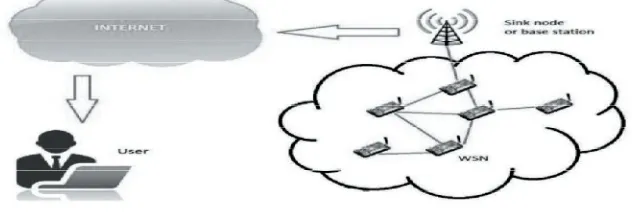
powersensor nodes, along with Big Data and cloudcomputing led to a greatexpansion of IoT. Figure
1 shows the integration of WSN and IoT.This combination of various technologies can be used to
place multiple sensor nodes everywhere, so that valuable information needed for collection can be
obtained. This will help in data collection in places without appropriateinfrastructures and
communication. The integration of WSN and IoT include a large number of applications
includingremote patient tracking, medicine, environment monitoring,active volcanoes, toxic vapors
industrial sites, radioactive areas, etc. One of the most important issues of this integration is to
provide security and confidentiality of the data.
In this paper, an effective protocol for detecting HELLO flood in WSN is proposed when it is
integrated with IoT. LEACH (Low Energy Adaptive Clustering Hierarchy) protocol is used for the
implementation of WSN. LEACH is used for clustered implementation of WSN making use of
Received Signal Strength (RSS) so as to dynamically select Cluster Heads (CHs). LEACH is also
exposed to HELLO flood attack in case a malicious node is selected as CH.
Cryptographic methods used for the prevention of a HELLO flood attack are not so
supportive and certain non-cryptographic methods for detecting HELLO Flood attack exist but they
lack efficiency
Figure 1: IoT & WSN integration
due to large test packet overhead. In this paper, HSRP (Hello flood attack Secure Routing
Protocol) as an extension to LEACH protocol is proposed to protect CH from HELLO flood attack.
HSRP makes use of encryption using Armstrong number. The decryption is done with the help of
AES algorithm so as to verify the identity of CH. The technique is implemented with the help of
NS2 for the implementation of WSN. The results show that HSRP has substantial ability for
recognition of HELLO flood attack which is launched for creating CH by the malicious node.The
IJSRR, 8(2) April. – June., 2019 Page 799 for neighbor discovery with the help of high power of transmission. This is done by creating an
illusion of neighborsensor node to other nodes so as to disrupt underlying routing protocol. The
attacker makes use of high transmission power to broadcast hello packets so that most of nodes in the
network selectattacker as CH in LEACH protocol. The sensor nodes in the network are convinced
that their neighbor is the attacker node. The nodes response to HELLO message generated by the
malicious attacker and as a result are forced to energy waste, thus resulting in a confused state.
Heinzelman et al. 2 Introduced LEACH protocol for routing in the sensor networks, whichdivides
the network into small clusters in which one sensor node is selected as CH and others as cluster
members. The CH after gathering data from nodes send it to the Base Station (BS) and this CH is
periodically re-elected. LEACH is divided into Setup and Steady phase used for the formation of the
clusters along with CH and sending data to the BS. CHs are randomly changed and it is very hard to
spot CHs. If attacker becomes a CH, then the HELLO flood attack can be easily launched. In our
previous work 1, a large number of measures to tackle with a Hello flood attackare discussed.In this
paper, HSRP as an extension to the LEACH protocol is proposed. HSRP is based on Armstrong
number encryption and AES algorithm decryption so as to validate CHfor preventing WSN from
Hello flood attack. HSRP can be used with different WSNs integrated with IoT so that secure
communication is possible.
I.
RELATED WORKS
In this section of the paper, the proposed work regarding selecting and securing CH’susing
the LEACH protocol in WSN is discussed.
LEACH protocol was proposed by Heinzelman et al.2in which each of the sensornode has
equal probability to be elected as CH. This protocol extendsthe lifetime of the network by allowing
every sensor node to play role as CH. In LEACH protocol, sensor nodes with high remaining energy
declare themselves to be CHs so that other nodes join as cluster members. LEACH assumes that
there are no compromised nodes in the network, and therefore has no method for protecting cluster
formation. F-LEACH3 was one of the extensionsto LEACH proposed to defend the clusterformation
from malicious nodes in the network. F-LEACHmakes use of common keys that are shared with BS
in case a sensor node wants to become a CH, so as to check the authenticity of the node to become
CH. The sink broadcast secure authentication for CHs using μTESLA is proposed in4. Normally
nodesin the network join one legitimateCH, this methodprovide noway to validatesensor nodes
which join any one of the clusters. For resolving this issue, Oliveira et al.5 proposedSecLEACH. In
this proposed work, BS is used to authenticate CH nodes while the CHs are further used to
IJSRR, 8(2) April. – June., 2019 Page 800 pre-assigned keys for the purpose of verificationbefore deployment. LEACH and SecLEACH only
help the network in external attackprevention from the attackers before joining of cluster formation
process, i.e.these protocols are not able to protect CHs from internal attacks.
Various extensions7-11to LEACH protocol in the past have beenproposed, but the majority of
these focus on energy consumption balancing over all the availablenodes so as to extend thenetwork
lifetime. Few of these8extensions dealsecure election of CH. However, most of these extensions are
not able to preventmalicious nodes from CH declarationas it can cheat other sensor nodes pretending
having short distance with large residual energy. Liu13proposed a method of cluster formation in
which pre-determined sensor nodes only can be declared as CHs. Other sensor nodes are allowed to
join any cluster either via a relay node or directly. Any CH allocation or cluster joins isdone by some
pre-assigning of polynomial share, therefore this method protects network from any external attacker
during the process of clusterformation. The method proposed avoid a compromised relay node from
invoking a DoS(Denial of Service)attack by the process of removing CH and its serving nodes
connection. Sun et al.14in the work proposed a protected method for cluster formation whichis used
for checking protocol conformity of nodes so as to discriminatemalicious nodes. In this work,
physical network transformation is done into cliques so that memberscan be connected openly to
each other in a clique. After clique is formed, each node in the clique checkswhether every member
has the similarclique membership view or not. The methods of19has enhanced14 safety, but with the
assumption that during cluster formation no collisionsare possible. This type of assumptionused is
very difficult to implement without using special measure like TDMA schedule assignment along
with separation code. Nishimura et al.21 in the work,proposed a methodby allocating a trust value to
every cluster node of CHin which most trusted are allowed as CH. The limitation of this work is that
it produces a lot overhead communication for trust evaluation system and is not appropriatein the
case of resource-constrained sensor network.
Rifà-Pous et al.20based on the public key cryptography in the paper proposed a protected
cluster formation method. The proposed method contains three phases; the phase of cluster
discovery, the phase of CH designation, and the phase of cluster maintenance. In thefirst phase of
cluster discovery, every node in a cluster is given same view as far as membership is concerned with
other nodes in the cluster. In thesecond phase of the cluster designation, election of CHis considered
on the basis of a numberof times already elected as CH in the past including number of its neighbors.
In the cluster maintenance phase, CHsthat has been elected to providea certificate of authorization to
each cluster member. The limitation of this method is that it assumes no node departs from
participating of cluster discovery. Crosby et al.21in the paper proposed a CH election based on
IJSRR, 8(2) April. – June., 2019 Page 801 trustworthy nodes are elected as CHs. A node behavior is counted by occurrence ofsuccessful and
unsuccessful node transmissions. The more anode is successful in its transmission, the more superior
reputation it has. During the process of electing new CH, nodes having more reputation value are
suggestedby cluster members for role of CH so that one of them is elected as a new CH.
Buttyan et al.22proposed a CH selection scheme using cryptographic which hidesthe election
processfrom outside nodes. But, the proposed work of concealmenttackles with only external
attackers. A compromised nodein the network can expose the selection result with no trouble. The
malicious node in the network can declare itself as a CH without having the eligibility.Sirivianos et
al.24proposed SANE (Secure AggregatorNode Election) protocol. In this protocol all the legal CH
membersof a cluster contribute in producing random value so that CH may be elected based on this
randomvalue. SANE isfurther divided into three sub-schemes based on the generationand
distribution of random value. The scheme makes use of Merkle’s puzzle, commitment scheme, and
scheme based on seeding. Dong et al.25in the work proposed scheme for preventing attackers from
participating in the process of election by making use of IDassignment scheme, which binds ID of
the node, itspolynomial shares and commitments. In this method,nodes not broadcasting participation
message are not allowed for participating in CHelectionand are excludedfrom the process of electing
CH candidates. TheCH is selected among one of the rest of the candidates, but still attacker may
change election result of CH byescaping distribution of participation message. Although, this
methodprovidesrecovery systemby combining various election results into one, but there is
requirement of co-operation of CH candidates.
II.
MATERIALS AND METHODS
The proposed HSRP to be used for detecting and isolating Hello flood attack in sensor network is
discussed in this section of the paper. The WSN model along with assumptions is discussed first,
followed by working of the proposed protocol.
A.WSN Model
The WSN considered to be a clusterednetwork having N static sensor nodes. The network
includes special sensor nodes called CH and BS along with member nodes. CHs collectinformation
from their clusters and then passes them to the BS for the purpose of making decisions/judgments.
LEACH protocol is used for the formation of clusters in which every sensor node has a unique
identity (ID). HSRP makes use of the following assumptionsfor the WSN.
1) Hello flooding attack sensor node is the compromised CH.
IJSRR, 8(2) April. – June., 2019 Page 802 3) All the sensor nodes in the network other than malicious nodes have same initial energy,
power of transmission, power of computing, internal structure of storage, etc.
4) Nodes are allocated ID’s that cannot be changed.
5) The Unique Armstrong number is allocated to each sensor node.
6) All the nodes in the network consume the same amount of energy for working on the same
stage.
B.Implementation of HSRP
The HSRP is used as an improved extension to LEACH protocol with more security,
therefore the proposed protocol make use of features of clustering used in the LEACH protocol. The
working of LEACH protocol is divided into the steps of set-up and stable phase. In the first phase of
set-up,all the nodes in the WSN follow the guidelines of fairness criterionalong with randomness
criterion. In first and fairness criteria every sensor node in the WSN hasequal probability ofbecoming
a CH. While in the second randomness criterion, random way is used for the election of CH. The
chance of a node to be elected as CH entirely depends on two things. First whetherthe node is elected
as CH in past recent rounds. Second,percentage of CH’s IN the WSN. After the election of CH’s in
the WSN, each member chooses a cluster to join it on the basis of maximum RSS (Received Signal
Strength)tillthe completion of all clusters.
Each cluster sensor node member has the responsibility of sensing surroundingof it,
i.e.environment so as to forwarddata to CHs respectively. The CH’s after collecting this information
from member nodes forwardsthe information to the BS. The LEACH protocol is vulnerable against
Hello flood attackbecause of these characteristics.Hello flood attack is one of the common routing
attacksused in the WSN in which the malicious node broadcasts a huge number of hellomessagesto
the sensor nodes with very higher transmission power in the WSN. The sensor nodes receiving such
a hello message will consider malicious node as their CH. After becoming the CH, malicious node
may create damage in WSNby modifying or discarding data received from cluster members.
C.Malicious CH determination
The BS of the WSN makes use of registration table in order to maintain records of created
CHs andmembers of clusters along with malicious nodes as different sets. These set values are
regularly updated as per the changesmade in the CHs and clusters.The following are the initial values
for these sets
Set CHnode = {null}, to store CHs in the WSN.
Set CHmember = {null}, to store members of clusters in the WSN.
IJSRR, 8(2) April. – June., 2019 Page 803 Each of the sensor nodesin the WSN trieswith a definite probability (p) to become CH
following the criterion of both randomness and fairness. The nodes that are able to become CH
broadcasts hello message for clusteringso as to attract sensor nodes tojoin it. The CH(i) is selected
with the level of RSSso as to join in a specific area range. The memberscalculated by CH for the
cluster are included in the set CHmember.
a) Unique ID allocation
The BS is used to allocate a unique ID number to each of the sensor nodes in the WSN. The
request of any sensor node for becoming CH is accepted only if it providesallocated unique ID to the
BS in order to fulfilnode validation.
b) Unique Armstrong number allocation
The BS is also given the responsibility of allocating a unique Armstrong number for each ID
to the sensor node in WSN. Armstrong number is defined as m (digit) base n no. so that sum of its
(base n) digits raised to the power m is no. itself. For example, 371 = 33+73+13 =27 + 343 +1 is an
Armstrong number. Any sensor node can become CH by sending an Armstrong number, encrypted
hello message to the sensor nodes in the WSN. Table 1 displaysa sample registration tablewhich is
maintained at BS.
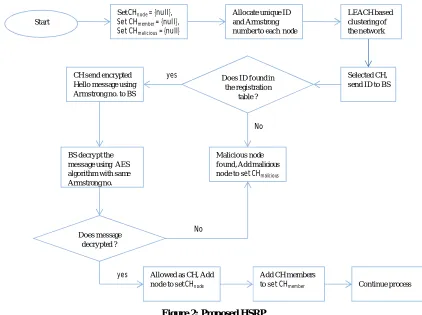
The flowchart of figure 2 represents the working of HSRP for the purpose of authenticating
CH by the BS. HSRP is a more secure version of the LEACH protocol as only authenticated sensor
nodes in the WSN are allowed to become CH’s. It becomes very difficult for a malicious node to
become CH by only having high transmission power. Therefore, HSRP provides a secure network
for the purpose of communication in the WSN.
Table 1: BS registration table
Sensor number Allocated unique ID Allocated Random Armstrong Number
001 S0001 153
002 S0002 407
. . .
. . .
IJSRR, 8(2) April. – June., 2019 Page 804
Figure 2: Proposed HSRP
III. RESULTS AND DISCUSSION
This part of paper presents results produced with the help of the simulation carried out in NS
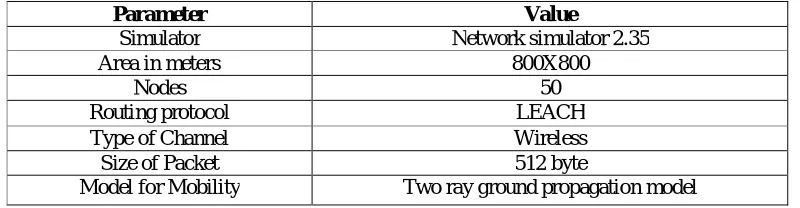
2.35 to show HSRP effectiveness. The parameters of the simulation are shown in table 2.
A.Throughput
Network throughput is defined as the average rate of effectively delivered packets.
Throughput calculation is done as:
Throughput = (Total no. of packets delivered) /(Simulation time);
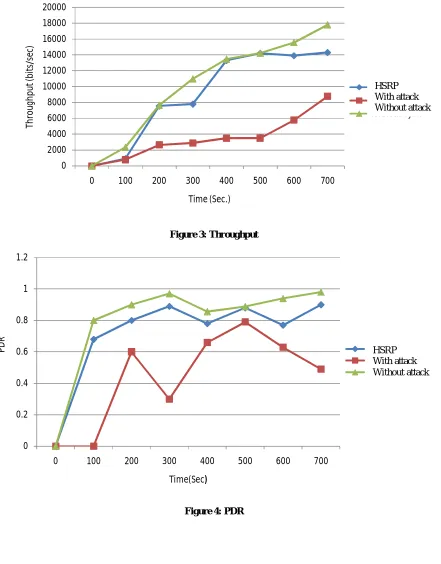
The figure 3 displays throughput for WSN with, without, and under Hello flood attack. The
figure also displays implementation of proposed HSRP. The proposed protocol after isolating Hello
flood attack increases throughput. Start
Set CHnode= {null},
Set CHmember= {null},
Set CHmalicious= {null}
Does ID found in the registration
table ?
Allocate unique ID and Armstrong number to each node
LEACH based clustering of the network
Selected CH, send ID to BS
Malicious node found, Add malicious node to set CHmalicious
yes
No CH send encrypted
Hello message using Armstrong no. to BS
BS decrypt the message using AES algorithm with same Armstrong no.
Does message decrypted ?
No
Allowed as CH, Add node to set CHnode
yes Add CH members
IJSRR, 8(2) April. – June., 2019 Page 805
Table 2: Parameters of Simulation
Parameter Value
Simulator Network simulator 2.35
Area in meters 800X800
Nodes 50
Routing protocol LEACH
Type of Channel Wireless
Size of Packet 512 byte
Model for Mobility Two ray ground propagation model
B.
Packet delivery ratio
Packet delivery ratio (PDR) of WSN is the ratio of total packets received to total packets
generated. PDR is defined as
PDR = (Packets received at destination/packets generated by source) * 100
Figure 4 displaysPDR analysis for without attack, under attack, and implementation of HSRP. The
figure 4 indicates that HSRP results in the increase of PDR.
C.
Delay
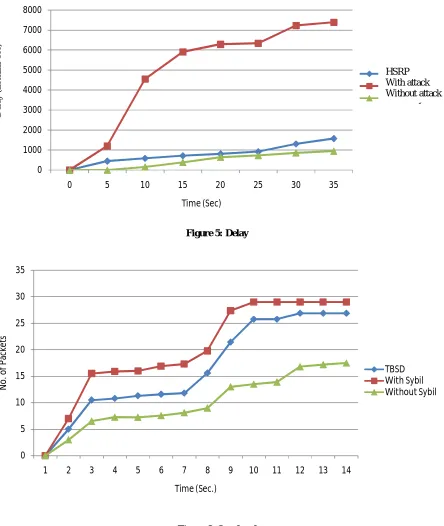
Delay is the average time required to deliver the packet at the destination, includingthe
process of route discovery and queue time for packet transmission. Delay is calculated as:
Delay = ∑ (arrive time – send them) / ∑ (Number of connections)
Figure 5 provide end-to-end delay in WSN withoutattack, under attack, and HSRP implementation.
The figure indicates that HSRP results in the decrease in delay.
D.
Overhead
Overhead is a measure of excess time by a protocolfor delivering packets to the destination.
Hello flood attack results in increase of overhead in WSN. Figure 6 displaysoverhead for WSN
without attack, under attack, and for HSRP. The HSRP decreasesoverhead for WSN as shown in
IJSRR, 8(2) April. – June., 2019 Page 806
Figure 3: Throughput
Figure 4: PDR
0 2000 4000 6000 8000 10000 12000 14000 16000 18000 20000
0 100 200 300 400 500 600 700
Th
ro
u
gh
p
u
t
(b
it
s/
se
c)
Time (Sec.)
TBSD With Sybil Without Sybil
0 0.2 0.4 0.6 0.8 1 1.2
0 100 200 300 400 500 600 700
P
D
R
Time(Sec)
TBSD With Sybil Without Sybil
HSRP With attack Without attack
IJSRR, 8(2) April. – June., 2019 Page 807
Figure 5: Delay
Figure 6: Overhead
IV.
CONCLUSION
Io T make use of various network technologies for communication of physical objects. IoT
also make use of different wireless sensor networks connected together so as to gather data present at
separated locations. The huge progress in the services of IoT needs authentic security mechanism.
The selection of cluster head in a secure way in wireless sensor network is important as all the
0 1000 2000 3000 4000 5000 6000 7000 8000
0 5 10 15 20 25 30 35
D ela y ( in m il li -s ec ) Time (Sec) TBSD With Sybil Without Sybil 0 5 10 15 20 25 30 35
1 2 3 4 5 6 7 8 9 10 11 12 13 14
IJSRR, 8(2) April. – June., 2019 Page 808 communication between the sensor nodes and base station is done via the cluster head. Hello flood
attack can be launched in sensor network so as to make cluster head compromised. In this paper,
HSRP (Hello flood attack Secure Routing Protocol) as an extension to LEACH protocol in sensor
networks is proposed. HSRP is based on Armstrong number encryption and AES algorithm
decryption. HSRP can be used to increase performance by timely detection of malicious nods and
avoiding the sensor nodes from such a mean cluster head. The IoT make use of different sensor
networks connected together via different network technologies so as to share the information
gathered. The proposed HSRP can be used to protect different WSNs from Hello flood attack in IoT.
The proposed HSRPis implemented with the help ofNS2 and show the efficiency for parameter
packet delivery ratio, throughput, overhead, and delay. The results of simulation show HSRP expels
compromised nodes in the clusters. Further, simulation with more parameters will be done to
increase number of sensor nodes in future.
REFERENCES
1. Singh R, Singh J, and Singh R. Hello flood attack Countermeasures in Wireless Sensor
Networks.International Journal of Computer Science and Mobile Applications 2016;4(5),
2016;1-9.
2. HeinzelmanW. R., ChandrakasanA., BalakrishnanH. Energy-efficient communication
protocol for wireless microsensor networks. In the proceedings of the 33rd Annual Hawaii
International Conference on System Sciences. 2000.
3. FerreiraA. C., VilacaM. A., OliveiraL. B., HabibE., WongH.C., and LoureiroA. A.On the
security of cluster-based communication protocols for wireless sensor networks. Proc. of 4th
IEEE Int’l Conf. on Networking, Reunion Island, France. 2005; 17-21.
4. Perrig A. et al.SPINS: Security Protocols for Sensor Networks. Wireless Networks. 2002;
8(5):521-534.
5. Oliveira L. B. et al. SecLEACH-a random key distribution solution for securing clustered
sensor networks. Proc. of 5th IEEE Int’l Symp. on Network Computing and Applications,
Cambridge, Massachusetts, USA,. 2006.
6. Shen Y., Liu S., Zhang Z.Detection of Hello Flood Attack Caused by Malicious Cluster
Heads on LEACH Protocol. International Journal of Advancements in Computing
Technology. 2015; 7(2).
7. Kang S. and Nguyen T. Distance Based Thresholds for Cluster Head Selection in Wireless
IJSRR, 8(2) April. – June., 2019 Page 809 8. Han Y., Park M., and Chung T. SecDEACH: Secure and Resilient Dynamic Clustering
Protocol Preserving Data Privacy in WSNs. Proc. of the 2010 Int’l Conf. On Computational
Science and Its Applications. 2010; 6018(1): 142-157.
9. Katiyar V., Cand N., Gautam G. C. and Kumar A. Improvement in LEACH Protocol for
Large-scale Wireless Sensor Networks. Proc. of Int’l Conf. On Emerging Trends in Electrical
and Computer Technology. 2011;1070-1075.
10. Saadat M., Saadat R. and Mirjality G. Improving Threshold Assignment for Cluster Head
Selection in Hierarchical Wireless Sensor Networks. Proc. of Int’l Symposium on
Telecommunications. 2010; 409-414.
11. Ren P., Qian J., Li L., Zhao Z., and Li X. Unequal Clustering Scheme based LEACH for
Wireless Sensor Networks. Proc. of Fourth Int’l Conf. on Genetic and Evolutionary
Computing. 2010;90-93.
12. Devi G., Sankar R., and Sahoo N. Hello Flood Attack Using BAP in WirelessSensor
Network. International Journal of Advanced Engineering Research and Science. 2015; 2(1).
13. Liu D. Resilient Cluster Formation for Sensor Networks. Proc. of 27th Int’l Conf. on
Distributed Computing Systems. 2007; 40-48.
14. Sun K. et al.Secure Distributed Cluster Formation in Wireless Sensor Networks. Proc. of 22nd
Annual Computer Security Applications Conference. 2006; 131-140.
15. Mayur S., Ranjith H. D. Security Enhancement on LEACH Protocol From HELLO Flood
Attackin WSN Using LDK Scheme. International Journal of Innovative Research in Science,
Engineering andTechnology. 2015; 4(3).
16. Rawan S., Suhare M., Manal A. Intrusion Detection of Hello FloodAttack in WSNs Using
Location Verification Scheme. International Journal of Computer and
CommunicationEngineering. 2015; 4(3).
17. Kaur D., Singh R. Energy level based Hello Flood attack Mitigation on WSN. International
Journal of Embedded Systems and Computer Engineering. 2015.
18. Jyoti, Bansal A. Detection of Hello Flood Attack on Leach Protocol Based on Energyof
Attacker Node. International Journal of Innovations & Advancement in Computer Science,
2015; 4(1).
19. Wang G., Kim D., and Cho G. A Secure Cluster Formation Scheme in Wireless Sensor
Networks. Int’l Journal of Distributed Sensor Networks. 2012.
20. Rifà-Pous H. and Herrera-Joancomartí J. A Fair and Secure Cluster Formation Process for Ad
IJSRR, 8(2) April. – June., 2019 Page 810 21. Crosby G. V and Pissinou N. Cluster-based Reputation and Trust for Wireless Sensor
Networks. Proc. of the 4th IEEE Consumer Communications and Networking Conference.
2007; 604-608.
22. Buttyan L. and Holczer T. Private Cluster Head Election in Wireless Sensor Networks. Proc.
of the Fifth IEEE Int’l Workshop on Wireless and Sensor Network Security, IEEE.
2009;1048-1053.
23. Magotra S., Kumar K. Detection of HELLO flood Attack on LEACH Protocol.
IEEEInternational Advance Computing Conference. 2014.
24. Sirivianos M. et al.Non-manipulable Aggregator Node Election Protocols for Wireless Sensor
Networks. Proc. of Int'l Sympo. on Modeling and Optimization in Mobile, Ad Hoc, and
Wireless Networks. 2007;1-10.
25. Dong Q. and Liu D. Resilient Cluster Leader Election for Wireless Sensor Networks. Proc. of
IEEE 6th Annual Comm. Society Conf. on Sensor, Mesh and Ad Hoc Communications and
Networks. 2009;108-116.
26. Nishimura I., Nagase T., Takehana Y., and Yoshioka Y. Secure Clustering for Building
Certificate MangementNodes in Ad-Hoc Networks. Proc. of 14th Int’l Conf. On
Network-Based Information Systems, Tirana, Albania. 2011.
27. Steffi J., Priyanka A., Tephillah S., and Balamurugan A. M. Attacks and countermeasuresin
WSN. International Journal of Electronics & Communication. 2014; 2(1).
28. Saini S. K., Gupta M. Detection of Malicious Cluster Head causing Hello FloodAttack in
LEACH Protocol in Wireless Sensor Networks. International Journal of Application or
Innovation inEngineering & Management. 2014; 3(5).
29. Dubey A., Meena D., Gaur S. A Survey in Hello Flood Attack in Wireless SensorNetworks.
International Journal of Engineering Research & Technology. 2014; (1).
30. Singh V. P., Aishwarya S., Ukey A., and Jain S. Signal Strength based Hello FloodAttack
Detection and Prevention in Wireless Sensor Networks. International Journal of
ComputerApplications. 2013; 62(15).
31. Fatema N,Brad R. Attacks and counterattacks on wireless sensor networks. International
Journal of Ad hoc, Sensor & Ubiquitous Computing. 2013; 4(6).
32. Wanjari A., Dhamdhere V. Evading Flooding Attack in MANET Using NodeAuthentication.
International Journal of Science and Research (IJSR). 2014; 3(12).
33. Haghighi M. S., Mohamedpour K., Varadharajan V., and Quinn B. G. Stochastic Modeling of
Hello Flooding in Slotted CSMA/CA Wireless Sensor Networks. IEEEtransactions on
IJSRR, 8(2) April. – June., 2019 Page 811 34. Singh V. P., Jain S., and Singhai J. Hello Flood Attack and its Countermeasures inWireless
Sensor Networks. International Journal of Computer Science Issues. 2010; 7(3).
35. Venkata C., Singhal M., Royalty J., and Varanasi S. Security inwireless sensor networks.
Wireless communications and mobile computing Published online in WileyInder Science.
2006.
36. Khozium M. O. Hello Flood Counter Measure for Wireless Sensor Network. International
Journal of Computer Science and Security. 2(3).
37. Hamid A., Rashid M., Hong C. S. Defense against lap-top class attacker inwireless sensor
network. The 8th International Conference Advanced Communication Technology. 2006.
38. Thiago H. et al. Malicious Node Detectionin Wireless Sensor Networks. 18th International
Parallel and Distributed Processing Symposium. IEEE. 2004.
39. Singh J., Gupta S. and Kaur L. A MAC Layer Based Defense Architecturefor
Reduction-of-Quality (RoQ) Attacks in Wireless LAN. International Journal of Computer Science
andInformation Security. 2010; 7(1).
40. Singh J., Gupta S. and Kaur L. A Cross-Layer Based IntrusionDetection Technique for
Wireless Networks. The International Arab Journal of Information Technology. 2012; 9(3).
41. Kumar, Alampalayam S., Vealey T., and Srivastava H. Security in internet of things:
Challenges, solutions and future directions. System Sciences (HICSS). 2016.
42. Khalil N., Abid M. R., Benhaddou D., Gerndt M. Wireless Sensors Networks for Internet of
Things. IEEE Ninth International Conference on Intelligent Sensors, SensorNetworks and
Information Processing (ISSNIP) Symposium on Public IoT. 2014.
43. Zorzi M., Gluhak A., Lange S., Bassi A. From Today's Intranet of Things to a Future Internet
of Things: A Wirelessand Mobility-Related View. IEEE Wireless Communication. 2010; 43–