ISSN(Online): 2320-9801 ISSN (Print): 2320-9798
I
nternational
J
ournal of
I
nnovative
R
esearch in
C
omputer
and
C
ommunication
E
ngineering
(An ISO 3297: 2007 Certified Organization)
Vol. 3, Issue 4, April 2015
A Model Based Neuromuscular
Blockade Control System with Injector
Roshan M.Bodile
1, Dr.S.M.Deshmukh
2, Prof.A.S.Patharkar
3PG Student, Dept. of Electronics & Telecomm., P.R.M.I.T & R, Badnera, Amravati, Maharashtra, India1
Professor, Dept. of Electronics & Telecomm., P.R.M.I.T & R, Badnera, Amravati, Maharashtra, India2
Assistant Professor, Dept. of Electronics & Telecomm., P.R.M.I.T & R, Badnera, Amravati, Maharashtra, India3
ABSTRACT: The proper neuromuscular blockade level during surgeries can be attained by providing a substantial
amount of drug to patients. Patients differ from each other even if same patient is considered within span of time the same drug given to him/her will result differently under consideration of factors like age, weight, sex and other physical attributes. Apart from the physical attributes of patient, nature and composition of drug is a deciding factor for anesthetist. During the anesthesia, in traditional practice drugs are given to patients on the trial and error basis, this may leads to the patients in risk. The system aims to develop the automatic controller which provides robustness against the variability of patients’ response to drug dosage under uncertain circumstances. The proposed system aims to satisfy different important goals as: To calculate the amount of drug considering the physical attributes and to provide drug automatically to the patient. The database of 9 patients is considered under this work.
KEYWORDS: Depth of Anesthesia, Injector, Control System, NMB, ASA.
I. INTRODUCTION
Anesthesia is a temporary state consists of unconsciousness, lack of pain and muscle relaxation the lack of response and recall to noxious stimuli. The control of the neuromuscular blockade provides a good illustration of the main features and inherent constraints associated with the control of physiological variables [10]. Getting muscle relaxation, hypnosis and analgesia is main aim of anesthesia. Absence of muscular movements is required in surgical interventions in the area under consideration. The inhibition of muscle movements can be obtained by providing drugs which block the neuromuscular transmission, therefore producing muscular paralysis [2].
ISSN(Online): 2320-9801 ISSN (Print): 2320-9798
I
nternational
J
ournal of
I
nnovative
R
esearch in
C
omputer
and
C
ommunication
E
ngineering
(An ISO 3297: 2007 Certified Organization)
Vol. 3, Issue 4, April 2015
The deployment of an automatic control system for infusion of drug dosage in Operation Theater poses several difficulties. Firstly robustness, reliability, and performance of the system are critical in the operating theater. On the other hand, the anesthetist will feel more comfortable with a control system which gives fast explanatory and transparent decisions so that the anesthetist will validate them online and suggest alternatives if and when needed. And also it is clear that the control system will give benefit from the introduction or modification of control rules in an anesthetist-friendly way for allowing her/him to use her/his own clinical knowledge and experience.
A classical tool provided by engineering is control system, a topic that is receiving attention for drug delivery in clinical pharmacology. Control can also significantly contribute for understanding the effects of pharmacology agents and provide progress in drug delivery systems. Automatic control of anesthesia can support the anesthetist in his activities. The automatic control system suppresses the danger of awareness or drug overdoses. A shorter stay time of the patient in the postoperative care unit helps saving money.
A general requirement in anesthesia is to ensure a suitable level of muscle relaxation in the patient. Thus, from a control engineering viewpoint, such a requirement can be considered as a regulation problem where the plant to be regulated is the patient, the output is the patient’s neuromuscular blockade level [%] and the input is the drug (Atracurium) infusion rate. In practice the problem is a complicated one, mainly because of undesirable transients caused by the initial ignorance on the relevant patient dynamics [11]. Automatic drug delivery can potentially improve drug therapy by allowing for more efficient delivery, reducing drug usage and costs; permitting health care staff to work more efficiently, providing better care; and allowing the safe use of drugs that are difficult to administer manually. It allows delivery of drug continuously while matching the dose to the patient’s needs [12].
II. RELATED WORK
ISSN(Online): 2320-9801 ISSN (Print): 2320-9798
I
nternational
J
ournal of
I
nnovative
R
esearch in
C
omputer
and
C
ommunication
E
ngineering
(An ISO 3297: 2007 Certified Organization)
Vol. 3, Issue 4, April 2015
the selection of the observer polynomial in the supervisor was also demonstrated.[4] This paper presented an approach for new modeling and identification strategies to obviate many difficulties in the identification of anesthesia dynamics. The most commonly used models for the muscle relaxant effects during general anesthesia comprised of high number (greater than eight) of pharmacokinetic and pharmacodynamic parameters. In the clinical practice, main problem related with identification of the neuromuscular blockade system is that, the input signals / the amount of drug to be infused in patient vary too little to provide a sufficient excitation of the system. A way to solve this problem is presented in this paper.[5]In this paper the recursive estimation of a parsimonious nonlinear Wiener model for the neuromuscular blockade (NMB) in closed-loop anesthesia is presented. In this paper it is also demonstrated that the main source of intra-patient variability lies in the nonlinear pharmacodynamic part of the model with the help of the model parameters that were recursively estimated from clinical data. The distance to a bifurcation phenomenon leading to nonlinear oscillations of the Wiener model under PID feedback is also evaluated.[6] The main objective of this paper was to develop an automatic system for the control of neuromuscular blockade by regularly infusing the non-depolarizing types of atheistic agents (atracurium, cistracurium, vecuronium, rocuronium). To fulfill this objective they used method called as Hipocrates which is based upon classical, adaptable, robust control. This also includes various noise reduction techniques with online adaption to patients characteristics feature. The system proposed is easy to setup and can be used in clinic. The system consists of a portable PC computer, a Datex AS 3NMT sensor and a Braim compact prefusion pump. They proved Hippocrates is extensively validated and also provides an excellent environment for education and training purposes.
III.DESIRED IMPLICATION
A. Algorithm:
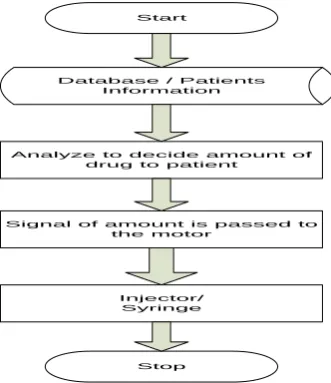
According to physical attributes and all other factors under consideration, the database is created. In accordance with database, the amount and composition of drug will be displayed. The signal relevant to amount of drug is passed to the stepper motor. The speed with which we want to inject the drug will be decided according to steps taken by stepper motor.
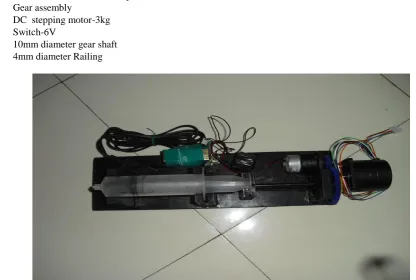
The system utilizes stepper motor with gear assembly for the motion of injector. As presented in hardware setup each gear assembly is operated by electronic stepper motor driver circuit. The motor driver circuits are in turn controlled by the program through the parallel port interface. The driver circuit comprises of ULN 2003 IC. The driver circuit used to operate the motor has inputs which are connected to the parallel port of the computer.
The main advantage of this system is if stepper motor fails/damaged, we have another mechanical system consisting of gear motor and gear assembly which will work manually with the help of switch.
Start
Database / Patients Information
Analyze to decide amount of drug to patient
Signal of amount is passed to the motor
Injector/ Syringe
Stop
ISSN(Online): 2320-9801 ISSN (Print): 2320-9798
I
nternational
J
ournal of
I
nnovative
R
esearch in
C
omputer
and
C
ommunication
E
ngineering
(An ISO 3297: 2007 Certified Organization)
Vol. 3, Issue 4, April 2015
B. Hardware Components and Setup: 60mL BD Syringe Luer-Lok
12V Step-Down Transformer
Geared motor-12V and 150rpm
Gear assembly
DC stepping motor-3kg
Switch-6V
10mm diameter gear shaft
4mm diameter Railing
Fig 2: Hardware setup
IV.RESULT ANALYSIS
By considering all the physical attributes like age, sex, race, operation etc. amount, composition and nature of drug is decided. Signal relevant to amount of drug passed to motor. Speed with which injector should inject is achieved by controlling the steps/rotation of the motor. Back-up mechanical system is present in the project. If stepper motor fails to do the automatic operation or we remove the stepper motor from the system the injector is controlled by the mechanical system (gear motor with gear assembly).
ISSN(Online): 2320-9801 ISSN (Print): 2320-9798
I
nternational
J
ournal of
I
nnovative
R
esearch in
C
omputer
and
C
ommunication
E
ngineering
(An ISO 3297: 2007 Certified Organization)
Vol. 3, Issue 4, April 2015
V. CONCLUSION AND FUTURE WORK
Thus an effective automatic controller system is modelled which decides the amount of drug using pateint’s database. System considering the physical attributes and parameters like muscle relaxation, hypnosis (Depth of Anesthesia), analgesia can be developed for optimization of drug. If all above parameters are considered more precise and efficient system can be developed. The system for simultaneous delivering two or three medicines can be developed. Making the system more precise and speed controlled, the same can be used for long-time drug delivery.
ACKNOWLEDGEMENT
I am very much thankful to my guides Dr. S.M. Deshmukh and A.S. Patharkar for their constant support and
encouragement throughout the work. I would also like to present my honest gratitude to Dr. Dinesh Lalwani for his immense help and support.
REFERENCES
1. O. Simanski, R. Kahler, B. Pohl, R. Hofmockel, R. Friedrich, B. P. Lampe, “Measurement And Control Of Neuromuscular Blockade and Depth Of Anaesthesia”.
2. Paulo Fazendeiro, Jose Valente de Oliveira and Witold Pedrycz, “ A Multiobjective Design of a Patient and Anaesthetist-Friendly Neuromuscular Blockade Controller”, IEEE Transactions on Biomedical Engineering, Vol. 54, No. 9, pp.1667-1678, 2007.
3. Teresa Mendonça, Joao M. Lemos, Hugo Magalhaes, Paula Rocha, and Simao Esteves, “Drug Delivery for Neuromuscular Blockade With Supervised Multimodel Adaptive Control”, IEEE Transactions on Control Systems Technology, Vol. 17, No. 6, pp.1237-1244, 2009.
4. Margarida Martins da Silva, Torbjörn Wigren and Teresa Mendonça, “Nonlinear Identification of a Minimal Neuromuscular Blockade Model in Anesthesia”, IEEE Transactions on Control Systems Technology, Vol. 20, No. 1, pp.181-188, 2012.
5. Olov Rosen, Margarida M.Silva and Alexander Mehvedev, “Nonlinear Estimation of a Parsimonious Weiner Model for the Neuromascular Blockade in Closed-loop Anesthesia”, IEEE Transaction, pp. 9258-9268, 2014.
6. Teresa Mendonça , Hugo Magalhaes, João M. Lemos, and Rui Dionísio, “Control of Neuromuscular Blockade in the Presence of Sensor Faults”, IEEE Transactions on Biomedical Engineering, Vol. 52, No. 11, pp. 1902-1911, 2005.
7. Erik van Lunteren and Michelle Moyer, “Combination of Variable Frequency Train Stimulation and K+ Channel Blockade to Augment Skeletal Muscle Force”, IEEE Transactions on Neural Systems and rehabilation Engineering , Vol. 12, No. 2, pp. 288-294, 2004.
8. Joeeta Anurag Tomer, Dr.R.P Dubey ,Dr.Ashok Sonkar,” A Hierarchical Self- Organizing fuzzy logic Control to Control Anesthesia using Weiner Models”, International Journal of Advanced Research in Computer Science and Software Engineering, Vol.3, No. 11, 2013.
9. Niloy Bhadra, Kevin L. Kilgore, “Direct Current Electrical Conduction Block of Peripheral Nerve”, IEEE Transactions on Neural Systems and rehabilation Engineering , Vol. 12, No. 3, Sept. 2004, pp. 313.
10. Joao M. Lemos, Hugo Magalhaes, Teresa Mendonça, Paula Rocha, “Observer dynamics in switching control: applicationto neuromuscular blockade”, IEEE 1-3 September, 2005, Faro, Portugal.
11. T. Agnoloni, C. Manuelli, E. Mosca,“ Controller Falsification in Automatic Drug Delivery for Neuromuscular Blockade Control”, IEEE Conference on Decision and Control, and the European Control Conference 2005.
12. T.J. Gilhuly,G.A. Dumont, B.A. MacLeod, “Modelling for Computer Controlled Neuromuscular Blockade”, IEEE Engineering in Medicine and Biology 27th Annual Conference Shanghai, China, September 1-4, 2005.
BIOGRAPHY
Roshan M.Bodile is a PG Student, Electronics and Telecommunication, PRMIT&R,
Badnera. He received Bachelor of Engineering (BE) degree in 2012 from SSGMCE, Shegaon, MS, India. His research interests are Control System , Digital Image Processing,