| INVESTIGATION
Introgression of a Block of Genome Under
In
fi
nitesimal Selection
Himani Sachdeva and Nicholas H. Barton1 Institute of Science and Technology Austria (IST Austria), Klosterneuburg A-3400, Austria ORCID ID: 0000-0002-8548-5240 (N.H.B.)
ABSTRACTAdaptive introgression is common in nature and can be driven by selection acting on multiple, linked genes. We explore the effects of polygenic selection on introgression under the infinitesimal model with linkage. This model assumes that the introgressing block has an effectively infinite number of loci, each with an infinitesimal effect on the trait under selection. The block is assumed to introgress under directional selection within a native population that is genetically homogeneous. We use individual-based simulations and a branching process framework to compute various statistics of the introgressing block, and explore how these depend on parameters such as the map length and initial trait value associated with the introgressing block, the genetic variability along the block, and the strength of selection. Our results show that the introgression dynamics of a block under infinitesimal selection are qualitatively different from the dynamics of neutral introgression. We alsofind that, in the long run, surviving descendant blocks are likely to have intermediate lengths, and clarify how their length is shaped by the interplay between linkage and infinitesimal selection. Our results suggest that it may be difficult to distinguish the long-term introgression of a block of genome with a single, strongly selected, locus from the introgression of a block with multiple, tightly linked and weakly selected loci.
KEYWORDSintrogression; linkage; infinitesimal model
L
IMITED introgression of genetic material between closely related subspecies or species is common (Arnold 2004; Hedrick 2013; Racimo et al. 2015). Introgression may be adaptive if it supplies new genetic variation that facilitates a response to selection. Well-documented examples include adaptive introgression between different species ofsun-flowers, resulting in increased herbivore resistance in the re-cipient species (Whitneyet al.2006), introgression between the Algerian mouse and the European house mouse, which likely caused the latter to acquire increased pesticide resis-tance (Songet al.2011), and possible introgression between Denisovans and the ancestors of modern-day Tibetans, re-sulting in adaptation to life at high altitude (Huerta-Sánchez et al.2014).
Unlikede novomutation, migration introduces multiple, linked allelic variants into a population. The likelihood of successful introgression or hybridization is thus sensitive to
the density of selected loci among these variants and the distribution of theirfitness effects, in addition to demography (Yeaman 2013). More generally,polygenicadaptation or in-trogression may involve minor shifts in allele frequencies as opposed to selective sweeps, leading to genomic signatures that are qualitatively distinct from those of major-effect loci (Pritchardet al.2010). Similarly, background selection due to many weakly deleterious loci shapes diversity at linked sites differently from a few strongly deleterious loci (Goodet al. 2014). Incorporating linked, polygenic selection into meth-ods for detecting introgression is thus an important challenge for population genetic inference (Elyashivet al.2016).
Most polygenic models of introgression or hybridization analyze the dynamics of a single beneficial or neutral locus embedded within a deleterious genomic background (Barton and Bengtsson 1986; Visscheret al.1996; Ueckeret al.2015). These analyses often make various simplifying assumptions about the genetic architecture of barriers to gene flow. For example, Barton and Bengtsson (1986) derive the effective migration rate between populations at a neutral locus in a variety of hybridization scenarios, by neglecting random drift and assuming that the neutral locus is embedded within a genome in which all loci are under divergent selection across Copyright © 2018 by the Genetics Society of America
doi:https://doi.org/10.1534/genetics.118.301018
Manuscript received April 10, 2018; accepted for publication May 25, 2018; published Early Online June 12, 2018.
populations. Similarly, Ueckeret al.(2015) use a branching process approximation to analyze how the introgression probability of a beneficial locus is altered by the presence of multiple, linked and unlinked deleterious mutations. Quali-tatively similar models have been used to investigate whether selecting on marker loci might reduce“linkage drag”during introgression in practical breeding programs (Visscheret al. 1996), where the objective typically is to introgress a single favorable allele from a donor population by repeated back-crossing, while minimizing the amount of background donor genome (which is assumed to be deleterious in the recipient). Genomic regions with many tightly linked beneficial vari-ants may, however, play an important role in adaptive intro-gression (Hedrick 2013). Fine-scale mapping of quantitative trait loci (QTL) reveals that these often consist of multiple alleles that affect the trait (Flint and Mackay 2009). In fact, recombination within QTL has been suggested as a possible explanation for the failure of simple marker-assisted introgres-sion schemes when attempting to introgress QTL for polygenic traits such as yield (Hospital 2005). Thus, a step toward more realistic models is to consider linked, introgressing variants associated with a range of selective effects—both positive and negative. Such models also provide more general insight into the limits of selection acting on complex traits.
A particularly useful limit for studying the dynamics of multiple selected loci is the infinitesimal model, which as-sumes that a given phenotype is influenced by an effectively infinite number of loci, each of infinitesimally small effect (Bulmer 1980). It follows that the effect of selection on indi-vidual polymorphisms is negligible, so that, in the absence of drift and linkage, the genic variance can be assumed to be constant over short time scales.
The infinitesimal model is quite general, as the limit of a model where many discrete loci with a range of effects sum to determine trait value (Bartonet al.2017). However, it does neglect linkage, which becomes untenable if the density of selected variants on the genome is high. To explore the effect of linkage on introgres-sion, we consider a trait determined by an effectively infinite number of loci, but now assume that these are uniformly distrib-uted on a genomic block of map lengthy0:This model, which we refer to as the“infinitesimal model with linkage”wasfirst in-troduced by Robertson (1977). It is parameterized by a single parameterV0;the genic variance per unit map length.
For simplicity, we assume that a single block of genome from a source population enters a genetically homogeneous native population having zero genic variance. By definition, the native population also has zero segregation variance, which is the variance in trait values among the offspring of any two ran-domly chosen individuals in the population. This implies that any adaptive response must be due entirely to genetic variation supplied by the introduced genome. We typically follow de-scendants of the introduced genome over a few hundred gen-erations after the initial hybridization event, and neglect the creation of new variation by mutation over these time scales.
The assumption of a genetically homogeneous native pop-ulation is unrealistic, but may approximate a situation where
that population has much lower genetic variation, and hence lower segregation variance, than the source population. Such a situation might arise, for instance, if the native population went through a recent bottleneck. A later shift of the selection optimum would spur further evolution when new variation is introduced via migration. Assuming a genetically homoge-neous native population allows us to focus on the dynamics of the introduced block, without considering additional effects due to the association of this block (or its descendants) with different native genomic backgrounds.
The assumption that most of the introduced genome is neutral, while only one block is under selection, may appear restrictive. However, even in a scenario where selected loci are spread across the entire introduced genome, a few genera-tions of back-crossing with the native population would yield descendant individuals carrying single fragments of the donor genome. The spread of each of these fragments through the population is then independent of other fragments, and can thus be described using our framework, as long as introgress-ing fragments are rare (so that they do not encounter each other) and short (so that only single crossovers occur and genomes carry at most one fragment).
Under the infinitesimal framework, any block of genome contains a very large number of weakly selected loci. This is a highly idealized model, which we regard as afirst step toward a fuller analysis. However, we shall see that it already shows quite rich behavior—in particular, the model allows for a long-term response to selection, at least in large populations. Thus, focusing on the dynamics of a single block can provide useful insight into the effect of polygenic selection during introgression.
The introgression of a neutral block of genome was mod-eled as a branching process by Bairdet al.(2003). They found that a neutral block of map lengthyis lost very slowly—the probability that at least some portion of the block survives at time tfalls asy=logðyt=2Þ;in contrast to the faster1=t decay observed for a single neutral locus. This is because a large block has a higher chance of being transmitted to off-spring than a small block (either as a whole or in part), result-ing in a relatively large number of descendants that carry at least some portion of the block in the first few generations. Over longer times, as surviving fragments become smaller, this transmission advantage is lost. However, by this time there are so many (yt) of these small descendant blocks, that the probability of all of them being lost from the popu-lation becomes very small.
strength of recombination relative to selection shapes the distribution of block sizes and trait values, while this distribu-tion itself determines the effective strengths of selecdistribu-tion and recombination in the population. The main goal of our work is to use the infinitesimal framework to understand how the re-sultant,dynamically changingbalance between selection and recombination influences the introgression of genomic blocks. To this end, we focus on two questions. First, can the introgression of a block of genome that contains very many weakly selected beneficial and deleterious loci be distinguished from neutral introgression? Second, is an extended block, which contains a large number of loci with infinitesimally small (but, on average, positive) effects, less likely or slower to introgress than a single strongly selected locus? These ques-tions also relate to the broader issue of whether weakly selected loci can, in aggregate, have discernible effects on evolution.
Methods
We consider a scenario where a single haplotype from a di-verged source population enters a native population, for exam-ple from a backcross. Each individual in the native and source populations expresses a trait that is the sum of effects of many genes, which are uniformly distributed over a genomic block of map lengthy0:The individuals are assumed to be diploid, but the analysis and results are essentially the same for haploids.
The native population is assumed to consist of individuals withidenticalhaplotypes and hence the same trait value,
de-fined asz¼0:For ease of analysis, we define the additive contributions of any allele (or indeed, any small region) of the native haplotype to be zero, and ignore nongenetic effects on the trait throughout. The native haplotype thus provides a reference with respect to which the additive contributions of different tracts of the introduced block are measured.
The introduced block has an associated trait value z0; which is obtained by integrating over the contributions from different regions of the block, over a map lengthy0:These regions typically make unequal contributions to the trait. Thus, when the introduced block is split by recombination, descendants inherit fragments associated with a range of trait values, which differ from the trait valuez0of the parent but also from each other.
The additive trait is under directional selection in the native population, such that individuals with trait value z have a Poisson-distributed number of offspring, with mean wðzÞ ¼2expðbzÞ;wherebrepresents the strength of selec-tion. Thus, each individual carrying native haplotypes pro-duces two offspring on average, while individuals carrying fragments of the introduced block may expect to produce more or less than two, depending on the trait value associ-ated with the fragment. This results in a response to selection, whose magnitude depends on the selection strength b, the trait valuez0 associated with the introduced haplotype, and the extent of genetic variation among descendants of this haplotype, which can be characterized in a simple way within the infinitesimal framework described below.
Infinitesimal model with linkage and no selection
The infinitesimal model with linkage was introduced by Robertson (1977), and can be thought of as the limiting case of a trait determined additively byLdiscrete loci uniformly distributed on a genomic block of map lengthy0:Consider a population in linkage equilibrium (LE), in which the allelic states of different loci determining the trait are statistically independent of each other (irrespective of linkage between the loci). Then, the additive contributionsaiof different loci (i¼1. . .L) on any particular block are identical, indepen-dent random variables drawn from some distribution (with mean and variance denoted bymands2). The contributions of all the loci sum to give the trait value of the block:
PL
i¼1ai¼z0:
If we now adopt a coarse-grained view of this block, and consider the additive contributions of small genomic tracts of map length dy0 (instead of individual loci), then these are normally distributed with variance s2Lðdy
0=y0Þ for dy0y0:This follows from the central limit theorem by as-suming that the number of trait loci in a tract of lengthdy0, given byðL=y0Þdy0;is sufficiently large, and that there is no linkage disequilibrium (LD).
Thus, the variance in additive contributions of small tracts of map length dy0 is proportional to dy0; with coefficient V0¼s2ðL=y0Þ; which is the genic variance per locus (s2) times the number of loci per unit map length (L=y0). We refer to V0 as the genic variance per unit map length; the genic variance is just equal to the additive genetic variance minus the variance due to LD (which is zero here, assuming LE). Note that in the infinitesimal limit, the distribution of allelic effects becomes irrelevant: onlyV0matters.
If we define zðxÞ as the trait value associated with the genomic region½0;xof the block, then it follows that zðxÞ is a Brownian path, since there is no LD or correlation be-tween the contributions of different genomic segments (see Table 1 for notation and terminology for infinitesimal intro-gression). The distribution of such Brownian paths is charac-terized by two quantities—the trait valuez0associated with the full block (or the net displacement of the path in the interval½0;y0), and the varianceV0per unit map length.
A key assumption of the infinitesimal model is thatV0is independent of the trait valuez0;and is equal to the genic variance (per unit map length) in the source population. This implies that in the absence of selection, the variance of trait values among diploid individuals in the source pop-ulation is simply 2V0y0(Appendix A). Thus, the parameter V0measures the extent of variability along a single genome as well as the variability between genomes in the source population.
Rðy0;z0/y1;z1Þ
¼ N
z1;y1
y0z0;V0y1
N
z02z1;y02y1
y0 z0;V0ðy02y1Þ
R
N
2Ndz 9 1N
z91;y1
y0z0;V0y1
N
z02z91;y02y1
y0 z0;V0ðy02y1Þ
¼ N
z1;
y1
y0z0;V0y1ð12y1=y0Þ
(1)
Thus, the trait value z1 of a daughter block (having map lengthy1) is normally distributed with meanðy1=y0Þz0 and varianceV0y1½12ðy1=y0Þ. Equation (1) is the main equation describing inheritance under the infinitesimal model with linkage (see also Robertson 1977, p. 309).
Note that the distribution of trait values among descendant blocks under our model differs qualitatively from that in models where all allelic effects on the introduced block have the same sign (e.g., Barton (1983)). In those models, the trait value (orfitness) of the descendant block isdeterministically proportional to its length. This case is recovered by taking the limitV0/0 of the more general model described here.
Equation (1) is valid only when allelic states at physically linked loci are uncorrelated, i.e., in LE. Correlations may, however, arise due to selection or genetic drift. In particular, stabilizing selection in the source population can build up negative LD between linked genomic regions (Lande 1976).
The variance released by recombination is then no longer described by Equation (1), but can be much lower than V0y1ð12y1=y0Þfory11. Thus, any one genome encodes information about the nature of multi-locus associations in the source population from which it originates. This infor-mation lies hidden in the distribution of trait values of its constituent sub-blocks, and is revealed gradually as recombi-nation separates these.
We assume LE in the source population from which the “introduced block” originates, such that individual blocks within this population can be represented by Brownian paths. In principle, we could generate the Brownian path specifying the introduced block during the course of one simulation run of the introgression process as follows—each time an individ-ual passes on a fragment of the introduced block to a descen-dant, we choose the trait value associated with this fragment by conditioning on the trait value of the parental block using Equation (1) (while also taking into account all known trait values of other fragments that have some overlap with this fragment). We would store trait values of different fragments of the introduced block in a master list and keep updating this list with the values of smaller and smaller fragments as these are generated by recombination. While this scheme would exactly simulate the infinitesimal model with linkage, it is quite cumbersome to implement.
Instead, we follow two different approximate simulation schemes that discretize the continuous Brownian path. In the
first“discrete locus”scheme, we approximate the Brownian path by a large number Lof discrete loci uniformly spread across the introduced block. The additive contributionaiof each locus is drawn from a normal distribution with mean z0=Land varianceðV0y0Þ=L;using an iterative scheme that ensures that all theaiadd up toz0(see Appendix B). When-ever the introduced block is split by recombination, the trait value of the descendant block is obtained by summing over the contributions of all loci that it inherits from the intro-duced block.
In the second simulation scheme, we divide the introduced block intoL sub-blocks and choose their additive contribu-tions as in thefirst scheme. However, now when a portion of the parent block is transmitted to an offspring, the trait value of the descendant block is obtained by summing the contri-butions of all thecompletesub-blocks inherited from the par-ent plus a random contribution z that corresponds to the partially inherited sub-block. If the crossover point lies within theithsub-block such that the descendant inherits a fractiona of this sub-block, then z is a normally distributed random variable with mean equal toatimes the additive contribution of the sub-block and varianceV0ðy0=LÞað12aÞ:Thus, under this approximation, the contribution of sub-blocks that are shorter thany0=Lis uncorrelated across different individuals, which is not true for the actual model. However, this approx-imation makes very little difference to various quantities of interest asLbecomes large (Appendix B).
An important difference between the discrete locus and sub-block-based schemes is that the maximum possible
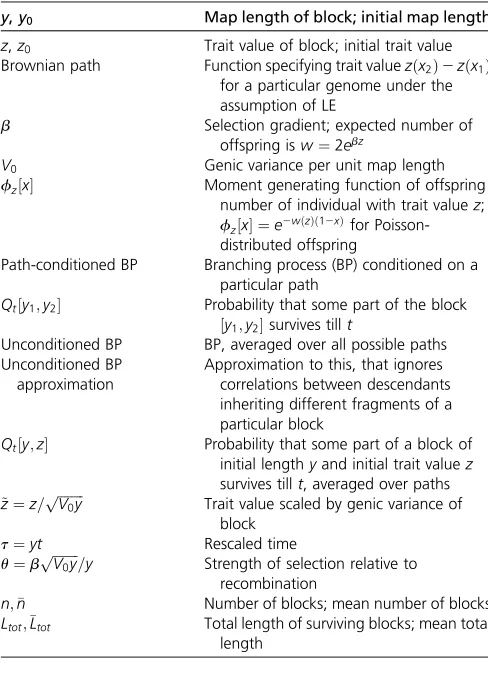
Table 1 Notation and terminology for infinitesimal introgression
y,y0 Map length of block; initial map length z,z0 Trait value of block; initial trait value
Brownian path Function specifying trait valuezðx2Þ2zðx1Þ
for a particular genome under the assumption of LE
b Selection gradient; expected number of offspring isw¼2ebz
V0 Genic variance per unit map length
fz½x Moment generating function of offspring number of individual with trait valuez; fz½x ¼e2wðzÞð12xÞfor Poisson-distributed offspring
Path-conditioned BP Branching process (BP) conditioned on a particular path
Qt½y1;y2 Probability that some part of the block
½y1;y2survives tillt
Unconditioned BP BP, averaged over all possible paths Unconditioned BP
approximation
Approximation to this, that ignores correlations between descendants inheriting different fragments of a particular block
Qt½y;z Probability that some part of a block of initial lengthyand initial trait valuez survives tillt, averaged over paths ~
z¼z= ffiffiffiffiffiffiffiffiV0y
p
Trait value scaled by genic variance of block
t¼yt Rescaled time
u¼b ffiffiffiffiffiffiffiffiV0y
p
=y Strength of selection relative to recombination
n;n Number of blocks; mean number of blocks Ltot;Ltot Total length of surviving blocks; mean total
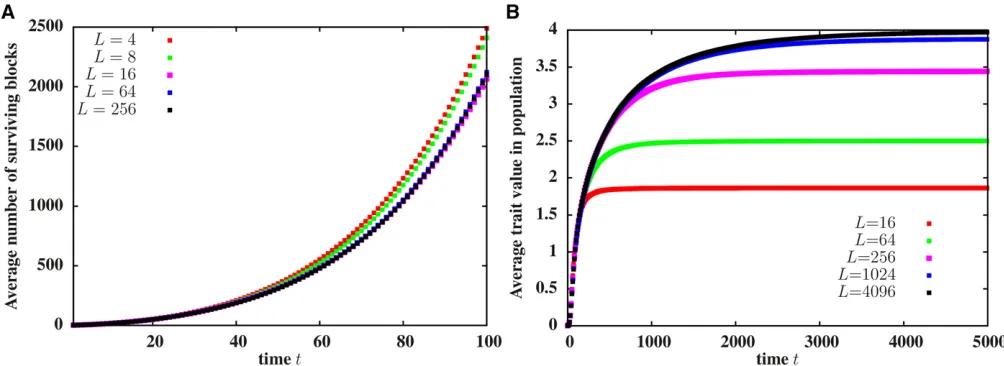
advance of trait value under selection is limited by the total number of loci with positive effect in the former, but can potentially be infinite under the latter, at least in an infinite population. Thus, the sub-block-based simulation scheme better represents the true infinitesimal model with linkage. However, in afinite population, the exact number of individual loci matters only if recombination can separate the loci within introgressing segments before thesefix. Thus, we expect the two approximate simulation schemes and the true infi nites-imal model with linkage to yield very similar predictions for various quantities in afinite population, as long asLis large (see Appendix B for details on the choice of L for both approximations).
Note that we only assume LE within the source population from which the introduced block is sampled. In the recipient population, LD is quite strong during early introgression—our model accounts for this by explicitly following the numbers of different blocks of genome in the population.
Modeling the initial spread of the introduced block as a branching process
During the initial phases of introgression, while the number of descendants of the introduced block is much smaller than the size of the recipient population, the likelihood of mating between two individuals, both bearing introgressed genetic material, is negligible. Further, if the map length y0 of the introduced block is small enough that multiple crossovers can be neglected, then any individual genome will carry at most one introduced fragment (of map lengthy), surrounded by native blocks (map length y02y). Since the native popula-tion is assumed to be genetically homogeneous, it is sufficient to follow just the fragments of the introduced block down various lineages without considering the rest of the genome, as described below.
The first generation after hybridization is simulated by drawing the number of offspring of the individual carrying the introduced haplotype from a Poisson distribution with meanwðz0Þ ¼2expðbz0Þ;where z0 is the trait value of the introduced block. Each of these offspring is either assigned no portion of the introduced block (probabilityð12y0Þ=2), or the whole block (probabilityð12y0Þ=2), or a fragment of the block (probabilityy0). The fragment is generated by choosing a single crossover pointx, uniformly distributed in the inter-val½0;y0;and then assigning to the offspring either the left ½0;xor the right½x;y0fragment with equal probability. If the descendant block is shorter than the parent block, then its trait value is decided using the sub-block-based simulation scheme described above.
This process is repeated in each generation for each de-scendant individual that carries any fragment of the intro-duced block, for a prespecified number of generations, or until no portion of the introduced block survives in the population. At the end of each generation, we ascertain the number of descendants carrying at least some introduced material, the total length of introgressed genome they carry, and various moments of the lengths and trait values of introgressing
fragments in the population. For each set of parameters, we obtain statistics by averaging over many (104) realizations, each corresponding to a different Brownian path. All paths are chosen from the same distribution, parameterized byz0 andV0.
Path-conditioned branching process: The above formula-tion describes a branching process (BP), in that it ignores correlations between the offspring number of different indi-viduals due to density-dependent regulation, and also ignores recombination between blocks. Note, however, that it is a BP conditioned on a particular Brownian path zðxÞ with end points at 0 andy0; thus, descendants inheriting overlapping (or complementary) segments of a block have correlated (or anticorrelated) trait values andfitness. This also implies that various statistics of the BP,e.g., the“extinction probability” Qtðy1;y2Þthat a genomic block with end-points aty1 andy2 has no descendantstgenerations later, must also be condi-tioned on this Brownian path. We can write the following recursive equation relating Qtþ1ðy1;y2Þ at timetþ1 to the corresponding probability at timet:
Qtþ1ðy1;y2Þ ¼
fzðy1;y2Þ
12ðy22y1Þ
2 þ
12ðy22y1Þ
2 Qtðy1;y2Þ þ
1 2
ðy2
y1
dxfQtðy1;xÞ þQtðx;y2Þg
(2)
Herezðy1;y2Þis the trait value associated with the genomic region ½y1;y2;and is specified by the Brownian path. The functionfz½xis the moment generating function of the num-ber of offspring of an individual carrying a block fragment with trait value z. If individuals have a Poisson-distributed number of offspring with mean wðzÞ ¼2expðbzÞ; then we havefz½x ¼expð2wðzÞð12xÞÞ:Thus,fz½xis nonlinear in x, resulting in a recursion (Equation (2)) that is also nonlinear.
Unconditioned branching process approximation: Equa-tion (2) describes the time evoluEqua-tion of extincEqua-tion proba-bilities for a particular genomic block described by a particular Brownian pathzðxÞ(i.e., with particular effects on the trait). We are interested in the outcome averaged over random paths, and can calculate this average numer-ically by drawing a large number of Brownian paths, solv-ing (2) for each, and taksolv-ing the average. However, since Equation 2 is nonlinear, this becomes computationally demanding.
In order to calculate the extinction probability (or other statistics), averaged over different Brownian paths, all char-acterized by the same value ofV0, we introduce a different “unconditioned”BP approximation. The unconditioned BP is not conditioned on any particular path, but treats the trait values of two or more descendants inheriting portions of the parent block asindependentrandom variables. These random variables have a distribution [specified by Equation (1)] which is only conditional on the map length and trait value of the parent block. This approximation thus ignores the cor-relations in trait values of offspring that inherit overlapping or even complementary tracts of a parent block. The under-lying assumption is that the effects of these correlations on various quantities of interest get averaged out, when averag-ing over Brownian paths.
It then follows that under the unconditioned BP approx-imation, the extinction probability of a block depends only on its map length yand trait valuez. DefiningQtðy;zÞ as the probability that a block of map length yand trait value z has no surviving descendants t generations after it enters the population, we can write the following recursions for Qtðy;zÞ:
Qtþ1ðy;zÞ ¼
fz
12y
2 þ
12y
2 Qtðy;zÞ þ
ðy
0 dy1
ðN
2Ndz1
exp 2
z12y1yz
2
2V0y1
12y1y
0 B @ 1 C A ffiffiffiffiffiffiffiffiffiffiffiffiffiffiffiffiffiffiffiffiffiffiffiffiffiffiffiffiffiffiffiffiffiffiffi
2pV0y1
12y1
y
r Qtðy1;z1Þ 2 6 6 6 6 6 6 6 6 6 4 3 7 7 7 7 7 7 7 7 7 5 (3)
Equation (3) is similar to Equation (2) except that now the third term involves an integral over the map lengthy1and trait valuez1associated with the descendant block. Note thatz1is now a random variable drawn from the distribution in Equa-tion (1), and is not prespecified by the chosen Brownian path, as in Equation (2). To numerically iterate Equation (3), we discretize (y,z) space and replace the two-dimensional inte-gral by a double summation.
Equation (3) is analogous to Equation 1 in Baird et al. (2003), but, unlike that equation, involves extinction proba-bilities that depend on both the length and the trait value of the introduced block. This reflects the fact that blocks evolve under the joint influence of selection and recombination in our model, in contrast to the neutral dynamics modeled in Bairdet al.(2003).
We can also express the Laplace transform of the joint distribution of the number, map lengths, and trait values of descendant blocks at timetþ1 in terms of the corresponding Laplace transform at time t, as in Baird et al. (2003) (see Appendix C). These can be used to recursively compute mo-ments of the total number of descendant blocks and the total amount of introgressed genome. In particular, the expected numberE½nt y;zof descendants of an introduced block with map lengthyand trait valuez(aftertgenerations) follows the linear recursion:
Entþ1 y;z
¼
2ebz 12y
2 E h
nt y;z i þ ðy 0 dy1 ðN
2Ndz1 exp 2
z12yy1z 2
2V0y1
12y1
y 0 B @ 1 C A ffiffiffiffiffiffiffiffiffiffiffiffiffiffiffiffiffiffiffiffiffiffiffiffiffiffiffiffiffiffiffiffiffiffiffi 2pV0y1
12y1
y
r E
h
nt y1;z1
i 2 6 6 6 6 6 6 6 6 6 4 3 7 7 7 7 7 7 7 7 7 5 (4)
Effective parameters governing introgression: Taking the continuous time limit of Equation (4) yields an integro-differential equation in terms of the map length y, the rescaled trait value ~z¼z= ffiffiffiffiffiffiffiffiV0y
p
; rescaled time t¼yt; and the ratio of the selection strength to recombination strength, given byu¼b ffiffiffiffiffiffiffiffiV0y
p
=y(see Appendix D):
@ny;~z;t
@t ¼
u~z21ny;~z;t
þ2
ð1
0 da
ðN
2N
d~z1 exp 2
~z12pffiffiffia~z2 2ð12aÞ
0 B @ 1 C A ffiffiffiffiffiffiffiffiffiffiffiffiffiffiffiffiffiffiffiffiffi
2pð12aÞ
p nðay;~z1;tÞ
ny;~z;0¼1
(5)
Herenðy;~z;tÞdenotes the expected number of descendants of a block of map length y and effective trait value ~z; at rescaled timet. Note that the parameters~zandt (as well as u) are themselves functions of y. An identical equation describes the evolution of the average total amount of introgressed genetic material Ltotðy;~z;tÞ; but with the initial condition Ltotðy;~z;0Þ ¼y: In this case, we argue that these equations must have solutions of the form
nðy;~z;tÞ ¼fðu;~z;tÞ and Ltotðy;~z;tÞ ¼ygðu;~z;tÞ: Thus, the expected number of descendants depends on the map length of the introduced block only implicitly via the rescaled pa-rametersu,~z,t. Similarly, the genic variance enters into the equations only viauand~z:
Individual-based simulations of long-term introgression into afinite population
To study the long-term dynamics of introgression into afinite population of size N, we also simulate individuals. These simulations start by randomly choosing a diploid individual to carry the introduced block. The introduced block is simu-lated via the discrete locus scheme, i.e., by assuming that there areLuniformly spaced loci embedded within it, and then iteratively choosing their additive contributions such that these sum to z0 (see Appendix B). The remaining N21 individuals are assumed to be identical and have zero genic variance.
In each generation,Nindividuals are created as follows. Two diploid parents are chosen for each offspring by sam-pling individuals in the previous generation in proportion to their fitness, defined as ebz:Here z is the sum of the trait values associated with the two haplotypes of the individual. Subsequently, a gamete is created from each parent either with no recombination (probability 12y0) or with a single crossover (probabilityy0) between parental haplotypes. With no recombination, one of the two parent haplotypes is chosen with equal probability to be the gamete. With recombination, the crossover point is sampled from a uniform distribution between 0 andy0;the gamete inherits all loci to the right of the crossover point from one parental haplotype and all loci to the left from the second haplotype. The two gametes gen-erated in this way together form a diploid individual. Note that, unlike in the BP framework, a gamete might contain multiple introgressed fragments, for example, if both parent haplotypes carry different fragments.
Data availability statement
FORTRAN 95 codes used to generate the simulated data can be found athttps://git.ist.ac.at/himani.sachdeva/Introgression_ source_codes/snippets. The authors state that all data neces-sary for confirming the conclusions presented in the article are represented fully within the article.
Results
Wefirst consider the introduction of a single genomic block with trait value z0 ¼0. This block is initially neutral with respect to the native population. However, its immediate de-scendants inherit fragments with various effects, resulting in a change in the average trait value in response to selection, with the response being stronger for higher values ofb ffiffiffiffiffiV0
p
: This is in contrast to the purely neutral case (Baird et al. 2003), where there is no variability along the genome (V0¼0) or alternatively no selection (b¼0), so that descen-dants always inherit neutral fragments of the originally neu-tral genome.
The distinction between theb ffiffiffiffiffiV0 p
¼0 limit considered in Bairdet al.(2003) and theb ffiffiffiffiffiV0
p
.0 scenarios we study here is less obvious at long time scales. As time progresses, recom-bination splits the original block into smaller and smaller
fragments that contribute less and less to trait value, and are thus expected to be effectively neutral. However, selec-tion favors descendants carrying larger fragments with sig-nificantly positive contributions to trait value, and thus tends to amplify the frequency of such fragments in the population, in opposition to recombination. Do the resultant long-term signatures of introgression in the presence of selection differ from the neutralb ffiffiffiffiffiV0
p
¼0 expectation, under the infi nites-imal model?
Introgression of an initially neutral block: an example
Before computing various statistics of the descendants of the introduced block and exploring their dependence on param-eters such asy0,z0=
ffiffiffiffiffiffiffiffiffiffi
V0y0 p
andb ffiffiffiffiffiffiffiffiffiffiffiffiV0=y0
p
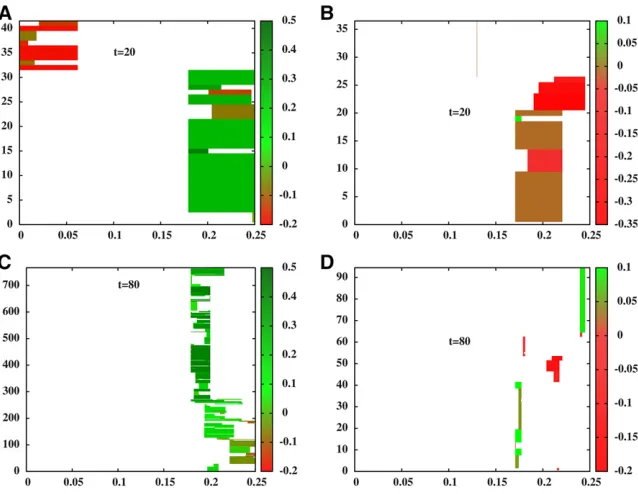
;it is useful to visu-alize a few random realizations of the process by directly simulating the path-conditioned BP. Figure 1, A and C show two snapshots of the process at t¼20 and t¼80 respec-tively, while Figure 1, B and D in the right panel show the analogous snapshots for another realization of the process, corresponding to a different Brownian path. The x-axis de-notes physical positions along the genomic region spanned by the introduced block (map length y0¼0:25). The numbers on they-axis index the descendants of the introduced block, and are different in Figure 1, A and C due to the larger num-ber of descendants carrying introgressed material at t¼80 thant¼20. Each horizontal line within a plot represents an individual genome. The colored segment depicts the frag-ment that has descended from the introduced block; the color encodes the trait value associated with the fragment (see accompanying color scales).
In each realization, descendant blocks are longer (on average) att¼20 than att¼80. Different individuals carry blocks associated with different trait values, with both dele-terious (z,0 or red) and favorable (z.0 or green) blocks present in the population at appreciable frequency att¼20. These blocks can themselves be viewed as mosaics of smaller sub-blocks with positive and negative contributions to trait value. As time progresses, recombination tends to isolate small sub-blocks from their genomic backgrounds, allowing selection to amplify the frequency of those sub-blocks that have significantly positive contributions. Thus, att¼80, sur-viving fragments are mostly associated with positive trait values (fewer red blocks).
t¼80), which suggests a correlation between the trait values and lengths of surviving fragments.
In Appendix E, we also consider replicate simulations cor-responding to the same introduced genome (represented by the same Brownian path), which differ from each other only in their stochastic histories of birth and recombination events. These replicates are also quite different from each other (see E1 in Appendix E), showing that both the stochas-ticity inherent in reproduction and recombination and the variation among introduced blocks are important sources of variability between replicates.
Introgression dynamics of an initially neutral block: branching process predictions
We now compute various statistics associated with individual fragments of the introduced block,first calculating the mean (or variance) of block lengths and trait values for any one realization of the introgression process, and then averaging the mean (or variance) over many such realizations, each corresponding to a different Brownian path.
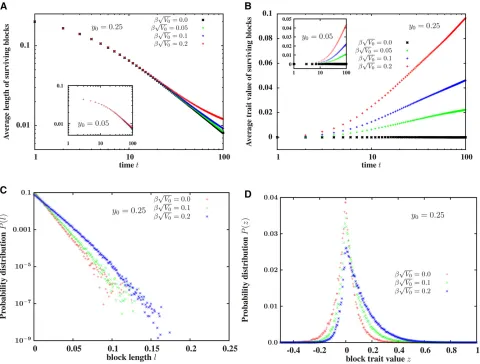
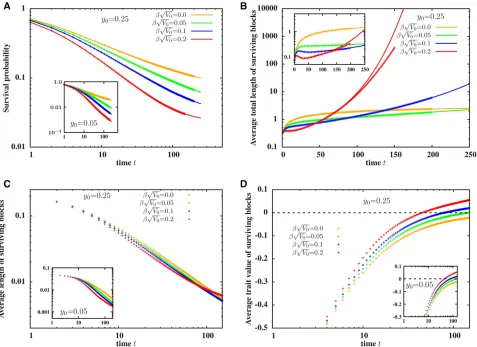
Figure 2B shows that the average trait value of surviving fragments of a block, introduced withz0¼0;is positive and increases with time, even as the length of the fragments de-creases (Figure 2A). This is consistent with Figure 1 and the observation that a large neutral block typically has small pos-itively selected fragments embedded within it, which can be dislodged by a few generations of recombination. The in-crease in average trait values is thus most dramatic for large b ffiffiffiffiffiV0
p
;i.e., when there is high genetic variability along the introduced genome (which makes it more probable that some of its constituent sub-blocks have significantly positive effects) and selection is strong (which results in a quasi-deterministic increase in the frequency of such blocks).
However, once a small positively selected genomic sub-block has been isolated, further splitting dilutes its selective advantage (unless there is an even more strongly selected, short fragment embedded within it). Average trait value associated with descendant fragments continues to increase nevertheless over several hundred generations (in spite of recombination), due to selection which favors descendants inheriting the whole sub-block over those inheriting smaller portions of this sub-block. To see this, note that a sub-block with map lengthy*and trait valuez*is passed on intact (i.e., without splitting) to an average ofwðz*Þð12y*Þ=2 descen-dants, and is transmitted in part to an average of wðz*Þy* descendants. Forbz* andy* sufficiently smaller than 1, we have wðz*Þð12y*Þ=21þ ðbz*2y*Þ: Thus any sub-block with a positive “growth rate,”i.e.,bz*2y*.0;spreads ex-ponentially through the population as a nonrecombining unit, while also constantly generating smaller blocks by re-combination, leading to the exponential growth of a“ quasi-species”consisting of the focal block and its constituent frag-ments (Eigenet al.1988).
The crucial point is that when individual loci have infi ni-tesimal effects, a sub-block can only have a significant positive contributionz*;and hence a significantly positive growth rate bz*2y*;if it contains many positive-effect loci. Thus, the sub-block must be large enough to contribute substantially to the trait, but small enough that it does not undergo frequent re-combination. The exponential proliferation of such medium-sized blocks that emerge from the extended neutral (z0¼0) block, is responsible for the increase in average trait value per descendant block over hundreds of generations (Figure 2B).
When selection is strong, fairly large sub-blocks with moderate positive contributions can still have positive growth rates and spread exponentially without being split.
Figure 1Snapshots of descendants of the intro-duced genome att¼20 (A) andt¼80 (C) for a single realization of the introgression process for an initially neutral block (z0¼0) with map length y0¼0:25 and b ffiffiffiffiffiffiV0
p
¼0:1: (B and D) show the corresponding snapshots for a second (indepen-dent) realization, obtained for introgression of a different genomic block (described by a different Brownian path). Each horizontal line represents the genome of an individual carrying a fragment of the introduced block; the colored portion repre-sents the introgressed fragment while the white portions represent native blocks. The trait value associated with each introgressed fragment is encoded by the color of the block (green for posi-tive trait values and red for negaposi-tive values) and can be read off from the accompanying color scale. The y-axis of each plot indexes the descendants carrying introgressed block fragments—e.g., in (A), there are 41 descendants of the introduced block at t¼20; thus, there are 41 lines representing 41 ge-nomes in (A). Thex-axis shows positions along the genomic region influencing trait value (here having map length y0¼0:25). Both realizations are
Thus, the average length of surviving fragments decays significantly slower than the neutral expectation for large values ofb ffiffiffiffiffiV0
p
(Figure 2B). Concomitantly, the distribution of block lengthslis shifted toward largel(Figure 2C) while the distribution of trait values among surviving blocks is sig-nificantly skewed toward positive values (Figure 2D) for strong selection (e.g.,b ffiffiffiffiffiV0
p
¼0:2).
Signatures of selection are evident in other statistics asso-ciated with the population as a whole (Figure 3). Figure 3A shows the probability PsurvðtÞthat at least some part of the introduced block,i.e., one or more of its fragments, survive in the populationtgenerations after the original hybridiza-tion event. This probability follows the neutral expectahybridiza-tion (dashed line) over 30 generations, irrespective of the se-lection strength, but then decays more slowly over longer time scales for larger values ofb ffiffiffiffiffiV0
p
.
Marked deviations from neutral dynamics are also evident for the number of descendants of the introduced block and the total amount of introgressed material they carry. Figure 3B
shows the average numbernðtÞ=PsurvðtÞof descendants carry-ing fragments of the introduced block, conditional on the sur-vival of at least one such descendant. Figure 3C depicts the total amount LtotðtÞ=PsurvðtÞ of introgressed genetic material (obtained by summing over the map lengths of all introgressed fragments present in the population), again conditional on survival of some part of the block. At long times, both these quantities growexponentially, as opposed to the linear in time spread of introgressed material predicted by Bairdet al.(2003) in the absence of selection (see also dashed black lines corre-sponding tob ffiffiffiffiffiV0
p
50 in Figure 3, B and C). This is consistent with our earlier observation that at long times, surviving frag-ments of the block are medium sized and have significantly positive trait values. Directional selection then results in expo-nentially fast introgression of some of these fragments.
Note that introgression is more likely (Figure 3A) and pro-ceeds faster (Figure 3, B and C) when the introduced block (with z0¼0) is longer. This can be seen by comparing the curves in the inset (y0 ¼0:05) and the main plot (y0¼0:25)
Figure 2 (A) Average length of surviving fragments of the introduced block in a population with at least one such fragment, and (B) average trait values of surviving fragments,vs. t, the number of generations since the initial hybridization event. (C) ProbabilityPðlÞof detecting an introgressed fragment of map lengthl,t¼100 generations after the initial hybridization event, for various values ofb ffiffiffiffiffiffiV0
p
:(D) ProbabilityPðzÞthat an introgressed fragment present in the population att¼100 is associated with trait valuez, for variousb ffiffiffiffiffiffiV0
p
. The introduced block has trait valuez0¼0;and map lengthy0¼0:25 (main
plots) ory0¼0:05 (insets). All plots are obtained from direct simulations of the path-conditioned BP, by averaging over 104realizations of the process, each
for any value ofb ffiffiffiffiffiV0 p
:Longer genomic blocks have a twofold advantage—the overall probability that a block of lengthyis passed on (either in part or wholly) to a haploid gamete increases asð1þyÞ=2 (fory1), resulting in a transmission advantage for longer blocks. Moreover, longer blocks display higher variability (proportional to V0y) and are thus more likely to contain medium-sized beneficial fragments, result-ing in a long-term selective advantage for their descendants. Interestingly, Figure 3 also shows that the predictions of the path-conditioned BP (points), when averaged over differ-ent Brownian paths, are indistinguishable from those of the unconditioned BP approximation (lines).
Long-term introgression of an initially neutral block into afinite population
Our BP analysis neglects the possibility of mating between individuals carrying introgressed fragments, and thus fails to describe introgression into a finite population of sizeNat
long time scales. Moreover, the indefinite exponential spread of medium-sized blocks with significant contributions (bz*2y*.0), as predicted by the BP analysis, is also unre-alistic for anyfiniteN. To study long-term introgression dy-namics, we simulate individuals in finite populations, and compare with BP predictions, to determine the domain of applicability of the latter.
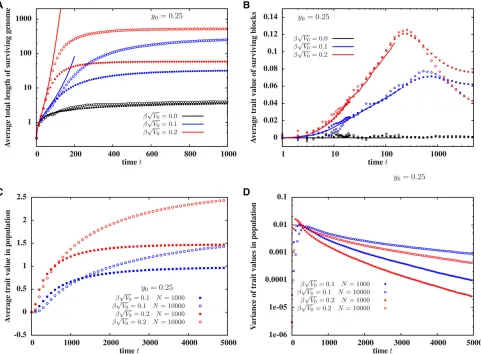
Figure 4A shows the average total amount of surviving introgressed genomeLtotðtÞas a function of timetafter the hybridization event. The predictions of the path-conditioned BP averaged over many paths (lines) agrees with finite N predictions from individual-based simulations (points) over a short time scale, whose duration is proportional to logðNÞ (forb ffiffiffiffiffiV0
p
.0). This is simply because the average number of descendants (as well as LtotðtÞ) grows exponentially within the BP framework (Figure 3, B and C), and thus becomes comparable to any Nat a time that scales as logðNÞ: Fur-ther, the time scale is inversely proportional to the rate of
Figure 3 (A) Survival probabilityPsurvðtÞ;that at least one descendant of the introduced block survives (B) average number of descendants of the block, and (C) average of the total map length of introgressed genetic material in the population,vs. t, the number of generations after the initial hybridization event. The averages in plots (B and C) are conditional on survival of at least some part of the block,i.e., are normalized byPsurvðtÞ:The introduced block is assumed to have trait valuez0¼0 and map lengthy0¼0:25 (main plot) ory0¼0:05 (inset). Both inset and main plot depict statistics for four
different values ofb ffiffiffiffiffiffiV0
p
:Points are calculated from direct simulations of the path-conditioned BP averaged over 104paths, while lines show predictions
introgression, which increases with the map length, for z00:Thus, for a neutral introduced block, BP predictions are valid for a shorter time when the introduced block is long and recipient population small.
Once descendants of the introduced block constitute a sizable fraction of the recipient population, mating between individuals carrying the introgressed genome becomes fre-quent, resulting in offspring withmultipleintrogressed frag-ments. For instance, with strong selection (b ffiffiffiffiffiV0
p
¼0:2), the average number of introgressed fragments per diploid genome ranges from 5:5 (for N¼1000) to 3 (for N¼100;000) as early as att¼200.
This has interesting implications for the evolution of trait values and hence, the rate of adaptation infinite populations (as shown in Figure 4, B and C). The average trait value associated with individual fragments in a finite population follows the BP prediction over a time scale of duration
logðNÞ, but then starts declining over longer times (Figure 4B). However, since a typical descendant accumulates many
such fragments over time, the average trait value associated with individualskeeps increasing (Figure 4C). The average trait value initially increases faster in the smaller (N¼103) population, in which mating between descendants of the in-troduced block starts occurring soon after the hybridization event (Figure 4C). However, the fixation of sub-blocks and the accompanying decline in genetic variability is also faster with N¼103 (Figure 4D). Since the trait mean advances each generation by an amountbtimes the genetic variance, the higher variance withN¼104 allows for a longer selec-tion response and a greater net advance of the trait value (Figure 4C).
Thus, in the present model, adaptive introgression into a
finite population involves two distinct processes occurring on different time scales. The first phase is characterized by splitting of the original block by recombination, the separa-tion of genomic fragments with positive fitness effects from their deleterious background and the amplification of these by selection. During this phase, the average trait value per
Figure 4 Simulations of afinite population ofNdiploids: (A) Total length of introgressed genome survivingtgenerations after the initial hybridization event as a function oft, for various values ofb ffiffiffiffiffiffiV0
p
:(B) Average trait value associated with a surviving block,vs. t. (C) Average trait value associated with individuals in the population,vs. t. (D) Variance of trait values associated with individuals in the population (averaged over replicates),vs. t. Lines in (A and B) represent predictions of the path-conditioned BP averaged over 104 paths, while points are from individual-based simulations ofN¼103
(squares) andN¼104(circles) populations. All simulations are withL¼212 discrete loci. The BP predictions match individual-based simulations of
descendant increases logarithmically in time and is well predicted by the BP. The second phase is characterized by increased probability of mating between individuals carrying introgressed genetic material and the emergence of individ-uals who bear multiple, beneficial introgressed fragments, and have a strong selective advantage. This causes a rapid increase in average trait value among individuals in the population at longer time scales, even as the average trait value per surviving fragment declines. This rapid increase is not predicted by the BP.
Nevertheless, the BP provides valuable intuition about the initial phases of introgression, and is easier to simulate since it only tracks single fragments. We now use the BP framework to explore how blocks that are originally non-neutral (with z06¼0) spread during early phases of introgression.
Introgression dynamics of a beneficial introduced block:
Suppose that a single copy of a beneficial block (with z0=
ffiffiffiffiffiffiffiffiffiffi
V0y0 p
1) enters the native population. Unlike in the case of a neutral (z0¼0) introduced block, we expect the
trait values associated with descendants to decrease as the original block splits into smaller fragments. Does this then imply that a long, positively selected genomic block is less likely to introgress than a discrete locus (which cannot be further split by recombination) with the same selective advantage? As before, we follow various attributes such as PsurvðtÞ;Ltot=PsurvðtÞ; and the average size and effect of de-scendant blocks through time using the BP framework, but now with a focus on how these vary withy0(the map length of the introduced block).
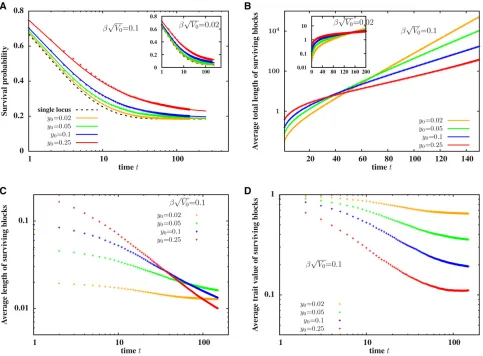
Figure 5A shows that the survival probabilityPsurv;a few hundred generations after the hybridization event, is actually minimum for the discrete locus and increases with map length y0;but more weakly than in the case of the z0¼0 block. This is true for both selection strengths shown in Fig-ure 5A (main plot and inset). The weak dependence of PsurvðtÞony0 reflects the tension between two opposing ef-fects—the higher (overall) probability of transmission of longer blocks to the gamete during meiosis,vs.the fact that long blocks are more likely to be split by recombination and
Figure 5 (A) Probability that at least one descendant of an originally beneficial (z0= ffiffiffiffiffiffi V0
p
¼1) introduced block survives (B) average of the total map length of introgressed genetic material in the population (conditional on survival of some part of the introduced block) (C) average length of surviving blocks and (D) average trait values of surviving block,vs. t, the number of generations since the initial hybridization event. Points are calculated from direct simulations of the path-conditioned BP, while lines in (A and B) show predictions of the unconditioned BP and are obtained from numerical iteration of Equations (3) and (4). Both inset and main plot depict statistics for four different values ofb ffiffiffiffiffiffiV0
p
hence transmit only a part of their selective advantage to the next generation.
However, within surviving lineages, short blocks introgress faster,i.e., leave more descendants and result in a higher total length of introgressed genome in the long run, than long blocks with the same selective advantage (Figure 5B). This is because short blocks undergo fewer divisions, and, hence, less dilution of selective effect. This is also evident in Figure 5D, which shows that the long-term average trait value asso-ciated with surviving fragments is highest for the shortest introduced block, for a given total value.
Since long blocks break up faster than short ones, frag-ments of they0 ¼0:25 genomic block are already shorter on average at t¼100, than fragments of an originally smaller (e.g.,y0 ¼0:02) block that had the same trait value (Figure 5C). Thus, at longer time scales, the average length of de-scendant blocks depends nonmonotonically on the map length of the original block—surviving fragments are longest when the initial selective advantage is spread over a block of intermediatelength (Figure 5C).
As in the z0¼0 case, the BP fails to describe long-term introgression intofinite populations. In afinite population, the average trait value associated with descendant individu-als actually increases at long time scales, even as trait values of descendant blocks falls (results not shown). As before, this is due to the emergence of individuals carrying multiple introgressed fragments. Thus, recombination can be thought of as playing a dual role during the introgression of a
bene-ficial genomic block. In the initial phase, recombination splits the original block into smaller and smaller fragments, thus diluting the selective advantage of descendants carrying block fragments over time. The most successful fragments that survive this phase are medium-sized and have a signifi -cant selective effect, causing them to be amplified faster by selection than they can be broken up by recombination. In later phases, recombination reassembles those fragments that have survived the initial phase, resulting in genomes with very large and positive trait values.
Note that the rate of introgression [reflected in the rate of growth of quantities such asLtotðtÞ=PsurvðtÞandnðtÞ=PsurvðtÞ] shows a qualitatively different dependence on the initial map length y0 when the introduced block is strongly beneficial (z0 ffiffiffiffiffiffiffiffiffiffiV0y0
p
)vs.when it is neutral (z00), suggesting that there could be a crossover between these two kinds of de-pendence at some critical value ofz0. To investigate this, we plot the average number of surviving descendantsn=Psurv a 100 generations after the initial hybridization event, as a function of map lengthy0 of the selected genomic block, for various initial trait valuesz0(Figure 6). For low or zeroz0, the number of descendants increases with increasingy0. This is due to the higher genetic variation associated with longer blocks. When the introduced block is neutral (or nearly neu-tral) with respect to the native population, the response to selection must be driven by the release of this variation by recombination. By contrast, when the initial trait valuez0 is high, initial introgression depends more on the selective
advantage of the introduced block over native blocks, and less on the generation of new variation. In this case, varying y0 essentially alters the balance between selection and re-combination, with longer blocks splitting faster, resulting in a rapid dilution of their selective effect. Thus, in this case,
n=Psurv att¼100 actually falls withy0:Interestingly, at in-termediate values of z0; the average number of surviving descendants exhibits a nonmonotonic dependence on y0 (see z0 ¼0:4 and z0¼0:6 curves in Figure 6), signifying a switch from z0=
ffiffiffiffiffiffiffiffiffiffi
V0y0 p
1 behavior (associated with strongly beneficial genomic blocks) toz0=
ffiffiffiffiffiffiffiffiffiffi
V0y0 p
1 behav-ior (associated with initially neutral blocks).
Figure 6 also shows that, for a fixed map length, intro-duced blocks with higher trait valuez0 leave more descen-dants. This effect is particularly marked when map lengths are small and introgression depends more on the selective effect of the introduced block and less on the generation of new variation. This also implies that if there is random sam-pling of blocks from a source population with a distribution of trait values (with mean z0 and varianceV0y0), then most successful introgression events will be initiated by outlier genomes with higher than average trait values within the source population. Thus, fragments of such genomes tend to be over-represented in the recipient population (relative to their frequency in the source population). As before, we expect this effect to be more pronounced when y0 is small. This is confirmed in simulations (Figure F1, Appendix F).
Introgression dynamics of a deleterious introduced block
Finally, we consider the introgression of a block withz0,0; which is at a selective disadvantage with respect to the native population. The role of selection in this scenario is subtle—on the one hand, stronger selection makes it likely that lineages
Figure 6 The average number of surviving descendants carrying some part of an introduced block forb ffiffiffiffiffiffiV0
p
¼0:1;100 generations after the initial hybridization event (conditional on survival of at least one such descendant),vs.pffiffiffiffiffiy0;wherey0is the map length of the introduced block.
The different colors correspond to different values ofz0;the (unscaled)
containing (deleterious) fragments of the original block die out in thefirst few generations; on the other, small fragments of the block with even mildly positive contributions to trait value, once separated from the deleterious background, have a strong selective advantage that causes their number to rap-idly increase. Thus, while the probability that at least part of the block survives declines more rapidly for largerb ffiffiffiffiffiV0
p
in thefirst few generations (Figure 7A), it also approaches its asymptotic value faster.
Moreover, the average number of descendant blocks (con-ditional on survival) and the total amount of introgressed genome they encompass, grows faster for largerb ffiffiffiffiffiV0
p
;i.e., for stronger selection against the original deleterious block and/ or higher genic variance of the block (Figure 7B). The trait value associated with surviving descendant blocks also becomes rapidly positive when b ffiffiffiffiffiV0
p
is large (Figure 7D). This is consistent with the general expectation that under strong selection, maladapted lineages must undergo rapid adaptation or else soon be lost from the population.
The average length of blocks descended from the origi-nally deleterious block is shorter than that of descendant blocks of the neutral (b ffiffiffiffiffiV0
p
¼0) block (Figure 7C). Shorter blocks are associated with less negative contributions to trait value (on average) and are favored by selection; thus, the stronger the selection, the more markedly the average block size deviates from the neutral expectation, at least at short times. At longer times, however, the decay in average block size slows down significantly for high values of b ffiffiffiffiffiV0
p
. As before, this is due to the emergence of small positively se-lected fragments from the deleterious blocks. Selection op-poses any further splitting of these fragments, and favors descendants who inherit the entire fragment, as opposed to a smaller portion.
Figure 7, A and B also show that large deleterious blocks are more likely to survive, and also leave more descendants within surviving lineages than small deleterious blocks with the same selective disadvantage (insetsvs.main plots). This is both because of the higher transmission advantage of large blocks during meiosis as well as the higher segregation var-iation and superior adaptive potential associated with them.
Discussion
Adaptive introgression under infinitesimal selection
Under the infinitesimal model, individual loci have vanish-ingly small effects. Nevertheless, the introgression of a block of genome with many such loci under directional selection differs qualitatively from neutral introgression. Positive se-lection causes the average number of descendants of such a block, as well as the average total amount of introgressed genetic material, to grow exponentially, at least while the number of descendants is much smaller than population size. For introduced blocks that are neutral or nearly neutral, exponentially fast introgression emerges only several tens of generations after the hybridization event (Figure 3, B
and C), once favorable fragments are dislodged by recombi-nation. By contrast, if the introduced block has a significant selective advantage, exponential growth of descendant blocks starts almost immediately after hybridization (Figure 5B), and continues indefinitely in an infinite population. This is contrary to the intuitive expectation that, under the infi n-itesimal model, multiple rounds of recombination should progressively dilute the selective effect of descendant blocks, leading to patterns that are essentially indistinguishable from those of neutral introgression over longer time scales. Here, we show that this dilution of selective effect is countered by selection, which tends to amplify medium-sized fragments with significant contributions, so that they proliferate, essen-tially as nonrecombining units.
Linkage plays a qualitatively different role, depending on whether adaptive introgression is driven by the initial selec-tive advantage of a very fit introduced block, or by the generation of new variation via recombination, for instance, if the introduced block is initially neutral or deleterious (Figure 6). When the introduced block is fit, tight linkage ensures that it is passed on intact to more descendants, lead-ing to faster introgression by shorter blocks. When the intro-duced block is nearly neutral, larger map lengths are correlated with more hidden variation and a higher probabil-ity that a positively selected sub-block can escape from the neutral block to grow exponentially. Thus, introgression is faster if a neutral or nearly neutral introduced block is longer.
Length of surviving blocks
Under the infinitesimal model, the process of introgression depends on relatively few parameters:y0;the map length of the introduced block,z0=
ffiffiffiffiffiffiffiffiffiffi
V0y0 p
;the trait value relative to the genic variance of the block, andb ffiffiffiffiffiffiffiffiffiffiV0y0
p
=y0;the strength of selection relative to recombination. Specifically, the length of surviving blocks is shaped by two opposing effects—the block must be small enough that it is transmitted intact (without recombination) to the majority of offspring, but large enough that it contributes substantially to trait value.
“Successful”descendant blocks that emerge from a neu-tral block of map length y0;have typical contributions that scale with ffiffiffiffiffiffiffiffiffiffiV0y0
p
;whereV0 is the genic variance per unit map length. Note thatV0 can be high either if the density of selected loci per unit map length is high or if the variance of their fitness effects is large. Thus, it may not be possible to disentangle the number of selected loci within initially success-ful fragments from the distribution of theirfitness effects. More generally, the initial survival of the genome depends on the growth rates of intermediate sized blocks, not on the fi ner-scaled variation that might eventually be uncovered and then reassembled by recombination in a large population. In fact, in a small population of sizeN, initially successful fragments may
can be accurately described by the infinitesimal model (Figure B1, Appendix B).
Variability among replicate populations
Most of the systematic trends described above are only evident for theaveragesof various quantities, where the averaging is over thousands of replicates, each involving a different re-alization of the introduced block. Individual replicates can, however, differ dramatically from one another (see Figure 1 above and Figure E1 in Appendix E) and also from the aver-age. Such variability between replicates presents a severe challenge for developing methods to infer population genetic parameters (typically from a single realization of the intro-gression process).
The high variability among replicates reflects two different kinds of underlying stochasticity. First, individual Brownian paths describing the introduced block can be quite different from each other, even if they are drawn from the same distribution. Positive-effect alleles may be physically clustered
on an individual block just by chance even if the distribution of effect sizes of loci is the same across different genomic regions and there is no population-wide LD in the source population from which the block originated. Rapid introgression en-sues when the introduced block happens to contain a genomic tract with strong positive effect (for instance in Figure 1, A and C), while introgression is much slower when the clustering is weaker and the constituent tracts only moderately beneficial (Figure 1, B and D). This also suggests that introgression would be more likely even with infinitesimal effect loci, if the underlying distribution of effect sizes were nonuniform across the genome, resulting in particular genomic regions that contribute significantly to the trait. Conversely, intro-gression becomes less likely if the source population is under very strong stabilizing selection (which would create nega-tive LD and reduce the likelihood that a genome contains stretches with significant positive effect).
Second, different replicates corresponding to the same Brownian path can also be very different due to the
Figure 7 (A) Survival probability of at least one descendant of an originally deleterious (z0= ffiffiffiffiffiffiV0
p
¼21) introduced block (B) average of the total map length of introgressed genetic material in the population (conditional on survival of some part of the introduced block) (C) average length of surviving blocks and (D) average trait values of surviving block,vs. t, the number of generations since the initial hybridization event. Points are calculated from direct simulations of the path-conditioned BP, while lines in (A and B) show predictions of the unconditioned BP and are obtained from numerical iteration of Equations (3) and (4). Both inset and main plot depict statistics for four different values ofb ffiffiffiffiffiffiV0
p
stochasticity inherent in reproduction and recombination events (see Figure E1 of Appendix E). Various stretches of a long, nearly neutral, introduced block may be lost from the population by chance early on, when segregating sub-blocks are also long, have weak effects, and are present in small numbers. At longer times, once medium-sized blocks with a substantial contribution to trait value (i.e., with positive growth ratebz2y) have been isolated, we expect introgres-sion to be dominated by the proliferation of the sub-block with the largest growth rate. Understanding whether the in-terplay between early stochasticity and long term, essentially deterministic dynamics can cause parallel introgression sig-natures in replicate populations that receive the same intro-duced genome, remains an interesting direction for future work.
Single locus vs. infinitesimal introgression
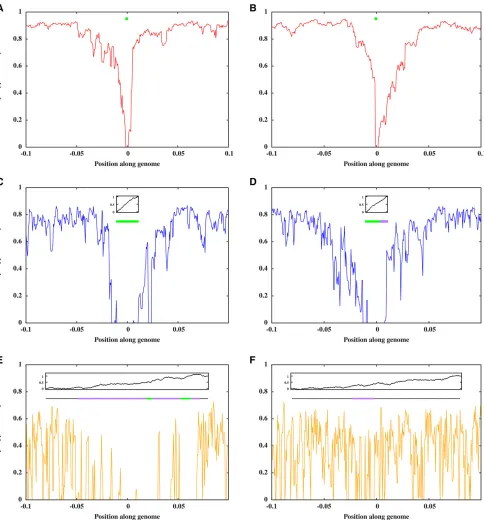
The exponential spread of medium-sized blocks even under infinitesimal selection, and the high variability among repli-cates suggest that patterns of neutral diversity (such as those associated with selective sweeps) may be very similar for an introgressing block with many weak-effect loci and a block with a single discrete locus. In both cases, a haplotype of map length1=Twillfix, whereTis the time tofixation, provided the positively selected region is smaller than this. However, if a successful fragment has map length .1=T, then the region of reduced diversity might be larger (Figure 8, C and D). It remains to be established whether such a pattern has power to systematically distinguish between one selected locusvs. many, and how it might be obscured if multiple blocks are introduced.
When a single genome introgresses, sweeps are necessarily “hard” (Hermisson and Pennings 2017). These can be ob-served in individual-based simulations by tracking haplotype
diversity H, measured as H¼ ð2N=ð2N21ÞÞ
12P i
x2 i
; where Nis the population size and xi is the frequency of haplotypei in the population (Nei and Tajima 1981). The native population is assumed to have 2Ndistinct haplotypes before hybridization. Figure 8 shows how haplotype diversity changes with increasing map distance from a selected locus or block, a few hundred generations after hybridization. The discrete locus and the extended blocks are associated with the same initial trait value (z0¼1) and experience the same selection (b¼0:1). Comparable regions of reduced diversity can be observed near the discrete locus (Figure 8, A and B) as well as the short block (Figure 8, C and D), and also near introgressing fragments of the large selected block (Figure 8, E and F), making it difficult to infer the underlying genetics from these observations.
Some insight may be gained, however, by comparing in-trogression signatures in replicate populations. If replicates were made starting with different extended blocks drawn from the source population, there should be no concordance between regions of reduced diversity among replicates under the infinitesimal (compare Figure 8, E and F), as long as all
genomic regions contribute approximately equally to the di-vergence between the source and recipient population. By contrast, sweep events are expected to be clustered in the same genomic regions in different replicates, when selection is concentrated at one or few loci. However, if the source population exhibits genomic islands of divergencei.e., if the average effect size of alleles, even though small, is systemat-ically different in certain genomic regions in the source pop-ulation, then again high concordance between replicates can be observed between replicates, even under the infinitesimal model. These issues will be explored in detail in future work.
Initial spread vs. long-term introgression
Our analysis of the initial spread of the introduced block and its descendants is based on the path-conditioned branching process, in which the number of offspring of different indi-viduals is assumed to be correlated only via the Brownian path that specifies the trait values of the introgressed fragments they carry. This allows us to analyze a rather complex poly-genic architecture, while still maintaining computational trac-tability. Interestingly, the predictions of the path-conditioned BP for the distributions of various quantities such as the block lengths and values, when averaged over different Brownian paths, are indistinguishable from the predictions of an un-conditioned BP approximation that neglects correlations in trait value among different descendants of an individual. Elucidating the correspondence between the exact and ap-proximate unconditioned BP, and exploring whether this correspondence might yield analytical predictions for signa-tures of sweep-like events under the infinitesimal model, remains an interesting direction for future work.
The BP framework predicts introgression dynamics in a
finite population of sizeNover a short, initial timescale that scales as logðNÞ. Over long timescales, mating between descendants of the introduced genome become common, resulting in faster introgression that cannot be predicted by the BP (Figure 4). Note that recombination plays a qualita-tively different role during these two phases of introgression. When the introduced block is strongly beneficial, recombina-tion dilutes the selective advantage associated with descen-dant blocks in early stages of introgression (thus acting counter to selection). In later phases, recombination tends to bring together small positively selected sub-blocks (that have survived the initial phase), generating descendant indi-viduals with multiple introgressed fragments and a strong selective advantage, thus countering Hill-Robertson interfer-ence (Hill and Robertson 1966). Ultimately, linked clusters of favorable variantsfix, along with small blocks of associated genome.