Incremental All Pairs Similarity Search for Varying
Similarity Thresholds
Amit Awekar, Nagiza F. Samatova, and Paul Breimyer
[email protected], [email protected], [email protected]
North Carolina State University, Raleigh, NC
Oak Ridge National Laboratory, Oak Ridge, TN
Abstract— All Pairs Similarity Search (AP SS) is a ubiqui-tous problem in many data mining applications and involves finding all pairs of records with similarity scores above a specified threshold. In this paper, we introduce the problem of Incremental All Pairs Similarity Search (I AP SS), where AP SS is performed multiple times over the same dataset by varying the similarity threshold. To the best of our knowledge, this is the first work that addresses theI AP SS problem. All existing solutions for AP SSperform redundant computations by invokingAP SS independently for each threshold value.
In contrast, our solution to the I AP SS problem avoids redundant computations by storing the history of previous AP SS invocations and using index splitting. While offering obvious benefits, the computation and I/O intensive nature of the I AP SS solution raises two key research challenges: (1) to develop efficient I/O techniques to manage computation history and (2) to efficiently identify and prune redundant com-putations. We address these challenges through the proposed (a) history binning technique that clusters record pairs based on similarity values and performs I/O during the similarity computation, and (b) splitting of inverted index that maps each dimension to a list of records that have a non-zero projection along that dimension. As a result, we evaluate the effectiveness of our techniques by demonstrating speed-ups in the order of
2X to over105X over the state-of-the-artAP SSalgorithm for four real-world large-scale datasets.
I. INTRODUCTION
Many data mining techniques search for all pairs of records that have similarity scores above a specified threshold [4], [13]. In the literature, this problem is referred to as similarity
join [13] or all pairs similarity search (APSS) [4]. For
example, the Jarvis-Patrick algorithm for clustering sparsifies the similarity score matrix by retaining only those entries that satisfy a predefined threshold [6].
Selecting a meaningful similarity threshold is an art be-cause it is data dependent. Domain experts often use a trial and error approach by looking at the quality of output. For example, the optimal threshold for sparsifying the similarity score matrix in the Jarvis-Patrick algorithm can be deter-mined only after evaluating the quality of different cluster-ings by varying the similarity threshold for sparsification.
Varying the similarity threshold leads to another impor-tant problem that we refer to as the incremental all pairs
similarity search (IAP SS), which performsAP SSmultiple
times on the same dataset by varying the similarity threshold
Nagiza F. Samatova is the corresponding author.
value. TheIAP SS problem is challenging to solve when it is applied frequently or over large datasets.
However, there are a number of important applications that require efficient handling theIAP SSproblem. For example, the output of IAP SS is used to detect all near duplicate document pairs [13]. A news search engine has to solve the
IAP SS problem every few minutes over a small subset of the web, whereas a general web search engine has to solve theIAP SSproblem once every few days, but over the entire web.
To the best of our knowledge, the IAP SS problem has not received a special treatment in the literature and the “brute-force” strategy is used instead. Namely, applying a new instance ofAP SS after each similarity threshold value changes. Obviously, this solution may be inefficient due to inherent redundancies.
All of the existing solutions forAP SS[13], [4], [2], [9] do not exploit the fact that a significant part of the computation is redundant across multiple invocations of AP SS, because each of the AP SS instances executes independently for changing similarity threshold values. For example, consider performingAP SStwice on a dataset. Initially, the threshold value is 0.9 and later it is reduced to 0.8. All pairs present in the output of the firstAP SS will also exist in the output of the secondAP SS. There is no need to compute the sim-ilarity score for these pairs during the secondAP SS. While executing the firstAP SS, the similarity score computed for some pairs would be less than 0.8. We can safely prune the similarity score computations of such pairs during the second
AP SS. Arguably, the more timesAP SS is performed, the greater the opportunity to optimize the search by eliminating redundant calculations.
as the Euclidian distance. However, their techniques assume that the triangle inequality holds true for distance measures, which is not the case for similarity functions like the cosine similarity and the Tanimoto coefficient.
Given a dataset with nrecords in a ddimensional space where d >> n, a na¨ive algorithm for IAP SS will com-pute and store the similarity scores between all pairs in
O(n2
∗d) time. However, this computational cost becomes prohibitively expensive for large-scale problems. To address this limitation our solution to the IAP SS problem stores the computation history during each invocation of IAP SS
and later uses the history to systematically identify and effectively prune redundant computations. The compute and I/O intensive nature of theIAP SS problem raises two key research challenges: (1) developing efficient techniques for I/O while using the computation history; and (2) efficiently identifying and pruning redundant computations. To address these challenges, we propose two major techniques: history
binning and index splitting.
The history binning technique stores information about all pairs evaluated in the current invocation of IAP SS. Pairs are grouped based on their similarity scores and stored in binary files. This information is used in the next invocation of IAP SS to avoid re-computation of known similarity scores. Grouping pairs enables our algorithm to read only the necessary parts of the computation history. The I/O for history binning is performed in parallel to the similarity score computation, which reduces the overhead in end-to-end execution time.
The index splitting technique divides the inverted index based on the values of tnew andtold. This splitting enables
our algorithm to avoid searching through a major part of the inverted index and to prune similarity score computations of pairs that exist in the computation history.
Lowering the value of the similarity threshold results in exploring a greater portion of the search space (i.e., the number of record pairs evaluated). The lowest similarity threshold value used in previousIAP SSinvocations defines the parts of the search space that have already been explored. Depending on the value of the current similarity threshold (tnew) and the previous lowest similarity threshold value
(told), we identify three different cases for theIAP SS
prob-lem: (1) booting, where the IAP SS algorithm is executed for the first time on a given dataset, (2) upscaling, where
told ≤tnew, and (3) downscaling, where told > tnew. The
history binning technique is used in all three cases, while index splitting is required only for the downscaling case.
We incorporate both history binning and index splitting into the state-of-the-artAP SS algorithm [4], which enables us to split theIAP SScomputation into various independent subtasks that can be executed in parallel. This paper proposes the following contributions:
• Develops history binning and index splitting techniques that systematically identify and effectively prune re-dundant computations across multiple invocations of
AP SS.
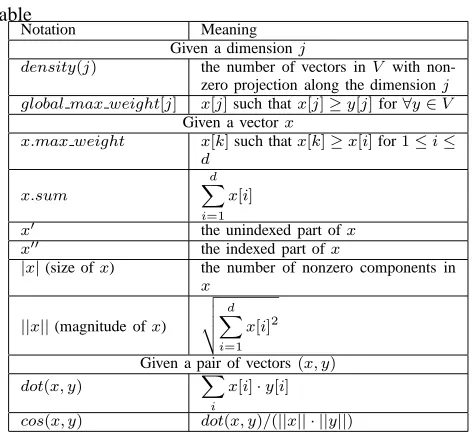
TABLE I: Notations Used table
Notation Meaning Given a dimensionj
density(j) the number of vectors inV with
non-zero projection along the dimensionj
global max weight[j] x[j]such thatx[j]≥y[j]for∀y∈V
Given a vectorx
x.max weight x[k]such thatx[k]≥x[i]for1≤i≤
d
x.sum
d X
i=1
x[i]
x′ the unindexed part ofx
x′′ the indexed part ofx
|x|(size ofx) the number of nonzero components in
x
||x||(magnitude ofx)
v u u t
d X
i=1
x[i]2
Given a pair of vectors(x, y)
dot(x, y) X
i
x[i]·y[i]
cos(x, y) dot(x, y)/(||x|| · ||y||)
• Incorporates our history binning and index splitting techniques into the state-of-the-art AP SS algorithm and parallelizes it, which leads to efficient end-to-end computation.
• Offers more responsive output than the state-of-the-art
AP SS solution by almost instantaneously identifying pairs with high similarity scores. This responsive nature is particularly desirable for processing large datasets requiring multiple hours for complete execution.
We perform empirical studies using four real-world mil-lion record datasets derived from: (a) scientific literature collaboration in Medline1 indexed papers, (b) Flickr2social
networks, (c) LiveJournal3 social networks, and (d) Orkut4
social networks. We compare the performance of our al-gorithm against the state-of-the-art AP SS algorithm [4]. Depending on the similarity threshold variation, our speed-ups vary from2X to over105
X.
II. DEFINITIONS ANDNOTATIONS
In this section we define the problem and other important terms referenced throughout the paper (please, see Table I for the summary of notations).
Definition 1 (All Pairs Similarity Search): The all pairs
similarity search (AP SS) problem is to find all pairs(x, y) and their exact value of similaritysim(x, y)such thatx, y∈ V andsim(x, y) ≥t, where
• V is a set ofnreal valued, non-negative, sparse vectors over a finite set of dimensionsD and|D|=d;
• sim(x, y) :V ×V → [0,1] is a symmetric similarity function; and
• t,t∈[0,1], is the similarity threshold.
1www.nlm.nih.gov/pubs/factsheets/medline.html
2www.flickr.com
Definition 2 (Incremental All Pairs Similarity Search): The
incremental all pairs similarity search problem is to the solve
AP SS problem for a given similarity threshold value tnew
when theAP SSproblem is already solved for the least value of similarity thresholdtold.
Definition 3 (Inverted Index): The inverted index maps
each dimension to a list of vectors with non-zero projections along that dimension. A set of alldlistsI={I1, I2, ...., Id}, i.e., one for each dimension, represents the inverted index for
V. Each entry in the list has a pair of values(x, w)such that if(x, w)∈Ik, thenx[k] = w. The inverse of this statement
is not necessarily true because some algorithms index only a part of each vector.
Definition 4 (Candidate Vector and Candidate Pair):
Given a vector x ∈ V, any vector y in the inverted index is a candidate vector for x, if ∃j such that x[j] > 0 and (y, y[j])∈Ij. The corresponding pair (x, y) is a candidate
pair.
Definition 5 (Matching Vector and Matching Pair): Given
a vector x ∈ V and the similarity threshold t, a candidate vectory∈V is a matching vector forxifsim(x, y)≥t. We say thatymatches withx, and vice versa. The corresponding pair (x, y)is a matching pair.
During subsequent discussions we assume that all vectors are of unit length (||x|| = ||y|| = 1), and the similarity function is the cosine similarity. In this case, the cosine similarity equals the dot product, namely:
sim(x, y) =cos(x, y) =dot(x, y).
Our solution to theIAP SSproblem can be extended to other popular similarity measures like the Tanimoto coefficient and the Jaccard similarity using transformations presented by Bayardo et al. [4].
III. AP SSALGORITHM
Because the proposed IAP SS algorithm is based on the
AP SS algorithm, here we briefly summarize AP SS and explain the All P airs algorithm [4], which is the state-of-the-art algorithm forAP SS. The basic idea is similar to the way information retrieval systems answer queries [11]. Every vector in the dataset is considered to be a query and the corresponding matching pairs are found using the inverted index. Most of the time, however, the information retrieval system only requires thetop−ksimilar pairs, whileAP SS
requires all matching pairs.
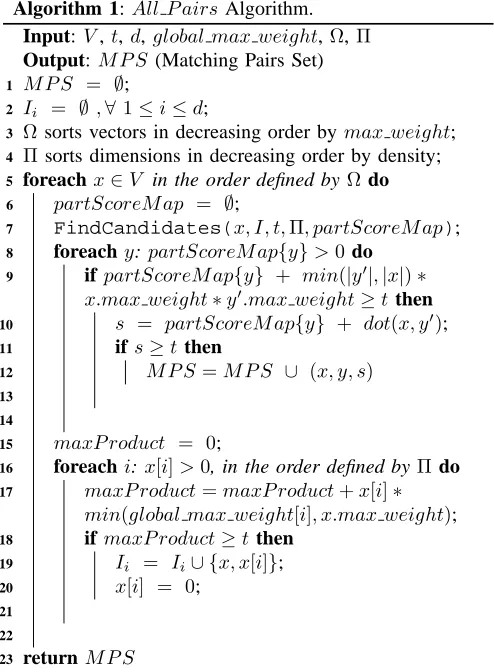
The algorithm can be broadly divided into three phases: data preprocessing, pairs matching, and indexing. The pre-processing phase (lines 1-4, Algorithm 1) reorders vectors using a permutationΩdefined overV and components within each vector using permutationΠ defined overD.
The matching phase (lines 6-14, Algorithm 1) finds can-didate pairs and selects matching pairs from them. For a given vectorx∈V, the F indCandidatesprocedure scans the lists in the inverted index that correspond to the nonzero dimensions in xto find candidate pairs. Simultaneously, it accumulates a partial similarity score for each candidate pair. Some of the candidate pairs can be safely discarded by
computing an upper bound on the similarity score in constant time. Otherwise, the exact similarity score is computed for the candidate pair.
The indexing phase adds a part of the given vector to the inverted index so that it can be matched with any of the remaining vectors (lines 15-21, Algorithm 1). The
All P airs algorithm uses an upper bound on the possible similarity scores with only a part of the current vector (line 17, Algorithm 1). Once this bound reaches the similarity threshold, the remaining vector components are indexed. Please, refer to Bayardo et al. [9] for more details.
Algorithm 1:All P airsAlgorithm.
Input:V,t,d,global max weight,Ω,Π
Output:M P S (Matching Pairs Set)
M P S = ∅;
1
Ii = ∅ ,∀1≤i≤d; 2
Ωsorts vectors in decreasing order bymax weight;
3
Π sorts dimensions in decreasing order by density;
4
foreachx∈V in the order defined byΩdo 5
partScoreM ap = ∅;
6
FindCandidates(x, I, t,Π, partScoreM ap);
7
foreachy:partScoreM ap{y}>0 do 8
if partScoreM ap{y} + min(|y′|,|x|)∗
9
x.max weight∗y′.max weight≥tthen
s = partScoreM ap{y} + dot(x, y′);
10
if s≥tthen 11
M P S=M P S ∪ (x, y, s)
12
13
14
maxP roduct = 0;
15
foreachi:x[i]>0, in the order defined byΠdo 16
maxP roduct=maxP roduct+x[i]∗ 17
min(global max weight[i], x.max weight);
if maxP roduct≥t then 18
Ii = Ii∪ {x, x[i]}; 19
x[i] = 0;
20
21
22
returnM P S 23
IV. IAP SSALGORITHMOVERVIEW
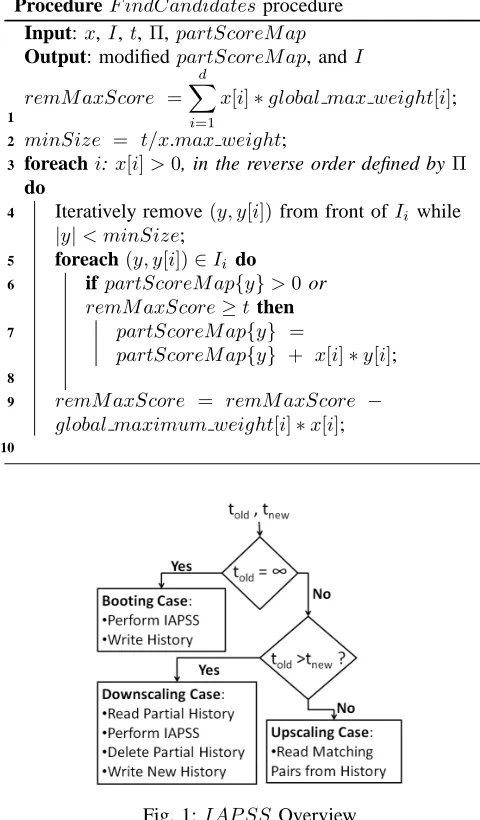
TheIAP SSalgorithm is based on the observation that the proportion of the search space explored during the execution of a single AP SS invocation is inversely proportional to the value of the similarity threshold. If t < t′, then the search space explored while executing AP SS for t′ is a subset of the search space explored for t. Therefore, the lowest previously used value of the similarity threshold is required while solving theIAP SS problem. Depending on the relative values of the current similarity threshold (tnew)
and the previous lowest similarity threshold value (told),
ProcedureF indCandidatesprocedure
Input:x,I,t,Π,partScoreM ap Output: modifiedpartScoreM ap, andI
remM axScore =
d X
i=1
x[i]∗global max weight[i];
1
minSize = t/x.max weight;
2
foreachi:x[i]>0, in the reverse order defined byΠ
3 do
Iteratively remove(y, y[i]) from front ofIi while 4
|y|< minSize;
foreach(y, y[i])∈Ii do 5
if partScoreM ap{y}>0or
6
remM axScore≥tthen partScoreM ap{y} =
7
partScoreM ap{y} + x[i]∗y[i];
8
remM axScore = remM axScore −
9
global maximum weight[i]∗x[i];
10
Fig. 1:IAP SS Overview figure
1) Booting:told =∞, executing the IAP SS algorithm
for the first time on a given dataset.
2) Upscaling:told≤tnew, reading a subset of pairs that
are already present in the computation history. 3) Downscaling: told > tnew, potentially adding new
similarity pairs to the computation history.
V. BOOTING
Booting is a relatively simple case of IAP SS that per-formsAP SSwhile recording the computation history using history binning.
A. History Binning
Our IAP SS algorithm takes a user defined parameter,
Pmax, that specifies the number of partitions for the
similar-ity interval of[0,1]. The interval is divided into equal sized non-overlappingPmaxpartitions. For example, ifPmax= 5,
then the similarity interval is divided into five partitions: [0,0.2);[0.2,0.4);[0.4,0.6);[0.6,0.8); and[0.8,1.0]. Given
a similarity value s, the corresponding partition numberPs
can be calculated in constant time as Ps=⌊s∗Pmax⌋. For
the special case ofs= 1 the partition number isPmax−1.
All experiments reported in this paper are performed with
Pmax = 20. The effect of varying Pmax is discussed in
Section IX-C.
The history binning technique classifies candidate pairs into two types: approximate pairs and exact pairs. For each partition, pairs of each type are stored in different files, called approximate pairs files and exact pairs files, respectively. During the similarity score computation some candidate pairs are discarded after computing an upper bound on their similarity score because they do not satisfy the given threshold value (line 9, Algorithm 1). Such pairs are stored as approximate pairs in an approximate pairs file of the partition corresponding to the value of the upper bound on their similarity score. The exact similarity score is computed for the rest of the candidate pairs (line 10, Algorithm 1). These pairs are stored in an exact pairs file of the partition corresponding to their exact similarity score.
B. Booting Algorithm
Booting is the case of executing the IAP SS algorithm for the first time on a given dataset. As there is no infor-mation available from any previous invocation of AP SS, ourIAP SS algorithm simply uses the fastest algorithm for
AP SS while storing the computation history. The booting algorithm is divided into two concurrent threads: the Can-didate Pair Producer and the CanCan-didate Pair Consumer. The Candidate Pair Producer executes the All P airs algorithm (please, refer to Algorithm 3), and the Candidate Pair Con-sumer writes candidate pairs to persistent storage (please, refer to Algorithm 4).
Algorithm 3: Candidate P air P roducer Algorithm: Replace lines 9-13 of Algorithm 1 with the following pseudocode
upperBound=partScoreM ap{y} + min(sum(y′)∗
1
x.max weight, sum(x)∗y′.max weight);
if upperBound≥tthen 2
s = partScoreM ap{y} + dot(x, y′);
3
Add(x, y, s, true)tocandidateP airQueue;
4
if s≥t then 5
M P S=M P S ∪ (x, y, s)
6
7 else 8
Add(x, y, upperBound, f alse)to
9
candidateP airQueue;
10
The producer and consumer share two data structures: the doneF lag and candidateP airQueue. The doneF lag
10 100 1000 10000
0.5 0.6 0.7 0.8 0.9 0.99
Time in Seconds
Booting Similarity Threshold
Medline Flickr
LiveJournal Orkut
(a) Running Time ofIAP SS
1 2 3 4 5 6
0.5 0.6 0.7 0.8 0.9 0.99
Speed-up
Booting Similarity Threshold
Medline Flickr
LiveJournal Orkut
(b) Speed-up overAll P airs
100 1000 10000 100000
0.5 0.6 0.7 0.8 0.9 0.99
Size in MB
Booting Similarity Threshold
Medline Flickr
LiveJournal Orkut
(c) Size of Computation History
Fig. 2: Results for Booting figure
0 0.5 1 1.5
0.5 0.6 0.7 0.8 0.9 0.99
Time in Seconds
Upscaling Similarity Threshold
Medline Flickr
LiveJournal Orkut
(a) Running Time ofIAP SS
100 1000 10000 100000 1e+06
0.5 0.6 0.7 0.8 0.9 0.99
Speed-up
Upscaling Similarity Threshold
Medline Flickr
LiveJournal Orkut
(b) Speed-up overAll P airs
0 25 50 75 100 125
0.5 0.6 0.7 0.8 0.9 0.99
Size in MB
Upscaling Similarity Threshold
Medline Flickr
LiveJournal Orkut
(c) Size of Computation History Read
Fig. 3: Results for Upscaling figure
Algorithm 4: Candidate P air Consumer Algorithm for a thread that writes candidate pairs to persistent storage
whiledoneF lag nottruedo 1
Dequeue all candidate pairs from
2
candidateP airsQueueinwriteP airsSet;
foreach Elementw inwriteP airsSetdo 3
Pw=⌊w.score∗Pmax⌋; 4
if w.isExactis truethen 5
Append entry (w.x, w.y, w.score) to file for
6
exact pairs corresponding to partition Pw else
7
Append entry (w.x, w.y)to file for
8
approximate pairs corresponding to partition
Pw 9
10
11
both vectors in the pair, the similarity score value, and a flag indicating if it is the exact score or an upper bound.
The producer thread performs the similarity computation and adds candidate pairs to the queue. The consumer thread removes candidate pairs from the queue and writes them to a file depending on the value of the similarity score. While writing approximate pairs, the value of the upper bound is
discarded to reduce the size of data to be written. In later invocations of IAP SS, the value of the upper bound of an approximate pair can be computed using its partition number. However, it will be a loose upper bound.
TheIAP SSalgorithm uses two tighter bounds on filtering conditions derived by Awekar and Samatova [3]. While searching for candidate pairs, the lower bound on the size of a candidate (line 2,F indCandidatesProcedure) is squared by theIAP SSalgorithm. While evaluating candidate pairs, the upper bound used by theIAP SSalgorithm on the similarity score is tighter (line 1, Algorithm 3) than the bound used by
All P airs(line 9, Algorithm 1).
Figure 2a shows the running time of theIAP SSbooting algorithm for various similarity threshold values. Speed-up with respect to the All P airsalgorithm is shown in Figure 2b. This speed-up is due to tighter bounds on the filtering conditions. Please, refer to Appendix for a description of the experimental set-up and datasets.
VI. UPSCALING
Upscaling is another simple case ofIAP SS, which only requires reading a part of the computation history and is the case where told ≤ tnew. The set of matching pairs for
thresholdtnewwill be a subset of the matching pairs fortold.
The matching pairs fortold are a subset of all the candidate
pairs for thresholdtoldand have already been stored through
history binning while executingIAP SSfortold. If a pair is a
(lines 3-7, Algorithm 3). Therefore, all matching pairs for threshold told have already been stored in exact pairs files.
No separate search is required to find the matching pairs for thresholdtnew.
Our algorithm only reads the computation history and outputs the matching pairs. It does not need to read the entire computation history because the history binning technique groups the pairs based on their similarity values. For current invocation of IAP SS, our algorithm first computes the partition numberPnewcorresponding to thresholdtnew, and
then reads the exact pairs files corresponding to all partitions
P, Pnew ≤P < Pmax. The pairs satisfying the threshold tnew are then added to the output.
During our experiments, the first IAP SS (booting) ex-periment used a threshold value of 0.5 and then performed upscaling with various similarity thresholds. For all datasets, upscaling was completed in less than two seconds (please, refer to Figure 3a); this is expected because the algorithm only reads and outputs matching pairs. It results in large speed-ups in the range102
Xto106
X (please, refer to Figure 3b). The speed-up for the upscaling case is not dependent on the value told because the number of pairs read by the
upscaling algorithm depends only on the value of tnew.
Grouping pairs by similarity score enables our algorithm to only read the required portions of the history. Figure 3c shows the effectiveness of grouping pairs using the history binning technique. Upscaling algorithms read at most five percent of the total history written during the booting case.
VII. DOWNSCALING
Downscaling is the case of told > tnew. This is the
trickiest case to handle because the search space explored for thresholdtold is a subset of the search space that needs
to be explored for threshold tnew, and the challenge is
to identify this overlap efficiently, which is achieved using history binning and index splitting.
A. Division of Search Space
The search space, that is, the set of candidate pairsC for the given similarity threshold tnew can be partitioned into
two parts:
• Cold= The search space explored after runningIAP SS
for thresholdtold, that is, the set of all candidate pairs
present in the computation history; and
• Cnew=C − Cold
Cold can be further partitioned into:
• Clow = Exact and approximate pairs having similarity
score less than tnew;
• Cmatch = Exact pairs having similarity scores greater
than or equal totnew; and
• Capprox = Approximate pairs having similarity score
upper bounds greater than or equal to tnew.
Pairs in Clow can be ignored, as they will not satisfy
threshold tnew. Pairs in Cmatch can be directly added to
the output without re-computing the similarity score. These pairs have already been written in the exact pairs files. The
Algorithm 5: Downscaling Algorithm.
Input:V,t,d,global max weight,Ω,Π,Pmax Output:M P S (Matching Pairs Set)
M P S = ∅;
1 Iold
i = ∅ ,∀ 1≤i≤d; 2
Inew
i = ∅ ,∀ 1≤i≤d; 3
Ωsorts vectors in decreasing order bymax weight;
4
Π sorts dimensions in decreasing order by density;
5
foreach PartitionP :Pnew≤P < Pmax do 6
foreach Exact Pair (x, y)in partitionP do 7
if s≥tnew then 8
M P S = M P S ∪(x, y, s);
9
10
11
foreachx∈V in the order defined byΩdo 12
Initialize approxListandknownList to empty
13
sets;
foreach PartitionP :Pnew≤P < Pmaxdo 14
Add each y toApproxList, such that(x, y)is
15
an approximate pair in P;
Delete (x, y)from computation history;
16
FindKnownCandidates();
17
FindNewCandidates(x, I, t,);
18
foreachy:partScoreM ap{y}>0 do 19
upperBound=
20
partScoreM ap{y} + min(sum(y′)∗
x.max weight, sum(x)∗y′.max weight);
if upperBound≥t then 21
s = partScoreM ap{y} + dot(x, y′);
22
Add(x, y, s, true)to
23
candidateP airQueue;
if s≥tthen 24
M P S=M P S ∪ (x, y, s)
25
26
else 27
Add(x, y, upperBound, f alse)to
28
candidateP airQueue;
29
SplitIndexVector();
30
told=tnew; 31
store updated value oftold to persistent storage; 32
returnM P S 33
similarity score must be recomputed for pairs inCapprox. The
search space explored in the current execution of IAP SS
is limited to Cunknown = Cnew ∪ Capprox and will
result in pruning similarity score computations for pairs in
Cknown=C−Cunknown=Clow ∪ Cmatch.
B. Index Splitting
The size of the inverted index is inversely proportional to the value of the similarity threshold (lines 16-21, Algo-rithm 1). The inverted indexIold is built for threshold value told and will be a subset of the inverted index I built for
ProcedureSplitIndexV ectorprocedure
Input:x,Iold,Inew,t
old,tnew,Π Output:
maxP roduct = 0;
1
foreachi:x[i]>0, in the order defined byΠdo 2
maxP roduct=maxP roduct+x[i]∗ 3
min(global max weight[i], x.max weight);
ifmaxP roduct≥told then 4
Iold
i = Iiold∪ {x, x[i]}; 5
x[i] = 0;
6
else 7
if maxP roduct≥tnew then 8
Inew
i = Iinew∪ {x, x[i]}; 9
x[i] = 0;
10
11
12
13
inverted index I into the following two partitions:Iold and Inew, whereInew =I − Iold. Please refer to procedure SplitIndexV ector for details. Index splitting is used by the downscaling algorithm to partition the search space into
Cknown andCunknown.
C. Downscaling Algorithm
The downscaling algorithm explores theCunknownsearch
space and stores each evaluated pair in the computation history. The pairs in Cmatch and Capprox are read from
computation history.Cknownis found by traversingIoldand
is used to prune redundant computations while finding and evaluatingCnew. All pairs inCunknown are evaluated using
the inverted index and added to the computation history. Old entries for the pairs in Capprox are removed from the
computation history because their updated similarity scores will be stored during the current invocation ofIAP SS.
1) Reading Cmatch: All pairs in Cmatch are already
present in the computation history. They are read from the exact pairs files corresponding to each partitionP, such that
Pnew ≤P < Pmax (lines 6-11, Algorithm 5). This step is
similar to the upscaling case.
2) Reading and EvaluatingCapprox: Similar to the pairs
in Cmatch, pairs in Capprox can be read all at once from
the approximate pairs files and evaluated directly. How-ever, computing similarity scores directly for all these pairs will not be efficient, because computing the dot product requires serially traversing both vectors. Instead, we read the pairs in Capprox during the matching phase (lines
15-16, Algorithm 5). For a given vector x, the list of pairs in Capprox is stored in approxList. The partial similarity
score for these pairs is calculated using the inverted index when findingCknown andCnew (please, refer to procedures F indKnownCandidatesandF indN ewCandidates). The similarity score computation using the inverted index is more efficient than serially traversing the vectors. In addition, the
ProcedureF indKnownCandidatesprocedure
Input:x,Iold,t
old,Π,partScoreM ap,knownList, approxList
Output: modified partScoreM ap, andknownList partScoreM ap = ∅;
1
remM axScore =
d X
i=1
x[i]∗global max weight[i];
2
minSizeold = (told/x.max weight)2; 3
foreachi:x[i]>0, in the reverse order defined byΠ
4 do
Iteratively ignore(y, y[i])from front of Iold i while 5
|y|< minSizeold; foreach(y, y[i])∈Iold
i do 6
if y∈approxListthen 7
partScoreM ap{y} =
8
partScoreM ap{y} + x[i]∗y[i];
else 9
Addy toknownList;
10
11
remM axScore = remM axScore −
12
global maximum weight[i]∗x[i];
if remM axScore < told then 13
return 14
15
16
evaluation forCapprox now piggybacks searching ofCknown
andCnew.
3) FindingCknown: Finding all the pairs inCknown can
be accomplished by reading the entire computation history. However, finding Cknown from the inverted index is more
efficient because it is an in-memory data structure. For a given vector x, the F indKnownCandidates procedure finds pairs in Cknown. It traverses the inverted index in
the same manner as the F indCandidates procedure in Algorithm 1. However, the similarity score is computed only for pairs in the approxList. The list of pairs in Cknown is
stored in theknownList.
4) Finding Cnew: For a given vector x, the
F indN ewCandidates procedure finds candidate
vectors in Cnew. The procedure is similar to the F indCandidates procedure in Algorithm 1. However, it does not search the part of the index that was traversed by F indKnownCandidates. If any candidate vector y
is present in that part of the index, then by definition (x, y) ∈ Cold. Therefore, any pair in Cnew cannot be
present in that part of the index. Simultaneously, the partial similarity score is accumulated in partScoreM ap for all pairs inCunknown.
5) Evaluating and Storing Cunknown: The partial
simi-larity score of all the candidate pairs in Cunknownis stored
25 75 125 175
0.5 0.6 0.7 0.8 0.9
Time in Seconds
Downscaling Similarity Threshold Medline
IAPSS All_Pairs
(a)
25 225 425 625
0.5 0.6 0.7 0.8 0.9
Time in Seconds
Downscaling Similarity Threshold Flickr
IAPSS All_Pairs
(b)
125 325 525 725
0.5 0.6 0.7 0.8 0.9
Time in Seconds
Downscaling Similarity Threshold LiveJournal
IAPSS All_Pairs
(c)
400 2000 4000 6000 8000
0.5 0.6 0.7 0.8 0.9
Time in Seconds
Downscaling Similarity Threshold Orkut
IAPSS All_Pairs
(d)
Fig. 5: Comparison of Running Time for Downscaling withAll P airs
figure
Fig. 4: Overview of Parallelization figure
VIII. PARALLELIZATION
Additional performance gains may be attained by inter-leaving I/O and computation, and by concurrently executing various subtasks, such as finding Cnew, Cknown, and
eval-uating Cunknown. Out of the three cases for the IAP SS
problem, the solution for the upscaling case only consists of reading matching pairs from the exact pairs files, and does not require parallelization. The solution for the booting case uses parallelization to multiplex I/O with the computation. The same is true in the solution presented in Algorithm 5. However, various smaller subtasks presented in Section VII-C present opportunities for parallelizing the downscaling computation. These subtasks can run in parallel, while data flows through these subtasks.
Figure 4 shows the parallelization outline. It works as a pipeline of producers and consumers. Each task works as a producer for its successor, and works as a consumer for its predecessor. For example, the task T4 finds the set of pairs inCnew for a given vectorx, and adds it to the queue
shared with task taskT5. The vectorxand the corresponding pairs inCnew are then removed from the queue by the task T5. In our implementations, each task runs as a thread and synchronizes with its neighbors using shared-memory data structures. Data flows from top to bottom in this pipeline. Synchronization between the last two tasks, T5 and T6,
was presented in Algorithms 3 and 4. For other producer-consumer pairs, synchronization scheme is similar.
Figure 5 shows running time comparisons for theIAP SS
downscaling case and the All P airs algorithm. We started with a booting similarity threshold of0.99. Then we reduced the similarity threshold to 0.5 in 0.1 decrement steps. The end-to-end running time is the most important measure for comparing theIAP SSsolution to theAll P airsalgorithm. The results for other comparison factors are available on the Web [1], such as the size of the search space and the amount of I/O performed.
IX. END-TO-ENDIAP SSPERFORMANCE
In this section, we present results for experiments that are relevant across all three cases of theIAP SSalgorithm using three metrics: (1) query responsiveness, (2) speed-up, and (3) sensitivity. We chose the following set of similarity threshold values for the experiments:
T ={0.99,0.9,0.8,0.7,0.6.0.5}.
A. Query Responsiveness to Similarity Value Changes in IAP SS
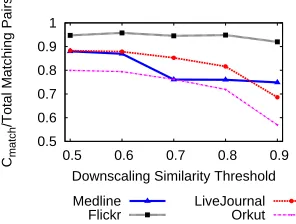
An algorithm has high query responsiveness if it immedi-ately generates the majority of its output and then computes the remaining portion of the output. Other algorithms that use the IAP SS output can benefit from the algorithm’s query responsiveness. These algorithms do not need to wait until all matching pairs are found. Instead, they can start using the matching pairs as they are identified. This is particularly useful while processing large datasets, where the total running time for finding all matching pairs may take hours.
The query responsiveness of the IAP SS solution for the booting case, is similar to the All P airs algorithm. The IAP SS solution directly outputs all matching pairs by reading them from the computation history for the upscal-ing case. For the downscalupscal-ing case, the IAP SS algorithm immediately outputs pairs in Cmatch and then finds pairs
inCunknown. All pairs having similarity scores greater than
or equal to told are present in Cmatch, i.e., pairs with high
similarity value are immediately identified by the IAP SS
ProcedureF indN ewCandidatesprocedure
Input:x,Iold,t
old,Π,partScoreM ap,knownList, approxList
Output: modifiedpartScoreM ap
remM axScore =
d X
i=1
x[i]∗global max weight[i];
1
minSizeold = (told/x.max weight)
2 ;
2
minSizenew = (tnew/x.max weight)
2 ;
3
foreachi:x[i]>0, in the reverse order defined byΠ
4 do
Iteratively remove(y, y[i]) from front ofInew i , and 5
Iold
i while|y|< minSizenew; ifremM axScore≥toldthen 6
foreach(y, y[i])∈Iold
i while |y|< minSizeold 7
/* remaining part in the list was traversed by
F indKnownCandidates procedure
*/ do 8
if y /∈knownListthen 9
partScoreM ap{y} =
10
partScoreM ap{y} + x[i]∗y[i];
11
foreach(y, y[i])∈Inew
i do
12
if y /∈knownListthen 13
partScoreM ap{y} =
14
partScoreM ap{y} + x[i]∗y[i];
15
16
else 17
foreach(y, y[i])∈Inew
i ∪Iiold do 18
if y /∈knownListthen 19
if partScoreM ap{y}>0or
20
remM axScore≥tnew then partScoreM ap{y} =
21
partScoreM ap{y} + x[i]∗y[i];
22
23
24
remM axScore = remM axScore −
25
global maximum weight[i]∗x[i];
26
downscaling similarity threshold values. This ratio represents the part of the output immediately generated by the down-scaling algorithm.
B. Extreme Cases Speed-up
The speed-up achieved by theIAP SSalgorithm depends on how the similarity threshold is varied. If the IAP SS
algorithm is executedntimes over a given dataset, then the following are the best and worst cases for the end-to-end running time.
Best Case: Execute booting followed by (n−1) upscaling cases.
0.5 0.6 0.7 0.8 0.9 1
0.5 0.6 0.7 0.8 0.9
Cmatch
/Total Matching Pairs
Downscaling Similarity Threshold
Medline
Flickr LiveJournalOrkut
Fig. 6: Fraction of Matching Pairs Immediately Found by Downscaling Algorithm
figure
Worst Case: Execute booting followed by (n−1) down-scaling cases.
1 5 10 15 20 25 30 35
Spped-up
Medline Flickr Live Journal
Orkut
Best Case Worst Case
Fig. 7: Best and Worst Case Speed-up for Similarity Values in Set T
figure
The best case is obtained by sorting the threshold values in the threshold setT in increasing order and then executing
IAP SS. The worst case is obtained by sorting the threshold values in decreasing order and then executing IAP SS. Figure 7 shows the best and worst case speed-ups achieved by theIAP SS solution compared to theAll P airsalgorithm. The speed-up is computed by comparing the total running time over all similarity threshold values in the set T. If the value of |T| is increased, i.e., if IAP SS is executed more often on the same dataset, then the resultant speed-up will increase because theIAP SSalgorithm will prune more redundant computations from later invocations.
The external algorithm that invokes theIAP SSalgorithm can implement various strategies to achieve the best case speed-up. A particular lowest similarity threshold can be predicted for some applications based on historical data and empirical knowledge. Alternatively, the external algorithm can also buffer the IAP SS request for some time instead of executing it immediately. Depending on the nature of the application, it can wait for a certain time to check if any other
IAP SS requests have been received with lower similarity threshold values.
C. Sensitivity to Varying Pmax
ThePmax parameter is used to divide the similarity range
IAP SSalgorithm has to read the computation history for all partitionsP :Pnew≤P < Pmax. Some pairs in the partition Pnew will not satisfy the similarity threshold, but must be
read anyway. This overhead is attenuated if the partition floor equalstnew, i.e.,Pnew=tnew∗Pmax. However, we observed
that this overhead is not significant. During our experiments, we varied the Pmax parameter from 3 to 25. The variation
in total running time for the best case and the worst case for values inT was less than ten percent.
X. CONCLUSIONS ANDFUTUREWORK
The Incremental All Pairs Similarity Search (IAP SS) problem is introduced and a solution is proposed. The major features of the solution are the following:
• Redundant computations in response to varying simi-larity thresholds across multiple invocations of AP SS
on the same dataset are systematically identified and effectively pruned using the proposed history binning and index splitting techniques.
• Additional performance gains are attained by paralleliz-ing ourIAP SSalgorithm to take advantage of modern multi-core processors.
• Query responsiveness is improved for our IAP SS solution, compared to theAll P airs AP SSalgorithm, because it almost instantaneously output pairs with high similarity values.
The compounded effect of these approaches resulted in speed-ups of2Xto over105
X on four large-scale real-world datasets.
Our current parallel solution for IAP SS is limited to a shared-memory multi-core system. Scaling the IAP SS
solution using both shared and distributed memory systems is an interesting direction for future work and may enable even larger datasets to be processed in the future.
APPENDIX
We empirically evaluate the effectiveness of our techniques by performing experiments on four real-world datasets for both the cosine similarity and the Tanimoto coefficient. Results for both similarity measures are quite similar. In this paper, we only present results for the cosine similarity for the sake of brevity. More details about the results for the Tanimoto coefficient can be downloaded from the Web [1].
All our implementations are in C++ and we used the standard template library for most of the data structures. We used the dense hash map class5 from GoogleT M for the
hash based partial score accumulation. We used the GNU
gcc4.1.2 compiler and the−O3option for optimization. We used the pthreads library for multithreading to implement parallelization. All experiments were performed on a 2.6 GHz IntelT M XeonT M class machine with eight CPU cores and 16 GB of main memory. The code and datasets are available for download on the Web [1].
5code.google.com/p/google-sparsehash/
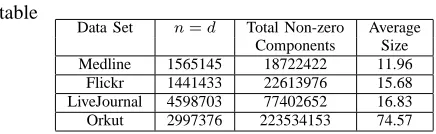
TABLE II: Data Sets Used table
Data Set n=d Total Non-zero Average Components Size Medline 1565145 18722422 11.96
Flickr 1441433 22613976 15.68 LiveJournal 4598703 77402652 16.83 Orkut 2997376 223534153 74.57
A. Datasets
One of the datasets comes from the scientific literature collaboration information in Medline indexed papers, while the rest come from popular online social networks: Flickr, LiveJournal and Orkut. These datasets represent a variety of large-scale web-based applications like digital libraries and online social networks that we are primarily interested in.
The distribution of the vector sizes in these datasets is the power law distribution [7], [3], [4]. These datasets are high dimensional and sparse (please, refer to Table II). The ratio of the average vector size to the total number of dimensions is less than10−4
. All these characteristics are common across datasets generated and used by many large-scale web based applications [13], [4]. These applications have to solve the
IAP SSproblem for high-dimensional datasets with millions of records, which are often sparse. Therefore, we expect our history binning and index splitting techniques to be relevant to other similar datasets as well.
1) Medline: This dataset was selected to investigate
possi-ble applications for large web-based scientific digital libraries like PubMed, the ACM Digital Library, and CiteSeer. We use the dataset prepared by the Auton Lab of Carnegie Mellon University. We are interested in finding pairs of authors with similar collaboration patterns. Each vector represents the col-laboration pattern of an author over the space of all authors. Two authors are considered collaborators if they write at least two papers together. Similar strategies were used in previous work [4] to eliminate accidental collaborations. We use the weighting scheme of Newman [8] to derive the collaboration weight between any two authors. If k authors have co-authored a paper, then it adds1/(k−1)to the collaboration weight of each possible pair of authors of that paper. All vectors are then normalized to unit-length.
2) Flickr, LiveJournal and Orkut: These three datasets
and are available on the Web [1].
ACKNOWLEDGMENT
This work is performed as part of the Scientific Data Management Center (http://sdmcenter.lbl.gov) under the De-partment of Energy’s Scientific Discovery through Advanced Computing program (http://www.scidac.org). Oak Ridge Na-tional Laboratory is managed by UT-Battelle for the LLC U.S. D.O.E. under contract no. DEAC05-00OR22725.
REFERENCES
[1] Code and data sets for our algorithms : www4.ncsu.edu/ ˜acawekar/snakdd/.
[2] A. Arasu, V. Ganti, and R. Kaushik. Efficient exact set-similarity joins. In VLDB ’06.
[3] A. Awekar and N. F. Samatova. Fast matching for all pairs similarity search. Technical Report TR-2009-14, CSC Department, NC State University, May 2009.
[4] R. J. Bayardo, Y. Ma, and R. Srikant. Scaling up all pairs similarity search. In WWW ’07.
[5] G. R. Hjaltason and H. Samet. Incremental distance join algorithms for spatial databases. In SIGMOD ’98.
[6] R. Jarvis and E. Patrick. Clustering using a similarity measure based on shared near neighbors. Computers, IEEE Transactions on, C-22(11), Nov. 1973.
[7] A. Mislove, M. Marcon, K. P. Gummadi, P. Druschel, and B. Bhat-tacharjee. Measurement and analysis of online social networks. In IMC ’07.
[8] M. E. J. Newman. Scientific collaboration networks. ii. shortest paths, weighted networks, and centrality. Physical Review, 64(016132), 2001. [9] S. Sarawagi and A. Kirpal. Efficient set joins on similarity predicates.
In SIGMOD ’04.
[10] E. Spertus, M. Sahami, and O. Buyukkokten. Evaluating similarity measures: a large-scale study in the orkut social network. In KDD ’05. [11] H. Turtle and J. Flood. Query evaluation: strategies and optimizations.
Inf. Process. Manage., 31(6):831–850, 1995.
[12] C. Xiao, W. Wang, X. Lin, and H. Shang. Top-k set similarity joins. In ICDE ’09.
[13] C. Xiao, W. Wang, X. Lin, and J. X. Yu. Efficient similarity joins for near duplicate detection. In WWW ’08.