A Bidirectional Wireless Communication
Technology – Light Fidelity
Antriksh Borkar
Final Year Engineering Student, Dept. of ENTC, Sinhgad Institute of Technology, Lonavala, Pune, India
ABSTRACT: Li-fi or Light fidelity is a technology that makes use of a LED light for transmitting data through illumination of the light bulb by varying its intensity that cannot be followed by a human eye. The variation in currents within the LED bulb leads to the data transmission. The speed of the internet decreases with the increasing connections to a single router. The demand for wireless data is increasing constantly while the radio spectrum is getting congested. Wi-Fi is efficient when it comes to general wireless communication within some range. But light reaches everywhere and the communication can go along with it. A wireless indoor communication can be provided by Li-Fi which can be more effective than Wi-Fi. It provides greater bandwidth and security along with blistering speeds. There are so many opportunities to explore as abundant light sources are available.
KEYWORDS: Lifi, Wifi, Communication, Visible light communication, LED
I. INTRODUCTION
The term Li-Fi was coined by Harald Hass in his 2011 Ted Talk. He begin his experimentation in 2007 with his assistant where data was sent through light signals. His invention is about the modulation of signal which is the information, embedded into light emitted by LED bulbs transmitted by many variations done to the intensity of light at a rate of 1000 million cycles per second (100MHz).
Today, it can also be called as the optimized version of Wi-Fi. It decreases the cost of wireless communication enormously. An 800Mbps capable network was created by few German Scientists by using a few green, blue, red and white LED bulbs. Simply, Lifi uses light instead of the radio waves used by Wifi for transmitting information. Here, instead of routers, transceiver-fitted LED lamps are used as a light or for transmission of the data communication through internet [1].
As the devices accessing the internet increase, high data transfer rates become low as the bandwidth available is fixed and the security of the network gets reduced drastically. LiFi uses the visible light communication spectrum without any ill effects. This available spectrum is much larger than the radio spectrum and is easily available since there are enough light bulbs already present. Thus it plays a role to relieve the heavy loads of the current wireless systems as it adds the unutilized bandwidth of the light. It offers a frequency band of 300 THz compared to the 300 GHz available in radio communication. It can also assuage the concerns of electromagnetic waves coming through WiFi which cause adverse effect on our health.
II. CONSTRUCTION
Lifi transfers the data using light by eliminating fiber from fiber optics and transmitting the data through LED light. Thus, it is a cheaper optical version of Wi-Fi. It is solely based upon VLC (Visible Light Communication) as it is implemented using LED light bulbs. The method of using pulses of light for the transmission of information without using cables (wirelessly) is called VLC. The VLC data rate can be drastically increased by some sophisticated techniques like using parallel transmission. The fast pulses of light are used to transmit any information wirelessly unnoticed by human eyes. The components mainly required in a Li-Fi system are:
a. Transmission Source – Can be a high brightness white LED. b. Receiver – A silicon photodiode.
The LED is switched on and off so that various different combinations of digital strings in 1s and 0s are generated. For generating a new data stream, the data can be encoded into the light by changing the flickering rate of LED. Thus the LED light is modulated with the data signal. By using proper multiplexing techniques, a high data communication rate is attainable.
The LiFi emitter system consists of these many assemblies: a. Enclosure
b. RF Power Amplifier Circuit c. Printed Circuit Board d. Bulb
The PCB contains the microcontroller and also controls the signals of the lamp. RF signal is generated by the Power Amplifier which is guided into the electric field of the bulb. The contents of the bulb get vaporized into plasma state due to the high concentration of energy in electric field at the center of the bulb. This plasma is a powerful source of light. A large amount of light is emitted each second from the Li-Fi source in a unit solid angle from a light source. A small single source having length in millimeters can produce up to 2500 lumens of white light. The subassemblies are contained in an aluminum enclosure[2]. The following figure (1) describes the constituents of Lifi assembly.
III.WORKING
Bright LEDs form the core of the light fidelity technology. LED bulbs used for illumination when applied a constant current are used. With the increasing variation in current, the output of the light is varied at excessive speeds. A digital 1 is transmitted when the LED is on, whereas a digital 0 is transmitted when the LED is off. The switching off and on of the LEDs gives us the medium to transmit the data through light which cannot be detected by human eyes.
The light emitter is kept at one end which is the LED and a photo detector is on the other which is a light sensor. The photo detector converts light signals into electric signals to give to the device connected to it. Level shifter circuits and voltage regulators are used to maintain a voltage level between receiver and transmitter. Whenever the LED is on, the photo detector registers it as digital 1 and as digital 0 whenever it is off. Therefore, to pass a message, the LED is flashed a numerous times. Fig 2 shows how the streaming content is transferred from the LED lamp to the photo detector and processed. This system can be improved by using an array of LEDs which would result into parallel transmission. An array of LEDs with basic three different colours (RGB) can also be used as different frequency which provides a different data channel for each resulting in obtaining extreme data rates. Enhancements and improvements can lead to speeds of 10 GBPS.
Fig.2.Working block diagram of LiFi[4]
When the flickering rate of LEDs is varied, the data can be encoded into the light generating strings of digital 1s and 0s. The LED intensity is modulated so rapidly that human eye cannot notice, so the light of the LED appears constant to humans[5].
IV.COMPARISON BETWEEN LI-FI AND WI-FI
Wifi is being used since a long time to provide wireless coverage within offices, buildings, colleges, etc. Same way, Li-Fi derived the name as it uses VLC technology to reach high speeds in wireless communication. Li-Li-Fi is satisfactory inside a room with high density wireless data coverage. It also liberates the issues of radio interferences.
A few comparisons are listed below: a. The radio waves have a limited bandwidth and are expensive. There is no spectrum left to spare with the growing technologies like 4G and so on. The wavelength of light is 10000 times wider than radio waves. Many light sources are already available to us. Hence, Li-Fi provides a much better capacity with equipment’s present on hand.
c. Radio waves penetrate through bricks and doors and can be hacked and intercepted. This lessens the security of the system as the information can be misused. While light waves don’t go through walls and hence they cannot be intercepted making it secure.
d. Radio waves are not available everywhere. For example, in an airplane whereas light can be found everywhere (which just needs to be replaced by LEDs for transmission of information).
e. Li-Fi enabled device cannot be as fast a Wi-Fi enabled device in open space as it can work only in a direct line of sight. But it would be given the first priority by everyone who wants to access the internet in a confined space due to its speed and cost.
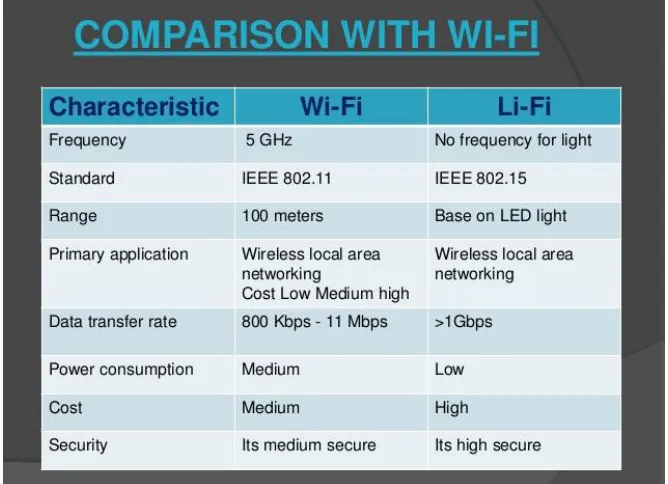
Fig 3 gives a brief comparison between the two technologies which gives us a clear idea of how LiFi is better than Wifi.
Fig.3.Comparison between LiFi and Wifi[6]
V. APPLICATIONS
Wi-Fi is banned in airplanes and isn’t safe to use for medical purposes as it interferes with the radio waves. Thus Li-Fi extends its presence in areas where Wi-Fi doesn’t work. It provides application in many fields such as education, airplanes, medical, automobile, etc. Mentioned below are a few future applications of Li-Fi:
a. Application in Hospitals: The use of Wi-Fi at hospitals may interfere with the equipment’s used to monitor health of the patient. This may lead to a hazard. Also, due to the concerns caused by radiations, use of WiFi is restricted in Operation Theatres. Therefore, to overcome these issues, Li-Fi can be implied to access the internet and also to control the medical equipment’s. Automatic surgeries and robotic surgeries are also possible in the future.
d. Underwater Applications: Beneath the sea, large cable are used to send and receive signals from others but they can be replaced with light. These underwater remotely operated vehicles (ROV) receive signals from pilot above but the wires are not sufficient enough to explore larger areas. Replacing them with light will increase the area of exploration. The headlamps can be used to communicate with pilot for exchanging data and information about the findings back to the surface.
e. Internet in Aircrafts: The communication in airways is performed by radio waves and hence Wi-Fi isn’t efficient because it may interfere with the navigational and technical systems of the airplane. Therefore, Li-Fi can be used to provide high data rates in the aircraft as the light source are present in the form of overhead bulbs in all aircrafts.
VI.CHALLENGES
Li-Fi surely offers us many advantages over Wi-Fi. But there are many hurdles which are to be cleared. The major problem it faces is about the requirement of line of sight. The receiving device faces a challenge to transmit data to the transmitter. The visible light cannot penetrate through walls and obstacles and the transmission can be blocked if someone walks through the line of sight.
VII. CONCLUSION AND FUTURE WORK
There are a numerous possibilities and opportunities provided by the compliant technology of Li-Fi. If practically used, every bulb we have could provide safer, secure, cleaner and brighter future. Issues like shortage of radio frequency bandwidth can be eliminated. It could assuage the airway traffic produced by Wi-Fi providing high speed and reliability. The technology can become a model of perfection for exchange of information in all platforms of human life.
REFERENCES
1. Wireless data from every light bulb Harald Hass, TED Global, Edinburgh, July 2011 (TED Talk)
2. http://www.lifi.com/pdfs/techbriefhowlifiworks.pdf
3. http://www.techtreme.com/internet/li-fi-vs-wi-fi-how-it-works/ 4. http://newtecharticles.com/new-li-fi-technology-to-access-internet/
5. http://groupivsemi.com/working-lifi-could-be-available-soon/
6. http://www.slideshare.net/ErVKEC/li-fi-technology-33987113
7. Jyoti Rani, Prerna Chauhan, Ritika Tripathi, “Li-Fi (Light Fidelity) – The future technology in wireless communication”, International journal
of Applied Engineering Research, ISSN 0973-4562 Vol.1 No.11 (2012).
BIOGRAPHY