University of South Carolina
Scholar Commons
Theses and Dissertations
2017
Cocoa and Carbon: Remedying Forest
Governance through Community Participation in a
Redd+Pilot in Ghana
Manali Baruah
University of South Carolina
Follow this and additional works at:https://scholarcommons.sc.edu/etd Part of theGeography Commons
This Open Access Dissertation is brought to you by Scholar Commons. It has been accepted for inclusion in Theses and Dissertations by an authorized administrator of Scholar Commons. For more information, please [email protected].
Recommended Citation
Baruah, M.(2017).Cocoa and Carbon: Remedying Forest Governance through Community Participation in a Redd+Pilot in Ghana.
COCOA AND CARBON: REMEDYING FOREST GOVERNANCE THROUGH COMMUNITY PARTICIPATION IN A REDD+ PILOT IN GHANA
by
Manali Baruah
Bachelor of Science Gauhati University, 2002
Master of Arts University of Delhi, 2005
Submitted in Partial Fulfillment of the Requirements
For the Degree of Doctor of Philosophy in
Geography
College of Arts and Sciences
University of South Carolina
2017
Accepted by:
Edward R. Carr, Major Professor
Amy Mills, Committee Member
Jesse C. Ribot, Committee Member
John A. Kupfer, Committee Member
ACKNOWLEDGMENTS
I express my deepest gratitude to all the people who have been instrumental in my
graduate education. First of all, a heartfelt thanks to my committee – to Ed, for your
unending support, trust and patience. To Jesse, for teaching me to think critically, to write
and for patiently reviewing all my drafts. To Dr. Kupfer, for your support and guidance in
finding all the funding to support my research. To Amy, for your willingness to listen to
my concerns about the dissertation and teaching. Special thanks to Jean – for giving me
the final push to finish this dissertation.
To all those many people in Ghana who agreed to participate in this study – I am
grateful for your time and patience. To the people in the villages of Wassa Amenfi, I
cannot thank you enough for your generosity, kindness and for everything that you all
shared with me. A special thanks go to Dorcas and Gifty, who patiently assisted me in
conducting the interviews and accompanied me during my dissertation fieldwork –
sharing insights, stories, food, and memories. To Rita, Dr. Marfo, Sister Adwoa, Dr.
Prince and Frank for making me feel at home in Kumasi, and all the beautiful Marfo
children for their delightful company. Special thanks to Saadia and Kofi Nyame of IUCN
Ghana for sharing insights and challenges of project management.
My Ph.D. field work was supported by the Responsive Forest Governance
Initiative and funded by IUCN, SIDA, and University of Illinois-Urbana Champaign. My
and the Geography Department Teaching Assistantships over the years. Travel grants
from the Graduate school and the Geography Department helped me present the initial
findings at several conferences. Thank you to all these institutions for supporting me
through my Ph.D.
I also wish to thank former and current staff members of the Geography
Department for their assistance in helping me navigate through the University of South
Carolina system: Elizabeth, Capers, Kevin, and Edith. Special thanks to Sylvain at
International Student Services – for patiently responding to my queries and for your
continuous support and help.
Moreover, a big thank you to all my peeps. To Amelia B, for listening, and
discussing “how to train the metaphorical dragons” over cups of coffee, and for
proofreading my drafts; to Elbie B, for sharing the appreciation for sweets, tea and long
walks in Congaree, for joining me in my adventure in Ghana, and teaching me that a
fulfilling life exists/awaits beyond graduate school; to Kwame, for your constant supply
of PhD comics and emails sharing both anguish (“paaa what have we got ourselves into”)
and encouragement. To Larianne ( and family) for opening up their hearts and beautiful
home in Columbia (she had no clue, I would be an unlawful tenant); to Ronnie B, for
sharing New Orleans gumbos, frozen ice creams, shoe obsessions and professorial advice
(I knew whom you would become when you grow up); to Pasang for your grace,
kindness and empathy; to Pattie (counselling, trips to Disneyland, and so much of your
generosity);and to Melissa and Alpan (my first home in Columbia), and to Ben, Catherine
A very special thanks to my colleagues at GEF-STAP – Sarah, Guadalupe,
Virginia and Robin for their encouragement and support and motivating me to finish.
Finally, a big thank you to my family – for all the timely and healthy doses of
love, criticism, advice, and encouragement. All those who are named and missed, my
ABSTRACT
Global loss and degradation of forests are well documented, and the potential role
of forests in climate change mitigation is widely recognized. While forests are key to
human well-being, forest resource management in the developing world is fraught with
governance challenges. Despite policy discourses that emphasize the importance of local
participation in the management of forest resources, it is rarely practiced. Many national
governments and non-governmental organizations have set up efforts around the
collaborative management of forest resources with local communities to tackle forest
loss. However, the operationalization of participatory principles and the effectiveness of
these collaborative initiatives are not well understood. In this dissertation, I analyze the
mobilization of participatory discourses within the context of a poorly studied
community-based resource conservation initiative: a Community-Based Resource
Management Area (CREMA) in Ghana. It is also a site for a Reducing Emissions from
Deforestation and Degradation (REDD+) pilot project. Using governmentality as a
theoretical lens, I explore the governmental rationalities of these projects to understand
how discourses on deforestation, forest degradation, and community participation were
used by various actors to shape the conduct of project stakeholders and achieve the
project’s instrumental objectives. This project was justified through expert discourses and
knowledge that institutionalized tree planting in the thinking and practices of cocoa
with agroforestry because they anticipated benefits, including private property rights over
“planted trees” and tradable claims over “carbon” sequestered by the planted trees.
However, these global and national policies mobilized discourses of participation and
safeguards to attract stakeholders at various scales, to improveforest governance or to
build robust democratic institutions. The contradictions between discourse and practice in
the case of this CREMA reflect larger challenges in forest governance globally, call into
question the logic of conservation and sustainable use of forest resources and hamper
local democratic participation and social justice outcomes that these interventions claim
TABLE OF CONTENTS
ACKNOWLEDGMENTS ... iii
ABSTRACT ... vi
LIST OF FIGURES ... xi
LIST OF ABBREVIATIONS ... xii
Chapter 1Introduction ... 1
1.1 Introduction ... 1
1.2 The Research Context ... 4
1.3 The Problem Statement ... 14
1.4 Research Questions and Dissertation Overview ... 16
1.5 Chapter Outlines ... 18
Chapter 2Conceptual Framework ... 21
2.1 Introduction ... 21
2.2 Community-Based Natural Resource Management ... 23
2.4 REDD+ Safeguards As Tools of Government ... 31
2.5 Conclusions ... 43
Chapter 3Research Methodology ... 45
3.1 Introduction ... 45
3.2 Research Setting and Focal Interventions ... 46
3.3 Research Methods ... 49
3.4 The Data Collection Process ... 53
3.5 Approaches to Data Analysis ... 69
3.6 Assumptions and Limitations ... 74
3.7 Conclusions ... 76
Chapter 4Whose Land And Whose Trees? Farmers’ Perspectives On Participation In Carbon Agroforestry Amidst Tenure Insecurity ... 77
4.1 Introduction ... 77
4.2 Prior Engagement with Conservation and Development Interventions Shapes Participation ... 82
4.3 Participation and CREMA/REDD+ ... 91
4.4 Anticipation of Benefits from CREMA/REDD+ Shapes Participation ... 95
4.5 Conclusions ... 102
5.1 Introduction ... 103
5.2 Rationale of the Focal Interventions ... 107
5.3 Forging Alignments for CBNRM and REDD+ to Mitigate the Risk ... 114
5.4 Delivering Assurances to Address the Crisis through Expertise and Capacity Development ... 121
5.5 Conclusions ... 131
Chapter 6Conclusions ... 132
6.1 Epilogue ... 132
6.2 Summary of Findings and Contributions ... 135
6.3 Participation as Mobilization ... 139
6.4 Future Research ... 141
References ... 145
Appendix AInterviews with Community Members ... 163
Appendix BInterviews with High Level Actors ... 165
LIST OF FIGURES
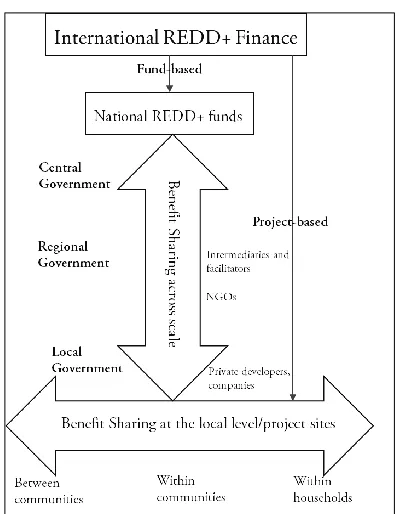
Figure 2.1 REDD-+ and benefit sharing ……….……...42
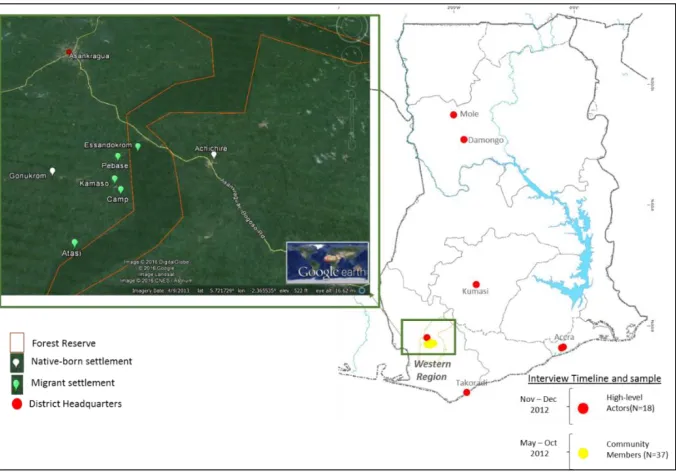
Figure 3.1 Location of Wassa Amenfi District in the Western Region,
Ghana………...47
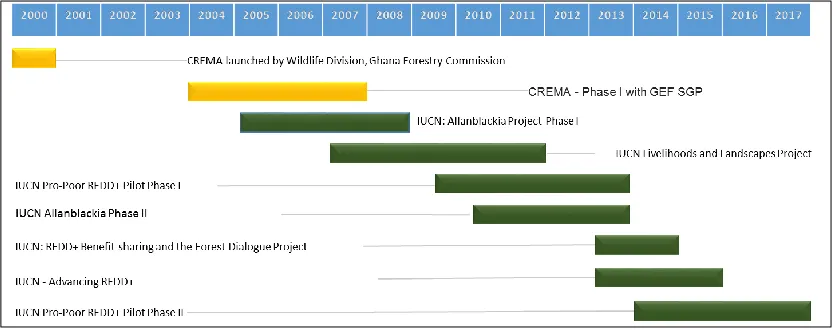
Figure 3.2 Timeline showing the projects at the study site ………...48
Figure 3.3 Site and samples of interviews ……….………..……….63
Figure 3.4 Non-timber forest products:Non-timber forest products. (a) Small game animals, (b) crabs, (c) mushrooms, and (d) making household items such as wooden pounding sticks and mortar; some of these are also available on people’s
farms………..68
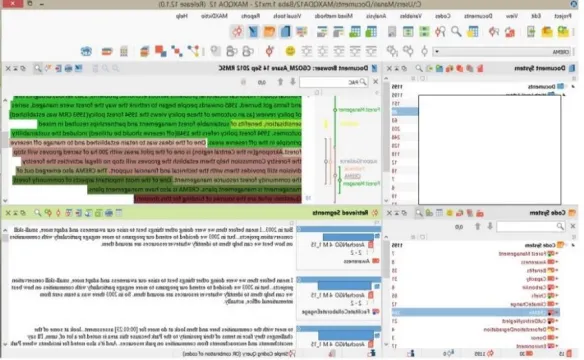
Figure 3.5 Screen shot of the MAXQDAinterface showing the initial codes…………..71
Figure 4.1 A cocoa farmer in his agroforestry farm ………...97
LIST OF ABBREVIATIONS
ARD ... Agroforestry and Rural Development
CREMA ... Community Resource Management Areas
DA ...District Assembly
FD ... Forest Department
FORIG... Forestry Research Institute of Ghana
GEF ...Global Environment Facility
IRB ... Institutional Review Board
IUCN ... International Union for Conservation of Nature
LLS ... Livelihoods and Landscapes Strategy
REDD ... Reducing Emissions from Deforestation and Degradation
SGP ... Small Grants Programme
CHAPTER 1 INTRODUCTION 1.1 Introduction
I am a cocoa farmer, and that is what I do. Why should I plant trees?
Why do we have to listen to the government, which cuts down all the trees for
timber, now telling us to plant trees, for CREMA, for carbon and so on?1
A farmer thus expressed his predicament about planting trees during a meeting
that marked the beginning of my fieldwork in Ghana’s Western Region, well known for
its cocoa production. His protest emerged in that setting because he knew the subject of
my research. It was at my request that the village chief2 and elders3 had organized the
meeting so that I could seek permission from them to allow me to stay and carry out my
research. During the earlier part of the meeting, when we made our introductions, I had to
state my “mission”4—to examine people’s participation in agroforestry promoted by two
1 Cocoa farmer, 46 years; Male, Western Region, Ghana, 2012, interpreted from Twi on site.
2 Customary leaders based on a kinship-based system.
3 Consisting of men and women who are married, with children, influential, and related to the
founding family/ies of the village. For men, financial independence, property ownership, and so on play important role in terms of who is considered an elder. For women, it is also related to having independent sources of income, property, if she is the head of a household, presence of other younger adult women (daughter in law, daughters) who take care of the household chores. Elders advise the chief on matters regarding village administration; there are no strict number requirement for people on the Council, and it depends on the village population.
4 It is customary among Akan hosts in Ghana to enquire about a visitor’s mission or purpose of
ongoing projects in the area—the Community5 Resource Management Areas (CREMAs)
and Reducing Emissions from Deforestation and Degradation (REDD+) pilot.
Participation with regard to my research means the transfer of secure discretionary
powers and rights to locally-accountable bodies who represent people’s needs and
aspirations, and who are accountable to their constituents for their decisions and actions
(Ribot 2002).In the context of decentralized interventions, it is important to frame
participation in terms of responsiveness and accountability, if local people are to be
enfranchised as citizens and participatory approaches to natural resource management
including forestry are to achieve what they aspire - to devolve decision making and
benefits from forests to local populations, along with responsibilities for forest
management. Often the latter is achieved through community based and decentralized
initiatives where local populations just remain dependent subjects with added
responsibilities but without secure rights and benefits.
This incident placed me and my research into a particular history and set of
practices because interplanting cocoa with both indigenous and exotic tree species such
as cidrella, odum, and teak has long been promoted by various institutions in Ghana,
primarily for creating agroforestry concessions, diversifying incomes, and providing
ecosystem services such as carbon sequestration and restoring degraded forests. It was
believed that on-farm availability of timber would lessen the pressure on forest reserves,
of which most were severely degraded (Hawthorne and Abu-Juam 1995). Farmers have
also selectively retained certain plant species, such as kola nuts and fruit trees, in farms
5 The term community/ies used in this dissertation refers to the targeted beneficiaries of the past
for additional income, for domestic use, or to boost cocoa production. Therefore, this
farmer’s question was a means of challenging the ways state bureaucracies have dictated
the terms of engagement in the forestry sector. However, the village linguist,6 a retired
schoolteacher and a stakeholder in the ongoing projects, decided to respond.7 He listed all
the benefits associated with trees—ecosystem services, wood, and non-timber forests
products, and the possibility of additional income from selling carbon credits. After he
had finished, he asked me to respond. I began by acknowledging not having the answers
that could explain the government’s contradictory positions on trees. Hence, the objective
of my research, I stated, was to examine some of those contradictions in the context of
the ongoing projects in the area and potentially address some of the issues in forest
resource management created by these inconsistencies. This particular incident also lays
bare some power relations in my research context—the linguist, because of his age and
status, felt free to answer for me, and to lecture other farmers, thus potentially allowing
his interests and role in the projects to drown out other voices.
In retrospect, it is easy to see that in my response I was establishing the
significance of my research to the community, and rationalizing my presence in the area.
I first acknowledged the farmer’s assessment of the deficiency in existing agroforestry
practices, a problem that needs to be fixed, and then utilized the strategy of promising
anticipated benefits of my work to my hosts, many of whom were going to be my
6 While the position of “linguist” is a common one among the Akan, in this case, the role was
more than ceremonial as the village chief did not speak English and the teacher was fluent in Twi and English.
7 While facing the gathering, he began by interpreting the question for me and proceeded to
interview participants. My goals were as aspirational as that of the projects I was set to
examine. My strategy was also not entirely different from how these projects mobilized
various elements such as discourses, institutions, regulatory decisions, and scientific
statements to engage local populations and direct their conduct to achieve desirable
environmental and social objectives—or benefits in the context of REDD+. This story
thus illustrates my research question: how are these resources “governed”—that is, how
are different actors’ interests aligned toward achieving forest conservation as well as
improving livelihoods? Who can speak? Who speaks for whom? It also brings out my
positionality as a socially situated subject in reproducing the existing discourses.
1.2 The Research Context
In this section, I explain some of the key ideas to contextualize this dissertation
research. It is important for the reader to understand the concepts of CREMAs, the
REDD+ mechanism, and the linkages between the two to situate the arguments and
claims made in this dissertation. A CREMA, as developed by the Ghanaian government,
is both a geographically defined area as well as an approach to integrate conservation and
rural development goals as part of a natural resource decentralization process (Asare,
Kyei, and Mason 2013). REDD+ is a global framework designed to financially
incentivize developing countries for any reductions in emissions realized through a
decrease in the conversion of forests to non-forests, and other land uses. In doing so,
countries have to demonstrate lower emission rates from a reference emission level (i.e.,
without REDD+). In Ghana, government thinking positions CREMAs as the appropriate
1.2.1 CREMAs in Ghana
CREMAs are a vehicle for governing forest resources that come out of a long
history of efforts to govern forests. Given that establishing protected areas in state-owned
forests has not succeeded in widely producing desired forest conservation outcomes in
Ghana, the Ghanaian state utilized collaborative resource management as an alternative
strategy to manage resources by partnering with local communities living around these
resources such as forests and wildlife. The Wildlife Division (WD) of the Ghanaian
Forestry Commission (FC) developed the CREMAs8 in Ghana. It aimed to address
wildlife management outside protected areas and forest reserves. Over time, the CREMA
approach became a model for decentralized resource management in Ghana, where it was
used to promote natural resource conservation and livelihood diversification outside of
protected areas. In post-Independence Ghana, the 1994 Forest and Wildlife Policy
marked the broader decentralization reforms in the natural resource sector. This policy
and subsequent reforms influenced the design of the CREMA approach. However,
despite the rhetoric, decentralization in the forestry sector in the country remains limited
(Teye 2011). The central state administrative institutions, particularly the FC, continue to
be reluctant to devolve decision making in forestry due to their substantial revenue
generating potential (Sasu 2004).
While initially, CREMAs established by the WD targeted the co-management of
the wildlife in protected areas, CREMAs now have extended their focus on any natural
resource they deem fit for conservation (Forestry Commission Ghana, 2004), including
8 During the 1990s, the Ghanaian state initiated a series of policies and programs claiming to
trees. The Ghanaian government identifies CREMAs as an important “participatory
model” and claims that the CREMAs will create the “right conditions” for democratic
participation, and opportunities and financial incentives for local communities to engage
in the conservation and management of forest resources. At present, there are over thirty
CREMAs in Ghana at various phases of the establishment process.
Despite the adoption of this approach and its spread through Ghana, community
forest management, and the decentralized natural resources governance offer no
guarantees of improved outcomes with regard to previous, state-led efforts. Such efforts
have resulted in mixed outcomes (Mayers and Vermeulen 2009; Tokede et al. 2005),
suggesting that success of community-based management is contingent on local
circumstances. For example, in some cases, they have led to enhancement of local
livelihood and improved income, forest conservation, and the transfer of discretionary
powers to local communities (Cronkleton, Pulhin, and Saigal 2012; Larson and Ribot
2007; Ribot, Lund, and Treue 2010). However in other cases, community forest
management interventions produced inequities in benefit sharing among local
stakeholders, the elite capture of benefits, and resulted in conflicts over local rights to
natural resources often marginalizing the less powerful more than before the
interventions (Charnley and Poe 2007; Ribot, Agrawal, and Larson 2006; Ribot, Lund,
and Treue 2010; Schreckenberg and Luttrell 2009; Tacconi 2007).
1.2.2 Reducing Emissions from Deforestation and Degradation
REDD+ is a climate change mitigation strategy framed around an incentive-based
compensation mechanism to conserve forest (and other carbon-rich habitats such as
emissions. REDD has evolved since it was first pitched as an idea by the governments of
Papua New Guinea and Costa Rica, during the 11th session of the Conference of the
Parties in Montreal.9 REDD initially focused on “reducing emissions from deforestation
and forest degradation.” It expanded to include three more objectives (a) Conservation of
forest carbon stocks, (b) Sustainable management of forests, and (c) Enhancement of
forest carbon stocks. This is how, at the 2010 COP-16 in Cancun, REDD became
REDD-plus (REDD+), to reflect these new components (“REDD+” 2017). With the inclusion of
a number of decisions related to REDD+ and forests in the Paris Agreement (COP21,
2015), forests once again found prominence as a key strategy for emission reduction and
mitigating climate change.
The primary goal of the REDD+ mechanism is to reduce global carbon emissions
by paying forest owners in developing countries for decreased CO2 emissions associated
with avoided deforestation and forest degradation and maintained carbon stocks (“REDD
- Warsaw Framework for REDD-Plus” 2013; “UN-REDD Programme” 2017). Benefit
schemes are therefore based on the difference between the actualized emissions and
projections from a historical baseline (UN-REDD 2009). These benefit schemes may
include both direct (e.g., cash payments) and indirect (e.g., improved governance,
availability of forest products, and ecosystem services) gains resulting from the
implementation of REDD+. Incentive-based conservation predates REDD+ and includes
9 The agenda item on “Reducing emissions from deforestation in developing countries and
Payments for Ecosystem Services (PES),10 a movement started in the early 1980s when
environmental economists (Pearce and Moran 1994) argued for putting a monetary value
on nature and its services to conserve it. Achieving forest conservation through this
approach seems straightforward in principle—forest owners (government, communities,
and individuals, depending on how ownership is defined) are compensated for
maintaining standing forests, offsetting their opportunity costs, and therefore leaving the
world with a greater stock of forest with which to take up emissions. However, in
practice, the approach has faced problems. These challenges include transaction costs
associated with identifying forest owners in systems of complex tenure (discussed later),
overlapping property rights and weak governance, more opportunity costs than benefits,
costly monitoring, reporting, and verification, and leakage.11 Another problem is
establishing additionality—that is, showing that reductions in deforestation and forest
degradation due to REDD+ activities are greater than they would have been without
REDD+ activities. Despite that, REDD+ has gained increasing traction among policy
makers as a potential solution to achieve conservation, development, and climate change
mitigation goals (Angelsen 2010).
REDD+ is implemented in three phases—readiness, piloting, or demonstration—
and includes policy reforms and full implementation including results-based action.12
10 Millennium Ecosystems Assessment in 2005 made the idea about ecosystem services popular.
MEA also triggered, a range of payment schemes for ecosystem services (e.g. biodiversity conservation , ecotourism,, carbon storage)
11 ‘Leakage refers to the fact that while deforestation might be avoided in one place, the forest
destroyers might move to another area of forest or to a different country’((REDD Monitor 2017).
12 REDD+ readiness phase includes activities implemented at the national level, such as
This step-wise approach isto ensure that REDD+ projects progressed seamlessly and
logically. Ghana’s involvement with the REDD process began in 2007, via the World
Bank’s Forest Carbon Partnership Facility (FCPF). Ghana has received REDD readiness
funds from both from the FCPF mechanism of the World Bank as well as non-FCPF
mechanisms (FCPF, Aug 2015). The first phase of Ghana’s REDD+ Readiness was
completed in November 2014. The main activities and outputs of phase I included
establishing mechanisms for benefit sharing, dispute resolution, social safeguards, and
the monitoring and evaluation framework, setting baseline emission levels, and a
measurement, reporting, and verification (MRV) systems. This phase also included
setting operational guidance and standards for national and sub-national REDD+
programs. At present (2016 onward), Ghana is in early implementation phase (2016–
2030) that includes monitoring, performance-based payments, and scaling up activities.
Ghana has opted for a nested national approach toward REDD implementation. This
mean Ghana will consider both national baselines, and if a project manages to adhere to
REDD-related activities, there may be a direct payment to beneficiaries (nested
approach).
1.2.3 CREMA as REDD+ Pilots
From a practical mitigation standpoint, it has been argued (Asare, Kyei, and
Mason 2013) that the CREMA has the potential to address many of the key challenges
for REDD. These challenges include boundary demarcation, free prior and informed
consent, ensuring democratic decision making, ensuring sustainability of institutions and
mechanisms, clarifying tenure and carbon rights, along with creating the right conditions
for equitable sharing of benefits. Since 2007, when Ghana began its involvement with the
REDD readiness phase through World Bank’s FCPF, there have been speculations about
the ability of CREMAs to generate carbon revenues in the near future. The FC of Ghana
supports the use of CREMAs for piloting forest carbon projects in the country. The
Ghana Wildlife Policy 2012 and Ghana’s REDD Readiness Preparation Proposal (R-PP)
support the CREMA approach as a means for implementing REDD demonstration
projects and pilots (Ghana REDD RPP 2010; Ghana Wildlife Policy 2012). Due to the
difference in stages of development and involvement in the carbon market and
certification schemes, no CREMA in Ghana has yet generated any revenues from
reducing emission.
The establishment of a CREMA area involves a series of administrative
procedures. It is a six-step process that involves: (a) defining governance structures, (b)
developing and approving the Constitution, (c) boundary demarcation, (d) by-law
preparation and approval by the DA, (e) recognition by the WD, and (f) authorization by
Minister of Lands and Forestry by Devolution of Management responsibilities to the
CREMA. The guidelines for CREMAs lay out a governance structure that would manage
the CREMA area. This structure involves institutions that operate at different scales.
First, at the village level, a Community Resource Management Committee (CMRC) is
elected by the villagers. The CMRCs handle the management of the CREMA at their
community. Then, CREMA members at the village level elect a representative from each
within the CREMA, and it includes the Divisional Chief of the Wassa Traditional area
(FC 2004b, 7).
1.2.4 The Value of Standing Trees
Using the earth’s resources responsibly and addressing poverty are two of our
greatest challenges, and climate change both problematizes and overtly connects them.
Curbing deforestation and forest degradation in tropical countries is argued to be a
potentially cost-effective way to reduce carbon emissions and address climate change
through land-use, land-use change, and forestry (LULUCF) activities (Canadell and
Raupach 2008; DeFries et al. 2007; Malhi et al. 2008). Among LULUCF activities,
afforestation, agroforestry, and reforestation respond to the need of enhancing
ecosystems, sequestering carbon, and shifting to a low carbon economy. This attention to
forests is not new. Forest conservation has been on the core agenda of international
conventions and agreements (e.g., the Millennium Development Goals, the Sustainable
Development Goals [SDGs], and Aichi targets)13 designed to achieve conservation and
development targets. It is only recently, however, that climate change has entered into
this conversation.
Agroforestry14 is being considered for use by many developing countries for Land
use, land-use change, and forestry (LULUCF) activities. This emphasis on agroforestry is
because of its potential for climate change mitigation and with components from both
13 Target 5—“By 2020, the rate of loss of all natural habitats, including forests, is at least halved
and where feasible brought close to zero, and degradation and fragmentation is significantly reduced” of the Aichi Biodiversity Targets, Strategic Goal B—“Reduce the direct pressures on biodiversity and promote sustainable use.”
14 In general terms, agroforestry is the association of trees with farming practices and can be
agriculture and forestry, agroforestry activities are critical for livelihoods of the global
poor dependent on agriculture and forests (Anderson and Zerriffi 2012). An estimated 1.2
billion people in the developing world currently practice and benefit from agroforestry.
Scholars and practitioners have argued that agroforestry has the potential to
simultaneously tackle both climate change and help achieve development goals by
generating used on “co-benefits” (Garrity 2004; P.K. Ramachandran Nair et al. 2009;
Pandey 2007), such as the sequestration of carbon and the delivery of income, via
payments for carbon credits to poor populations living in and around forests. The post-
Kyoto Protocol period has witnessed a surge in the establishment of financial
mechanisms to balance opportunity costs associated with pro-environment initiatives to
sequester carbon and reduce deforestation. The Bonn Challenge is another global effort to
restore 150 million hectares of degraded and deforested lands by 2020 and 350 million by
2030 (Ghazoul and Sheil 2010; IUCN Policy Brief 2017). Although these financial
mechanisms are primarily conceptualized and undertaken as interventions to enhance the
value of uncut forests and/or endorse reforestation activities, many have argued that they
can also help reduce poverty (Landell-Mills and Porras. 2002; Bishop and Pagiola 2012).
The forestry sector still comprises a valuable asset for Ghana’s economic
development, accounting for 3.5% of Ghana’s GDP and contributed USD1.3 billion
(FAO 2011) to the economy in 2011. However, the country incurs economic loss through
biodiversity loss due to deforestation and land degradation (Tutu, Ntiamoa-Baidu, and
Asuming-Brempong 1993). The main drivers of forest cover loss in Ghana are
agricultural expansion and wood exports in the wake of structural adjustment programs
deforestation include wildfires, mining, and urbanization (roads, settlements, and other
infrastructural development). Ghana, in response to declining food production until the
1980s and dwindling forest cover, gradually shifted its agricultural policies and initiatives
to include modern agroforestry and agricultural intensification practices as stated in the
National Agroforestry Policy, 1986. The main objective of this policy was to use
agroforestry to promote sustainable land use (Terakawa 2002). Its early focus in the
1980s was to establish nurseries for tree seedlings to provide readily available seedlings
to farmers willing to adopt agroforestry technologies. Today, Ghana has trees in public,
private, and government plantations as well as within protected areas, forest reserves,
community forests, and in people’s farms.
Ghana is the second largest exporter of cocoa in the world, and therefore cocoa
plays a significant role in the Ghana’s economy (15% of Ghana’s GDP) (ICCO 2004).
However, the expansion15 of cocoa farms has also been alleged to be the primary driver
of deforestation in the country’s high forest zone (HFZ) (Hawthorne and Abu-Juam
1995), largely confined to the south-western part of Ghana. However, these existing
narratives of over-exploitation of “natural” forests for cocoa cultivation usually
overlook/downplay the specific historical conditions and social institutions that
accompany them at a national, regional, or local scale (Fairhead and Leach 1998). In the
early 1990s, this forest zone also saw agroforestry projects implemented by both foreign
and Ghanaian timber companies encouraging farmers to actively incorporate trees on
15 Traditionally maintaining or increasing cocoa production was associated with farm expansion
and not with intensification or improved farming practices; in response to widespread
farm in an area gradually losing its forest cover (Appiah and Pedersen 1998; Prah 1994;
Richards and Asare 1999). Although the inclusion of suitable and valuable tree species16
at various phases of cocoa farm establishment is widely practiced by smallholders, tree
planting, particularly commercially valuable timber species, has faced resistance due to
complex land and tree tenure issues (discussed in later sections). Research by various
government and non-government institutions17 continues to look for the optimal shade
conditions for growing cocoa, and to identify suitable indigenous and exotic tree species
for cocoa agroforestry to harmonize tropical agricultural production with the surrounding
environment.
1.3 The Problem Statement
Since its inception in 2005, questions were raised about the long-term viability of
REDD+, particularly concerning financing. With the global economic crisis (2008–2009),
the landscape for REDD+ implementation looked discouraging (Peters-Stanley and
Daphne 2013). Although REDD+ projects are emerging as complex development
initiatives and are being implemented in many tropical forest regions of the world, till
now, they have been financed mainly through public sector finances with bilateral
organizations playing a major role (Norman and Nakhooda 2015). With the specific
inclusion of REDD+ in the Paris Agreement18 text during COP 21, the role of forests in
managing climate change impacts became solidified in the international climate agenda.
16 There are not too many studies on farmer preference but they prefer mixed tree species that
would fulfill household food and fiber needs and not only timber.
17 CRIG, Forestry Research Institute of Ghana, Conservation International, CARE, Kuapa Kooko,
and STCP-Ghana.
Also, there were also a number of pledges made during the Paris Agreement to increase
forest financing including significant pledges from Germany, Norway, and the United
Kingdom in support of REDD+. The Paris Agreement also ‘affirms’ the importance of
“public awareness, public participation, public access to information and cooperation at
all levels on the matters” addressed in the Agreement (Paris Agreement 2015). Looking
forward, with these strong endorsements, the developments around REDD+ and forest
governance are going to receive renewed attention. Also, under the SDG, environmental
protection, climate change mitigation, and poverty alleviation are now all connected—
and forest governance will be a key site where this plays out. Goal 15, of the SDGs,
specifically states, “Protect, restore and promote sustainable use of terrestrial ecosystems,
sustainably manage forests, combat desertification, and halt and reverse land degradation
and halt biodiversity loss”—once again emphasizing the role of the environment and
forests for sustainable development and human well-being.
REDD+ schemes have been piloted in many regions, but our knowledge about
REDD+ initiatives within a local context is limited (Bond 2010; Cohn et al. 2011). Some
tropical countries. civil society and indigenous people’s organizations are watchful of
REDD+-related development in their countries because of existing governance
challenges, lack of legal land rights and tenure issues, and therefore are critical and often
resist any possible government or private sector initiatives in this context (Angelsen
2008; Okereke and Dooley 2010). REDD+ projects are multidimensional in design, scale,
the place, and the social contexts in which they are going to be operationalized. Hence,
there are all sorts of conflicts that can arise between different types of knowledge and the
The exploitation of natural resources in weak institutional and governance settings
can lead to internal conflicts of rights, access, and usage among local communities
(Collier and Hoeffler 2005). As discussed, the implementation of REDD+ is directly
linked to institutional structures, good governance, and the process of unifying the rights
of various forest-dwelling and indigenous groups. Successful outcomes from REDD+
will hinge upon resolution of conflicts (related to rights, access, and usage) and the
adequate representation of diverse goals and interests in a manner that aligns individual
and community interests with policy goals of REDD+. Overall, understanding the local
governance shaped by REDD+ is, therefore, crucial to reduce vulnerability, boost
economic and social wellbeing, and promote forest conservation and better management.
As discussed before, CREMAs modeled on participatory approaches to natural
resource management are being promoted as the ideal institutional set-up in Ghana for
piloting of REDD+ readiness projects. The particular CREMA in Wassa Amenfi West
District in the cocoa landscape of Western Ghana with a pro-poor REDD+ Readiness
project provided the ideal setting to examine forest governance issues in the context of
REDD+. The CREMA case, therefore, presents an opportunity to examine how
discourses on participation are materialized in practice, and in this dissertation I look at
“participation’ as “conduct of conduct” (Dean 1999).
1.4 Research Questions and Dissertation Overview
The empirical analysis in this dissertation uses data from the HFZ of the Western
Region of Ghana, where the activities of the Bontori CREMA and International Union for
Conservation of Nature (IUCN’s pilot pro-poor REDD project) overlapped—I use the
dissertation. Using empirical data collected through semi-structured interviews with both
cocoa farmers and government and non-governmental organization (NGO) officials
associated with the projects, this dissertation describes the governance contexts that
influence people to participate in the agroforestry activities.
With both global and national focus on the legitimacy of REDD+ projects
(Corbera and Schroeder 2011; Luttrell et al. 2013), equity issues in the distribution of
benefits (Okereke and Dooley 2010; McDermott, Mahanty, and Schreckenberg 2013),
and its importance for tropical forest conservation and mitigating climate change, it is
important to understand the contextual elements and practices that influence how project
stakeholders are participating in the process. However, these REDD+ projects espousing
participatory processes require accountability and representation to achieve equity,
justice, and efficiency in outcomes (Ribot 2002). Building on a comprehensive review of
the literature surrounding conservation and development, decentralization, and political
ecology, the empirical research for this dissertation began with two broad questions: (1)
Who participates in CREMA/REDD+ activities and why? Through this question, I want
to understand the responses of various actors toward the CREMA/REDD+, how do they
align and negotiate their expectations within the broader rationalities of the intervention,
and besides the regulatory practices, what are the political and economic motivations of
the various parties involved in the intervention. (2) How is participation achieved?
Through this question, I attempt to understand the various practices, rationalities, and
forms of incentives and punishments that are brought together to engage various
stakeholders so that the intended objectives (reducing emissions, deforestation, and
understand if participation hinges on regulatory frameworks and the technologies of
remuneration and punishment or whether the making of responsible environmental
subjects is contingent on local context, uneven power relations, and diverse subject
positions of the farmers.
1.5 Chapter Outlines
This dissertation consists of six chapters. Chapter 1 introduces the research topic
and provided the background on collaborative resource management areas (CREMAs)
and REDD+ in Ghana and their contextual relevance for agroforestry activities associated
with conservation, rural development, and climate change mitigation goals. The chapter
then introduces the natural resource landscape of the Western Region of Ghana, land
tenure and tree tenure arrangements—elements that are framed both as problems and
technical fix, likely to optimize the achieving of objectives through REDD+.
Chapter 2 of this dissertation reviews theoretical approaches to conservation,
development, participation, based conservation to show that (1)
community-based natural resource management (CBNRM) approaches came out of a long history of
efforts to decentralize resource governance; (2) how REDD+ is reworking existing
elements of CBNRM for new purposes and defining “social protection” or “safeguards”
to address equity issues and account for past injustices in natural resource management;
(3) how “safeguards” such as community “participation” and “tenure” are not
straightforward; and (4) how these may impact benefit sharing and equity issues through
REDD+.
Chapter 3 focuses on the research methods. My main data source is
collection for this type of study and discusses some of the issues and limitations of this
approach. It also discusses the characteristics of the study population and the methods
used to recruit the study participants. I also draw data from government, NGO
documents, local newspaper articles, rural radio programs, and personal observations.
This chapter also provides an overview of data collection experiences and the methods I
use to analyze the data.
Drawing from the semi-structured interviews and review of policy documents,
Chapter 4 elaborates on how climate change and deforestation is problematized and
promised benefits through the ongoing projects is linked to governing the conducts of
cocoa farmers regarding farming practices. These alliances between parties who want to
govern with objectives such as (conservation, tenure rights, payments, livelihood
improvement, and sustainability) encourage people at the project sites to engage in
agroforestry activities despite their reservations against tree planting and skepticism
about equity issues in benefit sharing.
Chapter 5 shows the complicated ways and practices that the diverse interests of
the stakeholders are brought together, and connections are forged between them toward a
specific end of mitigating climate change, conservation, and improving rural livelihoods,
and how theses manifest themselves in the farmers’ narratives of their livelihoods and
well-being in the cocoa landscape of Western Ghana.
Chapter 6 starts with a description of the current status of the CREMA/REDD+ at
the study site. It then summarizes the main insights drawn from this empirical case,
implementation and how these findings contribute to the scholarship on forest
CHAPTER 2
CONCEPTUAL FRAMEWORK 2.1 Introduction
The central objective of this dissertation is to critically analyze the politics of
natural resource governance, local development, and climate change in the context of
CREMA/REDD+. In doing so, this study focuses on farmers’ participation in
agroforestry, the different subjectivities of the relevant actors, and the local contextual
elements that are likely to influence the realization of CREMA/REDD+ goals.
At their core, both CREMA and the REDD+ pilot initiatives seek to alter the
beliefs and practices and induce behavior change of cocoa-farmers by institutionalizing
their support for forest conservation, climate change mitigation, and improved livelihoods
through agroforestry (e.g., selling timber, payments for carbon credits). Both initiatives
are neoliberal in spirit, as they support decentralized community-based institutions,
encourage the privatization of state functions while advocating for private property rights
over “planted trees” and tradable claims over “carbon” sequestered by the planted trees.
While the CREMA, as a decentralized resource management strategy, seeks to reduce
pressure on protected forest reserves by garnering local support for off-reserve forest
management, the pro-poor REDD+ pilot seeks to institutionalize tree planting for forest
conservation and climate change mitigation into the thoughts and actions of cocoa
farmers, so that they not only become eager participants in REDD+ when it is fully
operationalized but will also conduct themselves consistent with REDD+ objectives in
CREMA/REDD+ implementation, Foucault’s concepts of governmentality and the
technologies of governance (techniques of rewards and punishment) that emerge from
and (re)create governmentality, as seen through the lens of Agarwal’s
“environmentality,” offer a useful analytical framework.
Political ecology, a field that offers “empirical, research-based explorations to
explain linkages in the condition and change of social/environmental systems, with
explicit considerations of relations of power” (Robbins 2011), is another useful
framework for studying the social, economic, ecological, and political dimensions of the
CREMA/REDD+ intervention. Political ecologists have a long-standing engagement with
the plurality of perceptions and framings of environmental and resource problems
(Blaikie and Brookfield 1987; Bryant 1998; Escobar 1996; Robbins 2000). With multiple
sponsors, including a range of actors from transnational and national to local, REDD+
projects bring in a range of interests, knowledge types, and agendas. Further, studies
using this framework illustrated the role of expert knowledge and discourses in defining
problems and devising solutions to climate change (Peet and Watts 2011; Bumpus and
Liverman 2011). I have relied on this theoretical literature to frame my exploration of
differences, heterogeneity, and multiplicity of meanings in the construction of
environmental risks, benefits, and participation under CREMA/REDD+, and to explore
the making and un-making of governable environmental subjects and how these subjects
negotiate the efforts of subject making.
Farmers’ engagement with agroforestry practices in the CREMA/REDD+ site is
related to overarching ideas about participatory approaches to conservation and
sharing of carbon payments), and specific contextual factors such as tenure and
institutions. In the following paragraphs, I develop the general conceptual and analytical
framework relevant to this dissertation research on the case of CREMA/REDD+
implementation in the Western Region of Ghana. I first provide a brief background on the
emergence of CBNRM strategies, which came out of a long history of efforts to better
govern natural resources by integrating conservation and development agendas around
notions of decentralization. I then argue that REDD+ strategies rework existing elements
of CBNRM for new purposes—mitigating climate change, conserving forests (including
biodiversity), and enhancing livelihoods—and thereby aim to produce forest conservation
stewards. Third, I outline how REDD+ adopts the rhetoric of “social protection” or
“safeguards” —in other words, tools of governance—to address equity issues and
account for past injustices in natural resource governance. Finally, I describe how the
success of these tools of remuneration and punishment are contingent on the local
context, uneven power relations, and multiple subject positions of the farmers, as well as
other relevant actors, all of which may impact the achievement of desired outcomes
through REDD+.
2.2 Community-Based Natural Resource Management
Decentralization has become a dominant paradigm for resource governance both
in rhetoric and in practice. Influenced by participatory and bottom-up perspectives in
development and conservation (Chambers 1995; 1997a; 2005) CBNRM is widely
advocated based on the assumption that such decentralized efforts will result in material
well-being, social justice, promote sustainable management and conservation of natural
2004; Dressler et al. 2010; Gruber 2010). Community-based approaches to natural
resource management are based on the assumption that local communities have a greater
stake and understanding of local issues than distant actors, and these collaborative
approaches came out of a long history of efforts to integrate the environment and
development agenda (Brosius, Tsing, and Zerner 2005; Shackleton et al. 2002).
The early development agenda, led by the World Bank and other major donors,
treated the environment as a resource base for economic gain. Strategies focused on
targeted nature preservation (e.g., influenced by the first National parks and forests in the
U.S.) while development strategies focused on economic growth and efficiency through
the transfer of technology to boost agricultural productivity and improve infrastructure
development (Richards 1985; Scott and Wilkinson 2011). These centralized, top-down
approaches to rural development have been heavily criticized because they were not
inclusive and left local populations outside of the decision-making processes and
contributed little to poverty alleviation and rural empowerment (Chambers 1997a;
Holling and Meffe 1996; Schmidt-Soltau and Brockington 2007). In response to these
growing criticisms, participatory approaches to development appeared in the 1970s,
evolved during the 1980s, and went to cover Central America, Africa, and Asia
(Participatory Action Research 1991; Chambers 1994, 1997b).
Criticism of top-down development strategies also came in the form of resistance
and protests from communities where many of these projects were implemented.
Communities challenged these command-and-control strategies when their resources
rights were taken away, and they were forced to move to urban areas in search of
Schmidt-Soltau 2006). Loss of livelihood and access to the rich-resource base as well as forced
migration fueled conflicts among local communities, state agencies, and other
stakeholders (Schwartzman, Moreira, and Nepstad 2000; McElwee 2010). These tensions
also contributed to the weakening of social structures and loss of natural resources with
minimal improvement in rural livelihoods or strengthening of local institutions
(Chambers 1997a; Schmidt-Soltau and Brockington 2007).
It was also around the same time that the linkages between development and
conservation were strengthened. As a result, the World Conservation Strategy was
formulated and launched in 1980 led by the World Conservation Union (IUCN) with
inputs from other organizations (McCormick 1986). To address the failures of command
and control-styled conservation strategies and to promote sustainable and equitable
natural resource management, conservation practitioners adopted the participatory
approaches for natural resources management including, forest, marine, and other
common resources in Latin America and Africa (Agrawal and Gibson 1999).
Despite the widespread appeal and adoption of community-based and
participatory approaches to natural resource management, they often failed to deliver on
its mandates. The most important of these criticisms are: considering and treating
“project beneficiaries”' as passive recipients of project undertakings (Pimbert and Pretty
1995); the short-term nature of projects and over reliance on outside knowledge and
expertise. Community-based projects also lacked concrete standards to evaluate their
effectiveness in conservation or enhancing human well-being (Kellert et al. 2000). Others
argue how certain social groups are recognized at the expense of sidelining others
also has been a common outcome of development and decentralization projects
(Dasgupta and Beard 2007; Fritzen 2007). Empirical evidence suggests that decision
making, even in projects implemented in the name of decentralization, is controlled and
dominated by the elites. Elite control can be particularly problematic in societies like
Ghana, where since the colonial period traditional leaders claiming to represent local
interests have had substantial decision-making powers over land management
(Acemoglu, Reed, and Robinson 2013).
As discussed, CBNRM approaches carry both opportunities and uncertainties, but
given their ability to coalesce both environmental and development priorities, these
strategies will remain pivotal parts of the natural resource governance conversation. In
the next section, I demonstrate how REDD+ is a newer form of CBNRM as it has
retained the same elements (objects to be managed, situated subjects such as
communities, goals, objectives, and rationalities) and characteristic of CBNRM
approaches.
2.3 REDD+ as a Reassembled Form of CBNRM
In an extended case of community forest management, Li (2007) demonstrated
how specific practices (described below) might be forged together toward the desired
outcome. In the case of community forest management, the outcomes are related to
material well-being: livelihoods, control, efficiency, sustainability, and conservation
among others. Li identified six practices that apply to any assemblage, described as an
ongoing process of coalescing disparate elements and forging linkages between them.
(1) Forging alignments: the work of linking together the objectives of the
various parties to an assemblage, both those who aspire to govern conduct and
those whose conduct is to be conducted. (2) Rendering technical: extracting
from the messiness of the social world, with all the processes that run through it,
a set of relations that can be formulated as a diagram in which problem (a) plus
intervention (b) will produce (c), a beneficial result. (3) Authorizing knowledge:
specifying the requisite body of knowledge; confirming enabling assumptions;
containing critiques. (4) Managing failures and contradictions: presenting failure
as the outcome of rectifiable deficiencies; smoothing out contradictions so that
they seem superficial rather than fundamental; devising compromises. (5)
Anti-politics: reposing political questions as matters of technique; closing down
debate about how and what to govern and the distributive effects of particular
arrangements by reference to expertise; encouraging citizens to engage in debate
while limiting the agenda. (6) Reassembling: grafting on new elements and
reworking old ones; deploying existing discourses to new ends; transposing the
meanings of key terms (Li 2007, 265).
Li’s analysis of assemblage is drawn from the notions of governmentality, a
concept developed by Foucault (1991). Governmentality refers to “governmental
rationality” or the “conduct of conduct,” an idea of government that is not only limited to
the control by states but can be employed by anybody who is interested in governing.
Using governmentality includes various regulatory techniques, some degree of
deliberation to shape our behavior “according to a particular set of norms and for a
conduct of conduct” (Foucault 1982) or “…a form of activity aiming to shape, guide or
affect the conduct of some person or persons (Gordon 1991).”
Dean (1999, 10) elaborates this point:
Government is any more or less calculated rational activity, undertaken by a
multiplicity of authorities and agencies, applying a variety of techniques and
forms of knowledge that seeks to shape conduct by working through our desires,
aspirations, interests and beliefs, for definite but shifting ends and with a diverse
set of relatively unpredictable effects, consequences and outcomes.
At the core of this framework lies the notion of problematization, which involves
first examining the thought process in the definition and framing of a problem and second
“how and why certain things (behavior, phenomena, processes) become a problem”
(Foucault 1985a, 115). Two essential features can be identified in the production of
governmental subjects: first, knowledge production to inform the formulation of
problems that need solving, identify priorities and goals, and rationalize forms of
interventions (Dean 1999). Second, the production of subjects involves the creation of
technologies of government, such as institutions and policies, documents, and so on, to
alter people’s conduct (Rose 1999; Li 2007). Both elements are interrelated.
Another important aspect of governmentality is to make the desired conduct
acceptable among the governed such that those considered to be the object of government
consent to be willing subjects. Thus, problem identification must be accompanied by
remedial strategies that direct subjects toward particular conduct, diminishing the barriers
Extending Foucauldian notions of governmentality to the governance of the
environment, Agrawal’s environmentality examines the results and functions of the
decentralization of environmental governance by analysing “knowledges, politics,
institutions, and subjectivities that come to be linked together with the emergence of the
environment as a domain that requires regulation and protection” (Agrawal 2005). Using
governmentality as a theoretical framework, scholars have examined the mechanics of
environmental policies and identify the rationalities and strategies that are used to
produce and govern neoliberal subjects (Agrawal 2005; Birkenholtz 2009; Bumpus and
Liverman 2011; Li 2007).
REDD+ fits into this literature as a form of environmentality. As Thompson et al.
(2011, 100) noted, “REDD+ is itself an emerging project of environmental governance –a
set of social norms and political assumptions that will steer societies and organizations in
a manner that shapes collective decisions about the use and management of forest
resources.” REDD+ is a process of environmental subject making—of various actors
from professionals working in the projects to local populations to the government, NGOs,
and private actors, all of whom will continually engage in constructing, challenging, and
practicing discourses of conservation and development as shaped by the context of
REDD+ (Agarwal 2004). In that sense, REDD+ is a site where both state and non-state
institutions, actors, policies, and practices meet and are aligned toward a set of goals—“a
transnational apparatus of governmentality” (Ferguson and Gupta 2002).
As REDD+ is piloted around the world, it is reworking existing elements of
CBNRM for new purposes—to bring ecological benefits through reduction of carbon
communities (Angelsen 2008, 2010). Scholars and experts engaged with the technical
and institutional issues of REDD+ implementation have suggested how REDD+
initiatives can draw lessons from community or collaborative management and forest
conservation (Agrawal and Angelsen 2009; Hayes and Persha 2010; Cronkleton, Pulhin,
and Saigal 2012) and many REDD+ projects have relied on existing community-based
institutions to realizing REDD+ activities on ground. This broad umbrella can be seen as
shaping the goals of CREMAs. CREMAs operate on principles of community forest
management and imply that decentralized resource management efforts through inclusive
local participation can achieve the collaborative management natural resources for
conservation and rural development outcomes.
The piloting of an REDD+ project in the CREMA site also exemplifies how
assemblages such as CBNRM incorporate “new elements onto the assemblage, reworking
existing elements for new purposes and transposing the meanings of key terms” (Li 2007,
284).Therefore, this case of CREMAs and REDD+ at this particular site offers an
opportunity to deploy governmentality to explain forest governance in emerging contexts
of market-based solutions. As demonstrated in Chapters 4 and 5, these practices are
assembled and employed as a means to address issues of deforestation, conservation,
livelihood security, and rural inclusion. At the same time, various interested parties use
these sets of practices to deliver notions of benefits and of improvement in forest
management that help create and enroll responsible and governable environmental
subjects, at least in those sections of the population who are participating in these
2.4 REDD+ Safeguards As Tools of Government
Governmentality describes a variety of technologies of government, including
policies, practices, and institutional arrangements, for making governable subjects (Dean
1999; Miller and Rose 1990). In the previous section, I discussed how in the context of
CREMA /REDD+, climate change and deforestation is problematized, and ongoing
projects are aimed at governing the conduct of cocoa farmers regarding farming practices
is presented as a solution.
Despite being positioned as an important and potentially cost-effective climate
change mitigation strategy, and having been piloted across the world, REDD+ faces
significant implementation challenges (Eliasch 2008; Palmer and Engel 2009). These
include clarifying land tenure rights, challenges in the quantification of carbon
sequestration, continued demand for food, timber, and biofuels worldwide, permanent
threats of illegal logging and emissions leakage,19 and potential degradation risks in
savannas, wetlands, and tropical forests across borders in countries that are not REDD
participants (Fry 2008; Irland 2008; Olander et al. 2008; Miles and Kapos 2008;
Sandbrook et al. 2010; Karsenty and Ongolo 2012). There are also challenges in ensuring
sustainable market and stable monetary value for carbon credits to ensure the long-term
success of REDD+. For example, high prices for cash crops (including biofuels) can
subvert REDD efforts as in southeast Asia (Butler, Koh, and Ghazoul 2009), as those
prices can result in larger incomes than possible through participation in REDD+
programs. Scholars have also raised concerns about land rights and access claims (Larson
et al. 2013; Resosudarmo et al. 2014; Sunderlin, Larson, and Cronkleton 2009) under
19 Refers to a situation that may occur if, due to REDD+ activities, drivers of deforestation shift
REDD+. For example, REDD+ projects may fail to recognize customary tenure, use and
property rights to forest resources, undermining the rights of many indigenous local, and
other marginalized groups. Similarly, REDD+ projects can result in the exclusion of
people from resources that they previously had access to or exclusion from project
benefits that may threaten their livelihoods (Luttrell et al. 2013). There may also be
ecological and social consequences of REDD+, such as conversion of natural forests to
plantations or other land uses, threats to biodiversity, displacement of deforestation to
other areas, or recentralize forest governance (Phelps, Webb, and Agrawal 2010;
Sunderlin, Ekaputri, et al. 2014).
REDD+ is entrenched in broader governance structures, as both deforestation and
forest degradation are linked to other global change processes (Biermann et al. 2009;
Rockström et al. 2009). As many have argued, the success of the REDD+ depends on the
alignment of interests of various stakeholders, for under the REDD+ framework, many
forest people will be subject to efforts to make the goals of the political, economic, and
social authorities parts of their livelihood and economic choices (Hiraldo and Tanner
2011; Thompson, Baruah, and Carr 2011). This new configuration of interests will bring
new obligations and duties to the affected communities and their national governments.
However, the failure to align traditional practices and local interests with the REDD+
goals (or vice versa) might lead to outcomes that diverge from project objectives.
The assumption that carbon credits will economically benefit the local
communities and how the ideas about these incentives gain “consent” on the ground
warrants a closer examination. Development is not monolithic, homogenizing, and
specific practices and discourses are examined in the context of various local
organizations (Perreault 2003). It can create alternative paths and spaces for resisting,
negotiating and contesting prevailing knowledge and practices (Bebbington 1996).
Fundamentally, REDD+ efforts require answers to some key questions, including: Given
immediate livelihood and survival concerns directly related to forests, why should
communities care about carbon and conservation? Will the payments for carbon
compensate the opportunity costs associated with surrendering access to forest resources?
What are the assurances, the information, and the coercions involved in legitimizing
REDD+-related development for the communities involved?
As discussed earlier, critiques abound of collaborative resource management
approaches—and because of the past negative outcomes through these approaches—there
is a growing consensus on the importance of “safeguards” or “social protection” to
address inequalities in the governance of forest resources through forest carbon and
REDD+ projects. These social safeguards include but are not limited to the respect for
indigenous and local communities, transparent and effective governance, equity, tenure
security, social benefits, public participation, and the protection of biodiversity
(McDermott, Mahanty, and Schreckenberg 2013; Visseren-Hamakers et al. 2012).
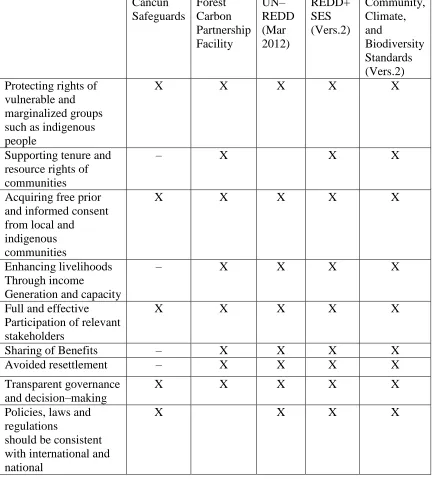
The seven safeguards, agreed to in Cancun in 201020 also known as the UNFCCC
REDD+ safeguards, address the environmental and human rights aspects of REDD+
interventions. They cover policy alignment; transparent and effective forest governance;
20 The safeguards are presented in Appendix I, Outcome of the work of the Ad Hoc Working