IJEDR1603063
International Journal of Engineering Development and Research (www.ijedr.org)387
Ensuring Outsourcing of Multiple Copies of Data
over Cloud
1Snehal.G.Shirole, 2Prof. N.B.kadu 1PG Student, 2Associate Professor 1Department of Computer Engineering 1Pravara Rural Engineering College, Loni, India
________________________________________________________________________________________________________
Abstract - Growing many organization are opting for outsourcing data to remote cloud service provider. Customer can rent cloud service provider storage infrastructure for storing unlimited amount of data. For scalability, availability, durability certain customer may need their data replicated on several server over several data center. Moreover many copy cloud service provider is asked to store additional fees customer are charged. Thus it is important for customer to have powerful assurance that actually getting service as they paid for them. Therefore customer need strong commitment that cloud service provider store entire data copy and entire copy are consistent. We are developing MBPMDDP scheme. It provides confirmation to customer that cloud service provider is not defrauder by storing limited copied. It maintains operation like block modification, insertion, deletion, append. It provides security to our system.
Index Terms –Cloudcomputing, outsourcing, data replication, dynamic environment
________________________________________________________________________________________________________
I.INTRODUCION
The advantage of cloud computing has expand quickly in several organization. Cloud computing is described as kind of computing that depends on dividing the computing resources instead of having localized server or individual equipment to manage the approach. Today numerous individual and institution transfer their data to cloud service provider. The outsourcing data to remote cloud service provider permit organization to store much data on cloud service provider than on personal computer. Additionally several authorized user can access the remotely stored data against various geographic location and creating it more suitable for them.
When data is transferred to cloud service provider that may not at all truthful, data owner lose exact control through there sensible data. This absence of control raising new formidable and difficult task associated to data confidentiality and integrity protection in cloud computing. The confidentiality problem can be treated by encrypting sensitive data since outsourcing to remote server. It is essential need of customer to have strong assurance that the cloud server still possess their data and it is not being change with or partly deleted over time.
Provable data possession (PDP) is procedure for verifying data integrity across the server. In provable data possession data owner introduced certain metadata or information for data file to be utilized afterward for verification reason across challenge-response protocol. The owner transmits the file to be stored on remote server that can be distrustful and deleted the local copy of the file. The basic design principle of outsourcing data is to produce dynamic behaviour of data for different application. That means remotely stored data could be not only access by data owner but also updated and scaled by data owner. While provable data possession strategy has been introduced for multiple copies of static data. To the principle of our understanding this is first provable data possession strategy handle with multiple copies of dynamic data. When authenticating multiple data copies the whole system integrity examine fail if there are corrupted copies. For this problem and identify which copy have been corrupted modification can be applied in this scheme.
II.LITERATURE SURVEY
IJEDR1603063
International Journal of Engineering Development and Research (www.ijedr.org)388
III.PROPOSED SYSTEMFig.System Architecture
The system consist of data owner, cloud service provider, authorized user. Data owner can be organization basically exhibit sensitive data to be store in cloud. Cloud service provider which control cloud server and distribute paid storing area on its framework to store owner’s file. Authorize user these are group of owner’s client which is desirable to obtain information. This system framework accepted by many experimental implementations. To give an example such as e-Health application can be considered by this model where patient database that involve huge and sensitive data can be stored on cloud server. In this e-Health organization examined as data owner and physician as authorized user which have right to acquire patient medical record. It depends on handling small data structure called map-version table. Map-version table consists of three columns serial number (SN), block number (BN) and the block version (BV).The SN indicate the physical location of block in data file. The BN indicate logical indexing/numbering. The relationship between serial number and block number can be considered as mapping among logical number and physical position. The BV indicates current version of file blocks. Although data file is at beginning created block version of all block is 1. When certain block is updated block version is increased by 1.
IV.IMPLEMENTATION DETAILS This scheme consists of following steps:
Key generation: The data owner runs the keyGen algorithm to produce private key and public key.
Formation of Discrete copy: The file F= {bj}, the data owner execute the CopyGengeration algorithm to build n distinguishable copies F= {Fi}, where copy F= {bij}.The encrypted block bij is divided into s sectors. The authorized user require only to store single secret key k.Later when authorized user collect copy from cloud service provider he decrypt the file block, remove the copy index from blocks and recombined the decrypted block to recreate plain form of the receive file copy.
Formation of tags: Given the distinct file copies F= {Fi}, the data owner select s random element and runs the TagGen algorithm to create tag for each block bij.To minimize the storage burden on the server and interaction value, owner create tags for block at similar indices in every copy Fi.
Dynamic operation: These operations execute at block stage bi by using request. The block operation corresponds to block modification, block insertion, block deletion, block append. Changes in map-version table because of several operation on copy of file F. Preventing the cloud service provider from defraud and applying limited store, the updated or insertion blocks for transferred not either similar.
Challenge: Since challenging the cloud service provider as well as verifying the integrity and consistency of all copy, verifier transmits copy and two keys at every challenge key k1 and key k2.
Response: The cloud service provider executes the Prove method to create set Q of random indexes and values. Cloud service provider still exactly possesses the n copies in an updated and uniform. The cloud service provider replies with proof P.
Check Response: On getting the confirmation through cloud service provider verifier runs the verify algorithm. The verifier manages value of indexes and map-version table to obtain the logical block BNj and BVj.
V.ALGORITHM HASH Algorithm 1. Initialize some variable. 2. Pick a string.
3. Break it into characters.
4. Convert character to ASCII code. 5. Convert numbers into binary. 6. Add ‘1’to end
7. Append ‘0’ to end
IJEDR1603063
International Journal of Engineering Development and Research (www.ijedr.org)389
10. Break the chunk into words.11. Extend into 80 words. 12. XOR
13. Left rotate.
14. Initialize some variable such as A=ho, B = h1, C = h2, D = h3, E = h4 and. main loop perform. 15. Four choices and put them together and it converted into hex and joined together.
SHA (Secure hash Algorithm) 1. Append padding bits. 2. Append length.
3. Prepare processing function. 4. Prepare processing constant. 5. Initialize Buffer.
6. Processing message in 512-bit blocks.
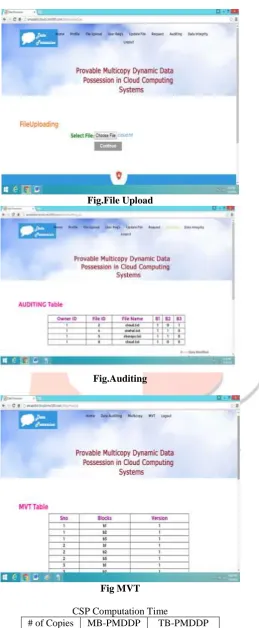
VI.RESULTS Result Snapshot
Fig.Homepage
IJEDR1603063
International Journal of Engineering Development and Research (www.ijedr.org)390
Fig.File UploadFig.Auditing
Fig MVT
CSP Computation Time
# of Copies MB-PMDDP TB-PMDDP
1 0.9616 1.178
5 1.093 2.152
10 1.259 3.434
15 1.425 4.687
IJEDR1603063
International Journal of Engineering Development and Research (www.ijedr.org)391
Verifier Computation Time# of Copies MB-PMDDP TB-PMDDP
1 1.57528 1.3575
5 1.57534 1.3951
10 1.57543 2.8883
15 1.57553 4.4197
20 1.57562 5.951
Owner Computation Time
# of Copies MB-PMDDP TB-PMDDP
1 1.2012 1.2013
5 2.359 2.361
10 3.818 3.821
15 4.525 4.528
20 5.448 5.452
VI.CONCLUSION
IJEDR1603063
International Journal of Engineering Development and Research (www.ijedr.org)392
between authorized user and cloud service provider is taking into account, where authorized user can access data copy accept from CSP using separate key distribute with data owner. It maintains the feature of determining indices of corrupted copies.VII.ACKNOWLEDGMENT
First and the foremost I, express my deep sense of gratitude, sincere thanks and deep sense of appreciation to my Project Guide Prof.N.B.Kadu, Department of Computer Engineering, Pravara Rural Engineering College, Loni for his precious and helpful guidance. I would also like to thank Prof.K.R.Pathak, P.G. Coordinator for his great understanding and support.
I am sincerely thankful to my H.O.D., Prof. S. D. Jondhale, Department of Computer Engineering for the systematic guidance and providing necessary facilities and the best support I ever had. Your opinion, views, comments and thoughts have really brought meaning to my hard-work. I would like to express my sincere gratitude to Dr. R.S. Jahagirdar, Principal, Pravara Rural Engineering College, Loni for providing a great platform to complete the thesis within scheduled time.
REFERENCES
[1] AyadF.Barsoum and M.Anwar Hasan, Provable Multicopy Dynamic Data possession in Cloud Computing System,pp.485-497,2015.
[2] G. Ateniese et al., Provable data possession at untrusted stores, in Proc. 14th ACM Conf. Comput. Commun. Secur.(CCS), New York, NY, USA, 2007, pp. 598609.
[3] K. Zeng, Publicly verifiable remote data integrity, in Proc.10th Int.Conf. Inf. Commun. Secur. (ICICS), 2008, pp.419434. [4] Y. Deswarte, J.-J. Quisquater, and A. Sadane, Remote integrity checking, in Proc. 6thWorking Conf. Integr. Internal Control Inf.Syst. (IICIS), 2003, pp. 111.
[5] D. L. G. Filho and P. S. L. M. Barreto, Demonstrating data possession and uncheatable data transfer,IACR (International Association for Cryptologic Research) ePrint Archive, Tech. Rep. 2006/150, 2006.
[6] F. Seb, J. Domingo-Ferrer, A. Martinez-Balleste, Y.Deswarte, and J.-J. Quisquater, Efficient remote data possession checking in critical information infrastructures,IEEE Trans. Knowl. Data Eng., vol. 20, no. 8, pp. 10341038,Aug. 2008.
[7] P. Golle, S. Jarecki, and I. Mironov, Cryptographic primitives enforcing communication and storage complexity, in Proc. 6th Int. Conf. Financial Cryptograph. (FC), Berlin, Germany, 2003, pp. 120135.
[8] M. A. Shah, M. Baker, J. C. Mogul, and R. Swaminathan, Auditing to keep online storage services honest, in Proc.11th USENIX Workshop Hot Topics Oper. Syst. (HOTOS),Berkeley, CA, USA, 2007, pp. 16.
[9] M. A. Shah, R. Swaminathan, and M. Baker, Privacy preserving audit and extraction of digital contents, IACRCryptology ePrint Archive, Tech. Rep. 2008/186, 2008.
[10] E. Mykletun, M. Narasimha, and G. Tsudik, Authentication and integrity in outsourced databases, ACM Trans.Storage, vol. 2, no. 2, pp. 107138, 2006.
[11] G. Ateniese, R. D. Pietro, L. V. Mancini, and G. Tsudik,Scalable and efficient provable data possession, in Proc. 4thInt. Conf. Secur.Privacy Commun. Netw. (SecureComm),New York, NY, USA, 2008,Art. ID 9.
[12] C. Wang, Q. Wang, K. Ren, and W. Lou. (2009). Ensuring data storage security in cloud computing, IACR Cryptology ePrint Archive, Tech.Rep. 2009/081. [Online].Available: http://eprint.iacr.org/