Word-Transliteration Alignment
Tracy Lin
Dep. of Communication Engineering National Chiao Tung University,
1001, Ta Hsueh Road, Hsinchu, 300, Taiwan
Chien-Cheng Wu
Department of Computer ScienceNational Tsing Hua University 101, Kuangfu Road, Hsinchu, 300, Taiwan [email protected]
Jason S. Chang
Department of Computer ScienceNational Tsing Hua University 101, Kuangfu Road, Hsinchu, 300, Taiwan [email protected]
Abstract
The named-entity phrases in free text represent a formidable challenge to text analysis.
Translat-ing a named-entity is important for the task of Cross Language Information Retrieval and
Ques-tion Answering. However, both tasks are not easy to handle because named-entities found in free
text are often not listed in a monolingual or bilingual dictionary. Although it is possible to
iden-tify and translate named-entities on the fly without a list of proper names and transliterations, an
extensive list certainly will ensure the high accuracy rate of text analysis. We use a list of proper
names and transliterations to train a Machine Transliteration Model. With the model it is
possi-ble to extract proper names and their transliterations in a bilingual corpus with high average
pre-cision and recall rates.
1. Introduction
Multilingual named entity identification and (back) transliteration has been increasingly recognized as an
important research area for many applications, including machine translation (MT), cross language
in-formation retrieval (CLIR), and question answering (QA). These transliterated words are often
domain-specific and many of them are not found in existing bilingual dictionaries. Thus, it is difficult to handle
transliteration only via simple dictionary lookup. For CLIR, the accuracy of transliteration highly affects
the performance of retrieval.
Transliteration of proper names tends to be varied from translator to translator. Consensus on
unique and unchanged thereafter. But for less known persons and unfamiliar places, the transliterations of
names may vary a great deal. That is exacerbated by different systems used for Ramanizing Chinese or
Japanese person and place names. For back transliteration task of converting many transliterations back to
the unique original name, there is one and only solution. So back transliteration is considered more
diffi-cult than transliteration. Knight and Graehl (1998) pioneered the study of machine transliteration and
pro-posed a statistical transliteration model from English to Japanese to experiment on back transliteration of
Japanese named entities. Most previous approaches to machine transliteration (Al-Onaizan and Knight,
2002; Chen et al., 1998; Lin and Chen, 2002); English/Japanese (Knight and Graehl, 1998; Lee and Choi,
1997; Oh and Choi, 2002) focused on the tasks of transliteration and back-transliteration. Very little has
been touched upon for the issue of aligning and acquiring words and transliterations in a parallel corpus.
The alternative to on-the-fly (back) machine transliteration is simple lookup in an extensive list
auto-matically acquired from parallel corpora. Most instances of (back) transliteration of proper names can
often be found in a parallel corpus of substantial size and relevant to the task. For instance, fifty topics of
the CLIR task in the NTCIR 3 evaluation conference contain many named entities (NEs) that require
(back) transliteration. The CLIR task involves document retrieval from a collection of late 1990s news
articles published in Taiwan. Most of those NEs and transliterations can be found in the articles from the
Sinorama Corpus of parallel Chinese-English articles dated from 1990 to 2001, including “Bill Clinton,”
“Chernobyl,” “Chiayi,” “Han dynasty,” “James Soong,” “Kosovo,” “Mount Ali,” “Nobel Prize,” “Oscar,”
“Titanic,” and “Zhu Rong Ji.” Therefore it is important for CLIR research that we align and extract words
and transliterations in a parallel corpus.
In this paper, we propose a new machine transliteration method based on a statistical model trained
automatically on a bilingual proper name list via unsupervised learning. We also describe how the
pa-rameters in the model can be estimated and smoothed for best results. Moreover, we show how the model
The remainder of the paper is organized as follows: Section 2 lays out the model and describes how to
apply the model to align word and transliteration. Section 3 describes how the model is trained on a set of
proper names and transliterations. Section 4 describes experiments and evaluation. Section 5 contains
dis-cussion and we conclude in Section 6.
2. Machine Transliteration Model
We will first illustrate our approach with examples. A formal treatment of the approach will follow in
Section 2.2.
2.1 Examples
Consider the case where one is to convert a word in English into another language, says Chinese, based
on its phonemes rather than meaning. For instance, consider transliteration of the word “Stanford,” into
Chinese. The most common transliteration of “Stanford” is “ .” (Ramanization: [shi-dan-fo]). We
assume that transliteration is a piecemeal, statistical process, converting one to six letters at a time to a
Chinese character. For instance, to transliterate “Stanford,” the word is broken into “s,” “tan,” “for,” and
“d,” which are converted into zero to two Chinese characters independently. Those fragments of the word
in question are called transliteration units (TUs). In this case, the TU “s” is converted to the Chinese
char-acter “ ,” “tan” to “ ,” “for” to “ ,” and “d” to the empty string λ. In other words, we model the
transliteration process based on independence of conversion of TUs. Therefore, we havethe
translitera-tion probability of getting the transliteration “ ” given “Stanford,” P( | Stanford),
P( | Stanford) = P( | s) P( | tan) P( | for) P( λ | d)
There are several ways such a machine transliteration model (MTM) can be applied, including (1)
transliteration of proper names (2) back transliteration to the original proper name (3)
word-transliteration alignment in a parallel corpus. We formulate those three problems based on the
Transliteration problem (TP)
Given a word w (usually a proper noun) in a language (L1), produce automatically the transliteration t in
another language (L2). For instance, the transliterations in (2) are the results of solving the TP for four
given words in (1).
(1) Berg, Stanford, Nobel,
(2) , , , Tsing Hua
Back transliteration Problem (BTP)
Given a transliteration t in a language (L2), produce automatically the original word w in (L1) that gives
rise to t. For instance, the words in (4) are the results of solving the BTP for two given transliterations in
(3).
(3) , Lin Ku-fang
(4) Michelangelo,
Word Transliteration Alignment Problem (WTAP)
Given a pair of sentence and translation counterpart, align the words and transliterations therein. For
in-stance, given (5a) and (5b), the alignment results are the three word-transliteration pairs in (6), while the
two pairs of word and back transliteration in (8) are the results of solving WTAP for (7a) and (7b)
(5a) Paul Berg, professor emeritus of biology at Stanford University and a Nobel laureate, …
(5b) 1
(6) (Stanford, ), (Nobel, ), (Berg, )
(7a) PRC premierZhu Rongji's saber-rattling speech on the eve of the election is also seen as having aroused re-sentment among Taiwan's electorate, and thus given Chen Shui-bian a last-minute boost.
(7b) 2
(8) (Zhu Rongji, ), (Chen Shui-bian, )
Both transliteration and back transliteration are important for machine translation and cross language
information retrieval. For instance, the person and place names are likely not listed in a dictionary,
there-fore should be mapped to the target language via run-time transliteration. Similarly, a large percentage of
1Scientific American, US and Taiwan editions. What Clones? Were claims of the first human embryo premature? Gary Stix and
keywords in a cross language query are person and place names. It is important for an information system
to produce appropriate counterpart names in the language of documents being searched. Those
counter-parts can be obtained via direct transliteration based on the machine transliteration and language models
(of proper names in the target language).
The memory-based alternative is to find those word-transliteration in the aligned sentences in a
paral-lel corpus (Chuang, You, and Chang 2002). Word-transliteration alignment problem certainly can be dealt
with based on lexical statistics (Gale and Church 1992; Melamed 2000). However, lexical statistics is
known to be very ineffective for low-frequency words (Dunning 1993). We propose to attack WTAP at
the sub-lexical, phoneme level.
2.2 The Model
We propose a new way for modeling transliteration of an English word w into Chinese t via a Machine
Transliteration Model. We assume that transliteration is carried out by decomposing w into k translation
units (TUs), ω1, ω2, …, ωk which are subsequently converted independently into τ1, τ2, …, τk respectively.
Finally, τ1, τ2, …, τk are put together, forming t as output. Therefore, the probability of converting w into t
can be expressed as P(t | w) = max ( | )
, 1 ... , ...
, 1 k 1 ki k i i
kω ω τ τ =Π P
τ
ω
, where w = ω1ω2 …ωk , t = τ1τ2 …τk , |t| ≤ k ≤|t|+|w|, τ iω i≠λ. See Equation (1) in Figure 1 for more details.
Based on MTM, we can formulate the solution to the Transliteration Problem by optimizing P(t | w)
for the given w. On the other hand, we can formulate the solution to the Back Transliteration Problem by
optimizing P(t | w) P( w) for the given t. See Equations (2) through (4) in Figure 1 for more details.
The word-transliteration alignment process may be handled by first finding the proper names in
Eng-lish and matching up with the transliteration for each proper name. For instance, consider the following
sentences in the Sinorama Corpus:
(9c) 你 你
(9e) "When you understand all about the sun and all about the atmosphere and all about the rotation of the earth, you may still miss the radiance of the sunset." So wrote English philosopher Alfred North Whitehead.
It is not difficult to build part of speech tagger or named entity recognizer for finding the following proper names (PN):
(10a) Alfred, (10b) North, (10c) Whitehead.
We use Equation (5) in Figure 1 to model the alignment of a word w and its transliteration t in s based
on the alignment probability P(s, w) which is the product of transliteration probability P(σ| ω) and a
trigram match probability, P(m i | m i-2, m i-1), where mi is the type of the i-th match in the alignment path.
We define three match types based on lengths a and b, a = |τ |, b = |ω |: match(a, b) = H if a = 0, match(a,
b) = V if b = 0, and match(a, b) = D if a > 0 and b > 0. The D-match represents a non-empty TU ω
matching a transliteration character τ, while the V-match represents the English letters omitted in the
To compute the alignment probability efficiently, we need to define and calculate the forward
probability α(i, j) of P(s, w) via dynamic programming (Manning and Schutze 1999), α(i, j) denotes the
probability of aligning the first i Chinese characters of s and the first j English letters of w. For the match
type trigram in Equation (5) and (8), we need also compute µ(i, j), the types of the last two matches in the
Viterbi alignment path. See Equations (5) through (9) in Figure 1 for more details.
For instance, given w = “Whitehead” and s = “ 你
你 ,” the best Viterbi path indicates a
decomposition of word “Whitehead” into four TUs, “whi,” “te,” “hea,” and “d” matching “ ,” λ, “ ,”
“ ” respectively. By extracting the sequence of D- and V-matches, we generate the result of
word-transliteration alignment. For instance, we will have ( , Whitehead) as the output. See Figure 2 for
more details.
3. Estimation of Model Parameters
In the training phase, we estimate the transliteration probability function P(τ| ω), for any given TU ω and
transliteration character τ, based on a given list of word-transliterations. Based on the Expectation
Maxi-mization (EM) algorithm (Dempster et al., 1977) with Viterbi decoding (Forney, 1973), the iterative
pa-rameter estimation procedure on a training data of word-transliteration list, (Ek, Ck), k = 1 to n is
described as follows:
Initialization Step:
Initially, we have a simple model P
0(
τ
|
ω
)
P0 (τ| ω) = sim( R(τ) | ω)
= dice(t 1t 2 …ta, w 1 w 2 …w b) (8)
= b a
c + 2
where R(τ) = Romanization of Chinese character τ R(τ) =t 1t 2 …ta
ω = w 1 w 2 …w b
For instance, given w = ‘Nayyar’ and t = ‘ ,’ we have and R(τ1) = ‘na’ and R(τ2) = ‘ya’ under
Yanyu Pinyin Romanization System. Therefore, breaking up w into two TUs, ω1 = ‘nay’ ω 2 = ‘yar’ is
most probable, since that maximizes P0(τ1 | ω 1) × P0(τ2 | ω 2)
P0(τ1 | ω 1)= sim( na | nay) = 2 × 2 / (2+3) = 0.8 P0(τ2 | ω 2)= sim( ya | yar) = 2 × 2 / (2+3) = 0.8
Expectation Step:
In the Expectation Step, we find the best way to describe how a word get transliterated via decomposition
into TUs which amounts to finding the best Viterbi path aligning TUs in Ek and characters in Ck for all
pairs (Ek, Ck), k = 1 to n, in the training set. This can be done using Equations (5) through (9). In the
training phase, we have slightly different situation of s = t.
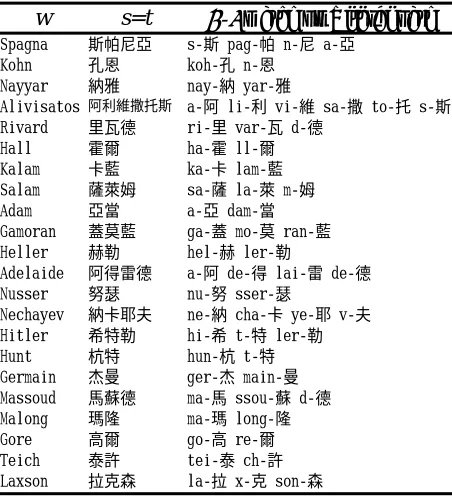
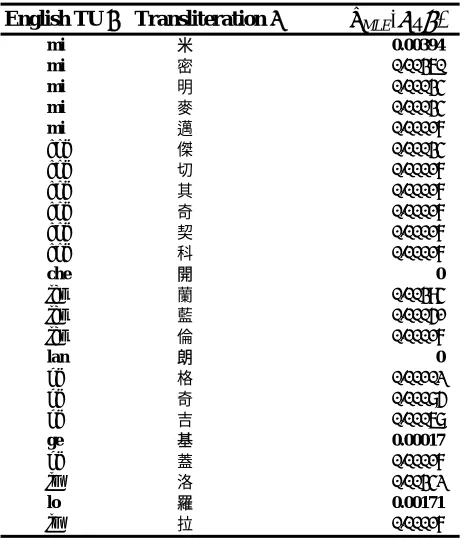
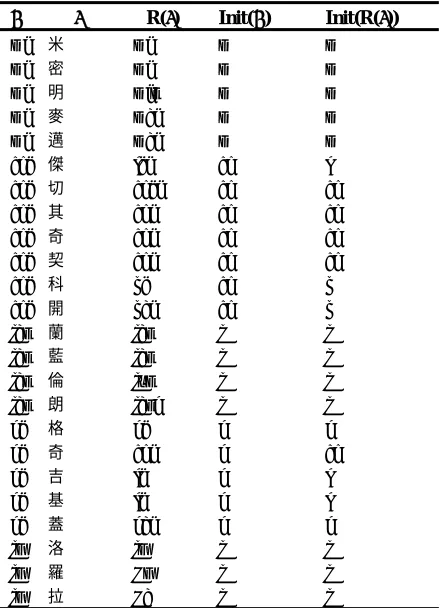
Table 1. The results of using P0(τ|ω) to align TUs and transliteration characters
w s=t ω-τ match on Viterbi path
The Viterbi path can be found via a dynamic programming process of calculating the forward
prob-ability function α(i, j) of the transliteration alignment probability P(Ek , Ck) for 0 < i < | Ck| and 0 < j < |
Edi-(11a)
(11b) Are ch'i-p'aos--the national dress of China--really out of fashion?
(12a)
(12b) a scroll of shou chin ti calligraphy
Without capitalized transliterations, it remains to be seen how word-transliteration alignment related to
common nouns should be handled.
6. Conclusion
In this paper, we propose a new statistical machine transliteration model and describe how to apply the
model to extract words and transliterations in a parallel corpus. The model was first trained on a modest
list of names and transliteration. The training resulted in a set of ‘syllabus’ to character transliteration
probabilities, which are subsequently used to extract proper names and transliterations in a parallel corpus.
These named entities are crucial for the development of named entity identification module in CLIR and
QA.
We carried out experiments on an implementation of the word-transliteration alignment algorithms
and tested on three sets of test data. The evaluation showed that very high precision rates were achieved.
A number of interesting future directions present themselves. First, it would be interesting to see how
effectively we can port and apply the method to other language pairs such as English-Japanese and
Eng-lish-Korean. We are also investigating the advantages of incorporate a machine transliteration module in
sentence and word alignment of parallel corpora.
Acknowledgement
We acknowledge the support for this study through grants from National Science Council and Ministry of
References
Al-Onaizan, Y. and K. Knight. 2002. Translating named entities using monolingual and bilingual
re-sources. In Proceedings of the 40th Annual Meeting of the Association for Computational Linguistics
(ACL), pages 400-408.
Chen, H.H., S-J Huang, Y-W Ding, and S-C Tsai. 1998. Proper name translation in cross-language
infor-mation retrieval. In Proceedings of 17th COLING and 36th ACL, pages 232-236.
Chuang, T., G.N. You, J.S. Chang (2002) Adaptive Bilingual Sentence Alignment, Lecture Notes in
Arti-ficial Intelligence 2499, 21-30.
Cibelli, J.B. R.P. Lanza, M.D. West, and C. Ezzell. 2002. What Clones? SCIENTIFIC AMERICAN, Inc.,
New York, January. http://www.sciam.com.
Dagan, I., Church, K. W., and Gale, W. A. 1993. Robust bilingual word alignment for machine aided
translation. In Proceedings of the Workshop on Very Large Corpora: Academic and Industrial
Per-spectives, pages 1-8, Columbus Ohio.
Dempster, A., Laird, N., and Rubin, D. (1977). Maximum likelihood from incomplete data via the EM
algorithm. Journal of the Royal Statistical Society, Series B, 39(1):1–38.
Dempster, A.P., N.M. Laird, and D.B. Rubin. 1977. Maximum likelihood from incomplete data via the
EM algorithm. Journal of the Royal Statistical Society, 39(1):1-38.
Forney, G.D. 1973. The Viterbi algorithm. Proceedings of IEEE, 61:268-278, March.
Knight, K. and J. Graehl. 1998. Machine transliteration. Computational Linguistics, 24(4):599-612.
Lee, J.S. and K-S Choi. 1997. A statistical method to generate various foreign word transliterations in
multilingual information retrieval system. In Proceedings of the 2nd International Workshop on
Infor-mation Retrieval with Asian Languages (IRAL'97), pages 123-128, Tsukuba, Japan.
Lin, W-H Lin and H-H Chen. 2002. Backward transliteration by learning phonetic similarity. In
Manning, Ch. and H. Schutze. 1999. Foundations of Statistical Natural Language Processing, MIT Press;
1st edition.
Oh, J-H and K-S Choi. 2002. An English-Korean transliteration model using pronunciation and
contex-tual rules. In Proceedings of the 19th International Conference on Computational Linguistics
(COLING), Taipei, Taiwan.
Proctor, P. 1988. Longman English-Chinese Dictionary of Contemporary English, Longman Group (Far
East) Ltd., Hong Kong.
Sinorama. 2002. Sinorama Magazine. http://www.greatman.com.tw/sinorama.htm.
Stalls, B.G. and K. Knight. 1998. Translating names and technical terms in Arabic text. In Proceedings of
the COLING/ACL Workshop on Computational Approaches to Semitic Languages.
Tsujii, K. 2002. Automatic extraction of translational Japanese-KATAKANA and English word pairs
from bilingual corpora. International Journal of Computer Processing of Oriental Languages,