An automatic close copy speech synthesis tool for large-scale speech corpus
evaluation
Dafydd Gibbon
1, Jolanta Bachan
21Universität Bielefeld
Postfach 100131, D-33501 Bielefeld, Germany
2
Uniwersytet im. Adama Mickiewicza H. Wieniawskiego 1, 61-712 Poznań, Poland E-mail: [email protected], [email protected]
Abstract
The production of rich multilingual speech corpus resources on a large scale is a requirement for many linguistic, phonetic a nd technological tasks, in both research and application domains. It is also time-consuming and therefore expensive. In particular the human component in the resource creation process is prone to inconsistencies, a situation which has frequently been documented in studies of cross-transcriber consistency in manual time-aligned signal annotation. In the present case, corpora of three languages were to be evaluated and corrected: (1) Polish, a large automatically annotated and manually corrected single-speaker TTS unit-selection corpus in the BOSS Label File (BLF) format, (2) German and (3) English, the second and third being manually annotated multi-speaker story-telling learner corpora in Praat TextGrid format. A method is provided for supporting the evaluation and correction of time-aligned annotations for the three corpora by permitting a rapid audio screening of the annotations by an expert listener for the detection of perceptually conspicuous systematic or isolated errors in the annotations. The criterion for perceptual conspicuousness was provided by converting the annotation formats into the interface format required by the MBROLA speech synthesiser. The audio screening procedure is complementary to other methods of corpus evaluation and does not replace them. Conceptually the ACCS synthesis tool is intended as an extension of the BLARK toolkit for speech corpora.
1.
Efficient quality control of richly
annotated corpora
The production of rich multilingual speech corpus resources on a large scale is a requirement for many linguistic, phonetic and technological tasks, in both
research and application domains. It is also
time-consuming and therefore expensive. In particular the human component in the resource creation process is prone to inconsistencies, a situation which has frequently been documented in studies of cross-transcriber consistency in manual time-aligned signal annotation, particularly with prosody (Grice 2006; Gibbon et al. 1997; Gibbon et al. 2000). In the present case, corpora of three languages were to be evaluated and corrected: (1) Polish, a large automatically annotated and manually corrected single-speaker TTS unit-selection corpus in the BOSS Label File (BLF) format (Demenko et al. 2006), (2) German and (3) English, the second and third being manually annotated multi-speaker story-telling learner corpora in Praat TextGrid format (Boersma 2001; Gut et al. 2004).
The first general goal is to provide a method for supporting the evaluation and correction of time-aligned annotations for the three corpora by permitting rapid audio screening of the annotations by an expert listener, who detects perceptually conspicuous systematic or isolated errors in the annotations. The criterion for perceptual conspicuousness is provided by converting the annotation formats into the interface format required by a suitable speech synthesizer, in this case the PHO format required by the MBROLA synthesizer (Dutoit & al. 1996). The audio screening procedure is complementary to other
methods of corpus evaluation and does not replace them. Functionally, the ACCS synthesis tool is intended as an addition to the BLARK (Krauwer 2005) toolkit for speech corpora.
A second general goal is a practical one: the method is also intended for use with corpora for less-resourced languages and for use in areas with very basic infrastructures. The method should therefore not only be of good quality and well-defined, but at the same time straightforward and as far as possible not dependent on complex cutting edge tools, expensive software packages, or the internet. Otherwise, usability by development teams working with sub-optimal infrastructures in an under-resourced languages paradigm is not assured. The focus in the present application is on segmental annotation evaluation, but the pitch pattern of the original speech signals was also extracted and mapped into the synthesiser interface in order to provide as natural a re-synthesis as possible for the segmental evaluation. Prosodic annotation is not evaluated. The issues addressed are:
1. Consistency of labels used with defined label set
(e.g. phoneme or phone set).
2. Correct time-stamp assignment (e.g. segment
duration).
3. Correct label selection from the relevant
inventory.
4. MBROLA diphone database (voice) for the language concerned.
5. Corpus:
a. Speech signal (in WAV format).
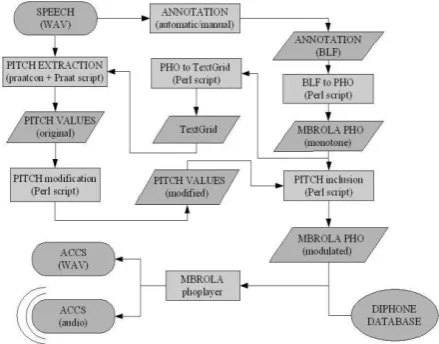
b. Time-aligned phonemic annotation (are converted to Praat TextGrid format). The ACCS system runs in Linux, Windows and Mac environments, and will be made available under open source conditions. Voice-making software is required for applications to other languages. An example from the corpus, with the ACCS synthesised file (top) and the original recording (bottom) are shown for comparision in Figure 2.
User interface: Schedule selection.
Schedule control:
Handling of multiple annotations and multiple voices.
Data processing:
Perl: Annotation format to
MBROLA interface format
conversion.
Praat: F0 pattern extraction for each phone interval.
Perl: F0 pattern insertion into MBROLA interface file.
Output: MBROLA: Mapping of interface
file to WAV file, and audio output.
Table 1: Main modules of ACCS system.
5.
Evaluation
Preliminary benchmarking and evaluation of the ACCS procedure was performed on the manually checked automatically annotated Polish data (Bachan 2007) by means of a set of short perception tests based on EAGLES standards (Gibbon et al. 1997). The three speech quality
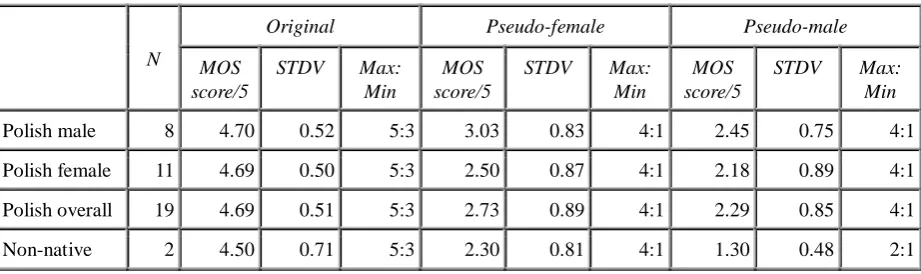
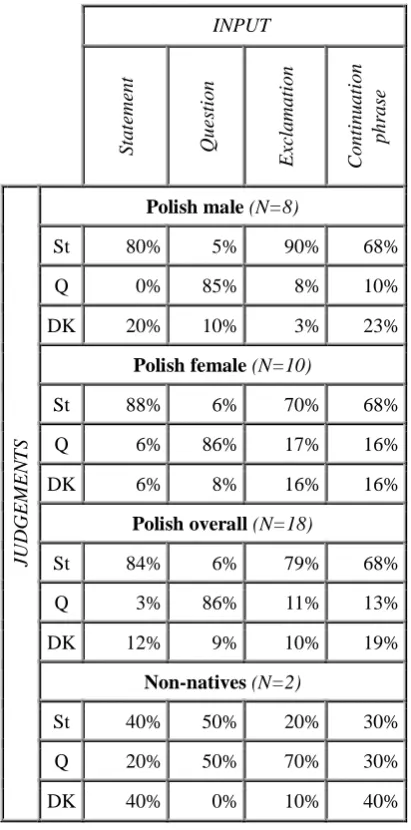
tests were administered to 19 Polish subjects and 2 non-native speakers with a good command of Polish. The youngest Polish subject was 8 years old, the oldest 55. The non-natives' ages were 22 and 25. The subjects took the tests separately. The stimuli were played to the subjects once, or twice if the subject requested this. Each test session lasted 30-45 min. The tests investigated:
1. Test 1: sentence and word recognition in 10 semantically predictable and 10 semantically unpredictable sentences, with repetitions. 2. Test 2: mean opinion score (MOS) of subjective
sentence quality on a five-point rating scale. 3. Test 3: intonation of isolated words.
5.1 Test 1: sentence and word recognition
Method: The synthetic material is presented to the subjects. Their task is to write down what they hear in the answer sheet. A set of semantically unpredictable sentences is used in order to eliminate the influence of the top-down processing on the perception task (Clark & Yallop 1995: 312, Ryalls 1996: 94).
Material: 10 meaningful and 10 meaningless sentences synthesised with the Polish female MBROLA voice (PL1) (Szklanny & Marasek 2002).
Results: The results of Test 1 on sentence and word recognition are presented in Table 2. Despite the small test sets, the results show that ACCS is highly intelligible by the Polish native speakers, though not by the non-natives. The non-natives' poor results are apparently due to the fact that although the non-natives spoke vernacular Polish well, they were unfamiliar with the vocabulary used in the tests. Therefore, after testing with two foreign subjects, no more test with non-native speakers were carried out. In Table 3, a comparison of the intelligibility of sentences and words in semantically predictable and unpredictable sentences is shown. The results indicate, predictably, that semantic information helps in speech signal recognition; both sets of sentences get high scores on word perception under this condition.
Figure 2: ACCS synthesis (top) vs. original recording file with annotation (bottom) for the Polish utterance “Wejście
7.
Conclusion
The goals set in the requirement specification were met. The ACCS audio screening method provided both a proof of concept of the workability of the approach in providing a rapid overview of the quality of the time-aligned annotations, and proved its practical value in uncovering many additional errors which had been missed by standard methods of manual checking by trained personnel.
It is clear that the prototype would benefit from additional statistical testing. However, it is not clear what difference this would make to the actual audio screening application. On the ergonomic side, it became clear that the current prototype would benefit from enhancement with an interactive GUI-based control and error logging system in order to enable rapid changes to be made to the annotations and also from an interface with annotation software for efficient error correction.
In summary, the ACCS system has turned out to be a valuable tool for rapidly obtaining an overview of annotation quality, with respect to identifying both systematic errors and random slips. Other uses of the system are currently under development, including the evaluation of prosodic annotation, prosodic parameter manipulation for corpus-based speaker attitude modelling, and the training of labelling personnel.
8.
Acknowledgements
We are grateful to Grażyna Demenko, Linguistics Department, U Poznań, and to Thorsten Trippel and Catharine Oertel for feedback on applications of the ACCS system in the LiteraSyn Project funded by Universität Bielefeld. The work was partly funded by an ERASMUS exchange grant to Jolanta Bachan, 2006-2007, partly by the LiteraSyn project, and partly by the Polish nationally funded project KBN 3T11C 038 27 Corpus based speech synthesis based on suprasegmental selection, 2004-2006, directed by Grażyna Demenko.
9.
References
Bachan, J. & Gibbon, D. (2006). Close Copy Speech Synthesis for Speech Perception Testing. In:
Investigationes Linguisticae, vol. 13, pp. 9--24. Bachan, J. (2007). Close Copy Speech Synthesis for
Perception Testing and Annotation Validation. M.A. thesis. Adam Mickiewicz University, Poznań, Poland. Boersma, P. (2001). Praat, a system for doing phonetics
by computer. GlotInternational 5:9/10, pp- 341--345.
Clark, J. & Yallop, C. (1995). An Introduction to
Phonetics and Phonology. Second Edition. Malden, USA: Blackwell Publishing.
Demenko, G., Grocholewski, S., Wagner, A. & Szymański, M. (2006). Prosody Annotation for Corpus
Based Speech Synthesis. In: Proceedings of the
Eleventh Australasian International Conference on Speech Science and Technology. Auckland, New Zealand, pp. 460--465
Dutoit, T., Pagel, V., Pierret, N., Bataille, F. & van der Vrecken, O. (1996). The MBROLA Project: Towards a Set of High-Quality Speech Synthesizers Free of Use
for Non-Commercial Purposes. In: Proceedings of
ICSLP 96. Philadelphia, vol. 3, pp. 1393--1396.
Gibbon, D., Moore, R. & Winski, R. (1997). Handbook of
Standards and Resources for Spoken Language Systems. Berlin: Mouton de Gruyter.
Gibbon, D., Mertins, I. & Moore, R. (2000). Handbook of
Multimodal and Spoken Dialogue Systems: Terminology, Resources and Product Evaluation. New York: Kluwer Academic Publishers.
Grice, M. (2006). Intonation. In: Keith Brown,
(Editor-in-Chief) Encyclopedia of Language &
Linguistics, 2nd Edition, vol. 5. Oxford: Elsevier, pp. 778-788.
Gut, U., Milde, J-T., Voormann, H. & Heid, U. (2004).
Querying Annotated Speech Corpora. In: Proceedings
of Speech Prosody 2004. Nara, Japan, March 23-26, 2004, n.p.
Krauwer, S. (2005). ELSNET and ELRA: a common past
and a common future. http://www.elda.org/article48.html,
accessed 2005-10-14.
Ryalls, J. 1996. A Basic Introduction to Speech Perception.
San Diego, California: Singular Publishing Group, Inc., and London: Singular Publishing Ltd.
Szklanny, K. & Masarek, K. (2002). PL1 - A Polish
female voice for the MBROLA synthesizer.
http://tcts.fpms.ac.be/synthesis/mbrola/mbrcopybin.ht