Three dimensions of the so-called "interoperability" of annotation schemes
Eva Hajičová
Charles University in Prague
Malostranské nám. 25, 118 00 Prague 1, Czech Republic E-mail: [email protected]
Abstract
“Interoperability” of annotation schemes is one of the key words in the discussions about annotation of corpora. In the present contribution, we propose to look at the so-called interoperability from (at least) three angles, namely (i) as a relation (and possible interaction or cooperation) of different annotation schemes for different layers or phenomena of a single language, (ii) the possibility to annotate different languages by a single (modified or not) annotation scheme, and (iii) the relation between different annotation schemes for a single language, or for a single phenomenon or layer of the same language. The pros and cons of each of these aspects are discussed as well as their contribution to linguistic studies and natural language processing. It is stressed that a communication and collaboration between different annotation schemes requires an explicit specification and consistency of each of the schemes.
Keywords: Annotation scenario, interoperability, multilinguality
1.
Introduction
Corpus linguistics – as very aptly documented by the fact that the 2014 LREC conference is already the 9th edition of these bi-annual meetings in a row – has made a remarkable progress during the last two decades, seen from most diversified angles: quantitatively, variety of languages, variety of annotation schemes, many-sided possibilities offered, etc. etc. Many new notions and terms have appeared, or some of the established notions and terms have received new interpretations. We believe that time has come to revisit some of these notions and to offer a more differentiated view on them. In order not to be misunderstood or to raise false expectations, we would like to emphasize that the reflections we offer in the sequel are deeply influenced by our linguistic roots, and, historically, by our experience with the creation and development of the Prague Dependency Treebank and its „offsprings”.
One of the most frequent key words in the discussions about annotation of corpora, which has received both positive and negative reactions, is the term „interoperability“ of annotation schemes. In our paper we want to propose that the very notion of interoperability is to be viewed from the perspective of different angles, which for the purpose of our discussion we call dimensions. This is not to say, of course, that other dimensions (or “vistas”) are not viable.
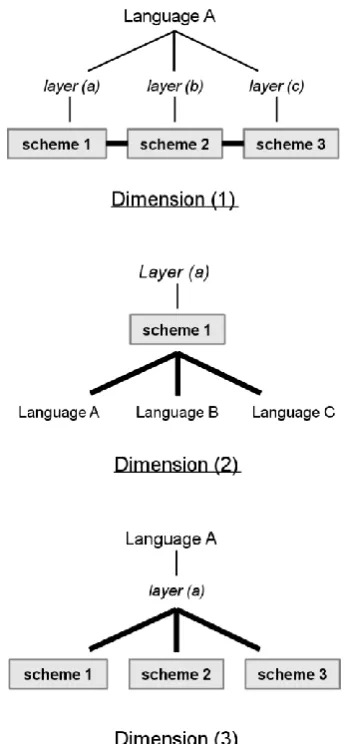
Schematically, these dimensions (or interpretations) of the notion of interoperability are captured in Fig.1.
We are fully aware that the representation given in Fig. 1 is highly simplified, at least in the following respects: (a) The label “language” is meant to refer to a particular language (be it English, German, Czech, etc.), and the
label “scheme” is supposed to refer to an annotation scheme applied (or proposed) for a particular language or a particular phenomenon (or a set of related phenomena) of a given language; a “resource” then can be understood as a pair [Language, Scheme], or better to say, an instance of annotated data. (b) For the sake of simplicity, the label “scheme” in the diagrams does not distinguish between the “contents” of the scheme and its “form”. When this distinction is relevant, we mention it explicitly in our discussion below.
2.
Dimension (1) The relation (and possible
interaction) of (possibly) different annotation
schemes for different “phenomena” of a
single language
This interpretation seems to correspond to the notion of interoperability as an ability of different systems to work together. A “phenomenon” is used here in a broad sense: it may mean a layer as understood in a multilevel approach to language description, or a phenomenon in the sense of a particular language phenomenon (or a set of closely related phenomena) such as multiword expression, named entity etc.
If one considers a language system to consist of several layers or subsystems, it is advantageous to describe (and analyze) a language system with regard to these layers. Interoperability of annotation in this sense refers to a possible cooperation of different layers of the annotation scenario. The idea of interoperability between different layers of an annotation scheme is e.g. applied in the approach of the Prague discourse treebank PDiT (Poláková et al. 2013)1 built upon the annotation on the
underlying (tectogrammatical) syntactic layer of the Prague Dependency Treebank annotation2 rather than on
a running text. The advantages seem to be apparent (see Mírovský, Jínová and Poláková 2013): the underlying structure representations explicitly reconstruct the items deleted on the surface (in the running text) so that if annotation is being carried out on the basis of these structures containing nodes for the reconstructed elements, the question of “zero” anaphor (i.e. with the
1Prague Discourse Treebank 1.0 is available at Lindat/Clarin: https://lindat.mff.cuni.cz/repository/xmlui/handle/11858/00-09 7C-0000-0008-E130-A
2 The Prague Dependency Treebank (see e.g. Hajič 1998; Böhmová et al. 2003, Hajič et al., 2006) consists of continuous Czech texts mostly of the journalistic style (taken from the Czech National Corpus) analyzed on three layers of annotation (morphological, surface syntactic shape and underlying syntactic structure including the information structure of sentences and some basic types of coreferential and bridging relations). At present, the total number of documents annotated on all the three layers is 3,168, amounting to 49,442 sentences and 833,357 (occurrences of) nodes; version 2.0 is available at Lindat/Clarin:
https://lindat.mff.cuni.cz/repository/xmlui/handle/11858/00-09 7C-0000-0001-B098-5)
deletion of the anaphor in the surface shape of the sentence) does not arise. Another advantage of a cooperation of the two annotation schemes lies in the fact that some relations established in the underlying representations can be more or less directly transferred as discourse relations (e.g. in case of relations of embedded clauses to the main clause). Some of the deep syntactic schemes even contain marks indicating a non-specified discourse relation. In addition, the (underlying) syntactic trees help to determine the extent of the arguments of discourse connectives.
The issue may be, of course, understood in a broader sense: Does a multilayer schematic scheme profit from an annotation of different layers of annotation (e.g. morphemics – surface syntax – deep syntax)? It seems to be a matter of course that this has an advantage for linguistic investigations: the researcher can view the relations as a whole and can draw conclusions from these interactions (see e.g. Bender 2008 on the effect of interaction of phenomena which may serve for an evidence for or against specific analyses). However, a question remains whether this helps the annotation process as such. Our experience with the annotation of discourse relations in PDiT, the inter-layer “collaboration” helps to maximize the value of the work (in our case, carried out manually) on the annotation of the other layer (s) and in effect it enriches the annotations already existing in the Treebank.
As stated earlier, this cooperation need not concern more or less well-defined layers of the annotations scheme, but also annotation schemes for different language phenomena for a single language (developed later for other languages as well). As an example, one can take the MAIS environment designed to allow easy access to the content of a set of linguistic annotations such as PropBank, NomBank, TimeBank each dealing with information on a specific language phenomenon (see Verhagen, Stubbs and Pustejovsky 2007). The kind of interoperability proposed relies on independent annotation schemes; one resource remains independent of the other resources and interactions between annotations are then defined based on used cases. A necessary condition for such an approach is, of course, an exact specification of each scheme and its basic units, which, as a matter of fact, holds true for any interpretation of the notion of interoperability.
Query; Pajas and Štěpánek 2009)3, a user-friendly
graphically oriented client-server system for querying treebanks annotated on multiple layers (including annotations crossing sentence boundary like coreference or discourse), developed primarily for searching in the Prague Dependency Treebank but since then used for many other treebanks (Štěpánek and Pajas, 2010). A complex multilayer annotation scheme as well as the integration of different schemes serving for the annotation of different aspects of language structure are extremely useful: they open up significant new possibilities for exploring linguistically annotated data (Neumann et al. 2013) and help linguists to broaden their perspectives and understanding of the multifarious system of language. However, there are also some dangers involved that have to be avoided in the process of manual annotation carried out in this way: first, and most importantly, the guidelines for annotators should refer only to the particular layer that is being annotated rather than to the other layers because such a reference would heavily influence the result and hurt its “autonomy”. Also, if the annotators have an access to the other (already accomplished) layers of annotation, they might be unduly influenced by the structures existing there and overlook some specific features of the structures they are supposed to analyze.
3.
Dimension (2) Annotation of different
languages by a single (modified or not)
annotation scheme
This seems to be the original interpretation of „interoperability“ as used in the early discussions on annotation schemes; one of the intentions was to help researchers working with under-resourced languages or newly entering the field of corpus annotation to have at their disposal a scheme presumably verified to work well for some other language. One of the first large-scale initiatives was the MULTEXT programme (Multilingual Text Tools and Corpora) funded by the Commission of EC, which started in 1994 (and later continued as MULTEXT-EAST and other variants to cover additional languages) with the goals to develop standards and specifications for the encoding and processing of linguistic corpora, and to develop tools, corpora and linguistic resources embodying these standards for a wide variety of languages, including Bambara, Bulgarian, Catalan, Czech, Dutch, English, Estonian, French, German, Hungarian, Italian, Kikongo, Occitan, Romanian, Slovenian, Spanish, Swedish and Swahili (Ide and Véronis 1994). The initiative underlying these programmes stemmed from the observation that the then existing tools for NLP and MT corpus-based research were typically embedded in large, non-adaptable systems which were fundamentally incompatible and there existed little effort to develop software standards and thus to make software tools reusable. As a result, there was a
3http://ufal.mff.cuni.cz/pmltq/
serious lack of generally usable tools to manipulate and analyze text corpora that would be widely available for research, especially for multi-lingual applications. At the same time, the proposers of the projects were convinced that availability of data was hampered by a lack of well-established standards for encoding corpora. The guidelines for text encoding provided by TEI were not intended to provide specific guidance for the purposes of NLP and MT corpus-based research and had been largely untested on real-scale data, especially multi-lingual data. Behind the MULTEXT project there was the effort to establish operational standards to be adopted by ongoing and future European corpus projects.
It has to be acknowledged that efforts to develop a standard both for the annotation format as well as to develop standardized tools has a great positive effect on the process of development of resources for under-resourced languages , and there are many examples in the literature that can be quoted to support this claim (even for typologically very different languages, see e.g. Smrž and Hajič 2010 on an application of a scheme developed originally for Czech to Arabic). Another possible application was in the domain of parallel corpora: an application of the same or a slightly modified annotation scheme to parallel texts in different languages provides a most useful material for contrastive linguistics or, as the case may be, for testing of some hypotheses on which the given annotation scheme is based (e.g. to examine how “universal” or “deep” the given annotation layer is, see e.g. Cinková et al. 2008).
An important remark should be added at this point. When speaking about standards, one has to make a distinction between the format of the annotation scheme and the contents, i.e the values of the categories that are annotated. Taking MULTEXT (and its variants) as an example, the format of the scheme was identical or at least similar, but the values were only slightly unified. This is, of course, also the case of the application of the PDT scheme on Arabic mentioned above: the format was the same, the individual categories correspond to the language in question (with the exception of parts of speech).
scenario to different languages offers for the studies in contrastive linguistics.
The above remarks concerned the efforts to propose annotation scheme or tools “from above”, i.e. to set in advance standards that are expected to be observed in order to create comparable and reusable resources. However, a “standardized” style may be achieved also by proceeding in a horizontal direction, namely by harmonizing existing scenarios in order to reach several possible (and plausible) aims. One of such efforts was the series of the shared task programme CoNLL on multilingual dependency parsing 2006-2009 (Buchholz and Marsi 2006, Nivre et al., 2007; Surdeanu et al. 2008; Hajič et al. 2009). Though the goal of the CoNLL shared tasks was not to merge several annotation scenarios under a single, standardized one, the work on these tasks focused attention on a unique dependency-based formalism and promoted parser evaluation in multilingual settings and semantic role labelling. However, as Zeman et al. (2012) say, the differences in parsing accuracies are not given solely by language differences, but are often caused by differing annotation styles of the treebanks. For this purpose, the authors propose a method to transform treebanks into a common style having studied treebanks of 29 languages; they propose one common style called HamleDT4 and provide
a transformation from the original annotation to that style. In addition to the structure, they also unify the morphological and POS tagsets and the dependency relation tags. They claim that the unification could be beneficial in comparative corpus linguistics as well as for machine learning of syntactic parsing. In their future work, besides deepening the current layer of harmonization and the addition of new treebanks and resources of other languages, they intend to evaluate the various annotation styles from the point of view of learnability by parsers.
A similar recent effort is the Google Universal Dependency Treebank (McDonald et al. 2013) which (as of February 2014) provides common-style annotation for 11 languages (https://code.google.com/p/uni-dep-tb). For several languages, the UDT project uses the same underlying texts but different transformations of annotations in comparison with HamleDT. For other languages, new manual syntactic annotation was created. Morphological features are not annotated and parts of speech are tagged using the extremely limited Universal POS tagset (Petrov et al. 2012). While UTD covers three languages that are currently not covered by HamleDT (French, Indonesian and Korean), the present coverage (29 vs. 11 languages in UTD) speaks in favour of HamleDT.
4https://ufal.mff.cuni.cz/hamledt/
4.
Dimension (3) Different annotation
schemes for a single language, or for a single
phenomenon or layer of the same language
In a similar vein as with Dimension 1, we start – when discussing the Dimension 3 - with a Language A, but instead of looking at a interoperability of different layers (or (sets of) phenomena) of the given language (with their particular annotation schemes) we look at the given Language (or a (set of) phenomena) and the interoperability of the schemes.This aspect of interoperability of annotation schemes has an important theoretical impact: in the ideal case it stems out from the conviction that there is no ideal way of describing a certain linguistic phenomenon and that it is then useful to take into account different standpoints and different views. Such an approach has been applied e.g. to the relation of verb valency (syntactico-semantic notion of valency/Fillmorean cases/case roles/frame semantics etc.).
A general strategy for comparing across two schemes of annotation, one hierarchical or nested and the other being its flat counterpart, is proposed by Ramanath et al. (2013), using the concept of entailment that formalizes a correspondence between the two schemes. They demonstrate that entailment can not only be used as an effective evaluation metric to assess the quality of annotations, but it can also be employed to filter out noisy annotation.
A classic example of this kind of interoperability is an existence of several different annotation schemes (often based on different formal theories of linguistic description) or treebanks for the same language. An interesting contribution to a conversion of annotation schemes for a single language is the conversion of an existing dependency-based Italian treebank into the Stanford Dependencies annotation formalism as presented by Bosco, Montemagni and Simi (2013); the aim of the authors was primarily to permit comparability with other resources.
One of the motivations of attempts at a conversion of several schemes into a single one is the effort to enrich one resource by another based on a different scheme, or the limited availability of training resources which is a real bottleneck for e.g. machine learning approaches for NLP. An example of the former effort is described by Ribarov, Bémová and Hladká (2006) who studied the possibility of merging the morphologically and partially syntactically annotated Czech corpus from the early times of corpus annotation into the complex and more advanced resource of Prague Dependency Treebank.
annotated) containing both written and spoken English, historical texts with minimal markup and also video recordings with time aligned word and phonetic annotations.
Attempts at a comparison or even transformations of one annotation scheme into another offer interesting theoretical insights into the possible descriptions and formal analyses both of the formal frameworks as such (see e.g. Žabokrtský and Kučerová 2002 for a proposal of transformation of the Penn Treebank basically phrase-structure scheme into the dependency-based scheme of PDT) or the description of individual language phenomena (e.g. the different approaches to the treatment of coordination in Popel et al. 2013).
5.
Summary
We propose to look at the so-called interoperability from three angles, each of which has its advantages and weak points. The application of the original interpretation of interoperability as a collaboration of components seems to be rather inspiring and has been already tested on several multilayered annotation schemes. One of the main obstacles for an adaptation of a single scenario for different languages is not only the different (typological) features of these languages but also the fact that each scenario (if well developed) has behind it a certain linguistic theory and people working with these theories have been “born” in them (we owe this remark to D. Hudson, in his invited talk at the DepLing conference in Prague 2013; see also Sanguinetti, Bosco and Lesmo 2013). Obviously, obstacles concern the fact that there was a parallel development of some of the schemes, and the older and more “elaborated” ones (more advanced, used for more languages etc.) are (obviously) not open to big changes. Communication or collaboration between different schemes requires, on the one hand, an explicit specification of each particular scheme, and, on the other, offers a reliable material for linguistic research and also for NLP applications. In the latter respect, the initiatives such as CoNNL shared tasks on multilingual dependency parsing, HamleDT or similar activities are important endeavours.
6.
Acknowledgements
The author would like to thank Barbora Vidová-Hladká, Zdeněk Žabokrtský, Dan Zeman and Jan Hajič for fruitful discussions on issues connected with the topic of this contribution and to Jiří Mírovský for a technical support, and last not least to the three anonymous reviewers for their invaluable comments.
The work on this paper has been using language resources developed and/or stored and/or distributed by the LINDAT-CLARIN project of the Ministry of Education, Youth and Sports of the Czech Republic (LM2010013).
7.
References
Bender, E. M. (2008). Grammar Engineering for Linguistic Hypothesis Testing. In: N. Gaylord, A. Palmer and E. Ponvert (Eds.). Proceedings of the Texas Linguistic Society X Conference. Computational linguistics for less-studied languages, Stanford, CSLI Publications, pp. 16-36.
Bosco, C., Montemagni, S. And M. Simi (2013). Converting Italian Treebanks: Towards an Italian Stanford Dependency Treebank, In: Proceedings of the 7th Linguistic Annotation Workshop & Interoperability with Discourse at the 51st Annual Meeting of the Association for Computational Linguistics, Sofia, Bulgaria, pp. 61-69.
Buchholz, S. and E. Marsi (2006). CoNLL-X shared task on multilingual dependency parsing. In: Proceedings of CoNLL-X, pp. 149-164.
Bunt, H. and M. Palmer (2013). Conceptual and Representational Choices in Defining an ISO Standard for Semantic Role Annotation. In: Proceedings of the 9th Joint ISO – ACL SIGSEM Workshop on Interoperable Semantic Annotation, Potsdam, pp. 41-50.
Cassidy, S. (2013). Interoperable Annotation in the Australian National Corpus. In: Proceedings of the 9th Joint ISO – ACL SIGSEM Workshop on Interoperable Semantic Annotation, Potsdam, pp. 35-40.
Cinková, S., Hajičová, E., Panevová, J. and P. Sgall (2008). Two Languages - One Annotation Scenario? Experience from the Prague Dependency Treebank. In:
The Prague Bulletin of Mathematical Linguistics, No. 89, Univerzita Karlova, pp. 5-22.
Hajič, J., Ciaramita, M., Johansson, R., Kawahara, D., Martí, M. A., Marquez, L., Meyers, A., Nivre, J., Pado, S., Štěpánek, J., Straňák, P., Surdeanu, M., Xue, N. and Y. Zhang (2009). The CoNNL-2009 Shared Task: Syntactic and semantic dependencies in Multiple Languages. In Proceedings of the 13th Conference on Computational Natural Language Learning (CoNLL-2009).
Hajič, J., Panevová, J., Hajičová, E., et al. (2006). Prague Dependency Treebank 2.0. Software prototype, Linguistic Data Consortium, Philadelphia, PA, USA, ISBN 1-58563-370-4, www.ldc.upenn.edu, July 2006. Ide, N., Véronis, J. (1994). MULTEXT: Multilingual Text
Tools and Corpora. Proceedings of the 15th International Conference on Computational Linguistics, COLING'94, Kyoto, Japan, pp. 588-92. McDonald, M, Nivre, J., Quirmbach-Brundage, Y,
Computational Linguistics, Sofia, Bulgaria, pp. 92-97. Mírovský, J., Jínová, P., and L.Poláková (2012). Does
Tectogrammatics Help the Annotation of Discourse? In: Proceedings of the 24th International Conference on Computational Linguistics (Coling 2012). Mumbai, India, pp. 853-862.
Neumann, A., Ide, N., Stede, M. (2013). Importing MASC into the ANNIS linguistic database: A case study of mapping GrAF. In: Proceedings of the 7th Linguistic Annotation Workshop & Interoperability with Discourse at the 51st Annual Meeting of the Association for Computational Linguistics, Sofia, Bulgaria, pp. 98-102.
Nivre, J., Hall, J., Kuebler, S., McDonald, R., Nilsson, J., Riedel, S., and D. Yuret (2007). The CoNLL 2007 shared task on dependency parsing. In Proceedings of EMNLP/CoNLL.
Pajas, P., Štěpánek, J. (2009). System for Querying Syntactically Annotated Corpora. In: Proceedings of the ACL-IJCNLP 2009 Software Demonstrations, Association for Computational Linguistics, Suntec, Singapore, ISBN 1-932432-61-2, pp. 33-36.
Petrov, S., Das, D. and McDonald, R. (2012). A Universal Part-of-Speech Tagger. In: Proceedings of the 8th LREC Conference, Istanbul, Turkey, pp. 2089-2094. Poláková, L., Mírovský, J., Nedoluzhko, A. et al. (2013).
Introducing the Prague Discourse Treebank 1.0. In:
Proceedings of the 6th Int. Joint Conference on Natural Language Processing, Asian Federation of Natural Language Processing, pp. 91-99.
Popel, M., Mareček, D. Štěpánek, J., Zeman D. and Z. Žabokrtský (2013). Coordination Structures in Dependency Treebanks. In: Proceedings of the 7th Linguistic Annotation Workshop and Interoperability with Discourse, 51st Annual Meeting of the Association for Computational Linguistics, Sofia, Bulgaria, pp. 517-527.
Ramanath, R., Choudhury, M., Bali, K. (2013). Entailment: An Effective Metric for Comparing and Evaluating Hierarchical and Non-hierarchical Annotation Schemes. In: Proceedings of the 51st Annual Meeting of the Association for Computational Linguistics, Sofia, Bulgaria, pp. 42-50.
Ribarov, K., Bémová, A. and B. Hladká (2006). When a statistially oriented parser was more efficient than a linguist, The Prague Bulletin of Mathematical Linguistics, No. 86, pp. 21-38, Univerzita Karlova, Prague.
Sanguinetti, M., Bosco, C. and L. Lesmo (2013). Dependency and constituency in translation shift analysis, In: Proceedings of the Second Int. Conference on Dependency Linguistics, ed. by E. Hajičová, K. Gerdes and L. Wanner, Prague, MATFYZPRESS, pp. 282-291.
Smrž, O. and J. Hajič (2010). The Other Arabic Treebank: Prague Dependencies and Functions. In: Arabic Computational Linguistics, CSLI Publications, Stanford, pp. 1-33.
Surdeanu, M., Johansson, R., Meyers, A., Marquez, L. and J. Nivre (2008). The CoNLL-2008 Shared Task on Joint Parsing of Syntactic and Semantic Dependencies. In: CoNLL 2008: Proceedings of the 12th Conference on Computational Natural Language Learning, Manchester, GB, pp. 159-177.
Štěpánek, J., Pajas, P. (2010). Querying Diverse Treebanks in a Uniform Way. In: Proceedings of the 7th International Conference on Language Resources and Evaluation (LREC 2010), European Language Resources Association, Valletta, Malta, ISBN 2-9517408-6-7, pp. 1828-1835.
Verhagen, M., Stubbs, A. and J. Pustejovsky (2007). Combining Independent Syntactic and Semantic Annotation Schemes, in: Proc. of the Linguistic Annotation workshop, ACL, Prague, pp.109-112. Zeldes, A., Ritz, J, Ludeling, A. and C. Chiarcos (2009).
ANNIS: A search tool for multilayer annotated corpora, In: Proceedings of the Corpus Linguistics Conference,
University of Liverpool.
Zeman, D., Mareček, D., Popel, M., Loganathan, R., Štěpánek, J., Žabokrtský, Z. and J. Hajič (2012). To Parse or Not to Parse?, In: Proceedings of the 8th International Conference on Language Resources and Evaluation (LREC 2012), European Language Resources Association, Istanbul, Turkey, ISBN 2-9517408-7-7, pp. 2735-2741.