Out in the Open: Finding and Categorising Errors in the Lexical Simplification
Pipeline
Matthew Shardlow
School of Computer Science, University of Manchester [email protected]
Abstract
Lexical simplification is the task of automatically reducing the complexity of a text by identifying difficult words and replacing them with simpler alternatives. Whilst this is a valuable application of natural language generation, rudimentary lexical simplification systems suffer from a high error rate which often results in nonsensical, non-simple text. This paper seeks to characterise and quantify the errors which occur in a typical baseline lexical simplification system. We expose 6 distinct categories of error and propose a classification scheme for these. We also quantify these errors for a moderate size corpus, showing the magnitude of each error type. We find that for 183 identified simplification instances, only 19 (10.38%) result in a valid simplification, with the rest causing errors of varying gravity.
Keywords:lexical simplification, text simplification, error annotation
1. Introduction
Text simplification comes naturally to many people. It is a task that people find easy, yet is innately difficult to model computationally. One popular form of simplifica-tion is ‘lexical simplificasimplifica-tion’ and is concerned solely with a text’s vocabulary. It follows the supposition that the read-ability and understandread-ability of a text may be improved by replacing words which a reader does not understand with more familiar substitutions. For example, in the following sentence:
“Aristotle profoundly shaped mediaeval scholar-ship”
The wordsprofoundlyandscholarshipmay be transformed todeeplyandlearningrespectively. Thus, improving the comprehensibility of the sentence for a low literacy reader. There are many groups that could benefit from simplifi-cation, with existing applications for people with aphasia (Devlin and Tait, 1998; Devlin and Unthank, 2006), deaf people (Inui et al., 2003), people with dyslexia (Bott et al., 2012), lay readers of technical medical language (Elhadad and Sutaria, 2007; Leroy et al., 2013) and low literacy read-ers (Watanabe et al., 2009). So far only a fraction of the po-tential uses have been explored and many are yet to come. Language is the medium of the information age and acces-sibility must be considered. Lexical simplification has the potential to improve accessibility, empowering readers and allowing texts to reach further.
When simplifying a text, certain considerations must be in place. The resulting text should convey the same mean-ing as its original, it should also be easier to read and un-derstand. It should minimise errors, grammatical or other-wise, that were not present in the original text. Here, we encounter some problems with the automatic simplification of documents. Automatic processes seek to implement gen-eral rules which work correctly in the majority of cases. However, in some cases these rules will fail and the result of the simplification operation either will be more difficult to understand, convey a different meaning, or in the worst case become completely unintelligible.
Rudimentary lexical simplification systems suffer from a high error rate as shown later in this paper. This is charac-terised by a form of simplified text which is often very hard to understand. The structure and contributions of this paper are as follows:
• A basic simplification system modelled on the seminal work in the field (Devlin and Tait, 1998) is presented in Section 3.1.
• The categorisation of errors is shown in Section 3.2. A
classification scheme is also proposed.
• The results of the classification for a moderate sized
corpus are presented in Section 4. An inter-annotator study is also presented.
Related and future work are presented in Sections 2. and 6. respectively. An extended discussion of the results can be found in Section 5.
2. Background
Manual text simplification has existed for a long time (Blum and Levenston, 1978), however its automation is a recent endeavour. The first such system was developed to aid writers of technical aircraft manuals (Hoard et al., 1992), where a strict controlled natural language was nec-essary. Later, Chandrasekar and Srinivas (1997) developed a sentence simplifier capable of learning specialised simpli-fication rules from a corpus.
!
"" #
$%& $'& $(&
)
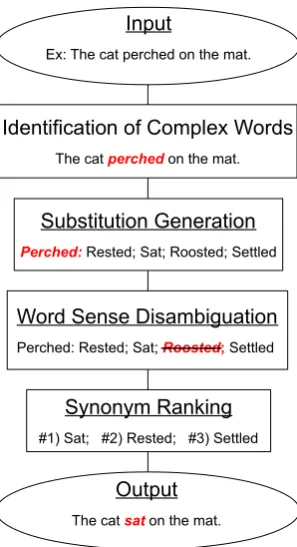
Figure 1: The lexical simplification pipeline. In the worked example the word ‘perched’ is transformed to sat. ‘Roosted’ is eliminated during the word sense disambigua-tion step as this does not apply properly in the context of ‘cat’.
strange sounding text (Pearce, 2001) and to change a text’s meaning (Lal and R¨uger, 2002).
A typical lexical simplification system follows the pipeline shown in Figure 1. The worked example shows how a sam-ple input sentence may be processed by the lexical sim-plification pipeline. This is heavily influenced by Devlin’s simplifier, the main addition being the word sense disam-biguation step. Although other simplification systems may not have explicitly followed the pipeline shown in Figure 1, most efforts can be shown to fall under this framework. The tasks of complex word identification and synonym ranking are highly similar as they both need a definition of lexical complexity. Complex word identification has been performed for technical medical language (Elhadad and Su-taria, 2007), with the aim of discovering which words are problematic for patients, however most lexical simplifica-tion systems only perform rudimentary identificasimplifica-tion. The two most prevalent techniques are either simplifying ev-erything (Devlin and Tait, 1998; Thomas and Anderson, 2012) and seeing which operations are successful, or im-plementing a threshold over some lexical complexity value (Biran et al., 2011; Zeng et al., 2005) (such as word fquency). Ranking has seen renewed interest since the re-cent SemEval-2012 task 1 on lexical simplification (Spe-cia et al., 2012), which asked participants to rank sets of synonyms according to their complexity in a given con-text. The winning system (Jauhar and Specia, 2012) incor-porated the Google-Web1T frequencies (Brants and Franz,
2006) with a number of lexical and syntactic features using a support vector machine for classification. More recent work using the same data from the SemEval-2012 task 1 has focussed on the composition of the corpus from which the word frequencies are derived (Kauchak, 2013). It was possible to show that using frequencies from a simple cor-pus was better for synonym ranking than frequencies from a more complicated corpus.
Substitution generation has received very little attention for lexical simplification. English language systems typically use WordNet, whereas non-English language systems use some other comprehensive thesaurus. The Spanish lan-guage Simplext project (Saggion et al., 2011) recently pro-duced a paper comparing thesaurus modules for their lex-ical simplification system (Saggion et al., 2013). The lack of substitution generation research is contrasted by a large amount of work towards reducing errors due to word sense disambiguation. Notable attempts have employed language models (De Belder et al., 2010), distributional semantics (Biran et al., 2011; Bott et al., 2012) and WordNet based classification (Thomas and Anderson, 2012).
3. Experimental Design
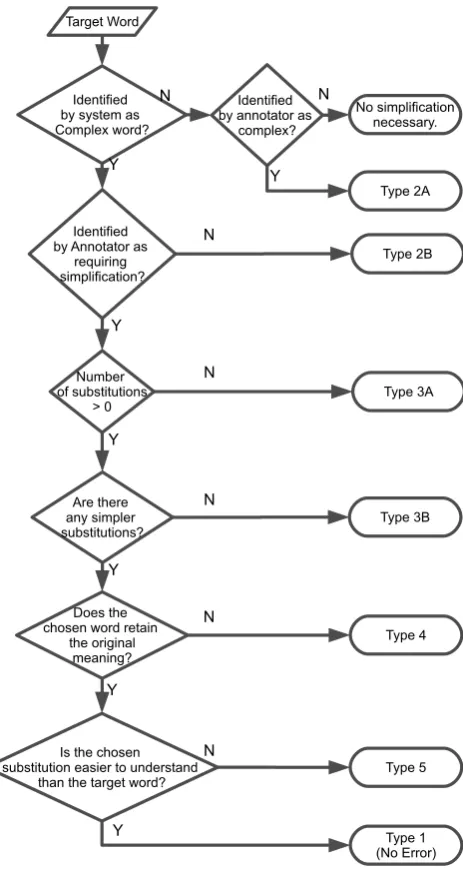
To investigate the types of errors prevalent in the lexical simplification pipeline, we built a simplification system similar to that described by Devlin and Tait (1998). As no standard system for lexical simplification exists, we chose not to apply any of the optimisations which have been pro-posed for Devlin’s simplifier. A corpus was created from the introductory lines of 115 news articles across varying topics. The original PSET project was designed for use with news text and we found the vocabulary in our corpus to be a suitable mix of linguistic difficulty. The system sim-plified each sentence in the corpus. To aid in the annotation process, the system printed a verbose transcript of each sim-plification operation. An annotation workflow, shown in Figure 2 was used to reduce subjectivity during the annota-tion. The simplifications were recorded and cross validated to ensure that categories were consistent. To further ensure consistency and reproducibility, we make all the raw data available via the LRE map.
3.1. Simplification System
The simplification system used in this research follows the structure shown in Figure 1. Below, we detail the design decisions taken for each step in the pipeline.
Complex Word Identification A threshold determined whether a word would require simplification. Every word with a Kuˇcera-Francis frequency (Kuˇcera and Francis, 1967) below five was considered for simpli-fication. We chose to omit capitalised words as these generally denote named entities.
Substitution Generation WordNet was used for substitu-tion generasubstitu-tion. All wordforms from all the synsets associated with the target were conflated to give a list of candidates for substitution.
0 20 40 60 80 100 120 140
Type 1 Type 2 Type 3 Type 4 Type 5
Number of Errors
Error Code 2B
3B
2A
3A
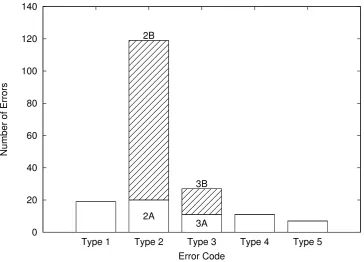
Figure 3: The distribution of errors between categories. N.B. The most common error is type 2, which is the first stage of the pipeline. Errors at later stages may be partially masked.
Description Error Code Amount
No error Type 1 19
Word not identified as complex Type 2A 20
Word incorrectly identified as complex Type 2B 99
No substitutions found Type 3A 11
No simpler substitutions found Type 3B 16
Substitution changes word sense Type 4 11
Substitution does not simplify Type 5 7
Table 1: The raw error data, showing the number of errors assigned to each type. In total, 183 simplification operations were identified. 164 of these resulted in some form of error.
the transcript of the simplification system and a separate document to record their annotation. They were briefed on the task and shown examples of the annotations they would be making. Inter-annotator agreement was calculated us-ing Fleiss’ kappa (Fleiss, 1971), which is an extension of Cohen’s kappa (Cohen, 1968) to more than two annota-tors. The kappa agreement of the annotators was 0.3556 (p < 0.0001). This indicates a moderate agreement be-tween the annotators with the chance of this result occur-ring by random being insignificant. Although 0.3556 may seem low (1 is a total agreement, 0 is no agreement) this is not necessarily the case. Kappa agreement is strongly af-fected by the number of categories from which an annotator may choose. The annotators in this scheme had seven very distinct categories (one for each error type) to choose from and this will have contributed to the reduced kappa. Al-though the agreement could be improved by reducing the number of choices available to the annotators, this would reduce the descriptive power of the error categorisations.
5. Discussion
0 % 10 % 20 % 30 % 40 % 50 % 60 % 70 %
Type 2 Type 3 Type 4 Type 5
Error Frequency
Error Code 65.03%
42.19%
29.73%
26.92%
Figure 4: The percentage of errors occurring at each stage of the pipeline. A lower proportion of errors occur at each stage.
16.81%
83.19%
Type 2A Type 2B
(a) Type 2A vs. Type 2B
40.74%
59.26%
Type 3A Type 3B
(b) Type 3A vs. Type 3B
Figure 5: The sub distributions for type 2 and 3 errors.
easily understandable. Using a more comprehensive dictio-nary or some compound word splitting may have aided in this task.
Overall, a stronger notion of lexical complexity is required. The Kuˇcera-Francis frequencies are an old resource and newer resources now exist which take their counts from
much larger corpora (Brysbaert and New, 2009; Brants and Franz, 2006). These may provide a more accurate notion of lexical complexity. Recently, work has used larger re-sources (Jauhar and Specia, 2012). To identify complex words, lexical simplification systems typically use either a thresholding approach, similar to that taken here (Zeng-Treitler et al., 2008; Elhadad, 2006), or a machine learning approach (Zeng et al., 2005). Very little work has taken place to recognise multi-word expressions for lexical sim-plification. This may be most manageable when simplifica-tion is required for specific domains.
The next most frequent error is type 3, those caused by a failure at the substitution generation stage. It may be intu-itive to believe that the main failure would be that complex (and hence infrequent) words are not found in WordNet and hence have no valid substitutions (Error 3A). However, the results in Figure 5b indicate that Error 3B (the case of sub-stitutions being generated, but none being sufficient to sim-plify the original word) is more frequent. This shows that as well as improving the scope of resources, it is also im-portant to directly generate simpler synonyms for complex words. This has been previously explored with limited suc-cess (Yatskar et al., 2010; Biran et al., 2011).
dra Maria Alu´ısio. 2009. Facilita: reading assistance for low-literacy readers. In Proceedings of the 27th ACM international conference on Design of communication, SIGDOC ’09, pages 29–36, New York, NY, USA. ACM. Mark Yatskar, Bo Pang, Cristian Danescu-Niculescu-Mizil, and Lillian Lee. 2010. For the sake of simplicity: Unsupervised extraction of lexical simplifications from Wikipedia. In Human Language Technologies: The 2010 Annual Conference of the North American Chapter of the Association for Computational Linguistics, HLT ’10, pages 365–368, Stroudsburg, PA, USA. Association for Computational Linguistics.
Qing Zeng, Eunjung Kim, Jon Crowell, and Tony Tse. 2005. A text corpora-based estimation of the familiar-ity of health terminology. In Jos´e Lu´ıs Oliveira, V´ıctor Maojo, Fernando Mart´ın-S´anchez, and Ant´onio Sousa Pereira, editors, Biological and Medical Data Analy-sis, volume 3745 ofLecture Notes in Computer Science, pages 184–192. Springer Berlin Heidelberg.