CSEIT1726159 | Received : 20 Nov 2017 | Accepted : 12 Dec 2017 | November-December-2017 [(2)6: 709-714]
International Journal of Scientific Research in Computer Science, Engineering and Information Technology © 2017 IJSRCSEIT | Volume 2 | Issue 6 | ISSN : 2456-3307
709
Performance Analysis for Joint Scheduling in Cloud Computing
towards Energy Enhancement
Dr. K. Kavitha
Assistant Professor, Department of Computer Science, Mother Teresa Women’s University, Kodaikanal, Tamil Nadu, India
ABSTRACT
Multi-tenant disseminated Simulation environment services offers progressive product advancement in Cloud computing. Joint Scheduling and Computation is a mandate mechanism for enhancing the performance in Cloud environment. The basic prototype of the two resource augmentation environments is to provide computation resources to user systems. Thus, the method of offloading a task onto the local private cloud involves only the energy consumption at the time of transferring data. On the other hand, offloading onto the public clouds involves: incurring energy consumption and monetary cost. This approach adds the service tenants to matched virtual machines and allocates the virtual machines to physical host machines using a best-fit heuristic approach. The Performance analysis determines the effectiveness of best-fit heuristic approach by allocating virtual machines to hosts by utilizing their capacity.
Keywords : Joint scheduling and computation offloading, Multi-tenant distributed simulation environment, Resource augmentation environments, Virtual machines.
I.
INTRODUCTION
Advancements in computing hardware and communication technologies have enabled user systems to support resource intensive applications. The resource constraints are essential to their size and weight create restrictions and most of the time the desired performance is not properly achieved, and their battery gets drained faster when compared to normal usage in existing works[1].Hence ,the proposed work, centralized broker node is utilized to accomplish task scheduling with large number of user systems. The proposed model with various constraints is projected for the centralized task scheduling problem. The model is evaluated in a large Cyber Foraging System (CFS) [2]and in User Cloud Computing (MCC) environments. The model delivers optimal solutions for the task scheduling problem by diminishing the total energy consumption across all user systems in the system. This paper focuses on user cloud computing which is an emerging research topic in the field of computing. In a user cloud computing environment, centralized broker node architecture is proposed in previous work for the resource augmentation of a large number of user
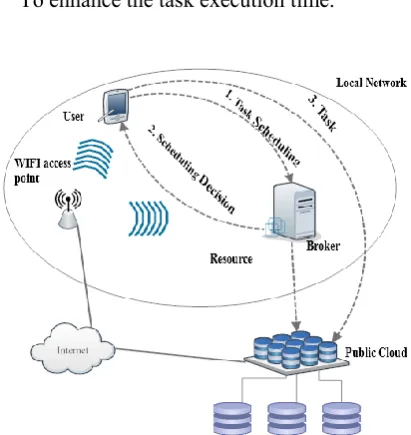
systems. Though, the model proposed in this work as shown in Fig 1 extends the optimization process by including an economic element to it. Indeed, offloading decisions are based on energy consumption, monetary cost, or a combination of the two. Thus, a vitality and economic cost-aware accurate task scheduler exemplary is intended for the integrated task programming problem. This model extends the previous energy aware task scheduler model by considering the minimization of total monetary cost as well as the total energy consumption across a large number of user systems. The model presented in this paper is enhanced to make it more realistic. Instead of limiting the number of tasks which is offloaded per user system, proposed work extended the model to allow user systems to simultaneously offload multiple responsibilities to the cloud.
Advantages
• When offloading a task, the user system may have various offloading goals set by the user, that includes:
a. To save energy on the user system,
b. To reduce the monetary cost of consuming calculation properties and
c. To enhance the task execution time.
Figure 1. System Architecture
The remaining section of this paper is organized as follows: Section II reviews some of the existing works related resource augmentation through task offloading .Section III illustrates the comprehensive representation of the entire proposed methodology. Section IV presents the performance analysis of the proposed technique. At last, this paper is well-concluded in Section V.
II.
Related Work
This section presents some of the existing works related to resource augmentation by task offloading from a single user system onto a server. Nir, et al. [3]offered an innovative research directing the space of Cyber Foraging (CF) which permits the user systems to offload substantial computations to resourceful computing nodes. They minimized the total energy consumption as well as used a centralized architecture handling the task scheduling. This model focused the optimization methodology by adding an economic element into it. Zhang, et al. [4]provided the characterization of both workload and machine heterogeneity to compute clusters. A heterogeneity-aware outline was outlined to regulate numeral machines with a stability between energy savings and
scheduling delay by seeing reconfiguration cost.Vallina-Rodriguez and Crowcroft [5] motivated the need for energy aware support in mobile operating systems and utilized collaborative mechanisms for sharing resources using low-power wireless connectivity. This approach lead to access control policies, security mechanism, privacy and possibly incentive schemes.
Zhou and He [13]formulated the distinct workflow transformation based optimization framework to design the performance cost and cloud offerings. A cost model guided planner is developed to effectively find the suitable transformation sequence for the given performance and cost goal. They also computed the framework by using real-world scientific flow applications and compare the state of art scheduling workflow applications. The chief contributions of this work are scheduled as below:
A transformation based workflow optimization methodology to address the performance and monetary cost optimizations.
To deploy the workflow optimization system in real cloud environments to promote the effectiveness with extensive experimentations.
A general optimization engine for minimizing the monetary cost of running workflows in cloud.
They extended their mathematical model based on the following assumptions and notations:
Assumptions
Notation signifying the cost parameters, constraints parameters, Decision variables
Cost function
Models.
Xia, et al. [10]demonstrated an energy efficient mobile cloud computing system named Phone2cloud which deserves as a calculation of offloading paradigm. The main intention is to improve the performance in the user experience and effectiveness of the smartphone by enhancing the application’s performance reduced the execution time.Phone2 cloud consists of several key components which are listed as follows:
Bandwidth monitor
Resource monitor
An execution time predictor
An offloading decision engine
A resident implementation manager
A far-off accomplishment manager
An offloading representation
Zhu, et al. [11]interpreted the dynamism conscious forecast for self-governing, a episodic real-time responsibilities in virtualized clouds. In order to achieve the objectives, a rolling-horizon scheduling architecture is suggested to analyze the system schedulability. A novel energy-aware scheduling algorithm named EARH for real time tasks were addressed to improve the energy aware scheduling. Beloglazov, et al. [12]recommended an energy effective calculation for the architectural values for operative supervision of clouds and quantity of open research challenges. This work aimed to fulfil the following criterions:
Outline an architectural framework suggesting the energy efficient cloud computing.
Explore the dynamism responsive source for provision and division of datacenter possessions.
Develop autonomic and energy aware mechanisms to manage the state of resources effectively in the service obligations.
Determine exposed pursuit experiments in dynamism effective source organization for virtualized cloud data centres.
Kosta, et al. [9] evaluated the range of benchmarks from simple micro-benchmarks to more complex applications. They showed a parallelizable application which invoked the multiple VMs to create a cloud and on-demand manner having greater reduction and execution time. They also used a memory-hungry image combiner tool to signify the computational power to meet the computational requirements. They designed based on the four key design objectives.
Vibrant alteration to fluctuating environment
Simplicity usage for developers
Performance upgrading from end to end cloud computing
Active mounting of computations
Mao and Humphrey [14]deliberated two innovative auto scaling resolutions to decline the job turnaround period within modest restraints for cloud workflows. The scheduling algorithm distributed the application-wide budget to every individual job to acquire cloud resources.Kim, et al. [15] suggested a model for estimating the energy consumption by computing the energy level consumption without any dedicated measurement devices. These working issues targets to build a holistic energy-aware resource provisioning scheme for cloud systems.
III.
Proposed Method
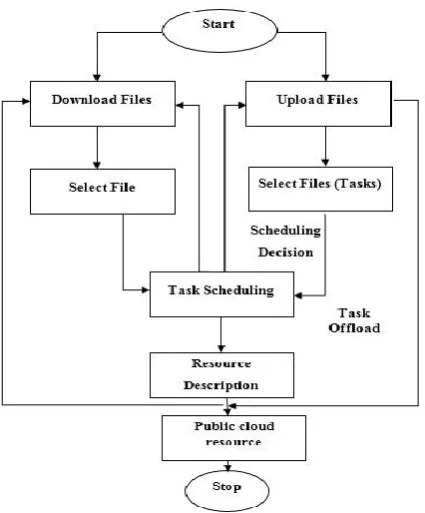
This section presents the detailed description of proposed task scheduler model for the two RAEs. The overall process of the proposed system is shown in Figure 2, which includes the following stages:
Upload Files
Download Files
Task Scheduling
Private Cloud Resource
Public Cloud Resource
Figure 2. Overall flow of the Proposed System
IV.
Performance Analysis
This section illustrates the performance analysis of the suggestedjoint scheduling and computation offloading (JSCO) for multi-component solicitation. The results are analyzed and evaluated in terms of
Downloading speed
Security Performance
Scheduling time with respect to resources
Scheduling time with respect to dataset size
Moreover, the proposed joint scheduling and computation offloading (JSCO) is compared with the existing techniques for proving the better performance of the proposed system. From this analysis, it is proved that the proposed work gives the best results.
A. Downloading speed
Download speed is defined as the rate at which data is transferred from the cloud to the user’s computer.From the Figure 3, it is well known that x –axis represents the data and y-axis denotes the time taken in milliseconds.
Figure 3. Downloading speed
The proposed system is less when compared with other technique. Offloading process signifies high speed by showing 78% and normal download shows 50 %. Especially, at maximum level, proposed work exhibits high speed rate with 35.89% improvement.
B. Security Performance
The objective of security to forecast the efficiency of data protection for each case in the data. The low level of security leads to low level of performance as the performance influences the security on the part of service provider. From this, it is known that better security provides better performance.
Figure 4. Security Performance
C. Scheduling with respect to Data size
From the Figure 5, it is well known that x –axis represents the data with and without offloading and y-axis denotes the dataset size. The proposed system offers high file size and instantly produces the results.
Figure 5. Scheduling time based on dataset size
For the cloud process without scheduling, data size capacity without scheduling lies at 60.But in the application of optimal scheduling with offloading improves the dataset size to 80.Hence,the proposed work exhibits maximum dataset size with 25 % improvement.
D. Scheduling with respect to resource
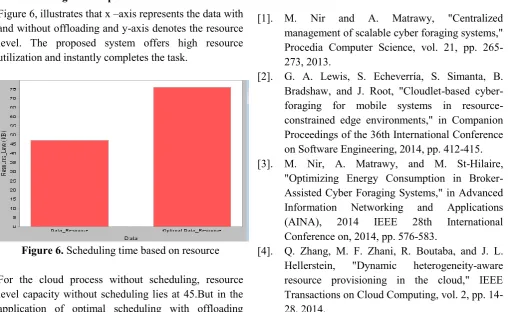
Figure 6, illustrates that x –axis represents the data with and without offloading and y-axis denotes the resource level. The proposed system offers high resource utilization and instantly completes the task.
Figure 6. Scheduling time based on resource
For the cloud process without scheduling, resource level capacity without scheduling lies at 45.But in the application of optimal scheduling with offloading improves there source level capacity to 75.Hence,the
proposed work exhibits maximum resource utilization level with 40 % improvement.
V.
Conclusion and Future Work
This paper proposed a centralized broker-node based architecture was used to handle the task scheduling and a general mathematical model for centralized task scheduling problem. The ultimate aim of this paper is to minimize the total energy consumption and total monetary cost across all the user systems. The model is computed under tow distinct resource augmentation environments for MCC, local private cloud and public clouds. The task scheduler model provided an optimal solution for task assignment, minimal energy consumption level which is evaluated in private cloud environment and public cloud environment. The results showed that the total energy consumption and total monetary cost across all user systems when offloading with optimization is less than the offloading without optimization using centralized task scheduler. Therefore, the future work attempts to develop a scheduler model to consider network congestion, task priority and task execution redundancy while scheduling task offloading.
VI.
REFERENCES
[1]. M. Nir and A. Matrawy, "Centralized management of scalable cyber foraging systems," Procedia Computer Science, vol. 21, pp. 265-273, 2013.
[2]. G. A. Lewis, S. Echeverría, S. Simanta, B. Bradshaw, and J. Root, "Cloudlet-based cyber-foraging for mobile systems in resource-constrained edge environments," in Companion Proceedings of the 36th International Conference on Software Engineering, 2014, pp. 412-415. [3]. M. Nir, A. Matrawy, and M. St-Hilaire,
"Optimizing Energy Consumption in Broker-Assisted Cyber Foraging Systems," in Advanced Information Networking and Applications (AINA), 2014 IEEE 28th International Conference on, 2014, pp. 576-583.
[5]. N. Vallina-Rodriguez and J. Crowcroft, "Energy management techniques in modern mobile handsets," IEEE Communications Surveys & Tutorials, vol. 15, pp. 179-198, 2013.
[6]. S. E. Mahmoodi, K. Subbalakshmi, and V. Sagar, "Cloud offloading for multi-radio enabled mobile devices," in Communications (ICC), 2015 IEEE International Conference on, 2015, pp. 5473-5478.
[7]. H. Wu, Q. Wang, and K. Wolter, "Tradeoff between performance improvement and energy saving in mobile cloud offloading systems," in Communications Workshops (ICC), 2013 IEEE International Conference on, 2013, pp. 728-732. [8]. M. Nir, A. Matrawy, and M. St-Hilaire, "An
energy optimizing scheduler for mobile cloud computing environments," in ComputerCommunications Workshops (INFOCOM WKSHPS), 2014 IEEE Conference on, 2014, pp. 404-409.
[9]. S. Kosta, A. Aucinas, P. Hui, R. Mortier, and X. Zhang, "Thinkair: Dynamic resource allocation and parallel execution in the cloud for mobile code offloading," in Infocom, 2012 Proceedings IEEE, 2012, pp. 945-953.
[10]. F. Xia, F. Ding, J. Li, X. Kong, L. T. Yang, and J. Ma, "Phone2Cloud: Exploiting computation offloading for energy saving on smartphones in mobile cloud computing," Information Systems Frontiers, vol. 16, pp. 95-111, 2014.
[11]. X. Zhu, L. T. Yang, H. Chen, J. Wang, S. Yin, and X. Liu, "Real-time tasks oriented energy-aware scheduling in virtualized clouds," IEEE Transactions on Cloud Computing, vol. 2, pp. 168-180, 2014.
[12]. A. Beloglazov, J. Abawajy, and R. Buyya, "Energy-aware resource allocation heuristics for efficient management of data centers for cloud computing," Future generation computer systems, vol. 28, pp. 755-768, 2012.
[13]. A. C. Zhou and B. He, "Transformation-based monetary costoptimizations for workflows in the cloud," IEEE Transactions on Cloud Computing, vol. 2, pp. 85-98, 2014.
[14]. M. Mao and M. Humphrey, "Scaling and scheduling to maximize application performance within budget constraints in cloud workflows," in Parallel & Distributed Processing (IPDPS), 2013 IEEE 27th International Symposium on, 2013, pp. 67-78.