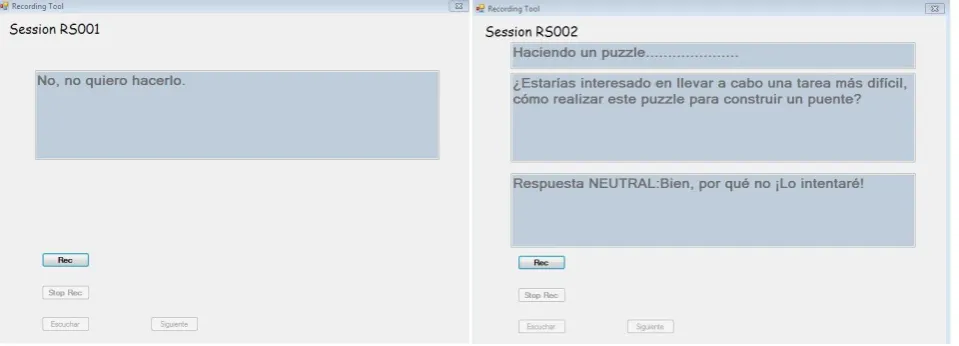
Figure 1: Graphical User Interface for recording sessions RS001 and RS002
2.
Objectives
The main objective of the PlayMancer project (Jiménez-Murcia et al., 2009) is to research and develop a purposely-designed platform, which will facilitate the development of serious games. The PlayMancer platform architecture integrates various existing or newly developed components, such as a game engine, a spoken interaction interface (speech recognition, understanding and synthesis), affect-emotion recognition components (speech-based, facial, biosignal-based), a motion tracking system and a specialized graphical user interface (GUI) for therapists (Kocsis et al, 2009). Two use cases, related to development of serious games in support of the physical rehabilitation of patients, and in support of treatment of patients with behavioural and addictive disorders are meant to validate the usefulness of the developed technological framework.
The PlayMancer video-game to be adopted for chronic mental disorders (mainly eating disorders and behavioural addictions) treatment, introduces the player to an interactive scenario where the final goal is to increase his general problem solving strategies, self-control skills and control over general impulsive behaviours. After using the game, specific targeted attitudinal, emotional and behavioural changes are expected by the subject. Each task will permit access to one or several types of resources which will facilitate and improve the game character’s, and hence the player’s, relaxation techniques and planning skills. The game will encourage the player to learn and develop new confrontation strategies.
3.
Methodology
Successful modelling of the affective states defined by the PlayMancer user requirements imposes sufficient data to be collected. For this purpose a pilot trial was conducted. It included three different data collection sessions: The first recording session (RS001) targeted
collection of spoken audio database for the domain adaptation of the acoustic and language models for Spanish speech recognizer.
The second recording session (RS002) targeted
collection of spoken audio data for (a) acted emotion for Spanish language, and (b) acoustic model for Spanish speech recognizer.
The third recording session (RS003) targeted collection of spoken audio data, video and physiological data (Pulse Rate and SpO2) for naturally expressed emotion for Spanish language. During the first and the second recording sessions the participants uttered prompts presented to them through the graphical user interface (GUI) seen in Figure 1. The GUI consists of textboxes displaying the content to be uttered and four buttons – two for start and stop of the recording process, one for listening/validating the recording completed, and finally one for proceeding to the next recording/saving the finished capture. All recording sessions took place in a room of 12 square meters with low reverberation properties.
During the first recording session, no interaction scenarios were envisaged. The content of the prompted utterances was related to the vocabulary expected within the user’s scenarios, according to current specifications of the PlayMancer game.
In the second recording session, the participant answered spontaneously to scenario-specific questions provided, by acting upon requested emotions (anger, boredom, joy, neutral, sadness, and surprise). For each scenario, suggested answers were presented; though each participant was encouraged to use her/his own words/expressions to answer (Figure 1).
In the third recording session, the participants were asked to interact with three video games (Global Conflict: Latin America, Dragon´s Lair 3D: Return to the Lair, and Trackmania Nations Forever). Each participant was playing for 20 minutes, and the different types of videogames were assigned in a balanced form (Latin Square).
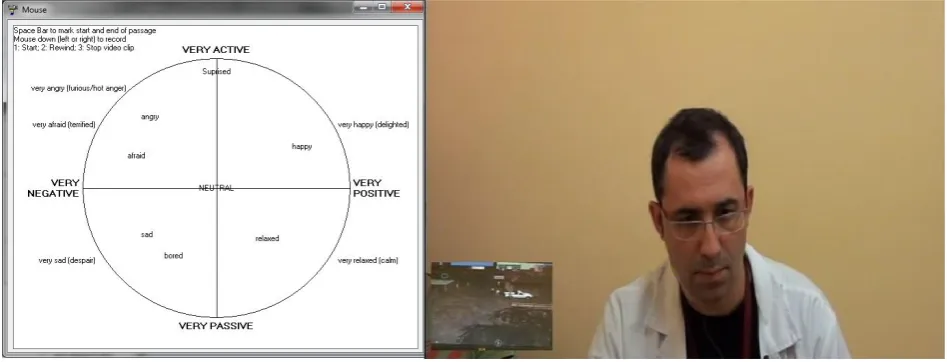
Figure 2: FeelTrace with customized emotion circle and example caption of video annotation material
4.
Recordings
Volunteered psychiatric-healthy subjects participated in this study. The Ethics Committee of the University Hospital of Bellvitge (Barcelona, Spain) approved this study and informed consent was obtained from all participants.
The collected data consist of recordings from 18 people: eight males and ten females. The age and gender distribution of the test subjects are shown in Table 1. The age reported by the test subjects was in the range between 18 and 43 years old, with mean value of 29.3.
Table 1: Distribution of participants over age groups and genders
Age Males Females Total %
18-30 5 6 11 61.11
31-45 3 4 7 38.89
Total 8 10 18 100
The number of the test subjects with respect to their region of origin and gender is shown in Table 2.
Table 2: Number of the participants with respect to their region of origin and gender.
Region Males Females Total %
Catalonia 7 7 14 77.80
Sweden 0 1 1 5.55
Valencia 1 0 1 5.55
Argentina 0 1 1 5.55
Italy 0 1 1 5.55
Total 8 10 18 100
For all the recording sessions, the speech signal was captured using a conventional lapel microphone with sampling rate of 44.1 kHz, single channel, resolution 16 bits. All audio files were stored in .WAV format. The camera recordings consist of both audio and video captures saved in MPEG-2 format, with a Sony HDR-XR520VE video camera in a 720 x 576 resolution.
The peripheral signals pulse-rate and oxygen saturation recorded from the test subjects were captured using the commercial device Mobi5 and transferred to a computer by the PortiLab software1. The bio-signals were saved as PortiLab binary format and converted to tab-separated files.
Realization of RS001 and RS002 resulted in total duration of speech recordings of approximately 2 and 4 minutes (84 and 132 items) collected per session, respectively. In RS003, approximately 60 minutes of audio-video and bio-signals were captured per session.
Consequently, the total duration of speech recordings collected during the first two recording sessions equals to approximately 110 minutes (3888 items). Further, the total duration of audio-video and bio-signal data collected is approximately 18 hours.
5.
Annotation
The subjects were asked to self annotate their own affective states based on three types of information that were recorded during the game sessions, using the software FeelTrace (Cowie et al, 2001): The game screen when the subject was playing, her/his facial expressions recorded by camera at the time of playing and the vocals recorded by the microphone (please refer to Figure 2).
FeelTrace is an emotion annotation software based on a two-dimensional emotion model, containing emotion labels positioned by the dimensions activation and evaluation. This software has been chosen among other annotation tools because of its convenient interface and ease of use.
The annotation is conducted by continuously moving the mouse pressed around the circle. For the needs of PlayMancer project, we created a partially customized circle including:
the emotions anger (angry), boredom (bored), joy (happy), neutral, sadness (sad), and surprise (surprised)
high intensities of the emotions anger and sadness.
1
PlayMancer: A European Serious Gaming 3D Environment. URL: http://www.playmancer.eu
Russoniello, C.V., O'Brien, K., Parks, J.M. (2009) EEG, HRV and Psychological Correlates while Playing Bejeweled II: A Randomized Controlled Study. Stud. Health Technol. Inform. 144, pp. 189--192.
Saitz, R., Helmuth, E.D., Aromaa, S.E., Guard, A., Belanger, M., Rosenbloom, D.L. (2004). Web-based screening and brief intervention for the spectrum of alcohol problems. Prev. Med. 39(5), pp. 969--975. Schott, G., Hodgetts. D. (2006). Health and Digital
Gaming, The Benefits of a Community of Practice. J. Health. Psychol., 11(2), pp. 309--316.
Squire, K., (2003). Video games in education.
International Journal of Intelligent Simulations and Gaming (2)1 n.p.
Wagner, J., Kim, J., Andre, E. (2005). From physiological signals to emotions: Implementing and comparing selected methods for feature extraction and classification. In Int. Conf. on Multimedia & Expo (ICME 2005), pp. 940--943.