Mining Parallel Text from the Web based on Sentence Alignment
*Bo Li, Juan Liu and Huili Zhu
School of Computer Science, Wuhan University Wuhan, 430072, China
[email protected], [email protected]
Abstract. The parallel corpus is an important resource in the research field of data-driven natural language processing, but there are only a few parallel corpora publicly available nowadays, mostly due to the high labor force needed to construct this kind of resource. A novel strategy is brought out to automatically fetch parallel text from the web in this paper, which may help to solve the problem of the lack of parallel corpora with high quality. The system we develop first downloads the web pages from certain hosts. Then candidate parallel page pairs are prepared from the page set based on the outer features of the web pages. The candidate page pairs are evaluated in the last step in which the sentences in the candidate web page pairs are extracted and aligned first, and then the similarity of the two web pages is evaluate based on the similarities of the aligned sentences. The experiments towards a multilingual web site show the satisfactory performance of the system.
Keywords: Parallel Corpus, Web Mining, Sentence Alignment, Information Extraction
1.
Introduction
Data-driven methods take a more important place in the research field of natural language processing nowadays, which calls an urgent need for enough parallel corpora with high quality. Parallel corpora made up with text in parallel translation are the foundational resource in data-driven natural language processing, which has a direct impact on the effectiveness of this kind of technologies such as statistical machine translation (Brown et al., 1990), cross-lingual information retrieval (Davis and Dunning, 1995; Landauer and Littman, 1990; Oard, 1997) and automatic lexical acquisition (Gale and Church, 1991b; Melamed, 1997). But it is disappointed that there are only a few parallel corpora publicly available today and most of them are small in size, specializing in narrow areas or out-of-date. It will cost too much time and human labor to construct parallel corpora with big scale and high quality, which constraints the increase of parallel corpora. The rapid development of the Internet and the intense intercourse between countries gives hope that we can construct parallel corpora automatically from the web. Through the rough observation, it is found that there are many web sites containing web pages in parallel translation. Based on the above considerations, we present a novel tool called Parallel Web Corpus Construction system (PWCC) to mine parallel corpora automatically from the web, which may help to facilitate the construction of parallel corpora with much less cost.
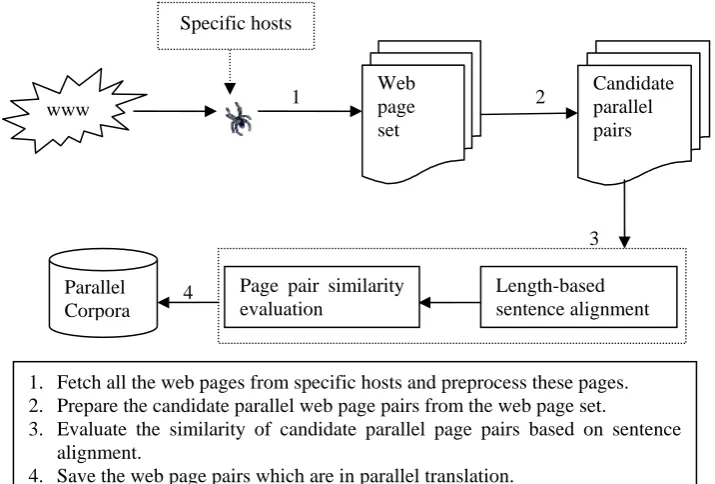
The PWCC system uses a four-step process to fetch parallel corpora from the web. In the first step, a tool called web spider is employed to fetch all the web pages from specific hosts which
*
The work was finished while the first author visited Wuhan Office of Comet Electronics Hong Kong.
which is also the most important module of PWCC. In this step, the text from the candidate web page pairs is aligned at sentence level first based on the length correlation criterion, and then the similarity of the web pages is measured by combination of the similarities of the sentences that have been aligned. The truly parallel web pages are saved at last.
3.
The Candidate Pair Preparation Module
Having been fetched from the web, the web page set consisting both Chinese web pages and English web pages is paired up. Each page is made up of one page from the Chinese page set and one from the English page set. It is important to pair them efficiently and effectively. The number of all the web pages is rather large, so it not only can save much time and RAM space to pair the pages up but also can save a great deal of time for the candidate parallel page pair evaluating step by effective pairing. Moreover, the candidate parallel page pair evaluation step can produce high recall and high precision at a higher probability given the candidate page pairs which are more parallel. There are about two types of methods to pair the web pages up in previous work. One is to pair web pages according to the similarity of the URLs and other features and the other is to simply treat each page from the Chinese page set and each page from the English page set as a candidate pair. It is clear that if the web page set is large, it may be inappropriate to adopt the latter idea because it will produce too many pairs for the evaluation step to process. For the former idea, previous work mostly utilizes the concept of similarity of
character strings. They first detect the patterns indicating the language version such as e, eng
and english in the URL string according to a pattern list and then use classic algorithms such as the minimal edit distance algorithm to measure the similarity of the two URLs. One notable drawback of the existed strategies is that they seldom consider for the deep characters of the URLs and simply treat them as strings. We design a novel candidate page pair preparation algorithm for the problem, which is more powerful than the methods in previous work, and meanwhile its time complexity is considerably low. The algorithm is based on the following assumptions:
Assumption 1: Parallel web pages have the most common paths and similar dictionary depths.
Assumption 2: Parallel web pages have similar file size.
Assumption 3: Parallel web pages have similar anchor texts.
In Assumption 1, the common paths mean the common dictionaries the URLs of two web pages
share, and the directory depth is the layer where the web page lies. For example, we consider
two web pages:
Chinese web page P1 URL: http://www.fmprc.gov.cn/chn/wjdt/zyjh/t263606.htm
English web page P2 URL: http://www.fmprc.gov.cn/eng/wjdt/zyjh/t264261.htm
The number of common paths between page P1 and page P2 is 2 which are the directories wjdt
and zyjh, and the difference of directory depths between page P1 and page P2 is 0, because the
directory depth of page P1 is 4 and that of page P2 is 4 too. In Assumption 2, the file size is the size of the pure HTML file not including files such as images and audios embedded in the web
page. In Assumption 3, the anchor text is the text shown at a hyper link, which usually gives the
user relevant descriptive or contextual information about the content of the link’s destination. Based on the above assumptions, the strategy we use in the PWCC system is as follows:
For each page C in the Chinese page set C-set, we find the pages in the English page set E-set
which can most probably constitute candidate pairs with the page C. We select first according to
the common paths measure. The English pages Es which have the most common paths with the
page C are selected first. Then the English pages Es are filtered by the directory depth criterion.
For convenience, the directory depth difference between web page A and B is denoted as DD(A,
B) and it is clear than DD(A, B)=DD(B, A). The directory depth filter step is as follow: if two
pages E1 and E2 in Es have different directory depth differences with the page C and we
suppose DD(E1, C)>DD(E2, C), we delete E1 from Es. At last, we filter Es based on the file
considers nonparallel and the page pairs which are actually nonparallel but PWCC considers parallel, we find that most of these pages contain many sentences with similar length, which always brings some problems to the length-based sentence alignment module. But fortunately this kind of web pages only occupy a very small proportion of the whole page set, and will not significantly influence the performance of the system.
6.
Conclusion
The PWCC system designed to fetch parallel text from the web is introduced in this paper. The system first uses the web spider to fetch all the web pages from some hosts given by the user, and then candidate parallel web page pairs are prepared by the candidate pair preparation module based on features such as URL and file size. In the last step, candidate parallel web page pairs are evaluated by the sentence alignment-based strategy. We design novel strategies for the second and the third steps, which are then proved to be rather efficient by the experiments. The PWCC system is useful and reliable for automatically constructing parallel corpora from the web.
References
Brown, P. F., J. Cocke, S. D. Pietra, V. J. D. Pietra, F. Jelinek, J. D. Lafferty, et al. 1990. A
Statistical Approach to Machine Translation. Computational Linguistics, 16(2), 79-85.
Davis, M. and T. Dunning. 1995. A TREC evaluation of query translation methods for
multi-lingual text retrieval. Proceedings ofThe 4th Text Retrieval Conference (TREC).
Gale, W. A. and K. W. Church. 1991a. A program for aligning sentences in bilingual corpora.
Proceedings of The 29th Annual Meeting of the ACL, Berkeley, CA
Gale, W. A. and K. W. Church. 1991b. Identifying word correspondences in parallel texts.
Proceedings ofThe 4th DARPA Workshop on Speech and Natural Language.
Landauer, T. K. and M. L. Littman. 1990. Fully automatic cross-language document retrieval
using latent semantic indexing. Proceedings of The 6th Annual Conference of the UW
Centre for the New Oxford English Dictionary and Text Research, UW Centre for the New OED and Text Research, Waterloo, Ontario.
Melamed, I. D. 1997. Automatic discovery of non-compositional compounds in parallel data.
Proceedings of The 2nd Conference on Empirical Methods in Natural Language Processing (EMNLP-97), Brown University.
Oard, D. W. 1997. Cross-language text retrieval research in the USA. Proceedings of The 3rd
DELOS Workshop.
Wu, D. 1994. Aligning a parallel English-Chinese corpus statistically with lexical criteria.
Proceedings of The 32nd Annual Meeting of the ACL, Las Cruces, NM
Appendix A: The Algorithm for Preparing Candidate Parallel Page Pairs
for each page C in C-set
{
maxCommonPath = -1;
directoryDepthDifference = 100;
// clear the E-set object
E-set = null;
for each page E in E-set
{
// CP(E, C) is the count of common paths between page E and C
if(CP(E, C) > maxCommonPath) {
// LD(E, C) is the file length difference between page E and C // AS(E, C) is the similarity of the anchor texts of E and C
maxCommonPath = CP(E, C);
// DD(E, C) is the directory depth difference between page E and C
directoryDepthDifference = DD(E, C);
E-set = null; Add E to E-set; }
}
else if(CP(E, C) == maxCommonPath)
{
if(DD(E, C) < directoryDepthDifference) {
if(LD(E, C) < 20kB && AS(E, C) == true) {
directoryDepthDifference = DD(E, C);
E-set = null; Add E to E-set; }
}
else if(DD(E, C) == directoryDepthDifference)
{
if(LD(E, C) < 20kB && AS(E, C) == true) {
Add E to E-set; }
} } }
// each page in E-Set can constitute a candidate parallel page pair with C