THE EFFECTS OF PARENTAL READING SOCIALISATION ON THE
READING SKILL PERFORMANCE OF RURAL PRIMARY SCHOOL
STUDENTS IN SARAWAK
Humaira binti Raslie1+
Radina Mohamad Deli2
Dexter Sigan John3
Damien Mikeng4
Ambigapathy Pandian5
1,2,3,4,5Universiti Malaysia Sarawak, Malaysia.
(+ Corresponding author)
ABSTRACT
Article History Received: 21 November 2019 Revised: 30 December 2019 Accepted: 4 February 2020 Published: 16 March 2020
Keyword
s
Parental reading socialisation Home literacy
Reading skills Ideological literacy model Rural learners
English language proficiency.
Extant research on home literacy practices such as parental reading socialisation have demonstrated positive impacts on children in terms of academic performance. A particular aspect that sparks pedagogic importance is the scaffolding potential of reading at home to the learning of English language in non-native English Language contexts. This study aimed to examine the effects of mother’s involvement in home-reading sessions on students’ English home-reading skill performance in Bau, Sarawak. Prior to carrying out the intervention of reading at home with their children, 31 mothers of Bidayuh ethnicity voluntarily attended a one-day workshop to orient them to the intervention and the use of logbooks to record details of their shared readings. However, only 18 mothers conducted reading sessions with their children and submitted a total of 21 logbooks detailing the frequency and material selection for reading. Their children, consisting of primary 1 to 4 students were required to sit for a pre-test and a post-test that measure their English language reading proficiency. The test scores were analysed using the paired-sample T-test. There was a significant increase in the students’ post-test scores following the reading intervention. The results revealed that despite the low frequency of mother-child shared reading sessions, the sessions positively affected the students’ reading performance. This finding suggests that parental reading socialisation can facilitate students’ literacy development. However, the use of materials in Bidayuh as a native language as opposed to Malay or English may increase the rural parents’ participation in home-literacy activities, and encourage early literacy in children.
Contribution/ Originality:
This study contributes to existing literature by examining the effects of mother’s involvement in home-reading sessions on students’ English reading skill performance in Bau, Sarawak.1. INTRODUCTION
In Malaysia, English Language proficiency is a national agenda; consistently being addressed not only by the Ministry of Education, but also by other government agencies, the private sector and even the public. The burgeoning concern over the language is underscored by country’s dependency on the capacity of its human capital
International Journal of Asian Social Science
ISSN(e): 2224-4441 ISSN(p): 2226-5139
DOI: 10.18488/journal.1.2020.103.159.170 Vol. 10, No. 3, 159-170.
to boost the industrial sector, and elevate Malaysia from a ‘developing’ to ‘developed nation’ status by the year 2020. English Language as the lingua franca of the 21st century is the gateway to new and advanced knowledge especially in the areas of science and technology; thus making it an epicenter in the building of Malaysia’s human capital. Parallel to this mission, English Language education reforms such as Malaysia Education Blueprint 2013-2025 or MEB was implemented in 2012 (Rajaendram, 2018) followed by English Language Education Reform Roadmap for Malaysia or ERR 2015-2015 (Hazita, 2016). The former emphasises on the 90% acquisition rate of English Language literacy by the time primary school students have reached the end of year Three (nine years old). The latter is an expansion of MEB, but with the strategic focus of ensuring that Malaysian students’ proficiency achieves the global standard of CEFR or Common European Framework of Reference (Hazita, 2016). In addition to education reforms, Malaysia also introduces and reintroduces policies such as the teaching of Science and Mathematics in English (Chin., 2020) and incorporate reading programmes such as ‘Highly Immersive Programme’ (HIP) (Chin, 2019) into the teaching and learning of the English Language in schools. Evidence has shown that one of the most important factors that determines the effectiveness of a literacy programme is teacher quality (Ambigapathy & Shanthi, 2010). However, for students, particularly young learners, to learn literacy at school alone is deficient. Parental involvement in the literacy development is deemed as necessary too. Therefore, it is of utmost importance to study the effect of parental reading socialization on the reading skill performance of primary school students especially in the rural area.
2. PROBLEMATISING ENGLISH LANGUAGE LEARNING AND LITERACY IN MALAYSIA
2.1. The Physical and Financial Challenges
In tandem with the country’s development trajectories, migratory as well as urbanisation activities occur; a typical scenario inherent across all developing communities. These phenomena distinctively wedged the Malaysian social landscape into two groups of urban and rural population. The rural-urban divide leads to unequal distribution of exposure and access to the English Language itself, as well as its learning materials. In Sarawak for example, some rural areas are only accessible via helicopters, boats or on foot (Asraf, Kassim, Ahmad, & Rahman, 2013). In addition to having minimal need to use the English Language in facilitating daily interactions, the remoteness of these locations poses a challenge in transporting sufficient supplies of learning resources on a frequent basis. Similar to the Orang Asal or indigenous tribe settlements in Peninsula Malaysia (Renganathan, 2017) or the rural areas in Sabah (Gerber & Huijsmans, 2016) the most comprehensive point of reference for English Language learning at some rural areas in Sarawak are the schools and village libraries (Kaur & Jawaid, 2018). However, several external factors hinder learners from going to school or to the library, such as structural and safety constraints in the forms of unpaved roads, unbridged rivers and unmonitored lorries using the dirt roads (Kaur & Jawaid, 2018; Renganathan, 2017). Moreover, there is the financial constraint of van and lorry fees for school transportation (Gerber & Huijsmans, 2016). Besides transportation, financial constrains are also manifested in the form of school fees as well as costly learning and reading materials.
2.2. Autonomous Literacy Approach and its Constraints
For years, the English Language learning and literacy in this country have been administered autonomously with the aim of equipping the students with the necessary language tools such as grammar and vocabulary for them to achieve the highest possible marks in their English literacy tests (Che Musa, Lie, & Azman, 2012; Raslie & Keong, 2017). Under the autonomous purview, l techniques such as memorization and drilling form part of the mechanism to ensure quick acquisition of overall language literacy and accuracy (Che Musa et al., 2012; Horn, 2016; Raslie & Keong, 2017). Additionally, according to the autonomous model, a literate person refers to someone who has obtained school-learned literacy or academic/ school literacy (Horn, 2016). This approach ignores other forms of literacy developed by engaging with the realities outside the mainstream learning institutions-therefore those who do not through formal schooling are regarded as ‘illiterate’ (Horn, 2016). In the Malaysian context, although the literacy rate in Malaysia is 95% (Bernama, 2017) the system has not been able to address the steady decline in terms of English Language proficiency among Malaysians (Radhi, 2019). In the addition to the paradox, this system has not been able to cater to the literacy needs of those from non-mainstream demographics such as the rural learners (Renganathan, 2017).
According to Horn (2016) the shortcoming of the autonomous model stems from its narrow outlook on literacy. It sidelines the socio-cultural influences that exist within the breadth of the learner’s reality – namely the other forms of literacy, existing schemata and experiences. These aspects are essential because they are cognitively familiar (Horn, 2016) especially for the rural learners (Renganathan, 2017). On this premise, their presence would support the literacy acquisition of a foreign language by adding meaning and relatability to the process. In a study conducted by Renganathan (2017) on the indigenous Semai ethnic group, it is discovered that the exclusion of the Semai socio-cultural aspects in the learning materials has intensified the group’s sense of disfranchisement from the outside world. Without meaningful context, literacy, especially English Language remained irrelevant to their reality. Renganathan (2017) finding corroborated with an earlier verdict by Hazita. (2009). Focusing on the pluri-literacy practices in rural Malaysia, Hazita. (2009) observed that while vernacular languages such as Mandarin and Tamil had been naturalised into the social domain of the multicultural rural communities, English was still confined to the school literacy underpinnings.
2.3. The Ideological Approach to Literacy
Hazita (2016) in her research on the implementation and challenges of education reforms in Malaysia commended the holistic 2013-2025 direction headed by the education system, at least where English Language Learning and English Literacy (henceforth English Literacy) are concerned. With the inception of MEB as well as the ERR, English literacy is ideally obtained via balanced ecology of both school and home literacy practices; where an increased involvement of parents or guardians is added to the process. The inclusion of home literacy leverages the students’ social realities with that of the school system; and within this ideal enclave, learners would gain the ability to appropriately contextualise their usage of the English language. This positive development demonstrates the system’s perpetual recline from the autonomous approach to English Language literacy and inclination towards adapting the ideological approach. The ideological paradigm regards literacy as a social practice, hence language is best handled by participating in meaningful interactions (Street., 2017). It also situates literacy as a daily practice that influences and is influenced by the formal and social realities (Hasselbacher, 2018; Raslie & Keong, 2017). On this note, the ideological model is anchored on the balanced dynamic between school and home literacies in the sense that both
learners with their English homework (Alvarez, 2015; Perry, 2009). Ultimately, this synergy allows home and school literacies to fluidly cross domains, thus providing holistic English Language literacy experience for the learners regardless of their realities; be it urban or rural.
On a broader spectrum, this approach bridges the gaps in the education system, more specifically where the rural-urban divide is concerned (Hazita, 2016). This is because at ideological crux, literacy is extensively inclusive; hence it will be able to capture the complex tapestry of Malaysia’s multicultural urban, suburban and rural ecosystem.
2.4. The Construct of Parental Reading Socialisation (PRS)
Parental socialisation has long been attributed to impact learners’ academic performance (Boonk, Gijselaers, Ritzen, & Brand-Gruwel, 2018; Daniel, Wang, & Berthelsen, 2016). Boonk et al. (2018) in their review of parental socialisation research, identified two types of parental socialisation, which are home-based involvement and school-based involvement. The ideological model of literacy within its purview regard home-school-based involvement as home literacy transpiring in the form of parental reading socialisation Boonk et al. (2018). Thus the ideological construct of parental reading socialisation includes literacy practices namely (i) parent-facilitated literacy-based activities such as reading with children and reading out-loud sessions (Puglisi, Hulme, Hamilton, & Snowling, 2017) (ii) literacy resources available at home (Boonk et al., 2018; Kloosterman, Notten, Tolsma, & Kraaykamp, 2011; Puglisi et al., 2017) as well as (iii) parental literacy practices and choice such as parents’ reading habit and choice of reading materials (Kloosterman et al., 2011; Puglisi et al., 2017).
Extant studies have also highlighted parental reading socialisation as a powerful impetus in developing learners’ interest in reading, and eventual reading habits. Puglisi et al. (2017) pointed out that even passive influences such as parents’ literacy-orientation as well as participation in literary activities could nurture learners to be readers. Additionally, Boonk et al. (2018) and Kloosterman et al. (2011) propagated that PRS positively impacted the early literacy development of learners especially at the primary school level. In as research on gauging teachers’ perception vis-à-vis PRS, Bano, Jabeen, and Qutoshi (2018) revealed that teachers believe parental role is pivotal in developing children’s interest in reading. Academically successful learners are usually those whose parents have established a robust home literacy environment such as parent-child shared reading sessions, out-of-school reading, and reading for pleasure (Bano et al., 2018).
2.5. Reading Habit and Academic Performance
As for the rural context, not many research explored the phenomenon of parental reading socialisation or the academic impacts of out-of-school reading practice on rural learners, especially those in Sarawak. Asraf et al. (2013) gauged the effects of a supplementary pleasure reading programme on the students in rural Sabah and Sarawak; where students were provided with fiction books which they could bring home to read. The outcomes showed that the literacy programme was able to create an unprecedented interest in reading as well as foster a positive perception of the English Language among the rural students. In another study, Kaur and Jawaid (2018) reported that rural learners’ reading habit is similar to that of their urban counterpart. Focusing on rural Sarawak, Kaur and Jawaid (2018) also corroborated (Asraf et al., 2013) s finding on rural learners’ high motivation vis-à-vis reading; in spite of the lack of resources as well as physical constraints posed by their residential area. Both studies suggested that the literacy practice of reading for pleasure and segregated from school literacy environment could bridge the rural-urban divide in Malaysia (Asraf et al., 2013; Kaur & Jawaid, 2018). Therefore, it could be hypothesised that PRS and parents’ explicit effort in naturalising the act of reading at home could mediate the geographical, financial and resources challenges faced by rural learners.
3. RESEARCH AIM AND OBJECTIVES
This research examined the relationship between parental reading socialisation in home literacy and with English reading skill performance of rural primary school students in Bau, Sarawak. The specific research objectives were to:
1. Identify the frequency of mother-child shared reading sessions.
2. Analyse the effects of the mother-child shared reading sessions on the students’ English reading skill performance.
4. METHODOLOGY
This study employed a quantitative research method. As this was a pilot study, the selection of participants was based on convenient sampling. 31 mothers participated voluntarily in a workshop conducted at a local rural primary school aimed at nurturing parent-child shared reading habit at home. In order to obtain in-depth details on the frequency of parent-child shared reading session and the effect of the reading sessions and reading skill performance, the mothers’ involvement in the home is of utmost importance. In that regard, mothers were required to spend a minimum of half-an-hour-a-day reading session with their children within the 10-month duration. For each session, the mothers were instructed to record the reading materials of their choice per reading session in a logbook provided by the researchers. Prior to the reading intervention, children of the mothers who were students at the school had to sit for a pre-test. Upon complete intervention at the end of the 10 months, students were required to sit for a post-test. The logbooks were then collected from 18 mothers, three of whom had more than one child. Personal information from the logbook was checked against the students’ information from the pre-test and post-test. Only students whose pre-test and post-test data were complete and whose logbooks were submitted by the mothers were considered for this study. Therefore, only 20 sets of logbooks and the corresponding pre-test and post-test scripts were examined. While data from the logbooks were manually calculated and tabulated for frequency and percentage, the test scores were analysed statistically using SPSS.
5. RESEARCH SITE
it fits the definition set by the Ministry of Education Malaysia with less than 10,000 inhabitants living in the area. The common source of income for the inhabitants is farming and other village works.
6. RESEARCH PARTICIPANTS
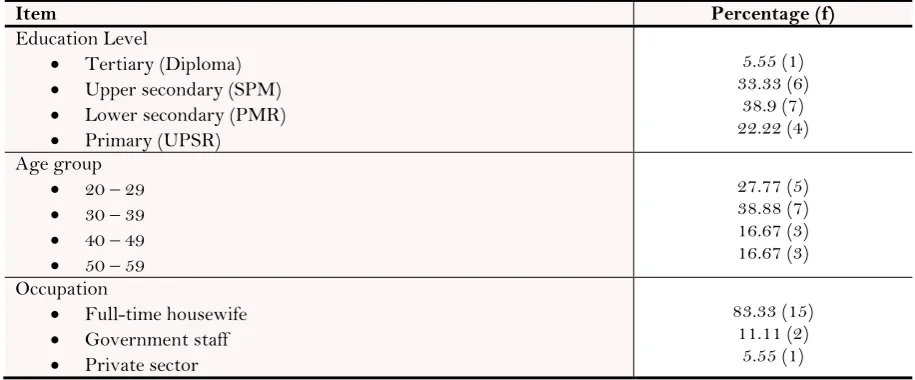
The research participants of this study were 18 mothers of Bidayuh ethnicity. Most of the mothers (83.33%) were full time housewives and residing in the nine villages in the Krokong area. Their ages ranged between 21 to 57 years. The majority of them were in the age group of 30 to 39 at 38.88% while only 16.67% were in the 50 to 59 age group. As for educational background, there were seven who completed lower secondary (38.90%), followed by six finishing at upper secondary level (33.33%), four at primary level (22.22%), and one at tertiary level (5.55%). Details of the mothers’ demographic profile are shown in Table 1.
Table-1. Mothers’ demographic profile.
Item Percentage (f)
Education Level
Tertiary (Diploma) Upper secondary (SPM) Lower secondary (PMR) Primary (UPSR)
5.55 (1) 33.33 (6)
38.9 (7) 22.22 (4) Age group
20 – 29 30 – 39 40 – 49 50 – 59
27.77 (5) 38.88 (7) 16.67 (3) 16.67 (3) Occupation
Full-time housewife Government staff Private sector
83.33 (15) 11.11 (2)
5.55 (1)
A total of 21 students of Bidayuh ethnicity (Age mean = 8.9 years) completed the logbooks at home with their mothers. A majority of the students or child participants were in Primary 3 (eight), followed by six in Primary 2, six in Primary 4, and one in Primary 1. However, only scores and data relevant to 20 students were used and analysed.
7. RESEARCH INSTRUMENT: PRE-TEST AND POST-TEST
To obtain the students’ level of English Language reading skill, the students were required to sit for the pre-reading test which was specifically designed according to the Standard-based English Language Curriculum for Malaysian National Primary School. The test was divided into five sections comprising of item response formats like multiple-choice items, complex multiple-choice items and close constructed response items. There were altogether 72 items in the test.Similar items were used in the post-test in order to obtain meaningful results. The passing mark is 40% based on the new marking scores according to the Standard-based English Language Curriculum.
8. RESULTS AND ANALYSIS
8.1. Frequency of Mother-Child Shared Reading Sessions
(Bracken & Fischel, 2008) measurement of parents’ reading involvement. In particular, the present study adapted only one aspect of the measurement namely the frequency for reading with children in which parents with low socioeconomic background in New York City reported via a survey how often they read with their pre-school children. Other studies examining parental involvement in shared reading also commonly used the survey method and varying measurement categories to gauge the frequency of reading (e.g. (Kloosterman et al., 2011; Weisleder et al., 2018)).
Figure-1. Frequency of mother-child shared reading sessions per individual student.
The categories outlined by Bracken and Fischel (2008) were (i) hardly ever, (ii) 1-2 times a week (iii) 1-2 times per month, and (iv) almost daily. However, some adaptations were required because the present study’s frequency information is based on logbook records rather than survey data. Furthermore, the mothers’ records showed uneven distributions in reading sessions over the period of 10 months or 40 weeks. Therefore, to approximate the study’s categorisation, the total number of reading sessions per mother-child couple were divided into 40 weeks to obtain the weekly or monthly average. For example, if the total reading session is 40, this will be divided into 40 weeks which translates into 1 reading session per week. Table 2 shows the alignment between Bracken and Fischel’s categorisation and that used for this study, as well as the percentage of total participants for each category.
Table-2. Categories of frequency of reading sessions and percentage of total mother-child participants in each category.
Bracken and Fischel (2008)
frequency categories Present study’s frequency categories mother-child participants Percentage of total
Hardly ever Less than 10 10%
1-2 times per month Between 10 to 39 sessions 50%
1-2 times per week Between 40 to 79 sessions 35%
Almost daily 80 and more 5%
conflicting pattern to the present study. It seems that despite the low socio-economic background of urban families in Bracken and Fischel’s study, parents showed high-level of participation in joint-reading as opposed to that shown by the rural mothers.
These results offer crucial evidence for poor reading habit among the Bidayuh community in the rural area. Reading is not a cultural norm in the Bidayuh community, nor is it in many other local communities in Malaysia. This is especially true for communities living in rural areas in Sarawak with limited access to books and other educational facilities (Asraf et al., 2013; Kaur & Jawaid, 2018). Although a general study on reading habits among Malaysians by the National Library of Malaysia in 2014 showed that Malaysians on average read about eight to 12 books a year, this is considered low compared to other more developed countries like the UK (Abrams, 2016). Therefore, it is hardly surprising that even parents with low socioeconomic background in more developed countries have been found to participate actively in shared reading sessions with their children (e.g. Bracken and Fischel (2008)).
Low socio-economic background however, is a common factor associated with poor reading habits (Le et al., 2019; Whitten et al., 2019) including in the Malaysian context. Most parents in rural areas, similar to mothers in the present study’s population, put less emphasis on reading habit and to an extent, education (Gerber & Huijsmans, 2016; Renganathan, 2017). This is because financial survival is a primary concern, hence life-sustenance activities such as helping out with the harvest are deemed to be more important that education-and literacy acquisition. Aside from that, rural children also prioritized assisting their parents in the home economic domain, such as cleaning the house and babysitting their siblings (Gerber & Huijsmans, 2016); positioning reading or any other education-related activities as a secondary or even a non-priority. Moreover, most mothers in this study are homemakers and have low education levels, and therefore, may lack reading skill especially in the English language which may have affected the frequency for shared-reading sessions.
In relation to literacy skills, it has commonly been argued that the development of literacy level is closely associated with the use of mother tongue (Savage, 2019). In this regard, it is also of note that Bidayuh language is still poorly documented. One of the contributing factors is the fact that the Bidayuh language has four different variants or dialects namely Bau-Jagoi, Bukar-Sadong, Biatah, and Salako-Lara (Chang, 2004) which may complicate the documentation process. Because Malay is the national language, students mostly learned literacy in this language causing further hindering the progress of positive reading habits. This scenario bears a close resemblence to Renganathan (2017) study on the literacy practices of the indigeneous Semai Orang Asli community in West Malaysia. It was found that the absence of Semai written language required the Orang Asli to learn literacy in Malay language and thus affecting the literacy development.
8.2. Effect of Reading Sessions on Reading Skill Performance
Figure-2. Individual students’ pre-test and post-test scores.
In order to determine whether the reading sessions had an effect on the reading performance of the students, a paired-sample T-test was conducted on the pre-test and post-test scores. As shown in Table 3, there was a significant increase (t = -2.998, p = .007) from the pre-test score before the reading intervention (M = 33.55, SD = 18.49) to the post-test score following the intervention (M = 39.05, SD = 14.45). These results suggest that the reading sessions had a positive impact on the students’ reading performance.
Table-3. Paired-sample T-test result on pre-test and post-test scores.
Paired Differences
t df (2-tailed) Sig. Mean Deviation Std. Std. Error Mean
95% Confidence Interval of the
Difference
Lower Upper
Pair
1 Pretest - Posttest -5.500 8.205 1.835 -9.340 -1.660 -2.998 19 .007
From the findings, we can generally say that parental reading socialization as evidenced through the mother-child reading sessions in this study have significantly facilitated the students’ overall reading performance. Weisleder et al. (2018) examined the impacts of a parent-child reading aloud program on their interactions and child development among low-income Brazillian families. The intervention was found to benefit parent-child interactions, and child language and cognitive development greater than those receiving educational child care alone. Of particular interest to this study is the positive effect on the children’s language as evidenced by the increase in their receptive vocabulary. The study, however, did not specifically assess the reading performance of the children whose ages range from two to four. In another study, Bracken and Fischel (2008) investigated the family reading behavior of 233 children from low-income families who attended a local preschool in New York. Parent–child reading interaction, one of the several behaviours in question, was found to be significantly related to children’s early literacy skills. Shared reading frequency was an aspect measured as part of this behaviour through a survey with the parents. Additionally, multiple regression analyses showed that parent-child reading interaction was a significant predictor of children’s receptive vocabulary, story and print concepts, and general emergent literacy skills. The findings from this study are also in line with those asserting that the positive effect of reading on academic achievement goes beyond socio-economic background (Le et al., 2019; Whitten et al., 2019).
findings in the present study generally showed a positive impact of mother-child reading sessions on reading performance, the effect of reading frequency was not taken into consideration. In order to investigate the relationship between the frequency of the reading sessions and the students’ reading performance, further statistical analyses will need to be conducted, and would potentially be a focal point in future discussions.
9. CONCLUSION
The evidences from this study suggest that there is a positive association between parental involvement in home-literacy and students’ academic achievement. Although the frequency of mother-child shared reading session was generally low, the students showed improved performance in their posttest. It is interesting to note that those with really low level of reading skill benefitted more from the sessions than those with high level reading skill. Taken as a whole, this is a clear indication that parents’ attitude and motivation are crucial in nurturing the reading habit in children which is likely to contribute to their future academic success. To foster good reading habits in the community, it would be advisable to have the Bidayuh language well documented, so that Bidayuh literacy among young learners can be developed, especially at the home. Learning literacy in their own language may encourage strong parental involvement in home-based reading activity because the parents can comprehend the reading materials better compared to Malay or English language materials. This may accelerate the reading progress and encourage independent reading. Additionally, more reading programmes should be conducted in the rural areas, especially in schools, despite some hesitance on the part of the parents with the aim to educate both parents and students on the importance of reading. Assistance should be given too to the rural parents on the selection of reading materials specifically for the young learners.
Funding: This study received no specific financial support.
Competing Interests: The authors declare that they have no competing interests.
Acknowledgement: All authors contributed equally to the conception and design of the study.
REFERENCES
Abrams, D. (2016). Frivolous’ themes: Criticism of popular reading in Malaysia. Retrieved from:
https://publishingperspectives.com/2016/06/malaysia-books-young-people-reading/.
Alvarez, S. (2015). Brokering the immigrant bargain: Second-generation immigrant youth negotiating transnational orientations
to literacy. Literacy in Composition Studies, 3(3), 25-47. Available at: https://doi.org/10.21623/1.3.3.3.
Ambigapathy, P., & Shanthi, B. B. (2010). Driving the agenda of learning in science literacy in Malaysia. E-Learning and Digital
Media, 7(3), 301-316.
Asraf, R. M., Kassim, N. A., Ahmad, I. S., & Rahman, Z. A. (2013). The effectiveness of a supplementary reading programme for
children in Malaysia’s remote schools. World Applied Sciences Journal, 21(Special Issue of Studies in Language Teaching
and Learning), 125-132.
Bano, J., Jabeen, Z., & Qutoshi, S. B. (2018). Perceptions of teachers about the role of parents in developing peading habits of
children to improve their academic performance in schools. Journal of Education and Educational Development, 5(1),
42-59. Available at: https://doi.org/10.22555/joeed.v5i1.1445.
Bernama. (2017). M'sia's literacy rate is almost 95%, not 55%: National library. The new straits times. Retrieved from: https://www.nst.com.my/news/nation/2017/05/236676/msias-literacy-rate-almost-95-not-55-national-library Boonk, L., Gijselaers, H. J., Ritzen, H., & Brand-Gruwel, S. (2018). A review of the relationship between parental involvement
indicators and academic achievement. Educational Research Review, 24, 10-30. Available at:
https://doi.org/10.1016/j.edurev.2018.02.001.
Bracken, S. S., & Fischel, J. E. (2008). Family reading behavior and early literacy skills in preschool children from low-income
backgrounds. Early Education and Development, 19(1), 45-67. Available at:
Chang, P. F. (2004). History of bidayuh in samarahan division, Sarawak Kuching, Malaysia: Sarawak Press Sdn. Bhd.
Che Musa, N., Lie, K. Y., & Azman, H. (2012). Exploring English language learning and teaching in Malaysia. GEMA Online®
Journal of Language Studies, 12(1), 35-51.
Chin, C. (2019). Creating a love for reading. The star. Retrieved from:
https://www.thestar.com.my/news/education/2019/03/17/creating-a-love-for-reading
Chin., C. (2020). Learn in English or get left behind. The star. Retrieved from:
https://www.thestar.com.my/news/education/2020/02/16/learn-in-english-or-get-left-behind.
Clark, C., & De Zoysa, S. (2012). Mapping the interrelationships of reading enjoyment, attitudes, behaviour and attainment.
London, England: National Literacy Trust.
Cunningham, A. E., & Stanovich, K. E. (1998). What reading does for the mind. American Educator, 22(1-2), 8-17.
Daniel, G. R., Wang, C., & Berthelsen, D. (2016). Early school-based parent involvement, children’s self-regulated learning and
academic achievement: An Australian longitudinal study. Early Childhood Research Quarterly, 36, 168-177. Available at:
https://doi.org/10.1016/j.ecresq.2015.12.016.
Gerber, N., & Huijsmans, R. (2016). From access to post-access concerns: Rethinking inclusion in education through children’s everyday school attendance in rural Malaysia. In C. Hunner Kreisel, & S. Bohne (Eds.), Childhood, Youth and
Migration. Children’s Well-Being: Indicators and Research (pp. 203-221). Cham, Switzerland: Springer
International Publishing Switzerland.
Hasselbacher, S. (2018). Introduction: Literacy ideologies. Language & Communication, 61, 71-74. Available at:
https://doi.org/10.1016/j.langcom.2017.09.002.
Hazita, A. (2016). Implementation and challenges of English language education reform in Malaysian primary schools. 3L:
Language, Linguistics, Literature, 22(3), 65-78. Available at: https://doi.org/10.17576/3l-2016-2203-05.
Hazita., A. (2009). English in 1 Malaysia: A paradox in rural pluri-literacy practices. Akademika, 76(1), 27-41.
Horn, K. M. (2016). Using the ideological model of literacy to approach early childhood, instruction, and assessment. Literacy
Education Plan B.
Kaur, P., & Jawaid, A. (2018). A comparative study of urban and rural reading habits. Sarawak Library Journal: Publication of
Pustaka Negeri Sarawak, 1(1), 1-7.
Kloosterman, R., Notten, N., Tolsma, J., & Kraaykamp, G. (2011). The effects of parental reading socialization and early school
involvement on children’s academic performance: A panel study of primary school pupils in the Netherlands. European
Sociological Review, 27(3), 291-306.
Kumar, K. K. (2017). Reading for pleasure and academic success: A preliminary note. Pacific Journal of Education, 1(1), 113-124.
Le, T.-T.-H., Tran, T., Trinh, T.-P.-T., Nguyen, C.-T., Nguyen, T.-P.-T., Vuong, T.-T., . . . Hoang, P.-H. (2019). Reading habits, socioeconomic conditions, occupational aspiration and academic achievement in Vietnamese junior high school
students. Sustainability, 11(18), 1-29. Available at: https://doi.org/10.3390/su11185113.
Perry, K. H. (2009). Genres, contexts, and literacy practices: Literacy brokering among Sudanese refugee families. Reading
Research Quarterly, 44(3), 256-276. Available at: https://doi.org/10.1598/rrq.44.3.2.
Puglisi, M. L., Hulme, C., Hamilton, L. G., & Snowling, M. J. (2017). The home literacy environment is a correlate, but perhaps
not a cause, of variations in children’s language and literacy development. Scientific Studies of Reading, 21(6), 498-514.
Available at: https://doi.org/10.1080/10888438.2017.1346660.
Radhi, M. N. A. (2019). Call for comprehensive study into decline in English proficiency among students [NSTTV]. New Straits Times. Retrieved from https://www.nst.com.my.
Rajaendram, R. (2018). Education blueprints to stay: The star. Retrieved from:
https://www.thestar.com.my/news/nation/2018/05/23/education-blueprints-to-stay-maszlee-activities-and-programmes-will-be-reviewed-periodically/.
Raslie, H., & Keong, Y. C. (2017). Literacy brokering among the international students of a public university. GEMA Online®
Renganathan, S. (2017). Literacy and development for the Orang Asli in Malaysia: What matters? Prospects, 46(3-4), 479-490. Savage, C. (2019). The importance of mother tongue in education. Independent Education Today. Retrieved from:
https://ie-today.co.uk/Blog/the-importance-of-mother-tongue-in-education/.
Street., B. (2017). New literacy studies in educational contexts. In J. Pihl, K. S. van der Kooij, & T. C. Carlsten. (Eds.), Teacher and librarian partnerships in literacy education in the 21st century (pp. 23-32). Rotterdam, Netherlands: Sense Publishers.
Weisleder, A., Mazzuchelli, D. S. R., Lopez, A. S., Neto, W. D., Cates, C. B., Goncalves, H. A., . . . Mendelsohn, A. L. (2018).
Reading aloud and child development: A cluster-randomized trial in Brazil. Pediatrics, 141(1), e20170723.
Whitten, C., Labby, S., & Sullivan, S. L. (2019). The impact of pleasure reading on academic success. Journal of Multidisciplinary
Graduate Research, 2(1), 48-64.