JAN-FEB, 2016, VOL-I, ISSUE-V www.srjis.com Page 416 A COMPARATIVE STUDY OF PHYSICAL HEALTH AWARENESS AMONG
ELEMENTARY SCHOOL STUDENTS.
Ved Parkash
Assistant Professor, SGGS Khalsa College Mahilpur Hoshiarpur (Punjab)
Abstract
This study intended to explore the physical health awareness among elementary school students.
The sample of the study, which was selected through random sampling. The sample comprised of
200 Elementary school students from District Solan of Himachal Pradesh. The tool was
developed by the investigator herself for the present study. The results of the study revealed that
Government and private Elementary school students differ significantly on their physical Health
Awareness, Boys and girls of private Elementary schools do not differ significantly on their
physical Health Awareness and boys and girls of government Elementary schools differ
significantly on their physical Health Awareness.
Keywords: Physical Health, Awareness, elementary school students.
Introduction
It is rightly said that “Health is Wealth.” It involves physical as well as mental health. Health as
it aims for the development of whole some balanced and integrated personality. It is possible
when one enjoy good health. Health Awareness helps in the proper development of the
individual. Good Health Awareness helps in seeking proper adjustment. He is able to seek
adequate adjustment with his self and his environment.
Mahatma Gandhi advocated that physical exercise is an important daily activity equivalent to taking of one‟ Meals by each individual. The National Policy on Education (1986) demands that
physical education, sport and Health Education should be an internal part of education.
He who enjoys good health is rich though he knows it or not.-Italian proverb. Human beings are
JAN-FEB, 2016, VOL-I, ISSUE-V www.srjis.com Page 417
everyone‟s life. A feeling of total well-being plays a critical part in attaining any lasting success
or happiness in life. To achieve this state of well being, one must attain a level of fitness, which
enables one to perform the best at all times. The present generation is living with a lot of
distractions. They do not know how to lead a healthy life.
The term „Health‟ is defined as the state of complete physical, mental and social well-being and not merely the absence of disease and infirmity (WHO). The term „Education‟ is defined as: “By
education I mean an all round drawing out the best in the child and the man, body, mind and
spirit” (Gandhiji).So Health Education is a combination of planned social action and learning
experiences, designed to enable people to gain control over the determinants of health and health
behaviors and the conditions that affect their health status and the health status of others. Health
generally means sound conditional well being our freedom from disease. Mental health is a state
of psychological well-being is freedom from mental desire. But our body and mind function
harmoniously. Good health awareness help seeking proper adjustment. He is able to see adequate
adjustment with himself and his environment good health awareness make the individual
conscious about his duties surgeon. The present scenario the student is facing no. of problems in
home and school. They are facing unemployment adjustment and facing number of problems due to these problem students becoming a victim of fear, anxiety, and despair frustration‟s, problem
of adjustment etc. These all effecting health of the students and there are round development
prosperity and progress of society is quite linked with the good he of its member and only the
person having good health can contribute its maxima to the society science. Good health
contributes a lot in far all round development of the personality. So due to much important of
good health in bring all round develops and brining adjustment.
Significance of the Study
Sound Health Awareness is the basis of all desirable learning. Sound health awareness enables
the individual to withstand the strains of life. Keeping well aware on Health, achieve satisfactory
in the life? Without the awareness on health his whole outlook about life changes. He starts
thinking that he is a worthless fellow, the world around him is full of misery, the society is hard
on him, friends are useless, none can be relied upon and so on. He withdraws from the society
and shut within his own self. The Health Awareness of the child as very important from the point
JAN-FEB, 2016, VOL-I, ISSUE-V www.srjis.com Page 418
Policy on Education (1986) demands that physical education, sport and Health Education should
be an internal part of education. Keeping in view the above the investigator of the present study
was interested to study the Physical Health Awareness among elementary school students.
Objectives of the Study
1) To compare the government and private Elementary school students with respect to their
Physical Health Awareness.
2) To compare to the boys and girls of private Elementary school students with respect to their
Physical Health Awareness.
3) To compare the boys and girls of government Elementary school students on Physical Health
Awareness.
Hypotheses of the Study
H01Government and private Elementary school students do not differ significantly on their
Physical Health Awareness.
H03 Boys and girls of private Elementary schools do not differ significantly on their Physical
Health Awareness.
H04 Boys and girls of government Elementary schools do not differ significantly on their
Physical Health Awareness.
Method
For the present study investigator used descriptive survey method.
Sample
The sample for the present study was selected randomly by using probability sampling
techniques. In this study sample consisted of 200 Elementary school students.
Tool used
In the present study the physical health awareness scale was developed and standardized by the
investigator himself.
Statistical Techniques used
The mean and standard deviation were calculated in case of descriptive statistics and „t‟ test was
calculated in case of inferential statistics.
Hypotheses testing;
Hypothesis :1 Comparison of physical Health Awareness among Government and Private
JAN-FEB, 2016, VOL-I, ISSUE-V www.srjis.com Page 419 Table 1
Significance of difference between government and private elementary School Students on
physical health awareness
Group N M S.D. df ‘t’
Government 92 23.47 1.22
198 2.07
Private 108 22.81 2.37
Table-4.1 reveals that the means scores of 23.47 and 22.81 in case of government and private
Elementary school students having standard deviation of 1.22 and 2.37 respectively. The
standard error of difference was calculated 0.24. When such values were subjected to the testing
of their significance of difference „t‟ ratio was found to be 2.07. The table value of „t‟ with 198
degrees of freedom is reported to be 1.97 and 2.60 at 0.05 and 0.01 level of significance respectively. As the calculated value of „t‟ is found to be more than the table value of „t‟ at 0.05
level of significance therefore, the calculated „t‟ ratio is found to be significant. Hence,
Hypothesis, “Government and private Elementary school students do not differ significantly on
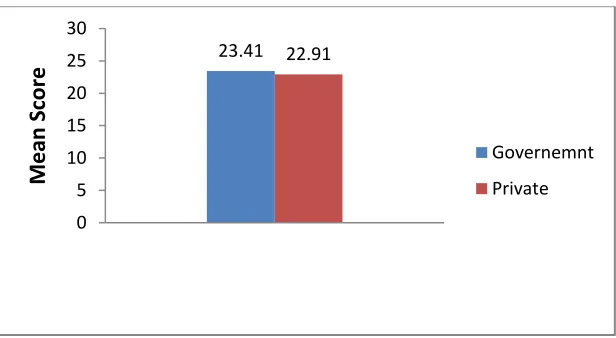
their physical Health Awareness” was rejected. Such data for its better understanding have been
presented in the form of histogram .
Fig. depicting means scores of comparison of physical Health Awareness among
Government and Private elementary school students.
4.4 Comparison of physical Health Awareness among girls and boys of Private Elementary
schools.
23.41 22.91
0 5 10 15 20 25 30
M
e
an
Scor
e
Governemnt
[image:4.612.153.461.489.658.2]JAN-FEB, 2016, VOL-I, ISSUE-V www.srjis.com Page 420 Table no. 2
Significance difference between means scores of private Elementary school girl and boy
students on physical health awareness
Group N M S.D. SED df ‘t’
Private Girls
42 23.32 2.43
0.45 98 0.75
Private Boys
58 22.64 2.20
Table-4.3 reveals that the means scores of 23.32 and 22.64 in case of private Elementary school
girl and boy students having standard deviation of 2.43 and 2.20 respectively. The standard error
of difference was calculated 0.45. When such values were subjected to the testing of their significance of difference „t‟ ratio was found to be 0.75. The table value of „t‟ with 98 degrees of
freedom is reported to be 2.60 and 1.97 at 0.01 and 0.05 level of significance respectively. As the calculated value of „t‟ is found to be less than the table value of „t‟ at 0.05 level of significance, therefore, the calculated value of „t‟ was not significant.
Hence, Hypothesis, “Boys and girls of private Elementary schools do not differ significantly on
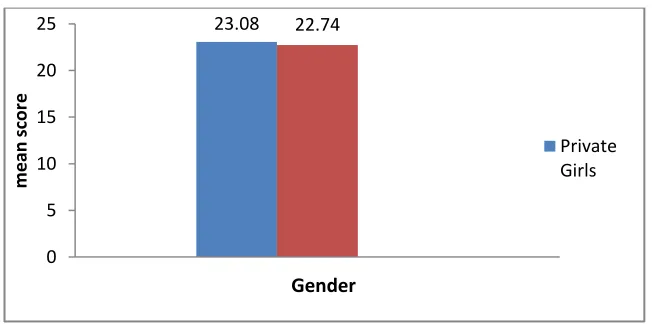
their physical Health Awareness” was accepted. Such data for its better understanding have been
presented in the form of histogram .
Fig.2 depicting means scores on comparison of health awareness among Private
Elementary school girl and boy students on health awareness
Hypothesis 3: Comparison of physical Health Awareness among boys and girls of
Government Schools.
23.08 22.74
0 5 10 15 20 25
m
ean
sco
re
Gender
[image:5.612.144.473.451.613.2]JAN-FEB, 2016, VOL-I, ISSUE-V www.srjis.com Page 421 Table No. 3
Significance difference between means scores of government Elementary school Boy
and Girl students on physical health awareness
Group N M S.D. df ‘t’
Government Boys 43 23.18 1.35
98 2.09
Government Girls 57 23.64 1.03
Table-4.4 reveals that the means scores of 23.18 and 23.64 in case of government Elementary
school students having standard deviation of 1.35 and 1.03 respectively. The standard error of
difference was calculated 0.22. When such values were subjected to the testing of their significant of difference „t‟ ratio was found to be 2.09. The table value of „t‟ with 98 degrees of
freedom is reported to be 2.60 and 1.97 at 0.01 and 0.05 level of significance respectively. As the calculated value of „t‟ is found to be more than the table value of „t‟ at 0.05 level of significance, therefore, the calculated value of „t‟ was found to be significant.
Hence, Hypothesis, “Boys and girls of government Elementary schools do not differ significantly
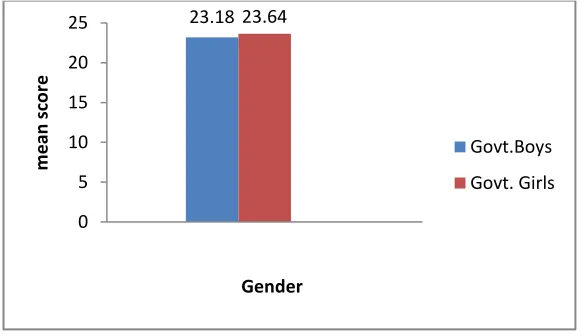
on their physical Health Awareness” was rejected. Such data for its better understanding have
been presented in the form of histogram .
Fig. depicting means scores on comparison of physical health awareness among
Government Elementary school students
Results
On the basis of the statistical analysis and interpretation of the obtained data the investigator of
the present study arrived at the following findings: 23.18 23.64
0 5 10 15 20 25
m
e
an
sco
re
Gender
Govt.Boys
[image:6.612.161.452.463.631.2]JAN-FEB, 2016, VOL-I, ISSUE-V www.srjis.com Page 422
1. Government and private Elementary school students differ significantly on their physical
Health Awareness.
2. Boys and girls of private Elementary schools do not differ significantly on their physical
Health Awareness.
3. Boys and girls of government Elementary schools differ significantly on their physical
Health Awareness.
Educational Implications
The findings of the study have some important implications for educational practices:-
1) Teachers must sort out the list of activities that impart the knowledge about health attitudes
and practices in the students and conduct those in class.
2) Comprehensive Health education needs to be implemented.
3) School should provide necessary information, counseling and Health care referral.
4) Special programme are needed to educate the students for proper transmission at Health
awareness to students.
5) Parents and teacher should provide Health education to their children/students.
6) Information, education and communication should be intensified to make students aware of
the Health problem order to prevent further spread of Health awareness.
7) Different activity should be organized in school such as lectures, drawing, documentaries,
short film, and movies on Health awareness.
References
Aggarwal .Y.P. (2009).“ Statistical Method Concept, Application and Computation”.
Kurukhshetra: Sterling publisher Pvt. Ltd. pp. 342-343.
Anuradha, T.S.and Roy,J. (1996) “Childrens attitude towards physical activities”. In Sixth
Survey of Educational Research.(1993-2000). Ed. J.P Sharma (2000),New Delhi:
NCERT, Shri Aurobindo Marg, Vol-,1 p.99
Benjamun,Willium ,Edward (2008). “Preservation of youth through Health Education .”
Edutracks ,Vol.7,No.9, pp19-20.
Chandramani, M. (1988).“Impact of nutrition education: Education at different levels”.In Fifth
Survey of Research in Education (1988-1992). Ed. J.P. Sharma(2000) New Delhi:
JAN-FEB, 2016, VOL-I, ISSUE-V www.srjis.com Page 423 Chaube S.P. & Chaube A. (2008).“School hygiene and health Education”. Vinod pustak
Solanr, Agra-2 pp 124-126.
CENTERAL REGLONAL CENTER (1981). “Nutrition healthy education and environmental
sanitation in Elementary School state Institute of science education”. In Third Survey of
Research in Education, Jabalpur 1981 (NCERT-financed), p.528.
Kaur,Manjeet.(2009).“An introduction to Health & Physical Education”. Tandon publication
Ludhiana, pp 232-234.
Narayana, K.R. (1995). “Message”. In Sixth Survey of Educational”. Research.(1993-2000).
Ed. J.P Sharma (2000),New Delhi: NCERT, Shri Aurobindo Marg,Vol-1 p.94
In Sixth Survey of Educational Research.(1993-2000). Ed. J.P Sharma (2000),New Delhi:
NCERT,Shri Aurobindo Marg,Vol-1 p.99
Panaehakel, Thomaskutly G.(1991). “Health education and community development”. In Fifth
Survey of Research in Education (1988-1992). Ed. J.P. Sharma (2000) New Delhi:
NCERT,Shri Aurobindo Marge,Volume-1 p.381.
Ramanmohan, V.(1990). “Nutrition education for adolescents (13-15 year) through games”. In
Fifth Servey of Research in Education (1988-1992). Ed. J.P. Sharma (2000) New Delhi:
NCERT,Shri Aurobindo Marg,Volume-1 p.387
Sadananthan .M,Kumari Kala S.k. Mofanato .(2009). “Health education in secondary schools .”Edutracks,Vol .9,pp. 19-20.
Sharma, A.K. (1995). “Survey of selected yogic practices on cardio- respiratory variables among persons exposed to M.I.C. gas.” In Sixth Survey of Educational
Research.(1993-2000). Ed. J.P Sharma (2000),New Delhi: NCERT, Shri Aurobindo Marg,Vol-1 p.95
Singh. R. (1997). “A study in physical growth patterns of psycho-Motor performance of students”. In Sixth Survey of Educational Research.(1993-2000). Ed. J.P Sharma
(2000),New Delhi: NCERT, Shri Aurobindo Marg,Vol-1 p.96
Shankar,G. (1995). “Rate of logic practices in health, Fitness and sports promotion. Role of physical Education and sports science in sports promotion”. In Sixth Survey of
Educational Research.(1993-2000). Ed. J.P Sharma (2000),New Delhi: NCERT,Shri
JAN-FEB, 2016, VOL-I, ISSUE-V www.srjis.com Page 424 Tayagi, S. (1994). “Physical Fitness norms for body and girls in grades 9 through 12 of Delhi state”. In Sixth Survey of Educational Research.(1993-2000). Ed. J.P Sharma
(2000),New Delhi: NCERT, Shri Aurobindo Marg,Vol-1 pp 99-100.
Upadhyay, B. (1990). “ Development of literacy and post literacy material on health for
illteracts and neo-literates”. In Fifth Survey of Research in Education (1988-1992). Ed.
J.P. Sharma (2000) New Delhi: NCERT,Shri Aurobindo Marg,Volume-1 p.382.
Verghese,M. (1991). “A study of the health status of Elementary school pupils and its influence on achievement for franing a school health programe”. In Fifth Servey of Research in
Education (1988-1992). Ed. J.P. Sharma (2000) New Delhi: NCERT,Shri Aurobindo
Marg,Volume-1 p.382
Wakhar,D.G. (1995). “Handbook of physical education.” In Sixth Survey of Educational
Research.(1993-2000). Ed. J.P Sharma (2000), New Delhi: NCERT,Shri Aurobindo