Unavailable Time Aware Scheduling of Hybrid Task
on Heterogeneous Distributed System
Hejun Xuan1,∗, Shiwei Wei2, Yanling Li1, Ran Li1and Wuning Tong3
1 School of Computer and Information Technology, Xinyang Normal University, Xinyang 464000,
China;[email protected](Y.L.);[email protected](R.L.);
2 School of Computer and Technology, Guilin University of Aerospace Technology, Guilin 541000 China;
[email protected](S.W.);
3 Shaanxi University of Chinese Medicine, Xianyang 712000, China; [email protected](W.T.);
* Correspondence: [email protected]; Tel.: +86-187-4043-7786
Abstract: The resource allocation for tasks in heterogeneous distributed system is a well known NP-hard problem. For the sake of making the makespan is minimized, it is hard to distribute the tasks to proper processors. The problem is even more complex and challenging when the processors have unavailable time and the tasks type are various. This paper investigates a resource allocation problem for hybrid tasks comprising both divisible and bag-of-tasks(BoT) in heterogeneous distributed system when the processors has unavailable time. First, the mathematical model, which minimizes the makespan of the hybrid tasks when the processors have unavailable time, is established. Second, we propose a scheduling algorithm referred to as bag-of-tasks allocate-pull and divisible task allocation (BoTAPDTA) algorithm for handling hybrid tasks on heterogeneous distributed systems. In addition, to solving the optimization model efficiently, a generic algorithm(GA) is proposed. For the sake of reducing the search space and solving the optimization model effectively, a two step scheduling algorithm(TSGA), which first allocate bag-of-tasks(BoT) using generic algorithm and then assign divisible task to processors like BoTAPDTA, is designed. Finally, numerical simulation experiments are conducted, and experimental results indicate the effectiveness of the proposed model and algorithm.
Keywords:Distributed computing; Task scheduling; Hybrid Tasks; Generic algorithm;
1. Introduction
Heterogeneous distributed system has emerged as commonly systems for handling large scale scientific and commercial applications in various fields, such as image processing, signal processing, pattern matching in text, and many scientific computation problems [1,2]. For the sake of improving the performance of the system, many task scheduling algorithms for heterogeneous or homogeneous distributed system have been proposed in the past decades[3,4]. Wang[3] proposed a multi-objective bi-level programming model for energy and locality aware multi-job scheduling in heterogeneous system. Literature [4] proposed two scheduling algorithms to schedule a BoT (bag-of-tasks, BoT) on heterogeneous system so as to minimize the makespan and the energy consumption. In Literature [5], the reliability cost, which is defined as the product of failure rate of processors and task processing time, is incorporated into scheduling algorithm for the tasks with precedence constraints on heterogeneous system. Lee and Zomaya classified the tasks into computation-intensive and data-intensive BoT task in literature[6] and presented two task scheduling algorithms in Grid computing system respectively. Anglano et al.[7] evaluated the performance of five knowledge-free task scheduling algorithms for scheduling multiple BoT in a desktop Grids computing system. In addition, the performance of several BoT scheduling solutions in large-scale distributed systems also have been studied in literature [8]. For BoT, there are some other studies that aim to maximize throughput by establishing linear programs or nonlinear programs[9,10], and the works focused on steady-state optimization problems and concentrated on numerous bag-of-tasks including independent and similar tasks. Legrand
et al.proposed a centralized and decentralized scheduling algorithm in literature[9]. To schedule concurrent bag-of-tasks, the online and off-line scheduling algorithms are presented by Benoit et al.[10]. In literature[11], a decentralized scheduling algorithm, which minimizes the maximum stretch among user-submitted tasks, is designed. Yang Y et al.[12] take the constraints of time, cost, and security into consideration, a scheduling algorithm for data-intensive tasks is designed. Literature [13] investigated both two problems: optimizing the makespan of the tasks under the constraints of energy, or minimizing energy consumption subject to makespan. However, this paper studied the static resource allocation to optimize makespan and energy robust stochastic for bag-of-tasks(BoT) on a heterogeneous computing system. A multi-objective optimization model, which minimizes makespan and resource cost, is established in literature[14]. To solve the optimization model, a scheduling algorithm based on the ordinal optimization method is designed. However, the scheduling algorithm is inefficient when the task number or processing node number is large.
In scheduling theory, the fundamental assumption is that all processors which take participate in processing tasks are always available for processing tasks[15]. However, it might be unreasonable. If some certain maintenance requirements, breakdowns, or other constraints exits, they will make the processers unavailable for executing the tasks. In literature [16], availability is defined. For a processor, availability is defined as the ratio of the total available time to the total time during a given interval. In previous work, Some work has investigated task scheduling algorithm with processor availability constraints[17]. Adiri et al[18]. investigates the scheduling problem with availability constraints in a single machine system. For minimizing maximum lateness of then jobs, literature [19] studied the problem on homogeneous machines under machine availability and eligibility constraints. A branch-and-bound method is proposed in literature[20] to solve the single-machine scheduling problem with machine availability constraints. For minimizing the total flow time, literature [21] investigated the non-permutation flow shop scheduling issue with the learning effects and machine availability constraints. To minimize the makespan, the two-machine permutation flowshop scheduling problem with an availability constraint is investigate in literature [22]. However, the basic assumption of this work is that the availability constraint imposed only on the first machine. Literature[23] developed a Hybrid Heuristic-Ant Colony Optimization (H2ACO) for multiclass tasks on heterogeneous distributed systems with availability constraint. H2ACO algorithm can make a good trade-off between availability and makespans of the tasks. An availability-aware scheduling model is investigated in literature [24], and an optimization algorithm to increase the availability and to minimize the makespan of tasks in heterogeneous systems is proposed. Literature [25] proposed a quantum-behaved particle swarm optimization algorithm to optimize the availability-aware task Scheduling on heterogeneous systems. A novel distributed availability-aware adaptive rate-allocation scheduling algorithm for multimedia tasks in heterogeneous wireless networks is proposed in literature [26].
Divisible task has been studied extensively in the last several decades, resulting in a cohesive theory called Divisible Load Theory (DLT)[27]. The main objective of the divisible load scheduling problem in distributed computing systems is minimizing the processing time, also called the makespan[28–30]. In our work, we investigates a resource allocation problem for hybrid tasks comprising both divisible and bag-of-tasks in heterogeneous distributed system when the processors has unavailable time. The major contributions of this study are summarized as follows:
• To minimize the makespan of the hybrid tasks, a mathematical optimization model, which takes unavailable time constraint of processors into consideration, is established.
• We propose a algorithm referred to as Bag-of-Tasks Allocate-Pull and Divisible Task Allocation (BoTAPDTA) algorithm for the hybrid tasks scheduling problem.
• To solving the optimization model effectively, a generic algorithm(GA) is proposed.
• For the sake of reducing the search space and solving the optimization model effectively, a two step scheduling algorithm(TSGA), which first allocate bag-of-tasks using generic algorithm and then assign divisible task to processors like BoTAPDTA, is designed.
The rest of this paper is organized as follows. Section2gives the system and task description, and the mathematical model is established. The scheduling algorithm referred to as bag-of-tasks allocate-pull allocate-pull scheduling (BoTAP) algorithm is described in section3. Section4proposed a generic algorithm to solving the optimization model effectively. The two step hybrid tasks scheduling algorithm is explained in section5. Section6presents simulation results to evaluate the algorithms. The paper is concluded with a summary and a future work in Section7.
2. Problem Formulation
2.1. System and Task Description
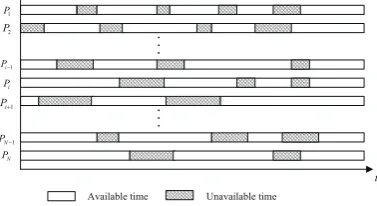
In our work, the heterogeneous distributed system hasN+1 processors, which includes a master processor andNslave processors.P0denotes the master processor, and the slave processors denoted by{P1,P2,· · ·,PN}. Each slave processorPi(i = 1, 2,· · ·,N) is associated with a speed indexwi,
which is the time taken to process a unit workload on processorPi. Slave processor is the most basic
processing unit in our research. Since some reasons, such as shutdown or maintenance requirements, slave processors have some unavailable time. [aij bji](i = 1, 2,· · ·,N;j = 1, 2,· · ·,ni)denote the
jth(j = 1, 2,· · ·,ni) unavailable segment of processorPi(i = 1, 2,· · ·,N), andni is the number of
unavailable segment for processorPi(i = 1, 2,· · ·,N). For the convenience, thejth(j = 1, 2,· · ·,ni)
available segment of processorPi(i=1, 2,· · ·,N)denoted by[cji dij](i=1, 2,· · ·,N;j=1, 2,· · ·,mi),
andmiis the number of available segment for processorPi(i=1, 2,· · ·,N). To understand easily, the
system model is shown in Fig.1
1
P
2 P
1 i
P
i
P
1 i
P
1 N
P
N
P
Available time Unavailable time
t
Figure 1.Available and unavailable time of the processors in the heterogeneous distributed system.
In our study, the hybrid tasks comprising both divisible and bag-of-tasks is investigated. Bag-of-tasks(BoT) are a representatively type of tasks including of numerous independent tasks and can be processed parallelly without communication. Divisible task(DT) can be partitioned into a large number of load fractions and can be processed independently on the processors in parallel since there are no precedence relationships among these tasks. That is to say, all the tasks our work investigated are independent. The workload includes Nτ+1 independent tasks and theith(0 ≤ i ≤ Nτ)task
is denoted byτi, where taskτ0is a divisible task, andτi(1≤ i ≤ Nτ)are bag-of-tasks. Following
the previous studies[31,32], we assume that the size of loadτiσ(0 ≤ i ≤ Nτ)is known after a task
arrives according to the prediction mechanisms such as code profiling and statistical prediction. As the previous work[33], these bag-of-tasks have different computing requirements, and we assume that each task can only be processed by some specific processors.Ωiis a set of the processor’s thatτican allocated
2.2. Mathematical Modeling
The task scheduling problem investigated in this paper is to schedule all theNτ+1 tasks to theN
processors in the heterogeneous distributed system with the purpose of minimizing the makespan of the tasks. Then, we will give the mathematical modeling of the optimization problem.
2.2.1. Objective Function
Generally speaking, makespan is the latest finish processing time of the processors. IfTidenote
the finish processing time of processorPi, the makespanTof the tasks can be denoted by Eq.(1).
T= max
1≤i≤N{Ti} (1)
In our work, the purpose is minimize the makespan of the hybrid tasks in the heterogeneous distributed system with unavailable time considered. So, the objective function can be described as Eq.(2).
minT=min
max 1≤i≤N{Ti}
(2)
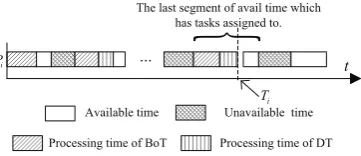
As shown in Eq.(1), we can see that the finish processing time of each processor should be calculated. For a specific processorPi, its processing time diagram is shown in Fig.2. In the processing
i
P t
Available time Unavailable time
Processing time of BoT ...
P
The last segment of avail time whichhas tasks assigned to.
i
T
Processing time of DT
Figure 2.The processing time of processorPi.
time diagram of processorPi, it shows that the finish time of processor Pi determined by the last
segment of available time which has tasks assigned to. Ifl(1≤l≤mi)andδildenote the last segment
of the tasks assigned to processorPiand the set of BoT tasks assigned to segmentlstrespectively.αli is
the ratio of the fraction size assigned to thelsegment on processorPito the workloadτ0σ. So, the finish
processing time of processorPican be calculated by Eq.(3).
Ti =cil+wi
αliτ0σ+
∑
q∈δl iτqσ
(3)
Then, we can rewrite Eq.(2) as Eq.(4)
minT=min
max 1≤i≤N{Ti}
=min
max 1≤i≤N
cli+wi
αliτ0σ+
∑
q∈δl iτqσ
(4)
2.2.2. constraint conditions
(a)All the BoT must be assigned to the processors that can satisfy BoT requirement: Θ = (θkij)Nτ×N×mj is a binary matrix, whereθ
k
ij=1 if only and if taskτiis assigned to thekth(1≤k≤mj)
Ifθijk =1, the processorPjof taskτi(1≤i≤Nτ)assigned to must in the setΩi. That is to say, Eq.(5) is
satisfied.
θijk =1⇒Pj∈Ωi (5)
(b)All the BoT must be allocated to assigned to the available time segments on processors: A crucial principle of bag-of-tasks scheduling problem is that all the tasks should be allocated to the suitable processors. According the definition of the binary matrixΘ, we can obtain Eq.(6) when all the tasks are allocated.
Nτ
∑
i=1N
∑
j=1mj
∑
k=1θijk = Nτ (6)
(c)All the workload of divisible task must be assigned to suitable processors:αijdenotes the ratio of
the fraction size assigned tojth(1≤j≤m
i)of processorPi(1≤i≤N)to the entire workload of the
divisible taskτ0. If the divisible taskτ0is assigned Completely, Eq.(7) can be obtained.
N
∑
i=1mi
∑
j=1αji =1 (7)
(d)The execution time of the tasks assigned to a available segment should not be greater than the available time of the segment: Since each processorPj(1≤j≤N)has unavailable time, the processing
time of tasks assigned tokthsegment should not be greater than the available time. The workload of
assigned tokth(1≤k≤mj)segment available time on processorPj(1≤ j≤ N)denoted byσjk, the
Eq.(8) should be satisfied as shown below.
wjσjk≤dkj −ckj (8)
There are BoT and divisible task fraction allocate to kth(1 ≤ k ≤ mj) available time segment of
processorPj(1≤j≤N). According to the definition ofθijk(1≤i≤Nτ)andαkj, we can can calculate
the workloadσjkof assigned tokthsegment available time on processorPjby Eq.(9).
σjk=αkjτ0σ+
Nτ
∑
i=1θkijτiσ (9)
Then, we can rewrite Eq.(8) as Eq.(10)
wj αkjτ0σ+
Nτ
∑
i=1θijkτiσ
!
≤dkj−ckj (10)
2.2.3. Mathematical Modeling
The task scheduling problem investigated in this paper is to schedule all theNτ+1 tasks to theN
function and constraints respectively. Then, the mathematical optimization model with constraints are presented in Eq.(11).
minT=
min
max 1≤j≤N
clj+wi
αljτ0σ+ ∑ q∈δl
j
τqσ
s.t.
(a)θkij=1⇒Pj ∈Ωi; (b)N∑τ
i=1
N
∑
j=1
mj
∑
k=1
θijk =Nτ;
(c) ∑N i=1
mi
∑
j=1
αij=1;
(d)wj
αkjτ0σ+
Nτ ∑
i=1
θkijτiσ
≤dk j −ckj; (e)1≤i≤Nτ, 1≤ j≤N, 1≤k≤mj;
(11)
In this optimization model, constraints (a)-(d) has description in section2.2.2, and constraints (e) gives the scope of parametersi,j,k. To solve this global optimization model, an algorithm referred to as bag-of-tasks allocate-pull and divisible task allocation (BoTAPDTA) algorithm and generic algorithm with a local research strategy are proposed. The algorithm of BoTAPDTA will be described in section3. The proposed generic algorithm and two step scheduling algorithm(TSGA) will be given in section4
and section5respectively.
3. Proposed BoTAPDTA Algorithm
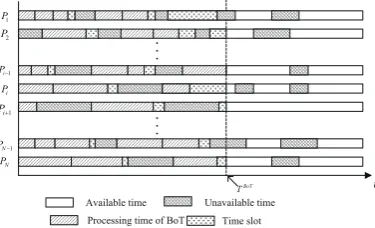
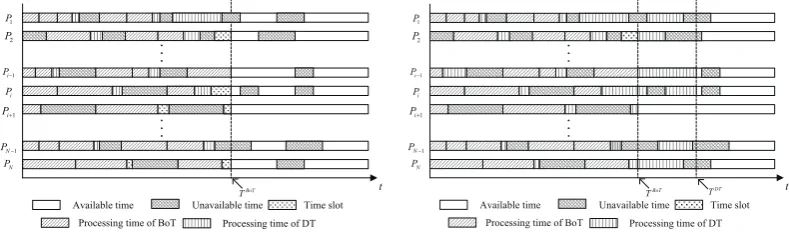
In our work, hybrid tasks comprising bag-of-tasks(BoT) and divisible task scheduling problem is investigated. In addition, unavailable time is taken into account. Since divisible can be divided into arbitrary fractions and proposed on any processor in heterogeneous system, it has a great flexibility. We first allocate BoT to suitable processor, and then the divisible task assigned to the time slot before TBoTand available time afterTBoTas shown in Fig.3.
1 P 2 P 1 i P i P 1 i P 1 N P N P
Available time Unavailable time
t
Processing time of BoT
BoT
T
Time slot
Figure 3.The processing time of processorPi.
Based on analyzing, the scheduling algorithm can be divide into two procedures: (a)Allocation the BoT to suitable processors; (2)Allocation the divisible task to suitable time slot and available time segment. For the sake of understanding the algorithm macroscopically, the framework of the scheduling algorithm is presented before presenting the detailed steps of the algorithm. The bag-of-tasks allocate-pull and divisible task allocation(BoTAPDTA) algorithm is shown in Algorithm1. Step 1 is sort all the tasksτi(i=1,· · ·,Nτ)in an descending order according to the workloadτiσ of
Algorithm 1:The algorithm framework of BoTAP
Input:Tasksτi(i=1,· · ·,Nτ), speed indexwiand available time[cji,d j
i](j=1,· · ·,mi)of
processorPi(i=1,· · ·,N);
Output:a schedule scheme;
1 Put all the tasks into a task queueTQ, and sort them in an descending order according to the
workloadτiσof tasksτi(i=1,· · ·,Nτ);
2 Allocation:
3 whileTQ is not emptydo
4 Take out the first task inTQ, and denote it asτhead;
5 Select a processorPheadinΩheadto make the current finish processing time is minimum; 6 Select a available time segment[cshead,dheads ]on processorPheadand assign taskτheadto it. 7 Update available time,cshead =cshead+τheadσ whead;
8 end
9 Pull:
10 fori=1to Ndo
11 whilel>1do
12 %lis the last segment of available time which has tasks allocated to.
13 Put all the tasks inlthsegment into a task queuesubTQl, and sort them in an
descending order according to the workload;
14 whilesubTQiis not emptydo
15 Take out the first task and denote it asτsubhead,f lag=0,k=1; 16 whilek<l& f lag=0do
17 ifτsubheadσ wi ≤dki −cki then
18 Update available time,cki =cki +τsubheadσ wi;
19 f lag=1;
20 end
21 k=k+1;
22 end
23 end
24 l=l−1;
25 end
26 end
27 Allocation DT:
28 if
N
∑
j=1 wj
µj
∑
k=1
φkj
!
≥τ0σthen
29 %φkj andµjare thekthtime slot and number of time slot beforeTBoTon processorPj;
30 assign the divisible task on the time slot of the processors;
31 else
32 assign the divisible task on the time slot and the available time segment afterTBoT;
3.1. Descending Order
In the algorithm of BoTAP, we first sort the tasks in descending order according to the workload of tasks. We will give the reason that we choose descending order as follow:
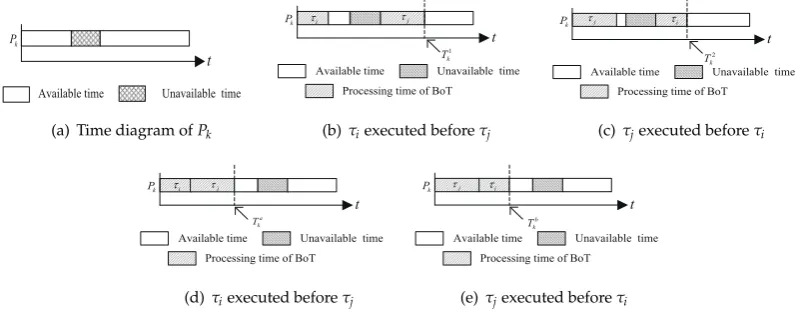
Case 1: As shown in Fig.4, suppose two tasksτi andτj are all allocated to processorPk, and
the workload of tasksτiandτjsatisfyτiσ <τjσ. In addition, tasksτiandτjcan executed in the first
available time segment on processorPkrespectively, butτiandτjcan not executed in the first available
time segment simultaneous. As shown in Fig.4(b), ifτi executed beforeτj, we should allocateτito
the first available time segment and allocate theτjto the second segment. So, the makespan of the
two tasks isTk1 = c2k+τjσwk. However, if τj executed beforeτi, the makespan of the two tasks is
Tk2=c2k+τiσwk. We haveτiσ<τjσ, soTk1>Tk2is obtained.
Case 2:As shown in Fig.4(d)and Fig.4(e), tasksτiandτjcan executed in the first available time
segment on processorPksimultaneous. Ifτiexecuted beforeτjas shown in Fig.4(d), the makespan of the
two tasks isTka =c1k+ (τiσ+τjσ)wk. Similarly, the makespan of the two tasks isTkb=c1k+ (τiσ+τjσ)wk
whenτjexecuted beforeτias shown in Fig.4(e). So, we can obtainTka=Tkb. From the above, we can
know that allocation order will effect the makespan of the tasks. If larger workload task allocated first, the makespan of tasks will equal to or shorter than that obtained by smaller workload task allocated first.
k P
t
Available time Unavailable time
(a) Time diagram ofPk
Processing time of BoT 1
k T k
P
t
Available time Unavailable time
i
W Wj
(b)τiexecuted beforeτj
Processing time of BoT
2
k T k
P
t
Available time Unavailable time
i W j
W
(c)τjexecuted beforeτi
Processing time of BoT
a k T k
P
t
Available time Unavailable time
i
W Wj
(d) τiexecuted beforeτj
Processing time of BoT b k
T
k
P
t
Available time Unavailable time
i W j W
(e)τjexecuted beforeτi
Figure 4.Influence of execute order on Makespan.
3.2. Processor Selection in Allocation
When the task queueTQis not empty, the first task is taken out and allocated to the processor. Since the objective is minimize the makespan of the tasks, so we must allocate the task on a processor that can be make the makespan is minimum. In our work, Eq.(12) and Eq.(13) is used to determine the processor that taskτishould be allocated to.
Φi= n
Pj|Pj ∈Ωi,∃1≤k≤mj ⇒τiσwj ≤dkj−ckj o
(12)
npproper =arg min
np
max
np∈Φi
Tnp
(13)
wherePnpis the processor in processors setΦithat the taskτican be allocated to, andnpproperis the
proper processor determined. Eq.(12) is to find the setΦithat the taskτican be allocated to inΩi. The
processors inΦishould satisfy two conditions: (1) the processors should in the setΩi. (2) At least a
3.3. Segment Selection in Allocation
After a proper processor determined, we should allocate taskτi to a optimal available time
segment on processorPnp. A excellent strategy that allocate task to a available time segment will help
to minimize makespan of the tasks. we use Eq.(14) and Eq.(15) to determine which segment should taskτiallocate to.
NS=nns|1≤ns≤mnp,dnsnp−cnsnp≥τiσwnp o
(14)
nsproper =arg min
ns n
dnsnp−cnsnp
|ns∈NSo (15)
Eq.(14) is used to find some available time segments that can complete taskτiin time on processor
Pnp. For the sake of decreasing time debris which can not complete any task in time, the shortest time
segment inNSis selected. There are two tasksτ1andτ2allocated on processorPk, andτ1σ >τ2σ.τ1can completed in segment 1 and 2, andτ1can completed in segment 2 and 3. Because the tasks in task queueTQare sorted in descending order according workload,τ1is allocated first beforeτ2. Forτ1, sinced1k−c1k<d2k−c2k, soτ1is allocate to segment 1 according to Eq.(15) as shown in Fig.5(b). Though segment 2 can completeτ2in time and segment 2 is before segment 3, we can see thatτ2is allocated to segment 3 from Fig.5(c). This strategy can help to decrease time debris and increase the utilization of the available time segment.
k P
t
Available time Unavailable time
(a) Time diagram ofPk
Available time Unavailable time
Processing time of BoT k
P
t 1
W
(b) Allocateτ1to segment 1
2
W
Available time Unavailable time
Processing time of BoT
k P
t
1
W
(c) Allocateτ2to segment 3
Figure 5.Segment determined.
3.4. The Strategy of Pull
After the process of allocate, all the tasks are allocated to the available time segments on processors. However, some available time segments are exit because the strategy that described in section3.3. As shown in Fig.6(a),τiis allocated to(j+1)thavailable time segment processorPk, so the processing
finish time ofPkisTk =cjk+1+τiσwk. Since thejthavailable time segment can complete taskτiin time,
we can pull taskτifrom(j+1)thavailable time segment tojthavailable time segment as shown in
Fig.6(b). So the processing finish time ofPkcan be denoted asTk0 =c j
k+τiσwk.Tk0 <Tkcan be obtained
intuitively. So, the strategy of pull tasks to another available time segment can decrease the processing finish time of processors. For the sake of decreasing the processing time of the processors as much as possible, we should solve following two problems:(1)which task should be pull to the objective segment? (2) which segment should be selected as the objective segment? These two issues will be tackled in section3.4.1and section3.4.2.
Available time Unavailable time
Processing time of BoT k
P
t
" P
available segment
th
j
i
W
(a) Time diagram ofPkafter tasks are allocated
Available time Unavailable time
Processing time of BoT k
P
t
" P
available segment th
j
i W
(b) Pullτitojthavailable time segment
3.4.1. Selection of Objective Task
In this paper, we investigate the bag-of-tasks scheduling problem, and the objective of scheduling algorithm is minimize makespan of thed tasks. The makepan of the tasks is determined by the processing finish time of all processors in the heterogeneous computing system. From Eq.(3), we can see that the processing finish timeTi(1≤ i ≤ N)is depended on the tasks completed time in last
available time segmentlwhich allocate tasks on processerPi. SupposeSubQl is the tasks set which
allocate to the last available time segmentl. Eq.(16) is used to determine the task which should be pull to another available time segment.
ntpro=arg min nt
{τiσ|τi ∈SubQl} (16)
3.4.2. Selection of Objective Segment
To decrease the processing finish time of processors, the strategy, which pulls a task to another segment, is designed. In this strategy, two problems should be solved. The problem of objective task determined has been tackled in section3.4.1. In this section, we will solve the other question. For the sake of guaranteeing the taskτntcompleted in time, the segmentnsprois selected according to Eq.(17).
nspro=arg min ns
ns|dnsk −cnsk >τprowk, 1≤ns≤l (17)
The strategy of pull task to another segment can decrease processing finish time as much as possible. First, the taskτntpro with largest workload is selected according to Eq.(16), and a available
time segmentnsprois selected according to Eq.(17). Ifnspro=∅, letSubQl =SubQl\ n
τntpro
o
, and then another taskτntpro is selected according to Eq.(16). Ifnspro 6= ∅, We pull the taskτntpro from
segmentlto the segmentnsprop.
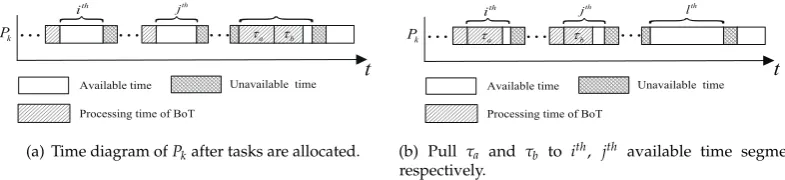
A example is presented in Fig.7. Taskτaandτbare allocated to thelthavailable time segment, and τaσ>τbσ. First,τaandτbare put intosubQl. According to Eq.(16), taskτais selected as the objective
task. Theithsegment is selected as the objective segment according to Eq.(17). Then, we pullτ ato
ithsegment and updatecik=cik+τaσwk. Sincenspro6=∅, we can select taskτbandjthsegment as the
objective task and objective segment respectively. Then, taskτbis pulled tojthsegment and update
ckj =cjk+τbσwk. Letl=l−1, a new round of pulling is conducted until the objective segment can not
found.
Available time Unavailable time
Processing time of BoT
k P
t
"
Pth
j
a
W
th
i
P
b
W
"
"
P(a) Time diagram ofPkafter tasks are allocated.
Available time Unavailable time
Processing time of BoT
k P
t
"
Pth
j
a W
th
i
P
b
W
"
"
Pth
l
(b) Pull τa and τb to ith, jth available time segment
respectively.
Figure 7.An example of pulling tasks to another available time segment.
3.5. Allocation Divisible Task
task. Then we will scheduling the small or large divisible task according to different strategy which described in section3.5.1and section3.5.2.
N
∑
j=1wj µj
∑
k=1φkj
!
≥τ0σ (18)
whereφkj andµjare thekthtime slot and number of time slot beforeTBoTon processorPj.
3.5.1. Small Divisible Task Scheduling
If the divisible task is regarded as a small task, it means that the divisible taskτ0can be completed in the time slot beforeTBoT. So, we can allocate the divisible task in the time slot as shown in Fig.8(a). In this case, we should solve two problems: (1)which processor should the divisible task allocate to? (2) which time slots in the processors should the divisible task allocate to? In our work, the method as follow is proposed to solve the two problems aforementioned. First,wj
∑µj k=1φkj
(j=1, 2,· · ·,N)
are sorted in descending order and put them into a arrayΓ. Then, the processors are determined by Eq.(19).
np=arg min
1≤np≤N
(np
∑
j=1Γj≥τ0σ
)
(19)
If∑nj=p1Γj = τ0σ, we will assign the divisible task onto the time slot on processors beforeΓnp.
Otherwise, we will assign the divisible task onto the time slot on processors beforeΓnp−1, and the
reminder workload(τ0σ−∑nj=p−11Γj)will allocate to processorΓnp−1. In this case, the makespan of the
hybrid tasks isTBoT.
3.5.2. Large Divisible Task Scheduling
If the divisible task is regarded as a large task, it means that the divisible taskτ0 can not be completed in the time slot beforeTBoT. In this case, we first allocate all the time slot beforeTBoT. Then, the reminder workloadτσ =τ0σ−∑Nj=1
wj
∑µj k=1φkj
will allocate to the available time afterTBoT as shown in Fig.8(b).
1 P
2 P
1
i
P
i P 1
i P
1
N P
N P
Available time Unavailable time
t
Processing time of BoT
BoT T
Time slot
Processing time of DT
(a) Allocation small divisible task to processors. 1
P
2 P
1
i
P
i P
1
i P
1
N P
N P
Available time Unavailable time
t
Processing time of BoT
BoT T
Time slot Processing time of DT
DT T
(b) Allocation large divisible task to processors.
Figure 8.Allocation Divisible task to processors.
In this case, the makespan of the tasks isTDT, and we haveTDT =T1. So the makespan of the hybrid tasks is calculated by Eq.(20).
TDT =T1=TBoT+s1+w1β1. (20)
The makespan of hybrid tasks can be calculated easily through Eq.(20).sidenotes the unavailable
time betweenTBoTandTDT of processorPi, andsiis related toTDT, so it is impossible to determinesi
whenTDTis not determined. For the sake of searching theTDT, a binary search algorithm is proposed
and its pseudocode is shown in algorithm2.
Algorithm 2:TDTand workloadβiare determined
Input:wi,[cjid j
i](i=1, 2,· · ·,N;j=1, 2,· · ·,mi), reminder workloadτσof divisible task;
Output:MakespanTDTand workloadβiassigned to processorPi;
1 min_time=0,max_time=
max 1≤i≤N{wi}
τσ;
2 whilemax_time−min_time>ξdo 3 %ξis a threshold of time;
4 mean_time= (max_time+min_time)/2;
5 Calculate unavailable timesi(i=1, 2,· · ·,N)betweenTBoTandTBoT+mean_timefor
everyPi;
6 The fractionsβi= (mean_time−si)/withat can be allocated toPiis calculated;
7 if∑iN=1βi <τσthen
8 min_time=mean_time;
9 else
10 max_time=mean_time;
11 end
12 end
13 TDT =TBoT+ (max_time+min_time)/2;
14 Calculate unavailable timesi(i=1, 2,· · ·,N)betweenTBoTandTBoT+mean_timefor every
Pi;
15 The fractionsβi= (mean_time−si)/withat can be allocated toPiis calculated;
4. GA for Hybrid Tasks Scheduling
Task scheduling is a NP hard problem in the well-known hardest combinatorial optimization problems. GA(generic algorithm, GA), which invented by Ehrlich and Raven[40], is employed to solve the task scheduling optimization model proposed in section2.2. GA is a efficient technique for many realistic application problems such as Control and Decision, image processing, and machine learning, etc[41,42].
4.1. Encoding and Population Initialization
Generally speaking, a suitable encoding scheme, which encodes the solutions in problem domain to a chromosome, is much more significant. A better encoding scheme will make the search easier by limiting the search space and converge to the global optimal solution rapidly. Based on what characterizes this optimization model for hybrid tasks scheduling problem, the encoding scheme of integer is adopted for bag-of-tasks. A arrayC2B×N
τ = (c
B
ij)2×Nτis represented as a list of 2×Nτelements, called chromosome. For a specific taskτj(1≤j≤Nτ), we havec1Bj=aandc2Bj=bif only and if the
taskτjallocate to thebthavailable time segment of processorPa. In addition, a real coding scheme is
employed. A arrayCDN×Ng = (cijD)N×Ngis chromosome for divisible task, whereNs =1max≤i≤N{mi}. In
CND×Ng, we havec D
ij =α
j
i(1≤i≤N, 1≤j≤mi)andcijD=0(1≤i≤N,mi≤ j≤Ng). We can obtain
Algorithm 3:Encoding and population initialization Input:N,Nτ, population sizePopsize;
Output:Initial populationPop_BoTandPop_DT;
1 fori=1to Popsizedo 2 InitialPop_BoT:
3 forj=1to Nτdo
4 f lag_allocated=0;
5 while f lag_allocated==0do
6 pΩjpermutation of the elements inΩj;
7 A random integer is generated in[1,size(Ωj)], denoted ask1;
8 Pop_BoT(1,j,i) =pΩj(k1);
9 f lag_segment=0;
10 while f lag_segment==0do
11 Letnp=Pop_BoT(1,j,i);pMis a permutation of elements1, 2,· · ·,np ;
12 A random integer is generated in[1,mnp], denoted ask2;
13 ifckn2p+τjσwnp ≤dkn2pthen
14 f lag_segment=1;
15 Pop_BoT(2,j,i) =pM(k2);
16 end
17 end
18 iff lag_segment==1then 19 f lag_allocated=1;
20 ckn2p =cnk2p+τjσwnp;
21 end
22 end
23 end
24 InitialPop_DT: 25
cD ij
N×Ng
is generated randomly, and all the elements range from 0 to 1;
26 forj=1to Ndo
27 fork=1to Ngdo
28 ifk<mjthen
29 Pop_DT(j,k,i) =cDjk
. N
∑
j=1
mj
∑
k=1 cDij
!
;
30 else
31 Pop_DT(j,k,i) =0;
32 end
33 end
34 end
4.2. Crossover Operator
For the sake of increasing diversity of the individuals in population, a crossover operator for divisible task(DT) coding presented in algorithm4respectively. To decrease the makespan of the tasks, the divisible load should be assigned to the former segment of the processors. So, two weight coefficients, which decrease gradually, are used in step11and12.
Algorithm 4:Crossover operator for DT coding
Input:IndividualC1inPop_DT, probabilitypn;
Output:OffspringsO1andO2for DT;
1 ifrand()< pnthen
2 An individualC2is selected in the neighborhoodsneiber(C1)of individualC1;
3 else
4 An individualC2is selected in the population except for theneiber(C1);
5 end
6 O1=C1,O2=C2;
7 fori=1to Ndo
8 minumbers are generated randomly, and put them intoWaccording to descend order.
9 W=W
mi
∑
j=1 W(j);
10 forj=1to mido
11 O1ij=Oij1+W(j)× |O1ij−O2ij|;
12 O2ij=Oij2+W(j)× |O1ij−O2ij|;
13 end
14 end
15 O1=O1
. N
∑
i=1
mi
∑
j=1 O1ij
!
,O2=O2. ∑N
i=1
mi
∑
j=1 O2ij
!
;
4.3. Mutation Operator
Mutation, which can change some gene values in a parent individual to a new state, is a genetic operator. A better mutation operator can produce entirely novel offspring individuals and improve diversity of the population. With these new individuals, the genetic algorithm may obtain a better solution than previously one possible. Mutation is an essential operator in generic algorithm, and it can help to make the populations escape the local optimum. Suppose that the chromosomeC = (cij)2×NτandC
D = (cD
ij)N×Ng are chosen to take part in mutation, and the offspringC 0 = (c0
ij)2×Nτ, CD0= (cDij0)N×Ng are obtained by the mutation as shown in algorithm5and algorithm6respectively.
Similar to algorithm4, weight coefficients are used too.
{npbest,nsbest}=arg min np,ns
(
max
np∈Ωi,1≤ns≤mnp
Tnp )
(21)
wherenpis the processor number of a tasks allocated to andns is the available time segment on processorPnp. Eq.(21) is used to search a best processorPnpbestand available time segmentnsbetteron
processorPnpbestfor tasksτito make the maximum processing finish time of the processors inΩiis
minimum.
4.4. Local Search Operator
Algorithm 5:Mutation operator for BoT coding Input:IndividualC= (cij)2×Nτ;
Output:OffspringC0 = (c0ij)2×Nτ;
1 C0 =C;
2 Two random integeri,j(i< j)are generated; 3 fork=i to jdo
4 Letnp=i+j−k;
5 ifC(1,np)∈Ωiand C(2,np)≤mC(1,np)then
6 C01k =C1np;
7 C02k =C2np;
8 else
9 Calculatenpbestandnsbestby Eq.(21);
10 C01k =npbest;
11 C02k =nsbest;
12 end
13 end
Algorithm 6:Mutation operator for DT coding Input:IndividualCD= (cijD)N×Ng and constantF;
Output:OffspringCD0= (cD0 ij )N×Ng;
1 CD0=CD;
2 fori=1to Ndo
3 minumbers are generated randomly, and put them intoWaccording to descend order.
4 W=W
mi
∑
j=1 W(j);
5 forj=1to mido
6 ifcDij <0.5then
7 δ= (1−cijD)1+F;
8 else
9 δ= (cDij)1+F;
10 end
11 R=rand();
12 ifR<0.5then
13 σ=1−(2R+ (1−2R)δ)
1
1+F;
14 else
15 σ=1−(2(1−R) +2δ(R−0.5))
1
1+F;
16 end
17 cijD0=cijD+W(j)σ;
18 end
19 CD0=CD0
. N
∑
i=1
mi
∑
j=1 cDij0
!
;
chromosomeC= (cij)2×NτandC
D = (cD
ij)N×Ng, the offspringC 0 = (c0
ij)2×NτandC
D0 = (cD0 ij )N×Ng
are obtained by local search operator as shown in algorithm7.
nsbetter =arg min
ns (
max 1≤ns≤mnp
Tnp )
(22)
wherenpis the processor number that the tasks is allocated to. Eq.(22) is used to search a better available time segmentnsbetterin processorPnp.
Algorithm 7:Local search operator
Input:C= (cij)2×Nτ,C
D= (cD ij)N×Ng;
Output:C0 = (c0ij)2×Nτ,C
D0= (cD0 ij )N×Ng;
1 C0 =C,CD0=CD;
2 fori=1to Nτdo
3 Calculatensbetterby Eq.(22); 4 ifnsbetter 6=C(2,i)then
5 C02i =nsbetter;
6 end
7 end
8 fori=1to Ndo
9 Two integerj1,j2and a random 0<R<1 are generated randomly, and 1≤j1<j2≤mi;
10 cijD0
1 =c
D
ij2(1+R),c
D0 ij2 =c
D
ij2(1−R);
11 end
4.5. Modify Operator
For the sake of accelerating the convergence of generic algorithm and minimizing makespan of the tasks, a modify operator is designed. The pseudocode of the modify operator is shown in algorithm8. ChromosomeC = (cij)2×Nτ andC
D = (cD
ij)N×Ng will modified asC 0 = (c0
ij)2×Nτ and CD0= (cDij0)N×Ng according to the modify operator.
5. TSGA for Hybrid Tasks Scheduling
To solve the optimization model, a generic algorithm is designed in section4. In GA, the allocation scheme of BoT and divisible task are both determined, a large search space exits. So, we propose a two step scheduling algorithm to minimizing makespan of the hybrid tasks. We first scheduling the bag-of-tasks using GA proposed in section4, and then the divisible task is scheduled through the methods described in section3.5.1and section3.5.2. The framework of the algorithm is shown in algorithm9.
6. Experiments and Analysis
Several experiments are presented in this section to show the efficiency of the proposed algorithm. In section6.1, some parameters used in the algorithms will be given. Experimental results are presented in section6.2. Finally, the experimental results are analyzed in section6.3.
6.1. Parameters Value
6.1.1. Tasks parameters
Algorithm 8:Modify operator
Input:C= (cij)2×Nτ,C
D= (cD ij)N×Ng;
Output:C0 = (c0ij)2×Nτ,C
D0= (cD0 ij )N×Ng;
1 C0 =C,CD0=CD;
2 fori=1to Ndo
3 forj=mito2do
4 Ψijis the tasks set allocated tojthavailable time segment of processorPi, and the tasks
sorted descending order according to workload;
5 fork=size(Ψi)to1do
6 if∃p<j satisfyτσ
Ψj i(k)
wi<dp−cpthen
7 ifΨji(k)6=0then
8 c0
2Ψji(k)=p;
9 else
10 cipD0=cipD0+cDij0;
11 cijD0=0;
12 end
13 end
14 end
15 end
16 end
Algorithm 9:Framework of TSGA algorithm
Input:Tasksτi(i=1,· · ·,Nτ), speed indexwiand available time[cji,d j
i](j=1,· · ·,mi)of
processorPi(i=1,· · ·,N);
Output:a schedule scheme;
1 Scheduling BoT by GA;
2 ifdivisible task workload is smallthen
3 Scheduling the divisible task according to the method proposed in section3.5.1;
4 else
5 Scheduling the divisible task according to algorithm2;
tasks numberNτis varying between 50 and 500. In addition, the processors setΩi(1≤i≤Nτ), which
can process taskτi(1≤i≤Nτ), is generated as follow:nris a random number in(0, 1],npro=bnrNc.
Then,nproprocessors are selected inPand put them inΩi. In our experiments, the workload of the
divisible task is generated randomly in
"
1
N N
∑
i=1
mi−1 ∑
j=1
wi(dji−c j i)
, ∑N
i=1
mi−1 ∑
j=1
wi(dji−c j i)
#
.
6.1.2. System parameters
In this section, we show our simulation system parameters. The simulation system has 20 heterogeneous slave processors, and the time consuming for unit workload wsi(1 ≤ i ≤ Ns) of Pi(1≤i ≤ Ns)in the heterogeneous distributed system is referred to Shang[43], whereNs denote
the number of processors in simulation system. The available time segment mi on processor Pi
is generated randomly in [5, 12]. The length ofkth(1 ≤ k < mi) on Pi is generated randomly in
wi× mean
1≤i≤Nτ
{τiσ}, 3wi× mean
1≤i≤Nτ {τiσ}
. Ifk= mi,dki can equal to+∞, that is to say, the processorPi
can processing tasks all the time inmth
i available time segment.
6.1.3. Generic algorithm parameters
In this paper, GA denotes the algorithm of generic algorithm without local search operator, and generic algorithm with local search and modify operator denoted as GALM. Similarly, GAL and GAM are indicated as the generic algorithm with local search and modify operator proposed in section4
respectively. TSGA denotes the algorithm proposed in section5without local search operator, TSGAL, TSGAM and TSGALM are denote the two step scheduling algorithm with local search or modify operator. In the algorithm of GA, GAL, GAM, GALM, TSGA, TSGAL, TSGAMA and TSGALM, the following parameters are chosen: population sizePopsize =100, crossover probabilitypc=0.8,
mutation probabilitypm=0.05, elitist numberE=5 and maximum iterationsGmax= Nτ. Since the
concept of neighborhoods of a individual is employed, neighbor sizeT=10 in our experiments. 6.2. Simulation Results
As there is no algorithm available in the literature for scheduling hybrid task in heterogeneous system with unavailable time segment constraints. To evaluate the effectiveness of the proposed scheduling algorithm, we first will present a performance evaluation study in simulation system. First, we will evaluate the nine algorithms (BoTAPDTA, GA, GAL, GAM, GALM, TSGA, TSGAL, TSGAM and TSGALM) on makespan for various tasks number (Nτ) and workload size, and the makespan
obtained by the five algorithms are shown in Fig.9(a)to Fig.9(f).
To evaluate the convenience of the eight algorithms(GA, GAL, GAM, GALM, TSGA, TSGAL, TSGAM, TSAGALM), convergence performance of the four algorithms are shown in Fig.10(a)to
Fig.10(d). In this experiment, a specific number of task is selected, Nτ = 50, and the maximum
iterationsGmax =1000 in every group experiment.
What is more, we evaluate the robustness of the eight algorithm(GA, GAL, GAM, GALM, TSGA, TSGAL, TSGAM, TSAGALM). In the experiments, every algorithm is executed 30 times independently. Workload of the bag-tasks are uniform distribution in [1000 5000], and the number of task ranges from 50 to 500. The statistics results of the four algorithms are shown in Fig.11(a)to Fig.11(h)respectively using Box-whisker Plot.
6.3. Experimental Analysis
50 100 150 200 250 300 350 400 450 500 3.16 3.18 3.2 3.22 3.24 3.26 3.28 3.3 3.32 3.34 3.36 BoTAPDTA GA GAL GAM GALM TSGA TSGAL TSGAM TSGALM
(a) 1000≤τiσ≤2000
50 100 150 200 250 300 350 400 450 500
3.2 3.25 3.3 3.35 3.4 3.45 BoTAPDTA GA GAL GAM GALM TSGA TSGAL TSGAM TSGALM
(b) 500≤τiσ≤3000
50 100 150 200 250 300 350 400 450 3.2 3.25 3.3 3.35 3.4 3.45 BoTAPDTA GA GAL GAM GALM TSGA TSGAL TSGAM TSGALM
(c) 1000≤τiσ≤4000
50 100 150 200 250 300 350 400 450 500
3.28 3.3 3.32 3.34 3.36 3.38 3.4 3.42 3.44 3.46 3.48 BoTAPDTA GA GAL GAM GALM TSGA TSGAL TSGAM TSGALM
(d) 1000≤τiσ≤5000
50 100 150 200 250 300 350 400 450 500
3.3 3.32 3.34 3.36 3.38 3.4 3.42 3.44 3.46 BoTAPDTA GA GAL GAM GALM TSGA TSGAL TSGAM TSGALM
(e) 1000≤τiσ≤6000
50 100 150 200 250 300 350 400 450 500
3.3 3.32 3.34 3.36 3.38 3.4 3.42 3.44 3.46 3.48 BoTAPDTA GA GAL GAM GALM TSGA TSGAL TSGAM TSGALM
(f) 1000≤τiσ≤7000
Figure 9.Makespan in small simulation system.
0 200 400 600 800 1000 0 200 400 600 800 3.4 3.5 3.6 3.7 3.8 3.9 4 4.1 4.2
Number of generation
Makespan
GA GAL GAM GALM
(a) 1000≤τiσ≤2000
0 200 400 600 800 1000 3.5 3.6 3.7 3.8 3.9 4 4.1 4.2 4.3
Number of generation
Makespan
GA GAL GAM GALM
(b) 1000≤τiσ≤3000
0 200 400 600 800 1000 3.6 3.7 3.8 3.9 4 4.1 4.2 4.3 4.4 4.5
Number of generation
Makespan
GA GAL GAM GALM
(c) 1000≤τiσ≤4000
0 200 400 600 800 1000 3.6 3.7 3.8 3.9 4 4.1 4.2 4.3 4.4 4.5
Number of generation
Makespan
GA GAL GAM GALM
(d) 1000≤τiσ≤5000
Figure 10.Convergence of the four algorithms in simulation system.
50 100 150 200 250 300 350 400 450 500 3.32 3.33 3.34 3.35 3.36 3.37 3.38
Number of tasks
Makespan
(a) The robustness of GA
50 100 150 200 250 300 350 400 450 500 3.32 3.33 3.34 3.35 3.36 3.37 3.38
Number of tasks
Makespan
(b) The robustness of GAL
50 100 150 200 250 300 350 400 450 500 3.32 3.33 3.34 3.35 3.36 3.37 3.38
Number of tasks
Makespan
(c) The robustness of GAM
50 100 150 200 250 300 350 400 450 500 3.32 3.33 3.34 3.35 3.36 3.37 3.38
Number of tasks
Makespan
(d) The robustness of GALM
50 100 150 200 250 300 350 400 450 500 3.32 3.33 3.34 3.35 3.36 3.37
Number of tasks
Makespan
(e) The robustness of TSGA
50 100 150 200 250 300 350 400 450 500 3.32 3.33 3.34 3.35 3.36 3.37
Number of tasks
Makespan
(f) The robustness of TSGAL
50 100 150 200 250 300 350 400 450 500 3.32 3.33 3.34 3.35 3.36 3.37
Number of tasks
Makespan
(g) The robustness of TSGAM
50 100 150 200 250 300 350 400 450 500 3.32 3.33 3.34 3.35 3.36 3.37
Number of tasks
Makespan
(h) The robustness of TSGALM
and GAM can convergent to a better solution than GA. That is to say, makespan obtained by GAL and GAM both are smaller than that obtained by GA. GALM is a algorithm that local search and modified operator are added into GA. So, makespan obtained by GALM is smallest. However, GAL is hard to tell from GAM. Because local search operator and modified operator both are search a local optimal solution by changing scheduling scheme of a task. As shown in the Fig.9, we can see that makespan obtained by GALM is smallest, and makespan obtained by GA is largest among the four algorithms(GA, GAL, GAM and GALM). Makespan obtained by GAL is smaller than that obtained by GAM in some cases. But, the opposite results can be obtained in other cases.
In additional, convergence of proposed four algorithms including GA, GAL, GAM and GALM are investigated in a simulation system. In this paper, we design a local search operator and a modify operator, and the two optimization algorithms referred as GAL and GAM. Local search operator and modified operator are conducive to increasing the diversity of the solutions and searching a local optimal solution in search space. On the one hand, local search operator can generate a better offspring than its parent individual by changing the value of a gene. On the other hand, modified operator can also decrease the processing finish time of a processor as much as possible. For a specific generation, the offsprings obtained by local search operator and modified operator will have better fitness than their parents. So, GAL and GAM can convergent to global optimal solution quickly. That is to say, GAL and GAM have a higher convergent speed than GA. However, we can not tell good or bad for GAL and GAM. As we can see in the experimental results, GAL is better than GAM in some cases, and GAM is better than GAL in others case. Because local search operator and modified operator are both searching a local optimal solution by changing scheduling scheme of a task. GALM is a algorithm that comprise of GA, local search operator and modified operator. So, it can convergent to a global optimal solution as fast as possible. As shown in the Fig.9, GALM has a highest convergent speed among the four algorithms (GA, GAL, GAM and GALM), and the convergent speed of GA is lowest.
What is more, the robustness of the four algorithms are investigated in simulation system. Fig.11(a)
to Fig.11(d)give the robustness of GA, GAL, GAM and GALM in simulation system for various task number. From the figures, we can see that the four algorithms have a high robustness for various task number. With increasing of the tasks and processors, much more local optimal solutions exit. So, the robustness of the four algorithms are much higher in a simulation system for the same task number.
7. Conclusion
In this paper, we investigate a hybrid tasks comprising both bag-of-tasks(BoT) and divisible tasks scheduling problem with unavailable time considered in heterogeneous distributed system. For the sake of minimizing the makespan of the tasks, a mathematical optimization model with the unavailable time constraint is established. To solve the optimization model effectively, a hybrid scheduling algorithms with local search or modified operator are designed. Makespan obtained by the four algorithms with various number of tasks and workload are evaluated. In addition, convergence and robustness of eight algorithm (GA, GAL, GAM and GALM) are evaluated in the simulation system. Experimental results show that the four algorithms proposed are efficiency. What is more, the four algorithms(GA, GAL, GAM and GALM) can converge to a better makespan and have a better robustness.
Author Contributions:Hejun Xuan (H.X.) contributed to the concept of the research, performed the data analysis and wrote the manuscript; Shiwei Wei (S.W) and Yanling Li (Y.L.) helped perform the data analysis with constructive discussions and helped performed the experiment. Ran Li (R.L.) and Wuning Tong (W.T.) revised the manuscript, and provided the necessary support for the research.
1. Foster, I.; Kesselman, C.; others. The Grid 2: Blueprint for a future computing infrastructure. Waltham:
Morgan Kaufmann Publishers2004.
2. Wang, X.; Veeravalli, B. Performance Characterization on Handling Large-Scale Partitionable Workloads on Heterogeneous Networked Compute Platforms.IEEE Transactions on Parallel & Distributed Systems2017,
28, 2925–2938.
3. Wang, X.; Wang, Y.; Cui, Y. A new multi-objective bi-level programming model for energy and locality aware multi-job scheduling in cloud computing.Future Generation Computer Systems2014,36, 91–101. 4. Sajid, M.; Raza, Z.; Shahid, M. Energy-efficient scheduling algorithms for batch-of-tasks (BoT) applications
on heterogeneous computing systems.Concurrency and Computation: Practice and Experience2015. 5. Srinivasan, S.; Jha, N.K. Safety and reliability driven task allocation in distributed systems.Parallel and
Distributed Systems, IEEE Transactions on1999,10, 238–251.
6. Lee, Y.C.; Zomaya, A.Y. Practical scheduling of bag-of-tasks applications on grids with dynamic resilience.
Computers, IEEE Transactions on2007,56, 815–825.
7. Anglano, C.; Canonico, M. Scheduling algorithms for multiple bag-of-task applications on desktop grids: A knowledge-free approach. Proceedings of Parallel and Distributed Processing, 2008. IPDPS 2008. IEEE International Symposium on. IEEE, 2008, pp. 1–8.
8. Iosup, A.; Sonmez, O.; Anoep, S.; Epema, D. The performance of bags-of-tasks in large-scale distributed systems. Proceedings of the 17th international symposium on High performance distributed computing. ACM, 2008, pp. 97–108.
9. Beaumont, O.; Carter, L.; Ferrante, J.; Legrand, A.; Marchal, L.; Robert, Y. Centralized versus distributed schedulers for bag-of-tasks applications. Parallel and Distributed Systems, IEEE Transactions on2008,
19, 698–709.
10. Benoit, A.; Marchal, L.; Pineau, J.F.; Robert, Y.; Vivien, F. Scheduling concurrent bag-of-tasks applications on heterogeneous platforms. Computers, IEEE Transactions on2010,59, 202–217.
11. Celaya, J.; Arronategui, U. Fair scheduling of bag-of-tasks applications on large-scale platforms.Future
Generation Computer Systems2015,49, 28–44.
12. Yang, Y.; Peng, X.; Wan, X. Security-aware data replica selection strategy for Bag-of-Tasks application in cloud computing. Journal of High Speed Networks2015,21, 299–311.
13. Oxley, M.A.; Pasricha, S.; Maciejewski, A.A.; Siegel, H.J.; Apodaca, J.; Young, D.; Briceno, L.; Smith, J.; Bahirat, S.; Khemka, B.; others. Makespan and energy robust stochastic static resource allocation of a Bag-of-tasks to a heterogeneous computing system. Parallel and Distributed Systems, IEEE Transactions on
2015,26, 2791–2805.
14. Zhang, F.; Cao, J.; Li, K.; Khan, S.U.; Hwang, K. Multi-objective scheduling of many tasks in cloud platforms.Future Generation Computer Systems2014,37, 309–320.
15. Schmidt, G. Scheduling with limited machine availability. European Journal of Operational Research2000,
121, 1–15.
16. Hoong Chuin LAU, C.Z. Job Scheduling with Unfixed Availability Constraints. Proceedings of the 35th Meeting of the Decision Sciences Institute(DSI). ACM, 2004, pp. 4401–4406.
17. Qin, X.; Xie, T. An availability-aware task scheduling strategy for heterogeneous systems.Computers, IEEE
Transactions on2008,57, 188–199.
18. Adiri, I.; Bruno, J.; Frostig, E.; Kan, A.R. Single machine flow-time scheduling with a single breakdown.
Acta Informatica1989,26, 679–696.
19. Sheen, G.J.; Liao, L.W. Scheduling machine-dependent jobs to minimize lateness on machines with identical speed under availability constraints. Computers&operations research2007,34, 2266–2278.
20. Kacem, I.; Sadfi, C.; El-Kamel, A. Branch and bound and dynamic programming to minimize the total completion times on a single machine with availability constraints. Proceedings of Systems, Man and Cybernetics, 2005 IEEE International Conference on. IEEE, 2005, Vol. 2, pp. 1657–1662.
21. Vahedi-Nouri, B.; Fattahi, P.; Ramezanian, R. Minimizing total flow time for the non-permutation flow shop scheduling problem with learning effects and availability constraints.Journal of Manufacturing Systems
22. Wang, X.; Cheng, T.E. An approximation scheme for two-machine flowshop scheduling with setup times and an availability constraint.Computers&operations research2007,34, 2894–2901.
23. Tong, Z.; Li, K.; Xiao, Z.; Qin, X. H2ACO: An Optimization Approach to Scheduling Tasks with Availability Constraint in Heterogeneous Systems. Journal of Internet Technology2014,15, 115–124.
24. Tong, Z.; Li, K.; Xiao, Z.; Qin, X. A QoS Scheduling Scheme with Availability Constraint in Distributed Systems. Parallel and Distributed Computing, Applications and Technologies (PDCAT), 2012 13th International Conference on. IEEE, 2012, pp. 481–486.
25. Yuan, H.; Wang, Y.; Chen, L. An availability-aware task scheduling for heterogeneous systems using quantum-behaved particle swarm optimization. InAdvances in Swarm Intelligence; Springer, 2010; pp. 120–127.
26. Zhou, L.; Wang, H.; Lian, S.; Zhang, Y.; Vasilakos, A.; Jing, W. Availability-aware multimedia scheduling in heterogeneous wireless networks. Vehicular Technology, IEEE Transactions on2011,60, 1161–1170.
27. Robertazzi, T.G. Ten reasons to use divisible load theory. Computer2003,36, 63–68.
28. Chou, F.D. Particle swarm optimization with cocktail decoding method for hybrid flow shop scheduling problems with multiprocessor tasks.International Journal of Production Economics2013,141, 137–145. 29. Marichelvam, M.K.; Prabaharan, T.; Yang, X.S. A discrete firefly algorithm for the multi-objective hybrid
flowshop scheduling problems. Evolutionary Computation, IEEE Transactions on2014,18, 301–305. 30. Hu, M.; Veeravalli, B. Dynamic scheduling of hybrid real-time tasks on clusters. Computers, IEEE
Transactions on2014,63, 2988–2997.
31. Lee, W.Y.; Hong, S.J.; Kim, J. On-line scheduling of scalable real-time tasks on multiprocessor systems.
Journal of Parallel and Distributed Computing2003,63, 1315–1324.
32. Doulamis, N.D.; Doulamis, A.D.; Varvarigos, E.A.; Varvarigou, T.A. Fair scheduling algorithms in grids.
Parallel and Distributed Systems, IEEE Transactions on2007,18, 1630–1648.
33. Hu, M.; Veeravalli, B. Requirement-Aware Scheduling of Bag-of-Tasks Applications on Grids with Dynamic Resilience. Computers, IEEE Transactions on2013,62, 2108–2114.
34. Xiao, L.; Zhu, Y.; Ni, L.M.; Xu, Z. Incentive-based scheduling for market-like computational grids. Parallel
and Distributed Systems, IEEE Transactions on2008,19, 903–913.
35. Veeravalli, B.; Li, X.; Ko, C.C. On the influence of start-up costs in scheduling divisible loads on bus networks. Parallel and Distributed Systems, IEEE Transactions on2000,11, 1288–1305.
36. Kim, H.; Mani, V. Divisible load scheduling in single-level tree networks: Optimal sequencing and arrangement in the nonblocking mode of communication. Computers & mathematics with applications2003,
46, 1611–1623.
37. Charcranoon, S.; Robertazzi, T.G.; Luryi, S. Parallel processor configuration design with processing/transmission costs.IEEE Transactions on Computers2000, pp. 987–991.
38. Bharadwaj, V.; Xiaolin, L.; Ko, C.C. Design and analysis of load distribution strategies with start-up costs in scheduling divisible loads on distributed networks.Mathematical and computer modelling2000,32, 901–932. 39. Wang, M.; Wang, X.; Meng, K.; Wang, Y. New model and genetic algorithm for divisible load scheduling in
heterogeneous distributed systems. International Journal of Pattern Recognition and Artificial Intelligence2013,
27, 1359005.
40. Ehrlich, P.R.; Raven, P.H. Butterflies and plants: a study in coevolution.Evolution1964, pp. 586–608. 41. Sastry, K.; Goldberg, D.E.; Kendall, G. Genetic algorithms. InSearch methodologies; Springer, 2014; pp.
93–117.
42. Ding, W.; Guan, Z.; Shi, Q.; Wang, J. A more efficient attribute self-adaptive co-evolutionary reduction algorithm by combining quantum elitist frogs and cloud model operators. Information Sciences2015,
293, 214–234.
43. Mingsheng, S. Optimal algorithm for scheduling large divisible workload on heterogeneous system.