- 1 -
Title:
1
Ontological and bioinformatic analysis of anti-coronavirus drugs and their implication for
2
drug repurposing against COVID-19
3 4
Yingtong Liu1, Wallace K.B. Chan2, Zhigang Wang3, Junguk Hur4, Jiangan Xie5, Hong
5
Yu6,7, Yongqun He1,8*
6 7
1. Department of Computational Medicine and Bioinformatics, University of Michigan Medical 8
School, Ann Arbor, MI 48109, USA. 9
2. Department of Pharmacology, University of Michigan Medical School, Ann Arbor, MI 10
48109, USA. 11
3. Department of Biomedical Engineering, Institute of Basic Medical Sciences and School of 12
Basic Medicine, Peking Union Medical College and Chinese Academy of Medical Sciences, 13
Beijing 100005, China. 14
4. University of North Dakota School of Medicine and Health Sciences, Grand Forks, ND 15
58202, USA. 16
5. School of Bioinformatics, Chongqing University of Posts and Telecommunications, 17
Chongqing 400065, China. 18
6. Department of Respiratory and Critical Care Medicine, Guizhou Province People’s Hospital 19
and NHC Key Laboratory of Immunological Diseases, People’s Hospital of Guizhou 20
University, Guiyang, Guizhou 550002, China. 21
7. Department of Basic Medicine, Guizhou University Medical College, Guiyang, Guizhou 22
550025, China. 23
8. Unit for Laboratory Animal Medicine and Department of Microbiology and Immunology, 24
University of Michigan Medical School, Ann Arbor, MI 48109, USA. 25
26
* Corresponding author
27 28
Email addresses: 29
YL: [email protected] 30
ZW: [email protected] 32
JH: [email protected] 33
JX: [email protected] 34
HY: [email protected] 35
YH: [email protected] 36
37
Keywords: Coronavirus, Drug, COVID-19, SARS, MERS, ontology, ChEBI, NDF-RT,
38
DrON, bioinformatics.
39 40
Submitted to:
41
Preprints.org
42
Abstract
44
Coronavirus-infected diseases have posed great threats to human health. In past years, 45
highly infectious coronavirus-induced diseases, including COVID-19, SARS, and MERS, have 46
resulted in world-wide severe infections. Our literature annotations identified 110 chemical drugs 47
and 26 antibodies effective against at least one human coronavirus infection in vitro or in vivo. 48
Many of these drugs inhibit viral entry to cells and viral replication inside cells or modulate host 49
immune responses. Many antimicrobial drugs, including antimalarial (e.g., chloroquine and 50
mefloquine) and antifungal (e.g., terconazole and rapamycin) drugs as well as antibiotics (e.g., 51
teicoplanin and azithromycin) were associated with anti-coronavirus activity. A few drugs, 52
including remdesivir, chloroquine, favipiravir, and tocilizumab, have already been reported to be 53
effective against SARS-CoV-2 infection in vitro or in vivo. After mapping our identified drugs to 54
three ontologies ChEBI, NDF-RT, and DrON, many features such as roles and mechanisms of 55
action (MoAs) of these drugs were identified and categorized. For example, out of 57 drugs with 56
MoA annotations in NDF-RT, 47 have MoAs of different types of inhibitors and antagonists. A 57
total of 29 anticoronaviral drugs are anticancer drugs with the antineoplastic role. Two clustering 58
analyses, one based on ChEBI-based semantic similarity, the other based on drug chemical 59
similarity, were performed to cluster 110 drugs to new categories. Moreover, differences in 60
physicochemical properties among the drugs were found between those inhibiting viral entry and 61
viral replication. A total of 163 host genes were identified as the known targets of 68 anti-62
coronavirus drugs, resulting in a network of 428 interactions among these drugs and targets. 63
Chlorpromazine, dasatinib, and anisomycin are the hubs of the drug-target network with the 64
highest number of connected target proteins. Many enriched pathways such as calcium signaling 65
and neuroactive ligand-receptor interaction pathways were identified. These findings may be 66
used to facilitate drug repurposing against COVID-19. 67
1.
Background
70
The COVID-19 outbreak, caused by SARS-CoV-2, has become a pandemic and is now 71
spreading worldwide. As of May 29, 2020, over 5,701,000 cases, which includes over 3572,000 72
deaths, have been reported to WHO. In addition to COVID-19, two other coronavirus-induced 73
diseases, including Severe Acute Respiratory Syndrome (SARS) (Xu, 2013) and Middle East 74
Respiratory Syndrome (MERS) (Zaki et al., 2012), had also caused huge damages previously to 75
public health. SARS emerged in China in November 2002, which lasted for 8 months and 76
resulted in 8,098 confirmed human cases in 29 countries with 774 deaths (case-fatality rate: 77
9.6%) (Control and Prevention, 2003;Xu, 2013). Approximately 10 years later in June 2012, the 78
MERS-CoV, another highly pathogenic coronavirus, was isolated in Saudi Arabia from the 79
sputum of a male patient who died from acute pneumonia and renal failure (Zaki et al., 2012). 80
MERS-CoV has caused outbreaks with 2,260 cases in 27 countries and 803 deaths 81
(35.5%)(WHO, 2018;Bernard-Stoecklin et al., 2019). To successfully fight against coronavirus 82
infections, intensive studies are required to identify effective and safe measures. 83
Drug administration is a major way to control coronavirus infections. There have been a 84
large number of studies to discover and develop drugs targeted to these coronaviruses. Many 85
studies have achieved various levels of success in vitro and in vivo (as detailed in this manuscript 86
later). By integrating the results of previous anti-coronavirus drugs, we may find clues for the 87
development and improvement of drugs to treat COVID19. Existing drugs might be repurposed 88
for treating COVID-19. Enriched patterns extracted from all existing anti-coronavirus drugs may 89
lead to the development of new drugs. 90
In the informatics field, a formal ontology is a human- and computer-interpretable set of 91
terms and relations that represent entities in a specific biomedical domain and how they relate to 92
each other. Ontology has played a significant role in knowledge and data standardization, 93
integration, and analysis (Ashburner et al., 2000;Bodenreider, 2008;Schulz et al., 94
2013;Hoehndorf et al., 2015). Three ontologies, including Chemical Entities of Biological 95
Interest ontology (ChEBI)(Hastings et al., 2016), National Drug File – Reference Terminology 96
(NDF-RT) (Peters et al., 2015), and Drug Ontology (DrON) (Hogan et al., 2017), have been 97
frequently used for drug studies (Tao et al., 2016;Liu et al., 2017). ChEBI is a database and 98
ontology of over 56,000 molecular entities with a focus on small chemical compounds. ChEBI 99
functional features. Produced by the U.S. Department of Veterans Affairs, NDF-RT organizes 101
drugs in a hierarchical and formal representation by modeling drug characteristics including 102
ingredients, chemical structure, physiologic effect, mechanism of action, pharmacokinetics, etc. 103
DrON provides an ontological representation of the drug contents on the RxNorm terminology 104
(Bodenreider and Rodriguez, 2014) that contains all medications available on the US market. 105
Once a list of drugs is identified, tools such as Ontofox (Xiang et al., 2010) can be used to extract 106
these drugs and their related characteristics from an ontology and perform specific analyses (Guo 107
et al., 2016;Xie et al., 2016;Wang et al., 2017;Yu et al., 2019). 108
In this study, we reported our systematic collection, annotation, and analysis of various 109
anti-coronavirus drugs from the biomedical literature. Over 90 chemical drugs and antibodies 110
against human coronavirus diseases were identified. We mapped the majority of these drugs to 111
the ontologies ChEBI (Hastings et al., 2016), NDF-RT (Peters et al., 2015), and DrON (Hogan et 112
al., 2017). We applied ontology to categorize these drugs and used ontology-based 113
bioinformatics methods to further analyze various features of these drugs. The gene/protein 114
targets of these drugs were also retrieved, and drug-target networks were analyzed to identify 115
hub drug targets. In the end, we will discuss how our results can be used to facilitate rational 116
drug design for COVID-19. 117
118
2.
Methods
119
2.1 Literature annotation and data extraction of anti-coronavirus drugs
120
Reliable peer-reviewed articles in PubMed, Google Scholar, and PubMed Central literature 121
databases were searched using relevant keywords. Chemical or biological drugs that exhibited 122
anti-coronavirus properties were collected. To be included in our list, each drug was required to 123
demonstrate a significant level of viral inhibition in vitro or in vivo. For each identified drug, we 124
recorded its targeted virus, mechanism, experimental model, assay, and paper citation(s). 125
Antibodies mentioned in this literature were also recorded with their types and antigens. 126
2.2 Ontology extraction and analysis
127
The list of identified anti-coronavirus drugs was mapped to ontology IDs from ChEBI(Hastings 128
repository(Ong et al., 2017) was used for the mapping. Using the ontology IDs collected above 130
as input, we extracted subsets of these three ontologies by the ontology extraction tool 131
Ontofox(Xiang et al., 2010). The output ontologies are in the format of OWL. Protégé 5.0 OWL 132
ontology editor (http://protege.stanford.edu/) was used for ontology editing and analysis. The 133
annotated data are stored at the GitHub website: https://github.com/CIDO-ontology/anti-134
coronavirus-drugs. The GitHub website hosts the information of the community-based 135
Coronavirus Infectious Disease Ontology (CIDO), which is targeted to include the annotated 136
drug information out of this study. 137
2.3 Clustering of anti-coronavirus drugs using ontology-based semantic similarity
138
analysis
139
All anti-coronavirus drugs that include ChEBI annotations were used in this study. Suppose that 140
the annotation terms of each drug include the annotation node and all its ancestor nodes as 141
defined by ‘is_a’ and ‘has_functional_parent’. The ontologyIndex R package (Greene et al., 142
2017) was used to extract the drugs’ annotated terms to form a corpus. The frequency of each 143
term Freq(t) in the corpus was calculated. The Information Content (IC) for a term t was defined 144
as: IC (t) = − ln (p (t)), where p(t)=Freq(t)/max(Freq(t’)) and t’ represent all the terms. The
145
pairwise semantic similarity of 99 drugs based on Lin’s similarity method (Lin, 1998) was 146
obtained and a heatmap was prepared based on semantic similarity hierarchical clustering using 147
Euclidean distance and complete linkage. 148
2.4 Chemical similarity-based analysis of anti-coronavirus drugs
149
Out of all the anti-coronavirus drugs compiled in the current study, 59 unique small molecules 150
with ChEBI identifiers were manually extracted, wherein structure-data file (SDF) format files 151
were obtained for each compound from ChEBI using their respective ChEBI identifiers and 152
imported into a Molecular Operating Environment (MOE, version 2019.0101) database. If a drug 153
(e.g. chlorpromazine) existed also existed as a salt (e.g. chlorpromazine hydrochloride), only the 154
nonsalt version was used for issues of redundancy. ChEBI entries for mefloquine (ChEBI: 63609) 155
and terconazole (ChEBI: 9451) were racemic mixtures, so thus the (-)-enantiomers were used for 156
both (ChEBI: 63687 and ChEBI: 82980, respectively). All compounds were subjected to the ‘Wash’ 157
function in MOE to clean up molecular structures, as well as remove salts present. Additionally, 158
saved within a single SDF file and analyzed with ChemmineR (version 3.10) package (Cao et al., 160
2008). Tanimoto coefficients were calculated between all compounds for chemical similarity using 161
1,024-bit atom pair fingerprints. Hierarchical clustering with single linkage was performed on the 162
resulting distance matrix, while the heat map was generated with the gplots package in R. 163
2.5 PCA analysis of physicochemical properties of anti-coronavirus drugs
164
SDF files corresponding to small-molecule drugs with the mechanisms, ‘Inhibit viral entry’ and 165
‘Inhibit viral replication’, were collected from ChEBI and imported into a MOE software database. 166
All compounds were cleaned as in section 2.4. The following descriptors for drug-like compounds 167
were calculated for each compound with MOE: 1) the number of hydrogen bond acceptors, 2) the 168
number of hydrogen bond donors, 3) molecular weight, 4) octanol-water partition coefficient 169
(slogP), and 5) topological polar surface area. PCA was performed on these five physicochemical 170
properties, and the first three principal components were taken for analysis. 171
2.6 Annotation of drug targets and drug-target network
172
The known targets of the identified drugs were collected from DrugBank (Wishart et al., 2018). 173
For any drug without a matching DrugBank record, multiple other online resources, including 174
ChEMBL and Wikipedia, to identify any known targets. The collected drug-target interactions as 175
well as protein-protein interactions among these targets, collected from the BioGRID interaction 176
database (Oughtred et al., 2019), were used to construct a drug-target interaction network and 177
visualized using Cytoscape v3.7.2 (Smoot et al., 2011). The collected drug targets were subjected 178
to a pathway enrichment analysis using our in-house functional enrichment tool richR 179
(http://hurlab.med.und.edu/richR) in terms of the Kyoto Encyclopedia of Genes and Genomes 180
(KEGG) pathways (Kanehisa et al., 2017). 181
182
3
Results
183
3.2 151 anti-coronavirus drug compounds effective against viral invasion, replication,
184
and/or in stimulating host immunity
185
We manually collected and identified 151 chemicals drug compounds, each of which was tested 186
at least in one cell line in vitro, and some also tested in vivo, and found effective against human 187
can be mapped to at least one of the three ontologies: ChEBI, DrON, and NDF-RT (Table 1), 15 189
drugs that do not have any record in these ontologies, and 26 biological drugs (monoclonal or 190
polyclonal antibodies) specifically targeting on coronavirus proteins (e.g., S protein) (Table 2). 191
Note that some listed compounds (e.g., chloroquine phosphate) are the salt forms of some drugs 192
(e.g., chloroquine), and they may be both included in our lists since they have independent 193
ontology IDs and were shown in the literature reports independently. They may also have the 194
same drug bank ID, so our Table 1 includes the drug bank IDs for easy checking. 195
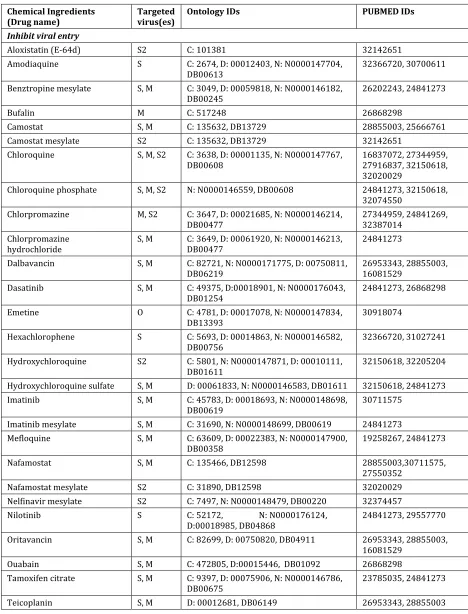
Our collected drugs were organized by three known mechanisms (inhibition of viral 196
entry, inhibition of viral replication, and modulation of host immune response) or unknown 197
mechanism (Table 1). Vero, Vero 6, Huh7, and BHK-21 cells are among the primate cell lines 198
commonly used in in vitro anti-coronavirus drug studies (de Wilde et al., 2014;Dyall et al., 199
2014;Shen et al., 2019). These studies often tested whether the anti-coronavirus effect occurred 200
at the viral entry level or viral replication level. To evaluate the entry level treatment, the drugs 201
were added to the cells before viral attachment, and at a time after infection, the virus-drug 202
mixture was replaced with fresh culture medium and maintained until the end of the experiment. 203
To evaluate the post-entry effect, drugs were added after viral infection (Wang et al., 2020a). For 204
example, chloroquine was found to function at both the entry and post-entry stages against 205
SARS-CoV-2 infection in Vero E6 cells (Wang et al., 2020a), and remdesivir and mefloquine 206
functioned only at a stage post the virus entry (Brickelmaier et al., 2009;Wang et al., 2020a). 207
Often we do not know whether a drug functions at the entry or post-entry stage, but we know 208
that the drug was able to modulate the host immune responses (Table 1). Some drugs’ anti-209
coronavirus mechanisms are unknown (Table 1). Several drug therapies utilized as a 210
combination of two or more drugs. Because it is difficult to evaluate individual drug properties, 211
combination drug therapy studies were not included from our annotations. 212
Our study found that 33 drugs inhibiting viral entry to host cells, 50 drugs that inhibit 213
viral replications inside host cells, and 12 drugs modulating host immune responses to 214
coronavirus infection (Table 1). At the viral entry-level, the interaction between coronavirus and 215
host-cell receptors can be blocked in multiple ways. For example, chlorpromazine has MoA as 216
dopamine antagonist and adrenergic-alpha antagonist, and it is active against SARS-CoV and 217
MERS-CoV (Zumla et al., 2016). Chlorpromazine also modulates clathrin-coated pits at plasma 218
receptors have been shown as potent entry inhibitors of Ebola and Marburg viruses (Cheng et al., 220
2015). After viral entry, there are potential inhibitors that can suppress coronaviral replication 221
via several pathways. For example, gemcitabine hydrochloride, classified as nucleic acid 222
synthesis inhibitor in NDF-RT, is a deoxycytidine analog, inhibiting DNA replication and repair. 223
Mycophenolic acid and mycophenolate mofetil also function as nucleic acid synthesis inhibitors 224
according to NDF-RT. They all can prohibit MERS-CoV and SARS-CoV by inhibiting viral 225
DNA or RNA replication. Different mechanisms are taken by drugs to modulate host immune 226
responses to coronavirus infection (Table 1). Interferons are biological modifiers that can elicit 227
transcription of hundreds of interferon-induced genes, encoding for anti-viral proteins (Fensterl 228
and Sen, 2009). Interferons have been evaluated to treat coronaviral infections in combination 229
with ribavirin (Chan et al., 2013). Nitazoxanide can inhibit MERS-CoV in vitro (Li et al., 2019). 230
Nitazoxanide blocks maturation of the viral hemagglutinin and promotes the production of 231
interferons in virus-infected cells (Rossignol, 2014). By targeting IL-6 receptor, tocilizumab has 232
been found effective in treating moderate to severe rheumatoid arthritis, cytokine storm, and 233
SARS-CoV-2 infection (Xu et al., 2020b) (Table 1). 234
We have also collected 26 anti-coronavirus antibodies, including 17 monoclonal 235
antibodies and 2 polyclonal antibodies that target on MERS-CoV, and 7 monoclonal antibodies 236
that target on SARS-CoV (Table 2). All of these antibodies were tested for their efficacy in
237
vitro, and over half of them were also tested in vivo. The SARS-CoV-specific antibodies target 238
for S spike protein, S1 receptor-binding domain (RBD), or S2 protein. For example, S230.15 and 239
m396 were found to compete with the SARS-CoV receptor ACE2 for binding to the RBD as a 240
mechanism of their neutralizing activity (Zhu et al., 2007). The MERS-CoV-specific antibodies 241
specifically target for S spike protein, S1 RBD, or human DPP4 receptor S2. Anti-DPP4 (CD26) 242
is another therapeutic option for fighting MERS-CoV. The anti-CD26 antibodies 2F9, 1F7 and 243
YS110 target the S1-DPP4 interaction from the host side, and prevent the MERS-CoV entry into 244
cells (Rabaan et al., 2017). 245
3.3 Drugs verified against SARS-CoV-2 infections in vitro or in vivo
246
Several drugs, including remdesivir, chloroquine phosphate, favipiravir, and tocilizumab 247
against the SARS-CoV-2 infections in vitro or in vivo and have potential in treating COVID-19 249
(Table 1 and Table 2). 250
As a drug used to successfully treat the first case of COVID-19 patient in the USA 251
(Holshue et al., 2020), remdesivir has become an highly promising drug for treating COVID-19. 252
Remdesivir is a nucleoside analog which inhibits viral proliferation (Wang et al., 2020a). It has 253
been shown to effectively fight against several kinds of viruses, including SARS-CoV and 254
MERS-CoV in vitro (Sheahan et al., 2017). Its anti-viral effects were also identified in the rhesus 255
macaque model infected with MERS-CoV (de Wit et al., 2020). A recent study showed 256
remdesivir can inhibit COVID-19 in vitro (Wang et al., 2020a). Then, remdesivir has been 257
evaluated in two clinical trials (Beigel et al., 2020;Wang et al., 2020b), showing that the 258
hospitalized COVID-19 patients receiving remdesivir treatment recovered faster than similar 259
patients who received placebo. As a result, US FDA has allowed remdesivir to be distributed and 260
used to treat adults and children hospitalized with severe COVID-19 261
(https://www.fda.gov/media/137564/download). 262
As an antimalarial drug, chloroquine phosphate has been shown with efficacy in blocking 263
CoVID-19 in vitro (Wang et al., 2020a). In addition to treating malaria, chloroquine can also 264
inhibit autophagy and be used to treat skin disorder and rheumatoid arthritis. Some clinical 265
results in China showed that chloroquine phosphate treatment promotes patient recovery as 266
compared to the control treatment (Gao et al., 2020). On March 28, 2020, US FDA issued an 267
Emergency Use Authorization (EUA) to allow hydroxychloroquine sulfate and chloroquine 268
phosphate drugs to be used for certain hospitalized patients with COVID-19 269
(https://www.fda.gov/media/136534/download). 270
A new study with a small sample size of COVID-19 patients concluded that the 271
combination of hydroxychloroquine and azithromycin (Gautret et al., 2020) could be used as a 272
very effective treatment of the COVID-19 disease. Like chloroquine, hydroxychloroquine is also 273
an antimalarial medication and possesses a similar antiviral mechanism of action with 274
chloroquine: it both inhibits viral entry and repress viral replication. Hydroxychloroquine was 275
also shown as more effective drug target to CoVID-19 than chloroquine (Yao et al., 2020). 276
Azithromycin is an antibiotic used to treat a number of bacterial infections and malaria as well. It 277
prevents bacterial growth by interfering with their protein synthesis. Azithromycin inhibits the 278
azithromycin is used to treat malaria, it was also found with antiviral properties by potentially 280
promoting interferon production in vitro (Schogler et al., 2015). Azithromycin has been found to 281
prevent the exacerbations of chronic obstructive pulmonary disease (COPD) (Albert et al., 2011). 282
However, consistent usage of the drug for a long time may cause hearing decrements in a small 283
percentage of subjects (Albert et al., 2011). 284
Favipiravir, also known as T-705, Avigan, or favilavir, is an antiviral drug being 285
developed with activity against many RNA viruses. Favipiravir resembles nucleoside analogue 286
and inhibits RNA-dependent RNA polymerase. It has been shown that favipiravir is effective to 287
against various RNA viruses, such as Ebola virus, Lassa fever, and other influenzas in animal 288
models and vitro (Shiraki and Daikoku, 2020). Favipiravir has been used in clinical trial as a 289
promising drug to treat COVID-19 (Dong et al., 2020). 290
Some studies have shown that lopinavir/ritonavir treatment has anti-viral effects in 291
COVID-19 therapy (Lim et al., 2020;Xu et al., 2020a). Lopinavir and ritonavir are enzyme 292
inhibitors that act after viral infection and prohibit viral protein cleavage and production of new 293
viral particles in treating HIV (Kemnic and Gulick, 2020). Several studies have shown that 294
lopinavir can have favorable outcomes in treating SARS and MERS in combination with 295
ritonavir, another enzyme inhibitor, in human and nonhuman primates (Chu et al., 2004;Chan et 296
al., 2015). However, a recent study with a total of 199 adult patients with laboratory-confirmed 297
SARS-CoV-2 infection showed that no benefit in terms of clinical outcomes and mortality was 298
observed with lopinavir–ritonavir treatment beyond standard care (Cao et al., 2020). 299
A recent study that a triple combination of Interferon beta-1b, Lopinavir-Ritonavir, and 300
Ribavirin in the treatment of mild to moderate COVID-19 patients was safe and superior to 301
lopinavir-ritonavir alone in alleviating symptoms and shortening the duration of viral shedding 302
(Hung et al., 2020). The adverse events for the early triple antiviral therapy included self-limited 303
nausea and diarrhea, which had no difference with the double lopinavir-ritonavir therapy. 304
3.4 Anti-coronavirus drugs are primarily inhibitors or antagonists, and many having the
305
anticancer role based on ontology analysis
306
These manually annotated 110 chemical drugs were mapped to and analyzed by three ontologies: 307
ChEBI, NDF-RT, and DrON. Among them, 99 have ChEBI IDs, 70 have NDF-RT IDs, and 60 308
(Xiang et al., 2010) and built relatively independent subsets of these ontologies. By analyzing 310
these subsets, we were able to identify more scientific insights. 311
ChEBI can be ontologically and systematically represent various anti-coronavirus drugs 312
and how such representation can be used for advanced analysis. After extracting these drugs and 313
their associations using Ontofox (Xiang et al., 2010), the hierarchical structure among different 314
anti-coronavirus drugs were clearly displayed . For example, we can find that chloroquine, 315
chlorpromazine, dasatinib, and three other drugs all belong to chlorobenzenes (Figure 1A). 316
Chloroquine has many roles including the antimalarial role. Since ontology is computer-317
understandable, we can query the ontology using different approaches including SPARQL 318
(Group, 2013) and Description Logic (DL) query (Pan et al., 2019). As shown in Figure 1B, we 319
performed a simple DL query on the subset of ChEBI and found three other drugs (i.e., 320
mefloquine, conessine, and lycorine) having the same antimalarial role. 321
Figure 2 demonstrates another usage of ontology in our drug study. NDF-RT has a 322
unique feature, i.e., representing the mechanisms of action (MoA) for different drugs. Our 323
mapping found that out of 70 anti-coronavirus drugs with NDF-RT records, 57 drugs had their 324
specified MoAs, the hierarchical structure of which are provided by NDF-RT (Figure 2A). By 325
analyzing these MoAs and identifying the drugs that have thee MoAs, we found that 47 of 57 326
anti-coronavirus drugs had MoAs as inhibitors or antagonists (Figure 2A). Specifically, 23 drugs 327
were inhibitors of enzymes such as kinase or protease. The antagonists were specific for G 328
Protein-coupled receptors. There was only one agonist drug, methylprednisolone, a 329
glucocorticoid hormone receptor agonist that is used to suppress the immune system and 330
decrease inflammation. 331
Using a DL-query, 29 chemical entities were identified to have the antineoplastic role 332
(Figure 2B). These 29 chemical entities are used as active ingredients compounds of 23 drugs. 333
To support viral program, viruses often hijack infected cells to have enhanced synthesis of 334
nucleic acids, proteins, and lipids and maintain boosted energy metabolism. The cell patterns are 335
also seen in cancer cells. Therefore, it is likely to use anticancer drugs to inhibit SARS-CoV-2 336
viral replication (Ciliberto et al., 2020). The 23 antineoplastic or anticancer drugs identified in 337
Our identified drugs were also found to have many other roles, including various 339
antimicrobial (e.g., antimalarial, antiviral, and antibacterial) roles. Figure 1B provides an 340
example of the drugs having the antimalarial role. 341
3.4 Anticoronaviral drug patterns based on ontology classification and heatmap analyses 342
In this section, we introduce our discovery of different anticoronaviral drug patterns based on 343
ontology-based hierarchical classification, and two different types of heatmap analyses (Figure 344
3-5). 345
First, our direct browsing of the anticoronaviral subset of ChEBI ontology identified 346
many enriched ontology hierarchies, including organochlorine compounds, aromatic amides, 347
primary/secondary/tertiary alcohols, phenothiazines, and organofluorine compounds (Figure 3). 348
Many drugs such as chloroquine, chloropromazine, and dasainib are all organochlorine 349
compounds. We found many anticoronaviral drugs are classified as primary, secondary, and 350
tertiary alcohols. For example, bufalin, mefloquine, everolimus, cephalotaxine, cycloheximide, 351
and sirolimus all belong to secondary alcohol group. Those drugs under the same classification 352
likely share similar anticoronaviral functions. 353
Figure 4 shows the heatmap results based on the semantic relations defined in the ChEBI 354
ontology. Seven clusters were identified. The first cluster colored in red, including imatinib and 355
remdesivir, is enriched with organooxygen compounds. The second cluster in blue is represented 356
by chloroquine and hydroxychloroquine, which appears to be enriched as organohalogen 357
compounds. The third cluster, including benztropine and nelfinavir, is enriched with organic 358
halide salt. The drugs in the fourth cluster, colored purple, including everolimus and sirolimus 359
were mostly heteroorganic compounds. Everolimus is the 40-O-(2-hydroxyethyl) derivative of 360
sirolimus (also known as rapamycin), and it works similarly to sirolimus as an inhibitor of 361
mammalian target of rapamycin (mTOR). The drugs in the fifth cluster, colored orange, seem 362
variable including toremifene and tamoxifen. The sixth cluster, including chlorpromazine and 363
fluphenazine, is enriched with heteroorganic compounds The seventh cluster in brown color, 364
have high similarities and were mostly organic halide salt.As ChEBI annotates drugs from both 365
molecular structure and functional radical aspects at a higher level than chemical structure, this 366
Figure 5 shows another heatmap patterns detected based on the physicochemical properties 368
of anti-coronavirus drugs. In this study, chemical similarity was calculated between 92 small-369
molecule anti-coronaviral drugs to determine whether there were clusters of chemically similar 370
drugs. As expected, the drugs grouped into islands representing varying classes of drugs (Figure 371
5). For example, the glycosides (glycyrrhizic acid, aescin, digoxin, and digitoxin), macrolides 372
(everolimus, sirolimus, and ivermectin), and a polyketides (monensin and salinomycin) were 373
grouped together (Figure 5, red bar). However, there was no clear association in this group between 374
the drugs and mechanism of action; glycyrrhizic acid was shown to modulate immune response 375
and inhibit viral replication, while everolimus only inhibits viral replication (Table 1). It should be 376
noted that the aforementioned glycosides will very likely not be useful as anti-coronaviral drugs 377
due to their high toxicity even in low doses (Cock, 2015). Though not grouped into the cluster, 378
azithromycin was also found to be chemically similar to the aforementioned compounds (Figure 379
5, asterisk). Interestingly, azithromycin was recently reported to be effective against SARS-CoV-380
2 (Gautret et al., 2020), suggesting that macrolides could be a potential class of chemical 381
compounds that could be utilized against coronaviruses. Though they are traditionally used in the 382
clinical setting against retroviruses (Pulido et al., 2008), the antiretrovirals, ritonavir, lopinavir, 383
nelfinavir, and SG85 also were observed to have a mixed mechanisms of action (Figure 5, green 384
bar); the former three act as inhibitors of viral entry, while SG85 inhibits viral replication (Table 385
1). Additionally, the structurally-similar anti-coronavirus drugs, toremifene, tamoxifen, and 386
triparanol (Figure 5, purple bar), all operate as inhibitors of viral entry, as annotated in this study 387
(Table 1). Apart from this function, they have been shown conventionally to inhibit cholesterol 388
biosynthesis (Jordan et al., 2014). However, bazedoxifene was also in the aforementioned cluster, 389
though it has currently an unknown mechanism (Table 1); judging by its chemical similarity to the 390
others, it is likely it could also function as an inhibitor of viral entry. 391
3.5 Different physicochemical profiles of drugs inhibiting viral entry and inhibiting viral
392
replication
393
Five common physicochemical properties associated with druggability were examined for anti-394
coronaviral drugs responsible for: 1) inhibiting viral entry and 2) inhibiting viral replication; there 395
were 25 and 44 small-molecule compounds, respectively. Utilizing PCA analysis on these 396
drugs (Figure 6A). Interestingly, chloroquine was annotated to work as an inhibitor of both viral 398
entry and replication and was also observed to be located in a dense area of PCA space of mixed 399
efficacy (Figure 6A, arrow), suggesting that it is possible that many of the drugs may possess a 400
dual mechanism of action. Overall, the compounds associated with inhibiting viral replication 401
possessed a greater number of hydrogen bond acceptors and donors and higher topological polar 402
surface area than those that inhibit viral entry after removal of five compounds (valinomycin, 403
telavancin, oritavancin, dalbavancin, and cyclosporine) greater than 1,000 Da (Figure 6B); this 404
removal was performed because these compounds were significantly larger in size than the others, 405
which would have allowed for a more fair comparison between groups. Consequently, compounds 406
that inhibit viral replication also had higher topological polar surface areas. However, octanol-407
water partition coefficients did not seem to be different between the two groups. 408
On average, the average number of hydrogen bond acceptors and donors were 2.90 and 409
1.33, respectively, for drugs that inhibit viral entry. On the other hand, the corresponding values 410
were 5.49 and 2.40 for drugs that inhibit viral replication. However, several outliers were observed 411
for both classes of drugs, as was expected with any generalization. Certain drugs that inhibit viral 412
entry, such as ouabain, had several hydrogen bond acceptors and donors. Additionally, drugs that 413
inhibit viral replication, such as chloroquine, have no hydrogen bond acceptors and donors. Given 414
chloroquine’s membership in both drug classes, the physicochemical differences between the two 415
types of drugs are not as clear cut as one would hope. Nonetheless, the present observations can 416
potentially serve as an approximate guideline in the design of anticoronoviral drugs. 417
418
3.6 Key drug-targeted biological pathways identified from drug-target network analysis
419
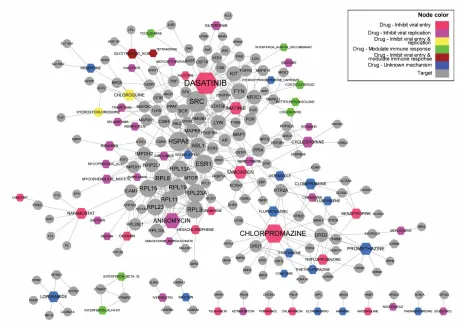
We generated a drug-target interaction network (Figure 7) that includes all unique drugs and 420
their known targeted proteins according to the records from DrugBank. This network included 68 421
drugs with their 163 known human protein targets with a total of 428 interactions. Multiple 422
clusters were identified from this network. The biggest one included the majority of the drugs 423
inhibiting viral replication (nodes in violet) and modulating immune response (nodes in green). 424
Another one was centered on the drug chlorpromazine as well as many drugs with unknown 425
mechanisms with respect to their usages in coronavirus treatment. 426
Three drugs with most connections in Figure 7 are chlorpromazine, dasatinib, and 427
in NDF-RT. It also interacts with serotonin receptor (HTRs) and histamine receptor (HRHs) 429
(Figure 7). Although how chlorpromazine exhibits anti-coronavirus properties is not fully 430
understood, adrenergic antagonists and histamine antagonists have been shown to inhibit RNA 431
virus such as Ebola and Marburg viruses (Cheng et al., 2015). Dasatinib, together as imatinib 432
(another coronavirus drug as seen in Table 1), is an inhibitor of the Abelson murine leukemia 433
viral oncogene homolog 1 (ABL1) pathway, a signaling pathway involved in cell differentiation, 434
cell adhesion, and cellular stress response. Previous studies showed that dasatinib and imatinib 435
can both inhibit BCR-ABL interaction and prohibit virus fusing with S protein of host cells 436
(Dyall et al., 2014;Sisk et al., 2018). 437
As another hub drug in Figure 7, anisomycin is an antibiotic that potently inhibits 438
flaviviruses, including Dengue virus and Zika virus, in vivo, by mainly affecting viral 439
macromolecular synthesis and replication(Quintana et al., 2020). At non-cytotoxic 440
concentrations, anisomycin strongly inhibited the replication of DENV and ZIKV viruses in 441
Vero cells, and also prevented DENV and ZIKV virus multiplication in human cell lines 442
(Quintana et al., 2020). Anisomycin induces apoptosis (Hori et al., 2008) and can target 443
ribosomes to interfere peptidyl transferase and then block protein synthesis (Barbacid and 444
Vazquez, 1974). However, the exact mechanism of viral replication inhibition by anisomycin is 445
still unclear. 446
The neurotrophic receptor tyrosine kinase 1 (NTRK1) is notable as a distinct human hub 447
protein in the drug-target network, and it interacts with many drugs and other genes (Figure 7). 448
NTRK1 is a kinase that can be activated by signaling factors. Activated NTRK1 protein 449
phosphorylates other proteins to transmit signals for cell growth and survival. NTRK1 has been 450
found to interact with Ebolavirus transcription- and replication-competent virus-like particles, 451
which are designed to express the Ebola virus proteins required for genome replication and 452
transcription to model Ebola virus life cycles, indicating that NTRK1 may act as an important 453
role in inhibiting viral proliferation (Yu et al., 2018). It is reasonable to assume that drugs in the 454
network can interact with NTRK1 directly or indirectly, leading to the inhibition of coronavirus 455
replication. 456
To better characterize the biological functions of these known drug targets, a KEGG 457
pathway enrichment analysis on the known targets was performed and the top 30 most 458
diverse pathways such as calcium signaling pathway, and neuroactive ligand-receptor 460
interaction. The most significant pathways with the most genes included neuroactive ligand 461
receptor interaction and calcium signaling pathways. The neuroactive ligand receptor interaction 462
pathway is aligned with many mechanisms of action reported in the NDF-RT analysis (Figure 2). 463
A recent study found that NAADP-dependent Ca2+ signaling regulates MERS-CoV pseudovirus 464
translocation through the endolysosomal system (Gunaratne et al., 2018). Calcium signaling 465
pathway is also crucial for viral infection and replication in host cells. Viral infection alters host-466
cell calcium cation homeostasis and viruses can take over the calcium signaling pathway for their 467
replication (Zhou et al., 2009). Therefore, drugs targeting the calcium signaling pathway have 468
the potential to be effective in fighting against viral infection. 469
470
4
Discussion
471
One novelty of this study is its usage of ontologies. The ontology can logically, 472
hierarchically, and systematically represent various drugs and their characteristics. The usage of 473
the three ontologies in our study significantly enhanced our analysis. For example, our ChEBI 474
analysis enabled us to quickly identify the hierarchical categorization of different anti-475
coronavirus drugs and query which drugs have the antimalarial role (Figure 1). By systematically 476
analyzing the mechanisms of action of 57 drugs based on NDF-RT, we discovered that the 477
majority of the drugs were inhibitors or antagonists that suppress various biological pathways 478
(Figure 2). The ChEBI was also used for the semantics-based similarity analysis (Figure 3). A 479
pitfall of our ontology-based study is that not all the drugs have annotations in these ontologies, 480
resulting in incomplete analysis power. 481
Another novelty of this study is the usage of bioinformatics and cheminformatics 482
methods in systematic analysis and prediction. The semantic and chemical similarity analyses, as 483
well as the PCA analysis, uncovered various potential drug candidates for COVID-19. The two 484
similarity heatmap clustering analyses provided different but complementary results. For 485
example, both heatmap studies found the group including everolimus and its related drug 486
sirolimus (also known as rapamycin). As ChEBI annotated drugs from both molecular structure 487
and functional aspects, we can sort out all the drugs based on similarity to infer potential new 488
development and mechanism study for COVID-19. For example, A clustered group of drugs as 490
anti-retroviral drugs, containing ritonavir and lopinavir also convoluted. Ritonavir and lopinavir 491
are promising drugs in treating coronaviruses. The PCA results demonstrate the two different 492
profiles of the anti-coronavirus drugs associated with the inhibition of viral entry vs the drugs 493
associated with viral replication. Such physicochemical profiles may aid in the design of novel 494
anti-coronaviral drugs based on the intended MoA. These findings also suggest that more refined 495
groups of drugs based on chemical properties and antiviral mechanisms may be required to have 496
the potential to find some hidden relations between them. 497
How our ontological and bioinformatics analysis of the systematically collected anti-498
coronavirus drugs provides implication for possible drug repurposing against COVID-19? 499
Our study found many drugs having similar roles or grouping to chloroquine and 500
hydroxychloroquine. Chloroquine and hydroxychloroquine are both antimalarial drugs. Our 501
collection includes three other antimalarial drugs, i.e., mefloquine, conessine, and lycorine 502
(Figure 1B). These three antimalarial drugs may also be effective against COVOD-19. 503
Meanwhile, our study found that chloroquine, chlorpromazine and dasatinib are all 504
chlorobenzenes (Figure 1A). Chlorpromazine and dasatinib were also found as hubs from our 505
drug-target interaction network (Figure 6). Given that chloroquine and hydroxychloroquine are 506
likely effective anti-COVID-19 drugs (Wang et al., 2020a), it is worth testing the role of 507
chlorpromazine and dasatinib as effective anti-COVID-19 drug as well. 508
For better therapeutic effect, it is common to use a combination therapy with two or more 509
synergistically acting drugs. The combined usage of two or more drugs may achieve the three 510
main biological processes, including prohibit viral entry, viral replication and induce host 511
immune response (Table 1). Those combinational choices that target these different aspects of 512
the viral lifecycle would be preferred choices. Our identification of the 110 drugs provides 513
choices of drugs for targeting these three areas (Table 1 and 2). 26 monoclonal and polyclonal 514
antibodies appear to be the obvious choices for prohibiting viral entry. Our ontological and 515
bioinformatics analyses in this study provide many possible choices for selecting drugs for 516
combinational therapy. 517
Various combinations of interferon-alfa or -beta with other antiviral drugs such as 518
ribavirin and/or lopinavir–ritonavir were used to treat patients with SARS or MERS (Al-Tawfiq 519
lopinavir–ritonavir (Zumla et al., 2016). However, the combination therapies consisting of 521
interferons and ribavirin did not generate consistently improved outcomes (Al-Tawfiq et al., 522
2014;Zumla et al., 2016). 523
It is interesting that the usage of azithromycin significantly improved the treatment 524
outcome in the combined usage of hydroxychloroquine and azithromycin (Gautret et al., 2020). 525
Like azithromycin, sirolimus, everolimus, and oligomycin are also macrolides that that consist of 526
a large macrocyclic lactone ring. Sirolimus/rapamycin has antifungal role. However, as 527
immunosuppressants, sirolimus and everolimus are typically used to prevent rejection of organ 528
transplants. These two drugs target mammalian mTOR, an important member of the PI3K-529
related kinase family of protein kinases. Treatment of cells with rapamycin inhibited MERS-530
CoV infection by 24-61% at 0.1-10 μM (Kindrachuk et al., 2015). How sirolimus and everolimus 531
may be effective against COVID-19 is unclear. However, they may induce strong adverse 532
reactions in the patients. Oligomycin (Shen et al., 2019) is an antibiotic that inhibits ATP 533
synthase by blocking its proton channel necessary for oxidative phosphorylation and energy 534
production. 535
In addition to azithromycin, our study found other antibiotics, including teicoplanin, 536
anisomycin (Dyall et al., 2014), valinomycin (Dubey et al., 2019), which demonstrated anti-537
coronavirus functions in vitro and/or in vivo (Table 1). Anisomycin was introduced earlier in the 538
article. Teicoplanin is an glycopeptide antibiotic used to prevent or treat serious infections 539
caused by Gram-positive bacteria such as methicillin-resistant Staphylococcus aureus and 540
Enterococcus faecalis. Teicoplanin inhibits bacterial cell wall synthesis. Teicoplanin was also 541
found to potently prevents the entry of Ebola envelope pseudotyped viruses into the cytoplasm, 542
and was able to block the entry of MERS-CoV and SARS-CoV envelope pseudotyped viruses as 543
well (Zhou et al., 2016). Valinomycin is a K+ ionophore that can change the membrane potential 544
by conducting ions directly through membrane. It can treat B. gibsoni, a species of bacterial 545
infection, by changing bacteria’s cellular cation concentration in vitro(Yamasaki et al., 2009). In 546
a study, TZMbl cells were treated with valinomycin before HIV infection, and valinomycin at 547
10 nM concentration impeded HIV entry to TZMbl cells by nearly 50% (Dubey et al., 2019). The 548
study also showed that valinomycin inhibits HIV entry by increasing the membrane 549
valinomycin may use the same mechanism against virus and bacteria. However, valinomycin is 551
classified as an extremely hazardous substance in the United States. 552
It is likely that the antibacterial role of the antibiotics may play a critical role in COVID-553
19 treatment. Microbiomes exist in many parts of human body such as the gut and lung (He et 554
al., 2020). The lung is now known to hold a large amount of bacteria (Fabbrizzi et al., 2019). 555
Bacterial microbiomes play an important role in human metabolism and immune response to 556
various pathogens. However, in a COVID-19 patient, the normally healthy bacteria inside human 557
lung and other parts of human body may become harmful and cause infections. Therefore, the 558
usage of an antibiotics may support the treatment by killing these previously good but now bad 559
bacteria in the infected lung. Such a hypothesis may still need experimental verification. 560
A recent study demonstrates that a network-based quantification and analysis of the host-561
coronavirus interactions and drug targets would help identification of candidate repurposable 562
drugs (Zhou et al., 2020). Their network-based drug repurposing method is aligned with our 563
ontology-based and bioinformatics-based study. Our drug-target network provides a backbone 564
for further network analysis and our ontology approaches provide more logically defined 565
relations between drugs and other types of entities (such as MoA, roles, and diseases). Our 566
ontology-based bioinformatics strategy can enhance the network standardization and computer 567
interpretation in a logical, interoperable, and consistent way, leading to improved prediction of 568
drugs for COVID-19. 569
As an important part of the network study of interactions among host, host cells, 570
coronavirus, and drugs, we will need to systematically understand the SARS-CoV-2-human 571
protein-protein interactions (PPIs). Recently a bioRxiv paper introduced a SARS-CoV-2-human 572
PPI map that reveals drug targets and potential drug-repurposing (Gordon et al., 2020). This 573
study cloned, tagged, and expressed 26 of the 29 viral proteins in human cells and identified 332 574
high confidence SARS-CoV-2-human PPIs. The authors identify 67 druggable human proteins or 575
host factors targeted by 69 existing FDA-approved drugs, drugs in clinical trials and/or 576
preclinical compounds. Among their 25 FDA-approved drugs, six drugs are included in our drug 577
list. These six drugs are camostat, chloroquine, mycophenolic acid, nafamostat, rapamycin, 578
ribavirin. How these drugs can be applied for COVID-19 deserves further investigations. 579
While our systematic collection of experimentally verified anti-coronavirus drugs and 580
repurposable for COVID-19 treatment, clinical and experimental studies are required to evaluate 582
these hypothesized choices. Our collection of drugs was primarily verified from experimental 583
settings and most of them came from SARS or MERS studies, which may not reflect the 584
outcome from clinical settings and what to expect for COVID-19. An example is the lopinavir– 585
ritonavir treatment that worked for SARS and MERS but not for COVID-19 treatment as 586
discussed earlier. By using computational methods, FDA-approved drugs, like indinavir and 587
atazanavir, are able to target to viral proteases and potentially can be used for COVID-19 588
treatment (Chang et al., 2020;Contini, 2020). However, an in vitro study on SARS-CoV has 589
shown indinavir has no inhibitory effect on SARS-CoV (Tan et al., 2004). These also 590
demonstrate that we will need to continuously develop new and better algorithms and tools to 591
improve our predictions for clinical and experimental verification. 592
Ontology has a unique role of providing standard and computer-understandable 593
representation on entities in the host-virus interactions and logic relations among these entities. 594
Such an ontology platform would be able to support advanced computer-assisted machine 595
learning analysis of anti-coronavirus drugs and their mechanisms, and provide more clear clues 596
on drug repurposing against COVID-19. For this purpose, we have recently initiated a 597
community-based Coronavirus Infectious Disease Ontology (CIDO) (https://github.com/CIDO-598
ontology/cido). The CIDO has also been approved to be an Open Biomedical Ontology (OBO) 599
Foundry library ontology (http://obofoundry.org/ontology/cido.html). The drug information 600
introduced in this article will be included in the CIDO. CIDO will also represent the fundamental 601
host-coronavirus molecular and cellular interaction networks and how the drugs can interact with 602
such interaction networks, and such computer-interpretable mechanism presentation can be used 603
to support different applications. We also welcome more participation from the community to 604
support its deep development and applications. 605
606
5.
List of abbreviations
607
ChEBI: Chemical Entities of Biological Interest; DrON: Drug Ontology; NDF-RT: The National 608
Drug File - Reference Terminology. 609
6.
Conflict of Interest
The authors declared that they have no competing interests. 611
7.
Author contributions
612
YL: Manual collection and annotation, ontology processing. WC: Chemical feature-based 613
clustering and PCA analysis. ZW: ChEBI ontology-based semantic similarity analysis. JH: Drug-614
target network analysis. JX: Comparative and ontological drug analysis; HY: Clinical expertise 615
in treating coronavirus disease patients, and ontology-based drug effect analysis; YH: Project 616
design, ontology processing, and results integration and analysis. All authors participated in 617
discussion, result interpretation, manuscript preparation and editing, and approved the 618
manuscript. 619
8.
Funding
620
This work was supported by a bridge funding to YH at the University of Michigan Medical 621
School and the University of North Dakota Host-Pathogen Interactions COBRE Pilot grant to 622
JH. The research has also received funding from the National Natural Science Foundation of 623
China (Grant Nos. 61801067), the Natural Science Foundation of Chongqing (Grant No. 624
cstc2018jcyjAX0243), the non-profit Central Research Institute Fund of Chinese Academy of 625
Medical Sciences 2019PT320003 and the Guizhou Science and Technology Cooperation Support 626
Project (Grant No. [2020]4Y002). 627
9.
Acknowledgements
628
We appreciate the review and feedback from Dr. Duxin Sun from the University of Michigan. 629
We acknowledge ChEBI team’s inclusion of our submitted Remdesivir record to ChEBI. 630
631
Availability of data and material
632
The data and materials introduced are all openly available in this article or at the GitHub website: 633
https://github.com/CIDO-ontology/anti-coronavirus-drugs. 634
635
References
Al-Tawfiq, J.A., Momattin, H., Dib, J., and Memish, Z.A. (2014). Ribavirin and interferon 637
therapy in patients infected with the Middle East respiratory syndrome coronavirus: an 638
observational study. Int J Infect Dis 20, 42-46. 639
Albert, R.K., Connett, J., Bailey, W.C., Casaburi, R., Cooper, J.A., Jr., Criner, G.J., Curtis, J.L., 640
Dransfield, M.T., Han, M.K., Lazarus, S.C., Make, B., Marchetti, N., Martinez, F.J., 641
Madinger, N.E., Mcevoy, C., Niewoehner, D.E., Porsasz, J., Price, C.S., Reilly, J., 642
Scanlon, P.D., Sciurba, F.C., Scharf, S.M., Washko, G.R., Woodruff, P.G., Anthonisen, 643
N.R., and Network, C.C.R. (2011). Azithromycin for prevention of exacerbations of 644
COPD. N Engl J Med 365, 689-698. 645
Ashburner, M., Ball, C.A., Blake, J.A., Botstein, D., Butler, H., Cherry, J.M., Davis, A.P., 646
Dolinski, K., Dwight, S.S., Eppig, J.T., Harris, M.A., Hill, D.P., Issel-Tarver, L., 647
Kasarskis, A., Lewis, S., Matese, J.C., Richardson, J.E., Ringwald, M., Rubin, G.M., and 648
Sherlock, G. (2000). Gene ontology: tool for the unification of biology. The Gene 649
Ontology Consortium. Nat Genet 25, 25-29. 650
Barbacid, M., and Vazquez, D. (1974). (3H)anisomycin binding to eukaryotic ribosomes. J Mol
651
Biol 84, 603-623. 652
Beigel, J.H., Tomashek, K.M., Dodd, L.E., Mehta, A.K., Zingman, B.S., Kalil, A.C., Hohmann, 653
E., Chu, H.Y., Luetkemeyer, A., Kline, S., Lopez De Castilla, D., Finberg, R.W., 654
Dierberg, K., Tapson, V., Hsieh, L., Patterson, T.F., Paredes, R., Sweeney, D.A., Short, 655
W.R., Touloumi, G., Lye, D.C., Ohmagari, N., Oh, M.D., Ruiz-Palacios, G.M., Benfield, 656
T., Fatkenheuer, G., Kortepeter, M.G., Atmar, R.L., Creech, C.B., Lundgren, J., Babiker, 657
A.G., Pett, S., Neaton, J.D., Burgess, T.H., Bonnett, T., Green, M., Makowski, M., 658
Osinusi, A., Nayak, S., Lane, H.C., and Members, A.-S.G. (2020). Remdesivir for the 659
Treatment of Covid-19 - Preliminary Report. N Engl J Med. 660
Bernard-Stoecklin, S., Nikolay, B., Assiri, A., Bin Saeed, A.A., Ben Embarek, P.K., El Bushra, 661
H., Ki, M., Malik, M.R., Fontanet, A., Cauchemez, S., and Van Kerkhove, M.D. (2019). 662
Comparative Analysis of Eleven Healthcare-Associated Outbreaks of Middle East 663
Respiratory Syndrome Coronavirus (Mers-Cov) from 2015 to 2017. Sci Rep 9, 7385. 664
Bodenreider, O. (2008). Biomedical ontologies in action: role in knowledge management, data 665
integration and decision support. Yearb Med Inform, 67-79. 666
Bodenreider, O., and Rodriguez, L.M. (2014). Analyzing U.S. prescription lists with RxNorm 667
and the ATC/DDD Index. AMIA Annu Symp Proc 2014, 297-306. 668
Brickelmaier, M., Lugovskoy, A., Kartikeyan, R., Reviriego-Mendoza, M.M., Allaire, N., 669
Simon, K., Frisque, R.J., and Gorelik, L. (2009). Identification and characterization of 670
mefloquine efficacy against JC virus in vitro. Antimicrob Agents Chemother 53, 1840-671
1849. 672
Cao, B., Wang, Y., Wen, D., Liu, W., Wang, J., Fan, G., Ruan, L., Song, B., Cai, Y., Wei, M., 673
Li, X., Xia, J., Chen, N., Xiang, J., Yu, T., Bai, T., Xie, X., Zhang, L., Li, C., Yuan, Y., 674
Chen, H., Li, H., Huang, H., Tu, S., Gong, F., Liu, Y., Wei, Y., Dong, C., Zhou, F., Gu, 675
X., Xu, J., Liu, Z., Zhang, Y., Li, H., Shang, L., Wang, K., Li, K., Zhou, X., Dong, X., 676
Qu, Z., Lu, S., Hu, X., Ruan, S., Luo, S., Wu, J., Peng, L., Cheng, F., Pan, L., Zou, J., Jia, 677
C., Wang, J., Liu, X., Wang, S., Wu, X., Ge, Q., He, J., Zhan, H., Qiu, F., Guo, L., 678
Huang, C., Jaki, T., Hayden, F.G., Horby, P.W., Zhang, D., and Wang, C. (2020). A Trial 679
of Lopinavir-Ritonavir in Adults Hospitalized with Severe Covid-19. N Engl J Med. 680
Cao, Y., Charisi, A., Cheng, L.-C., Jiang, T., and Girke, T. (2008). ChemmineR: a compound 681
Chan, J.F., Chan, K.H., Kao, R.Y., To, K.K., Zheng, B.J., Li, C.P., Li, P.T., Dai, J., Mok, F.K., 683
Chen, H., Hayden, F.G., and Yuen, K.Y. (2013). Broad-spectrum antivirals for the 684
emerging Middle East respiratory syndrome coronavirus. J Infect 67, 606-616. 685
Chan, J.F., Yao, Y., Yeung, M.L., Deng, W., Bao, L., Jia, L., Li, F., Xiao, C., Gao, H., Yu, P., 686
Cai, J.P., Chu, H., Zhou, J., Chen, H., Qin, C., and Yuen, K.Y. (2015). Treatment With 687
Lopinavir/Ritonavir or Interferon-beta1b Improves Outcome of MERS-CoV Infection in 688
a Nonhuman Primate Model of Common Marmoset. J Infect Dis 212, 1904-1913. 689
Chang, Y.-C., Tung, Y.-A., Lee, K.-H., Chen, T.-F., Hsiao, Y.-C., Chang, H.-C., Hsieh, T.-T., 690
Su, C.-H., Wang, S.-S., and Yu, J.-Y. (2020). Potential therapeutic agents for COVID-19 691
based on the analysis of protease and RNA polymerase docking. Preprints 2020020242. 692
Cheng, H., Lear-Rooney, C.M., Johansen, L., Varhegyi, E., Chen, Z.W., Olinger, G.G., and 693
Rong, L. (2015). Inhibition of Ebola and Marburg Virus Entry by G Protein-Coupled 694
Receptor Antagonists. J Virol 89, 9932-9938. 695
Chu, C.M., Cheng, V.C., Hung, I.F., Wong, M.M., Chan, K.H., Chan, K.S., Kao, R.Y., Poon, 696
L.L., Wong, C.L., Guan, Y., Peiris, J.S., Yuen, K.Y., and Group, H.U.S.S. (2004). Role 697
of lopinavir/ritonavir in the treatment of SARS: initial virological and clinical findings. 698
Thorax 59, 252-256. 699
Chu, J.J., and Ng, M.L. (2004). Infectious entry of West Nile virus occurs through a clathrin-700
mediated endocytic pathway. J Virol 78, 10543-10555. 701
Ciliberto, G., Mancini, R., and Paggi, M.G. (2020). Drug repurposing against COVID-19: focus 702
on anticancer agents. J Exp Clin Cancer Res 39, 86. 703
Cock, I. (2015). The safe usage of herbal medicines: counter-indications, cross-reactivity and 704
toxicity. Pharmacognosy Communications 5. 705
Contini, A. (2020). Virtual screening of an FDA approved drugs database on two COVID-19 706
coronavirus proteins. chemrxiv.org, 1-6. 707
Control, C.F.D., and Prevention (2003). Revised US surveillance case definition for severe acute 708
respiratory syndrome (SARS) and update on SARS cases--United States and worldwide, 709
December 2003. MMWR. Morbidity and mortality weekly report 52, 1202. 710
De Wilde, A.H., Jochmans, D., Posthuma, C.C., Zevenhoven-Dobbe, J.C., Van Nieuwkoop, S., 711
Bestebroer, T.M., Van Den Hoogen, B.G., Neyts, J., and Snijder, E.J. (2014). Screening 712
of an FDA-approved compound library identifies four small-molecule inhibitors of 713
Middle East respiratory syndrome coronavirus replication in cell culture. Antimicrob
714
Agents Chemother 58, 4875-4884. 715
De Wit, E., Feldmann, F., Cronin, J., Jordan, R., Okumura, A., Thomas, T., Scott, D., Cihlar, T., 716
and Feldmann, H. (2020). Prophylactic and therapeutic remdesivir (GS-5734) treatment 717
in the rhesus macaque model of MERS-CoV infection. Proc Natl Acad Sci U S A. 718
Dong, L., Hu, S., and Gao, J. (2020). Discovering drugs to treat coronavirus disease 2019 719
(COVID-19). Drug Discov Ther 14, 58-60. 720
Dubey, R.C., Mishra, N., and Gaur, R. (2019). G protein-coupled and ATP-sensitive inwardly 721
rectifying potassium ion channels are essential for HIV entry. Sci Rep 9, 4113. 722
Dyall, J., Coleman, C.M., Hart, B.J., Venkataraman, T., Holbrook, M.R., Kindrachuk, J., 723
Johnson, R.F., Olinger, G.G., Jr., Jahrling, P.B., Laidlaw, M., Johansen, L.M., Lear-724
Rooney, C.M., Glass, P.J., Hensley, L.E., and Frieman, M.B. (2014). Repurposing of 725
clinically developed drugs for treatment of Middle East respiratory syndrome coronavirus 726
Fabbrizzi, A., Amedei, A., Lavorini, F., Renda, T., and Fontana, G. (2019). The lung 728
microbiome: clinical and therapeutic implications. Intern Emerg Med 14, 1241-1250. 729
Fensterl, V., and Sen, G.C. (2009). Interferons and viral infections. Biofactors 35, 14-20. 730
Gao, J., Tian, Z., and Yang, X. (2020). Breakthrough: Chloroquine phosphate has shown 731
apparent efficacy in treatment of COVID-19 associated pneumonia in clinical studies. 732
Biosci Trends 14, 72-73. 733
Gautret, P., Lagier, J., Parola, P., Hoang, V.T., Meddeb, L., Maihe, M., Doudier, B., Courjon, J., 734
Giordanengo, V., Vieira, V.E., Dupont, H.T., Honore, S., Colson, P., Chabriere, E., 735
Scola, B.L., Rolain, J., Brouqui, P., and Raoult, D. (2020). Hydroxychloroquine and 736
azithromycin as a treatment of COVID-19: results of an open-label non-randomized 737
clinical trial International Journal of Antimicrobial Agents In press. 738
Gordon, D.E., Jang, G.M., Bouhaddou, M., Xu, J., Obernier, K., O'meara, M.J., Guo, J.Z., and 739
Danielle L. Swaney, T.a.T., Ruth Huttenhain, Robyn Kaake, Alicia L. Richards, Beril 740
Tutuncuoglu, Helene Foussard, Jyoti Batra, Kelsey Haas, Maya Modak, Minkyu Kim, 741
Paige Haas, Benjamin J. Polacco, Hannes Braberg, Jacqueline M. Fabius, Manon 742
Eckhardt, Margaret Soucheray, Melanie Brewer, Merve Cakir, Michael J. Mcgregor, 743
Qiongyu Li, Zun Zar Chi Naing, Yuan Zhou, Shiming Peng, Ilsa T. Kirby, James E. 744
Melnyk, John S Chorba, Kevin Lou, Shizhong A. Dai, Wenqi Shen, Ying Shi, Ziyang 745
Zhang, Inigo Barrio-Hernandez, Danish Memon, Claudia Hernandez-Armenta, 746
Christopher J.P. Mathy, Tina Perica, Kala B. Pilla, Sai J. Ganesan, Daniel J. Saltzberg, 747
Rakesh Ramachandran, Xi Liu, Sara B. Rosenthal, Lorenzo Calviello, Srivats 748
Venkataramanan, Yizhu Lin, Stephanie A. Wankowicz, Markus Bohn, Raphael Trenker, 749
Janet M. Young, Devin Cavero, Joe Hiatt, Theo Roth, Ujjwal Rathore, Advait 750
Subramanian, Julia Noack, Mathieu Hubert, Ferdinand Roesch, Thomas Vallet, Björn 751
Meyer, Kris M. White, Lisa Miorin, David Agard, Michael Emerman, Davide Ruggero, 752
Adolfo GarcÍ-Sastre, Natalia Jura, Mark Von Zastrow, Jack Taunton, Olivier 753
Schwartz, Marco Vignuzzi, Christophe D'enfert, Shaeri Mukherjee, Matt Jacobson, 754
Harmit S. Malik, Danica G Fujimori, Trey Ideker, Charles S Craik, Stephen Floor, James 755
S. Fraser, John Gross, Andrej Sali, Tanja Kortemme, Pedro Beltrao, Kevan Shokat, Brian 756
K. Shoichet, Nevan J. Krogan (2020). A SARS-CoV-2-Human Protein-Protein 757
Interaction Map Reveals Drug Targets and Potential Drug-Repurposing. bioRxiv,
758
https://www.biorxiv.org/content/10.1101/2020.1103.1122.002386v002382. 759
Greene, D., Richardson, S., and Turro, E. (2017). ontologyX: a suite of R packages for working 760
with ontological data. Bioinformatics 33, 1104-1106. 761
Group, T.W.C.S.W. 2013. SPARQL 1.1 Overview. Available: http://www.w3.org/TR/sparql11-762
overview/. 763
Gunaratne, G.S., Yang, Y., Li, F., Walseth, T.F., and Marchant, J.S. (2018). NAADP-dependent 764
Ca(2+) signaling regulates Middle East respiratory syndrome-coronavirus pseudovirus 765
translocation through the endolysosomal system. Cell Calcium 75, 30-41. 766
Guo, A., Racz, R., Hur, J., Lin, Y., Xiang, Z., Zhao, L., Rinder, J., Jiang, G., Zhu, Q., and He, Y. 767
(2016). Ontology-based collection, representation and analysis of drug-associated 768
neuropathy adverse events. J Biomed Semantics 7, 29. 769
Hastings, J., Owen, G., Dekker, A., Ennis, M., Kale, N., Muthukrishnan, V., Turner, S., 770
Swainston, N., Mendes, P., and Steinbeck, C. (2016). ChEBI in 2016: Improved services 771
He, Y., Wang, H., Zheng, J., Beiting, D.P., Masci, A., Yu, H., Liu, K., Wu, J., Curtis, J.L., 773
Smith, B., Alekseyenko, A.V., and Obeid, J.S. (2020). OHMI: The Ontology of Host-774
Microbiome Interactions. Journal of Biomedical Semantics, In press. . 775
Hoehndorf, R., Schofield, P.N., and Gkoutos, G.V. (2015). The role of ontologies in biological 776
and biomedical research: a functional perspective. Brief Bioinform. 777
Hogan, W.R., Hanna, J., Hicks, A., Amirova, S., Bramblett, B., Diller, M., Enderez, R., 778
Modzelewski, T., Vasconcelos, M., and Delcher, C. (2017). Therapeutic indications and 779
other use-case-driven updates in the drug ontology: anti-malarials, anti-hypertensives, 780
opioid analgesics, and a large term request. J Biomed Semantics 8, 10. 781
Holshue, M.L., Debolt, C., Lindquist, S., Lofy, K.H., Wiesman, J., Bruce, H., Spitters, C., 782
Ericson, K., Wilkerson, S., Tural, A., Diaz, G., Cohn, A., Fox, L., Patel, A., Gerber, S.I., 783
Kim, L., Tong, S., Lu, X., Lindstrom, S., Pallansch, M.A., Weldon, W.C., Biggs, H.M., 784
Uyeki, T.M., Pillai, S.K., and Washington State -Nco, V.C.I.T. (2020). First Case of 2019 785
Novel Coronavirus in the United States. N Engl J Med, doi: 10.1056/NEJMoa2001191. 786
Hori, T., Kondo, T., Tabuchi, Y., Takasaki, I., Zhao, Q.-L., Kanamori, M., Yasuda, T., and 787
Kimura, T. (2008). Molecular mechanism of apoptosis and gene expressions in human 788
lymphoma U937 cells treated with anisomycin. Chemico-biological interactions 172,
789
125-140. 790
Hung, I.F., Lung, K.C., Tso, E.Y., Liu, R., Chung, T.W., Chu, M.Y., Ng, Y.Y., Lo, J., Chan, J., 791
Tam, A.R., Shum, H.P., Chan, V., Wu, A.K., Sin, K.M., Leung, W.S., Law, W.L., Lung, 792
D.C., Sin, S., Yeung, P., Yip, C.C., Zhang, R.R., Fung, A.Y., Yan, E.Y., Leung, K.H., Ip, 793
J.D., Chu, A.W., Chan, W.M., Ng, A.C., Lee, R., Fung, K., Yeung, A., Wu, T.C., Chan, 794
J.W., Yan, W.W., Chan, W.M., Chan, J.F., Lie, A.K., Tsang, O.T., Cheng, V.C., Que, 795
T.L., Lau, C.S., Chan, K.H., To, K.K., and Yuen, K.Y. (2020). Triple combination of 796
interferon beta-1b, lopinavir-ritonavir, and ribavirin in the treatment of patients admitted 797
to hospital with COVID-19: an open-label, randomised, phase 2 trial. Lancet 395, 1695-798
1704. 799
Jordan, V.C., Mcdaniel, R., Agboke, F., and Maximov, P.Y. (2014). The evolution of 800
nonsteroidal antiestrogens to become selective estrogen receptor modulators. Steroids 90,
801
3-12. 802
Kanehisa, M., Furumichi, M., Tanabe, M., Sato, Y., and Morishima, K. (2017). KEGG: new 803
perspectives on genomes, pathways, diseases and drugs. Nucleic Acids Res 45, D353-804
D361. 805
Kemnic, T.R., and Gulick, P.G. (2020). "HIV Antiretroviral Therapy," in StatPearls. (Treasure 806
Island (FL)). 807
Kindrachuk, J., Ork, B., Hart, B.J., Mazur, S., Holbrook, M.R., Frieman, M.B., Traynor, D., 808
Johnson, R.F., Dyall, J., Kuhn, J.H., Olinger, G.G., Hensley, L.E., and Jahrling, P.B. 809
(2015). Antiviral potential of ERK/MAPK and PI3K/AKT/mTOR signaling modulation 810
for Middle East respiratory syndrome coronavirus infection as identified by temporal 811
kinome analysis. Antimicrob Agents Chemother 59, 1088-1099. 812
Li, C.C., Wang, X.J., and Wang, H.R. (2019). Repurposing host-based therapeutics to control 813
coronavirus and influenza virus. Drug Discov Today 24, 726-736. 814
Lim, J., Jeon, S., Shin, H.Y., Kim, M.J., Seong, Y.M., Lee, W.J., Choe, K.W., Kang, Y.M., Lee, 815
B., and Park, S.J. (2020). Case of the Index Patient Who Caused Tertiary Transmission of 816