R E S E A R C H
Open Access
LCBPA: two-stage task allocation algorithm
for high-dimension data collecting in
mobile crowd sensing network
Ning Zhou
1,2*, Jianhui Zhang
1, Binqiang Wang
1and Jia Xiao
3Abstract
Mobile crowd sensing (MCS) is a novel emerging paradigm that leverages sensor-equipped smart mobile terminals (e.g., smartphones, tablets, and intelligent wearable devices) to collect information. Compared with traditional data collection methods, such as construct wireless sensor network infrastructures, MCS has advantages of lower data collection costs, easier system maintenance, and better scalability. However, the limited capabilities make a mobile crowd terminal only support limited data types, which may result in a failure of supporting high-dimension data collection tasks. This paper proposed a task allocation algorithm to solve the problem of high-dimensional data collection in mobile crowd sensing network. The low-cost and balance-participating algorithm (LCBPA) aims to reduce the data collection cost and improve the equality of node participation by trading-off between them. The LCBPA performs in two stages: in the first stage, it divides the high-dimensional data into fine-grained and smaller dimensional data, that is, dividing an m-dimension data collection task into k sub-task by K-means, where (k < m). In the second stage, it assigns different nodes with different sensing capability to perform sub-tasks. Simulation results show that the proposed method can improve the task completion ratio, minimizing the cost of data collection.
Keywords: Task allocation, Mobile crowd sensing, High-dimensional data collection
1 Introduction 1.1 Background
The term mobile crowd sensing (MCS) has been coined by Ganti et al. [1] in 2011, which introduced a new data collection method by leveraging mobile ter-minals such as smart phones. Compared with trad-itional data collection technologies, MSC has some unique characteristics. First, the mobile devices have more computing, communication, and storage capabil-ity than mote-class sensors. Second, by leveraging the mobility of the mobile terminal users, the deployment cost of specialized sensing infrastructure for large-scale data collection applications would be largely re-duced. Currently, MSC has been widely used in many applications, including environmental monitoring [2],
transportation [3], social behavior analysis [4], health-care [5], and others [6–9], which demonstrates that MCS is a useful solution for large-scale data collec-tion applicacollec-tions. In general, the MCS process always consists of four steps: assigning sensing tasks to mo-bile terminals, executing the task on the momo-bile ter-minals, collecting, and processing sensed results from the crowd [10–14]. Obviously, assigning sensing tasks to mobile terminals is the primary issue to deal with the following steps, which is also the main issue in this paper.
1.2 Related work
Recently, a lot of efforts have been focused on task allo-cation [15–17] and generally can be divided into two categories: rule-based task allocation method [18–20] and map-based task allocation method [21–24]. The rule-based task allocation mainly allocates task according to each node’s sensing capability, such as position and power of perception. By dividing node characteristics
© The Author(s). 2019Open AccessThis article is distributed under the terms of the Creative Commons Attribution 4.0 International License (http://creativecommons.org/licenses/by/4.0/), which permits unrestricted use, distribution, and reproduction in any medium, provided you give appropriate credit to the original author(s) and the source, provide a link to the Creative Commons license, and indicate if changes were made.
* Correspondence:[email protected]
1National Digital Switching System Engineering and Technology Research Center, Zhengzhou 450002, People’s Republic of China
into different task groups, the system assigns the corre-sponding task to each task group. In Ref [18], a task as-signment algorithm dual task assigner (DTA) has been designed. The DTA has leveraged learn weights to evalu-ate the sensing capability of participations for each task, and the server allocates tasks according to the sensing capability level to maximize the benefit. Angelopoulos et al. [19] have selected appropriate users by selecting the optimal characteristics of nodes (quotation and qual-ity) to allocate tasks, achieving the equalization between cost and task completion ratio. Shibo et al. [20] have considered the number of mobile nodes, the number of tasks and the task completion time, and proposed the optimal scheduling algorithm for each user in the dis-patching area to reduce the sensing cost. Secondly, map-based task allocation method has been used to combine the geographical locations to task types to build a task map, and participations can obtain the content and loca-tion of a task by downloading the task map. When par-ticipations arrive in a specific task location, they can form a task group by self-organizing, and coordinate with each other to accomplish the sensing task. Dang et al. [21] have proposed the map-based mobile sensing task allocation framework named Zoom for the first time. Based on Zoom, Huy et al. [22] have studied the assignment of pixel values in the task map, and proposed a scalable reuse method for task map pixel values. In Ref [23], a raster-vector mixed task distribution method for mobile crowd sensing system has been proposed, which raster the sensing area first, and encodes the task infor-mation to improve the inforinfor-mation utilization and re-duce the data redundancy. A vector task map has also been proposed in Ref [24], which can substantially re-duce the amount of data in the task map by gradually distributing the sensing tasks.
In summary, the above methods for task allocation always believe that the mobile terminals can handle all types of required data. They seldom take into con-sideration the fact that a sensing node needs to carry out a data sensing task that beyond to its sensing capability. For example, to construct a radio environ-ment map to monitor the wireless resource, the appli-cation requires more than twenty types of data: data collection time, GPS information, and the device identification, and some 2G/3G/4G/Wi-Fi network data. Usually, few nodes can collect all types of the data because of their limited sensing capability, and most of the nodes can perform a fraction of types of the sensing data. The problem is that the sensing node with lower sensing capability compared with high-dimensional data is difficult, and we defined it as high-dimension data sensing problem. In this situ-ation, the first efficient step is to divide the high-dimension data sensing task into multiple lower
dimensional tasks. The second step is to assign differ-ent sub-tasks to nodes with differdiffer-ent sensing capabil-ity, and the optimal goal is to minimize the total cost, as well as improving the task completion ratio.
1.3 Methods and contributions
This paper proposes an efficient data collection mechan-ism based on two-stage task allocation named low-cost and balance-participating algorithm (LCBPA), and the contributions are as follows:
We design a two-stage task allocation algorithm
LCBPAfor high-dimensional data collection in MCS
network. In the first stage, in order to divide a high
m-dimension data collection task intok-multiple sub-tasks with lower dimensional data, we leverage theK-means method to make partition based on the similarity of sub-tasks. In the second stage, we allo-cate multiple nodes with different sensing capability with one or more sub-tasks based on certain optimal conditions.
To minimize the total sensing cost and avoid some nodes to be allocated with too many sub-tasks while some nodes have only few sub-tasks, we introduce the equality parameterλito adjust the node partici-pation probability to prevent the inequality problem stated above. We also make our node selection pol-icy by trading-off between minimizing the total cost and maximizing the equalityλithrough the weight parameterα.
We also analyze the influence of the variation of sub-task number k and trade-off weight parameter α to the task completion ratio, total sensing cost, and node sub-task degree distribution in different scale of networks. Simulation results show that, compared with non-task-division methods, our LCBPA can reduce the total cost, and it can also make a more even sub-task degree distribution among sensing nodes.
The rest of this paper is organized as follows: System model and task allocation problem are discussed in Sec-tion2. The detailed design of our proposed LCBPA algo-rithms is discussed in Section3. The performance of our algorithm is evaluated in Section 4. Section 5 illustrates the conclusions and our future work.
2 Problem description and challenges 2.1 Problem description
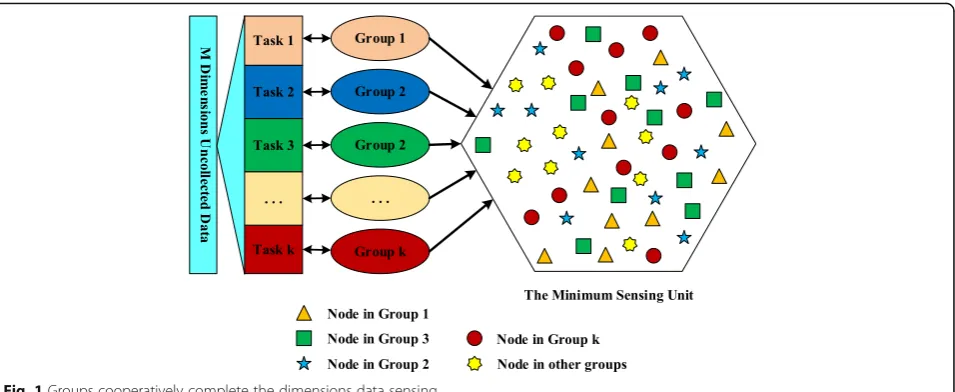
node can only handle partial types of data sensing. In order to deal with the high-dimensional data collection, it needs to divide the high-dimensional data collection task intoksub-task with lower data dimension to reduce the load of a sensing node. For each sub-task, it corre-sponds to a sensing group with numberCsensing nodes. The problem of task allocation is transformed into divid-ing the m-dimension data sensing task intok sub-tasks, and then for each sub-task, choosing enough sensing nodes to form a sensing group to finish the data collection.
For simplicity, we make assumptions as follows: first, the data types contained in each sub-task will not overlap and the sum of all sub-tasks’ dimension is m; second, each sub-task requires the same
mini-mum number of sensing nodes as C; third, in each
group, the node number C can cover the whole
sens-ing unit, and we will not consider the location of a node. As is shown in Fig. 1, we assume that all the sensing nodes in each group will cover the minimum sensing area.
2.2 Challenges in task allocation
We propose a task partition model to solve the problem of the high-dimensional data when we collecting data from a single node. Through this method, the data di-mension is reduced, and multiple sensing nodes that work together can accomplish high-dimensional data collection tasks. Challenges for this high-dimensional data collection are as follows:
(1) How to improve the task completion ratio. In conventional methods, one node has to sense all types of required data, and this may beyond its sensing capability, which will reduce the task completion ratio. In the MCS, by dividing a
high-dimensional data into lower dimensions, a node only needs to collect partial types in all of the data types.
(2) How to minimize the total sensing cost as much as possible. For a large-scale complex sensing task, it requires a significant number of nodes to collect data, and the cost of data collection is enormous for large-scale tasks. It needs to select nodes for a suit-able sub-task to minimize the cost of data collection under the premise of guaranteeing the task
completion.
(3) How to equalize the participation probability of each node, that is to say, avoiding that some nodes join in a significant number of sub-tasks while others only join in very few sub-tasks. The current task allocation methods are always aim-ing to select the node that can minimize the total cost, which may result in the fact that some nodes may be overloaded to deal with a great number of sub-tasks, while some nodes only per-form small number of sub-tasks. It is difficult to minimize the whole cost of the system while making sub-tasks distributed among participants evenly.
3 The proposed algorithm of LCBPA 3.1 Model definition
Assuming that a system requires mobile nodes (mobile terminals) to finish anm-dimension data collection task, and for simplicity, one dimension corresponds to one data type. The required data type set is A, which is a matrix withmrows andNcolumns. LetA= {G1,G2,⋯,
Gm}A= {G1,G2,…,Gm}, and eachGidenotes a data type
in them-dimension data task collection. For each vector
Gi, the element gij represents that the data type Gi can
be collected by nodej, andjis the node number, (j∈(1,
N)). Ifgij= 1, it means that theith dimensional data can
we assume that the data types contained in each sub-task are not overlapped and the sum of all sub-sub-tasks’ di-mension ism.
Each node corresponds to a tripleψi= {i,Ti,Vi}, where
iis the node number, and i∈(1,N).Ti is the task which
can be sensed by user i, which is a k-dimension vector. For each element tij in Ti, if tij= 0, it means that the
node i does not have the capability to sense the data type required in the sub-tasksj, while, iftij= 1, it means
that node ican perform the sub-tasksj.Viis the cost of
the sensing task, which is also a k dimensional vector. For each element vij, the value is the cost of node i for
sensing sub-tasksj.
The total cost for a mobile crowd sensing system to finish the data collection task is
W¼X will minimizeW, that is
T¼
The trade-off between minimizing the total cost andλi
is performed as follows: used to make the trade-off between cost constraints and node participation on the probability of node selection [25]. Let wj denote the total quoted price that all the
nodes can senseGj, thenwj¼
PN
i¼1vij. Letrjdenote the
number of nodes that can perform sub-task, and rj
¼PN i¼1tij.
As stated above, in order to avoid some nodes joining in too many tasks while others only join in few sub-tasks, we introduce the adjustment coefficient λi [26]. When a node has already been selected in the previous sub-task allocation rounds, this parameter may reduce the probability that a node being selected. When we se-lect a node to participate in a sub-task, the system will make a trade-off between the total cost and the adjust-ment coefficientλi. We computeλiby Eq. (6):
where tih represents whether the node i was assigned
with the sub-tasksh, andtih= 1 means that the nodeiis
assigned to sub-task h, else tih= 0. rh denotes the node
number that can perform the sub-tasksh, which can be
computed by Eq. (7):
rh¼XNi¼
1tih ð7Þ
3.2 The two-stage task allocation algorithm of LCBPA The detail steps for the system to select sensing nodes are divided into two stages:
Stage one: Dividing an m-dimensional data collection task into ksub-tasks by K-means method. According to the sensing capability attributes (the data type a node can sense) of each node, we need to divided the whole sensing task into k sub-tasks. Here, we choose the K -means algorithm, which is a classical algorithm to solve the clustering problem, and it is simple and fast. When processing large data sets, the k-means algorithm main-tains scalability and efficiency. The general processes are as follows: First, chosekdata types from data type setA
as the initial clusters center randomly. Second, for the remaining data types inA, assign them to the nearest k
initial clusters according to the distance D. When calcu-lating the cluster center of each new cluster, keep re-peating the process until the standard measure function
Dis converged.
The standard measure functionDfor converging clus-ters is
where the distanceDis computed by the Euclidean dis-tance dij from Gi and Gj. The shorter the distance
data types, and the higher probability those two data types will be divided into the same sub-task.
dist Gi ;Gj¼
ffiffiffiffiffiffiffiffiffiffiffiffiffiffiffiffiffiffiffiffiffiffiffiffiffiffiffiffiffiffiffiffi
XN
i¼1 Gi−Gj
2
r
ð9Þ
The correspondent algorithm for the first stage is as follows:
However, dividing the whole sensing task into k sub-tasks is only a basic step in our proposal, we need fur-ther to adjust the mapping between participating nodes and sub-tasks by other considerations, such as minimiz-ing the total cost and avoidminimiz-ing a node beminimiz-ing assigned too many sub-tasks in the following step.
Stage two: Assigning different nodes with different sensing capability to a suitable sub-task by the trade-off between minimizing the total cost and node participa-tion equality. After the first data type clustering stage, the system will allocate node to each sub-task. For each
sub-tasksj∈S, it will judge whether a node can perform
the sub-task and calculate the adjustment factor λi ac-cording to formula6. It will also calculate the probability
pij to decide whether a node can be selected in a
sub-task by Eq.5. The system will sort the probabilitiespijof
all the nodes from high to low, and select the top-C
nodes for sub-task sj. The correspondent algorithm for
the second stage is stated in algorithm 2:
4 Results and discussion 4.1 Simulation setting
In this section, we will evaluate the performance of our proposed LCBPA scheme by simulation. Our simulation environment is Ubuntu 14.04. We compare the
perform-ance of our LCBPA with non-task-division (NTD)
method, which is the method that nodes participate high-dimension data collection directly. The simulation parameters are set as follows: the sensing area is 600 × 600 m2, and the sensing radius of each node is 25 m. The network size (sensing node number) varies from 50 to 500, the data dimension is 50, and the sub-task num-ber ranges from 10 to 50, and the trade-off weight
par-ameter α varies from 0.1 to 0.9, the minimum node
of node participationui. The parametersηanduiare
de-fined as follows:
(1) The task completion ratioηis defined as the number of the wholem-dimension tasks that can be completed, that is
η¼ B
C ð10Þ
where
B¼
f
min1≤j≤k
XN
i¼1
tij; if min
1≤j≤k
Xn
i¼1
tij<C;
C; if min
1≤j≤k
XN
i¼1
tij≥C;
ð11Þ
(2)μidenotes the participation equality of nodei, which is the percentage of the total number of sub-tasks assigned to each node:
μi¼ 1 k
Xk
j¼1tij ð12Þ
4.2 Simulation results
4.2.1 Comparison of task completion ratio
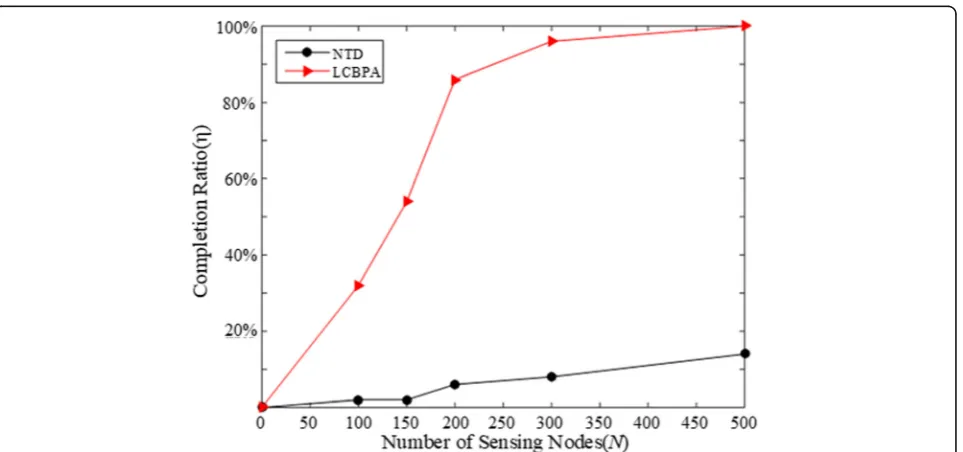
Figure 2 shows the comparison of the task completion
ratio of our LCBPA with NTD method under different
network scale. In this scenario, the number of sub-task is 20, andα= 0.5. The simulation shows ourLCBPAhas a higher task completion ratio, and the ratio increases as the network node number increases, which is because the node number for participating each sub-task is increased.
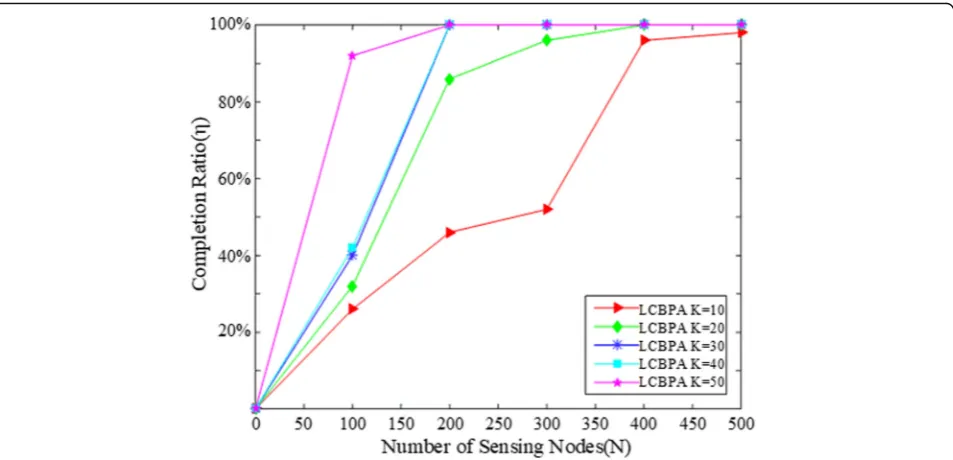
Figure3shows the comparison of the task completion ratio of ourLCBPAwith various sub-task numberk var-ies from 10 to 50 under different network scale. The re-sult in Fig. 3 shows that the task completion rate is increasing as a high-dimensional task is divided into more sub-tasks. Under the same network scale condi-tion, the task completion ratio is increased whenkis in-creased, which may be because the more detailed the division of the high-dimension task, the higher probabil-ity a node is assigned to the right sub-task, improving task completion ratio.
Figure4shows the comparison of the task completion ratio of ourLCBPAwith the weight parameterαvarying from 0.1 to 0.9 under a different network scale. The re-sult in Fig. 4 shows that the five lines are overlapped, which means that the task completion rate remains un-changed with different value of α. It may because that the total number of nodes that need to perform a sub-task is more than C, which makes no difference on the task completion ratio.
4.2.2 Comparison of the total cost
Figure5 shows the comparison of the total cost of data sensing in ourLCBPAwithNTDmethod under different network scale. In this scenario, the number of sub-task is 20, and α= 0.5. The simulation result shows that our
LCBPA has a lower total cost, and the total cost in-creases as the network scale is extended, which may be because the participating node number for each sub-task is increased.
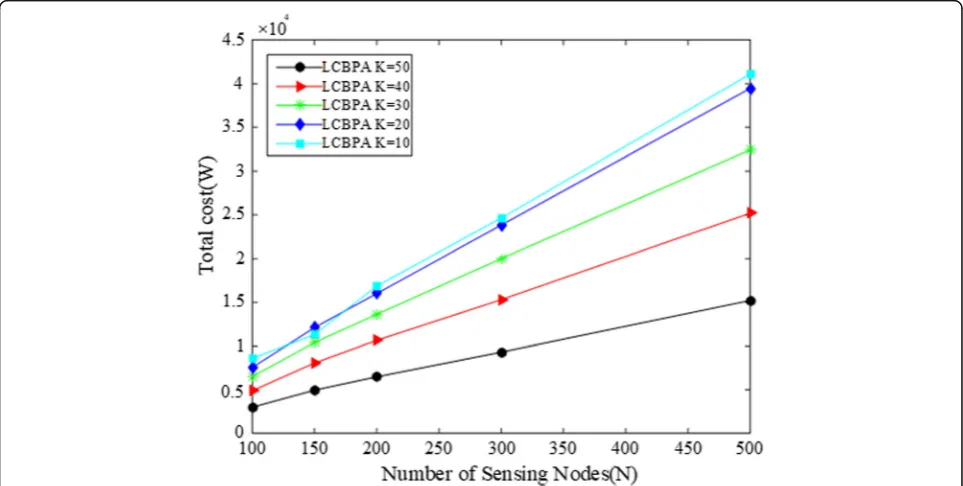
Figure6 shows the comparison of the total cost of our
LCBPAwith different sub-task numberkvarying from 10 to 50 under different network scale. The result in Fig.6 shows that as the size of the network increases, the total cost also increases. Under the same network scale, the lar-ger the number of the sub-taskk, the lower the total cost
of the system, which may be because more sub-task k
makes different nodes being assigned to more different suitable sub-tasks, saving some unnecessary cost.
Fig. 3Task completion ratio comparison ofLCBPAwith different sub-task numberk, whenα= 0.5 under different network scale
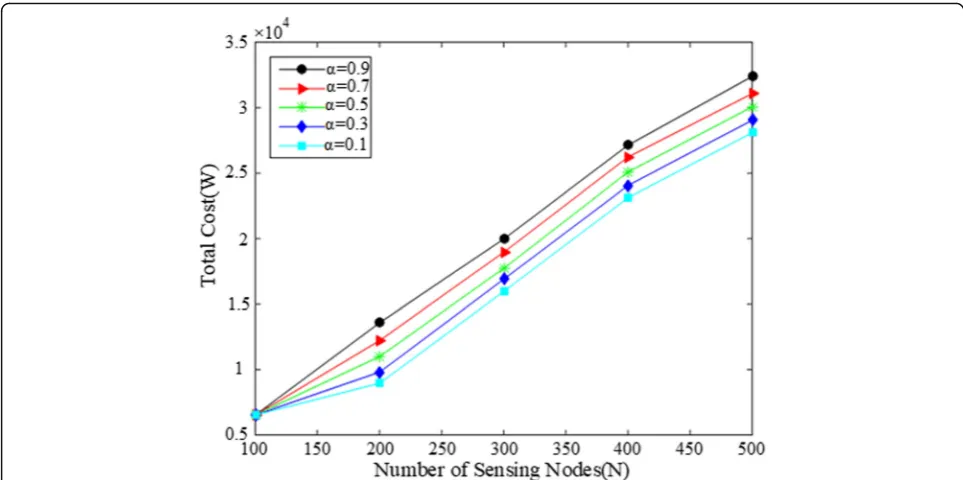
Figure 7 demonstrations the comparison of the total cost of our LCBPA at different network with trade-off weight parameterαvarying from 0.1 to 0.9 and atk= 20. The result in Fig.7shows that the total cost is increased as the network scale is higher. Under the same network scale, the larger the number of the sub-task, the higher the total cost of the system because a largeαvalue may
take less consideration of minimizing the total cost, im-proving the total cost.
4.2.3 Comparison of the node participation equality under a different network scale
Figure8shows the comparison of the node participation
equality of our LCBPA with NTD method under the
Fig. 5Total cost comparison ofLCBPA and NTDwhenk= 20,α= 0.5 under different network scale
same network scale. In this scenario, the sub-task num-ber is 20, and α= 0.5. The simulation shows that in our
LCBPA, a larger proportion of nodes are allocated with a smaller proportion of sub-tasks, and the proportion of nodes to perform more sub-tasks are significantly reduced.
Figure9 shows the comparison of the node participa-tion equality ofLCBPAwith the sub-task numberk vary-ing from 10 to 50 under same network scale. The result
in Fig. 9 shows that the node participation becomes
more concentrated when a high-dimensional task is di-vided into more sub-tasks. It means that the proportion of nodes performing too many tasks will be reduced, and most of the nodes are assigned to an average amount of sub-tasks.
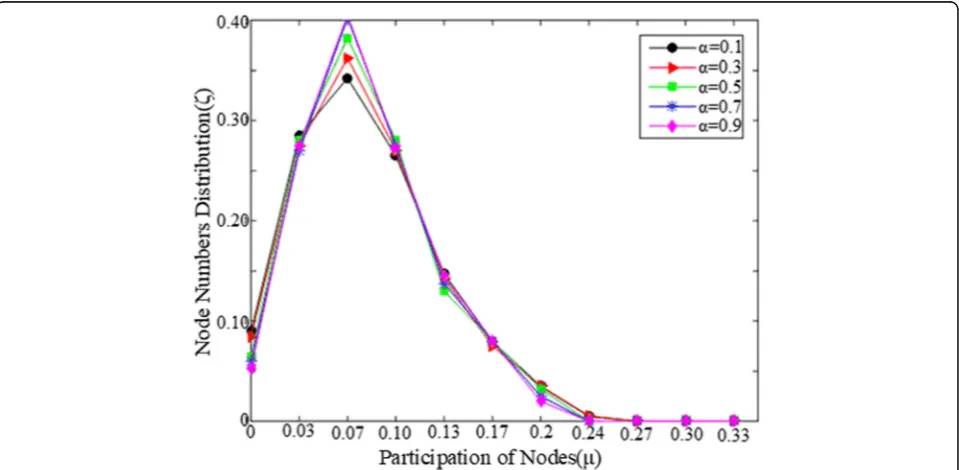
Figure10shows the comparison of the node
participa-tion equality of our LCBPA with different trade-off
weight parameter α which varies from 0.1 to 0.9.
Fig. 7Total cost ofLCBPAwith different trade-off parameterαwhenk= 20 under different network scale
Figure10shows that the participation of nodes become more concentrated asαincreased, which means that the proportion of nodes performing too many tasks will be reduced as α is increased, and most of the nodes are assigned to an average amount of sub-tasks.
5 Conclusion
This paper proposes a high-dimension data collection al-gorithm LCBPA for mobile crowd sensing network. In
particular, we introduce the two-stage operation scheme to deal with the problem that a node with lower sensing capability confronted with the higher dimensional col-lection data. To evaluate our proposed scheme, we for-mulate the evaluation parameters, and we also calculate the task completion ratio, the total cost of the data, and the node participation equality. As a result, our scheme can effectively work when the network scale varies from 50 to 500, and the sub-task number kvaries from 10 to
Fig. 9Comparison of node participation equality ofLCBPAwith different sub-task number k whenα= 0.5,N=300
50, with trade-off weight parameter α varying from 0.1 to 0.9. However, there are also some limitations of our proposed schemes: (1) we only simulated our proposed method by simulations, not in the real sensing activities; (2) Our method can reduce the sensing cost and diffi-culty, while it is only works based on the assumption that each dimension of the data can be collected inde-pendently, which means that there is no correlation be-tween different dimensions of the data, which may be not always the case. (3) When assigning each sensing task to different nodes, we do not consider the location and mobility of a node. (4) In practical, the value of the data will be elapsed as the time passed, which is also not considered in our proposed method. In the future work, we will evaluate hardware-based experiments, and take the node mobility and location into consideration, and we will also consider the data value as one of the factors in task allocation.
Abbreviations
DTA:Dual task assigner; LCBPA: Low-cost and balance-participating algo-rithm; MCS: Mobile crowd sensing; NTD: Non-task-division
Acknowledgements
Not applicable.
Authors’contributions
NZ proposed an idea and provided the guidance for deriving these expressions. JZ verified the correctness of the simulations cooperatively. BW improved the presentation of the draft and provided valuable suggestions. JX has great and distinct contribution to the writing and editing on the new revision version of this manuscript, and all the author agree to add him as the forth author. All authors read and approved the final manuscript.
Funding
Not applicable.
Availability of data and materials
The datasets generated and analyzed during the current study are not publicly available, but are available from the corresponding author on reasonable request.
Competing interests
The authors declare that they have no competing interests.
Author details 1
National Digital Switching System Engineering and Technology Research Center, Zhengzhou 450002, People’s Republic of China.2Xinxiang University, NO.191, Jinsui Avenue, Xinxiang 453000, China.3Beijing University of Posts and Telecommunications, Beijing 100086, China.
Received: 10 June 2019 Accepted: 29 November 2019
References
1. R.K. Ganti, F. Ye, H. Lei, Mobile crowdsensing: Current state and future challenges. IEEE Commun. Mag.49(11), 32–39 (2011)
2. R. K. Rana, C. T. Chou , S. S. Kanhere, et al. Ear-Phone: An End-to-End Participatory Urban Noise Mapping System. ACM/IEEE International Conference on Information Processing in Sensor Networks. (ACM, Stockholm, 2010) pp.105–116
3. S. Liu, Y. Liu, L. Ni, et al., Detecting crowdedness spot in city transportation. IEEE Trans. Veh. Technol.62(4), 1527–1539 (2013)
4. Y. Altshuler, M. Fire, N. Aharony, et al., Trade-offs in social and behavioral modeling in mobile networks. Int. Conf. Soc. Comput.78(12), 412–423 (2013)
5. R. Pryss, M. Reichert, J. Herrmann, et al.,Mobile Crowd Sensing in Clinical and
Psychological Trials -- A Case Study, IEEE International Symposium on
Computer-Based Medical Systems (IEEE, Sao CArlos, 2015), pp. 23–24 6. M. Ra, B. Liu, T.L. Porta, et al.,Medusa: A Programming Framework for
Crowd-Sensing Applications, International Conference on Mobile Systems (2012), pp.
337–350
7. L.Y. Qi, W.C. Dou, W.P. Wang, et al., Dynamic mobile crowdsourcing selection for electricity load forecasting. IEEE ACCESS6, 46926–46937 (2018) 8. Z. Gao, H.Z. Xuan, H. Zhang, et al., Adaptive fusion and category-level
dictionary learning model for multi-view human action recognition. IEEE. Intern. Things. vol. 6 J., 1–14 (2019)
9. L.Y. Qi, R.L. Wang, S.C. Li, et al., Time-aware distributed service recommendation with privacy-preservation. Inf. Sci.480, 354–364 (2019) 10. D. Zhang, L. Wang, H. Xiong, et al., 4W1H in mobile crowd sensing. IEEE
Commun. Mag.52(8), 42–48 (2014)
11. C. Yan, X.C. Cui, L.Y. Qi, et al., Privacy-aware data publishing and integration for collaborative service recommendation. IEEE ACCESS6, 43021–43028 (2018)
12. L.Y. Qi, Y. Chen, Y. Yuan, et al., A QoS-aware virtual machine scheduling method for energy conservation in cloud-based cyber-physical systems. World Wide Web. vol. 22 J., 1–23 (2019)
13. W. Li, X. Liu, J. Liu, et al., On Improving the accuracy with auto-encoder on conjunctivitis. Appl. Soft Comput., vol 81, 1–11 (2019)
14. W.W. Gong, L.Y. Qi, Y.W. Xu, Privacy-aware multidimensional mobile service quality prediction and recommendation in distributed fog environment. Wirel. Commun. Mob. Comput.2018, 1–8 (2018)
15. S. He, Q. Yang, R.W.H. Lau, et al.,Visual Tracking Via Locality Sensitive
Histograms, Proceedings of the IEEE conference on computer vision and
pattern recognition (IEEE, Portland, 2013), pp. 2427–2434
16. L.Y. Qi, S.M. Meng, X.Y. Zhang, et al., An exception handling approach for privacy-preserving service recommendation failure in a cloud environment. Sensors18(7), 1–11 (2018)
17. L.Y. Qi, W.C. Dou, J.J. Chen, et al., Weighted principal component analysis-based service selection method for multimedia Services in Cloud. Computing98(1), 195–214 (2016)
18. C.J. Ho, J.W. Vaughan,Online Task Assignment in Crowdsourcing Markets, AAAI Conference on Artificial Intelligence (2012), pp. 45–51
19. C.M. Angelopoulos, S. Nikoletseas, T.P. Raptis, et al.,Characteristic Utilities,
Join Policies and Efficient Incentives in Mobile Crowd Sensing Systems,
Proceedings of the IFIP Wireless Days (2014), pp. 1–6
20. S. He, D.H. Shin, J. Zhang, et al., Toward optimal allocation of location dependent tasks in crowdsensing. Proce. IEEE. Int. Conf. Comput. Commun 5(11), 745–753 (2014)
21. T. Dang, W.C. Feng, N. Bulusu,Zoom: A Multi-Resolution Tasking Framework
for Crowdsourced Geo-spatial Sensing, Proceedings - IEEE INFOCOM (2011),
pp. 501–505
22. T. Huy, N. Bulusu, D. Thanh, et al.,Scalable Map-Based Tasking for Urban
Scale Multi-Purpose Sensor Networks, Proceedings of the IEEE Topical
Conference on Wireless Sensors and Sensor Networks (2013), pp. 142–144 23. H. Chen, Z. Siwang.Raster-vector mixed task distribution method for mobile
crowd sensing system, J Computer Engineering and Applications. (23),
130-134 (2016)
24. J.T. Zhang, Z.H. Zhao, S.W. Zhou, Vector task map:progressive task allocation in crowd-sensing. Chinese J. Comput.39(3), 1–14 (2016)
25. C.C. Yin, C.W. Wang, Optimality of the barrier strategy in de Finetti’s dividend problem for spectrally negative Lévy processes: an alternative approach. J. Comput. Appl. Math.233, 482–491 (2009)
26. P. Li, S.L. Zhao, R.C. Zhang, A cluster analysis selection strategy for supersaturated designs. Comput. Stat. Data. Anal.54(6), 1605–1612 (2010)
Publisher’s Note