MADARi: A Web Interface for Joint Arabic
Morphological Annotation and Spelling Correction
Ossama Obeid, Salam Khalifa, Nizar Habash,
Houda Bouamor,
†Wajdi Zaghouani,
⇤Kemal Oflazer
†Computational Approaches to Modeling Language Lab, New York University Abu Dhabi, UAE
†Carnegie Mellon University in Qatar, Qatar ⇤Hamad Bin Khalifa University, Qatar
{oobeid, salamkhalifa, nizar.habash}@nyu.edu,
[email protected], [email protected], [email protected] Abstract
In this paper, we introduce MADARi, a joint morphological annotation and spelling correction system for texts in Standard and Dialectal Arabic. The MADARi framework provides intuitive interfaces for annotating text and managing the annotation process of a large number of sizable documents. Morphological annotation includes indicating, for a word, in context, its baseword, clitics, part-of-speech, lemma, gloss, and dialect identification. MADARi has a suite of utilities to help with annotator productivity. For example, annotators are provided with pre-computed analyses to assist them in their task and reduce the amount of work needed to complete it. MADARi also allows annotators to query a morphological analyzer for a list of possible analyses in multiple dialects or look up previously submitted analyses. The MADARi management interface enables a lead annotator to easily manage and organize the whole annotation process remotely and concurrently. We describe the motivation, design and implementation of this interface; and we present details from a user study working with this system.
Keywords:Arabic, Morphology, Spelling Correction, Annotation
1. Introduction
Annotated corpora are vital for research in natural language processing (NLP). These resources provide the necessary training and evaluation data to build automatic annotation systems, and benchmark them. The task of human manual annotation, however, is rather difficult and tedious and sev-eral annotation interface tools have been created to assist in such effort. These tools tend to be specialized to optimize for specific tasks such as spelling correction, part-of-speech (POS) tagging, named-entity tagging, syntactic annotation, etc. Certain languages bring additional challenges to the annotation task. Compared with English, Arabic annotation introduces a need for diacritization of the diacritic-optional orthography, frequent clitic segmentation, and a richer POS tagset.
In this paper, we focus on designing and implementing a tool targeting Arabic dialect morphological annotation. Standard Arabic morphology is quite rich (Habash, 2010), but Arabic dialects introduce more complexity than Stan-dard Arabic in that the input text has noisy orthography. For example, the word
i.J⌦ mÃ'@AÎÒK.AK⌦
wyAbwhAAlxlyj1in-volves two spelling errors2(a word merge and character
re-placement) which can be corrected as
i.J⌦ mÃ'@ AÎÒK.Ag.
wjAb-whA Alxlyj‘and they brought it to the Gulf’. Furthermore, the first of the two corrected words includes two clitics that when segmented produce the form:AÎ
+@ÒK.Ag.
+
w+ jAbwA +hA‘and+ they-brought +it’.1Transliterations are in the Habash-Soudi-Buckwalter scheme (Habash et al., 2007).
2Since Arabic dialects do not have a standard orthography,
spelling correction here means to conventionalize as per the CODA standard (Habash et al., 2018).
Previous work on Arabic morphology annotation inter-faces focused either on the problem of manual annotations for POS tagging (Maamouri et al., 2014), or diacritiza-tion (Obeid et al., 2016), or spelling correcdiacritiza-tion (Obeid et al., 2013). In this paper we present a tool that allows do-ing all of these tasks together, eliminatdo-ing the possibility of error propagation from one annotation level to another. Our tool is named MADARi3after the project under which
it was created: Multi-Arabic Dialect Annotations and Re-sources (Bouamor et al., 2018).
The remainder of this paper is structured as follows: we present work related to this effort in Section 2. In Section 3., we discuss the design and architecture of our annotation framework. In Section 4. and Section 5., we discuss the annotation and management interfaces, respectively. We finally describe a user study of working with MADARi in Section 6.
2. Related Work
Several annotation tools and interfaces were proposed for many languages and to achieve various annotation tasks. Some are general purpose annotation tools, such as BRAT (Stenetorp et al., 2012) and WebAnno (Yimam et al., 2013). Task-specific annotation tools for post-editing and error correction include the work of Aziz et al. (2012), Stymne (2011), Llitjós and Carbonell (2004), and Dickinson and Ledbetter (2012).
For Arabic, there are several existing annotation tools, however, they are designed to handle specific NLP tasks and are not easy to adapt to our project. Examples in-clude tools for semantic annotation such as the work of Saleh and Al-Khalifa (2009) and El-ghobashy et al. (2014),
3
and the work on dialect annotation by Benajiba and Diab (2010) and Diab et al. (2010). Attia et al. (2009) built a morphological annotation tool. Recently, Al-Twairesh et al. (2016) introduced MADAD, a general-purpose online collaborative annotation tool for readability assessments project in Arabic. In the COLABA initiative (Diab et al., 2010), the authors built tools and resources to process Ara-bic social media data such as blogs, discussion forums, and chats. Javed et al. (2018) presented an online interface for joint syntactic annotation and morphological tokenization for Arabic.
In general, many of these existing tools are not designed to handle the peculiarities of dialectal Arabic. They neither provide facilities for managing thousands of documents nor permit the distribution of tasks to tens of annotators, includ-ing managinclud-ing inter-annotator agreement (IAA) tasks. Our interface borrows ideas from three other existing annotation tools: DIWAN, QAWI, and MANDIAC. Here we describe each of these tools and how they have influenced the design of our system.
DIWANis an annotation tool for Arabic dialectal texts (Al-Shargi and Rambow, 2015). It provides annotators with a set of tools for reducing duplicate effort including the use of morphological analyzers to pre-compute analyses, and the ability to apply analyses to multiple occurrences simul-taneously. However, it requires installation on a Windows machine and the user interface is not very friendly to new-comers.
QAWI (the QALB Annotation Web Interface) was used for token-based text editing to create raw and and text corrected parallel data for automatic text correction tasks (Obeid et al., 2013; Zaghouani et al., 2014; Zaghouani et al., 2015; Zaghouani et al., 2016). It supported the exact recording of all modifications performed by the annotator which previous tools did not. We utilize this token-based editing system for minor text corrections that transform text of a given dialect into the appropriate CODA orthography (Habash et al., 2018).
MANDIAC utilized the token-based editor used in QAWI to perform text diacritization tasks (Obeid et al., 2016). More importantly, it introduced a flexible hybrid data storage system that allows for adding new features to the annotation front-end with little to no modifications to the back-end. MADARi utilizes this design to provide the same utility.
3. MADARi Design
The MADARi interface is designed to be used by human annotators to create a morphologically annotated corpus of Arabic text. The text we work with comes from social me-dia and is highly me-dialectal (Bouamor et al., 2018; Khalifa et al., 2018) and has numerous spelling errors. The annotators will carefully correct the spelling of the words and also an-notate their morphology. The in-context morphology anno-tation includes tokenization, POS tagging, lemmatization and English glossing.
3.1. Desiderata
In order to manage and process the annotation of the large scale dialectal Arabic corpus, we needed to create a tool to streamline the annotation process. The desiderata for devel-oping the MADARi annotation tool include the following:
• The tool must have very minimal requirements on the annotators.
• The tool must allow off-site data management of docu-ments to allow annotation leaders to assign and grade documents from anywhere in the world and to allow hiring annotators anywhere in the world.
• The tool must allow easily customizable POS tag sets
by annotation leads.
• The tool must allow easy access to other user
annota-tions of similar texts.
• The tool must allow for easy navigation between spelling changes and morphological disambiguation.
3.2. Design and Architecture
The design of our interface borrows heavily from the de-sign of MANDIAC (Obeid et al., 2016). In particular, we utilized the client-server architecture, as well as the flexi-ble hybrid SQL/JSON storage system used by MANDIAC. This allows us to easily extend our annotation interface with minor changes, if any, to the back-end. Our system stores documents one sentence per row, unlike MANDIAC which stores one document per row. This modification allows the annotation interface to handle larger file sizes without affecting its performance by only overwriting the JSON of the modified sentences and not that of the entire document. Like, DIWAN and MANDIAC, we also utilize MADAMIRA (Pasha et al., 2014), a morphological ana-lyzer and disambiguator for Arabic to pre-compute analy-ses.
4. Annotation Interface
The annotation interface (illustrated in Figures 1 to 4) is where annotators perform the annotation tasks assigned to them. Here we describe the different components and utili-ties provided this interface.
4.1. Task Overview
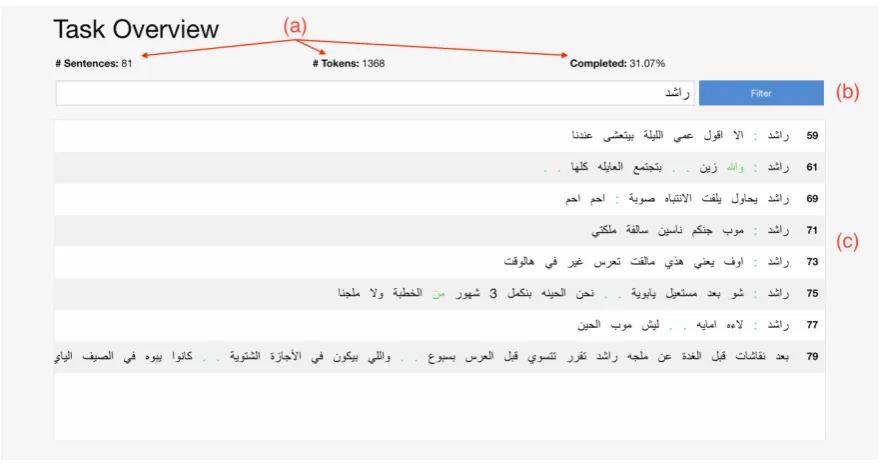
When starting an annotation session, annotators are first shown the “Task Overview” screen (Figure 1). Here an-notators can see information on the size of the current task and their progress so far (Figure 1a). The sentence list can be filtered to contain sentences matching a desired search term using the filter bar (Figure 1b). The list of sentences in the current task is also displayed with validated tokens color-coded green (Figure 1c). Clicking on any word in the sentence list will open the annotation interface (Figure 2) at that word.
4.2. Word Analysis
Figure 1: MADARi Task Overview screen
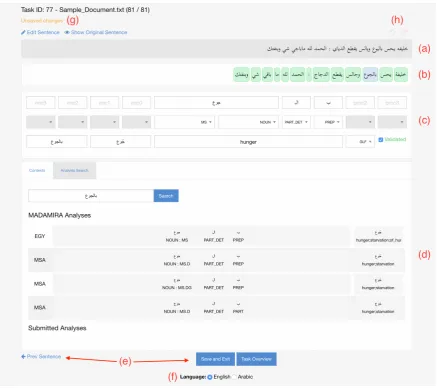
Figure 2c is the heart of the annotation interface, where annotators manually disambiguate the morphological anal-ysis. Disambiguation includes morphologically tokenizing each word into proclitics, baseword, and enclitics (Figure 2c, first row from right to left, respectively). Each of these are assigned a POS tag as well as a morphological feature4
where applicable (Figure 2c, second row). Annotators also assign the lemma, gloss, and dialect for each word (Figure 2c, third row, second to fourth fields from the left respec-tively). For the convenience of the annotators, we provide pre-computed values for each field using MADAMIRA’s morphological analysis. Each word has a validated field (Figure 2c, third row, right-most field) to indicate that the annotator has fully analyzed it and is confident with their analysis.
Generally, the final form of a word is a concatenation of the proclitics, baseword, and enclitics. However, there are certain cases where that is not true because some or-thographic rewrite rules must apply (Habash et al., 2018). Using the example in the introduction,
AÎÒK.Ag.
wjAbwhAshould be tokenized by annotators into
AÎ
+@ÒK.Ag.
+
w+ jAbwA +hA. However, when displaying the detokenized to-ken, the system should showAÎÒK.Ag.
wjAbwhA and notAÎ@ÒK.Ag.
wjAbwAhA. MADARi has built-in rewrite rules for trivial detokenization cases but we also allow annotators to manually edit the detokenized form manually as needed (Figure 2c, third row, left-most field).4.3. Text Editing
Annotators can freely alternate between morphological analysis and spelling modification of the words in the sen-tence. This gives them the freedom to make joint decisions on spelling and morphology and avoid error propagation. Sentence edits can be made by going to the “Edit Sentence”
4We use the CAMELPOS tag set and features defined by Khal-ifa et al. (2018).
view (Figure 3). In the “Edit Sentence” view, only the word tokens of the sentence are shown, each with a left and right arrow button surrounding them (Figure 3a). Clicking on one of these arrows merges that token with the one on the left or right respectively. Double clicking on a token dis-plays the “Edit Token” pop-up (Figure 3a). In this pop-up, an annotator can edit a word or split it into multiple tokens by inserting spaces between the letters.
4.4. Utilities
We have added a number of utility features to make the annotation process easier and more efficient for annota-tors. Basic utilities include undo and redo buttons (Fig-ure 2h), switching between English and Arabic POS tags (Figure 2f). Annotators can jump to the next or previous sentence, go to the “Task Overview” screen, or exit the task in the navigation bar (Figure 2e). All functions in the navi-gation bar automatically save any changes made by the an-notator. Furthermore, annotators can see what document and sentence they are currently annotating as well as the whether there are any unsaved changes in the task status bar (Figure 2g).
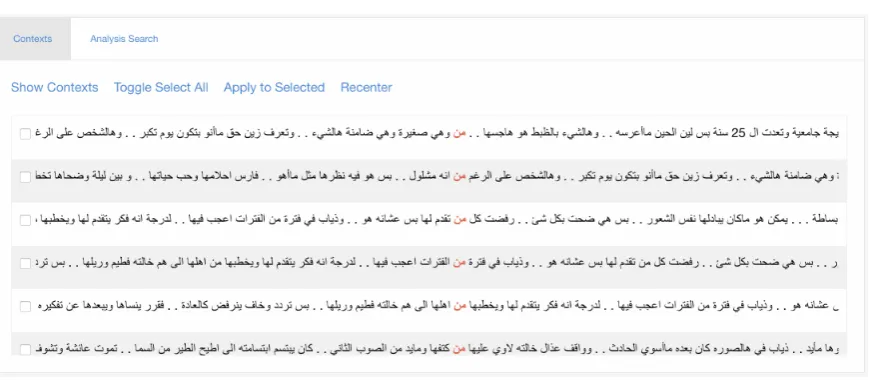
We also allow annotators to update multiple instances of a word with the same orthography together. In the “Con-texts” panel, annotators are shown a list of all occurrences of a word within the current document in context (Figure 4a). They can then select each context they would like to update by clicking on the check box on the left of each in-stance. Finally, annotators click on the “Apply to Selected” button (Figure 4a) to apply the analysis of the current word to all the selected instances.
Figure 2: Full view of the MADARi annotation interface
(a) Token merge and split view
(b) Token edit pop-up
(a) Contexts panel view
[image:5.595.81.516.62.258.2](b) Analysis search panel.
Figure 4: Contexts and analysis search view
“Search” retrieves a list of out-of-context analyses from MADAMIRA and a list of previously submitted analyses of the search term. Double clicking on a listed analysis applies it to the current word if the current word can be tokenized in such a way that its clitics match those of the selected anal-ysis. For example
…J⌦ ÀAK.
bAllyl‘during the night’ andPAÓ DÀAK.
bAlnhAr‘during the day’ have the same proclitics +
»@
+H.
b+Al+and no enclitics, thus they have matching clitics.
5. Management Interface
The Annotation Management Interface enables the lead an-notator to easily manage and organize the whole annotation process remotely and concurrently. The management inter-face contains: (a) a user management tool for creating new annotator accounts and viewing annotator progress; (b) a document management tool for uploading new documents, assigning them for annotation, and viewing submitted an-notations; (c) a monitoring tool for viewing overall anno-tation progress; (d) a data repository and annoanno-tation export feature; and (e) a utility for importing pre-annotated docu-ments, overriding MADAMIRA’s analyses.
6. User Study
Our tool is being used as part of an ongoing annotation project on Gulf Arabic (Khalifa et al., 2018). In this pa-per, we describe the experience of one annotator who has done annotations in different settings previously. The anno-tator morphologically disambiguated 80 sentences totaling in 1,355 raw tokens of Gulf Arabic text.
The annotator preferred, based on her experience, to con-vert the orthography of the text to CODA first, which made the disambiguation task more efficient.
It took about 52 minutes to complete this task (corre-sponding to a rate of 1,563 words/hour). The annotator made a few minor fixes later on, which is an advantage of our tool to minimize error propagation. The total number of words that were changed from the raw tokens to CODA was 288 (21%). Changes were mostly spelling adjustments and the rest is word splitting (44 cases or 15% of all changes) but no merges. The final word count is 1,398 words.
spent to finish the spelling adjustment and the full disam-biguation tasks for this set of data about 7 hours (at a rate of 200 words/hour).
Since the tool provides initial guesses for all the annota-tion components, the annotator was able to use many of the valid decisions as is, and modify them in other cases. In the event of a word split, the tool currently removes the raw word predictions, but the analysis search utility allows fast access to alternatives to select from.
We compared the final tokenization, POS tag and lemma choices to the ones suggested by the tool on the CODA ver-sion of the text. We found that the tool gave correct sugges-tions 74% of the time on tokenization, 69% of the time on baseword POS tags and 70% of the time on lemmas.
The annotator indicated that their favorite utilities were the ability to annotate multiple tokens of the same type in different contexts simultaneously, and the ability to use the
Analysis Searchbox to annotate multiple fields simultane-ously.
7. Conclusion and Future Work
We presented an overview of our web-based annotation framework for joint morphological annotation and spelling correction of Arabic. We plan to release the tool and make it freely available to the research community so it can be used in other related annotation tasks. In the future, we will continue extending the tool to support different dialects and genres of Arabic.Acknowledgments
This publication was made possible by grant NPRP7-290-1-047 from the Qatar National Research Fund (a member of the Qatar Foundation). The statements made herein are solely the responsibility of the authors.
Bibliographical References
Al-Shargi, F. and Rambow, O. (2015). DIWAN: A Dialec-tal Word Annotation Tool for Arabic. InProceedings of the Second Workshop on Arabic Natural Language Pro-cessing, page 49.
Al-Twairesh, N., Al-Dayel, A., Al-Khalifa, H., Al-Yahya, M., Alageel, S., Abanmy, N., and Al-Shenaifi, N. (2016). Madad: A readability annotation tool for arabic text. In Nicoletta Calzolari (Conference Chair), et al., editors, Proceedings of the Tenth International Confer-ence on Language Resources and Evaluation (LREC 2016), Paris, France, may. European Language Re-sources Association (ELRA).
Attia, M., Rashwan, M. A., and Al-Badrashiny, M. A. (2009). Fassieh, a Semi-automatic Visual Interactive Tool for Morphological, PoS-Tags, Phonetic, and Se-mantic Annotation of Arabic Text Corpora. IEEE Trans-actions on Audio, Speech, and Language Processing, 17(5):916–925.
Aziz, W., de Sousa, S. C. M., and Specia, L. (2012). PET: a tool for post-editing and assessing machine translation. InProceedings of the LREC’2012.
Benajiba, Y. and Diab, M. (2010). A Web Application for Dialectal Arabic Text Annotation. InProceedings of the LREC Workshop for Language Resources (LRS) and Human Language Technologies (HLT) for Semitic Lan-guages: Status, Updates, and Prospects.
Bouamor, H., Habash, N., Salameh, M., Zaghouani, W., Rambow, O., Abdulrahim, D., Obeid, O., Khalifa, S., Eryani, F., Erdmann, A., and Oflazer, K. (2018). The MADAR Arabic Dialect Corpus and Lexicon. In Pro-ceedings of the International Conference on Language Resources and Evaluation (LREC 2018).
Diab, M., Habash, N., Rambow, O., Altantawy, M., and Be-najiba, Y. (2010). Colaba: Arabic dialect annotation and processing. In LREC Workshop on Semitic Language Processing.
Dickinson, M. and Ledbetter, S. (2012). Annotating Errors in a Hungarian Learner Corpus. In Proceedings of the International Conference on Language Resources and Evaluation (LREC 2012).
El-ghobashy, A. N., Attiya, G. M., and Kelash, H. M. (2014). A Proposed Framework for Arabic Semantic Annotation Tool. 3(1).
Habash, N., Soudi, A., and Buckwalter, T. (2007). On Ara-bic transliteration. In Abdelhadi Soudi, et al., editors,
Arabic Computational Morphology, volume 38 ofText, Speech and Language Technology, chapter 2, pages 15– 22. Springer.
Habash, N., Khalifa, S., Eryani, F., Rambow, O., Ab-dulrahim, D., Erdmann, A., Faraj, R., Zaghouani, W., Bouamor, H., Zalmout, N., Hassan, S., shargi, F. A., Alkhereyf, S., Abdulkareem, B., Eskander, R., Salameh, M., and Saddiki, H. (2018). Unified Guidelines and Re-sources for Arabic Dialect Orthography. InProceedings of the International Conference on Language Resources and Evaluation (LREC 2018), Miyazaki, Japan.
Habash, N. (2010). Introduction to Arabic Natural Lan-guage Processing. Morgan & Claypool Publishers. Javed, T., Habash, N., and Taji, D. (2018). Palmyra:
A platform independent dependency annotation tool for morphologically rich languages. In Proceedings of the International Conference on Language Resources and Evaluation (LREC 2018), may.
Khalifa, S., Habash, N., Eryani, F., Obeid, O., Abdulrahim, D., and Kaabi, M. A. (2018). A Morphologically Anno-tated Corpus of Emirati Arabic. In Proceedings of the International Conference on Language Resources and Evaluation (LREC 2018), Miyazaki, Japan.
Llitjós, A. F. and Carbonell, J. G. (2004). The Transla-tion CorrecTransla-tion Tool: English-Spanish User Studies. In
Proceedings of the 4th International Conference on Lan-guage Resources and Evaluation (LREC’04).
Maamouri, M., Bies, A., Kulick, S., Ciul, M., Habash, N., and Eskander, R. (2014). Developing an Egyptian Ara-bic Treebank: Impact of Dialectal Morphology on An-notation and Tool Development. InProceedings of the Ninth International Conference on Language Resources and Evaluation (LREC-2014), Reykjavik, Iceland. Euro-pean Language Resources Association (ELRA).
K., and Tomeh, N. (2013). A Web-based Annotation Framework For Large-Scale Text Correction. In The Companion Volume of the Proceedings of IJCNLP 2013: System Demonstrations, pages 1–4, Nagoya, Japan. Obeid, O., Bouamor, H., Zaghouani, W., Ghoneim, M.,
Hawwari, A., Alqahtani, S., Diab, M., and Oflazer, K. (2016). MANDIAC: A Web-based Annotation System For Manual Arabic Diacritization. InThe 2nd Workshop on Arabic Corpora and Processing Tools 2016 Theme: Social Media, page 16.
Pasha, A., Al-Badrashiny, M., Kholy, A. E., Eskander, R., Diab, M., Habash, N., Pooleery, M., Rambow, O., and Roth, R. (2014). MADAMIRA: A Fast, Comprehensive Tool for Morphological Analysis and Disambiguation of Arabic. InIn Proceedings of LREC, Reykjavik, Iceland. Saleh, L. M. B. and Al-Khalifa, H. S. (2009). AraTation: an Arabic Semantic Annotation Tool. InProceedings of the 11th International Conference on Information Inte-gration and Web-based Applications & Services, pages 447–451. ACM.
Stenetorp, P., Pyysalo, S., Topi´c, G., Ohta, T., Ananiadou, S., and Tsujii, J. (2012). BRAT: A Web-based Tool for NLP-assisted Text Annotation. InProceedings of the Demonstrations at the 13th Conference of the European Chapter of the Association for Computational Linguis-tics, Stroudsburg, PA, USA.
Stymne, S. (2011). Blast: a Tool for Error Analysis of Machine Translation Output. In Proceedings of the ACL’2011: Systems Demonstrations, pages 56–61. Yimam, S. M., Gurevych, I., de Castilho, R. E., and
Bie-mann, C. (2013). WebAnno: A Flexible, Web-based and Visually Supported System for Distributed Annotations. InACL (Conference System Demonstrations), pages 1–6. The Association for Computer Linguistics.
Zaghouani, W., Mohit, B., Habash, N., Obeid, O., Tomeh, N., Rozovskaya, A., Farra, N., Alkuhlani, S., and Oflazer, K. (2014). Large Scale Arabic Error Annota-tion: Guidelines and Framework. InProceedings of the Ninth International Conference on Language Resources and Evaluation (LREC’14), Reykjavik, Iceland.
Zaghouani, W., Habash, N., Bouamor, H., Rozovskaya, A., Mohit, B., Heider, A., and Oflazer, K. (2015). Correc-tion annotaCorrec-tion for non-native Arabic texts: Guidelines and corpus. Proceedings of The 9th Linguistic Annota-tion Workshop, pages 129–139.