A High-level Morphological Description Language
Exploiting Inflectional Paradigms
Peter Anick and Suzanne Artemieff
Digital Equipment Corporation 111 Locke Drive, L M O 2 d / D I 2
Marlboro, MA 01752 [email protected]
Abstract
A high-level language lor the description of inflectional morphology is presented, in which the organization of word lormation rules into an ii~herilance hierarchy of paradigms allows l o r a natural encoding of the kinds of nfles typically pre~uted in grammar txroks. We show how tim language, composed of orthographic rides, word formation rules, and paradigm inheritance, can be com- piled into a run-time data structure for efficient morpho- logical analysis and generation with a dynamic secondary storage lexicon.
1 Introduction
Pedagogical grmnmar Nalks typically organize their de- scriptinns of the inflectiomd morphology of a langtmge in terms of paradigms, groups of rnlas which characterize the inflectional behavior of some subset of the language's vocabulary. A French grannnar may divide verbs into the first, secoud, and third conjugations; German grammars speak of "weak" and "strong" verbs; Spanish grammars classify verbs by their infiuitival endings, etc. The family nf word forms that each v(x:abuhu'y item may have can thus he describexl by a combination of a b a ~ stem (such as the "citation lbrm" used to index words in a dictionary) and the paradigm the word belongs to. Irregular words, which exhibit belu~viors not completely captured by gen- eral paradigms, often tend to be partially describable by reference to regular parudigmatic patterns.
The word formation rules that comprise a paradigm are usually expressed in terms of a sequence of stem change and affixation operations. For example, one French text- Imok [NEBEL741, in describing first conjugation verbs, shows how to fi)rm present tense forms nsing the inliniti- val stem with its "er" suffix rmnoved. Future tense is tormed by appending ',fffixes to the fifll infinitival stem, while the stem of the imperfect tense is Ionnd by taking the first person plural of the present tense and dropping the "ons". Ill addition to such word formation roles, there are spelling change rules wbich describe variations ill
spelling, often ctmditioned by file phonologic~d or ortho- graphic context th which a word lbrnlation rule is applied. While the above characterization of morphological behav- ior is a huniliar oue, inost description languages that have been developed for cumputatioual morphology (e.g., I KC)- SKENNIEMI841, [G(}RZ881 ) have tended to locus more on the orthographic and of fixation rules, and pay less at- tention to explicitly captaring the regularities within and between parudignts. Recently, some researchers have be- gun exploring the advantages to be derived from a nora. tion in which paradigms play a more central role (e.g., [CALDER891. IRUSSELL911). This paper presents such a notation, called PDL (for Paradigm Description l.au- guage), which we are using as the basis of the morpho- logical an~dyzer for A1-STARS, a multi-lingual "lexicon- assisted" informatiml retrieval system ([ANICK901). It has been a goal of our high-level language design to pre- ~rve, as umch as possible, the kinds of descriptive de- vices traditiorually used in grammar books.
Our approach to the representation of pmacfigms borrows from the Artificial Intelligence cmnmunity's notion of "frames", data structures made up (ff slots with attached procedares, orgmlized hierarchically to snpport default slot inheritance and overtkles (e.g., [BOBROW771). In a paradigm's "frume", the slots correspond to surlace anti stem li)nns, whose values are either explicitly stoxvd (in the lexicon) or else computed by word formation rules. The hierarchical organization of paradigms helps to cap- tore the sharexl linguistic behaviors among classes of words in all explicit and concise mlnnler.
Our ;qlplicatiou domain introdnces several constraints on the design of its morphological component:
- The morphological recognizer must work with a dy- namic secondary storage lexicnn access~xl via an in- dex on stem tornls. 'Ibis constratht rnles out ap- proaches relying on a left to right scan of file wool using special in-mmnory letter Iree eucodings of the dictionary (e.g., [GORZ881). It requires an approach
in which potential stems are derived by affix rc- moral/addition and/or stem chat,ges and then probed for in the lexicon.
• The morphoh)gical information must additionally support surface form genemtiun and "guessing". The guesser, to be employed in computer-assisted lexicon acquisition, mast he able to construct potenti:tl cita- tion forms (e.g., infinitive lorms lot verbs), not just stripped stems.
• The high-level language (PDL) mast be compilable into a lonn suitable for efficient run-time perfonn- ancc. 'Illis implies not only efficient in-memory data structures but also a system which minimizes disk (lexicon) accesses.
Our aim is to develop morphological rcpmsenlations tbr a number of (primarily European) hmguages. We have built t~firly complete representations h)r English, French, and Gennan, and have begun invcsfigating Spanish. While it is premature to predict how well our approach will apply across the range of European langnages, we have fimnd it contains a nnmher of desirable aspects for applications such as AI-STARS.
in the next section, we provide an overview of the PDL hmguage, describing how word fonnation rules are organ- ized into a hierarchy of paradigms and how the lexicon and morphological rules interact. Then we provide an il- lustration of the use of paradigm inheritance to construct a concise encoding of French verb forms. Next we present algorithms for the compilation of PDL rote efficient run- time data structures, and lot the recognition and genera- tion of word fi)rms. We conclude with an evaluation of the strengths anti weaknesses of rite approach, and areas for future research.
2 Paradigm Description Language
Oar paradigm description language (PDL) is composcd of three major components - form rules, an inheritance hier- archy of paradigms, and orthographic rules.
2.1 Form Rules
We divide word lorms into
• surface forms, which are those that show tip in a
text,
• lexical forms, which are those that are stored di-
rectly in the lexicon, and
• intermediate forms, those forms created by affixa-
tion or stem-change operations applied to other lorms. These terms may not ever show up in a text but are useful in describing intermediate steps in the construction of surlhce lorms from lexical fi)rms.
In the form ennstruction rules, we distinguish between two major categories of strings. Stems are any forms which include the primary [exical base of tile word, whereas affixes comprise tile prefixes and suffixes which can be concatenated with a stein in the process of word formation. Once an affix is appended to or removed from a stem, the result is also a stem, since tire result also in- cludes the primary lexical base. Form construction rides ,are restrictexl to the five cases below:
• <form> : <stem> + <affix> • <form> : <stem> - <affix> • <form> : + <affix> <stem> • <form>: - <affix> <stem> • <forul> : <stein>
The <lotto> is a name for the string form created by the rule. <stem> is the name of a stein form. <affix> may be a prefix or suffix string (or string variable), its type (i.c., prefix or suffix) impliexl by its position before or after the <stcm> in the rulc. The operator (+ or -) always precexles the affix. If +, then the affix is appended to the stem as a prefix or suffix. If -, then the affix is removexl from the stem. The rest,lting <lorm> name may in turn be used as a stem in the consU'uction e l some other k}rm. In this way, the construction of a surface form may be described via a succession of affixatinn or stem-change operations, each operation described in a single rule.
The special syndml LEX may be used in the right-hand- side of a form rule to imlicate that the tonn is stored as a lexical stem in the lexicon.
Grammatical [~ttures may be associated with form names, as follows:
<form> [<feature> = <vahte>, <feature> = <value>, ...]
2.2 Paradigms
A paradigm in PDL is composed of a set of term con- struction rules which collectively characterize the filmily of surface forms for those words which belong tn that paradigm. To capture the similarities among paradigms and to avoid redundancy in the description of a language, we allow one paradigm to be based on another paradigm. If paradigm B is based on paradigm A, then all the fimns and fi)rm construction rules that have been defined R)r paradigm A also apply, by default, to paradigm B. We can then differentiate paradigm B ti'om A in three ways:
I. We can add new lorms and their conslrnction rules fi~r tbrms that do not exist in A.
2. We cue rewrite (override) tile construction rnles tor tornls Ihal do exist in A.
3, i f a li)rra in A is no longer applicable in [I, we can delete it lionl t3.
Note that the l~ttnre set(s) associated with lornl names cannot change froin paradignl to l)aradignl; fornl nanles are nniversal, denoting tim same lcatures regardless of where they appear.
Ill order to facilitate the capture of generalizations across paradigms, we allow tile definition of abstract pamdignls. These ;ire paradigms to which no words of a langnago ac- tnally belong, hut which contain a sot of tbrnls and con- smictions which other paradigms have in connnon. Thus a COllCrCic paradignl nlay be based on shine ()tiler concrete paradigm or o n an abstract l)aradigm. Likewise, air a b -
stract paradigm nlay itself be based on yet another ab-
stract (or concrete) paradigm.
The ability to base one paradignl on another, combined with the ability to represent intermediate stenl forms ;IS slols in a paradigm, is a very lXlwerful feature of our mor- phological description langnage. Not only does it allow for paradign/descriptions that correspond closely with the kinds of descriptions lonnd in graminar hooks, but, since the roguhirilies alnong paradignls can Ix: ahstracled ont and shared hy nniliil/te llaradiglns, it alklws for very con- cise descrilltions el ioiloctional hehavinr (inchlding subregularities often overlooked in graulnlar hooks), ;.is il- Inslrated in section 3.
2.3 Orthographic Rules
l,'orm COllSlfnction rules describe which stems can coln- bine with which aflixes to create new |orms. The con- catenation or removal of all affix may in some cases result ill fl spoiling change other than tile mere concatenation or removal of tile affix string. In English, inany words end- ing in a vowel followed by a consonant will donble the fi- nal consonant whml an affix starting with a vowel is ap- pended, ill French, the addition of certain affixes requires that ;in "e" in the stein of some verbs be rewritten as "~,". Since these spelling change rules ;ire often hased on gen- eral phonological/orthographic llroperties nf alfixes and steins, rather lhnn llle specific forln rules Ihe, lnsolvos, and hmlce may apply acrnss paradigms, we supllort the m¢le- poudent st×~cificatinn of spelling rules caplnring lheso changes. Each rnle is written to allply to the orthographic context of a slen/and affix at tile point el the concatena- tion or deletion opontiion. Thus, there ;ire two kinds of spelling rules:
1, Suffix rules, which describe spelling changes ap- plying to the end of tile stem and the hoginnmg of the snffix, and
2. Prefix rnles, which describe spelliug changes al I- IIlying to tile end el lhc prelix and tim beginning of the stein,
A sllelling rule can make reference to literal strings and variables. A vnriahle refers to a nanled Set of characters and/or slrings, snch as Vowel f,a,e,i,oai) or Dental (d,t,dn,m,chn,fn,gn). The grammar writer nray define snch sets and variables ranging over those gets.
The general feral o f a suffix spelling rule is ;is fklllows:
(<parameter>*) [<slcm-paneHl>l <opcrator>{<aflix paneul> I > [<mergtul panern>] {<lots>}
The opelator may he either ~ or , indicnting concatena- tion and deletion respectively. The <incrged-pattern> re liars to tile term constructed by perfornlmg tile operation on a Stem and alfix. The two pattelns tin tile left of tile arrow refer lo tile slem anti affix parlicipating ill tile con struction. Each pattern is a list of variables and/or literal strings. Whenever tile stlnle variable nanle appears more I]lan once ill the rule, it is assnlned to take on tile salile value throughout.
<paranletcr> is a lloole:in condition on the applicallility of tile spelling ride, It it necessary for ttloso cases wilere tile application of the rnle depends on iuik)rlnntion al)ont the lexical ilcln whk'h is not inclnded in Ih¢ orlhograllhy. (Like {BEAR88 I, we choose to represeot these conditions ;is featnres rather tllan ;is diacritics I KOSKENNIEMIB4 I,) All exanlllle in linglish where a parameter is necessary is lhe case of gonlinating final consonants. GelninaLinn tle- pends on llhonological ciiaracteristics which ;ire not pro- dictahle fronl tile spelling alone. Only words whose lexi- cnl entries contain the specified parameter valne will nndergo spelling changes sensitive to that parameter.
Specifying orthographic rules indel~ndently e l the spe- cific affixe, s to which they apply allows for a more coucise declarative rcpresenlu[ioll, as regnklritics across pal'a- digms and Ibrms can I~,, abstracted out. However, there are cases in which the application of ;in orthographic rnle is constrained to specific paradigms or to specific forms wilhin a paradigin. The oplional <h/cs> qualifier can Ix: nsed to liniit the paradignis and/or specific lornis it) which the orthographic rifle applies.
Prefixntion rules are exliressed ill a similar nlalnler, c, xcept that tile <operator> precedes the first pattern in tile left haud side. Stein changes fin whk;h a stein undergoes a spclliug change in the absence of ally affixalion ot)elation ) are llandled hy the association of an orthographic rule wilh a fornl rule el tile lorni <:folul> : <stem>. The, ortho- graphic rule in snch a case wonhl contain no affix pattern.
t lore we illnslrato a hypothelical spelling rule:
I"a" Cons Consl i/Vowell > "t2" (?tills Vowel
This is a suffix rule, since the operator precedes the sec- ond left-hand-side pattern. Accordingly, the <stem- pattern> refers to the characters at the end of the stem while the <affix-pattern> refers to the letters at the begin- ning of the affix. This rule states that, if we are append- ing an affix which begins with a vowel to a stem which ends in the character "a" followed by two identical conso- nants, then we construct the resulting form (<merged- pattern>) as follows:
1. Remove the last three characters from the stem, leaving <sub-stem>.
2. Remove the first character from the suffix, leaving <sub-allix>.
3. Construct the string <spell-change> by concatenat- ing the strings and iastantiated character variables described by the right-hand-side pattern. 4. Construct the resulting form as the concatenation
of the strings <sub-stem>, <spell-change>, and <sub-affix>.
2.4 The Lexicon
We have seen above how one paradigm can be based on another, thereby allowing lorm conslruction roles to be "inherited" by paradigms. This inherit~mce is controlled through the form names themselves. If we have a para- digm B based on paradigm A, then any form rules in A for which there is no rule in B with the same form name are by detroit assumed to be part of paradigm B. Although onr lexicon is maintained as a secondary storage database with entries represented and indexed differently from the (memory resident) paradigms, it is useful to think of a lexical entry as "inheriting" rules from its para- digm ~ts well. The inflectional behavior of any individnal word will depend on both the information inherited from its paradigm and the information stored in the lexicon. Lexicon entries contain the equivalent of a single kind of form construction rule:
<fi)rm> : <stem>/{ supersede I augment}
The interaction of lexical information with the word's p~tradigm is as fi)llows:
• If <form> correspends to a lexical stem nile in the paradigm (i.e., one whose right-hand-side is the special symbol LEX), then this form provides the stem fi)r that rule.
• If <form> correspomLs to a surface form in the paradigm or an iutermediate form qualified with the qualifier/allow lexical override , then the lcxical fornl either supersedes or augments the consU'nc-
tion rule in the paradigm, depending on the value of the stem's /[supersede I augment} qualifier. The qualifier/allow_lexical override is necessary to in- form the run-time inflectional analyzer when to attempt a lexical lookup of an intermediate form stem. By default, the analyzer looks up any form found directly in the text (surface form) and any forms whose right hand side is LEX. The use of the /allow lexical override flag can save disk accesses by limiting lexical lookups of interme- diate forms to just those cases in which lexical overrides may actually occur.
Utilizing the/allow lexical_override qualifier and the de- fault lookup of suri~,ce forms, one could write lexical en- tries in which all the rules in a paradigm were overridden by lexical information. In general, this is not a good idea, since it fails to take advantage of the generalizations that paradigms provide, but there are exceptional cases, such as the verb "be", fl~r which there must necessarily be a large number of lexical stems. Allowing lexical overrides in this manner eliminates the need to create tm excessive number of highly idiosyncratic paradigms specifically to accomodate irregular verbs in languages like French and German (see section 3).
3 Using Paradigm Inheritance to Capture Linguistic Generalizations
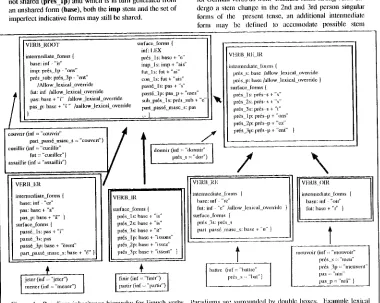
In PDL, word formation is characterized as a sequence of discrete transformational steps, lu many cases, paradigms (as well as iudividual lexical items) will differ with re- spect to one or more of these intermediate steps, yet share the bulk of the rules that apply to the results of the inter- mediate operations. Default inheritance, including the in- heritance of the partially derived forms, makes it possible to express such facts very succinctly. Figure I depicts the hierarchy of paradigms we have developed for the French verbs. The root of the hierarchy ( V E R B R O O T ) repre- sents the "greatest common denominator" of all the para- digms in the hierarchy. (All of the inteianediate form rules in the root paradigm are shown in Figure 1, but many of the surface form rules are omitted because of space limitations. However, all of the form rules, both in- termediate and surface, in the other paradigms are listed.) The first sub-paradigm, VERB ER, represents wlmt are commonly referred to ,as first conjugation verbs, VERB_IR represents the second conjugation, and VERB_RE_IR, VERB OIR, and V E R B R E together rep- resent the third conjugation, which includes virtually all of the "irregular" verbs.
[BESCHERELLE90] describes over 70 conjugation types that fall within one of the three basic groups, the third group being subdivided iuto three sections, one for the ir- regular verbs ending in -ir, one tier the -oir verbs and one for the -re verbs. These sections map directly onto para-
digms VERB. RE IR, VERB OIR, and V E R B R E , re- s p e c t i v e l y , with the exception of several types (which ac- tually fit V E R B R O O T directly.) Through the use of form rule inheritance, intermediate form odes, lexical override and orthographic rules, we arc able to condense the rules for the 78 types into these six paradigms, which capture in a straightforward way most of the linguistic regularities within and a m o n g the paradigms.
The useful role played by intermediate form rides in in- heritance can be seen by comparing the VERB ER and VERB IR paradigms. Both share (inherit) the imp inter- mediate form and the set of six surface forms that do- scribe the imperfect tense (e.g., imp Is). However, they differ in the siirface lbrm prt~s_lp, which is overridden in VERB IR, and in the interlnediate form bllse, which is overridden in VERB_ER. The interesting point here is that even though the imperfect indicative tetras employ the stein imp, a form that is generated from a form that is not shared (prOs lp) and wliich is in turn generated from an unshared form (base), both the i m p stem ~md the set of imperfect indicative forms may still be shared.
Another example of how ovcrridable intermediate fonn niles can be used to condense paradiguls is provided by the V E R B _ R E IR paradignt (which handles all of the ir- regular verbs ending in -it that behave nlore like the -re verbs, e.g., dormir and v~tir) and its sub-paradigms. This is accomplished by first defining a new intermediate form, prl~s_s, which may be oveIliden by a lexical entry (or stem change rule). This ,,dlows for au irregular stem in the singular fonns of the present indicative (e.g., dormir - >
dot. mouvoir - > meu) whilc lint overriding the base
form, which is used elsewhere. Secoudly, allowing lexi- cal override of the stems used to generate the fliture and t)res, ent conditional tense forms (fur) and the past simple and impedcct subjunctivc terms (pas), respectively, al- lows for irregular stems such as valoir --> vaudr (fur) anti mouvoir --> mu (pas).
We have found this combination of intermediate form niles and lexical override uscful for defining paradignis for Gemlan verbs as well. Bccausc some strong verbs un.. dergo a stem changc in the 2nd and 3rd person singular forms of the prescnt tease, an additional intermediate feint uiay bc defiued to accoulotklte ix)ssible stem
VF, RI~ R(K)T intermediate forms {
base: inf - "Jr" imp: prds lp "ons" prds sub: prfis 3p - "ent"
/Allow lexicaloverride t fur: mf /allow lcxical_overdde
17xas: base + 'T' /allow lexical_.over ride pas~: base + "[" /aallow lexical override
/
,
. . . . .7(i.f=,'<:<>,,,,,i: ' '" l i l p~,td,a~e - , ~ _ : = "co,,,,,:,t") I ,i t cueillir (inf ="cucillir" I /
flit= "cueiller"} I / assaillir (inf
= "assaillir")
] I//
VERB_El(
i
i
I .
base: inf "er"
II
surface_forms { 11 prds_;
pass6 ls:lxasd "i" II prds.: ,:~'sst-3s: t'as II prds- i~ass6 3p: base -<. +Ic:rcllt" prds; part pass6 masc s: base + "6" I I prds i
jeter (inf = "jeler") nlener (inf = "mencr"), ,
surface totals { inf: I.L:X pfds Is: base + "c" imp Is: imp + "ais" hit 1 s: flit t. "at" coil ls: fur + "ais" passt_ls: pas + "s" tmss6 lp: pas p + ",lies" sub prts 1 s: prds sub + "e' ~1~ palt~ass6 masc s: pas ""1
l
I domlir (i,ff, "domlir"/ /
pros .s ="dor") I
VERB RE
VER B JtE_IR intermediate t]mns {
prtss: base /allow lexicaLoverfide prts p: base/allow lexical ovelride } surface Iorm~ {
prds Is: prts-s t- "s" prts2s: prts- s 1%" prts 3s: pl~s s b "l" prds [p: lll~s~l + "ons" prds_2p: prds~p e "ez" p~s 3p: pros p 4 "ent" }
intermediate l~mns { base: ill|" "tC"
fur: lid" "e" /allow lexical ovenide surface totals {
prts 3s: prds s
part i.~tss6 mast s: base ~, "u" ) _IR
isurface totals { pr6s ls: base 4 "is" prts 2s: base + "is" pr6s 3s: base ~ "it" pros Ip: base ~ "issotzs" prts 2p: base + "issez" prds 3p: base b"isscnt" )
t
[ ] p r d s s :: '%at"} linir(int= "linir") [
partir (inf - "parlir") ]
\
VERI~ OIR " - intermediate l'omls {
mouvoif (inf = "lllouvoir" prts s ="meu" pft~s 3p ~ "lnl~llVellt" pas ~: "lltll" pas p = "rot?' }
Figure 1. Paradigm inheritance hierarchy for [,'reuch verbs, l'aradigms are surrounded by douhle boxes. Exanlple lexical items for each paradigm are in single boxes.
[image:5.432.23.403.194.497.2]changes in these two [orms, just as the intermediate form pr~s_s was employed in the French paradigm VERB_RE IR. This alh)ws all of the st,'ong verbs to he combined into a single l)aradigm.
4 Compilation and Run-time Algorithms
A PDL description is con}piled into a non-ileterministic transition network, suilable tor the recognition and gen- eration of word forms, as tollows. First, the form rules arc chained into a network based on the form i}antcs ap- pearing in the rules' left aud right hand sides. The full set e l paradigms u) which each form lule applies is calculated and stored ;.it each corresponding node in the network. Then the orthographic rules are conftated with lhe word formatirnl rules by unifying tile orthographic patterns with tile affixes th the form rules, Finally, a character dis- crimination net is constructed front all suffix surface lorm rules to optimize tile rul}-linlc inatehing of the outermost suffix patterns in the form rule transition net.
During morphological analysis, tile conflated patterns arc matched against the input string and the string undergoes whatever Iranslormation tile correspontling word lk}rma- tion rule diclates. At each step through the network, the set of paradigms for which that step is valid is intersected with the set that has been valid tip to that point in the deri- vation. If this intersection becomes N U L L , then the path is abanthmed as iuvalid. Traversal through the net pro- ceetls a h m g ;.ill possible paths for as h)ng its patterns con- tinue to match. Lexicou Iookups of candidate stem strings occur only when a I,EX node or node marked ;is Icxically overritkthle is reached. If a lexical stein matching the fern} mune, paradigm set, and tcaturc constrnints acquired from the uet is found, then its len}lna is returned. For generation, the traversal is reversed, llowever, m or- tier to calcuhtte the sequence uf rules to traverse tu gener- ate a surface lorm, we must work backwards from the nile that prty.luces the desired surtitce form (given the para- digm of tile lemma) to the rule that precedes that rule, and s(I on, untd we reach a lorm whose stem is salted with the lemma in the lexicon. At this point, we know both the proper starting lexical stem li)rm and tile sequence nf rules to apply to that stem.
5 Discussion
A number of researchers have proposed tile use of tither[- lance in representing aspects of natural language (e.g.,
[IIUDSON841, [EVANS891 IDAELEMANS9I)I,
[PUSTEJOVSKY91]). The wnrk described here is most similar in spirit to the wurk of [CALDER89} and [R/JS- SELL91], who also al)ply principles of del;casible inheri- lance to 111e domain of conllltltational morphology, Cal- dot's word Rmnation rules make use of string equations,
an elegant and powerful tlechtrative device which, while more expressive than our (deliberately) conslrainetl wm'd lbnnatioa and orthographic rules, may bc less amenable to efficient compilation anti appears geared towards an th- memory lexicon. By di~llowing recursion in our form rules, limiting each form rule to at most one affixatkm op- eration, and encoding directionality within our nrthtl- graphic patterns, wc are able to cOral)lie rules into transi- tion networks in a swaightforward manner, reducing the need for extensive run-time unification. In oar experience to date, these language limitations have m)t interfered wilt} the concise capture of morphological behavior. Indeed, our separation of orthographic rules and fonn talcs allows us to capture orthographic gmtcralizatimts that Calder (1989) canm)t. Furthermore, whereas Calder's system "disallows the possibility of inheritance of partial derived string forms," we have found that the thheritanee of inter- mediate stmns contributes considerably to the descriptive power of our h}rmalism.
Russell ct al ([RUSSELL911) have tlevelnpctl language extensions to the PATR II style aniiicatiou grammar Ibr- realism which allow lot multiple defanlt inheritance in the description of lexical entries. Multil)le inheritance is a useful tool fur partitioning syntactic, semantic, and mor- phological classes el behavior. However, while we have encountered occasional cases iu which a word appears to derive variants Item multil)le paradigms, we have so f,'~r npted to preserve the simplicity ol a single itthcritance hi- erarchy in PDL, utilizing extra lexical stems to accomo- date such variants when they arise.
Byrd and Tzoukermann ([BYRD881) nolo that Iheir French word g r a m m a r contains 165 verb stem rules and another 110 affix rules; and they question the rehltive value nf storing rules versus inflected Iorms. This is a concern of ours as well, as we wish to minimize the num- ber of run-time "[~dse alan'as", lXltential stems generated during morpl}ological analysis which do not actually exist in the lexicon. Our mlxtel of the French verb inflections uses 81 form rules and 17 orthogml}hic rules. We have tried to tlesign our paradigms to minimize the numtxzr of inflected stems that must be stored m the lexicon, while at the same time avoiding roles that woukl conlribnte to a prolit)ration (ff false alarms during analysis. We 1)clieve that the use of lexically overridable intermediate ff)rms is a key to strikiug this balance.
For the purtx}se n[ acquiring moqthnlogical information about unknown words m a coqms, however, it is useful tn have a single canonical furm (citation lorm) t~)r each para- dignl, from which all inflected fornls in the paradignt can be derived. Thus we have opted to extend our language with the notkm el "acquisition-only" paradigms. These paradigu/s are essentially tile saute as those used for rec- ognition; however, they include extra form rules (typically siren change rules) to reduce all lexical steins wilhth a
paradigm to a single citation stem. The intleritance provi- sions of PDL make it very easy to add sucb paradigms. I lowever, any lemum created dnring Ihe acqnisition pro- cedure nsing an acquisition-only paradigm must be nlappe{| to iks eqnivalent lelnma based ou Ihe correspond- ing recognition-thne paradigm. This iuvolves generating tile extra lexical stems required by Ihe rec{}gnition-lime paradigm, so that these stems, in addition to tile citation stem, call be stored directly ill the lexicon.
Several traditionally problematic aspects of German mor pholtlgy have proved problematic for our fllrnlalism as well aod we lulve adoptexl extensions to tile language to acconmdate thenl. Modeling tile stem changes revolving German "l.lmlantmtg" (FI'ROST90]) has required tbc a{l- dition of a variable mappiug function to tile spccificatinn of orthographic rales. German separablc prefixes are han- dled via tile use of an affix variable, which retains tile value of the separable prefix for later unificalion with tile separable-pretix fcature of potential lexical stems. Ger- inatl conlpounding renlains impossible to capture witllin our current I{)rlrl rules, as they are, constrained to a single <stenr> component. While we expect t{} store nlost COlO- ponnds directly in Ihc lexicon, we arc looking rote henris- tics Ibr analyzing componnds that minimize the number of probes needed into our secondary slorage lexicon.
6 Conclusions
Our experience so far with PDL bas suplxnted our hy- pofllesis that organizing moq}lllllogical behavior in terms of hierarchically related inflectiomd pamdignls belps to explicitly characterize tile similarities and differences among classes of words an{I makes it easier tl} capture in a COIICISB and transparent nlallller tile kinds of word fornla- tion rules describ{xt iu many gralninar books. The lan- guage Call be compiled into a form anlenable to efficieut analysis and generation with a dynamic secondary Stl}rage lexiclm, Future work includes further "tuumg" of existing ndesets, extending our coverage of European languages, and interfacing the inflectional system with roles {}f {led- vational moq)hology and compouuding.
Aeknowledl~ements
The anthers gratefully acknllwledge tile invaluable ass{s- lance of Alain Couillanlt, Ilcngfimeh Irandoust, and Michael Carl ill developing grammars ]i}r I:rench and German. We also wish IN thank Rex Elyun, David Hansseu, and Mayank Prakash R/r their thoughtful fixxl- I)ack on our design of PDI,.
References
[ANICK9{}I An{ok, P. G., J. I ) Brcnnan, P,. A, Flynn, D. R. tlansseu, lk Alvey and J. M. Robbms. A Direct Ma- nipulatkm [utcrface f{}L t;ooIcan hff{}onation Removal via Natulal language Query, ill Proceedings of ACM/SIGIR '9{}, B uisscl s, 1990.
IBEAR88] P, ear, John. Morphology with Two-l.evel I;',ulcs and Negative Rule Features, ill Pr{zccedings of CO- LING '88, Budapest, 1988.
IBIkS{'tlEREI,I,Ik9{)I Bescherelle. I~a Conjngaison 120(}() Verbes. ltatie/: Pads, 1990.
[BOI~ROW771 Bowbrow, l). G. and T, Wmograd. Au Overview of KRI,, a Knowledge l,(epresentation l.au- guage. C{}gnitivc Scie, ncc, 1:3-46, 19"t7.
I]:IYRI)881 llyrd, Roy J. and F, velync :l'zotlkerlnann. Adalllmg au English Morphological Analyzer for French, in Proceedings oI ACE, 1988.
{CAIA)ER89[ Calder, Jonathan, Paradignlalic MorphoF ogy, in Prl}ceedings of the 4th tZACI., Manchester, 1989. ]I)AEI.tiMANS9(}I Daelemans, W. and G. Gazllar (eds.) lnherilance in Nattlral Lauguage Processing: Workshop Proceedings. 1TK, '['ilbnrg University, 1990.
IEVANS891 Iivans, Roger and (}craM Gazdar. InfcrcllcC in DATR, iu Pr{}ccedmgs el the 4th I';A{'L, Mancheswr, 1989.
[(;()RZSN] G/irz, Giinther and I)ietrich F'aulus. A Fiaitc State Approach to Geunan Verb Morphuklgy, in Prllceed ings of COI,ING '88, Budapest, 1988.
IHUDSON841 lludson, Richard. Word (;rumlnur. Basil Blackwell: Oxlord, 1984.
IKOSKENNIEMI841 Koskenuienli, K. A General Com- [}utational Model lor Word-forln RecclgnilR}n aud Produc- t{ira, in Proceedings of COLIN{] '8,l, SIanlord, 1984. [NEBEL741 Nebel, Cdcile and Frederick F. Falcs. French Grammar, Monarch Press: New York, 1974. [I}US'IT:JOVSKY91] Pusteiovsky. James. The Genera- tive I,exicon. Colnl)UlUtional I,inp, uistics, 17(4), 1991. II¢,I, JSSEI,I,911 Russell, (;mhauL John Carroll, and Susan Warwick-Armstrong. Mnhiplc I)cfault Inherilancc in a Unification-.Based l,cxicou, m Pr{}ccexlings el ACI., Ber- keley, 1991.
[TROST9()I Trost, l larald. The Api}lication of Two-level Mllrl}llt}l(lgy to Non-couealcnative Gerlnan Morphology, in Proceedings of COl ,IN(; '91), I lelsiuki, 199{}.