A P o r t a b l e & Quick J a p a n e s e Parser : Q J P
Masayuki KAMEDA
Information and Communication R &: D Center, RICOH COMPANY, LTD.
2-3, Shin-Yokohama 3-chome, Kohoku-ku, Yokohama, 222, Japan
kameda(~ic.rdc.ricoh.co.jp
A b s t r a c t
Q J P is a portable and quick softwaxe module for Japanese processing. Q J P analyzes a Japanese sen- tence into segmented morphemes/words with tags
and a syntactic bunsetsu kakari-uke structure based
on the two strategies, a) Morphological analysis based on character-types and functional-words and b) Syntactic analysis by simple treatment of struc- tural ambiguities and ignoring semantic information. Q J P is small, fast and robust, because 1) dictio- nary size (less than1 100KB) and required memory size(260KB) are very small, 2) analysis speed is fast (more than 100 words/see on 80486-PC), and 3) even a 100-word long sentence containing unknown words is easily processed.
Using Q J P and its ana]ysis results as a base and adding other functions for processing Japanese docu- ments, a valqety of applications can be developed on UNIX workstations or even on PCs.
1
I n t r o d u c t i o n
Natural language parser/analyser is essential for al- lowing advanced functions in document processing systems, such as keyword extraction to characterize a text, key-sentence extraction to abstract a document, grammatiea] style checker, information or knowledge retrieval, natura] lmlguage understanding, naturai language interface and so on. But a general pur- pose parser requires 1) a laxge dictionary database with more than several tens of thousands words, 2) advanced techniques for disambiguation and process- ing semantics, aald 3) substantial machine resources, such as a lot of memory and high speed CPU.
In addition, users must mMntain additional terms in dictionaxies for specialized fields. As a result, most parsers cannot be easily used in applications and it is difficult to develop a practical parser which can be easily integrated into many applications.
We changed our viewpoint in order to design and develop aal applicable and usable Japanese parser. First, we focused on the unique sets of character- types in written Japanese and constructed a very small dictionary using mainly functional words in hiragana-chm'acter. Similar approaches[i][2] were
used for segmentation or preliminary morphological analysis about 20 years ago, using the transition- point between types of ehaxaeter sets to cue word segmentation. Second, we noticed that dealing with syntactic ambiguities creates a large processing bur- den and even using semantic information does little to assist syntactic analysis at the current level. So we either simplified dealing of structural ambiguities or ignored semantics to lighten the syntactic processing. We first created a prototype of our parser[3] us- ing AWK language, and then rewrote it [4] in C so it could be included in applications. The resulting parser, named QJP, is portable, fast and robust. It is an effective parser for many general purpose appli- cations, despite of a dictionalT size of only 5 thousand words. It can analyze a 100-word sentence on a PC in less than one second, while using less than half of a megabyte of memory. In addition, it requires no further dictionaxT maintenance for new terms .
In this paper we describe the Q J P ' s analysis methods and report on its current performances.
2
A n a l y s i s M e t h o d
Q J P performs two types of analysis : 1) morphologi- cal analysis to segment a sentence into part-of-speech tagged morphemes and words, 2) syntactic analysis
to place words into bunsetsuLdependency structure.
Analysis strategies are the followings :
• The morphological analysis is achieved by ex- panding an earlier methods[ill2] for bunsetsu or word segmentation using character-types thus Mlowing the use of a very small dictionary. • The syntactic ana]ysis uses no semantic infor-
mation, only part-of-speech and other syntactic information. In addition, rather than creating all possible, or some preferable, parses, we con- struct the best syntactic structure preserving lo- cal ambiguities.
1Bunsetsu(3~i)
is a kind of phrasal unit i n Japanese, con-sistiug of one content w o r d ( ~ / ~ , ~ . ~ , / ~ ) [such as n o n n ( ~
~ ) , v e r b - n o u n ( @ ~ ) , verb(~315~), adjective(~l:~.~), verb-
a d j e c t i v e ( ~ J ~ J ) and ad~rerb(~q~])] and successive adjunc-
tive w o r d s ( l ' ; . ~ ) [such as auxiliary verbs(II)J~J~) and post- positional particles(tlJJ~)], and carrlng one concept.
2.1
Morphological Analysis
Characteristics
of
written
Japanese
A Japanese sentence has no spaces
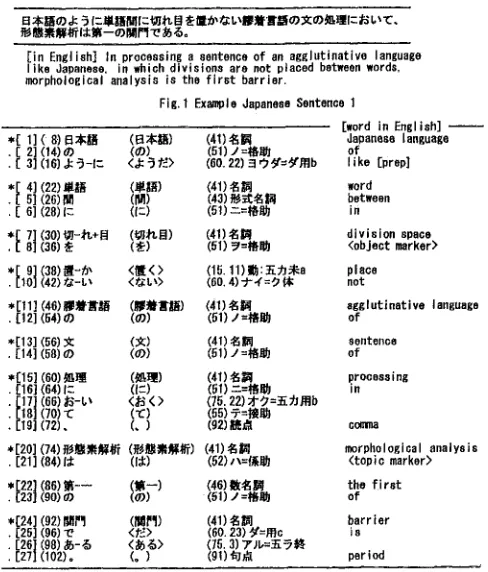
between words[Figure 1]. So it is
difficult to segment a sentence into
words. However, the fact that at
least four distinct sets of characters [for example,
kanfi(" ~'' ,,~c .... ~=x,,
,,~o~ragana(" ©"," J~"," ~ ",etc), katakana("
.]"," ~:'," ~ " , e t c ) and other characters (alphabets, nmnbers, symbols etc.)] are used to write Japa~mse can be used for segmenting words. Most words written
in kanji
orkatakana
are content words, such as nouns, verb-noun and stems(-~ @) of verbs or adjectives. Most wordsin hiragana
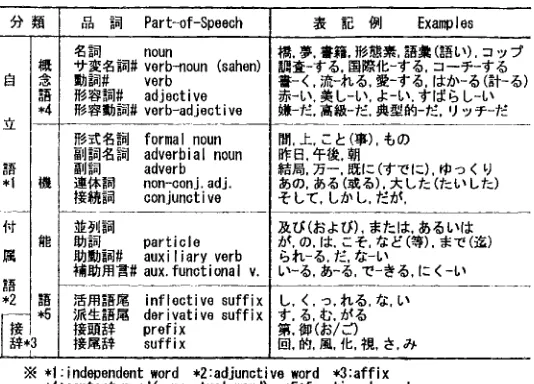
are functional w o r d s ( ~ 4 ~ ) , such as postpositional particles, auxiliary verbs and inflective s u f f i x ( 7 : ~ , ~ - ) of verbs and others [Table 1]. And the vo- cabulary of content words is umch larger than that of functional words.Table 1. Classifications of Japanese Part-of-Speech and their word examples
,A
*1 gt
S h a r i n g o f M o r p h e m e s b y D i c t i o n a r y a n d R u l e s
Our strategy is that all functional words, wMch are few in nmnber, are stored in the dictionary and most content words or their stems in
kanji
orkatakana
are to be extracted and given their I)ar~-ofo speech candidates based on character-types.Standard morphological analyser uses a dictio- nary to obtain morpheme or word candidates. But in our approach, morpheme candidates 2 are extracted either from the morpheme dictionary or using al- location rules based on character-type. For exam- pie, if the dictionary look-up fails, the allocation rules extract each sequence of character in which all of the characters belong to the same character set. Then, using the allocation rules, part-of-speech can- didates are assigned based on the sequence's charac- ter set and length. The candidates au'e disambiguated by checking connection with the the following mor- phemes based on the connection table between mor- phenm parts-of-speech. The following morphemes, in most cases, are functional words or inflective suffixes. T h e dietiomu'y contains funetionM words [such as postpositional particles, auxilim'y verbs, formal n o u n s ( N ~ < ~ ) , a d v e r b M n o u n s ( ~ q ~ S N ) , con- j u n c t i o n s ( ~ - ~ N ) , adverbs and so on], inflective suf- fixes and exceptional content words which cannot be or axe not covered by the allocation rules.
Here are some examples of the allocation rules for 1)
1-kanji
character sequence, 2)2-kanfi
character sequence and 3)katakana
character sequence.2in this analysis, a inllected word is treated a+s two or more morphemes - a stem part and one or more inflection part.
.% N Part-of-Speech
~ noun
+ Y ~ N # verb-noun (sahon)
I ~ # verb
~ # adjective
~ 7 # verb-adjective
F ~ formal noun N N ~ N adverbial noun =HN adverb ~ I ! ~ non-oonj, adj. ~ N conjunctive
~ particle
~ J ~ $ # auxiliary verb ~ l i ~ # aux. functional v.
~ J ~ inflective suffix
T~-~J~ derivative suffix
~ prefix
~J~i~ suffix
E ~1 Examples
~ - J - ~ , ~m~h-J-6, -~--~-j-6
~-<, , ~ - ~ , ~-J'6, I$]+,-~ (~- ~) ~ - b . ~ L-t,~, J:-I,<-¢1~6 L-L~ ~-f~, ~ - V . ~ - ~ £ , U ,~ -~-f"
N:U:(~ J: U:), $/':15. ~5~ I,~12
~-¢, ~5-~, ~ - ~ , 15 < -~
~Y. ,5, ~', ~{,5
•
~ *l:indeloendent word *Z:adjunctive word *3:affix • 4:content word(conceptual word) *5:functional word
# : i n f l e c t i v e - : s e l e c t point between stem and infleution part
1) noun / stem of
5-dan
verb(~i!~g~NJ~ ) / stem ofshimo-1-dan
verb(~--~-~.~JJ~,7)2) noun / (stem of 5-dan verb) / (stem of shimo-
1-dan) / verb-noun(sahen-meishi; ~ ) ' ~ N) /
verb- adjective ( ~ "-~!~0J~ )
3) noun / verb-noun / verb-adjective
T h e
1-kanji
character nouns and verb-stems are largely of old-JN)anese-origin words,wago(~H~),
and 2-kanji
character nouns, verb-nouns and verb- adjectives are mainly Chinese-origin words,kango(~
~ ) . In addition, there are several
1-kanji
chaxac- ter stems ofkami-l-dan
v e r b s ( ] a - - ~ [ ~ t J ~ ) ,sahen
verbs(+)-~gOJ-~) and adjcctives()f~-~l) which axe stored in the dictionalsr because they ~rc so few in nmnber. T h e word number of words which can be treated using rules like those given above is so great t h a t the dictionary size is substantially reduced.
T r e a t i n g o f
Wage
c o m p o u n d w o r d s Another characteristic of old-Japanese-origin verbs(wage
verb) is that they often continue with other words or morphemes to become verbs or nouns. For examples, two verbs"=-j]~ <"('to write') and " ~
~e"
('to become crowded')
combine into the compound verl) "~@i_},_~"('towrite into'),
the verb" ~ 2 " ( ' t o
read')
become the verb" ~ i " ' ( ' cause to read')
with the causative suffix "@-", and the verb "~JSu-~2"('tostep')
becoines the the noun",~fi~Y-]-"('a step')
with the derivative suffix " 7 f ' . There axe a great mmly compound words such ,as these.A word-compounding part determines a word fl-om morphemes using word-constituent rules based not only on inflections but also on compounds or derivations such as those shown above. Such rules also greatly reduce the diction,'u'y size.
[image:2.596.248.515.105.297.2]: [ 1]( 8) E l * = fi~] (523)~J~
' 2] (14) 0) (37))=~1~
. [ 3](16) J~9 [ZH] (293) El'~g=gl~
I [ 4] (20) 12 [zH] (250) ~]lRb
G] (26) I~1 (355) ~ { ~ I ~ 1
• [ 7] (28) I.= [zH] (36) - = t ~
* [ 8](30)~ [Zd] ( 3 4 9 ] ~ O ~
[[ 9] (32];h. [zH] ( 3 5 1 ) " F ~
• [11] (36) ~ (41) =~=I~P~
*[12] (36) ,~ [zJ] (369) :~ 2
1113] (40) h, [zH] (372) ~ . ~ a
• [14] (42) t~ [zH] (266)'24=9~
1115] (44) ~ [zH] (2O5) 9 ~
*[18] ( 4 6 ) . ~ , , } i ~ (523) ~JR
• [17] (54) ¢) (37) J = ~
*[18] (563~ [zJ] (523) ~P]
• [19] (583o) [zH] (37) ] = ~
*[20] (GO) ~1~ ~ 1 (523) , ,
• [211 (04) t : (36) - = ~ - ~
• [22] (66) ~ [zH] (1843 ~ = ~ @
I [231 (08) I,~ [zH] (375) :~Jl~lb
• [24] (70)-~ [zH] (72) ~ = ~
• [25] (72), [zT] ( 5 1 2 ) ~
• [27] (04) 15 (47) # ' ~ = ~
*[28](86)~ fz X] ( 5 0 2 ) ~ = !
1129] ( 8 8 ) - (5013 ~ l ~ l
• [30] (90) a) [zH] (37) ] =~tt~
*[31] (92) ~ 1 [za] (523) ~
• [32] (06) "e [zH] (243) ~ = ~ c
11341 (100) z~ (434) ~ ; O ~
• [35] (102) o [zP] (353) ~J~
[in English] In processing a sentence of an agglutinative language
[image:3.596.120.254.63.356.2]like Japanese, in which divisiono are not placed between words, morphological analysis is the f i r s t harrier.
Fig. 1 Example Japanese Sentence 1
[word in English] - -
* [ 1] (8) f l ~ (O2g~] (41) 4 ~ Japanese language
[ 2] (14)~9 (O) (51) 2 = ~ of
f 3] (16] J: 9 - [ - <J: 9 ~J> (60. 22) ~ O 0 * = ~ b like [prep]
* [ 4] (22)$~ ($I]f) (41) ~i~ ~erd
_[ 5] (2{}) ~ (M) (43) ~ J between
• [ 5] (28)I~ (l:) (51)-:=~R1/ in
* [ 7] (30)t~1-~+~1 (~h%!ei) (41)~1 division space
- [ 8] (36) '~ ('$) (51) ~ = ~ <object marker>
* [ 9] (38) ~-h~ <~<> (15, 11) ll~: ~ R e a place
• [10] (42) t~-i,~ <~1,~> (60. 4) -24=0 {$ not
*[11] ( 4 6 ) J ~ J ~ ( ] ~ ' ~ ) (41)~I~l agglutinative language
• [12] (54) d~ (~O) (61) . / = ~ J ~ of
*[13] (56) :~ (~) (41) ~i ~J sentence
• [14] ( 5 8 ) ~ ( ~ ) (51) ] = ~ of
*[15] (60) ~ (~,t~) (41) ~ 1 processing
• [16] (64) l: (1:) (51) : = ~ in
• [17] (66) t~-t,~ < ~ < > (75.22) ~9=:~ ; ~ b
• [18] (70) -c ('c) (55) - ~ = ~
• [19] (72). ( , ) (923 ~ 1 soma
*[20] ( 7 4 ) ~ ' ~ i ~ $ f (~l~Mf$~) (41)~lal morphulogisal analysis
• [21] (84) 1~: ( l ~ : ) (52)#x=f~ <topic marker>
*[221 (86) ~ - - - (~I--) (46] ~[~ ~ the f i r s t
• [23] (90) ~ ( o ) ) (51) J = ~ of
*[24] (92) IIII~ (~l~¶) (41) ~l~ barrier
• [25] (96) ~ <t'£> (60. 23) a]=R]c is
• [26] (98) ~ - ~ <~ ~> (75.3) 7 1 b = ~
• [27] (102). ( . ) ( 9 1 ) ' ~ period
Figure 2. Segmented Morphemes with Tugs Figure 3. Segmented Words with Tugs
Morphological Output from QJP
An example of segmented morphemes with morpheme-tags are shown in Figure 2, where 8 nouns (" 1 ~ 2 ~ " , " ~ - ~ " , e t c . ) and 2 stems of word (,,t:)]', ,, ~ " ) , maxked by '[zJ]', in kanji character are recog- nized using allocation rules and connection table.
The words with part-of-speed, tags
and morpheme-divisions('-','+') axe shown in Figure 3, where a compound noun "~avb H" (the 7th word) is a compound of the morphemes 8-10 [ " ~ " ( s t e m of
shimo- l-dan verb " ~)J ~ " ), " ~%" ( renyou-kei inflective suffix of shimo-l-dan verb; T ~ ~ [ ~ ) ~ : ~ - z ~
~ ) and " g"(noun)] using a word-constituent rule. In Figure 3, the root forms of inflected words have been derived and are shown in the <>-parentheses, such us "~]~ <" which is the root form (shuushi-kei;
~ ) of " ~ " . These morphemes and words ~u'e not in the dictionaxy.
2.2 Syntactic Analysis
Kakari-uke
Analysis
Many J~l)aamse syntactic analyses are ba~ed
on orthodox bunsets,>depcndency analysis, called
kakari-uI~e a anMysis(~.~ 0 ~}~{J~:) between bunsetsu
phrases, where a buckets'a-dependency structure cor-
responds to a set of kakari-uke bunsetsu pairs. We
also take this approach because it is intuitive, under- standable and easily implemented.
a T h e r e l a t i o n of kakari a n d uke e q u a l s to modifier a n d rood ifiee.
Simple Treatment of Structural Ambi-
guities
StructurM ambiguities are usually dealt with ei- ther by generating all possible structures or by select- ing the more preferable ones ba,sed on some scoring scheme. Such method usually leads to combinatorial explosions which causes a lot of memory and process- ing time.
For this problem we have already proposed a substitutional light method[5) in kakari-uke analysis.
This method extracts all possible kakari-uke pairs,
and then rather than generate not M1 or some pos- sible sets of pairs~ only one best set of pairs is gen- erated while still retaining all other possible ]Tairs. Thus, instead of generating multiple number of sets, it most-likely set is selected ~ l d the applie~tion/user is presented with alternative kakari-uke pMrs at the same time that the selected pairs are presented. If
the application/user corrects any alternative kakari-
uke pairs, the most likely set is re-calculated using re- taining possible kakari-uke pairs. This means of deal- ing with structural ambiguities avoids combinatorial explosions and requires flu' less machine resources.
Not Using of Semantic Inibrmations
Most methods for analyzing Japanese use c ~ e patterns with semantic features for preference selec- tions. However, such analysis techniques using se- mantic informations are not yet adequate and seine- times i~ctmdly lead to adverse results[6).
In addition, semantic information nmst be stored
[image:3.596.293.537.64.350.2]in the dictionary. This reduces the merit of the very small dictiomtry achie.w.'d in morphological analysis section. We limit the information to morphologi- c~fl/word ~md syntactic levels [such as the presence of coi[Ima(-~,%~), adverbial noun, surface or syntactic similarity[7]] without using semantic information for structurM analysis.
Flow of QJP's Syntactic Analysis
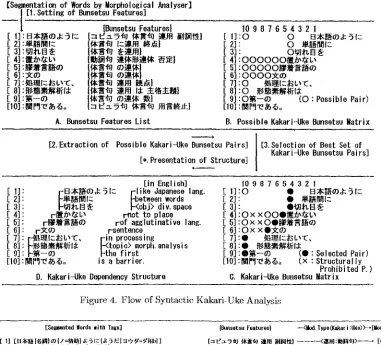
Under these approaches, Q J P ' s syntactic aatai- yser processes words sequence in three steps[Figure 4] each following its own set of rules. First it determines bunsetsu fcatures[A] for each bunsctsu according to its word constituents. Second it extracts "all possible kakari-uke bunsetsu pairs [marked by ' O ' in B] based on specific combinations of bunsctsu features for each bunsetsu pair.Last, it selects the best uke-bunsctsu (modifice)
[marked by ' ~ ' in C] from possible ones for each bunsetsu which is a kakari-bunsctsu (modifier), ex- cept tim last one, because every bunsetsu modifies one of the following bunsctsus, so the last one has no uke-bunsetsu. Thc default uke selection is the nearest possible uke bunsctsu and, if nccessazsr, Q.}P substi- tutes the selcetion 1)ascd on rules comparing the two pairs - the currcnt selected ukc-bunsetsu and a more distant possible uke-bunsetsu for thc subject kakari- bunsctsu. In Figure 7, solnc pairs are not the new,rest ones. Tile at)pli(:ation/uscr's kakari-ukc pairs correc- tions rest,%rts the selection ; Q J P first selects the cor- rected kakari.ukc p,fir(s) [maxked by ' I ' in Figure 7] and then re-selects remaining kakari-ukc pairs.
Figure 4-C and Figure 7 ;~re kakari-uke matrices showing the possible pairs and selected pairs. Figure 5 is the o u t p u t of kakari-ukc pairs tagged with parts- of-speech and bunsctsu features.
[Se~entation of Words by Hor~ological klalyser]
I [1. Setting of BunsetsuFeatures]
1
[Bunsetsu Features}[ 1] : E l l l o ~ 9 1 : [ 2] :~ltllltlllz
[ 3] : ~ & B £~
[ 4] :~:~t~u~
[ 5] : l l t t l i l i o ) [ 6] : ~
[ 7] :~l!~lzlm,~m,
[ 8] : ~ I $
[ 9] : ~ - o ) [10] :11=1'~ ~ $ 0
[ I ~ ~ I I ~ ~ l
~ ~ ~ o ) ~ }
A. Bunsetsu Features List
1 0 9 8 7 6 5 4 3 2 1
[ 1] 0 0 E I ~ o ~ 5 1 : :
[ 2] 0 $iiltllllZ
[ 3] O~:L',,B ,~
[ 4] : O 0 0 0 0 0 f l t D ' ~ U ~ [ 5] : 0 0 0 0 0 1 1 t t ~ - 1 ~ [ 6] : 0 0 0 0 ~ o )
[ 7]:0 ~ l : ~ U ~ ,
[ 8 ] : o ~ f f A I ~ l ~
[ 9] : 0 ~ - o ) ( 0 : Possible Pair)
[10] : B I I P ' I ~ o
B. Possible Kakari-Uke Bunsetsu g a t r i x
[2. Extraction of
-
1
Possible Kakari-Uke Bunsetsu Pairs]
[*. Presentation of Structure]
[&Selection of Best Set of Kakari-Uke Bunsetsu Pairs]
[ 1]: [ 2]: [ 3]: [ 4] [ 5] [ 6] [ 7] [ 8] [ 9] [10]
[in English] B ~ o ) J ~ 5 1 c v l i k e Japanese lang.
~lilllll< t-between words
~I, PI~ I-<obj> div. space
r~h~t~b ~ mot to place
r l l t ~ i t ~ O ) r o f agglutinative lang.
r ~ O ) rsentence
F~
till}ltltlt#li l C t ~ b ~ , Fin processing I-<topic> morph, analysis--o) Pthe f i r s t
lllP~/187Oo is a barrier.
D. Kakari-Uke Dependency Structure
1 0 9 8 7 6 5 4 3 2 1
[ 2] : • ~-~rdtlz
[ 3 ] : e ~ % ~l ~
[ 4] :Ox x O O e ~ l ~
[ 5] : 0 x x O i l t l l t t ~ o ) [ 6] : O x x e ~ o ) [ 7 ] : 0 YS]~lz t~i, vC, [ 8] : II tf~llt~ltAil#l;t
[ 9] :llllll--(b (tll : Selected Pair)
[10] :Ml'1-eil~7~o ( x : Structural ly
Prohibited P. ) O. Kakari-Uko Bunsetsu l a t r i x
Figure 4. Flow of Syntactic Kakari-Uke Analysis
[Sel~n~ted Words with Tags]
[ 3] [w~kq [~Pll {~1~=~1]
[ 61 [ ~ [ ~ } ~ l ~ = ~ l ]
[ 7] [~[~ii~) ra (==~10) ~u, [~s < I~r 9=iK~llb] ~ [~=1~], I ~ l ]
[ 9) [S~-i~,~l~llm[.,'=~l]
{B~msetsu Features) ~-<ilod. Type (K~kar i :Uko) >~ [lied. No. ]
[= ~ = g m t % t ~ ~t~ ~l~f~} - - - < ; ~ : 1 ~ 1 ~ > ~ [4]
{I~l~ ~I~t~,~I~ i ~ l ---<~t~,~:~>---~' [51
l(%tt~l o ) ~ l ! ~ l ~<~g;l~:~i~J>--~, [6l
{~lV~ o)il~l ~-<o)~I~:t~ts]>----~ [71
Figure 5. Kakari-Uke Pail~ with 2.hgs
[image:4.596.107.488.298.643.2]3
QJP
3.1
I m p l e m e n t e d S o f t w a r eQ J P currently is implemented in the C language both a Q J P library and an interactive/batch console application, QJP workbench. They have been imple- mented on D O S / P C and UNIX/Sun workstation.
Q J P ' s dictionary consists of 4 files whose total size is less than 50KB and which contain about 5 thou- sands nmrphemes. QJP requires a~mther control ta- ble file for the compressed 533>(533 morpheme-POS connection table, the table for the allocation rules, the dictionary file indices and others, which is at most 35KB. 6 sets of morphological rules a~d 4 sets of syn- tactical rules [Table 2] are embedded in the form of
if-then rule
in C functions. The size of the work- bench execution file on DOS is about 185KB. The tota~ size (executables and dictionaries) is much less than 300KB[DOS] which is quite small and portable as a natural l a n g u a g e analyser.3.2
Analysis Experiment
Q J P performaJ~ces were measured for the QJP work- bench using two sentence test-sets : 1 [24t sentences, average length 24.1 words/sentence] and 2 [210 sen- tences, average length 29.5 words/sentence].
E x e c u t i o n P e r f o r m a n c e
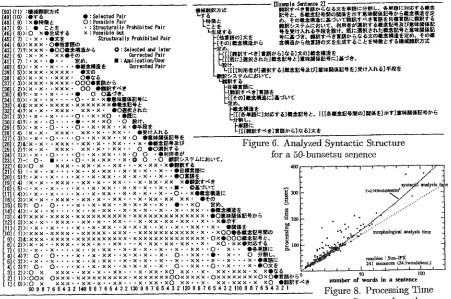
About 260KB of memory are required on DOS and 500KB on UNIX. With this amount of memory Q J P can process a very long sentence, such az 100- word sentence [Figure 6].
The analysis speed is 80 to 150 words/see on an 80486/25~IHz PC and 700 to 800 words/see on a Sun- SS20. A 100-word sentence c~n be analyzed in less than 1 second on PC. Figure 8 shows the relationship of processing time to sentence length. Syntactic pro- cessing time is on the order of the square of the sen- tence length. But its coefficient is so small that the total processing time increases linearly in the range of actual long sentences.
Table
2.
Linguistic data and RulesM o r p h o l o K i o s l ~ n a l y s e r
[D] d i o t i o n a r y : - 3 5 0 0 e n t r i e s . ~ 5 0 0 0 morphe~ea [P] morpheme/word P a r t - o f - S p e e c h : 533/49 POSs [ T ] c o n n e c t i o n t a b l e : 5 3 3 x 5 3 3
( ~ [R] c o n n e c t i o n s o u r c e - r u l e s : ~ 3 0 0 r u l e s ) char. sequence e x t r a o t i o n r u l e s : ~ 20 r u l e s
[R]R momheme-POS
allooat on rules :14 rules
f~] mor~heme-POS d i s a ~ b i ~ u a t i o n r u l e s : ~ 50 r u l e s w o r d - c o n s t i t u e n t r u l e s ~ 60 r u l e s f~] bunaeLsu head e x c e p t i o n a l r u l e s ~ 20 r u l e s a u x i l i a r y f u n c t i o n a l v e r b r u l e s ~ 15 r u l e s
S y n t a o t i c a l ~ n a l y s e r [ F ] bunsetsu f e a t u r e s
[R] bunaetsu f e a t u r e s s a l t i n e r u l e s [ R ] k a k a r i - u k e p a r e x t r a c t i n g r u l e s [ R ] k a k a r i - u k e p a i r e x o e p t i o n a l r u l e s [ R ] k a k a r i - u k e f a i l u r e r e o o v e r y r u l e s
68 f e a t u r e s 80 r u l e s 20 r u l e s 40 r u l e s -~ 4 r u l e s
• ~[O]:diotionsry [T]:table [R]:rule [P]:POS [F]:foature
[50] (I1) :tll~lll~l~-~
[ 4 9 ] (1O) : • ~ , ~ • : Sol•uteri Pair
[ 4 8 ] ( 9 ) : x O 4 ~ l t t & O : P o s s i b l e Pair
[47](9) : • r_&,,~ • :Struoturally Prohibited Pair [46] ( 8 ) 7 : 0 x • ~ 7 ~ x :Poaaible l~t
[45](7) : • x • • •~C~ StruotursllY Prohibited Pair
[44] ( 6)>:x x x • 0 0 ~ I ~
[43] ( 7)?: x X X • O 0 0 a l ' ~ t l l ~ i ~ 6 0 : Selected and later [42] ( 5 ) : x • × , x x • - ~ o ) Corr~ted Pair [41](7) : . x - " 0 ' ' ~ , II:~olicatiorVUsar [40] ( 6)>: • x • • x . . . . O ~ ; ~ t ~ J ~ Correatod Pair [39]( E)>:x XX • X X X X ' I I ~ : ~
[ ~ ] ( 4 ) > : X . X . . x x x , O • ~ T a [37] ( 3] >: x x x • x x x x • O 0 0 I ~ ~ 6 [ 3 6 ] ( 2 ) > : x . x . . x x x . O 0 t l l f f i l ~ l ' ~
[ 3 5 ] ( 6 ) 7 : ' x " , x . . . . • 0 0 ~ " J ~ ' . [ 3 4 ] ( 5 ) > : - x • • x . . . . O ' • x • x • ~ l =
[33]( 4)&:x x X • x x x x • x x x x x x x • l ~ : ~ & [ 3 2 ] ( 4 ) ? : x . x . . x x x . x x . x . 0 0 ~ = ~ ? : [ 3 1 ] ( 3 ) > : . x • . x . . . . O " , x . x O ' O ~ l : [ 3 0 ] ( 6 ) ? : . x , " 0 . . . . O . - x . x O ' 0 ~H',
[ 2 9 ] ( S ) > : ' X . . 0 . . . . O " " x ' x x " . x . O ~
[28](4) : x . x . X x x . X x . x . . X X . . •'~l't.A,~n,~
[ 2 7 ] ( 3 ) > : ' x " . 0 . . . . O , " x ' x x " . x , O • ~ l ~ l l ~
[ 2 6 ] ( 2 ) & : X , x • • x x x • • x X • x • • x x • • • x • O ~ E ~
[ 2 5 1 ( 2 ] ? : x . x . x x x . x x . × - . x x . . 0 e O ~ : ~
[ 2 4 ] ( 1 ) > : " x • ' 0 . . . . O : • x • x x • . x ' 0 0 " • ~ R ] ~ ¢
[ 2 3 ] ( 7 ) - : O , • . . . . O , " x . x x " , x , O 0 . 0 1~l l~ "> 7, -7- ~, l : i~ l, vC. [22,1 ( 6)>:0 × x x x . • x x - x • • x x • • • x • x x • xOl~lffitr~
[ E x ~ o e S ~ t o n o e 2 ] '
: _ ~ 4 ~ t f A t ~ - l ~ l ~ h ~, ~ l : ] l ~ , ; } ; h , t = ~ . ~ . t : : 9 ~ l z
~
] ~ d ~ , ~Llmlp,'¢" .~
~ .
,
Figure 6. Analyzed Syntactic Structure for a 50-bunsetsu senence
[ 2 0 ] ( 5 ) ? : . x . . x . . . . x . . x . x x . . x . x . x . . x . , l l O f l ~ I- " /
[19](4) : x . x . , x x x . , x x . x . . x x . . . x . x x . x x xOImlR~Y-<~ 6 "
. . . X X " ~ J l , ~ ~ L synt~ji~" ~lysL~ U
Ira(4)>:'×" "× . . . . x . . × . × × " . x , × . × . . x . "O" . x H ~ m = ,~'~[- ~ ~,W/,,, . . .
[ 1 6 ] ( 3 ) > : x - x . - x x x . - x x , x . - x x . . . x . x x . x x x x - • { - 0 ] [~ I " ~ .""
[15](537: O . 0 . . . . x . . x . x x . , x . x - x . , x . O . . x O ~E~b, ~ I" / ....
[ 1 4 ] ( 4 ) > : ' x " . x . . . x . . x . x x . . x - x . x . . x . . x . . x x . . O / J I t ~ I I ~ ~ I " , / .,"" [ 1 3 ] ( 4 ) ? : x x x ' x x x x ' x x x x x x X X x x ' x x x x x x x x x x x x x x ' O O m ~ l ~ l ~ G ~ I " " . ~ ....
[1O] ( 1 ] > : X X X - X X X X • I l l s ] e p i c a l lnalysi~ time
[ 9]( 3 ) & : x x x . x x x x . [ [
[ 8 ] ( 2 ) > : x • × • • × x x , ~ , r ~
[7](I)>:. × . . x . . . "" "" 72"~
[5](4)?: O . 0 . . . . x . . x . x x . . x x . x - - x . O . . x x . . e - x . . 0 ~ i ~ .
[ 5 ] ( 3 ) > : . x . . x . . . . x . . x - x x . . x x . x . . x . - x . . x x . - x . - x . - . x , • l W l ~ l : I - ~ m ~ : S u n ~ X . . , ,
[4](3)?: O . 0 . . . . x . x . x x . . x x . x . - • u . . x ' . u . . . u.x.~: t'~"i - . . , , t [ 3 ] ( 2 ) > : 0 x x x x . . x x . x . . x x . . x . x x . x O x x . . x , x x . x x x . x x O ~ ,. , , ~ = I I I I ~
[ 2 ] ( 1 ) > : 0 0 x O x x x . x x x x x x x x x x x x x x x x x O O x x x x x - O x X X X X X X X O X O O ~ b ~ ° ~o
[ 1 ] ( 0 ) > : 0 x X X X . . X X . X . . X X . . X . X X . X O X X . . X , X X . X X X . X X O 0 ~ " ~ . ~ ~ u m b c r of w o r d s in a sentence
5 0 9 8 7 6 5 4 3 2 1 4 0 9 8 7 6 5 4 3 2 1 3 0 9 8 7 6 5 4 3 2 1 2 0 9 8 7 6 5 4 3 2 1 1 0 9 8 7 6 5 4 3 2 1 F i g u r e 8. Processing Time
Figure 7. Kakari-Uke Matrix for a 50-bun~etsu senence vs. Sentence L e n ~ h
[image:5.596.316.517.253.379.2] [image:5.596.76.527.409.708.2]A n a l y s i s P e r f o r m a n c e
We used test-sets I and 2 for tuning and blind- test, respectively. F o r test-sets 1 and 2, the ac- curacy of analyzed nmrphenms/words is 99.3/99.3% and 95.7/96.1%, the accuracy of almlyzed uke bun- sets,~s for each buusetsu excel)t the last one is 95.1% and 90.5¢)/0, and the accuracy of set of kakari-uke pairs in a sentence is 71.0% and 43.8%, respectively.
For sentences wlfich have lengths of 3 to 15- bunsetsus and are nmrphoh)gically analyzed cor- rectly, the accuracy of analyzed uke bunsets~s for each bunsetsu is 97.3% and 93.6%, and the accuracy for sets of kakari-uke pairs in a sentence is 82.9% and 70.5%, resl)ectively,
C o m p a r i s o n
There are no public data for the performance of other Japanese analysers, so comparison is difficult. But not oldy the size of files lint also the 1)erfornlallce figures for memory and speed of Q J P are thought to be mot'(,, than ten times better than those of existing Japanese analysers[4]. As for analysis accuracy, the morphologicM accnracy is a little lower than that of the existing Jai)anese morphological aualysers usil,g large s(Me dictionaries, but the syntactic analysis ac- curacy is thought to be no worse than that of the existing Jalmnese syntactic analysers.
4
C o n c l u s i o n s
We have designed and implemented Q J P h~r the pur- pose of readily and e,~sily applicable morlflmlogical and syntactic amdyser for Japanese. The design strategies are based on 1) the morphological anal- ysis bLsed on character-types and fimctional words to reduce the size of diet&mary, and 2) the syntac- tic am'dysis by simple treatment of structural ambi- guities and ignoring semantic information to lighten processing.
QJP, ~s implelnented, is portable, quick and ro- bust. All tiles needed for execution im:luding dictio- nary total less than 300KB on DOS. Even on a slow P C a 100-word sentence (:an be analyzed in less than 1 second using a small amount of memory. This per- formances is thought to be quite excellent. The alml- ysis accuracy is comparable to that of other existing analysers. No dictionary maintenance is necessary for new ternls.
The fnnctions of Q J P are inq)lemented ~Ls a Q J P lil)rary an(l a Q J P workbench. We lmve alremly uti- lized Q J P flw keyword extraction, natnrM language query and text reading supt)ort fltnctioas[9] and are t)lamfing fllrther applications, such ms infi)rlnati(m re- trieval system. Others use Q J P fimctions for other purposes, such as linguistic d a t a extraction.
Q J P currently doesn't segment compound kanji words of Chinese-origin and leaves this segmentation to the application. In the fltture, we plan to real-
ize such at segmenting fimction using on statistical data[10] a,,d aIlixes[2].
R e f e r e n c e s
[1] Yoshiyuki SAKAMOTO: An Automatic Segmenta- tion for Japanese Text, M~tthematical Linguistics, Vol.ll, No.6, 1978 (ill Japmlcse).
[2] Makoto NAGAO, Jun-ichi TSUJII, Akira YAM- AGAMI, Shuji TATEBE: Data-Structure of a Large Japanese Dictionary and Morphological Analysis by Using It, Journal of hfformation Processing Soci- ety of JaI)au , Vol.19 No.0, pp.514-521, 1978 (ill .Japanese).
[3] Masayuki KAMEDA: A Quick aat)anesc Parser, Information Pro~iessing Society of Japan SIG Note~, 94-NL-4, 1993 (in aapmmse).
[4] Masayuki KAMEDA: A Portable & Quick Japanese Processing Tool : QJP, I'roc. of the 1st Annual Meeting of the Association for Natural Language Processing, 1995 (in Jai)anese ).
[5] Masayuki KAMEDA, Shin ISIIII, tIideo ITO: Inter- active Disaml)iguation ill a JaI)anese Analysis Sys- tem, Information Processing Society of Japan SIG Notes, 84-NL-2, 1991 (in Japanese).
aeSO 7~ J L ~ : ' ~ ~ ©~)J~mt]l'l>~, EDR 7tJ: f-iga%~*lJ)l] ~/7],~9¢d & i,~.9.::JJ~, 1995 (in Jai)ancsc ).
[7] Sadao KUROHASHI, Makoto NAGAO: A Method for Analyzing Conjmmtive Structures in Japanese, q¥ansactions of Infornuttion Processing Society of Japan, Vol.33 No.8, I)p.1022-1031, 1992 (in Jal)anese ).
[8] Sadao KUROHASIII, Toshihisa NAKAMURA, Yuji MATSUMOTO and Makoto NAGAO : hnprovement of Japanese Morl)hologic~d Analyser JUMAN, Proc, of the International Workshop on Sharablc Natural Language Resources, pp.22-28, 1994.
[9] Masayuki KAMEDA: Supl)ort fimctions for Read- ing Japanese text, hfformation Processing Society of Japan SIG Notes, ll0-NL-9, 1995 (in Japanese).
[10] Koichi TAKEDA, Tetsunosuke FUJISAKI: Auto- marie Decomposition of Kanji Compound Words Us- ing Stochastic Estimation, Transactions of Infof marion Processing Society of Japan, Vol.28 No.9, pp.952-961, 1987 (ill Japanese).
E x a m p l e S e n t e n c e s
1 Tohru HISAMITSU: Proc.of the 42th Meeting of Information Processing Society of Japan, 1991.
2 Japanese Laid Open Patent No.60-20{)368, 1985.