Towards the Annotation of Penn TreeBank with Information Structure
Bernd Bohnet School of Computer Science
University of Birmingham Birmingham, UK
Alicia Burga DTIC
Pompeu Fabra University Barcelona, Spain [email protected]
Leo Wanner ICREA and DTIC Pompeu Fabra University
Barcelona, Spain [email protected]
Abstract
Information Structure (IS) determines the “communicative” segmentation of the meaning of an utterance, which makes it central to the semantics–syntax– intonation interface and therefore also to NLP. Despite this relevance, IS has not received much attention in the context of the majority of the reference treebanks for data-driven NLP that already contain a semantic and syntactic layers of anno-tation. We present our work in progress on the annotation of the Penn TreeBank with the thematicity dimension of the IS as defined in the Meaning-Text Theory. We experiment with tagging and transition-based parsing techniques. Especially the latter achieve acceptable accuracy with even very small training samples, which is promising for languages with scarce re-sources.
1 Introduction
The Information Structure(IS) (aka Topic-Focus
Articulation, TFA (Sgall, 1967) in the Prague
School and Communicative Structure, CommStr (Mel’ˇcuk, 2001) in the Meaning-Text Theory) de-termines the “communicative” segmentation of the meaning of an utterance. This makes it central to the semantics–syntax–intonation interface (Lam-brecht, 1994; Hajiˇcov´a et al., 1998; Steedman, 2000; Mel’ˇcuk, 2001; Erteschik-Shir, 2007) and therefore also to NLP. However, despite its promi-nence, IS has been largely ignored so far in the context of the reference treebanks for data-driven NLP: Penn Treebank (Marcus et al., 1993) and its semantic counterpart PropBank (Palmer et al., 2005) for English, Tiger (Thielen et al., 1999) for German, Ancora (Taul´e et al., 2008) for Spanish, etc. To the best of our knowledge, only the Prague
Dependency Treebank (PDT) (Hajiˇc et al., 2006) is annotated with IS in terms of TFA. This is not to say that no proposals have been made for the an-notation of IS in general; see, e.g., (Calhoun et al., 2005) for English, (Dipper et al., 2004) for Ger-man, (Paggio, 2006) for Danish, etc. However, in the light of the above mentioned interface, it is crucial to have the same corpus annotated with se-mantic, syntactic and IS structures.
In this paper, we present our work in progress on the annotation of the ConLL ’09 variant of the Penn TreeBank (PTB) (Hajiˇc et al., 2009) with
the thematicity dimension of Mel’ˇcuk’s
Comm-Str.1 We have chosen thematicity because (i) it dis-tinguishes, apart from the traditional Theme and Rheme, a Specifier element, and (ii) it is hierarchi-cal in that a thematicity partition can be embedded into another thematicity partition. Both of these features facilitate a fine-grained communicative partition of complex utterances with subordina-tions and thus a more accurate and detailed projec-tion between the different layers of the semantics– syntax–intonation interface.
Unlike most other proposals, we aim to au-tomate the annotation procedure and experiment with tagging and transition-based parsing tech-niques. In this respect, our goal is similar to that of Postolache et al. (2005), who explore differ-ent classifier models for automatic labeling of tec-togrammatical nodes in the PDT with Topic / Fo-cus. But while Postolache et al. use for training 78.3% (38,737 sentences or 494,759 tectogram-matical nodes) of the TFA+tectogramtectogram-matical layer of the PDT, our training sample is infinitely smaller: we train on 360 manually annotated sen-tences. The purpose of the small training sample is
1
It is important to note that thematicity does not intend to capture the IS in its entirety—as, e.g., Vallduv´ı (1992)’s or Erteschik-Shir (2007)’s proposals do. It is just one of the eight dimensions of the CommStr, although the most central one.
twofold. First, to minimize the manual annotation effort, and, second, to assess whether automatic IS annotation can be bootstrapped starting from min-imal resources.
In the next section, we introduce the theoretical notion of thematicity in the sense of the Meaning-Text Theory and present the criteria for the deter-mination of its individual elements. Section 3 de-scribes our tagging and parsing approaches to au-tomatic annotation of thematicity. Section 4 out-lines the experiments we carried out in order to assess the quality of both approaches, and Section 5, finally, discusses the outcome of these experi-ments and sketches some directions of future work we plan to undertake in this area.
2 Theoretical Background
Since its introduction by the Prague School of Lin-guistics (Mathesius, 1929; Firbas, 1966; Daneˇs, 1970), a great number of models that define and determine the IS of an utterance have been pro-posed; for an overview, see, e.g., (Vallduv´ı, 1992; Mel’ˇcuk, 2001; Kruijff-Korbayov´a and Steedman, 2003; Zimmermann and F´ery, 2009). In our work, we draw upon Mel’ˇcuk (2001)’s model, which foresees a tripartite communicative segmentation of the meaning of an utterance: Theme–Rheme– Specifier. The Specifier (SP) sets up the context of the utterance U; Rheme (R) denotes the part of U that the speaker presents as stated by U; and Theme (T) denotes that part of U that the speaker presents as something about which R is stated.2 T and R (also referred to in the litera-ture astopic/focusandtopic/comment) constitute
theCommunicative Core(CC) of a sentence.
The basic unit that we annotate with SP/T/R tags is a proposition. A proposition (P) is either
a full clause, i.e., a clause that contains a finite
verb, or areduced clause, i.e., a clause with eli-sion of the corresponding finite verb (asup 150in
Mitsubishi Estate ended the day at 2680, up 150).
The following assumptions hold: (i) each P pos-sesses a CC; (ii) if a sentence is composed by a coordination of Ps (each with its own subject), no global CC is assigned: each of the Ps has its own CC, with the coordinative conjunction as the SP of the second P; (iii) two non-coordinated Ps (each holding an independent CC, with the subordinated
2Strictly speaking, Theme and Rheme are defined over the
meaning of an utterance, rather than the utterance itself. It is for brevity that we speak of an IS of an utterance.
conjunction as SP) form a global CC such that the one that comes first is T and the other one is R; if their linear order is altered, the T/R assigment switches although the meaning remains the same; (iv) if a sentence contains a main P and a rela-tive subordinate P, one main CC is assigned (with-out taking into account the presence of the relative clause), and at the same time an embedded CC is assigned to the subordinate proposition. That is, as already mentioned in Section 1, thematicity in the Meaning-Text Theory isper sehierarchical in that each thematicity element (SP/T/R) can in itself be again assigned a thematicity structure.3
Consider (1) for illustration of the thematicity segmentation of a sample sentence (for clear and unambiguous notation, propositions are enclosed in “{. . .}”):
(1) {[Years ago]SP, [he]T [collaborated with the
new music gurus Peter Serkin and Fred Sherry in the very countercultural chamber group Tashi,
{[which]T [won audiences over to dreaded
con-temporary scores like Messiaen’s Quartet for the End of Time]R}.]R}
For the communicative segmentation of a frag-ment of the PTB as gold standard, we used the following empirically determined criteria:
Criteria for determining the Specifier: Given that Specifiers do not express a separate message, but, rather, the context of the message to which they belong, we mark as Specifiers:
– fronted temporal, locative and manner circum-stantials:{[Apparently]SP[he]T[did so]R}; – fronted AdjPs with a sentential scope:{[Tired of the same]SP,[he]T[gave up]R};
– fronted discourse markers: {[But]SP[it]T[was neither deep]R};
– circumstantials of the typeaccording to . . . (in-dependently of their position): {[About 25 % of
the insiders]T ,[according to SEC figures]SP,[file
their reports late]R};
– phrases that introduce direct speech (indepen-dently of their position):{[It]T [is done]R, [he said]SP};
– NPs in vocative case (independently of their po-sition):{[Anna]SP,[he]T[did it]R}.
3
Criteria for determining the Theme: Themeis the part of the sentence that expresses what the Speaker is talking about. Therefore, it tends to be located in the initial part of the sentence (after the Specifiers, if there are any). In an SVO language as English, the Theme therefore coincides most of the times with the subject. Apart from thisad hoc
criterion, a number of “hard” criteria to identify the Theme are available; among them:
– it can be identified by the question “And what about X” (then, X is Theme):{[John]T[answered
the question]R}: And what about John? (*And
what about question?);
– it is not accessible for general negation/ques-tioning:{[He]T[did it]R}: *Not he did it;
– a relative clause is treated as an independent proposition, and therefore the relative pronoun is the Theme only if it is subject (otherwise, it is a focalized part of the Rheme): the boy {[who]T
[cooked]R} vs. the boy {[whom]R1-1,Foc [I]T
[met]R1-2};
– indefinite pronouns such asnobody, somebody,
nothing, etc. and negative noun phrases cannot be
Themes: e.g., inNone of the boys did it, it is not
none of the boys, which is the Theme, but ratherit;
– sentences of the formIt + is + Adjective +
Infini-tive verbreverse the typical position of the theme,
with the infinitive verb being the theme:{[It’s nec-essary]R[to talk]T};
– headings or titles are all-thematic.
Occasionally, a split of Theme can be observed:
{[Considered as a whole]T1-1,[[Mr. Lane]T1(SP)
[said]R1(SP)]SP, [the filings required under the
proposed rules]T1-2 “[will be at least as effective,
if not more so , for investors following transac-tions]R .’’}
Criteria for determining the Rheme: The eas-iest way to recognize Rheme is through exclusion: if an element is not Theme nor Specifier, then it is part of the Rheme. A few explicit criteria can also be introduced:
– Rheme can be negated and/or questioned: {[I]T
[think so]R}:I don’t think so/Do I think so?; – existential sentences (those that begin withThere
is/are) are all rhematic:{[There are apples on the
table]R};
– non-fronted temporal, locative and manner cir-cumstantials form part of the Rheme: {[I]T[met John some months ago in the park, in a very
unex-pected way]R.}
In addition, it is to be noted that if the Rheme
contains a ditransitive verb that allows arguments to exchange syntactic positions, we assume that this exchange is motivated by different ISs; cf.
{[John]T [[gave me]T(R1) [money]R(R1)]R1} vs.
{[John]T [[gave money]T(R1) [to me]R(R1)]R1}
(the tag ‘R’ is supplied with a number for un-ambiguous notation). Furthermore, within NPs that start with wh-words that do not belong to pseudo-clefting constructions, split Rhemes are observed: {[[What]R1-1(T1)[he]T(T1) [said] R1-2(T1)]T1[was hilarious]R1}.
3 Annotating PTB with Thematicity
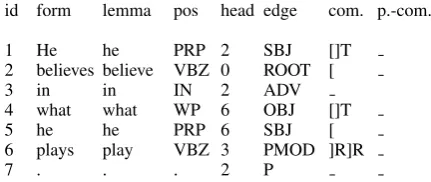
Given that the thematicity structure as used in this paper is of a hierarchical nature, its automatic an-notation can be viewed not only as a tagging but also as a (constituency) parsing task. We carried out experiments with both approaches, taking the tagger variant as baseline (the idea is to apply a simple and well researched technique in order to compare it with a more elaborated one). For both, we use the CoNLL ’09 format; cf. Figure 1. A line in this format consists of an id, a word form, a lemma, a pos tag, and the dependency annotation with the head node and the edge label (all retrieved from the CoNLL Shared Task 2009 data set). The last two columns contain the gold communicative tag and the tag predicted in the course of the auto-matic annotation, respectively.
id form lemma pos head edge com. p.-com.
1 He he PRP 2 SBJ []T
2 believes believe VBZ 0 ROOT [
3 in in IN 2 ADV
4 what what WP 6 OBJ []T
5 he he PRP 6 SBJ [
6 plays play VBZ 3 PMOD ]R]R
7 . . . 2 P
Figure 1: Example of a sentence annotated with its thematicity structure in CoNLL format.
In the case of tagging, we aim to assign to each element of a sentence a T, R or a SP tag. For this purpose, we use classifier-based sequence tagging. The tagger assigns one of the three tags to each word by going from left to right through the sen-tence. For the selection of the appropriate tag, the tagger considers features from a window of two words before and after the word in question.; cf. Table 1 for the features used by the tagger.
param-Features based on PoS tags
π(i),π(i−1)π(i),π(i)π(i+ 1),π(i+ 1)π(i+ 2)
π(i−1)π(i−2), π(i−2)π(i−1)π(i), π(i−1)π(i)π(i+ 1), π(i)π(i+ 1)π(i+ 2)
Features involving PoS tags and word forms
w(i),π(i−1)w(i),w(i)π(i+ 1),w(i+ 1)π(i+ 2)
π(i+ 1)w(i+ 2),w(i−1)π(i−2),π(i−1)w(i−2)
w(i−1)w(i),w(i)w(i+ 1)
w(i+ 1)w(i+ 2),w(i−1)w(i−2)
Table 1: Features for the sequence tagger. i(i = 0,1, . . .) denotes the ith word in the input sen-tence;πandware functors to extract the PoS tags respectively word forms of the tokens.
eters obtained in the training algorithm is applied for classifying the test examples.
In the case of parsing, we aim to derive the hi-erarchical IS (or communicative tree) of a given sentence. The communicative treeTcof a sentence x = w1...wn is a quintupleTc = (V, E, L, δ,00),
such that V = Vt ∪Vc is a set of nodes, with
Vt = 0, ..., nas a set of terminal nodes andVc = o0,10, ..., m0 as a set of non-terminal communica-tive (label) nodes;E ⊆V ×V is a set of edges;L
is the set of communicative labels (in the case of thematicity: SP, T, R and P);δ :E→Lis a label-ing function for nodes;00is the root node. That is, we interprete theTcas a kind of constituency tree.
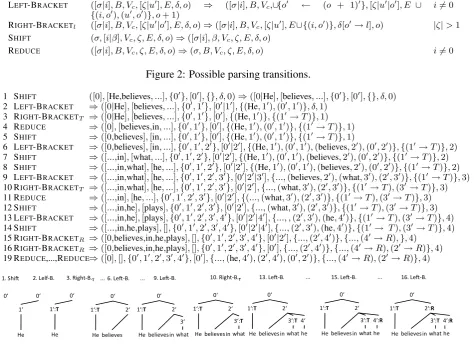
For the implementation of the parser, we use the idea of transition-based parsing (Yamada and Matsumoto, 2003; Nivre et al., 2004), which uses a classifier to predict the shift/reduce actions. We draw upon the transition set of the arc-eager
parserNivre (2004), but with a slightly different
semantics in that we define a transition system for the derivation of the Tc as a quadruple C = (S, Y, c0, Sy), whereSis a set of parsing states;Y
is a set of transitions, each of which is a (partial) function t: S →S;s0 is an initialization function
that maps a sentencex to a configurations ∈ S; andSy ⊆Sis a set of terminal states. A transition
sequence for a sentence x in C is a sequence of pairs of states and transitions. As setS of states, we use the tuples= (Σ, B, Vc, Z, E, δ, o), where
the stackΣand the input bufferBare disjoint sub-lists of the terminal nodesVt,Vcis the set of com-municative (label) nodes, Z is the stack of com-municative nodes, E is the set of edges, δ is a labeling function for communicative label nodes
n∈Vc, andois a counter for the number of pairs
of delimitation brackets. The initial state for a sen-tencex iss0 = ([0],[1, ..., n],{00},[00],{}, δ,0).
Terminal configurations have an empty buffer and
only the root noden is contained in the stackΣ:
s = ([0],[], Vc, Z, E, δ, x). Figure 2 shows the possible transitions.
As features of the transition-based system, we use a rich feature set based on the dependency structure drawn from (Zhang and Nivre, 2011) (since we use as input a dependency structure these features are available). In addition, we use the path from the top stack element to the word of the last open bracket (as sequence of pos tags). For the training of the transition-based system, we use the perception algorithm with averaging, a beam-search with 10 elements and early update (Collins and Roark, 2004). The oracle for training of the system follows the bottom-up parsing strategy. As soon as the communicative part is completed, we remove (reduce) the nodes that belong to it from the stack. Figure 3 shows a sequence of transi-tions that the analyser performs to create theTcof
the example sentence in Figure 1.
4 Experiments
Following the criteria in Section 2, four annotators in teams of two manually annotated a fragment of 435 sentences of the PTB with the thematic-ity structure, in a series of blocks of about 40–50 sentences. To ensure high mutual agreement, the annotation procedure went as follows. First, one of the teams provided a first round annotation of a block of sentences. This annotation was revised by the other team and the two annotations were discussed in plenum to achieve a consensus and to refine the annotation guidelines. The refined guidelines were used by the first team to annotate the next block of sentences—to be again revised by the other team and discussed in plenum. And so on.4
For training, we use the first 360 sentences, the next 40 sentences as development set, and the re-maing 35 sentences as test set. Table 2 presents the results on the test set for the sequence tagger and the transition-based analyser. The Accuracy Score (AS) measures the correctly assigned the-maticity tags on a token basis in the same way as PoS tagging is evaluated. That is, given, e.g., the sequence [, ,[]T,[,]R]R and the predicted sequence , ,[]T,[,]R, we see 3 correct
to-4
Transition Condition
Figure 2: Possible parsing transitions.
1 SHIFT ([0],[He,believes, ...],{00},[00],{}, δ,0)⇒([0|He],[believes, ...],{00},[00],{}, δ,0)
Figure 3: Transition sequence for the sentence:He believes in what he plays.
kens out of 5, i.e., an accuracy score of 60%. Note that the assignment ]]Rinstead of]Ris consid-ered as wrong. In contrast to this simple score, the labeled bracket score (LBS) and the unlabeled bracket score (UBS) consider the bracketing; the scores are calculated with the evalb-script as used for the evaluation of phrase structure parsers.
System AS LBS UBS
sequence tagger 71.74 51.78 53.29 transition-based 88.67 68.95 74.33
Table 2: Accuracy scores for the assignment of the communicative labels.
5 Discussion and future work
The results of our experiments show that the in-terpretation of the annotation of PTB with IS as a transition-based parsing task is promising. Ac-ceptable accuracy scores are achieved already with a very small training set. A direct comparison with other works on automatic annotation with IS, as e.g., (Postolache et al., 2005) with TFA, is not possible since the data sets and the annotation
schemata are different; see, e.g., (Hajiˇcov´a, 2007) for a precise outline of the criteria for the annota-tion of TFA in the Prague school and a juxtapo-sition of TFA and the CommStr. However, it is instructive to observe that the AS we achieve with the transition parser is about the same as Posto-lache et al.’s accuracy with RIPPERand MAXENT models and only slightly below their performance with C4.5. This means that parsing is a valid alter-native to token-oriented classification. However, we must be aware that parsing can only be applied if we assume the IS structure to be hierarchical (more precisely, a tree). The parser performance in terms of LBS and UBS, which capture the “brack-eting” of the transitivity elements within the struc-ture, are somewhat lower and can still be improved with a larger training sample (see below).
and/or punctuation) thematicity markers are ana-lyzed correctly. Cf., e.g., (2) and (3):
(2) [Indeed]SP, [the government]T [is taking a
cal-culated risk]R
(3) [At the same time]SP, [the government]T
[didn’t want to appear to favor GM by allowing
a minority stake[that]T [might preclude a full bid
by Ford]R]R
In more complex sentences, the algorithm does not accurately detect the propositions involved, triggering the following errors: (a) consecutive themes (even if the second one begins with a verb) (4); (b) consecutive rhemes (even if there is no theme and there is no verb in the first rheme) (5); (c) reduced clauses are not labelled as embedded rhemes (6).
(4) [In a prepared statement]SP, [GM]T [
sug-gested its plans for Jaguar]T [would be more
valu-able in the long run than the initial windfalls
in-vestors]T [migh reap from a hostile Ford bid]R.
(5) [Erwin Tomash, the 67-year-old founder of this maker of data communications products and a
for-mer chairman and chief executive]R, [resigned as
a director]R.
(6) [In national over-the-counter trading]R, [SFE
technologies shares]T [closed yesterday at 31.25
cents a share,up 6.25 cents]R.
Another detected error is that just the verb is la-belled as rheme, which also brings embededdness problems (7).
(7) “ [Our intensive discussions with Jaguar , at
their invitation]R , ” [GM said]R , “ [have as their
objectives to create a cooperative business
rela-tionship with Jaguar[that]T [would]Rprovide for
the continued independence of this great British
car company...]R.
Apart from these major errors, a number of mi-nor errors can be detected—e.g., subordinate con-junctions are assumed as part of the theme if they are initial (8); initial locative or temporal specifiers are always labelled as part of the rheme (9); initial specifiers are confused with themes (10); etc. (8) [Although GM]T [has U.S. approval to buy up
to 15% of Jaguar’s stock]SP, [it]T [[hasn’t yet
dis-closed how many shares it now owns]R.
(9) [After a stronger - than - expected pace early
this year]R , [analysts]T [say the market , after
a series of sharp swings in recent months, now
shows signs of retreating].
(10) [Under the circumstances]T , Dataproducts
said, [[Mr. Tomash]T [said]R]SP [he]T [was
un-able to devote the time required because of other
commitments]R.
Finally, we found some few cases of non-annotated parts (Dataproducts said in (10)) or over-generated levels of embededness.
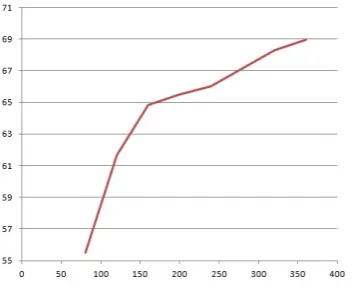
All these errors are likely to be straighten out with a larger training sample. The dependency curve between the accuracy (y-axis) and the size of the training set (x-axis) in Figure 4 shows that an increase of the size of the training set (e.g., to 1000 sentences) will further improve the scores. We are about to do this and apply the retrained transition-based analyser to the en-tire PTB. The information about how the result-ing IS-bank can be accessed will be posted at http://www.taln.upf.edu/resources.
Our future work involves the extension of the annotation by other dimensions of the CommStr and a study of the correlation between the various dimensions of the IS and prosody. We assume that in particular the hierarchical structure of thematic-ity will correlate well with the prosodic structure of both simple and parenthetical or subordinate constructions, and thus contribute to a better qual-ity in speech synthesis. Our positive experience with it in natural language text generation, where it guides syntactic realization, confirms this assump-tion.
Figure 4: Dependency between the size of the training set and accuracy.
References
S. Calhoun, M. Nissim, M. Steedman and J. Brenier 2005. A Framework for Annotating Information Structure in Discourse. InProceedings of the Work-shop on Frontiers in Corpus Annotations II: Pie in
the Sky, pages 45–52. Ann Arbor, MA: Association
for Corpus Linguistics.
M. Collins. 2002. Discriminative Training Meth-ods for Hidden Markov Models: Theory and Ex-periments with Perceptron Algorithms. InEMNLP
M. Collins and B. Roark. 2004. Incremental parsing with the perceptron algorithm. In Proceedings of ACL, pages 112–119.
F. Daneˇs. 1970. Zur linguistischen Analyse der Textstruktur.Folia Linguistica, 4:72–78.
S. Dipper, M. G¨otze, M. Stede, and T. Wegst. 2004. ANNIS: A Linguistic Database for Exploring Infor-mation Structure. In S. Ishihara, M. Schmitz and A. Schwarz (eds.). Working Papers of the SFB 632,
In-terdisciplinary Studies on Information Structure 1,
pages 245–279. Potsdam: University of Potsdam.
N. Erteschik-Shir. 2007. Information Structure:
The Syntax-Discourse Interface. Oxford University
Press, Oxford.
J. Firbas. 1966. Non-thematic Subjects in Contem-porary English. Travaux Linguistiques de Prague, 2:229–236.
Jan Hajiˇc, Massimiliano Ciaramita, Richard Johans-son, Daisuke Kawahara, Maria Ant`onia Mart´ı, Llu´ıs M`arquez, Adam Meyers, Joakim Nivre, Sebastian Pad´o, Jan ˇStˇep´anek, Pavel Straˇn´ak, Mihai Surdeanu, Nianwen Xue, and Yi Zhang. 2009. The CONLL-2009 shared task: Syntactic and semantic dependen-cies in multiple languages. In Proceedings of the
2009 CoNLL Shared Task, pages 1–18.
J. Hajiˇc, J.Panevov´a, E. Hajicov´a, P. Sgall, P. Pajas, J. ˇStep´anek, J. Havelka, M. Mikulov´a, Z. ˇZabokrtsk´y. 2006. Prague Dependency Treebank 2.0. Charles University Prague.
E. Hajiˇcov´a. 2007. The Position of TFA (Information Structure) in a Dependency Based Description of Language . In K. Gerdes, T. Reuther, and L. Wanner (eds.). MTT 2007. Proceedings of the 3rd
Interna-tional Conference on Meaning-Text Theory. Wiener
Slawistischer Almanach, Sonderband 69, Munich & Vienna.
E. Hajiˇcov´a, B. Partee, P. Sgall. 1998. Topic-Focus Ar-ticulation, Tripartite Structures, and Semantic Con-tent. Kluwer Academic Publishers, Dordrecht.
I. Kruijff-Korbayov´a and M. Steedman. 2003. Dis-course and Information Structure. Journal of Logic,
Language and Information, 12(3):249–259.
K. Lambrecht. 1994. Information structure and sen-tence form: Topic, focus and the mental
representa-tions of discourse referents. Cambridge University
Press, Cambridge.
M.P. Marcus, B. Santorini and M.A. Marcinkiewicz. . 1993. Building a Large Annotated Corpus of En-glish: The Penn Treebank. Computational Linguis-tics, 19(2):313–330.
V. Mathesius. 1929. Zur Satzperspektive im moder-nen Englisch. Archiv f¨ur das Studium der neueren
Sprachen und Literaturen, 155:202–210.
I.A. Mel’ˇcuk. 2001. Communicative Organization in Natural Language: The semantic-communicative
structure of sentences. Benjamins Academic
Pub-lishers, Amsterdam.
J. Nivre, J. Hall, and J. Nilsson. 2004. Memory-based dependency parsing. In Proceedings of CoNLL, pages 49–56.
J. Nivre. 2004. Incrementality in deterministic de-pendency parsing. InProceedings of the Workshop on Incremental Parsing: Bringing Engineering and
Cognition Together (ACL), pages 50–57.
M. Palmer, D. Gildea, and P. Kingsbury. 2005. The Proposition Bank: An Annotated Corpus of Seman-tic Roles. Computational LinguisSeman-tics.
Computa-tional Linguistics, 31(1):71–105.
P. Paggio 2006. Annotating Information Structure in a Corpus of Spoken Danish. InProceedings of the Fifth International Conference on Language
Re-sources and Evaluation (LREC), pages 1606–1609.
O. Postolache, I. Kruijff-Korbayov´a and G.-J. M. Krui-jff 2005. Data-driven approaches for information structure identification. In Proceedings of Human Language Technology Conference and Conference on Empirical Methods in Natural Language
Pro-cessing, pages 9–16.
P. Sgall. Functional Sentence Perspective in a Genera-tive Description of Language. 1967.Prague Studies
in Mathematical Linguistics, 2:203-225.
M. Steedman. Information Structure and the Syntax-Phonology Interface. 2000. Linguistic Inquiry, 31(4):649-685.
M. Taul´e, M.A. Mart´ı and M. Recasens. 2008. An-Cora: Multilevel Annotated Corpora for Catalan and Spanish. InProceedings of the Sixth International Conference on Language Resources and Evaluation
(LREC). Marrakesh, Morocco.
C. Thielen, A. Schiller, S. Teufel and C. St¨ockert. Guidelines f¨ur das Tagging deutscher Textkorpora mit STTS. 1999. Institute for Natural Language Processing, Uni-versity of Stuttgart. http://www.ims.uni-stuttgart.de/projekte/corplex/TagSets/.
E. Vallduv´ı 1992. Information Component. Garland, New York and London.
H. Yamada and Y. Matsumoto. 2003. Statistical de-pendency analysis with support vector machines. In
Proceedings of IWPT, pages 195–206.
M. Zimmermann and C. F´ery 2009. Information Structure: Theoretical, Typological, and
Experi-mental Perspectives. Oxford University Press,
Ox-ford.