Hierarchical Memory Networks for Answer Selection on Unknown Words
Jiaming Xua,∗, Jing Shia,∗, Yiqun Yaoa, Suncong Zhenga, Bo Xua, Bo Xua,b aInstitute of Automation, Chinese Academy of Sciences (CAS). Beijing, China bCenter for Excellence in Brain Science and Intelligence Technology, CAS. China
{jiaming.xu, shijing2014, yaoyiqun2014}@ia.ac.cn {suncong.zheng, boxu, xubo}@ia.ac.cn
Abstract
Recently, end-to-end memory networks have shown promising results on Question Answering task, which encode the past facts into an explicit memory and perform reasoning ability by mak-ing multiple computational steps on the memory. However, memory networks conduct the rea-soning on sentence-level memory to output coarse semantic vectors and do not further take any attention mechanism to focus on words, which may lead to the model lose some detail informa-tion, especially when the answers are rare or unknown words. In this paper, we propose a novel Hierarchical Memory Networks, dubbed HMN. First, we encode the past facts into sentence-level memory and word-sentence-level memory respectively. Then,k-max pooling is exploited following reasoning module on the sentence-level memory to sample thek most relevant sentences to a question and feed these sentences into attention mechanism on the word-level memory to focus the words in the selected sentences. Finally, the prediction is jointly learned over the outputs of the sentence-level reasoning module and the word-level attention mechanism. The experimental results demonstrate that our approach successfully conducts answer selection on unknown words and achieves a better performance than memory networks.
1 Introduction
With the recent resurgence of interest in Deep Neural Networks (DNN), many researchers have concen-trated on using deep learning to solve natural language processing (NLP) tasks (Collobert et al., 2011; Sutskever et al., 2014; Zeng et al., 2014; Feng et al., 2015). The main merits of these representation learning based methods are that they do not rely on any linguistic tools and can be applied to differ-ent languages or domains. However, the memory of these methods, such as Long Short-Term Memory (LSTM) (Hochreiter and Schmidhuber, 1997) and Gated Recurrent Unit (GRU) (Cho et al., 2014) com-pressing all the external sentences into a fixed-length vector, is typically too small to accurately remember facts from the past, and may lose important details for response generation (Shang et al., 2015). Due to the drawback, these traditional DNN models encounter great limitation on Question Answering (QA), as a complex NLP task, which requires deep understanding of semantic abstraction and reasoning over facts that are relevant to a question (Hermann et al., 2015; Yu et al., 2015).
Recently, lots of deep learning methods with explicit memory and attention mechanism are explored for Question Answering (QA) task, such as Memory Networks (MemNN) (Sukhbaatar et al., 2015), Neural Machine Translation (NMT) and Neural Turing Machine (NTM) (Yu et al., 2015). These meth-ods exploit a external memory to store the past sentences with a continuous representation and utilize attention mechanism to automatically soft-search for parts of the memory for prediction. Compared with NMT and NTM, MemNN, making multiple computational steps (termed as “hops”) on the memory be-fore making an output, is better qualified for textual reasoning tasks. However, for QA task, MemNN only conducts the reasoning on sentence-level memory and does not further take any attention mechanism to focus on words in the retrieved facts. More recently, Yu et al. (2015) constructed aSearch-Response This work is licensed under a Creative Commons Attribution 4.0 International Licence. Licence details: http:// creativecommons.org/licenses/by/4.0/
∗The first two authors contributed equally.
pipeline whereSearchcomponent uses MemNN to search the supporting sentences andResponse com-ponent uses NMT or NTM to generate answer on the selected sentences. However, that work needs the supervision of the supporting facts to guide the training ofSearchcomponent and the combination of these two components through a separate training way may hurt the performance. Along the direction of that work, we believe that a joint learning model can achieve a better performance by designing a hierarchical architecture, with sentence-level and word-level components, which has shown promising results on document modeling (Lin et al., 2015) and document classification (Yang et al., 2016).
Besides, rare and unknown word problem as an important issue should be considered in NLP tasks, especially for QA task, where the words that we are mainly interested in are usually named entities which are mostly unknown or rare words (Marrero et al., 2013; Gulcehre et al., 2016). In order to control the computational complexity, many methods limit the trained vocabulary size, which further leads to lots of low-frequency words outside the trained vocabulary (Li et al., 2016). Traditional methods directly mask the rare or unknown words with meaninglessunkwhich may lose the important information for answer selection task. For example, given a set of sentences as follows:
1. Miss, what is your name? 2. Uh, my name isWainwright.
3. Please tell me your passport number. 4. Ok, it is899917359.
Assume that the wordsWainwrightand8999173591are rare words or outside the trained vocabulary.
If these words are discarded or replaced with unk symbol, any models may not be able to select the correct answers for response during testing.
Based on the above observations, this paper proposes a Hierarchical Memory Networks2(dubbed to
HMN) for answer selection. Our method first maps the sentences into a sentence-level memory and reasoning module takes multiple hops on the sentence-level memory to soft-search the related sentences. Meanwhile, all words in the sentences are encoded into a word-level memory with recurrent neural networks. Then, we exploitk-max pooling to sample the most relevant sentences and feed these selected sentences into attention mechanism on the word-level memory to focus the words. Finally, the prediction is jointly learned over the outputs of the sentence-level reasoning module and the word-level attention mechanism. Our main contributions are three-fold:
(1). We proposed a novel hierarchical memory networks for answer selection, where the reason-ing module is performed on sentence-level memory to retrieve the relevant sentences and the attention mechanism is applied on word-level memory to focus the words. This hierarchical architecture allows the model to have explicit reasoning ability on sentences and also focus on more fine-grained words.
(2). k-max pooling is exploited to sample the most relevant facts based on the results of the sentence-level reasoning and then feed these facts into word-sentence-level attention mechanism, which can filter the noise information and also reduce the computational complexity on word-level attention.
(3). We release four synthetic domain dialogue datasets3, two from air-ticket booking domain and
two from hotel reservation domain, where the answers are mostly rare or unknown words, and lots of answers should be reasoned based on some supporting sentences. The experimental results show that our approach can successfully conduct answer selection on unknown words.
2 Background: Memory Networks
Here, we give a brief description of memory networks which have shown promising results on QA tasks (Weston et al., 2015; Bordes et al., 2015; Sukhbaatar et al., 2015). Memory network first introduced by Weston et al. (2015) is a new class of learning models which can easily read and write to part of a long-term memory component, and combine this seamlessly with inference for prediction. Formally, besides the explicit memory which is an array of cells to memorize the pre-trained vector representations
1Note that the personal information used in our examples and datasets throughout this paper is all synthetic and not real. 2It is worth noticing that the term “Hierarchical Memory Networks” has been mentioned in (Chandar et al., 2016) where the
intention was to organize the memory into multi-level groups based on hashing, tree or clustering structures to make the reader efficiently access the memory, whereas in our paper the term has a different meaning.
Query q
( )S p
Answer y
( )S r u
{ }ai
( )
{ S}
i
a { }ci
Softmax
Softmax
Query q
Answer y
-max Pooling
Sentence-level Memory Word-level Memory
( )S M
(W)
M
( )S p
(W)
p
Query q
(W)
p
Answer y
{mt}
( )
{ W}
t
a
GRU
GRU GRU
GRU
GRU
GRU
... ...
k
Sentences X={ }xi i=(1,2,..., )n Sentences X={ }xi i=(1,2,..., )n
Sentences X={ }xi i=(1,2,..., )n
( )S
a
(a) (b)
(c) Attention
Reasoning
...
[image:3.595.78.525.62.296.2]...
Figure 1: An illustration of our Hierarchical Memory Networks (HMN). (a): The overall architecture of the proposed HMN. (b): Reasoning module of our approach on sentence-level memory. (c): Attention module of our approach on word-level memory.
of the external data, a general memory network consists of four major components: (1). Input feature mapwhich converts the incoming input to the internal feature representation. (2).Generalizationwhich updates old memories given the new input. (3).Output feature mapwhich produces a new output based on the new input and the current state. (4).Responsewhich converts the output into the response format desired. Along the above framework, Sukhbaatar et al. (2015) put forward end-to-end memory networks which do not require the supervision of the supporting facts and are more generally applicable in realistic setting. Thus, we choose end-to-end memory networks, denoted as MemNN throughout our paper, as the foundation of our proposed approach.
3 Hierarchical Memory Networks for Answer Selection
3.1 Approach Overview
As described in Figure 1(a), we give an illustration of our HMN for answer selection. Given a set ofn
sentences denoted as: X ={xi}i=(1,2,...,n)and a queryq, whereiis the timestep of sentencexi in the
set. We first map these sentencesXinto the sentence-level memoryM(S) and the word-level memory
M(W)with low-dimensional distributed representations respectively. Then, reasoning on the
sentence-level memory is utilized to soft-search the related sentences. We further exploitk-max pooling to sample the most relevant sentences based on the soft-searching results and take attention mechanism to focus on word-level memory of the selected sentences. The target answery is used to guide the learning of the reasoning on sentence-level memory and the attention on word-level memory learning simultaneously. 3.2 Sentence-level Memory and Reasoning
In this section, we apply reasoning module to make multiple interaction on sentence-level memory based on the adjacent weight tying scheme of MemNN (Sukhbaatar et al., 2015), as shown in Figure 1(b). Given two word embedding matricesA∈R|V|×dandC∈R|V|×d, where|V|is the vocabulary size and
dis the dimension of the word embedding, we first encode the wordxij at timestepjin the sentencexi
into dual channels of word representation asAxij ∈RdandCxij ∈Rd.
lgj = (1−j/Ji)−(g/d)(1−2j/Ji), 1≤j≤Ji, 1≤g≤d, (1)
andJiis the length of the sentencexiandgis the embedding index. This positional encoding scheme is
also successfully applied in (Xiong et al., 2016).
Two temporal encoding matricesTA∈Rn×dandTC ∈Rn×dare further utilized to encode the order
of the sentences. Then, the sentence-level memoryM(S) ={{a
i},{ci}}i=(1,2,...,n)is reformed as:
ai =
∑
jlj·(Axij) +TA(i), ci=
∑
jlj ·(Cxij) +TC(i), (2)
whereljis thej-th column vector of the position encoding matrixlaccording to the sentencexiand the
operation “·” means the element-wise multiplication.
For the query q, the j-th word qj is also embedded as Aqj ∈ Rd, where the A is the embedding
matrix used in Eqn. (2). By encoding the word positionjinto the query representation, we get the probe representation of the queryqas follows:
u(1S)=∑
jlj·(Aqj), (3)
wherelj is thej-th column vector of the position encoding matrixlaccording to the queryq. Then the
attention weights of the sentences according to the query can be calculated through the inner product of the two vectors asα(iS)=softmax(aT
i u(1S)), and the output of the sentence-level memory based on the
activation of the query can be obtained as:o1 =∑iα(iS)ci.
In order to perform reasoning on sentence-level memory to find the most relevant sentences, we make
Rhops to soft-search the sentences and output the final vectoroR. To be specific, during ther+ 1hop of
the reasoning operation, the process can be formalized as:u(rS+1) =or+u(rS),α(iS) =softmax(aTiu(rS+1)),
or+1 =∑iα(iS)ci, and the dual-channel memories are updated as follows:
ai =
∑
jlj·(Ar+1xij) +TrA+1(i), ci=
∑
jlj·(Cr+1xij) +TrC+1(i), (4)
where1 ≤ r ≤ (R−1). Specifically, during ther + 1hop, the word embedding matricesAr+1 and
Cr+1are mutually independent, so as the temporal encoding matricesTr+1
A andTrC+1. But during the
adjacent two hops, Ar+1 = Cr andTr+1
A = TrC. Finally, we can get the predicted word probability
distribution by applying softmax on the output vector of the reasoning on the sentence-level memory as:
p(S)(w) =softmax((CR)T(o
R+u(RS))), (5)
wherew={wt}t=(1,2,...,|V|)is the word set with a vocabulary size of|V|, the weight matrix is the same
as the embedding matrixCR∈R|V|×don the last hop, andTis the operation of matrix transposition.
3.3 k-max Pooling
Here, we exploit a pooling operation over the top attention weights α(S) of the reasoning module on
the sentence-level memory to sample the most relevant sentences. Given a valuekand the top attention weights α(S) of length n ≥ k, we use the k-max pooling to select a subset of sentence sequences
ˆ
X={xˆi}i=(1,2,...,k), corresponds with their top-kmaximum values ofα(S)on the sentences.
Thek-max pooling operation makes it possible to pool thekmost relevant sentences to the query and filter the noise information, which maybe more beneficial to select the correct answers. Moreover, this sampling module feeds a subset of sentencesXˆ to the following attention mechanism on the word-level memory, which can reduce the computation complexity of the attention to focus on the relevant words. 3.4 Attention on Word-level Memory
For word-level memory, we first apply a Bi-directional GRU (BiGRU) to compute the hidden states of all the ordered wordsw¯={w¯t}t=(1,2,...,|t|)in the sentence setX, where|t|is the time steps of the words
Domain (Lang) Train/Dev/Test Vocab Unseen Answers (Dev/Test) Max Len (P/S)
Air-Ticket (CH) 5,400/600/6,000 8,540 409 (68.2%)/4,020 (67.0%) 16/17
Hotel (CH) 5,400/600/6,000 7,586 367 (61.2%)/3,690 (61.5%) 16/16
Air-Ticket (EN) 5,400/600/6,000 7,537 342 (57.0%)/3,489 (58.2%) 16/18
Hotel (EN) 5,400/600/6,000 7,134 357 (59.5%)/3,452 (57.5%) 16/16
[image:5.595.71.526.63.146.2]Total 21,600/2,400/24,000 29,092 1,406 (58.6%)/13,872 (57.8%) 16/18
Table 1: Statistics of the datasets, including the domain and the language of the dataset (CH: Chinese and EN: English), the number of train/dev/test set entries, the vocabulary size of datasets, the number and proportion of unseen answers on dev/test set, and the max paragraph length and sentence length of the datasets. TheTotaldataset consists all the samples of the above four datasets.
it as hidden states⃗ht = →
GRU(CRw¯ t) and
←
ht = ←
GRU(CRw¯
t) respectively, whereCR is the word
embedding matrix of the last hop on the sentence-level memory, and we set the dimension of⃗htand ←
ht
equals to the dimension of the word embedding. By summing the forward hidden states and the backward hidden states, we obtain the word-level memory asM(W)={mt}
t=(1,2,...,|t|), wheremt=⃗ht+ ←
ht. In
this way, the memorymtcontains the context information of thet-th wordw¯tin the sentence setX.
Then, we perform attention on the subset of the ordered words wˆ = {wˆt}t=(1,2,...,|ˆt|) in the selected
sentencesXˆ by using the probe vector u(RS) of the last hop on the sentence-level memory and a sub-set of word-level memory {mˆt}t=(1,2,...,|tˆ|) selected form M(W) according to the word subsetwˆ. The
normalized attention weightsα(W) ={α(W)
t }t=(1,2,...,|ˆt|)on the word-level memory are calculated as:
α(tW)=softmax(vTtanh(Wu(RS)+Umˆt)), (6)
wherev ∈ Rd×1,W ∈ Rd×dandU ∈ Rd×dare all learning parameters updated during the training.
Inspired by Pointer Networks (Vinyals et al., 2015), we adopt the normalized attention weightsα(W)on
the word collectionwˆas the probability distribution of the output words:
p(W)(w) =trans(p(W)( ˆw)) =trans(α(W)), (7)
where trans(·) means the operation to map the words probability distribution p(W)( ˆw) ∈ R|ˆt| into the probability distributionp(W)(w) ∈ R|V|. To be specific, the map operation makes the probability distribution p(W)( ˆw) of the word subset (wˆ = {wˆ
t}t=(1,2,...,|ˆt|)) to be added into their corresponding
positions in the vocabulary (w = {wt}t=(1,2,...,|V|)), and the probabilities of the words not in selected
word subsetwˆwill be set to zero4. Finally, we get the new probability distributionp(W)(w)∈R|V|.
3.5 Joint Learning
In this paper, we combine the probability distributions of the output words both on the sentence-level memory and the word-level memory to predict the joint probability distributionp(w)as follows:
p(w) =p(S)(w) +p(W)(w). (8)
Finally, we use the target answery to guide the learning of the reasoning module on sentence-level memory and the attention module on word-level memory simultaneously. We choose the cross entropy as the cost function and apply Stochastic Gradient Descent (SGD) (Bottou, 1991) as the optimization
method to train our joint model. The learned parameters include word embedding matrices A1 and
{Cr}
r=(1,2,...,R), temporal encoding matricesT1Aand{TrC}r=(1,2,...,R)in Eqn. (2) and (4), the
parame-ters{θBiGRU}of the BiGRU model and the attention parametersv,WandUin Eqn. (6).
4For example, if the word “airport”, at two different timesteps in the ordered word subsetw, has two probabilities “0.1” andˆ
Air-Ticket (CH) Hotel (CH) Air-Ticket (EN) Hotel (EN) Total
MemNN-H1 4,727.8±79.2 3,680.8±48.3 4,051.8±53.8 3,067.4±71.3 14,492.8±282.8
MemNN-NT 3,424.0±106.6 2,816.2±35.9 2,984.2±93.0 2,304.0±70.3 10,250.4±152.1
MemNN 67.5±9.1 84.0±9.8 55.5±9.4 56.2±10.7 225.6±41.1
HMN-Sent 99.8±29.9 175.0±19.3 112.8±51.2 129.2±15.3 125.6±27.4
HMN-Word 22.2±7.5 31.8±7.8 24.8±9.6 12.8±4.9 27.4±4.8
[image:6.595.72.530.64.161.2]HMN-Joint 4.2±2.5 9.8±1.9 4.4±2.7 3.0±1.2 4.2±1.8
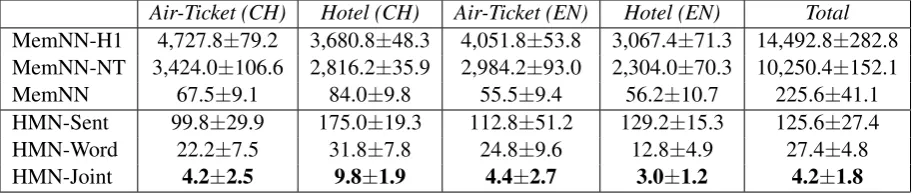
Table 2: Comparison of predicted test error numbers of our HMN and MemNN with different com-ponents on four domain datasets (Test: 6,000 samples) and the Total dataset (Test: 24,000 samples). MemNN-H1: Memory network with 1 hop and temporal encoding, MemNN-NT: Memory network with 3 hops but without temporal encoding. MemNN: Memory network with 3 hops and temporal encod-ing. Note that HMN-Sent and HMN-Word, as the parts of HMN-Joint, are joint learning but give their predicted answers separately.
4 Experiments
4.1 Datasets and Setup
We conduct answer selection tasks on four synthetic domain dialogue datasets, two from air-ticket book-ing domain and two from hotel reservation domain. One complete dialogue history of each dataset has eight round responses. Besides greeting and ending sentences, one dialogue history consists six round responses to query and answer client’s personal information, such as name, phone and passport number. The datasets contain hundreds of response patterns and thousands of entity information. More detailed descriptions can be found in our released datasets. The statistics of the datasets are summarized in Ta-ble 1. We use 45% of the data for training, 5% for validation and the remaining 50% for test. From the statistics, we can see that the proportions of the unseen answers on dev/test sets all overtake 57%.
In our experiments, the most of hyper parameters are set uniformly for the datasets as described in Table 3. The training gradients with anl2norm larger than 40 are clipped to 40 and the learning rate is annealed every 15 epochs byλ/2until 60 epochs are reached. The learned parameters are all initialized randomly from a Gaussian distribution with zero mean and 0.1 standard deviation. In order to make the comparison more intuitive, we use the number of predicted error samples on each dataset to evaluate the performance for answer selection and calculate the average result by repeating each experiment 5 times.
Hyperparameter Hidden dim. Hops Max pooling Learning rate Batch size (Total)
Value d= 100 R= 3 k= 4 λ= 0.01 30 (32)
Table 3: Hyperparameters used in our experiments. The dimension of word embeddings and the dimen-sion of GRU hidden states are set equally to 100, batch sizes are 32 forTotaland 30 for the others.
4.2 Comparison with Memory Networks
Dialogue history Reasoning Sampling Attention
5.7e-2 2.7e-3 1.7e-29
-- --
--4.5e-2 3.7e-4 1.5e-31
7.2e-2 2.3e-3 3.7e-28 4.1e-2 1.3e-3 7.2e-31
1.7e-1 3.0e-1 6.9e-27
-- --
---- --
--1.6e-1 6.9e-1 1.0
Hop 1 Hop 2 Hop 3 4-max pooling Attention on word-level memory
Question:"When does the client depart?" Correct Answer:"10/13/2018"
Prediction (Sent):"598771901" Prediction (Word):"10/13/2018" Prediction (Joint):"10/13/2018" 1. Hello, this is air ticket booking agent
center. What can I do for you?
9. The phone number, Miss?
10. 0016173976838.
13. Miss, the travel time is?
. . .
14. I'd like to go on 10/13/2018 . . .
. . .
8. 899917359, my passport number.
899917359 , my passport number .
0016173976838 .
Miss , the travel time is ?
I'd like to go on 10/13/2018 Time Text
0.0 0.0 0.0 0.0 0.0 0.0
4.3e-7 0.0
9.2e-6 1.1e-5 1.0e-7 0.0 1.2e-6 0.0 0.0
[image:7.595.76.525.61.324.2]0.0 0.0 0.0 0.0 8.5e-7 1.0
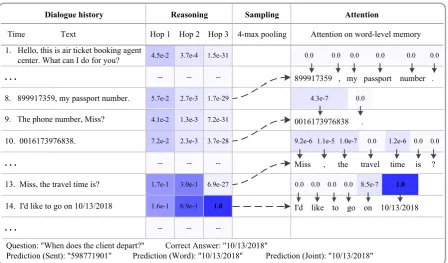
Figure 2: One example prediction by our HMN for answer selection. The hop columns in reasoning module show the probabilities of each hop, and the sampling module selects the 4-max relevant sentences and feeds these selected sentences to the attention module on word-level memory. In the experiments, all the sentences in the dialogue history are indexed in reverse order to reflect their relative distance.
further improve the answer selection performance on all the datasets. Compared with the results of HMN-Sent and HMN-Word, the results also show that the joint prediction can make a better performance.
4.3 How to Select the Correct Answers on Unknown Words
Here, we try to answer two questions: (1) How does the reasoning module focus on the related sentences and predict the rare and unknown words on sentence-level memory? (2) How does the attention module focus on the correct answers and distinguish multiple rare and unknown words on word-level memory? We give a visual example of our HMN over one dialogue history for answer selection in Figure 2 to get a better understanding of the effect of each module. The example is one dialogue history from air-ticket booking domain which contains 16 sentences associated with their temporal indexs.
Value of k for the max pooling
1 4 7 10 13 16 Number of the predicted error samples 102
103 454.2 1447.4 1497.6 1549.4 1468.6 1597.2 276.0 177.6 129.2 144.4 125.6 159.4 176.0 125.6 129.2 130.8 113.8126.8 (a). HMN-Sent Embedding GRU BiGRU
Value of k for the max pooling
1 4 7 10 13 16
Number of the predicted error samples
102 103 104 28.6 11587.8 12458.6 12346.8 14436.2 14647.0 27.6 97.8 155.0 168.2 134.8 129.0 28.4
27.4 30.6 32.4
46.8 39.8
(b). HMN-Word
Embedding GRU BiGRU
Value of k for the max pooling
1 4 7 10 13 16
Number of the predicted error samples
101 102 103 30.4 1353.4 1394.2 1519.4 1508.6 1576.8 15.2 19.0 23.2 24.0 19.2 16.2 6.2
4.2 5.6 5.4 5.6 5.0
(c). HMN-Joint
[image:8.595.85.507.66.240.2]Embedding GRU BiGRU
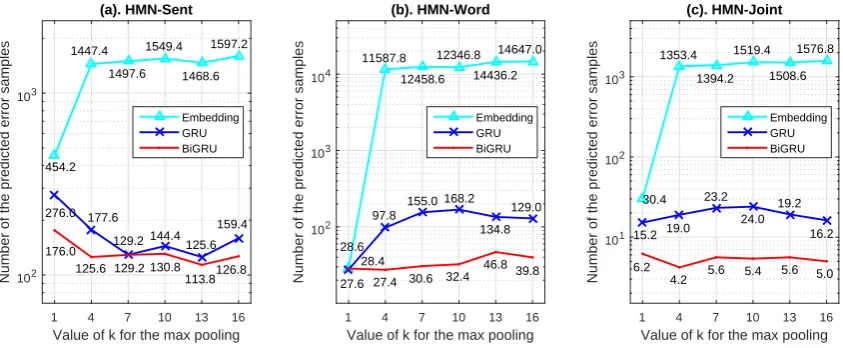
Figure 3: Answer selection evaluations of HMN-Sent, HMN-Word and HMN-Joint with different word-level memory encoding methods (BiGRU, GRU and Embedding) using various values ofkonTotal.
target answers. Another reason is that attention mechanism performs inhibitory effect on our task which can successfully filter the almost useless words, such as “time”, “go” and “on” in the example. Besides the above reasons, we also investigate the influence of different word-level memory encoding meth-ods, such as BiGRU (GRU→ (CRw¯t)+GRU← (CRw¯t)), GRU (GRU(CRw¯t)) and Embedding (CRw¯t), by
varying the values ofkfor max pooling, and the comparison of answer selection performance are present in Figure 3. The results show the expected effect that encoding the context information into word-level memory via BiGRU or GRU can help the attention module distinguish multiple rare and unknown words when we enlarge the value ofkand introduce more unknown words to the attention mechanism.
From Figure 3, we further investigate the influence of kto the answer selection performance. We can see that the performances almost unchanged by using HMN-Joint with BiGRU when we vary the value ofk. Considering that the more sentencesk-max pooling samples from sentence-level memory, the more computational complexity the attention mechanism as Eqn. (6) costs on word-level memory, 4-max pooling used in our experiments is a good trade-off.
5 Related Works
6 Conclusion
In this paper, we introduce hierarchical memory networks to solve answer selection problem on unknown words. We first encode the sentences into a sentence-level memory with temporal encoding. Then reasoning module conducts multi-hop interaction on the memory to retrieve the related sentences, and
k-max pooling samples the k most related sentences. For word-level memory, BiGRU is utilized to
encode the words and introduce context into the memory, then a sophisticated attention mechanism is applied on the selected word-level memory to focus the fine-grained words. We conduct answer selection experiments on four synthetic domain dialogue datasets which contain lots of unseen answers. The experimental results show that our hierarchical memory networks can achieve a satisfying performance.
Acknowledgements
We thank the anonymous reviewers for their insightful comments, and this work was supported by the Strategic Priority Research Program of the Chinese Academy of Sciences (Grant No. XDB02070005), the National High Technology Research and Development Program of China (863 Program) (Grant No. 2015AA015402) and the National Natural Science Foundation (Grant No. 61602479 and 61403385).
References
Dzmitry Bahdanau, Kyunghyun Cho, and Yoshua Bengio. 2015. Neural machine translation by jointly learning to align and translate. InProceedings of the 3rd International Conference on Learning Representations (ICLR). Antoine Bordes, Nicolas Usunier, Sumit Chopra, and Jason Weston. 2015. Large-scale simple question answering
with memory networks. arXiv preprint arXiv:1506.02075.
L´eon Bottou. 1991. Stochastic gradient learning in neural networks.Proceedings of Neuro-Nımes, 91(8). Sarath Chandar, Sungjin Ahn, Hugo Larochelle, Pascal Vincent, Gerald Tesauro, and Yoshua Bengio. 2016.
Hierarchical memory networks.arXiv preprint arXiv:1605.07427.
Kyunghyun Cho, Bart Van Merri¨enboer, Caglar Gulcehre, Dzmitry Bahdanau, Fethi Bougares, Holger Schwenk, and Yoshua Bengio. 2014. Learning phrase representations using rnn encoder-decoder for statistical machine translation. InProceedings of the 2014 Conference on Empirical Methods in Natural Language Processing (EMNLP), pages 1724–1734.
Ronan Collobert, Jason Weston, L´eon Bottou, Michael Karlen, Koray Kavukcuoglu, and Pavel Kuksa. 2011. Natu-ral language processing (almost) from scratch. Journal of Machine Learning Research (JMLR), 12(Aug):2493– 2537.
Minwei Feng, Bing Xiang, Michael R Glass, Lidan Wang, and Bowen Zhou. 2015. Applying deep learning to answer selection: A study and an open task. In2015 IEEE Workshop on Automatic Speech Recognition and Understanding (ASRU), pages 813–820. IEEE.
Alex Graves, Greg Wayne, and Ivo Danihelka. 2014. Neural turing machines.arXiv preprint arXiv:1410.5401. Caglar Gulcehre, Sungjin Ahn, Ramesh Nallapati, Bowen Zhou, and Yoshua Bengio. 2016. Pointing the unknown
words. arXiv preprint arXiv:1603.08148.
Karl Moritz Hermann, Tomas Kocisky, Edward Grefenstette, Lasse Espeholt, Will Kay, Mustafa Suleyman, and Phil Blunsom. 2015. Teaching machines to read and comprehend. InAdvances in Neural Information Process-ing Systems (NIPS), pages 1693–1701.
Sepp Hochreiter and J¨urgen Schmidhuber. 1997. Long short-term memory. Neural computation, 9(8):1735–1780. Xiaoqing Li, Jiajun Zhang, and Chengqing Zong. 2016. Towards zero unknown in neural machine translation. InProceedings of the 25th International Joint Conference on Artificial Intelligence (IJCAI), pages 2852–2858. AAAI Press.
M´onica Marrero, Juli´an Urbano, Sonia S´anchez-Cuadrado, Jorge Morato, and Juan Miguel G´omez-Berb´ıs. 2013. Named entity recognition: fallacies, challenges and opportunities. Computer Standards & Interfaces, 35(5):482–489.
Lifeng Shang, Zhengdong Lu, and Hang Li. 2015. Neural responding machine for short-text conversation. In Proceedings of the 53rd Annual Meeting of the Association for Computational Linguistics (ACL), pages 1577– 1586.
Sainbayar Sukhbaatar, Jason Weston, Rob Fergus, et al. 2015. End-to-end memory networks. InAdvances in Neural Information Processing Systems (NIPS), pages 2440–2448.
Ilya Sutskever, Oriol Vinyals, and Quoc V Le. 2014. Sequence to sequence learning with neural networks. In Advances in Neural Information Processing Systems (NIPS), pages 3104–3112.
Oriol Vinyals, Meire Fortunato, and Navdeep Jaitly. 2015. Pointer networks. InAdvances in Neural Information Processing Systems (NIPS), pages 2692–2700.
Jason Weston, Sumit Chopra, and Antoine Bordes. 2015. Memory networks. InProceedings of the 3rd Interna-tional Conference on Learning Representations (ICLR).
Caiming Xiong, Stephen Merity, and Richard Socher. 2016. Dynamic memory networks for visual and textual question answering. InProceedings of the 33rd International Conference on Machine Learning (ICML). Zichao Yang, Diyi Yang, Chris Dyer, Xiaodong He, Alex Smola, and Eduard Hovy. 2016. Hierarchical attention
networks for document classification. InProceedings of the 2016 Conference of the North American Chapter of the Association for Computational Linguistics: Human Language Technologies (NAACL-HLT).
Yang Yu, Wei Zhang, Chung-Wei Hang, and Bowen Zhou. 2015. Empirical study on deep learning models for question answering.arXiv preprint arXiv:1510.07526.